




These Contemporary South Asia Class 12 Notes give a quick, exam-ready summary of India and its seven neighbours, set to the 2026-27 CBSE syllabus. The notes pull together every key country fact, treaty and conflict from Chapter 3 of Contemporary World Politics. Students can use them for a fast revision the night before a test or to fix the main ideas before they attempt the back-exercise questions.
- Covers the seven countries, the mixed record of democracy, India-Pakistan relations and SAARC in one place.
- This Class 12 Political Science chapter usually carries 5 to 6 marks in the board paper.
- Pairs with the NCERT Solutions, Handwritten Notes and Book PDF linked lower on this page.
These Contemporary South Asia Class 12 notes are written from the official NCERT Contemporary World Politics textbook and checked against the last five years of CBSE board papers.
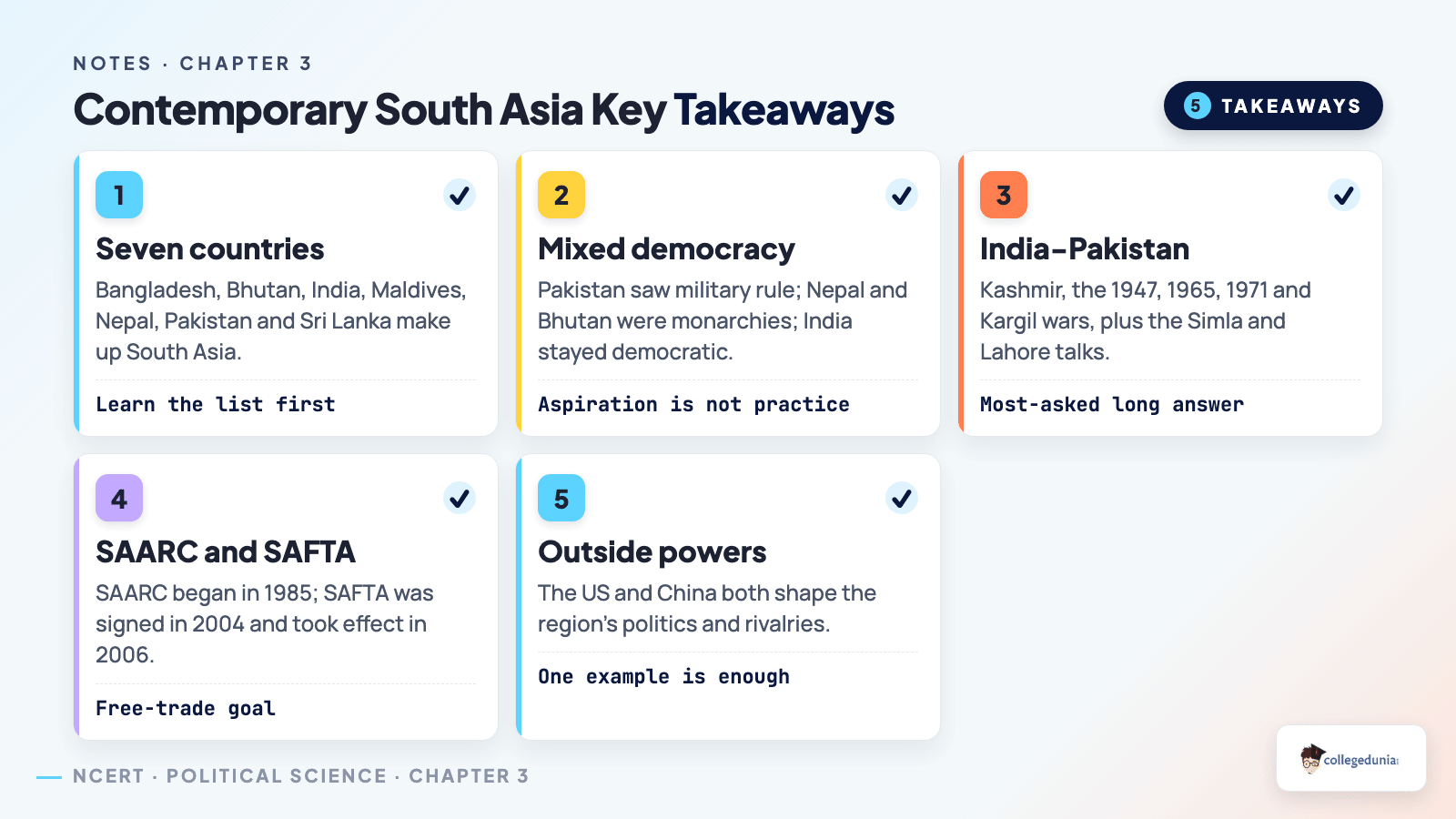
Student Feedback: In a Collegedunia poll of 8,510 Class 12 Political Science students taken before the 2026 boards, 71% of students said short, point-wise notes on the seven countries and the India-Pakistan wars were the fastest way to revise this chapter. Most students kept the country facts and treaty dates on a single sheet for last-minute recall.
Source: 2026-27 Class 12 Political Science student poll. Sample of 8,510 students from CBSE schools across 12 states.
What the Contemporary South Asia Notes Cover
Contemporary South Asia is the third chapter of Contemporary World Politics. It studies India and its seven neighbours: Bangladesh, Bhutan, India, the Maldives, Nepal, Pakistan and Sri Lanka. The chapter looks at how democracy has fared in the region and how these countries get along, from open conflict to slow cooperation.
The easiest way to organise your revision is to split the chapter into three threads:
- Democracy: a mixed record, from army rule in Pakistan to a new republic in Nepal.
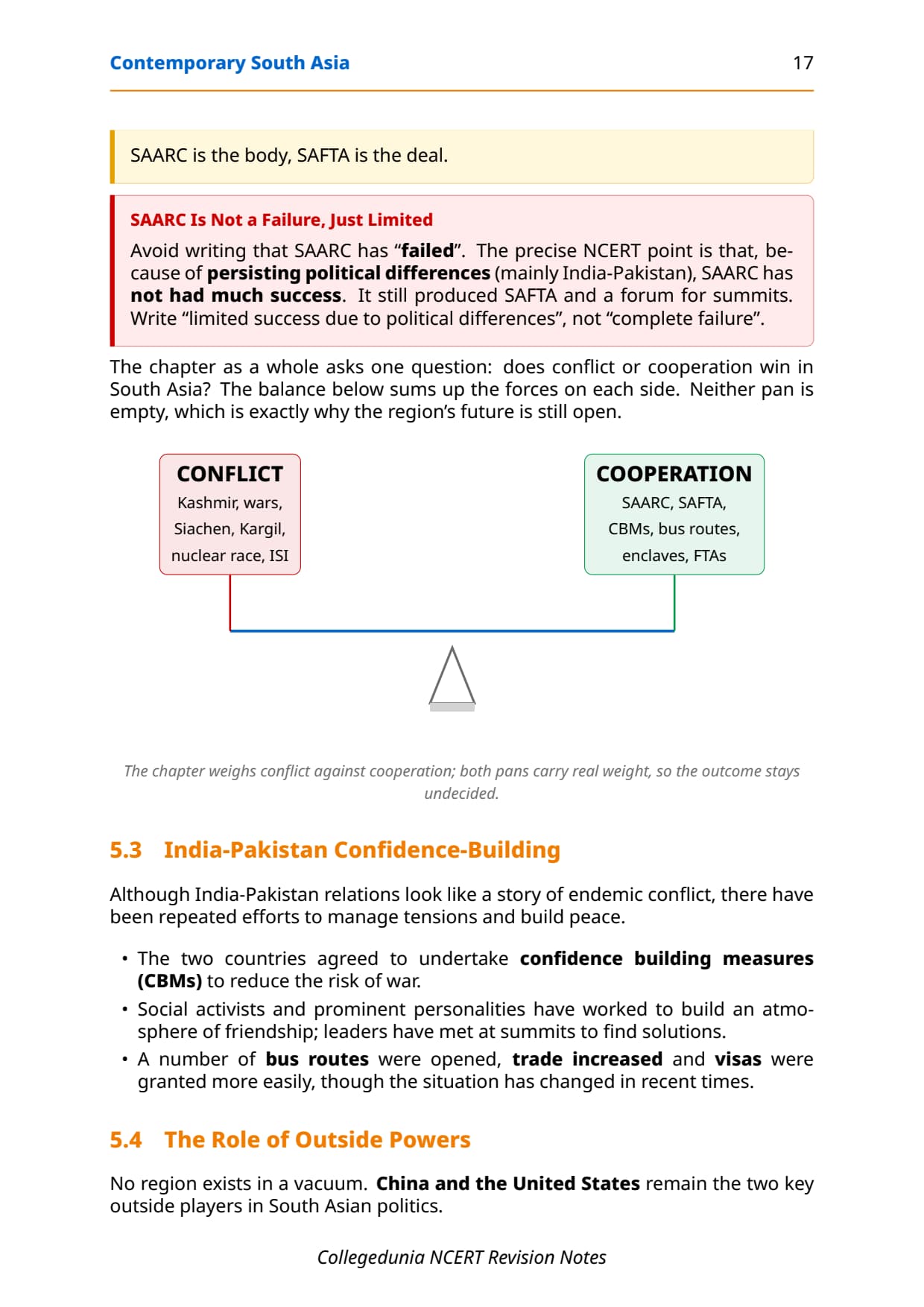
- Conflict: disputes over Kashmir, rivers, ethnicity and India's size.
- Cooperation: SAARC, the SAFTA free-trade pact and the role of outside powers.
So these notes are really about India and its neighbours. If you sort each fact under democracy, conflict or cooperation first, almost every question in Contemporary South Asia class 12 becomes easier to answer. Keep this three-part frame at the top of your revision sheet and slot each new detail into one of the boxes as you read.
The Seven Countries of South Asia
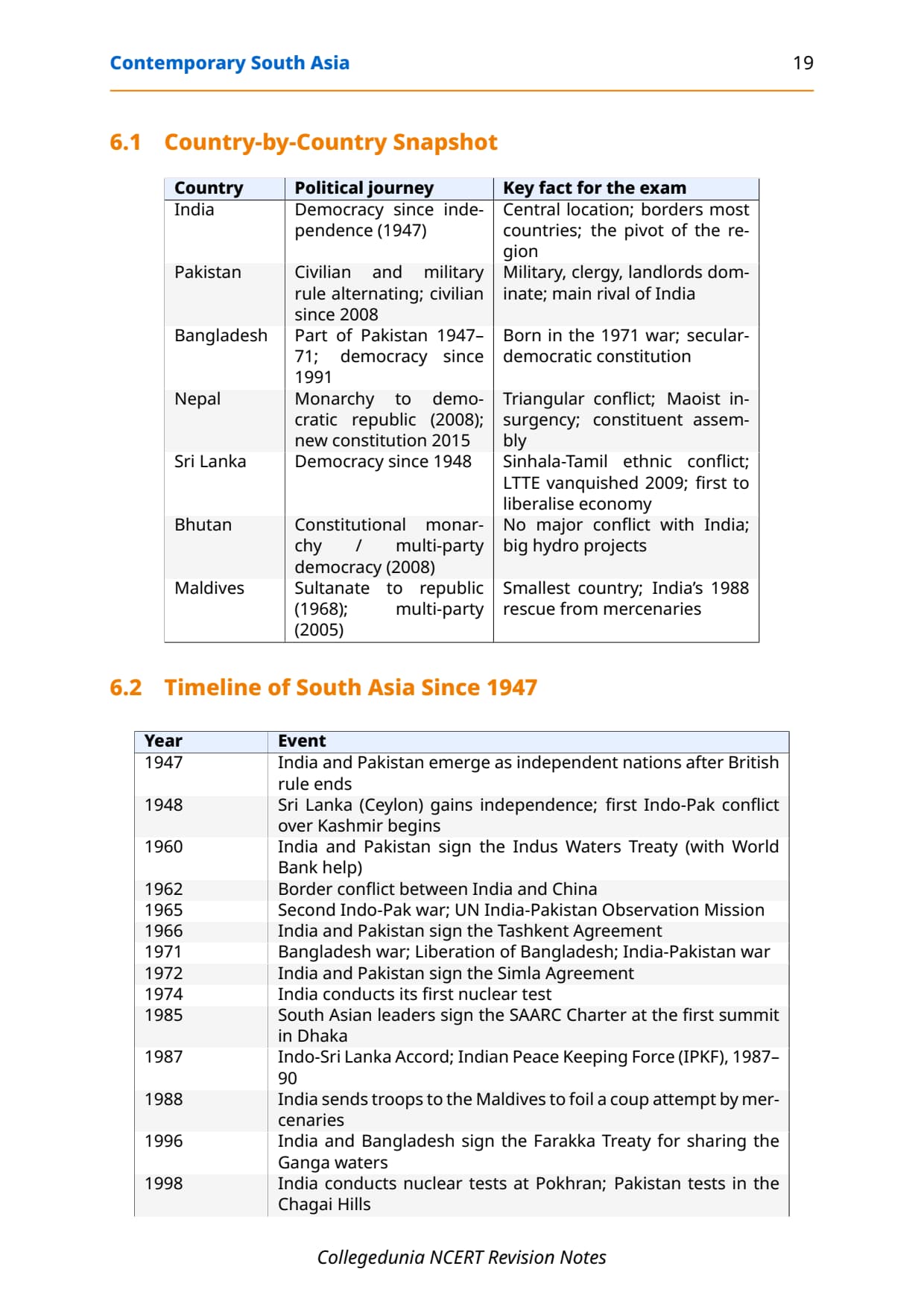
The base of the chapter is the seven countries and one signature fact for each. For quick revision, learn them as a boxed list so you can answer the identify-the-country question straight from memory. Each country has a clue the exam loves to test.
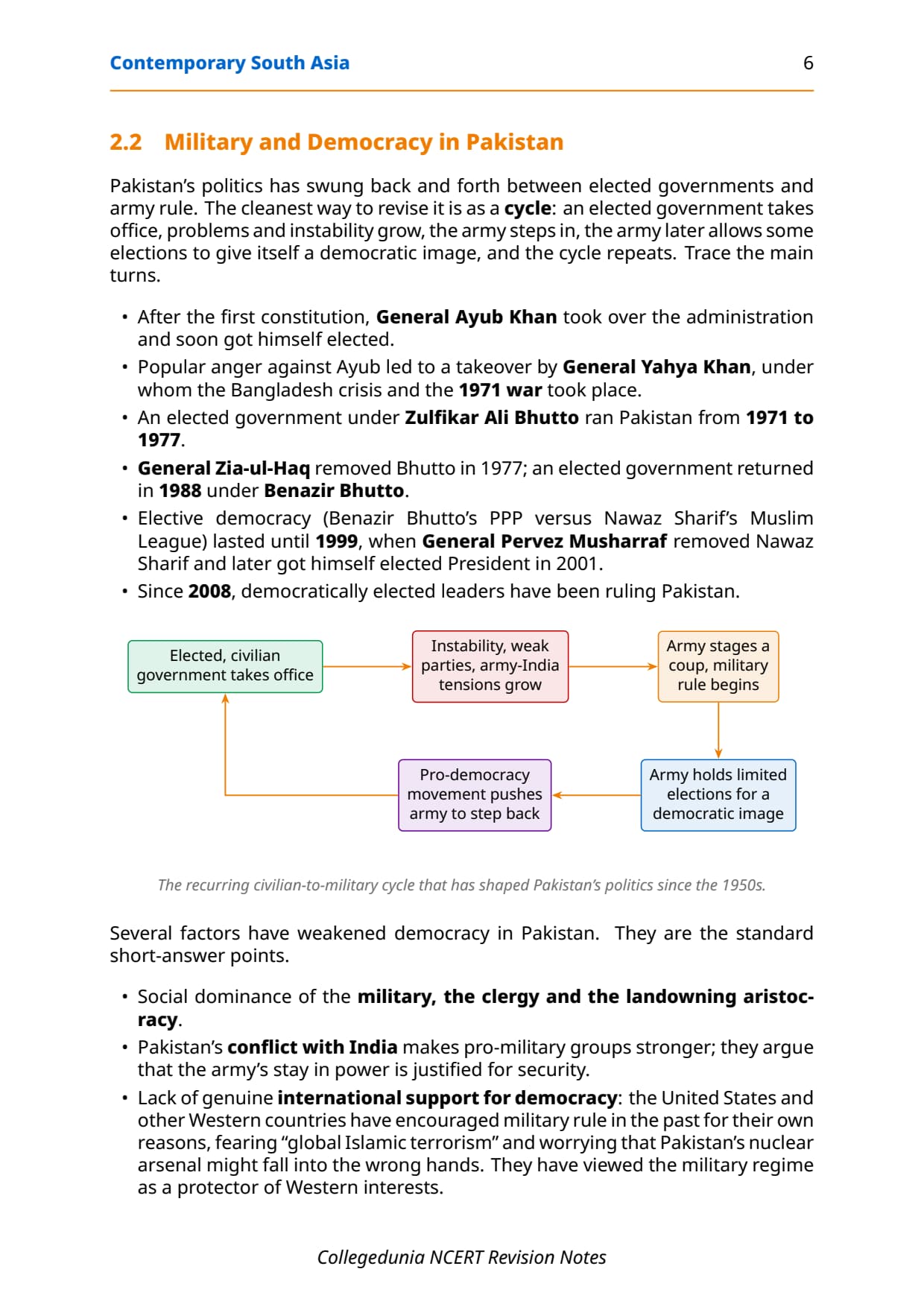
- Pakistan: military and democracy by turns, with four army coups.
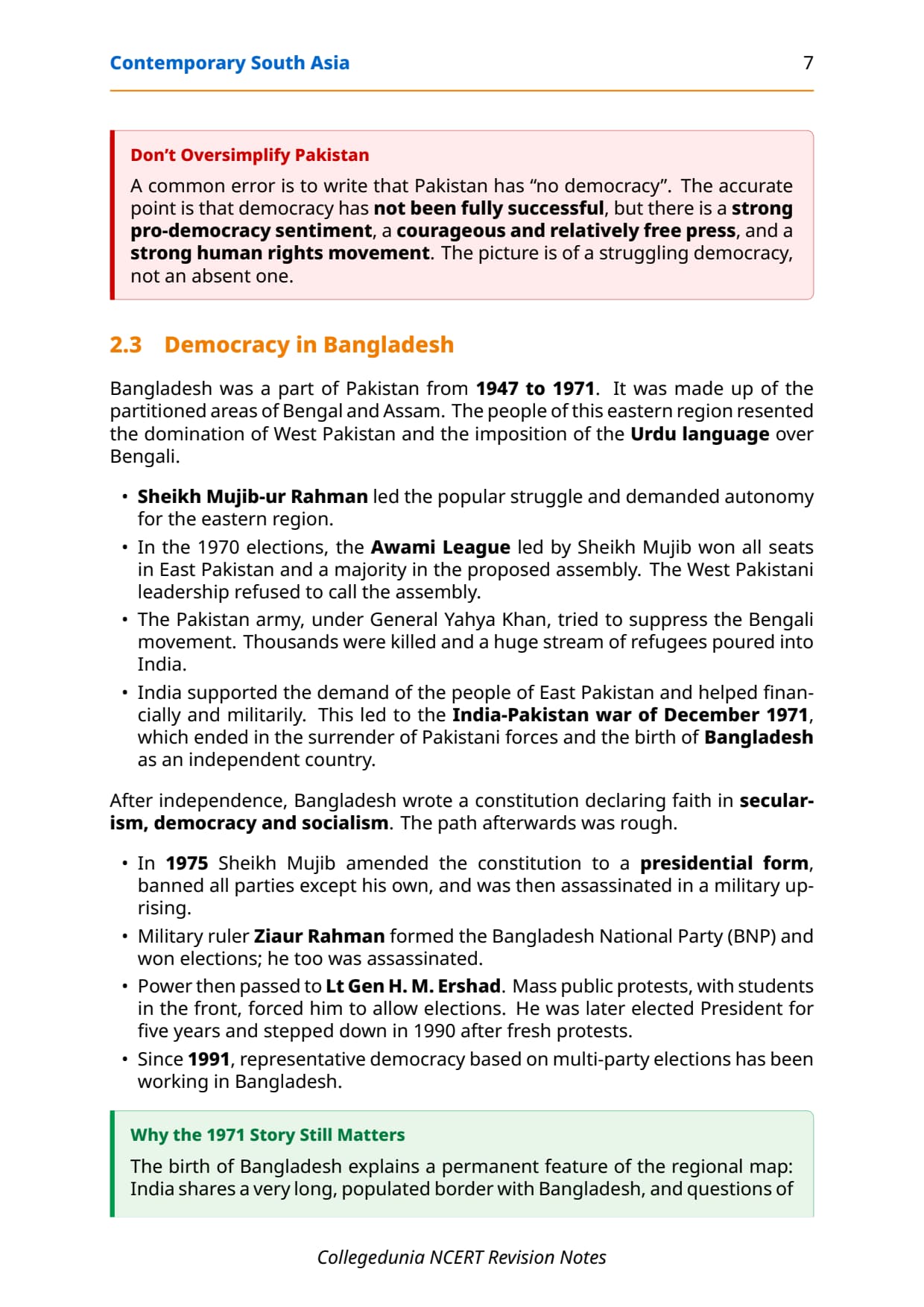
- Bangladesh: freedom in 1971, democracy since 1991, the Grameen Bank model.
- Sri Lanka: the first in the region to liberalise its economy.
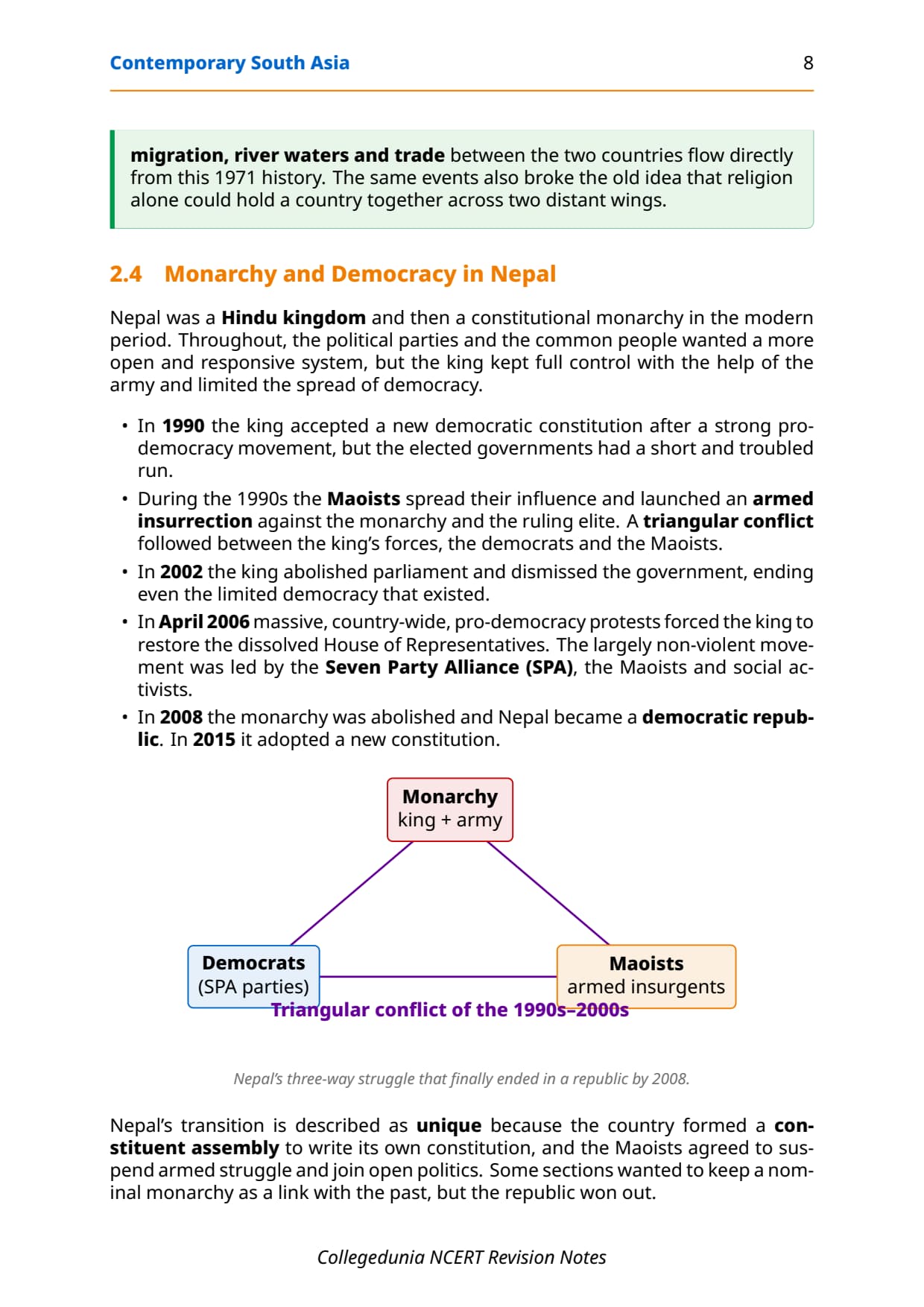
- Nepal and Bhutan: landlocked; Nepal became a republic in 2008, Bhutan a monarchy turned multi-party democracy.
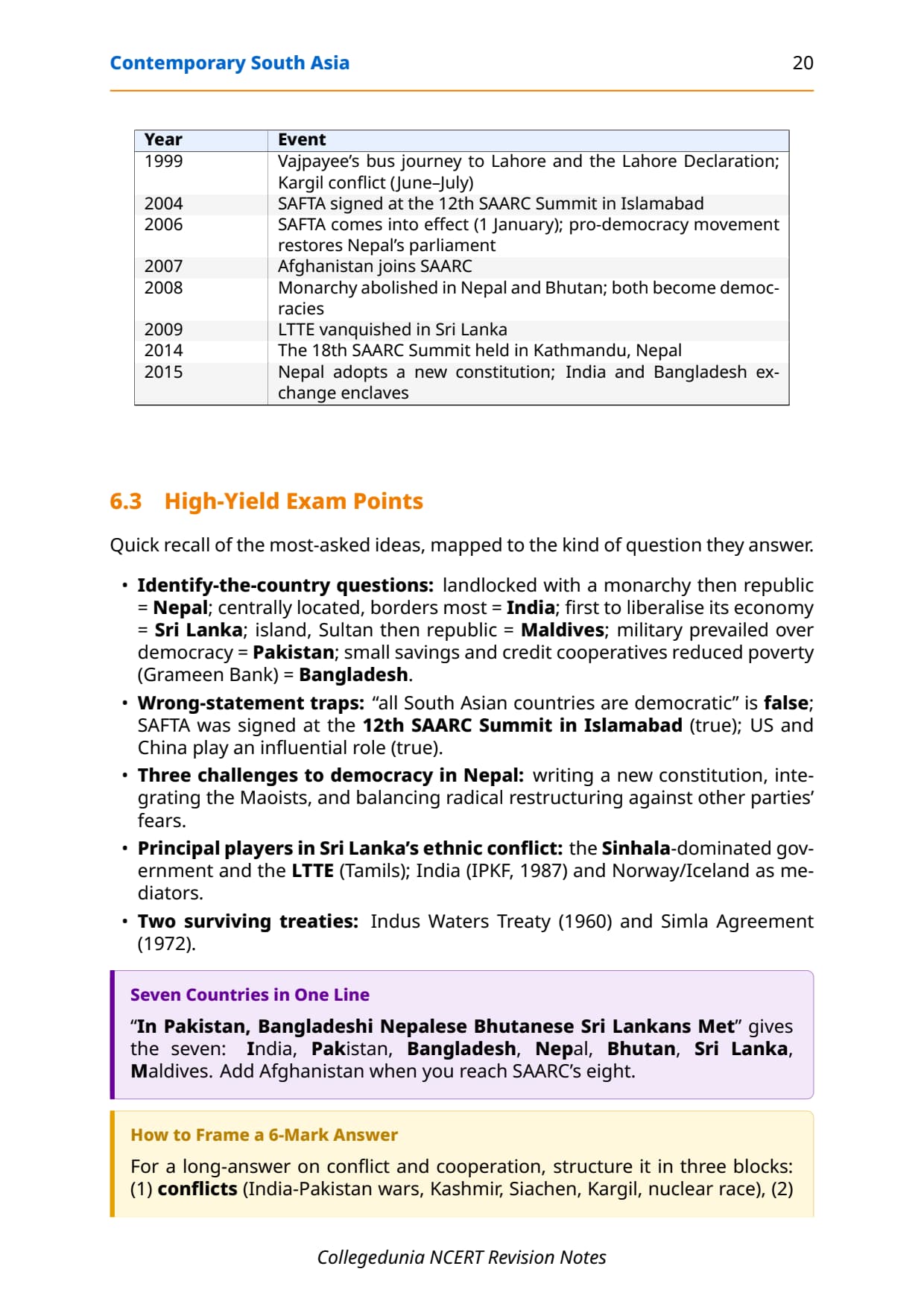
The point examiners test most is the trap in the identify question: Sri Lanka, not India, was the first to liberalise. Keep India's central location and the two landlocked states clear too. The Maldives, a Sultanate that became a republic in 1968, rounds out the seven.
The Mixed Record of Democracy
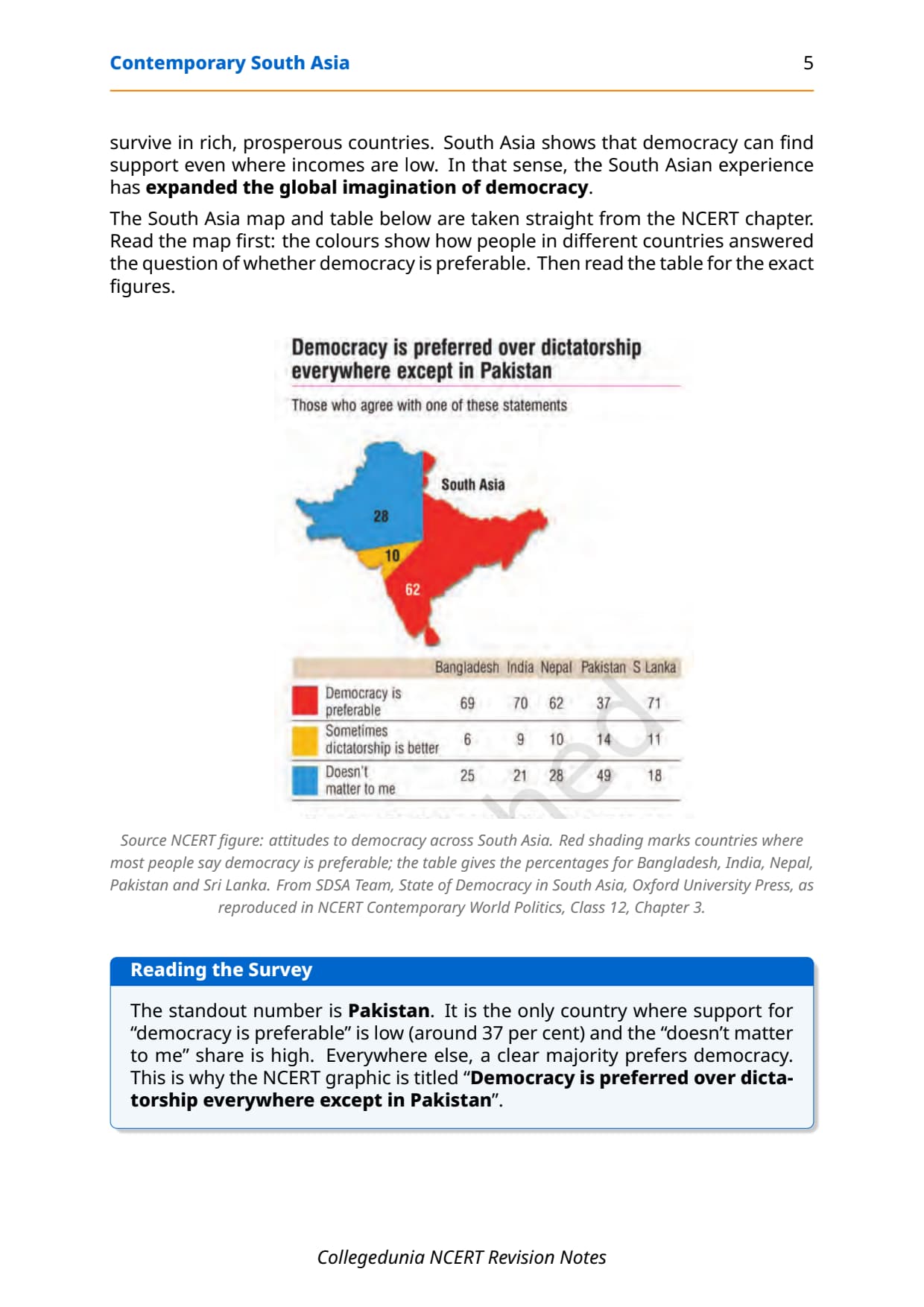
South Asia's record on democracy is uneven, and this is a long-answer favourite. These notes keep it as a clear table rather than a story. Learn it as a list and you can answer any version of the question.
| Country | Democratic experience to recall |
|---|---|
| Pakistan | Army rule by turns; four coups by Ayub, Yahya, Zia and Musharraf. |
| Bangladesh | Won freedom in 1971; democracy has held since 1991. |
| Nepal | Hindu monarchy to a republic in 2008 after a Maoist movement. |
| Sri Lanka | A working democracy, but scarred by a long ethnic conflict. |
| India | Democratic since 1947, the region's most stable system. |
The one-line takeaway for your sheet is that South Asia has a mixed record, not a uniform one. This is why the MCQ marks the line "all the countries in South Asia are democratic" as wrong. Keep the country-by-country split clear in your notes so you never overstate the region's democracy.
India-Pakistan Conflicts and Peace Efforts
The India-Pakistan story is the heart of the chapter. These notes keep the wars and the peace moves side by side, because students often blur them. Learn the two lists separately so you can give both sides in the long answer.
- The dispute: Kashmir, claimed by both since 1947.
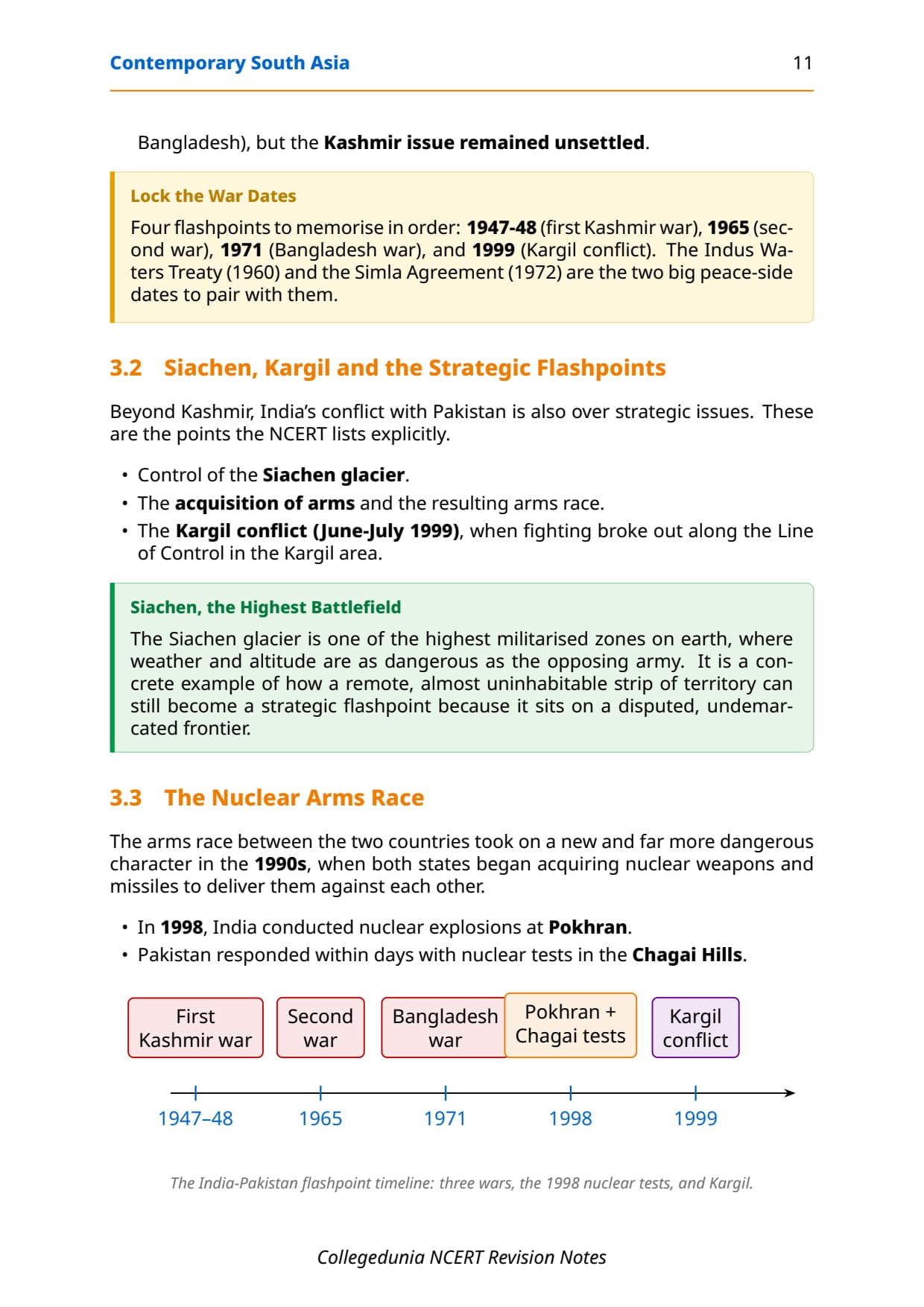
- The wars: 1947-48, 1965, the 1971 war over Bangladesh, and 1999 Kargil.
- The peace moves: the 1972 Simla Agreement and the 1999 Lahore Declaration.
- Confidence-building: trade links, travel and people-to-people contact.
The honest revision line is that the two have signed agreements but trust is still low. Wars, terror attacks and the Kashmir deadlock keep relations fragile, while trade and talks slowly help. Tie the four wars and the two treaties together so the timeline sticks for the exam.
India and Its Other Neighbours
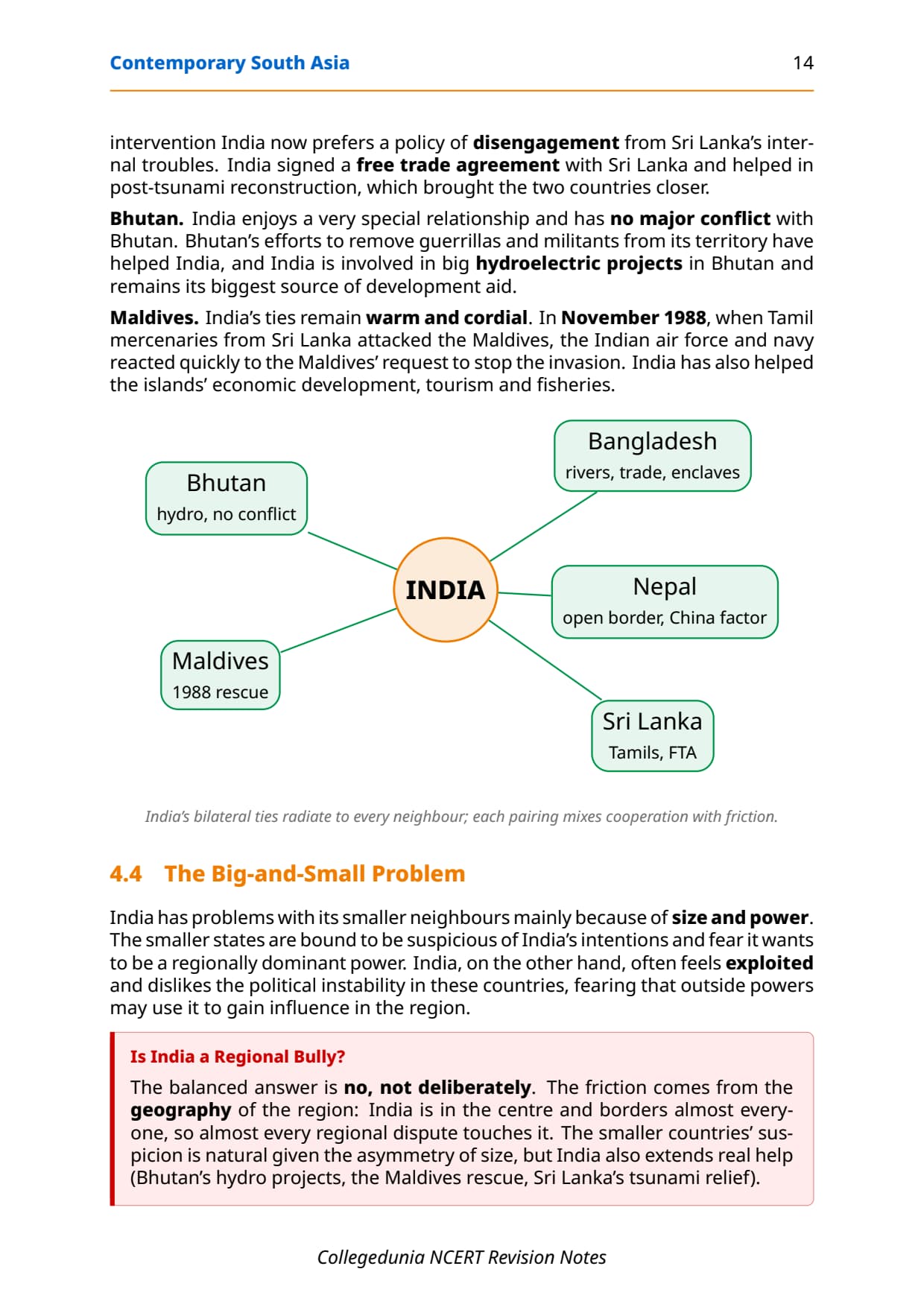
India also has a long history with Bangladesh, Nepal and Sri Lanka. These ties mix cooperation with friction, so your notes need both sides. The table keeps cooperation and disagreement next to each other for fast revision.
| Neighbour | Cooperation and friction to recall |
|---|---|
| Bangladesh | Work together on trade, disaster relief and the Farakka river-water treaty; differ over illegal migration and border issues. |
| Nepal | Open border and trade ties; friction over water and at times over Chinese influence. |
| Sri Lanka | A free-trade pact and close trade; the Tamil ethnic conflict once strained ties. |
The sharp point for your notes is that India's neighbours often feel its size lets it dominate. The chapter calls this the "big brother" worry, but India also helps smaller states with trade, aid and disaster relief. So a balanced answer says the impression is partly fair but not the full picture.
SAARC, SAFTA and Outside Powers
The last theme is cooperation. These notes give the SAARC facts first, then the role of outside powers, because the exam asks for both. Keep the dates and the limits as short, boxed points.
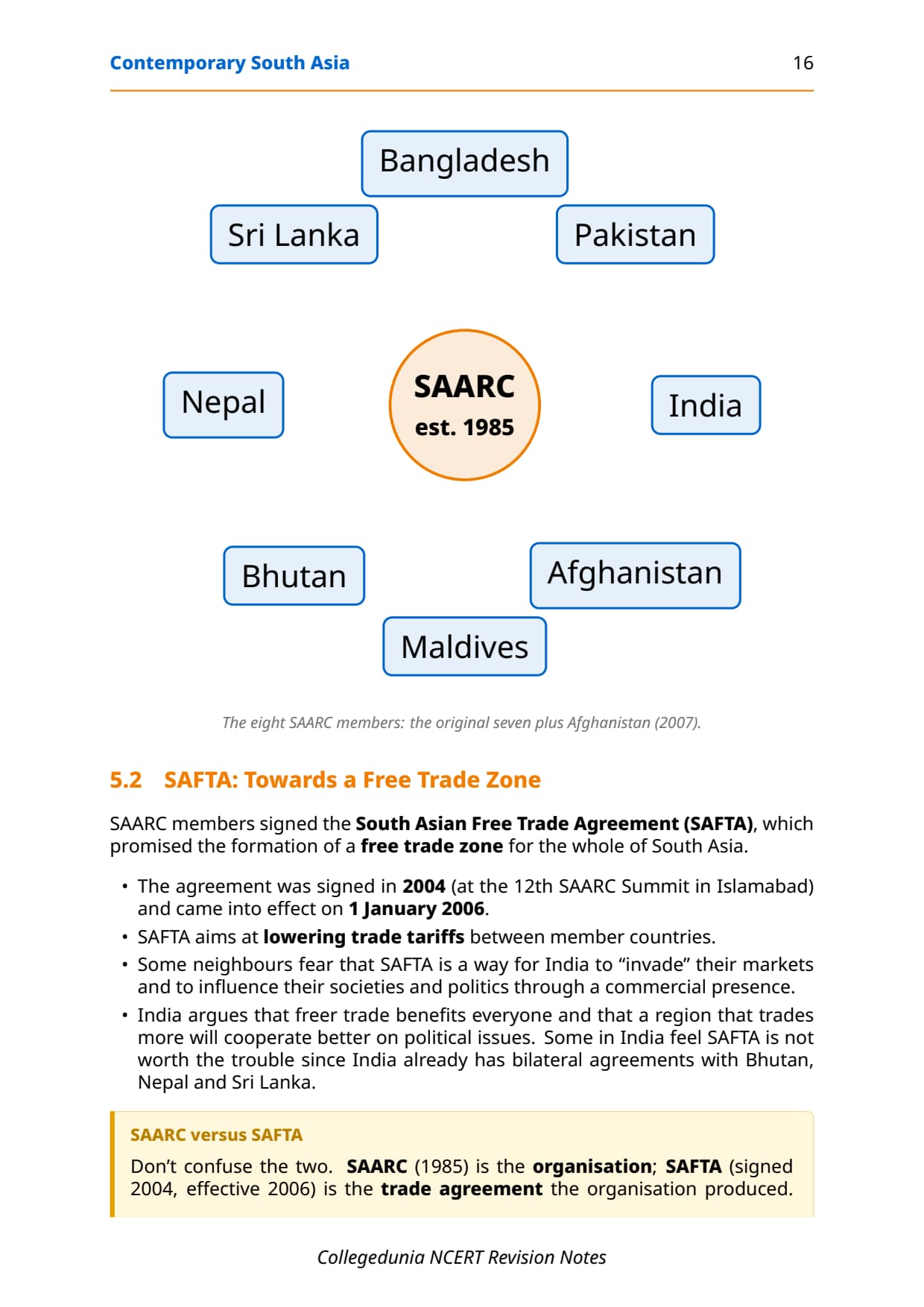
- SAARC: the South Asian Association for Regional Cooperation, formed in 1985.
- SAFTA: the free-trade pact signed in 2004, in effect from 2006.
- Its limits: India-Pakistan tension and the fear of Indian dominance slow real cooperation.
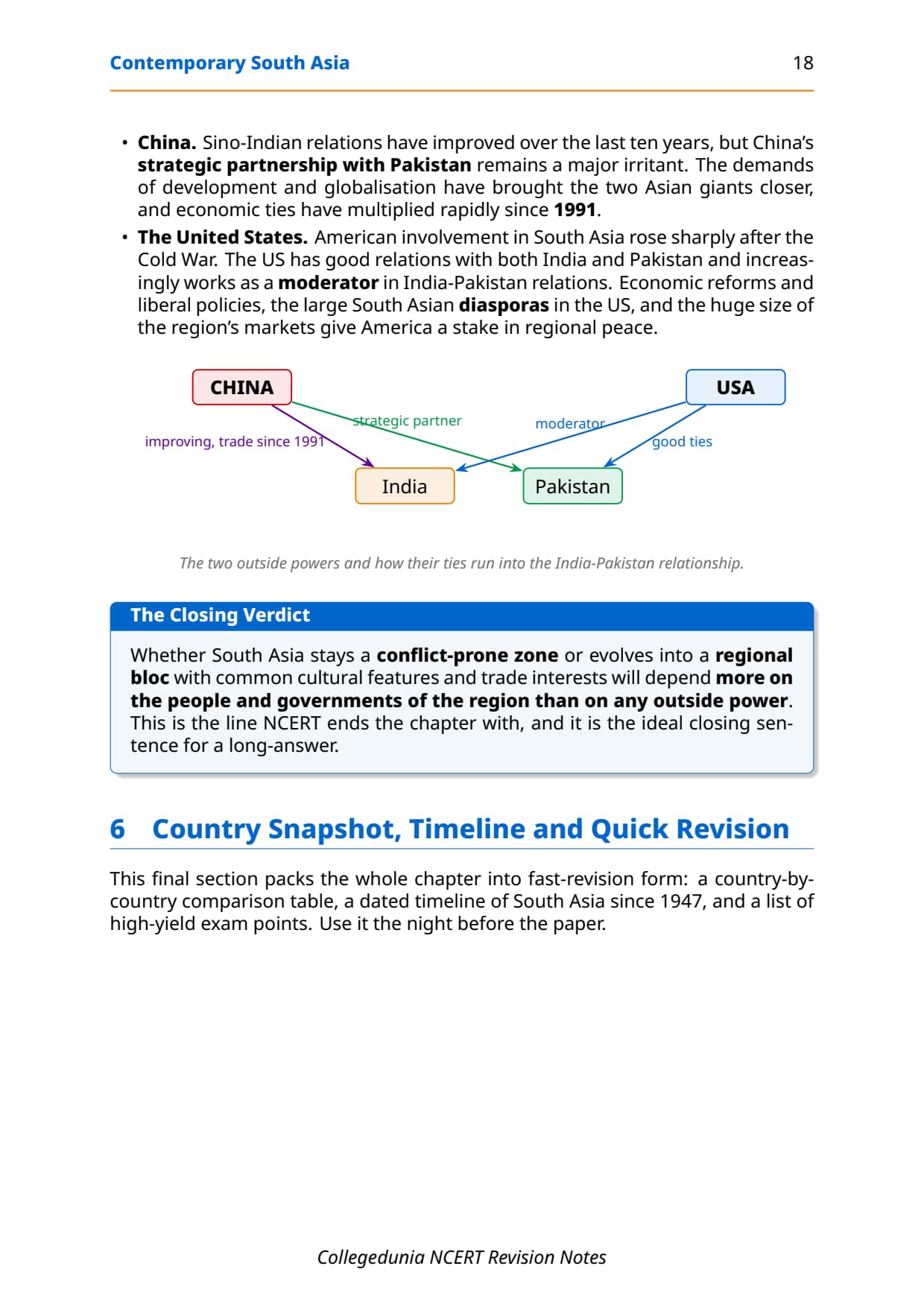
- Outside powers: China and the United States both shape the region's politics.
The judgement to remember is that SAARC has helped, but politics holds it back. It set up free trade in principle, yet rivalry between members keeps trade low. For the outside-powers question, one clear example, such as China's close ties with Pakistan, is enough to score full marks.
Contemporary South Asia Important Questions and Exam Pointers
CBSE sets a steady mix of MCQ, short and long answers from this chapter. Knowing the pattern helps students decide how much to write and which topics to revise first. A focused list of Contemporary South Asia important questions saves a lot of time before the board exam.
- Long answer (5 to 6 marks): India-Pakistan relations, or the role and limits of SAARC.
- Short answer (4 marks): the ethnic conflict in Sri Lanka, or challenges to democracy in Nepal.
- Source-based: a passage on India and its neighbours or on outside powers, with sub-parts.
- Objective and MCQ: the seven countries, SAARC and SAFTA dates, and the Farakka Treaty.
For quick recall, students often practise a short class 12 political science chapter 3 mcq drill and a list of Contemporary South Asia class 12 important questions. The most repeated items are the India-Pakistan wars and the SAARC facts, so keep those answer points ready in your own words. Reading these notes once, then writing the key lists from memory, is the fastest way to lock the chapter in.
Common Mistakes Students Make in This Chapter
A few errors cost marks every year. Most come from mixing up the countries, or giving only one side of the India-neighbour debate. Fixing these five points is the quickest way to lift a score, so add them to the end of your revision sheet.
- Saying "all South Asian countries are democratic" - they are not; the record is mixed.
- Naming India as the first to liberalise - it was Sri Lanka, a common examiner trap.
- Confusing the landlocked states - both Nepal and Bhutan have no sea coast.
- Forgetting SAARC began in 1985 and SAFTA was signed in 2004.
- Writing that India only fights its neighbours - it also gives trade, aid and disaster relief.
Students who fix these five points usually move from average to high marks. The exam rewards a balanced view, so always give both the conflict and the cooperation before you judge any relationship. These notes flag each soft point so you can phrase it safely in the answer sheet.
How These Notes Pair with the Solutions and Book PDF
These revision notes summarise the chapter. To prepare fully, students should use them alongside the other resources for the same chapter, all linked in the table below. Read the notes first, then test yourself with the solutions, and open the book PDF whenever you need the original text and maps.
| Resource | Best used for |
|---|---|
| Contemporary South Asia NCERT Solutions | Step-by-step answers to all 10 back-exercise questions |
| Contemporary South Asia Handwritten Notes | Last-minute, one-shot revision in a scanned notebook style |
| Contemporary South Asia NCERT Book PDF | Reading the original NCERT chapter text and maps |
Tip: read these notes first, then attempt the solutions on your own, and only then check the model answers. That order builds memory faster than copying answers straight away.
All Class 12 Political Science Notes by Chapter
The table links the revision notes for every chapter in both Class 12 Political Science books, so students can move across the course in one click. Contemporary South Asia is highlighted.
| Chapter | Notes |
|---|---|
| Contemporary World Politics | |
| Chapter 1 | The End of Bipolarity |
| Chapter 2 | Contemporary Centres of Power |
| Chapter 3 | Contemporary South Asia |
| Chapter 4 | International Organisations |
| Chapter 5 | Security in the Contemporary World |
| Chapter 6 | Environment and Natural Resources |
| Chapter 7 | Globalisation |
| Politics in India Since Independence | |
| Chapter 1 | Challenges of Nation Building |
| Chapter 2 | Era of One-Party Dominance |
| Chapter 3 | Politics of Planned Development |
| Chapter 4 | India's External Relations |
| Chapter 5 | Challenges to and Restoration of the Congress System |
| Chapter 6 | The Crisis of Democratic Order |
| Chapter 7 | Regional Aspirations |
| Chapter 8 | Recent Developments in Indian Politics |
FAQs on Contemporary South Asia Class 12 Notes
Contemporary South Asia Class 12 Political Science Notes Common Questions
Ques. Where can I download the Contemporary South Asia Class 12 notes PDF?
Ans. You can download the Contemporary South Asia Class 12 Political Science notes PDF directly from this page. It is free, follows the 2026-27 NCERT, and covers the seven countries, the mixed record of democracy, India-Pakistan relations and SAARC in a short, point-wise format.
Ques. What does the Contemporary South Asia chapter cover for Class 12?
Ans. It covers the seven South Asian countries, how democracy has fared in each, the India-Pakistan wars and peace talks, India's ties with Bangladesh, Nepal and Sri Lanka, the role of outside powers, and cooperation through SAARC and SAFTA.
Ques. Which seven countries make up South Asia?
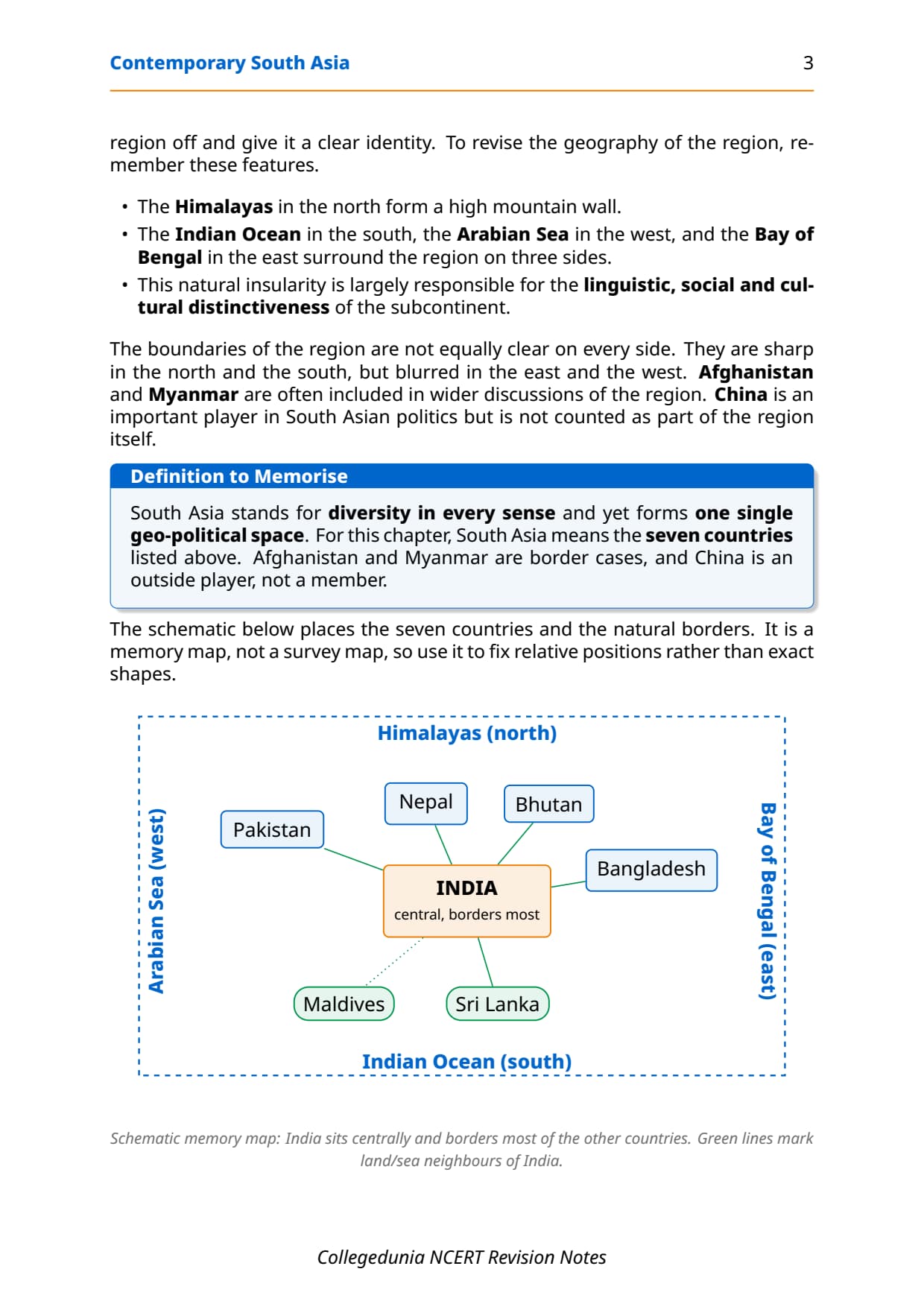
Ans. South Asia here means Bangladesh, Bhutan, India, the Maldives, Nepal, Pakistan and Sri Lanka. India sits centrally and borders most of them, while Nepal and Bhutan are landlocked. Knowing one signature fact per country is the base of the chapter.
Ques. Why is Contemporary South Asia important for the board exam?
Ans. Because it is a high-scoring chapter on India's own neighbourhood. The India-Pakistan relationship, the SAARC facts and the identify-the-country item appear almost every year, so revising these notes well secures both MCQ and long-answer marks.
Ques. How should I use these notes to revise quickly?
Ans. Read the notes once under the democracy, conflict and cooperation frame, keep the seven country facts and treaty dates on one sheet, then write the key lists from memory. Finish by attempting a short class 12 political science chapter 3 mcq drill to test the small facts.



Comments