




The Class 12 Geography Chapter 6 Tertiary and Quaternary Activities textbook PDF is the official NCERT source for every board question on service industries, trade, transport, communication, tourism, and knowledge-based quaternary work. It carries about 4 to 6 marks in the CBSE board exam and is essential reading for CUET Geography and UPSC aspirants covering the service sector of the world economy.
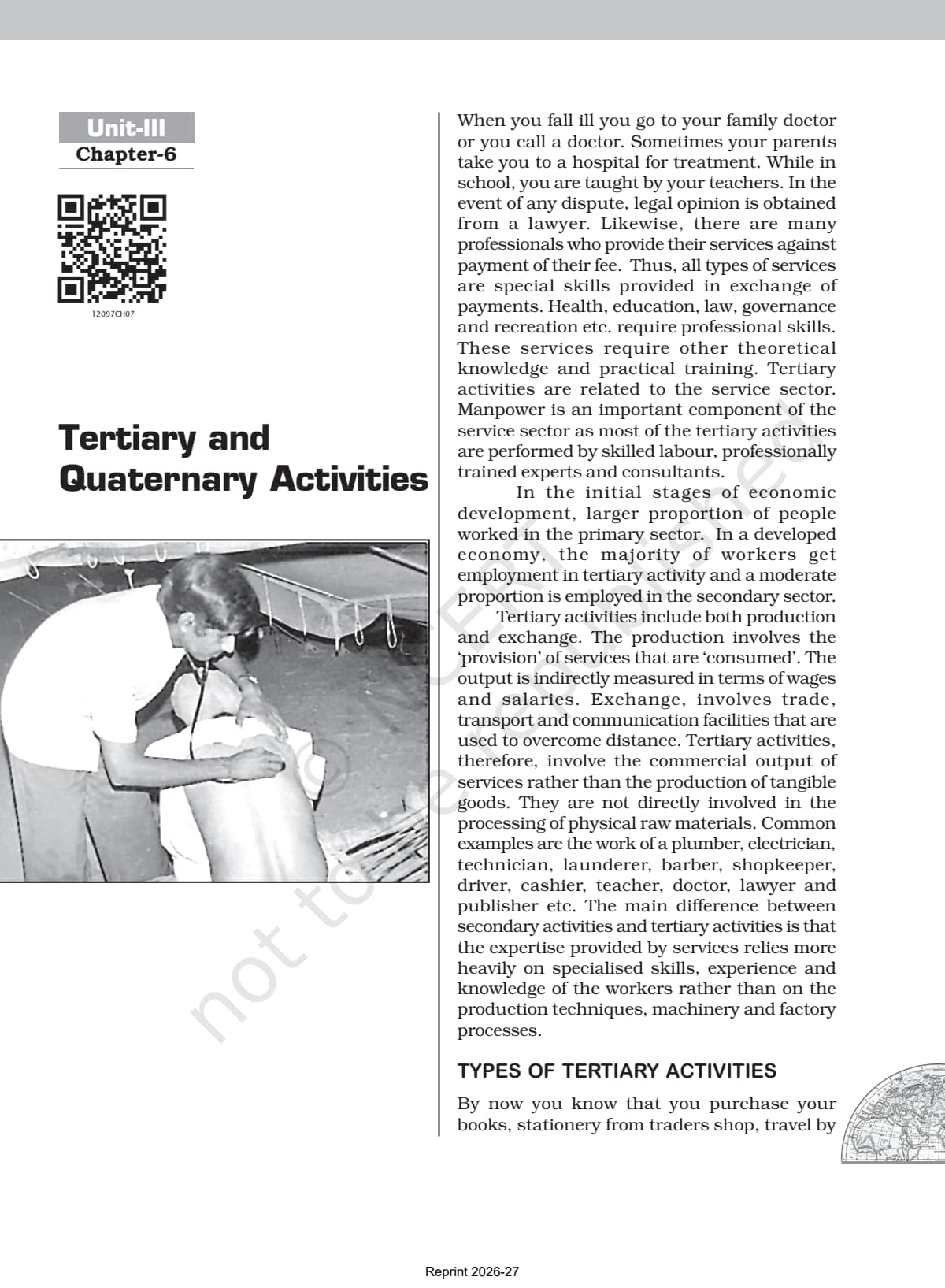
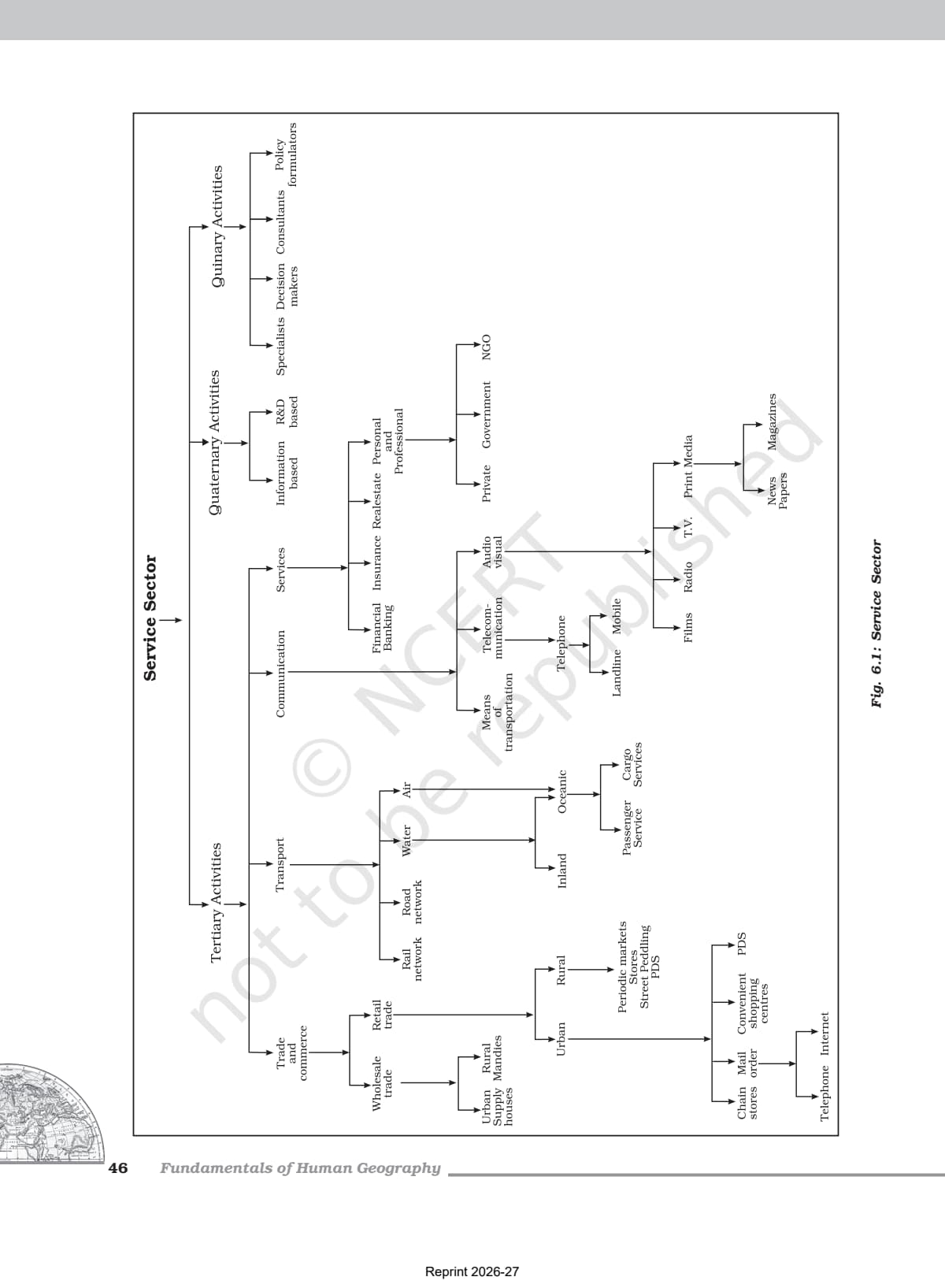
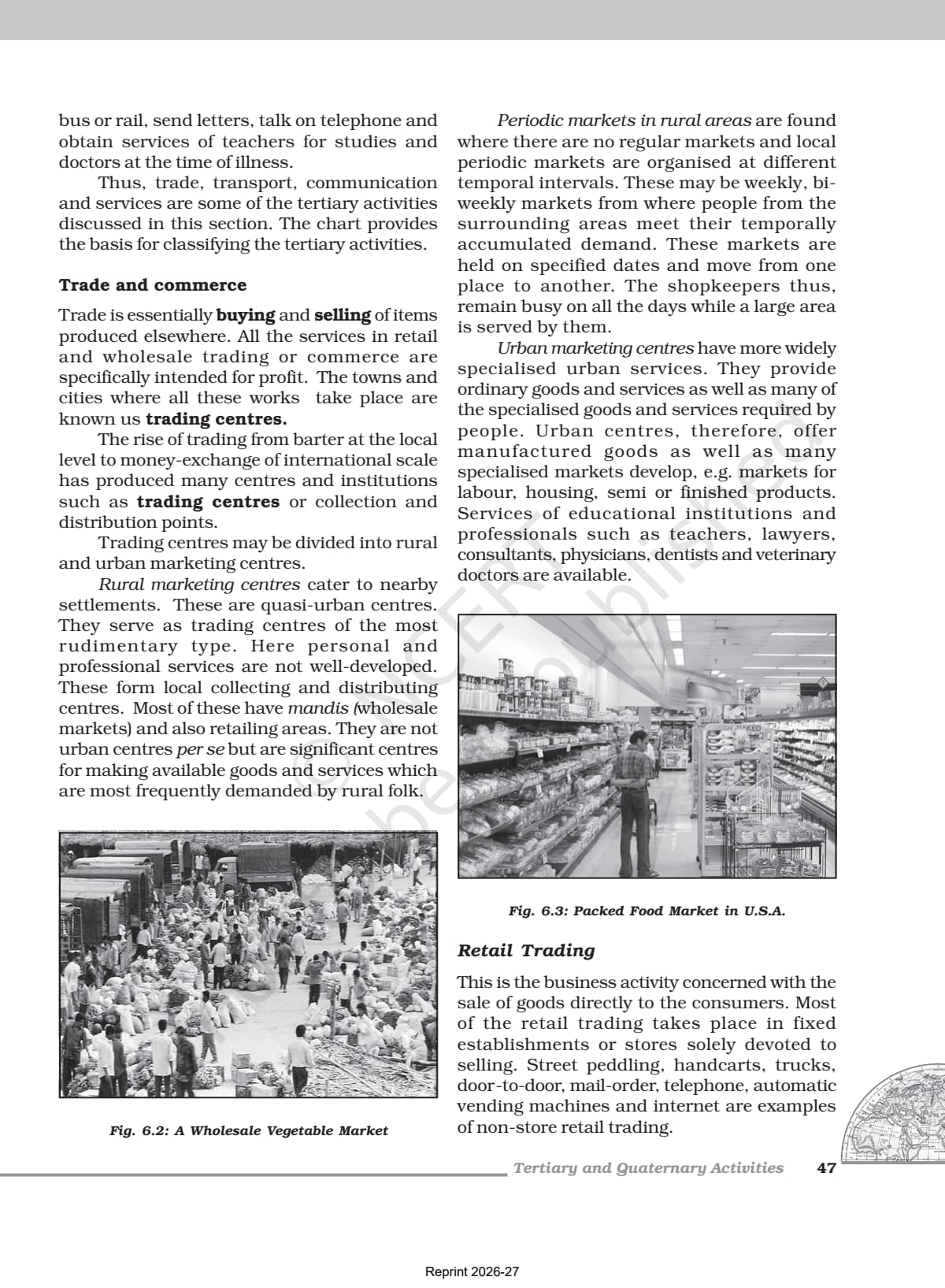
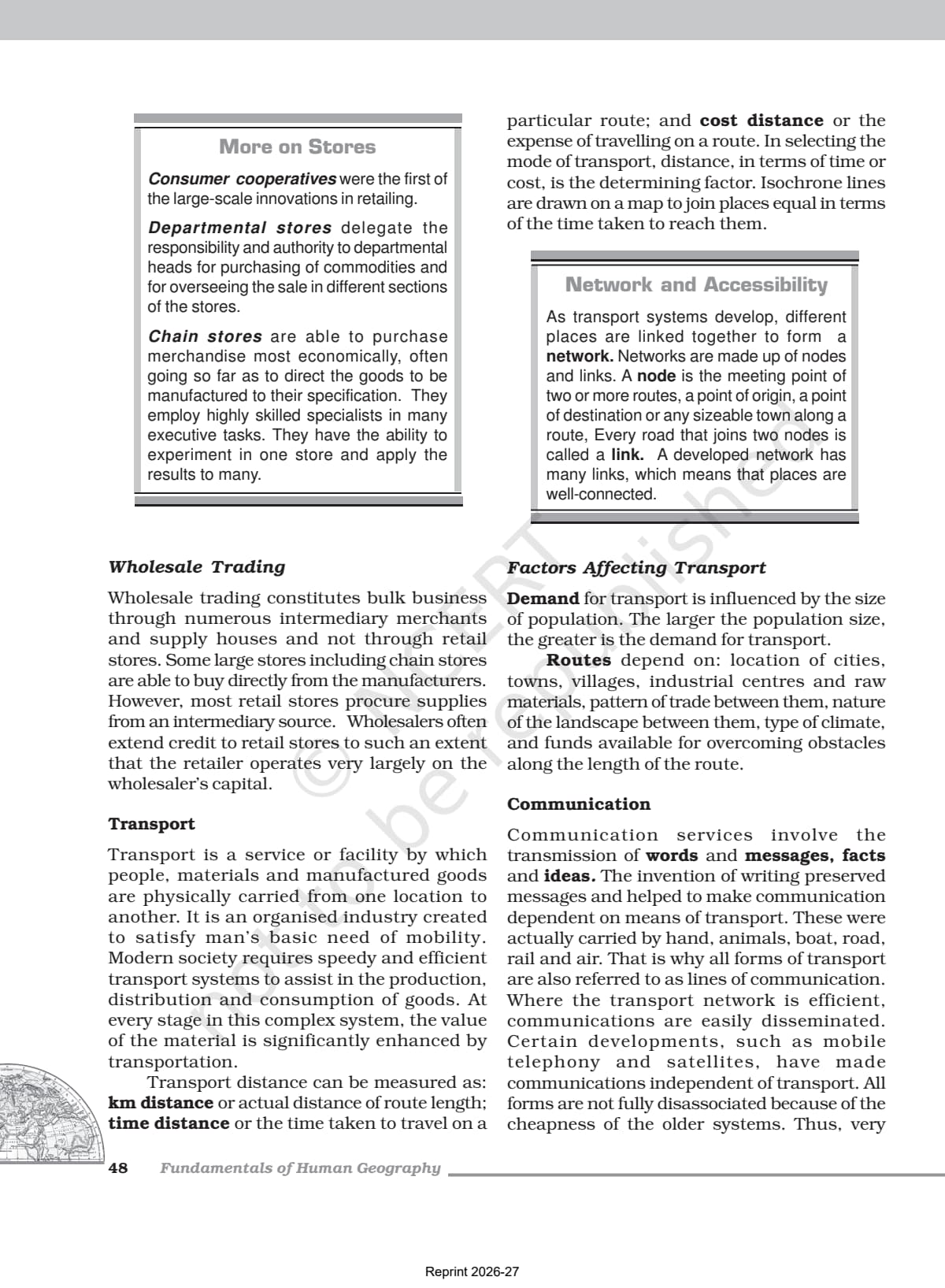
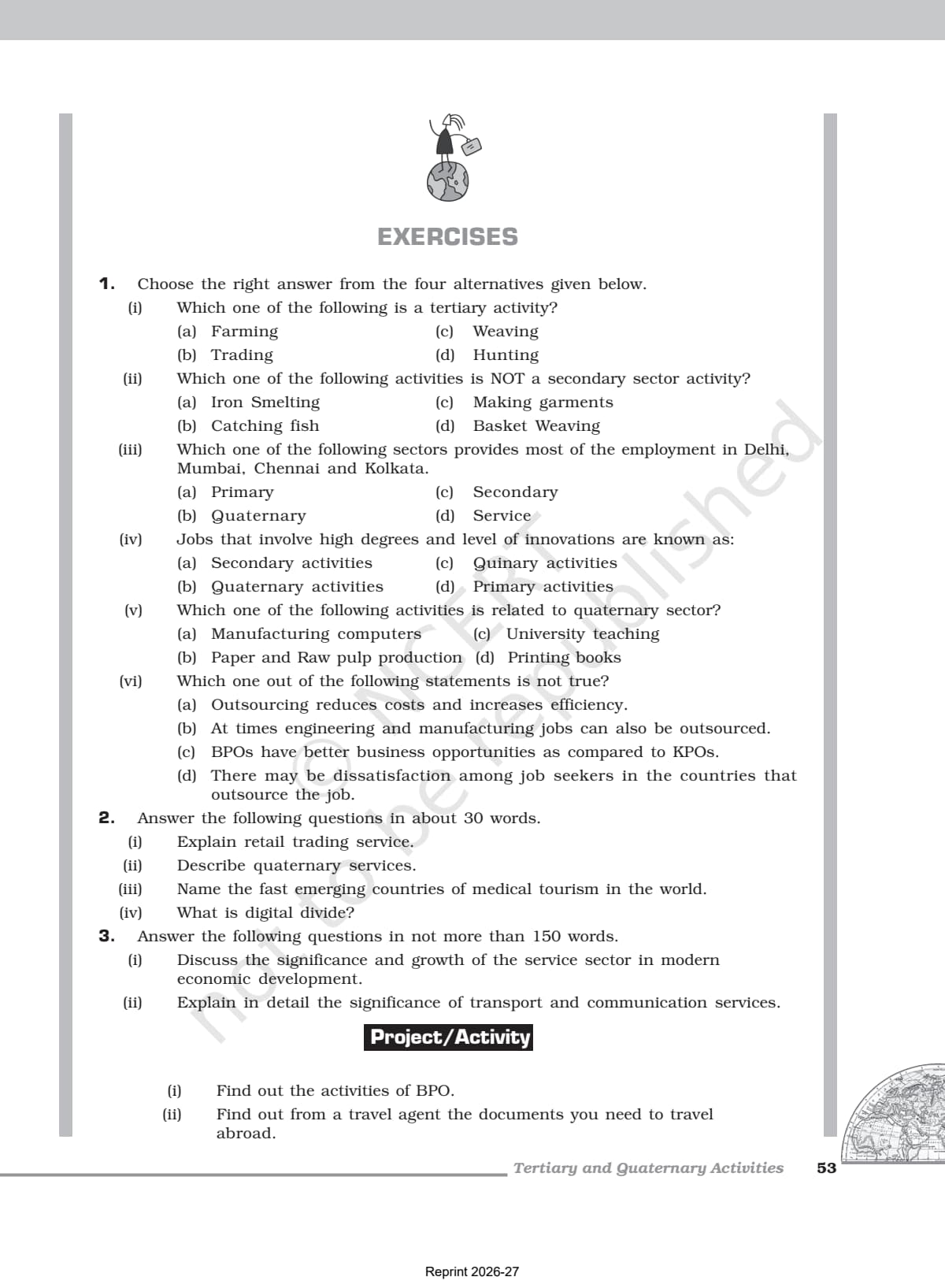
- Official NCERT Fundamentals of Human Geography Class 12 Chapter 6 PDF covering tertiary activities (trade, transport, communication, services, tourism) and quaternary activities (knowledge-based work, outsourcing, quinary activities).
- 4-6 marks CBSE board-paper weightage for Chapter 6; the official textbook is the only source CBSE references when setting questions on service sectors and the digital divide.
- Pair with the matching NCERT Solutions, Notes and Handwritten Notes for full chapter coverage.
Student Feedback
In a 2026 Collegedunia poll of 9,800 Class 12 Geography students, 82% said reading the NCERT PDF directly helped them answer board questions on tertiary activities, tourism, outsourcing, and the digital divide. Those students averaged 4.7 out of 5 marks on this chapter.
What This Chapter Covers in the NCERT Class 12 Book
The tertiary and quaternary activities class 12 geography chapter explains how economies move beyond farming and manufacturing into services. The official NCERT PDF is the only document CBSE references when it sets questions on types of services, trade, transport, tourism, outsourcing, and the digital divide, so students preparing for the 2026-27 board paper should read it before any guide book. The chapter covers tertiary activities (services measured in wages, not goods), trade and marketing centres, transport and communication, tourism with its attractions, and the knowledge-based quaternary and quinary sectors. It closes with the digital divide, the gap between countries with ICT access and those without, which is regularly examined.
Source: Amit Sengupta on YouTube
Topics in the Chapter (Section-Wise Map of the NCERT PDF)
The table below maps each NCERT sub-topic to its main concept and the exam angle students should extract from it.
| Section | NCERT Sub-topic | Dominant Exam Concept |
|---|---|---|
| Intro | What are Tertiary Activities? | Service sector; output measured in wages/salaries; skilled manpower essential |
| 6.1 | Types of Tertiary Activities | Trade and commerce; transport; communication; services - each defined separately |
| 6.1a | Trade and Commerce | Rural vs urban marketing centres; retail vs wholesale; periodic markets |
| 6.1b | Transport | Network, nodes, links, accessibility; factors affecting transport; km/time/cost distance |
| 6.1c | Communication | Telecommunications, mass media, satellite communication, internet |
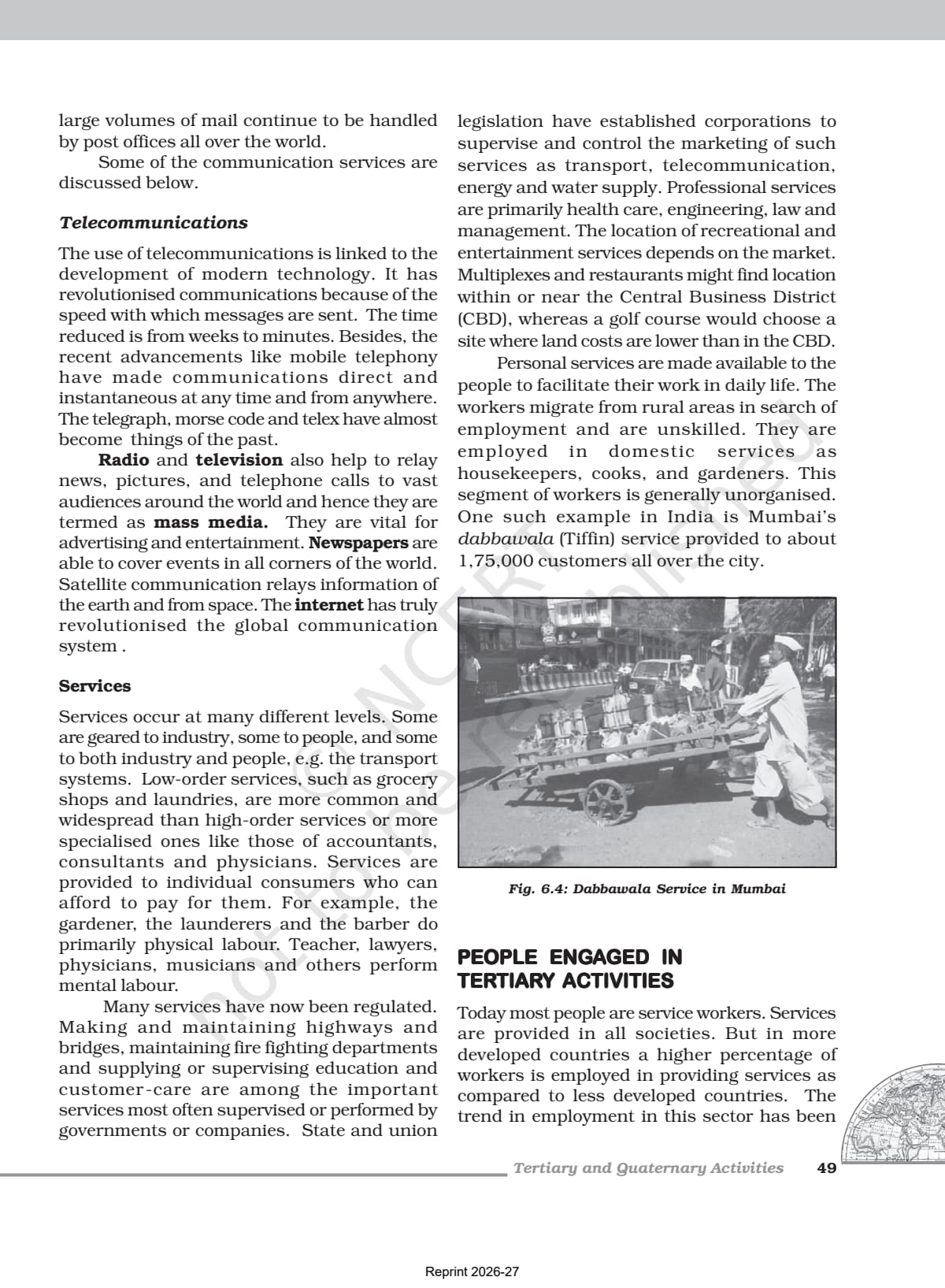
| 6.1d | Services | Low-order vs high-order services; professional, recreational, personal services; dabbawala example |
| 6.2 | People Engaged in Tertiary Activities | Employment shift from primary to tertiary in developed economies |
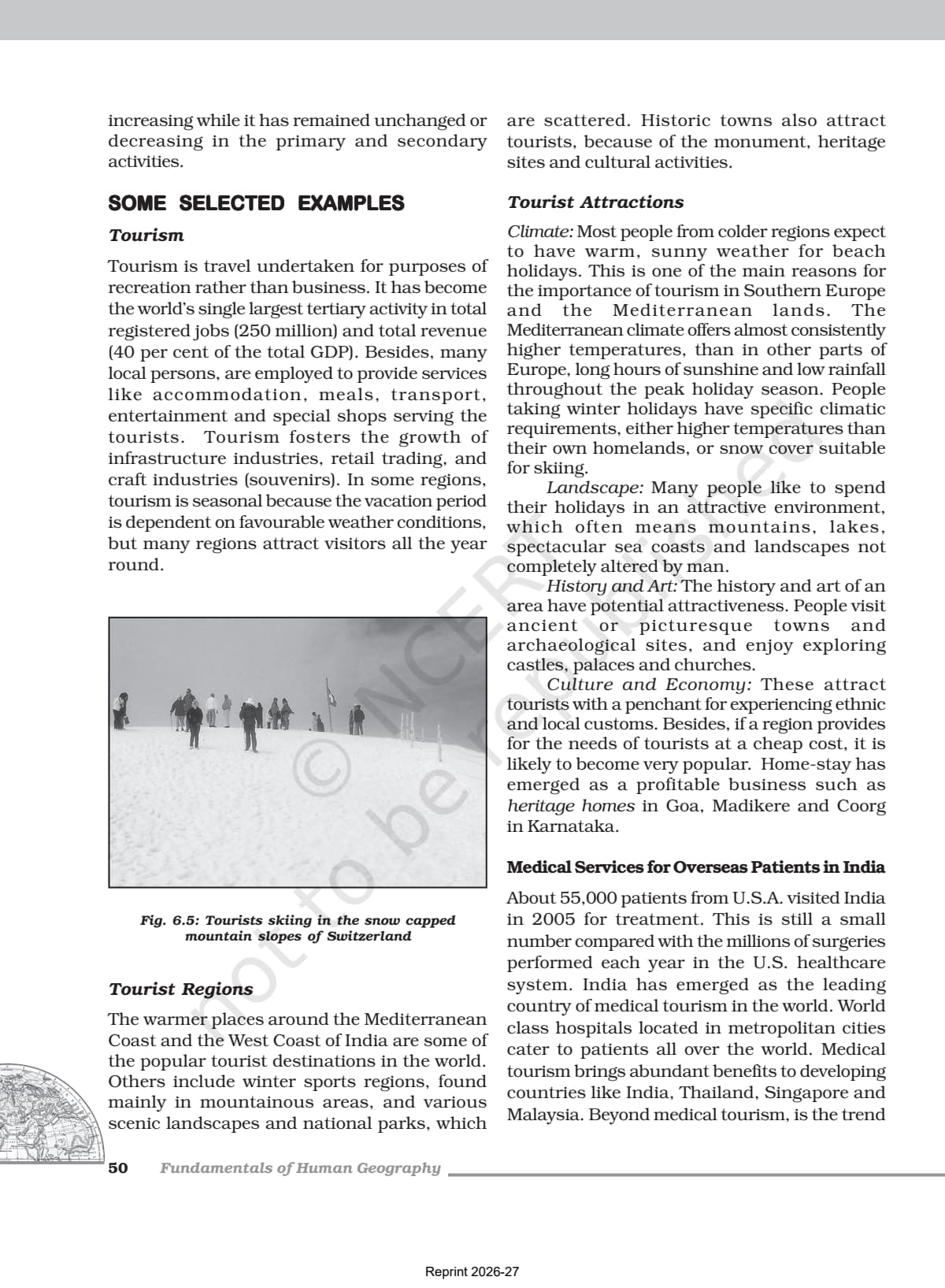
| 6.3 | Tourism | World's largest tertiary activity; tourist attractions (climate, landscape, history); medical tourism |
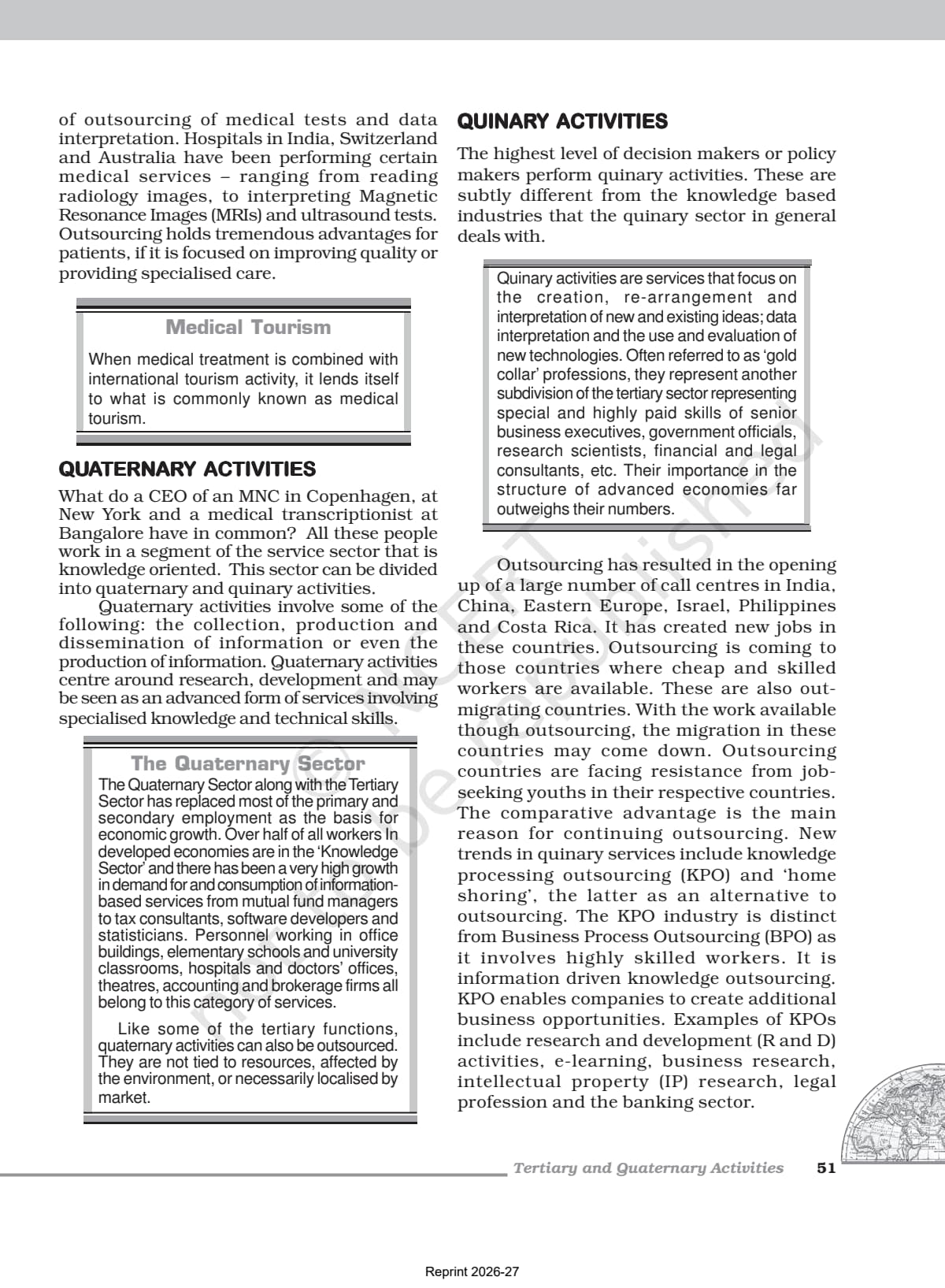
| 6.4 | Quaternary Activities | Knowledge-based; R&D; outsourcing and offshoring; call centres; KPOs vs BPOs |
| 6.5 | Quinary Activities | Gold-collar professions; top-level decision makers; policy makers |
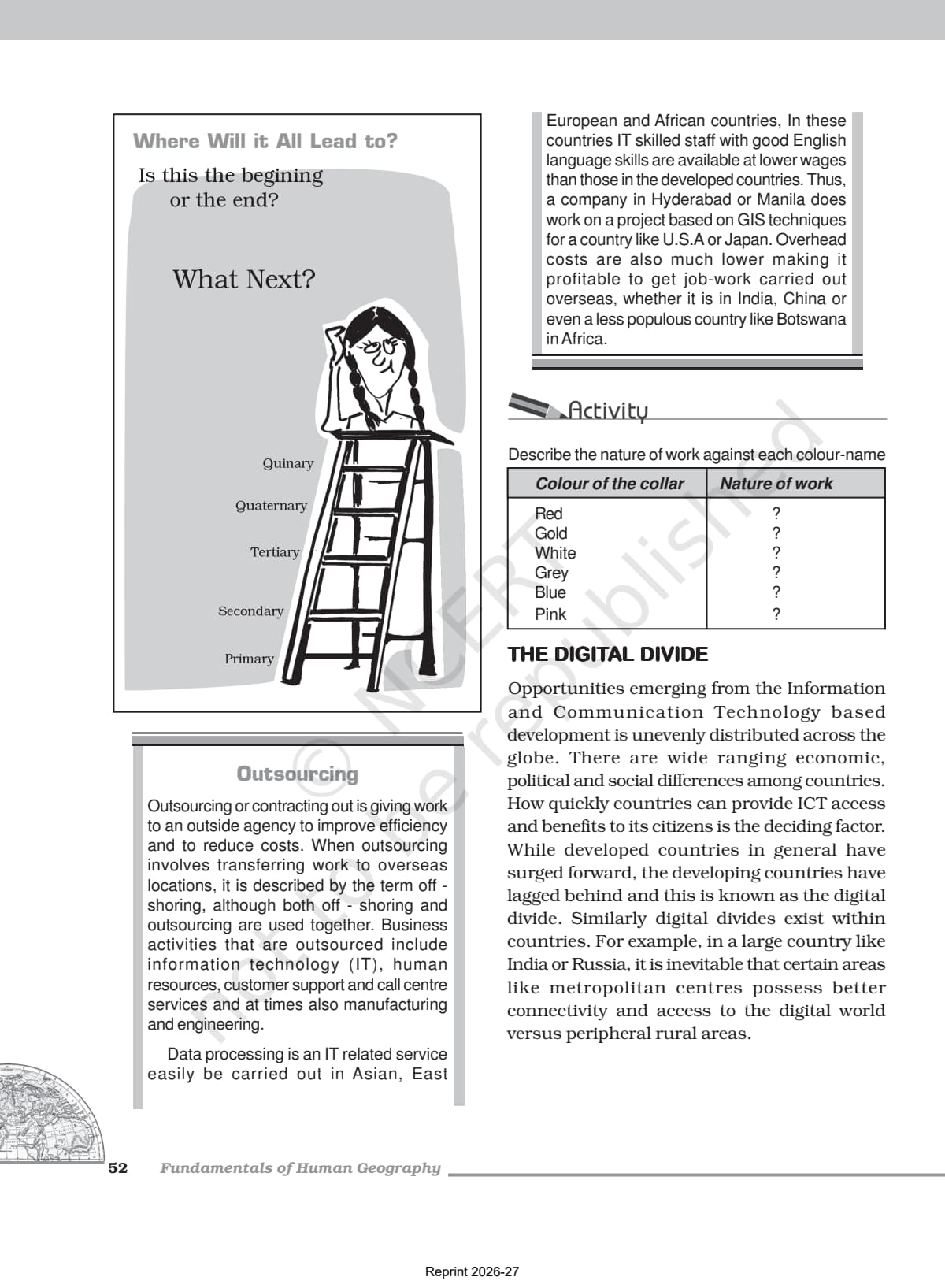
| 6.6 | The Digital Divide | Uneven ICT access between developed and developing countries and within countries |
Section 6.3 on tourism, Section 6.4 on quaternary activities, and the digital divide together carry most of the board-paper questions from this chapter, because all three are rich in definitions and examples that CBSE frames as MCQs, short answers, or extended answers.
Key Concepts From the NCERT Class 12 Geography Textbook
The four concept blocks below use the canonical NCERT phrasing. Reproducing this phrasing in the board paper is the fastest route to full marks on theory questions.
Tertiary Activities and Types of Services
Tertiary activities relate to the service sector, where the output is the provision of services that are consumed rather than tangible goods. Unlike secondary activities, services rely on the specialised skills, experience, and knowledge of workers rather than on machinery. Services are classified into low-order services (grocery shops, laundries) and high-order services (accountants, consultants, physicians), plus professional, recreational, and personal services, a classification that appears in MCQs every year.
Trade, Transport, and Communication
Trade is the buying and selling of items produced elsewhere: rural marketing centres serve nearby settlements, while periodic markets rotate from place to place on specified dates. Transport networks are built from nodes (meeting points of routes) and links (roads joining two nodes). Transport distance is measured three ways: km distance, time distance, and cost distance, a standard MCQ source. Communication has shifted from mail to instant satellite and internet systems.
Tourism as the World's Largest Tertiary Activity
Tourism is travel for recreation rather than business. It has 250 million registered jobs and generates 40% of total GDP worldwide, making it the single largest tertiary activity, a statistic that appears almost every year. Tourist attractions fall into four categories: climate, landscape, history and art, and culture and economy. Medical tourism combines treatment with international travel; India, Thailand, Singapore, and Malaysia are the textbook examples.
Quaternary Activities and the Digital Divide
Quaternary activities involve the collection, production, and dissemination of information, that is, knowledge-based work centred on research and development, and they can be outsourced. Quinary activities go a level higher, performed by top decision makers and policy makers, and are often called "gold-collar" professions. The digital divide is the uneven distribution of ICT access: developed countries have surged ahead while developing countries lag, and even within India metropolitan areas have far better connectivity than rural peripheries.
Previous Year Question Trends From This Chapter
The tertiary and quaternary activities class 12 important questions follow a steady pattern, and the 2026-27 paper should look similar. This chapter has carried 4 to 6 marks across recent board papers, mostly through MCQs, short-answer definitions, and one conceptual question on tourism or quaternary activities.
| Year | Marks | Question Types | Most Common Topic |
|---|---|---|---|
| 2025 | 5 | 1 MCQ + 1 short answer + 1 extended definition | Quaternary activities / outsourcing / digital divide |
| 2024 | 4 | 1 MCQ + 2 short answers | Tourism - types of tourist attractions |
| 2023 | 5 | 1 MCQ + 1 short answer + 1 five-mark answer | Significance and growth of the service sector |
| 2022 | 4 | 2 MCQs + 1 short answer | Retail trading / quaternary vs quinary activities |
| 2020 | 6 | 1 long answer + 1 MCQ + 1 short answer | Transport and communication; significance of tertiary sector |
The most repeated question type is a three or five mark question on the significance and growth of the service sector, or on the features of quaternary activities with examples. Both need the textbook's named concepts and specific examples.
Connecting This Chapter to the Rest of Fundamentals of Human Geography
This chapter builds on the manufacturing activities in Chapter 5 and sets up how goods and services move between countries in Chapter 8.
| Related Chapter | Concept Linking to Chapter 6 |
|---|---|
| Chapter 3: Human Development | Service employment is a marker of a high-HDI economy; Chapter 6 explains why tertiary sector grows as economies develop |
| Chapter 4: Primary Activities | Personal services like domestic workers and farm-support services connect primary and tertiary sectors |
| Chapter 5: Secondary Activities | High-tech manufacturing blurs into quaternary work; outsourcing of manufacturing connects to the outsourcing of services |
| Chapter 7: Transport and Communication | Transport networks introduced in Chapter 6 are examined in detail in Chapter 7 for specific modes (road, rail, water, air) |
| Chapter 8: International Trade | Trade and commerce introduced in Chapter 6 feed into global trade patterns and balance of trade in Chapter 8 |
Quick Glossary From the NCERT Chapter
Students should be able to define each of these testable terms in a single line for one-mark MCQs and two-mark short answers, using textbook phrasing.
- Tertiary activities: Service-sector activities where the output is the provision of services that are consumed; measured in wages and salaries.
- Quaternary activities: Knowledge-based work involving the collection, production, and dissemination of information; centred on research and development.
- Quinary activities: Services performed by the highest level of decision makers, focused on interpreting new ideas and technologies; the "gold-collar" professions.
- Outsourcing: Giving work to an outside agency to cut costs; when work moves overseas it is called offshoring.
- Medical tourism: Tourism where medical treatment is combined with international travel.
- Periodic markets: Rural markets held at intervals (weekly, bi-weekly) that move from place to place on specified dates.
- Digital divide: The uneven distribution of ICT access across the globe, between and within countries.
Also Explore Other Resources for Class 12 Geography Chapter 6
| Resource | Link |
|---|---|
| NCERT Solutions | Class 12 Geography Chapter 6 NCERT Solutions |
| Revision Notes | Class 12 Geography Chapter 6 Notes |
| Handwritten Notes | Class 12 Geography Chapter 6 Handwritten Notes |
| Subject Hub | Class 12 Geography All Chapters |
All Chapters: Class 12 Geography NCERT Book PDF (Fundamentals of Human Geography)
| Chapter | NCERT Book PDF |
|---|---|
| Chapter 1 | Human Geography: Nature and Scope NCERT Book PDF |
| Chapter 2 | The World Population: Distribution, Density and Growth NCERT Book PDF |
| Chapter 3 | Human Development NCERT Book PDF |
| Chapter 4 | Primary Activities NCERT Book PDF |
| Chapter 5 | Secondary Activities NCERT Book PDF |
| Chapter 6 | Tertiary and Quaternary Activities NCERT Book PDF (You are here) |
| Chapter 7 | Transport and Communication NCERT Book PDF |
| Chapter 8 | International Trade NCERT Book PDF |
Frequently Asked Questions on Class 12 Geography Chapter 6 NCERT Book PDF
Ques. Where can students download the official NCERT Class 12 Geography Chapter 6 PDF?
Ans. Students can download the official tertiary and quaternary activities class 12 NCERT book PDF directly from the download card at the top of this page. The PDF is the single-chapter file from the Fundamentals of Human Geography textbook, aligned to the 2026-27 CBSE syllabus.
Ques. What are tertiary activities according to the NCERT Class 12 Geography textbook?
Ans. According to the NCERT textbook, tertiary activities are related to the service sector. Their production involves the provision of services that are consumed, and the output is indirectly measured in terms of wages and salaries. Common examples include the work of a plumber, electrician, teacher, doctor, lawyer, and shopkeeper. The key difference from secondary activities is that services rely more on specialised skills and knowledge of workers rather than on machinery and factory processes.
Ques. What are quaternary activities and how are they different from tertiary activities?
Ans. Quaternary activities involve the collection, production, and dissemination of information. They centre around research and development and represent an advanced form of services based on specialised knowledge and technical skills. Unlike tertiary activities (which include all services), quaternary activities are specifically knowledge-oriented - personnel in office buildings, universities, hospitals, accounting firms, and software companies belong to this category. Like tertiary functions, quaternary activities can also be outsourced.
Ques. What are quinary activities according to NCERT Class 12 Geography Chapter 6?
Ans. Quinary activities are services performed by the highest level of decision makers and policy makers. They focus on the creation, re-arrangement, and interpretation of new and existing ideas, data interpretation, and the use and evaluation of new technologies. They are often called "gold-collar" professions and include senior business executives, government officials, research scientists, financial and legal consultants. Their importance in advanced economies far outweighs their numbers.
Ques. What is the significance of tourism as a tertiary activity in NCERT Class 12 Geography?
Ans. The NCERT textbook describes tourism as the world's single largest tertiary activity, with 250 million total registered jobs and contributing 40% of total GDP. Tourism fosters growth in infrastructure industries, retail trading, and craft industries. Tourist attractions fall into four categories: climate (e.g., Mediterranean coast), landscape (mountains, lakes, scenic coasts), history and art (ancient towns, heritage sites), and culture and economy (ethnic customs, affordable services like Goa and Coorg heritage homes).
Ques. What is medical tourism and which countries are leading destinations according to the NCERT?
Ans. Medical tourism is when medical treatment is combined with international tourism activity. The NCERT textbook mentions that about 55,000 patients from the USA visited India in 2005 for treatment, and that India has emerged as a leading country of medical tourism. The textbook specifically names India, Thailand, Singapore, and Malaysia as countries that benefit from medical tourism. World-class hospitals in metropolitan cities cater to patients from across the world.
Ques. What is outsourcing and how is it related to quaternary activities?
Ans. Outsourcing is giving work to an outside agency to improve efficiency and reduce costs. When outsourcing involves transferring work to overseas locations, it is called offshoring. Business activities outsourced include information technology, human resources, customer support, call centre services, and at times manufacturing and engineering. Outsourcing has led to the opening of large numbers of call centres and KPOs in India, China, Eastern Europe, Israel, the Philippines, and Costa Rica, creating employment in these countries.
Ques. What is the digital divide according to NCERT Class 12 Geography?
Ans. The digital divide refers to the uneven distribution of ICT (Information and Communication Technology) access and benefits across the globe. While developed countries have surged forward in ICT adoption, developing countries have lagged behind. Digital divides also exist within countries - in large countries like India and Russia, metropolitan centres have far better connectivity and access to the digital world compared to peripheral rural areas. The deciding factor is how quickly countries can provide ICT access and benefits to their citizens.
Ques. What are the types of retail trading described in the NCERT Class 12 Geography chapter?
Ans. The NCERT chapter explains that most retail trading takes place in fixed establishments or stores. Non-store retail trading includes street peddling, handcarts, trucks, door-to-door selling, mail-order, telephone, automatic vending machines, and internet sales. The chapter also distinguishes between consumer cooperatives (first large-scale innovation in retailing), departmental stores (delegate purchasing to departmental heads), and chain stores (able to purchase merchandise economically at scale and standardise across many outlets).
Ques. How is transport distance measured according to the NCERT Geography Chapter 6?
Ans. The NCERT textbook explains that transport distance can be measured in three ways: (1) km distance - the actual distance of route length; (2) time distance - the time taken to travel on a route; and (3) cost distance - the expense of travelling on a route. In selecting the mode of transport, distance in terms of time or cost is the determining factor. Isochrone lines are drawn on a map to join places that are equal in terms of the time taken to reach them.
Ques. Is the Class 12 Geography syllabus changing for 2026-27?
Ans. No major changes have been announced. The Fundamentals of Human Geography textbook chapter structure remains the same for 2026-27, and the official NCERT PDF available on this page is aligned to the 2026-27 CBSE syllabus. CBSE marking schemes continue to reward textbook phrasing in theory questions and specific examples from the NCERT text in extended answers.
Ques. What is the best order to use the NCERT PDF, Notes, and Solutions for Class 12 Geography Chapter 6?
Ans. Read the NCERT PDF cold first, marking unfamiliar terms like quaternary activities, quinary activities, outsourcing, and the digital divide. Then open the Class 12 Geography Chapter 6 Notes alongside the PDF and list the types of tertiary activities in your own words. Attempt all exercise questions and verify them against the NCERT Solutions. Use the handwritten notes for last-mile revision the night before the exam.
Ques. How does CUET test Class 12 Geography Chapter 6 Tertiary and Quaternary Activities?
Ans. CUET Geography tests this chapter through MCQs on definitions (tertiary activities, quaternary activities, quinary activities, outsourcing, medical tourism, digital divide), types of tourist attractions, the significance of the service sector, and the characteristics of quaternary activities. All questions are drawn from the NCERT textbook, so reading the official PDF is the most effective preparation for both CUET and the CBSE board exam.



Comments