




The Class 12 Geography Chapter 1 Human Geography Nature and Scope textbook PDF is the official NCERT source for every board question on the nature, scope, and schools of thought in human geography. It covers about 4 to 5 marks in the CBSE board exam and sets the conceptual foundation for every chapter in the Fundamentals of Human Geography book.
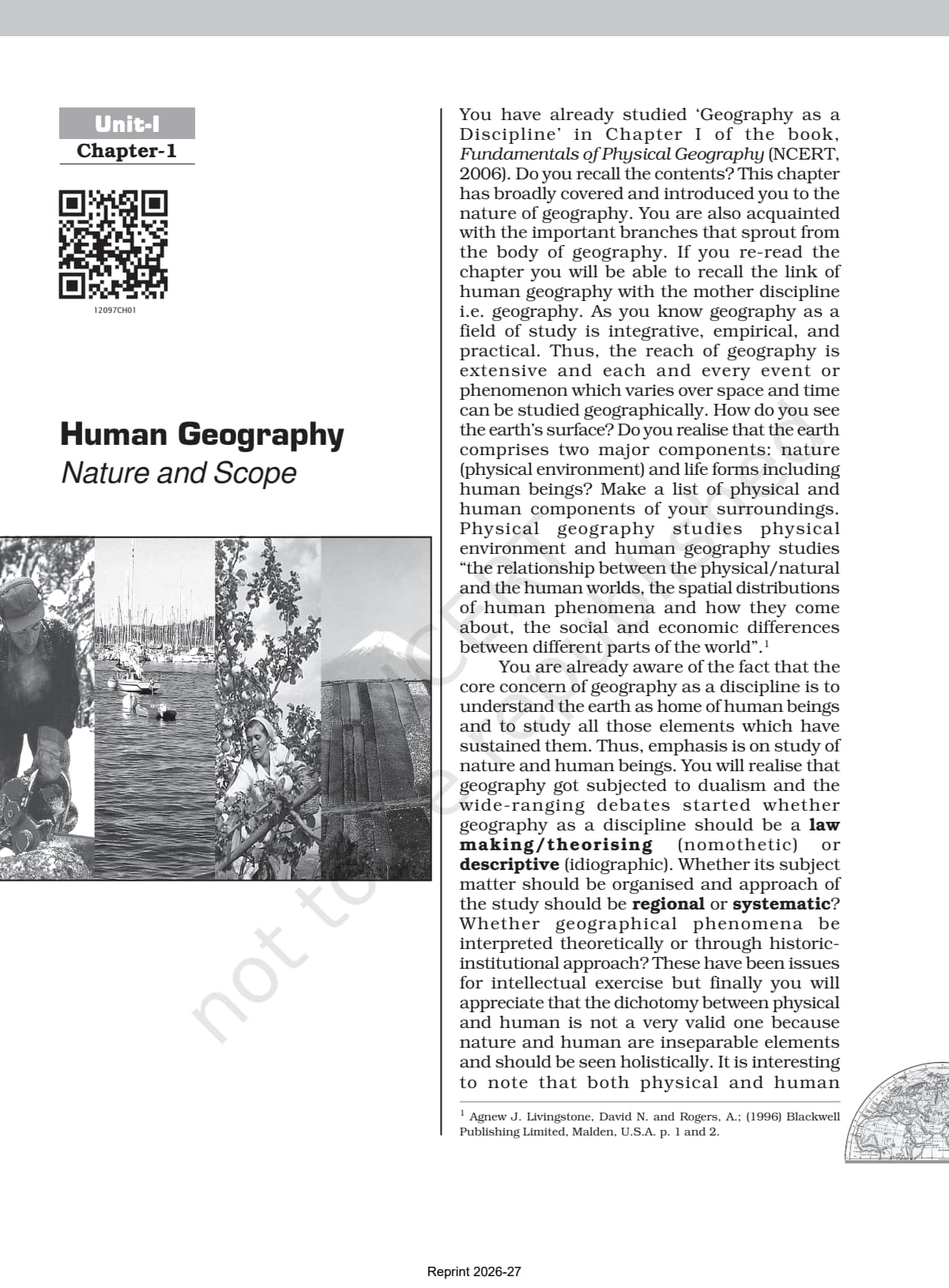
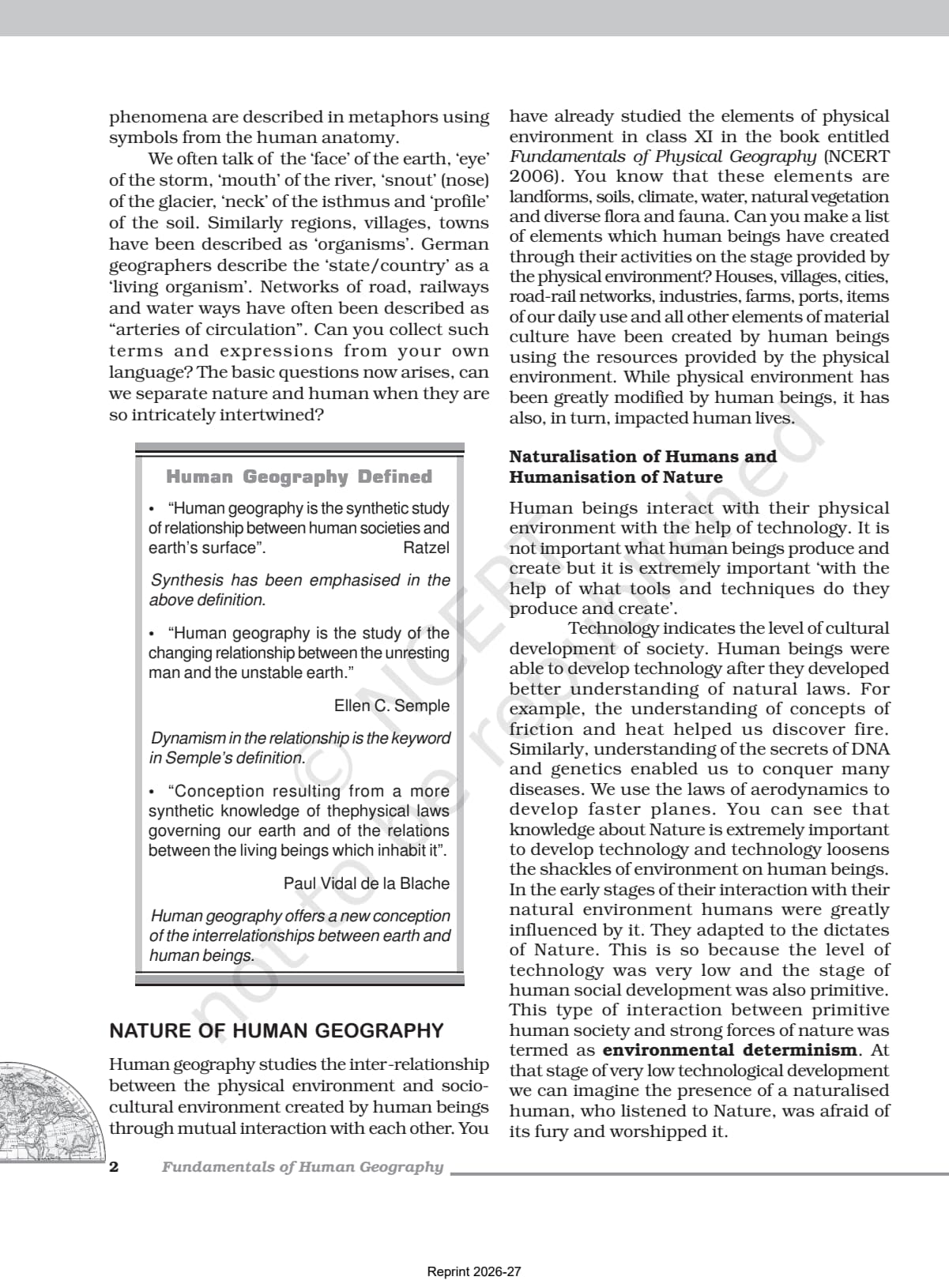
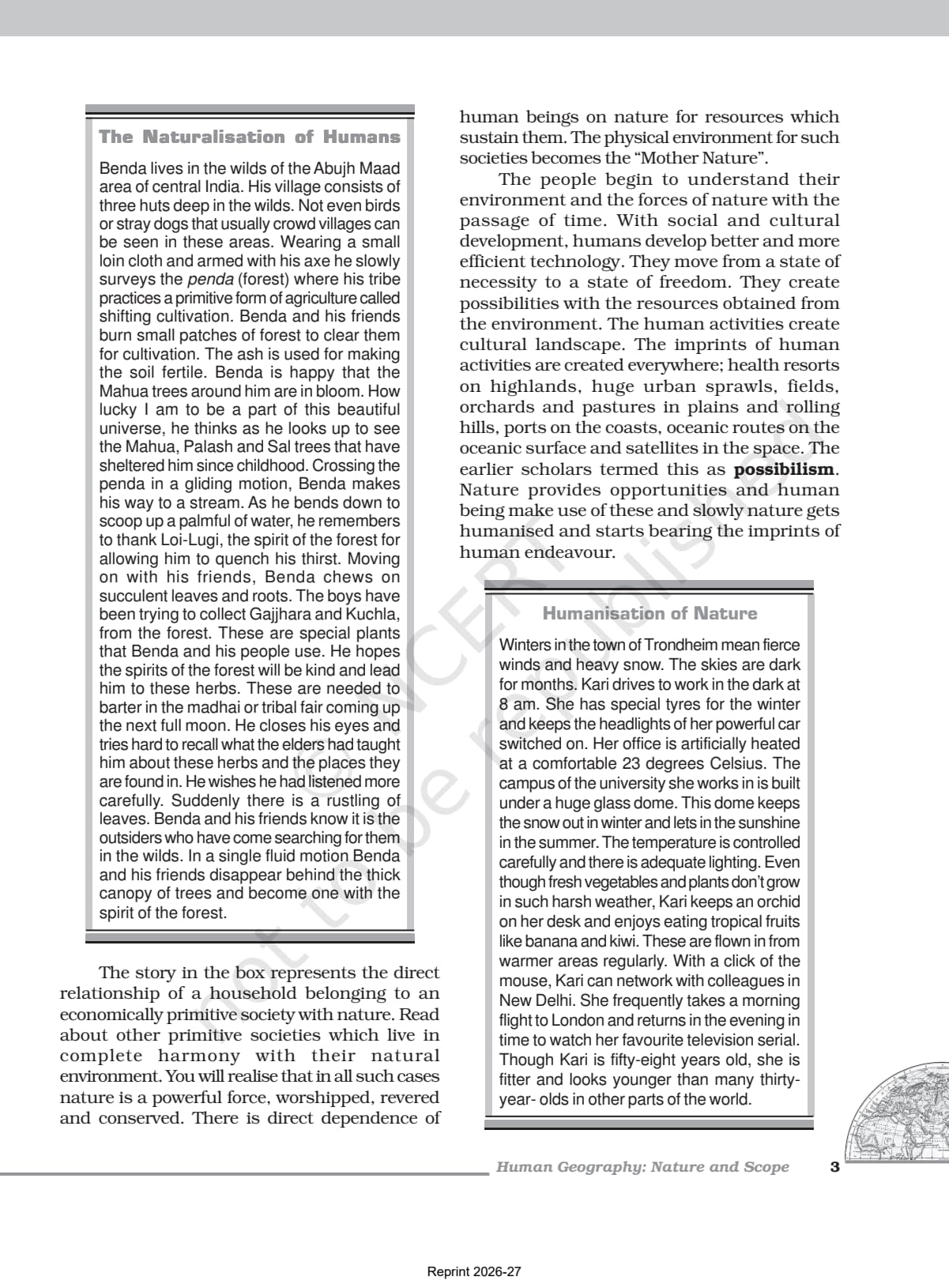
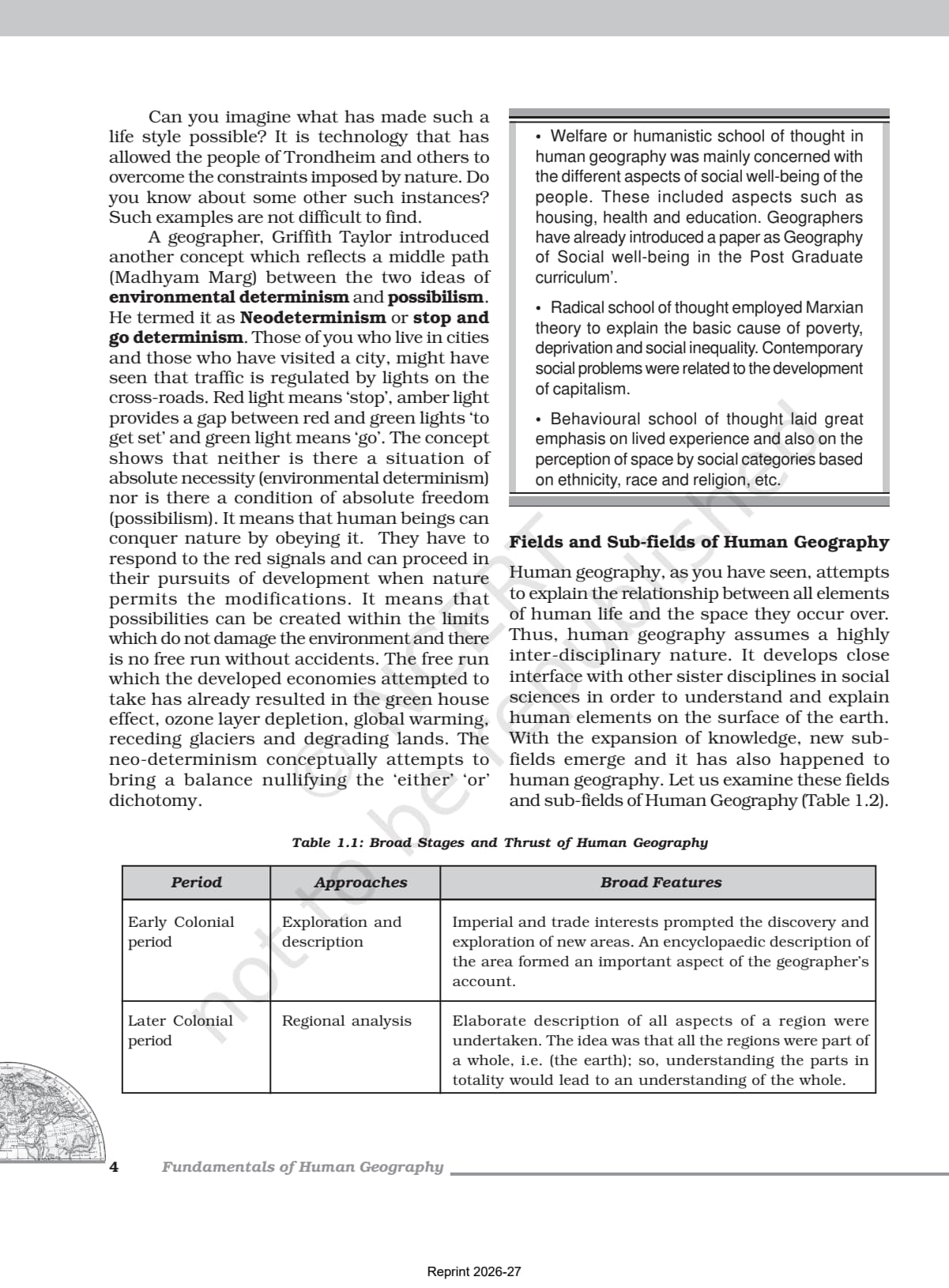
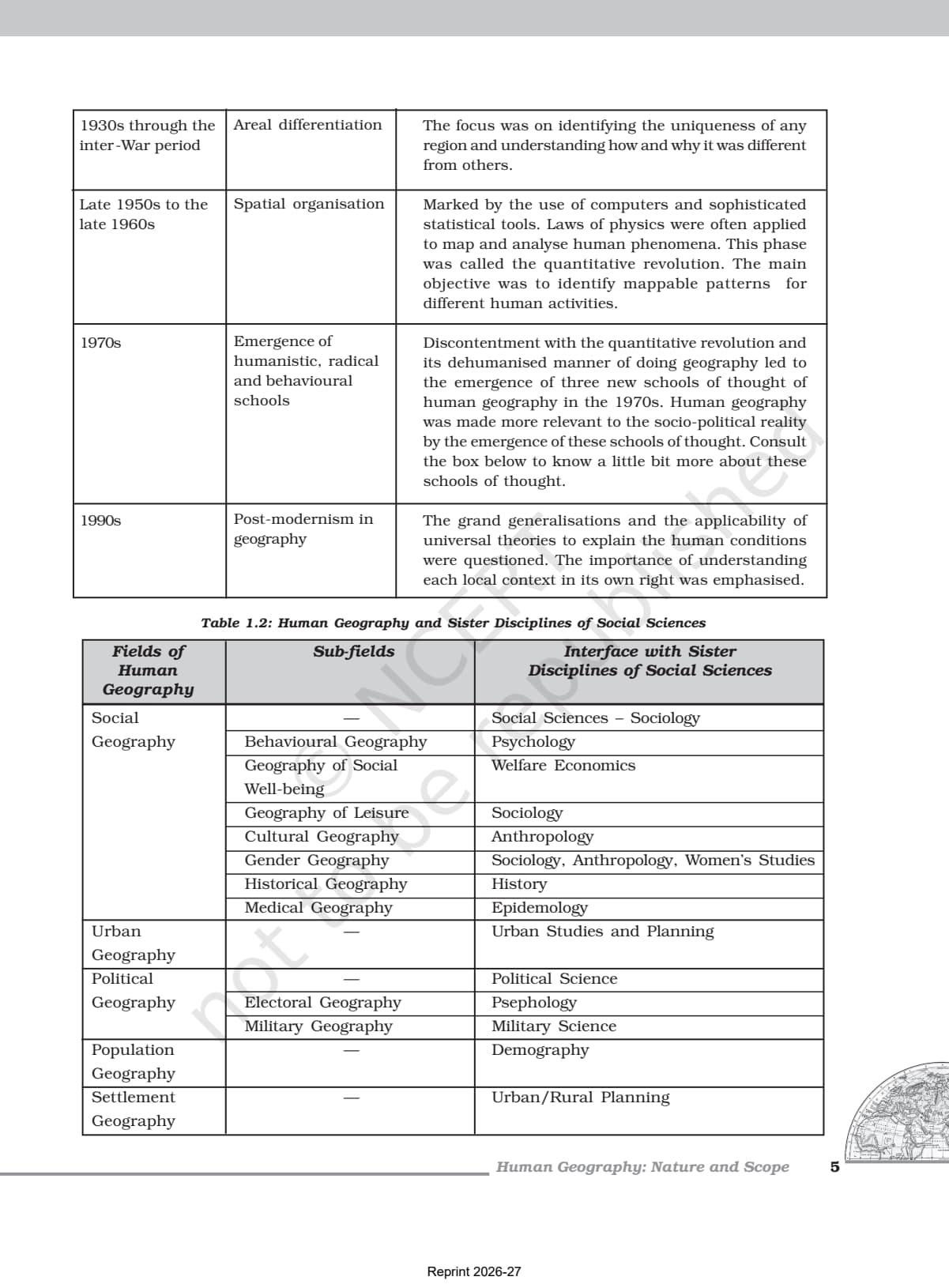
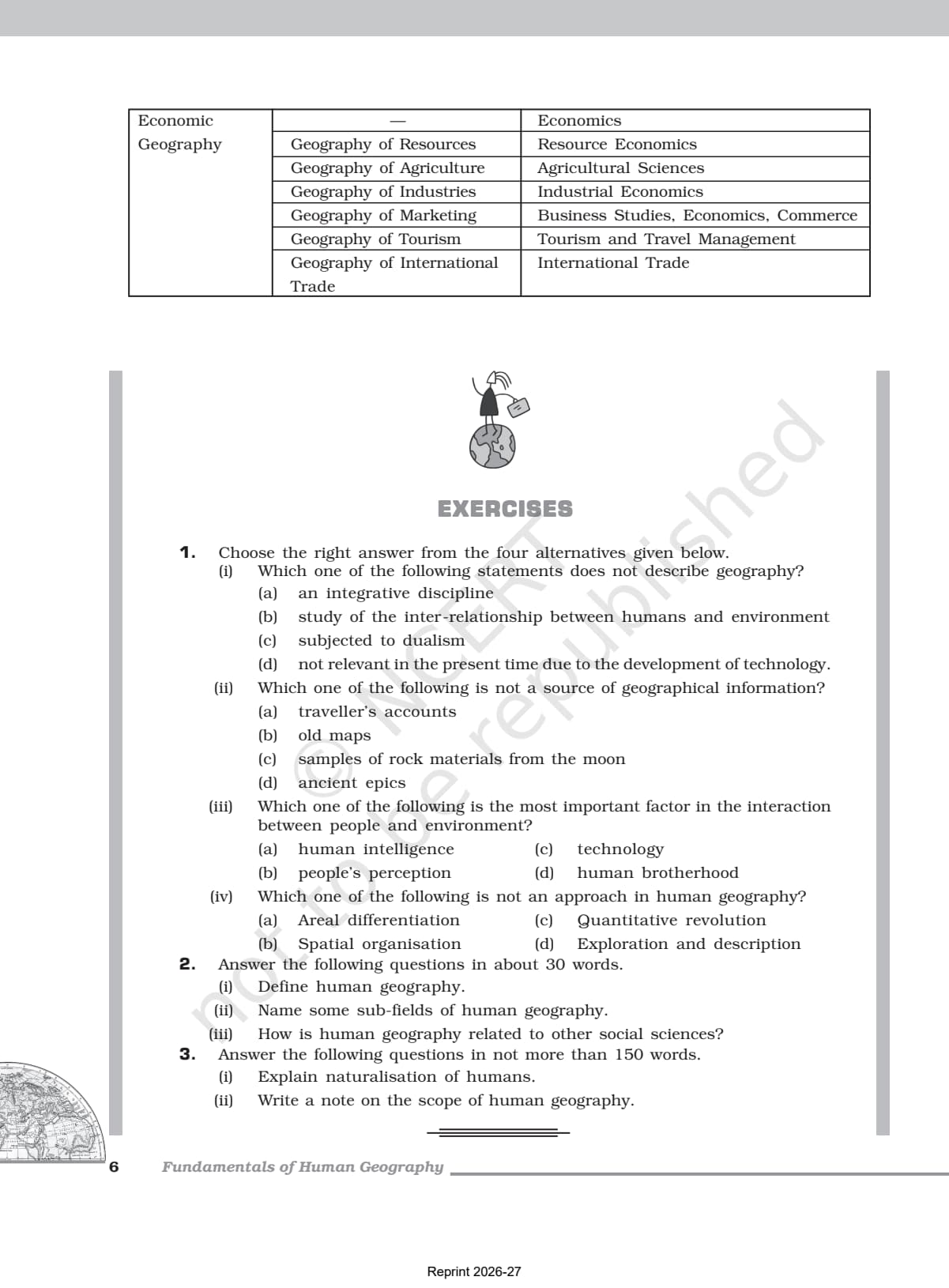
- Official NCERT Fundamentals of Human Geography Class 12 Chapter 1 PDF covering environmental determinism, possibilism, neo-determinism, and sub-fields of human geography.
- 4-5 marks CBSE board-paper weightage for Chapter 1; the official textbook is the only source CBSE references when it sets definition and short-answer questions.
- Pair with the matching NCERT Solutions, Notes and Handwritten Notes for full chapter coverage.
Student Feedback
In a 2026 Collegedunia poll of 9,200 Class 12 Geography students, 81% said reading the NCERT chapter PDF directly improved their board-paper answers on definitions and the three philosophical schools more than any reference book. Students who read the full PDF averaged 4.6 out of 5 marks on questions from this chapter.
What This Chapter Covers in the NCERT Class 12 Book
The human geography nature and scope class 12 chapter opens the Fundamentals of Human Geography textbook and sets the framework for every topic that follows. It is the only document CBSE references for definition and short-answer questions from this chapter, so students preparing for the 2026-27 board paper should read this PDF before any guide book. It moves from a broad definition of human geography to the three philosophical schools of thought, and then maps the sub-fields where human geography meets other social sciences.
The chapter introduces the definitions of Ratzel, Semple and Vidal de la Blache, then explains environmental determinism (nature controls human life), possibilism (technology frees humans to create possibilities) and neo-determinism (Griffith Taylor's middle path). Every later concept in the book traces back to ideas introduced here.
Source: Magnet Brains on YouTube
Topics in the Chapter (Section-Wise Map of the NCERT PDF)
The PDF is organised into numbered sub-sections. The table below maps each sub-topic to its main concept and the dominant exam angle.
| Section | NCERT Sub-topic | Dominant Exam Concept |
|---|---|---|
| 1.1 | Human Geography Defined | Definitions by Ratzel, Semple, Vidal de la Blache; synthesis, dynamism, inter-relationships |
| 1.2 | Nature of Human Geography | Inter-relationship between physical and socio-cultural environment |
| 1.2.1 | Naturalisation of Humans | Environmental determinism; primitive societies depending on nature |
| 1.2.2 | Humanisation of Nature | Possibilism; technology and cultural landscape creation |
| 1.2.3 | Neo-determinism | Griffith Taylor's stop-and-go concept; traffic-light analogy |
| 1.3 | Scope of Human Geography | Fields and sub-fields; interface with social sciences (Table 1.2 in NCERT) |
| 1.4 | Approaches in Human Geography | Exploration, areal differentiation, spatial organisation, humanistic, radical, behavioural schools |
Sections 1.2.1 to 1.2.3 on the three schools of thought (determinism, possibilism, neo-determinism) contribute most board-paper questions from this chapter, since distinguishing the three is the single most testable idea in the opening unit.
Key Concepts From the NCERT Class 12 Geography Textbook
The PDF carries the canonical NCERT phrasing of these ideas. Reproducing this phrasing is the fastest route to full marks on theory questions. The four concept blocks below come straight from the chapter.
The Three Definitions of Human Geography
The textbook opens with three scholarly definitions. Ratzel calls it "the synthetic study of relationship between human societies and earth's surface" - synthesis is the keyword. Ellen C. Semple defines it as "the study of the changing relationship between the unresting man and the unstable earth" - dynamism is the keyword. Paul Vidal de la Blache sees it as a new conception of interrelationships between earth and human beings. The board paper often asks which keyword belongs to which geographer.
Environmental Determinism
In the early stages of human development, technology was low and people adapted to the dictates of nature rather than changing it. The textbook uses Benda, a tribal from Abujh Maad in central India who depends entirely on the forest for food, water and shelter. This total dependence of primitive society on natural forces is environmental determinism. One-mark questions regularly ask for this definition.
Possibilism
As technology improved, humans gained the freedom to create possibilities within nature. The cultural landscape (cities, roads, fields, ports) is the human imprint on the environment. The textbook uses Kari in Trondheim, Norway, who drives a heated car, eats tropical fruits flown in from warmer regions and networks globally from her desk. Technology lets people overcome the constraints of nature, and this stage is called possibilism.
Neo-determinism (Stop and Go Determinism)
Griffith Taylor introduced a middle path using the traffic-light analogy: red means stop, amber get set, green go. Humans cannot ignore nature completely, nor are they completely controlled by it. Possibilities can be created within limits that do not damage the environment. The free run of developed economies has already caused the greenhouse effect, ozone depletion, global warming and degraded land. This is neo-determinism, or stop-and-go determinism.
Key ideas the NCERT chapter introduces:
- Environmental determinism - primitive societies controlled by nature; Benda story.
- Possibilism - technology frees humans to create cultural landscapes; Kari story.
- Neo-determinism - Griffith Taylor's traffic-light middle path between the two extremes.
- Sub-fields of human geography - social, cultural, political, economic, settlement, population geography.
- Interface with social sciences - sociology, anthropology, history, economics, political science, demography.
Previous Year Question Trends From This Chapter
The human geography class 12 important questions in CBSE board papers follow a steady pattern, and no structural change is announced for 2026-27. This chapter has contributed 3 to 5 marks across recent papers, mostly through short-answer and definition questions.
| Year | Marks | Question Types | Most Common Topic |
|---|---|---|---|
| 2025 | 4 | 1 MCQ + 1 short answer + 1 definition | Environmental determinism definition |
| 2024 | 5 | 1 MCQ + 1 short answer + 1 long answer | Distinguish determinism from possibilism |
| 2023 | 3 | 1 MCQ + 1 short answer | Neo-determinism / traffic-light analogy |
| 2022 | 4 | 2 short answers + 1 MCQ | Sub-fields of human geography |
| 2020 | 5 | 1 long answer + 1 MCQ | Nature and scope of human geography |
The most repeated question asks students to distinguish environmental determinism from possibilism, or explain neo-determinism with the stop-and-go analogy. Both need textbook phrasing, which comes only from reading the PDF.
What Students Should Avoid While Reading This NCERT PDF
The chapter is short but dense, and students make four predictable mistakes when reading it cold. The most expensive is skipping the Benda and Kari stories and learning determinism and possibilism from a definition list only. Board papers regularly ask students to "explain with an example from the textbook", so those who skip the stories cannot answer.
- Do not skip the in-text stories. Benda and Kari illustrate environmental determinism and possibilism; they appear in board questions.
- Do not confuse neo-determinism with possibilism. Neo-determinism says human beings CAN conquer nature but must obey its limits. Possibilism says nature gives opportunities that humans can freely use.
- Do not skip Table 1.2 on sub-fields. Two-mark questions regularly ask students to name sub-fields and their sister disciplines.
- Do not read the chapter only once. The chapter is short but dense with new terms. Two passes spread a week apart work better than one sitting.
Connecting This Chapter to the Rest of Fundamentals of Human Geography
This chapter is the lens for every later chapter. Without possibilism and environmental determinism, students cannot grasp why world population is unevenly distributed (Chapter 2) or why human development varies across countries (Chapter 3). Roughly 30% of the paper depends on ideas from this opening chapter, since every later chapter revisits the people-environment relationship.
| Later Chapter | Concept Inherited From Chapter 1 |
|---|---|
| Chapter 2: World Population | Distribution of population explained partly by environmental determinism and possibilism |
| Chapter 3: Human Development | Technology and cultural development as measures of how far possibilism has advanced |
| Chapter 4: Primary Activities | Gathering, shifting cultivation, and pastoralism as examples of environmental determinism |
| Chapter 5: Secondary Activities | Industrialisation as an example of humanisation of nature |
| Chapter 6: Tertiary and Quaternary Activities | Post-industrial service economy as advanced possibilism |
Quick Glossary From the NCERT Chapter
Students should be able to define each term in a single line for one-mark MCQs and two-mark short answers, using textbook phrasing.
- Cultural landscape: The imprint of human activities on the physical environment (cities, roads, farms, ports).
- Naturalisation of humans: The stage where primitive humans lived completely under the control of nature.
- Humanisation of nature: The stage where humans, through technology, reshaped nature to create cultural landscapes.
- Nomothetic: Law-making or theorising approach to geography.
- Idiographic: Descriptive, case-by-case approach to geography.
Also Explore Other Resources for Class 12 Geography Chapter 1
| Resource | Link |
|---|---|
| NCERT Solutions | Class 12 Geography Chapter 1 NCERT Solutions |
| Revision Notes | Class 12 Geography Chapter 1 Notes |
| Handwritten Notes | Class 12 Geography Chapter 1 Handwritten Notes |
| Subject Hub | Class 12 Geography All Chapters |
All Chapters: Class 12 Geography NCERT Book PDF (Fundamentals of Human Geography)
| Chapter | NCERT Book PDF |
|---|---|
| Chapter 1 | Human Geography: Nature and Scope NCERT Book PDF (You are here) |
| Chapter 2 | The World Population: Distribution, Density and Growth NCERT Book PDF |
| Chapter 3 | Human Development NCERT Book PDF |
| Chapter 4 | Primary Activities NCERT Book PDF |
| Chapter 5 | Secondary Activities NCERT Book PDF |
| Chapter 6 | Tertiary and Quaternary Activities NCERT Book PDF |
| Chapter 7 | Transport and Communication NCERT Book PDF |
| Chapter 8 | International Trade NCERT Book PDF |
Frequently Asked Questions on Class 12 Geography Chapter 1 NCERT Book PDF
Ques. Where can students download the official NCERT Class 12 Geography Chapter 1 PDF?
Ans. Students can download the official human geography nature and scope class 12 NCERT book PDF directly from the download card at the top of this page. The PDF is the single-chapter file from the Fundamentals of Human Geography textbook, aligned to the 2026-27 CBSE syllabus.
Ques. What is environmental determinism according to the NCERT Class 12 Geography textbook?
Ans. Environmental determinism is the stage of human-nature interaction where primitive human society was greatly controlled by natural forces. Because technology was very low, humans adapted to the dictates of nature rather than modifying it. The textbook uses the story of Benda from Abujh Maad to illustrate this concept. This stage is also called the naturalisation of humans.
Ques. What is possibilism in the context of Class 12 Geography Chapter 1?
Ans. Possibilism is the stage where technology gives human beings the freedom to create possibilities using resources provided by the environment. Nature provides opportunities; humans make use of them to create a cultural landscape. The textbook uses the story of Kari from Trondheim, Norway to show how technology allows people to overcome natural constraints. This stage is also called the humanisation of nature.
Ques. What is neo-determinism and who introduced it?
Ans. Neo-determinism, also called stop-and-go determinism, was introduced by geographer Griffith Taylor. It is a middle path between environmental determinism and possibilism. Taylor used the traffic-light analogy: red (stop) means nature sets limits, amber means get ready, and green (go) means humans can proceed when nature permits. The key idea is that "human beings can conquer nature by obeying it."
Ques. How many end-of-chapter questions are in NCERT Class 12 Geography Chapter 1?
Ans. The official NCERT chapter contains exercise questions divided into three parts: four MCQs asking students to identify correct statements about geography, two short-answer questions (30 words each) on the definition of human geography and its sub-fields, and two long-answer questions (150 words each) on naturalisation of humans and the scope of human geography. All questions are covered in the matching NCERT Solutions linked above.
Ques. What are the main sub-fields of human geography according to the NCERT textbook?
Ans. According to Table 1.2 of the NCERT textbook, the main fields of human geography are Social Geography, Cultural Geography, Political Geography, Economic Geography, Population Geography, and Settlement Geography. Each has sub-fields that interface with a sister social science - for example, Cultural Geography interfaces with Anthropology, and Historical Geography interfaces with History.
Ques. What are the three definitions of human geography given in the NCERT Class 12 textbook?
Ans. The three definitions are: (1) Ratzel - "the synthetic study of relationship between human societies and earth's surface" (keyword: synthesis); (2) Ellen C. Semple - "the study of the changing relationship between the unresting man and the unstable earth" (keyword: dynamism); (3) Paul Vidal de la Blache - human geography as a new conception of interrelationships between earth and human beings.
Ques. Is the Class 12 Geography syllabus changing for 2026-27?
Ans. No major changes have been announced. The Fundamentals of Human Geography textbook chapter structure remains the same for 2026-27, and the official NCERT PDF available on this page is aligned to the 2026-27 CBSE syllabus. CBSE marking schemes continue to reward textbook phrasing in theory questions.
Ques. How does CUET test Class 12 Geography Chapter 1?
Ans. CUET Geography tests this chapter through MCQs on definitions (Ratzel, Semple, Vidal de la Blache), the three philosophical schools (environmental determinism, possibilism, neo-determinism), and the sub-fields of human geography. The questions are drawn directly from the NCERT textbook, so reading the official PDF is the most effective preparation for both CUET and the CBSE board exam.
Ques. What is the best order to use the NCERT PDF, Notes, and Solutions for Class 12 Geography Chapter 1?
Ans. Read the NCERT PDF cold first, marking unfamiliar terms. Then open the Class 12 Geography Chapter 1 Notes alongside the PDF and write key concepts in your own words. Attempt all exercise questions and verify them against the NCERT Solutions. Use the handwritten notes for last-mile revision the night before the exam.
Ques. What is the difference between naturalisation of humans and humanisation of nature?
Ans. Naturalisation of humans refers to the early stage when humans lived under the control of nature - adapting to it, worshipping it, and depending on it completely (environmental determinism). Humanisation of nature refers to the later stage when humans, through technology, modified and reshaped nature to create cultural landscapes like cities, roads, and farms (possibilism). The two stories of Benda and Kari in the NCERT chapter illustrate these two contrasting stages.



Comments