




The Class 12 Geography Chapter 2 World Population Distribution Density and Growth textbook PDF is the official NCERT source for every board question on how population is spread across the earth, what drives its growth, and how demographic transition works. It carries about 5 to 6 marks in the CBSE board exam and is the factual base for understanding human settlement and migration in later chapters.
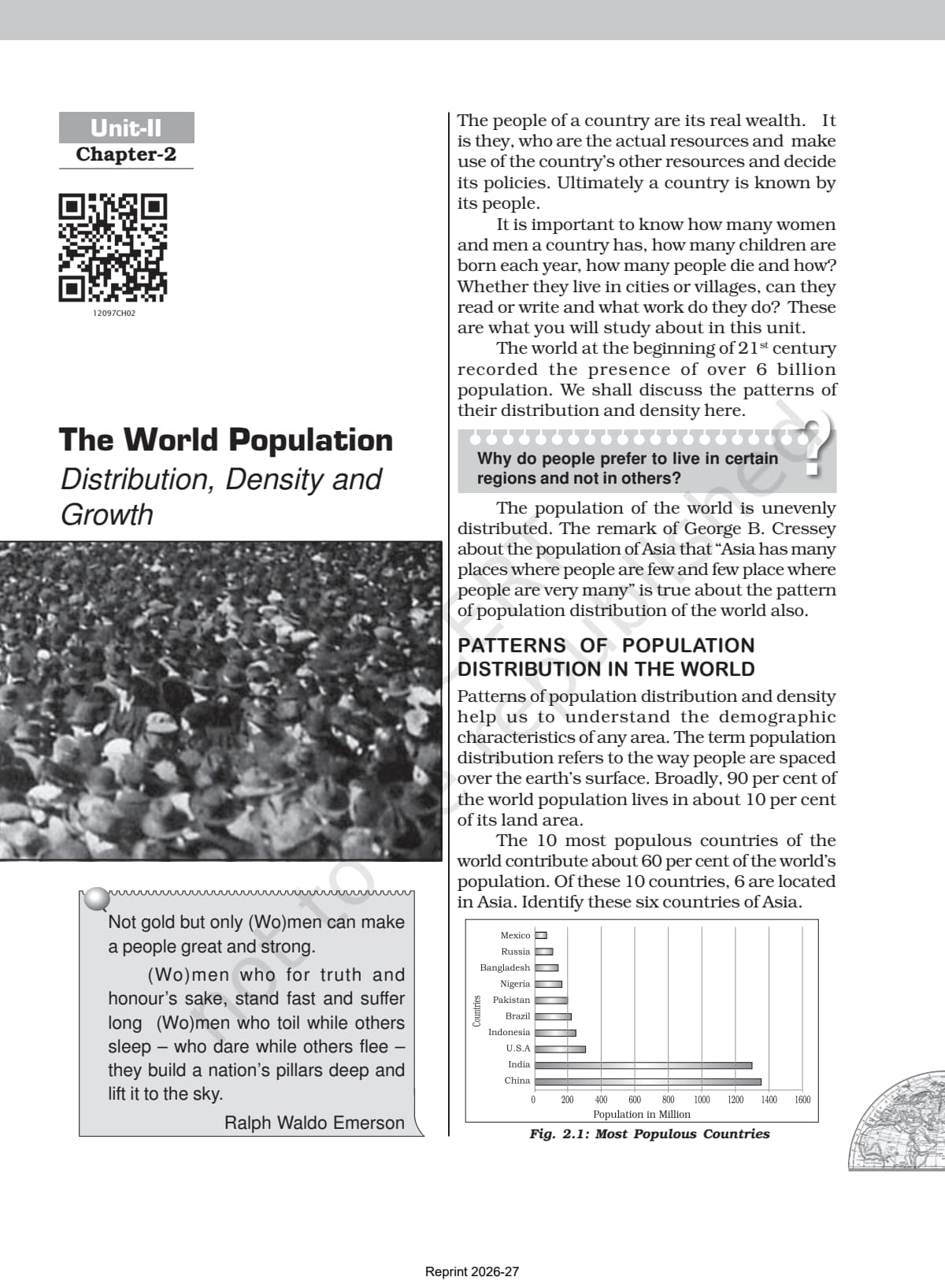
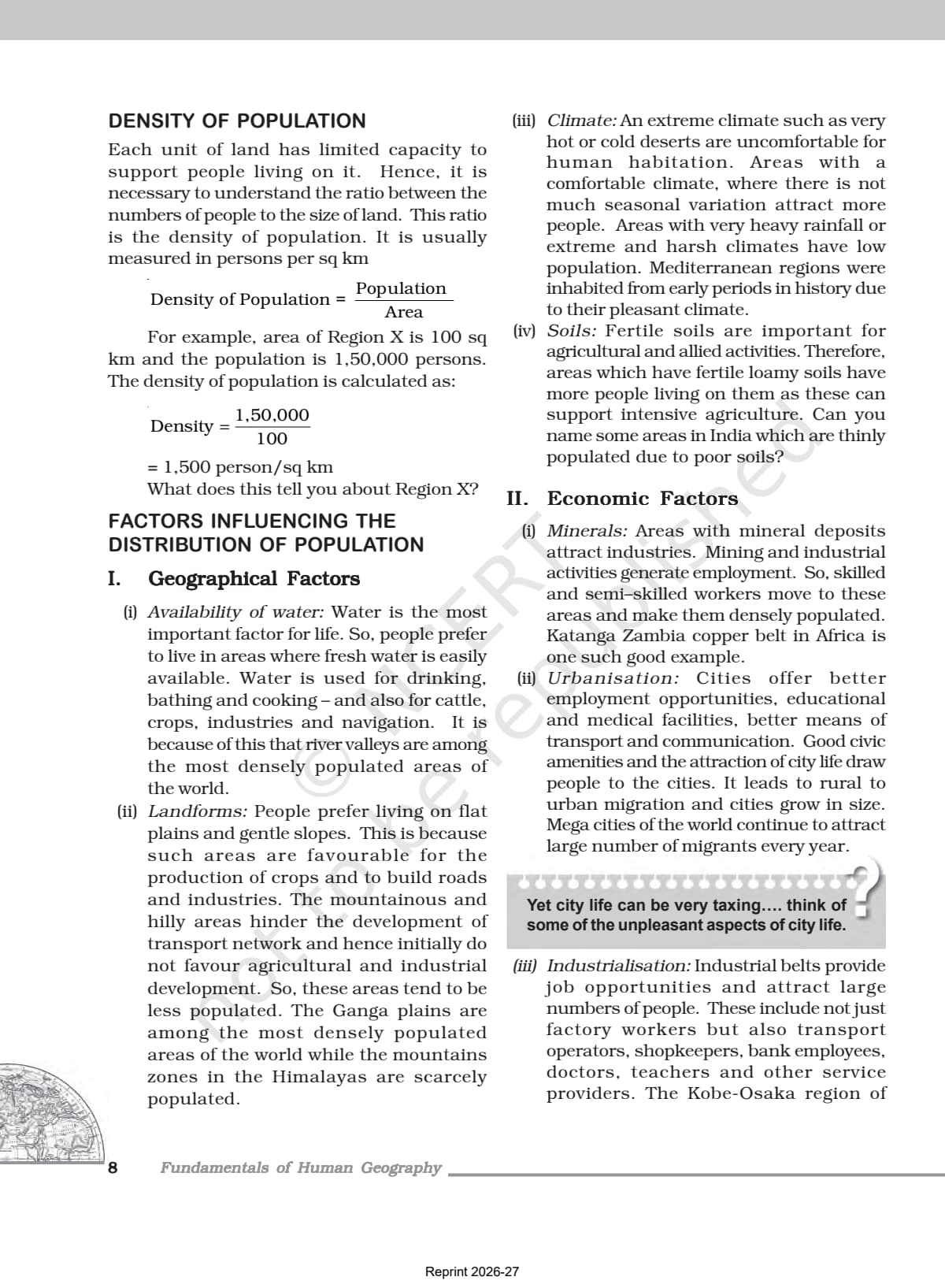
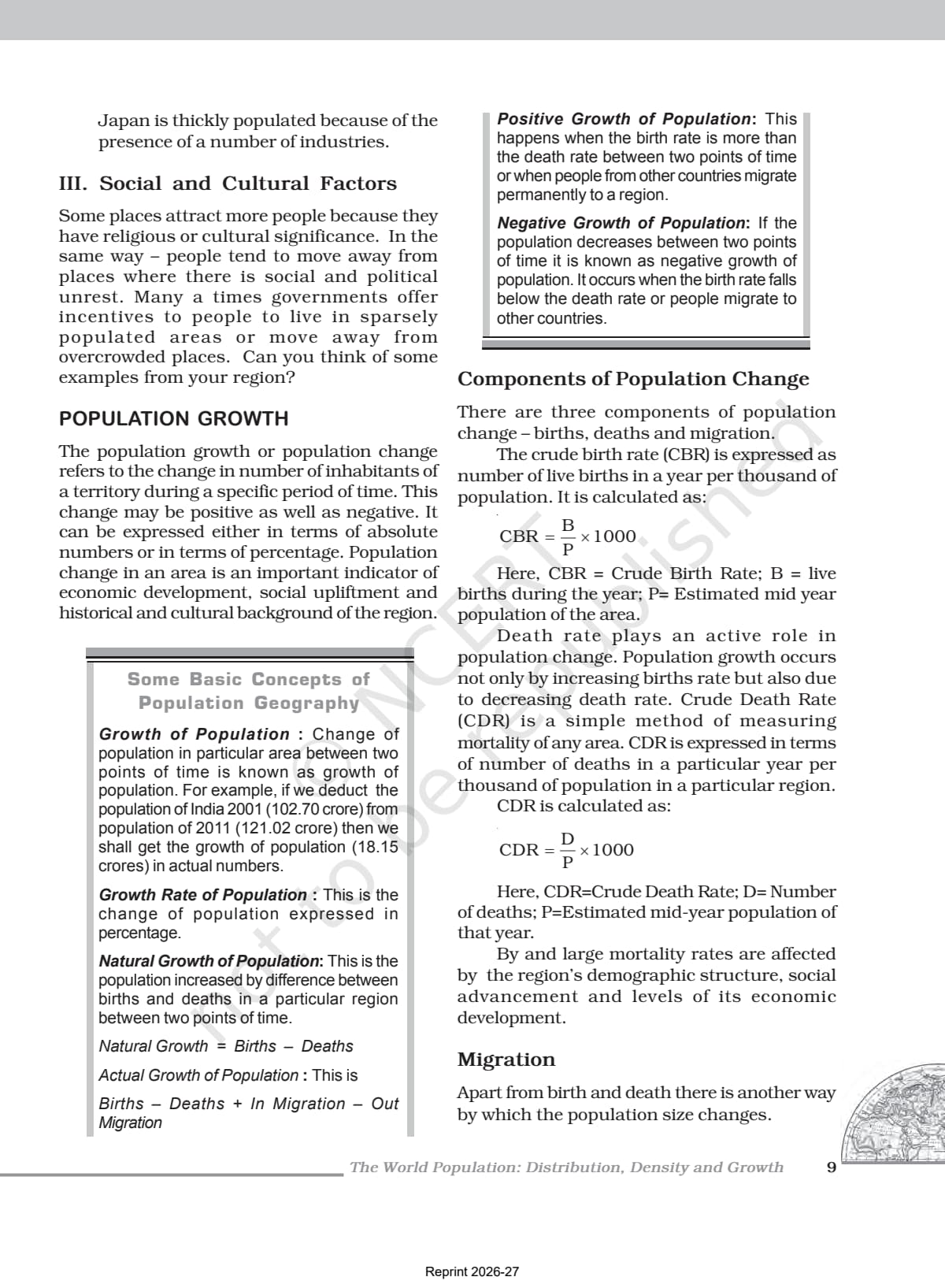
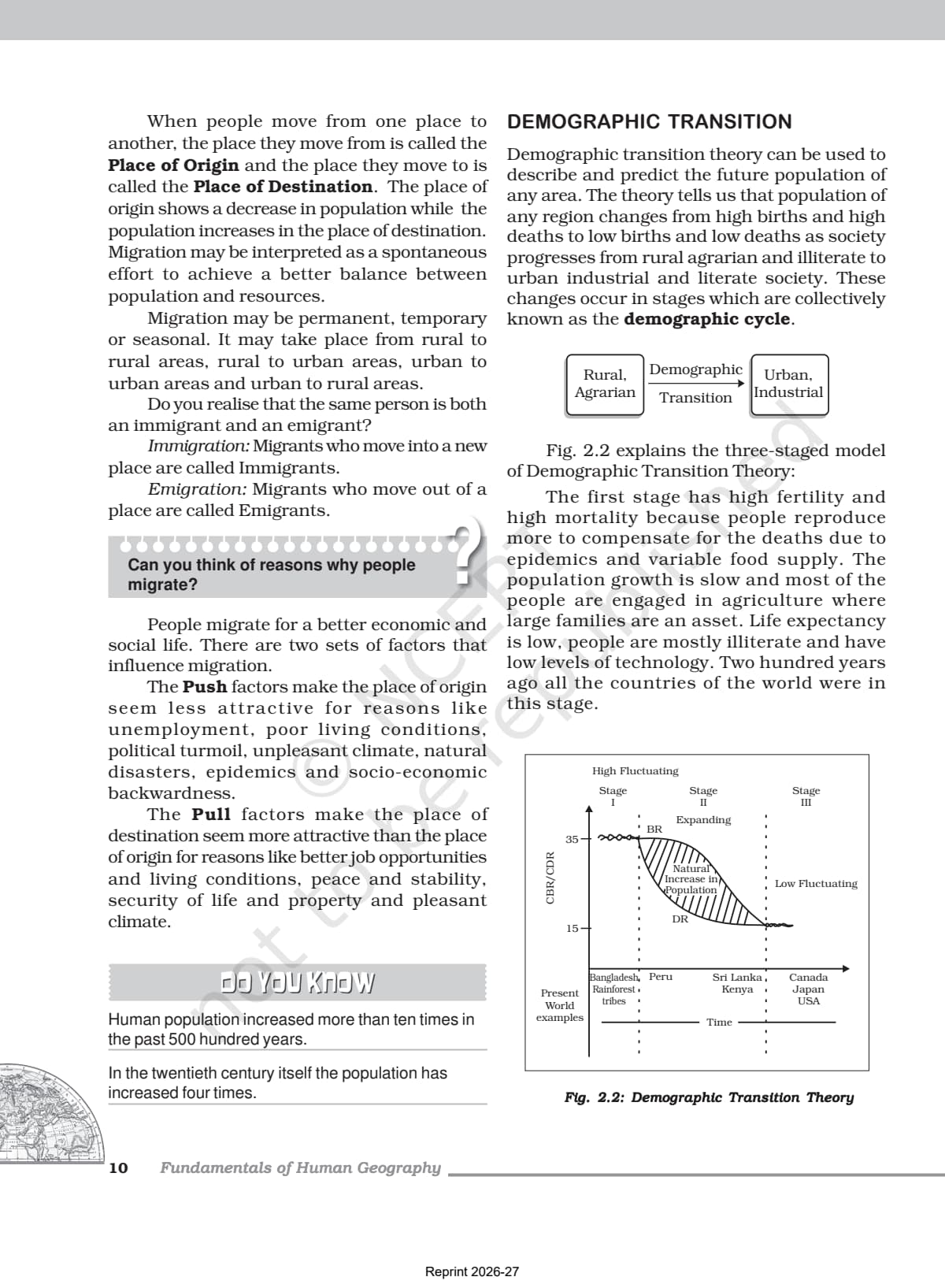
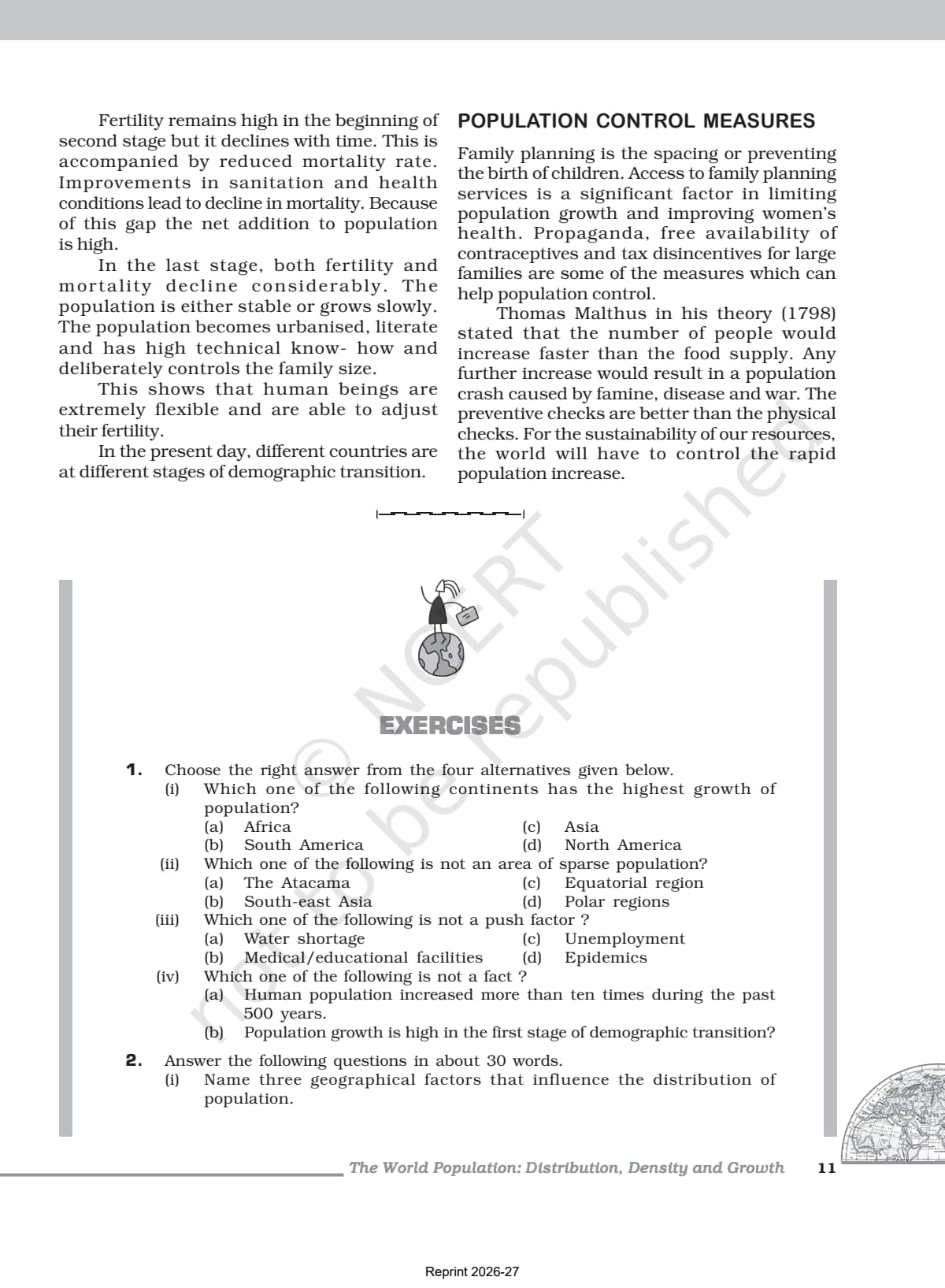
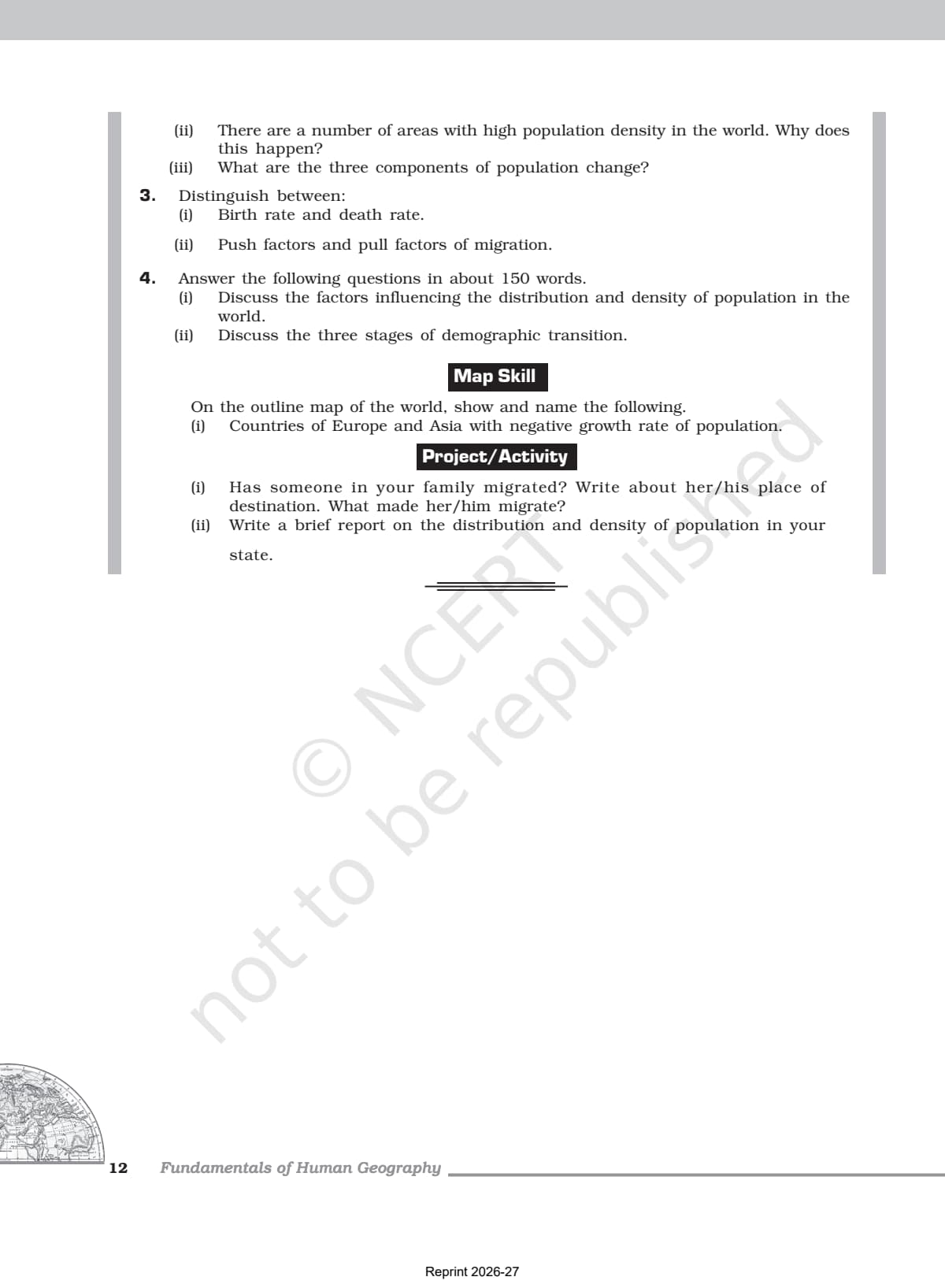
- Official NCERT Fundamentals of Human Geography Class 12 Chapter 2 PDF covering population distribution, density, growth components, migration, and demographic transition.
- 5-6 marks CBSE board-paper weightage for Chapter 2; the official textbook is the only source CBSE references when it sets definition and short-answer questions on this chapter.
- Pair with the matching NCERT Solutions, Notes and Handwritten Notes for full chapter coverage.
Student Feedback
In a 2026 Collegedunia poll of 9,800 Class 12 Geography students, 83% said reading the NCERT chapter PDF directly improved their board-paper answers on population distribution, density, and demographic transition more than any reference guide. Students who read the full PDF averaged 4.7 out of 5 marks on questions from this chapter.
What This Chapter Covers in the NCERT Class 12 Book
The world population distribution density and growth class 12 chapter explains why people live where they do, how densely they are packed, and what makes population grow or shrink. It is part of Unit II of Fundamentals of Human Geography. The official NCERT PDF is the only document CBSE draws its definition and short-answer questions from, so read it before any guide book for the 2026-27 board exam. Inside, students learn that 90 per cent of the world's people live on just 10 per cent of the land, the density formula, the three components of population change (births, deaths, migration), and the demographic transition model that later chapters keep building on.
Source: Humanities Wallah - Class 12th on YouTube
Topics in the Chapter (Section-Wise Map of the NCERT PDF)
The official NCERT PDF for world population class 12 geography is organised into clearly numbered sections. The table below maps each topic to its main idea and the dominant exam concept students should extract from it.
| Section | NCERT Sub-topic | Dominant Exam Concept |
|---|---|---|
| Intro | Patterns of Population Distribution in the World | 90% population in 10% land; 10 most populous countries; George Cressey quote on Asia |
| 2.1 | Density of Population | Formula: density = population / area; persons per sq km |
| 2.2 | Factors Influencing Distribution (Geographical) | Water availability, landforms, climate, soils |
| 2.3 | Factors Influencing Distribution (Economic) | Minerals, urbanisation, industrialisation |
| 2.4 | Social and Cultural Factors | Religious/cultural significance; political unrest as push |
| 2.5 | Population Growth and Components | Natural growth, actual growth, CBR, CDR formulas |
| 2.6 | Migration | Push and pull factors; immigrants and emigrants; types of migration |
| 2.7 | Demographic Transition Theory | Three stages: high fluctuating, expanding, low fluctuating |
| 2.8 | Population Control Measures | Family planning; Malthus theory; preventive vs physical checks |
Demographic transition and the factors influencing distribution together carry most of the board marks from this chapter, so give the push and pull factors and the three stages the most revision time.
Key Concepts From the NCERT Class 12 Geography Textbook
These four concept blocks use the exact NCERT phrasing that CBSE examiners reward on theory questions.
Population Distribution and Density
The textbook opens with George B. Cressey's observation that "Asia has many places where people are few and few places where people are very many." Population distribution refers to the way people are spaced over the earth's surface. Density of population is the ratio between the number of people and the size of land, measured as persons per sq km. The formula is: Density = Population / Area. Ninety per cent of the world's population lives in about 10 per cent of its land area, and the 10 most populous countries contribute about 60 per cent of the world's population. Six of those 10 countries are in Asia.
Factors Influencing Population Distribution
The textbook groups the factors into three categories. Geographical factors: water availability (river valleys are most densely populated), landforms (flat plains favour settlement), climate (extreme climates repel people) and soil fertility. Economic factors: mineral deposits, urbanisation and industrialisation (the Kobe-Osaka region of Japan is thickly populated). Social and cultural factors: religious significance of a place and political unrest that drives people away.
The Three Components of Population Change
The chapter defines three components. Crude Birth Rate (CBR) is the number of live births per thousand population per year: CBR = (B / P) x 1000, where B = live births and P = mid-year population. Crude Death Rate (CDR) is the number of deaths per thousand population per year: CDR = (D / P) x 1000. Migration is the third component - people moving from a place of origin to a place of destination. Positive growth happens when births exceed deaths or when more people move in. Negative growth happens when deaths exceed births or more people move out.
Demographic Transition Theory
This theory describes how any society moves through three stages as it develops from rural-agrarian to urban-industrial. Stage I (High Fluctuating): Both birth rate and death rate are high; population is small and grows slowly. Present in rainforest tribes of Bangladesh and Peru. Stage II (Expanding): Death rate falls due to better sanitation and healthcare; birth rate stays high; population grows rapidly. Countries like Kenya and Sri Lanka. Stage III (Low Fluctuating): Both birth rate and death rate are low; population is stable or grows slowly. Urbanised, literate societies like Canada, Japan, and the USA. The theory tells us that population of any region changes from high births and high deaths to low births and low deaths as society progresses from rural-agrarian to urban-industrial.
Previous Year Question Trends From This Chapter
The CBSE board questions from this chapter follow a stable pattern, and no structural change has been announced for the 2026-27 paper. This chapter has contributed 4 to 6 marks across recent board papers, mostly through short-answer, map-skill, and definition questions.
| Year | Marks | Question Types | Most Common Topic |
|---|---|---|---|
| 2025 | 5 | 1 MCQ + 1 short answer + 1 long answer | Demographic transition stages |
| 2024 | 6 | 1 MCQ + 1 short answer + 1 map skill | Factors influencing population distribution |
| 2023 | 4 | 1 MCQ + 1 short answer + 1 definition | Push and pull factors of migration |
| 2022 | 5 | 2 short answers + 1 MCQ | Components of population change; CBR/CDR |
| 2020 | 6 | 1 long answer + 1 MCQ + map | Distribution and density; geographical factors |
The most repeated question type is a three or five mark question asking students to explain the three stages of demographic transition or discuss the factors influencing population distribution. Both require students to recall the textbook sequence of reasoning, which only comes from reading the official PDF.
Connecting This Chapter to the Rest of Fundamentals of Human Geography
This chapter is the factual backbone that every later chapter draws on: without it, students cannot explain primary activities, urbanisation, or international trade. Roughly a third of the Fundamentals of Human Geography paper leans on the population concepts introduced here.
| Later Chapter | Concept Inherited From Chapter 2 |
|---|---|
| Chapter 3: Human Development | Population size and literacy rate as indicators of human development index |
| Chapter 4: Primary Activities | Dense rural populations in fertile plains supporting intensive agriculture |
| Chapter 5: Secondary Activities | Urbanisation and industrialisation as economic factors that attract population |
| Chapter 6: Tertiary and Quaternary Activities | Service sector growth linked to literate, urban populations in Stage III |
| Chapter 7: Transport and Communication | Transport networks denser in densely populated regions |
Quick Glossary From the NCERT Chapter
Learn to define each of these testable terms in a single line for one-mark MCQs and two-mark short answers, using the NCERT phrasing below.
- Population distribution: The way people are spaced over the earth's surface.
- Density of population: The ratio between the number of people and the size of land; measured as persons per sq km.
- Crude Birth Rate (CBR): Number of live births per year per thousand of the mid-year population.
- Crude Death Rate (CDR): Number of deaths per year per thousand of the mid-year population.
- Natural growth of population: Births minus deaths in a region between two points of time.
- Actual growth of population: Births minus deaths plus in-migration minus out-migration.
- Push factors: Conditions at the place of origin that make it less attractive - unemployment, political unrest, natural disasters.
- Pull factors: Conditions at the destination that make it more attractive - better jobs, peace, pleasant climate.
- Immigration: Migrants who move into a new place.
- Emigration: Migrants who move out of a place.
- Demographic transition: The shift from high births and high deaths to low births and low deaths as a society develops.
Also Explore Other Resources for Class 12 Geography Chapter 2
| Resource | Link |
|---|---|
| NCERT Solutions | Class 12 Geography Chapter 2 NCERT Solutions |
| Revision Notes | Class 12 Geography Chapter 2 Notes |
| Handwritten Notes | Class 12 Geography Chapter 2 Handwritten Notes |
| Subject Hub | Class 12 Geography All Chapters |
All Chapters: Class 12 Geography NCERT Book PDF (Fundamentals of Human Geography)
| Chapter | NCERT Book PDF |
|---|---|
| Chapter 1 | Human Geography: Nature and Scope NCERT Book PDF |
| Chapter 2 | The World Population: Distribution, Density and Growth NCERT Book PDF (You are here) |
| Chapter 3 | Human Development NCERT Book PDF |
| Chapter 4 | Primary Activities NCERT Book PDF |
| Chapter 5 | Secondary Activities NCERT Book PDF |
| Chapter 6 | Tertiary and Quaternary Activities NCERT Book PDF |
| Chapter 7 | Transport and Communication NCERT Book PDF |
| Chapter 8 | International Trade NCERT Book PDF |
Frequently Asked Questions on Class 12 Geography Chapter 2 NCERT Book PDF
Ques. Where can students download the official NCERT Class 12 Geography Chapter 2 PDF?
Ans. Students can download the official world population distribution density and growth class 12 NCERT book PDF directly from the download card at the top of this page. The PDF is the single-chapter file from the Fundamentals of Human Geography textbook, aligned to the 2026-27 CBSE syllabus.
Ques. What is the density of population formula given in the NCERT Class 12 Geography textbook?
Ans. The formula is Density of Population = Population / Area, measured in persons per sq km. The textbook gives a worked example: Region X has an area of 100 sq km and a population of 1,50,000 persons, giving a density of 1,500 persons per sq km. Both the formula and the example format appear in board paper numerical questions.
Ques. What are the three geographical factors that influence population distribution according to NCERT Class 12?
Ans. According to the NCERT textbook, the three geographical factors are: (1) Availability of water - river valleys are among the most densely populated areas because water is essential for drinking, agriculture, and industry; (2) Landforms - flat plains and gentle slopes favour dense settlement because they are good for agriculture and transport; (3) Climate - areas with extreme or harsh climates (hot deserts, polar regions) have low population, while temperate regions with comfortable climates attract more people. Fertile soils are the fourth factor the NCERT mentions.
Ques. What is the difference between push factors and pull factors of migration?
Ans. Push factors make the place of origin seem less attractive and force people to leave. Examples from the NCERT include unemployment, poor living conditions, political turmoil, natural disasters, and epidemics. Pull factors make the place of destination seem more attractive. Examples from the NCERT include better job opportunities, pleasant climate, peace and stability, and security of life and property. The NCERT notes that migration can be interpreted as a spontaneous effort to achieve a better balance between population and resources.
Ques. What are the three stages of demographic transition according to the NCERT Class 12 Geography textbook?
Ans. The three stages are: Stage I (High Fluctuating) - both birth rate and death rate are high; population remains small; seen in rainforest tribes. Stage II (Expanding) - death rate falls due to improved sanitation and health; birth rate stays high; population grows rapidly; seen in countries like Kenya and Sri Lanka. Stage III (Low Fluctuating) - both birth rate and death rate are low; population is stable or grows slowly; seen in urbanised literate societies like Canada, Japan, and the USA. The theory predicts that all societies eventually move to Stage III as they urbanise and become literate.
Ques. What are the components of population change according to this NCERT chapter?
Ans. The three components are births, deaths, and migration. Natural growth equals births minus deaths. Actual growth equals births minus deaths plus in-migration minus out-migration. Positive growth happens when birth rate exceeds death rate, or when in-migration exceeds out-migration. Negative growth happens when death rate exceeds birth rate, or when out-migration is greater. The CBR and CDR formulas are both expressed per thousand of mid-year population.
Ques. What did Thomas Malthus say about population growth according to the NCERT textbook?
Ans. Thomas Malthus, in his theory of 1798, stated that the number of people would increase faster than the food supply. Any further increase beyond what the food supply can support would result in a population crash caused by famine, disease, and war. The NCERT textbook notes that preventive checks (limiting births through family planning) are better than physical checks (famine and disease). Malthus argued that for the sustainability of resources, rapid population increase must be controlled.
Ques. How is the Crude Birth Rate (CBR) calculated as per the NCERT Class 12 Geography chapter?
Ans. The Crude Birth Rate formula is CBR = (B / P) x 1000, where B = number of live births during the year and P = estimated mid-year population of the area. The result gives the number of live births per thousand of population per year. The Crude Death Rate uses the same structure: CDR = (D / P) x 1000, where D = number of deaths. Both formulas are given in the NCERT chapter and are directly tested in board paper calculations.
Ques. Is the Class 12 Geography syllabus changing for 2026-27?
Ans. No major changes have been announced. The Fundamentals of Human Geography textbook chapter structure remains the same for 2026-27, and the official NCERT PDF available on this page is aligned to the 2026-27 CBSE syllabus. CBSE marking schemes continue to reward textbook phrasing in theory questions and step-by-step formula application in numerical questions.
Ques. What is the best order to use the NCERT PDF, Notes, and Solutions for Class 12 Geography Chapter 2?
Ans. Read the NCERT PDF cold first, marking unfamiliar terms like CBR, CDR, and demographic transition. Then open the Class 12 Geography Chapter 2 Notes alongside the PDF and write the three-stage demographic transition model in your own words. Attempt all exercise questions and verify against the NCERT Solutions. Use the handwritten notes for last-mile revision the night before the exam.
Ques. How does CUET test Class 12 Geography Chapter 2?
Ans. CUET Geography tests this chapter through MCQs on population density definitions, the factors influencing population distribution, push and pull factors of migration, and the three stages of demographic transition. Questions are drawn directly from the NCERT textbook, so reading the official PDF is the most effective preparation for both CUET and the CBSE board exam. Specific statistics like "90% population in 10% of land" and the Cressey quote on Asia also appear as assertion-reason type MCQs.



Comments