




These Class 12 Geography Chapter 6 Tertiary and Quaternary Activities notes cover every NCERT definition plus trade, transport, communication, services, tourism, quaternary and quinary activities, outsourcing and the digital divide, aligned to the 2026-27 syllabus. Built for night-before revision.
- Concept-first revision of the whole chapter: trade, transport, communication, tourism, quaternary and quinary sectors, outsourcing, KPO vs BPO and the digital divide.
- CBSE-ready one-line definitions plus a quaternary vs quinary comparison table.
- Question trends, common mistake alerts, and cross-links to NCERT Solutions, Handwritten Notes and the NCERT Book PDF.
Written by Collegedunia Geography experts, mapped to the 2026-27 NCERT Fundamentals of Human Geography textbook and checked against the last five years of CBSE board papers.
Student Feedback
71% of Class 12 students found telling quaternary from quinary the most confusing part, and 3 out of 4 rated outsourcing, KPO vs BPO and the digital divide most worth revising.
Source: 2026-27 Class 12 Geography student poll, 9,840 CBSE students.
Quick Concept Recap: Tertiary and Quaternary Activities at a Glance
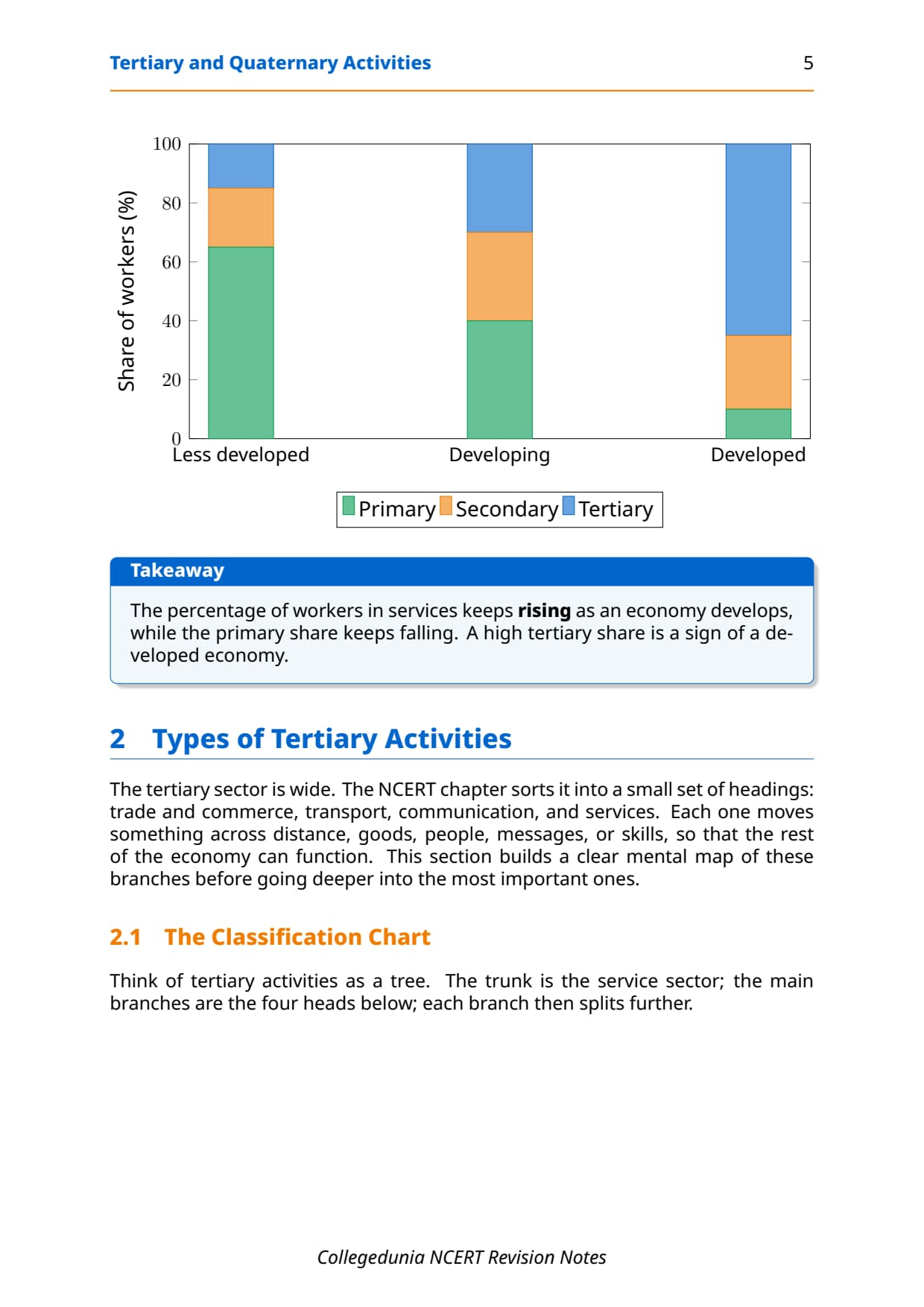
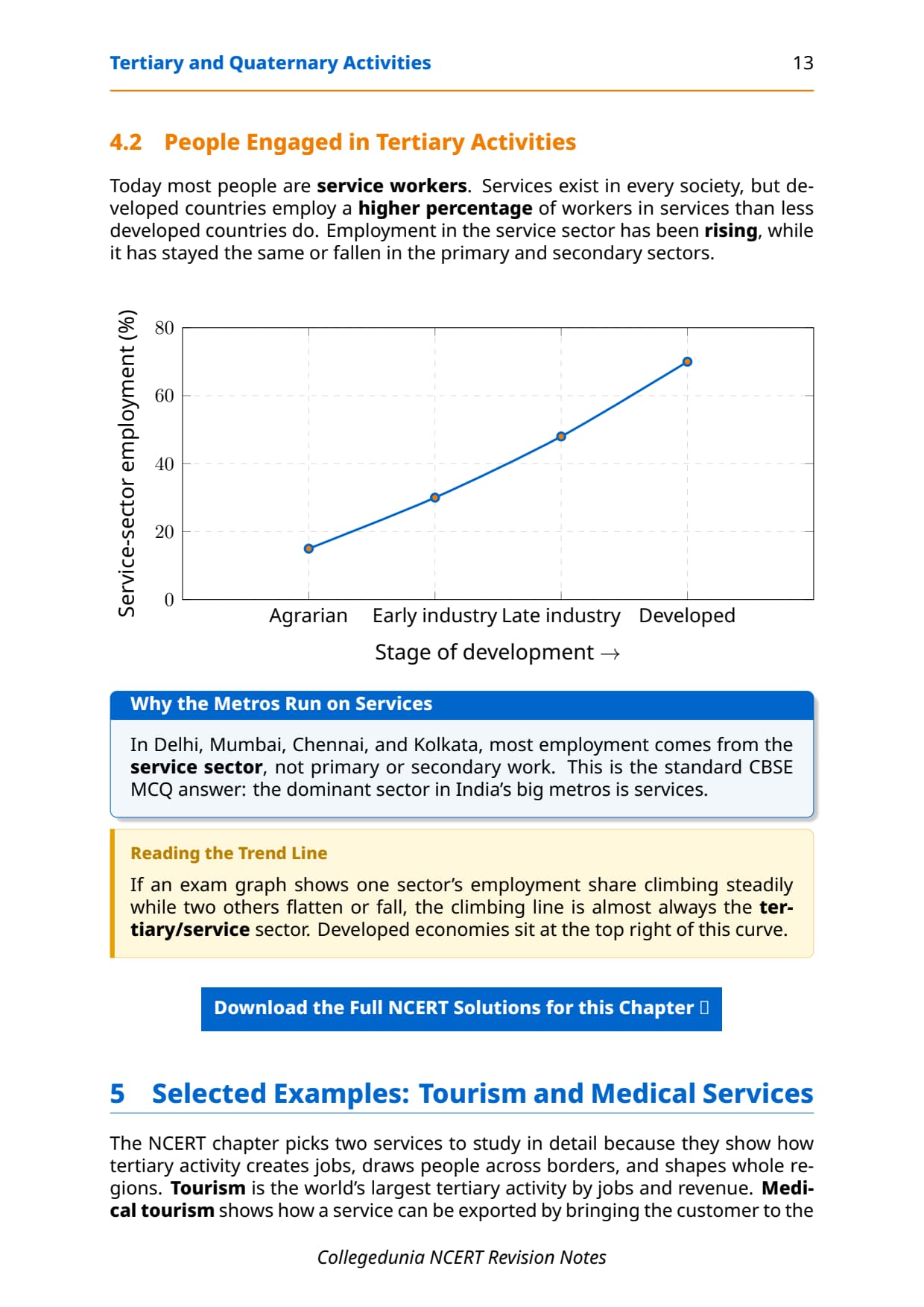
Chapter 6 covers the service sectors that dominate jobs in developed economies. As economies grow, workers shift from primary and secondary into tertiary and quaternary work.
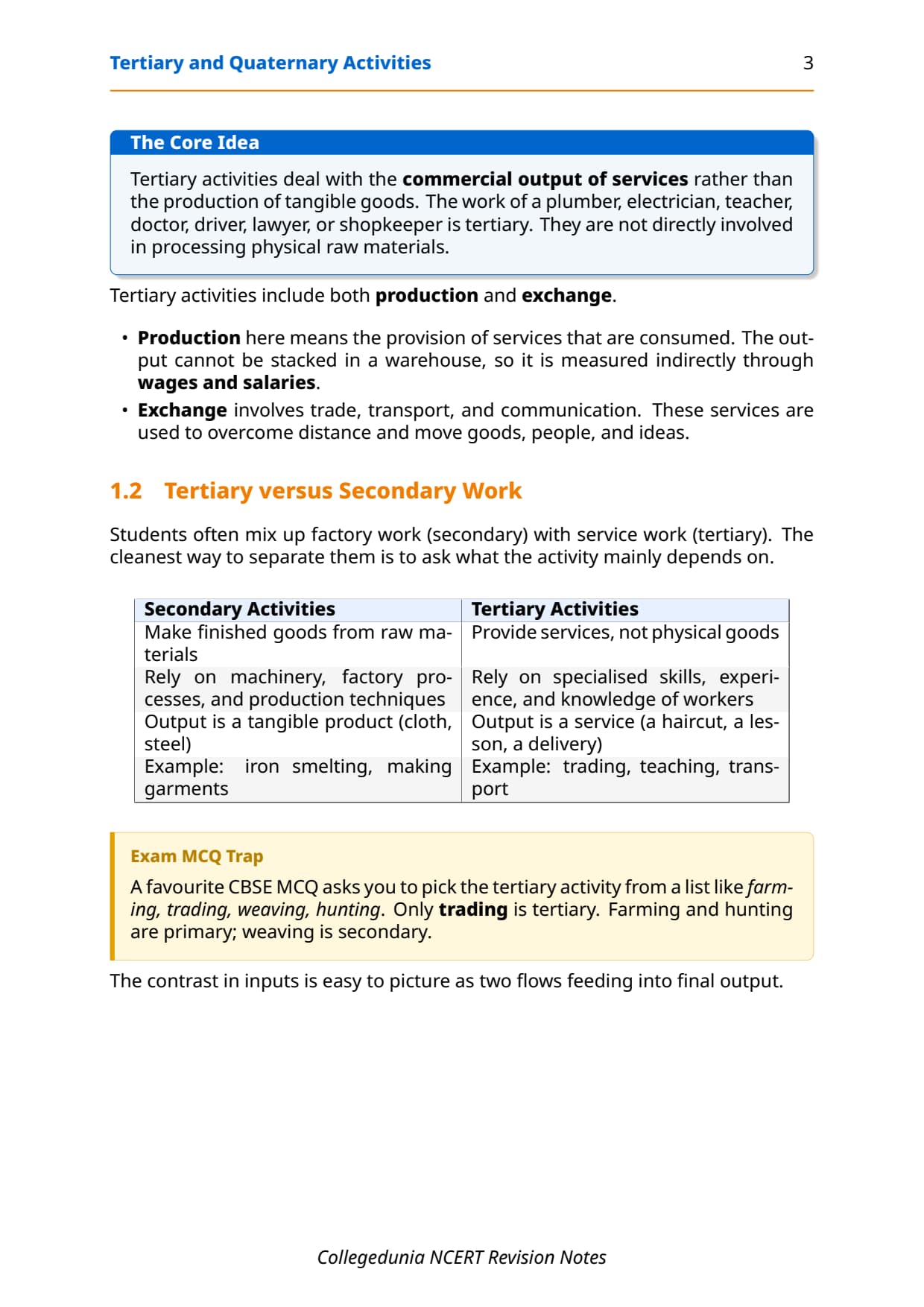
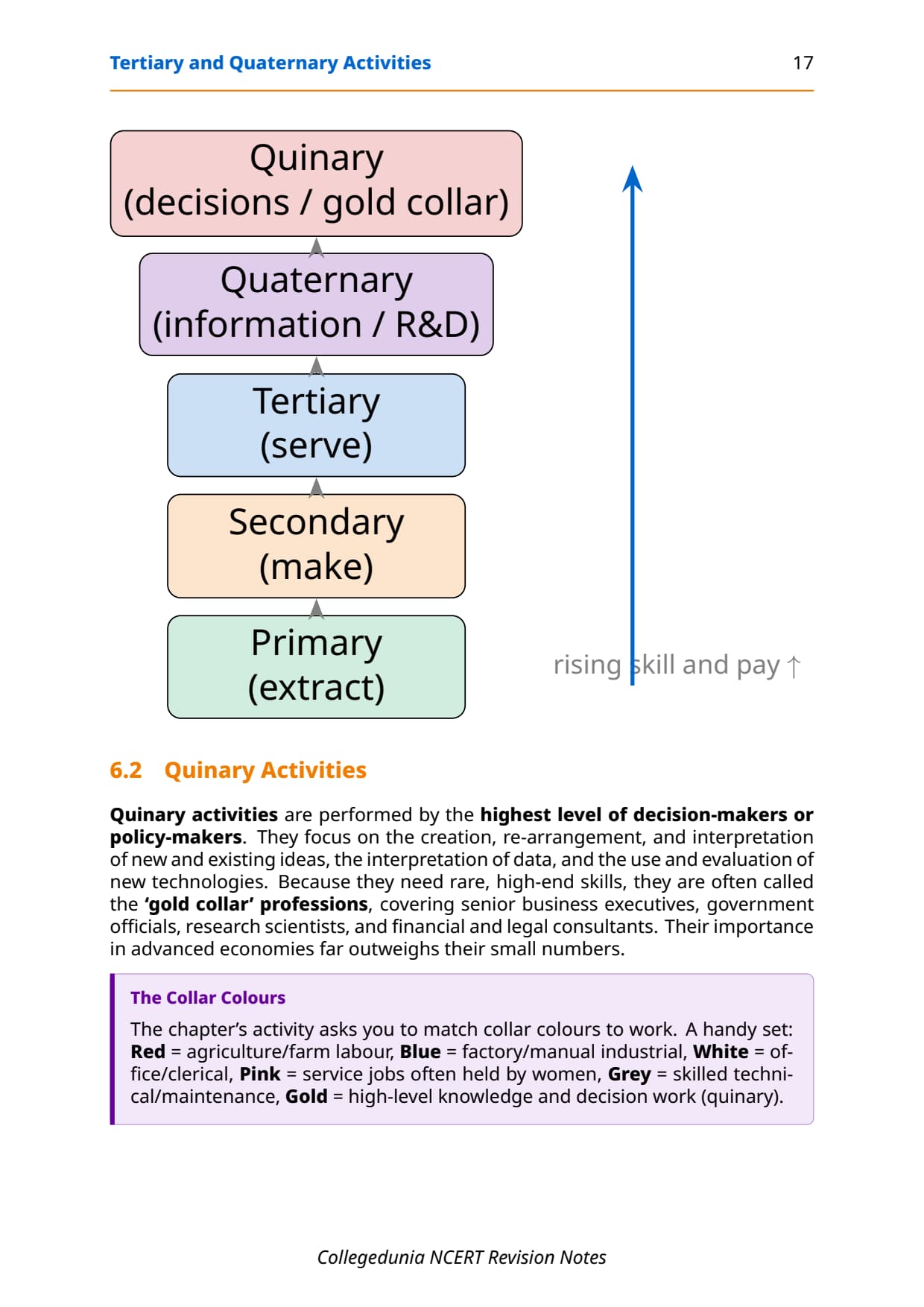
- Tertiary activities: services (trade, transport, communication, tourism, personal services); workers use skills more than machines.
- Quaternary activities: the knowledge segment (R&D, software, consultancy, finance, university teaching).
- Quinary activities: top decision-making "gold collar" roles (senior executives, officials, research scientists).
- Outsourcing and digital divide: knowledge work can be outsourced to cheaper skilled countries; uneven ICT access creates the digital divide.
Read these notes, then use the matching NCERT Solutions for Chapter 6 for drill.
Source: Amit Sengupta on YouTube
Key Definitions for Tertiary and Quaternary Activities Class 12
Most objective and short-answer questions start with a definition.
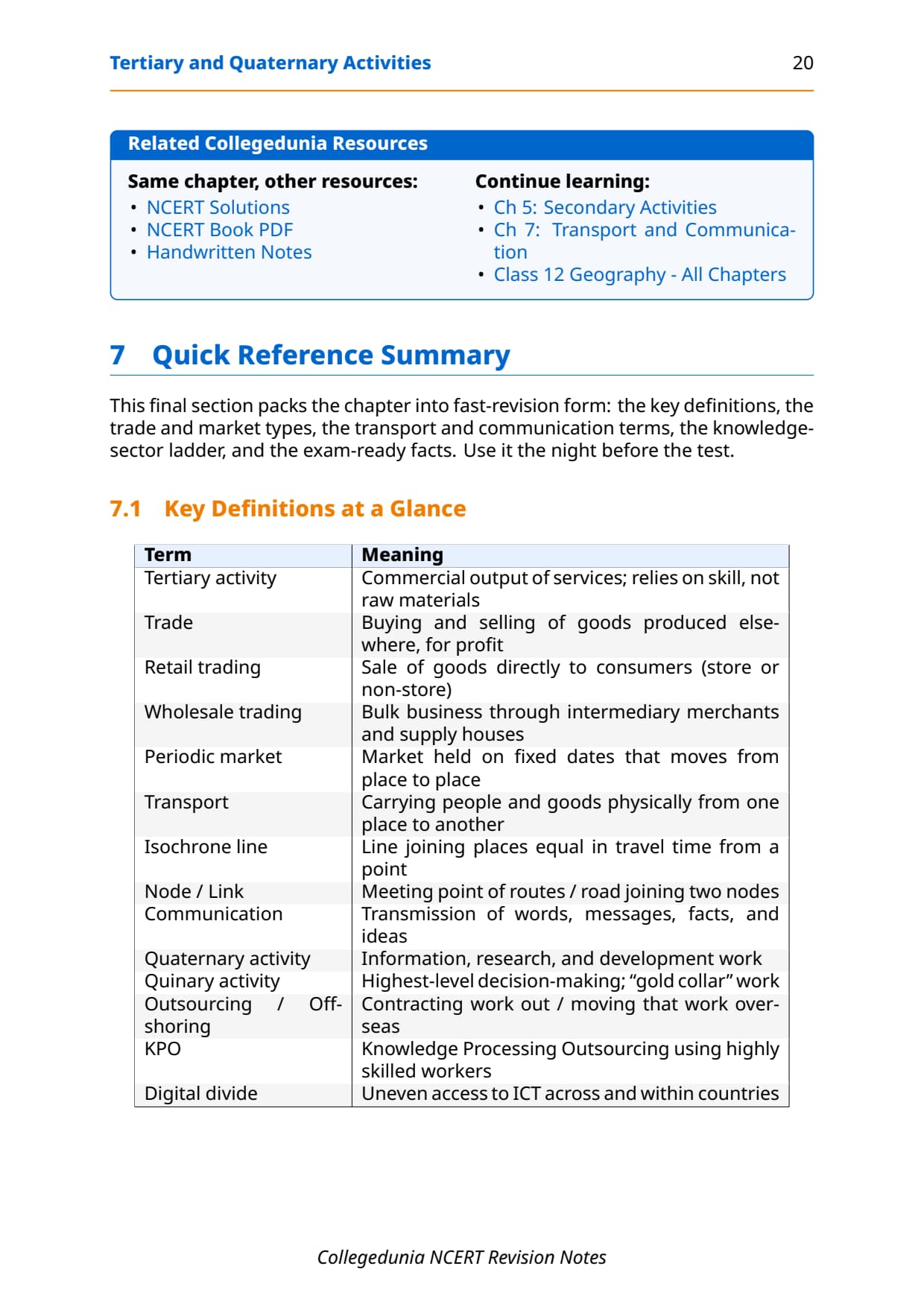
| Term | One-line definition | NCERT section |
|---|---|---|
| Tertiary Activities | Economic activities that involve the provision and exchange of services rather than the production of tangible goods; include trade, transport, communication, education, health, law and recreation. | Intro |
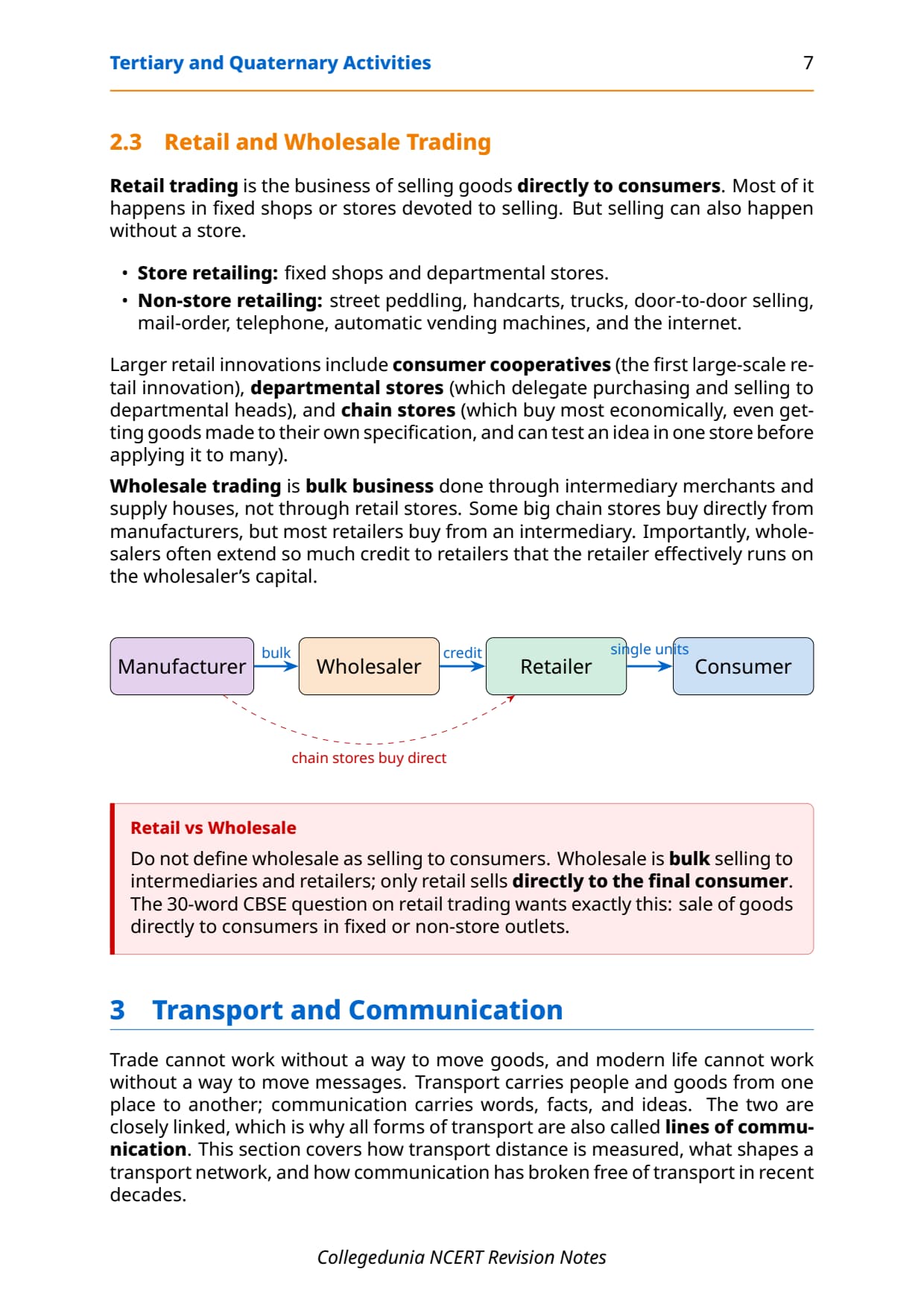
| Retail Trading | The business of selling goods directly to the final consumer; takes place in fixed stores or through non-store channels like street peddling, door-to-door, mail-order and internet. | Section on Trade |
| Wholesale Trading | Bulk business conducted through intermediary merchants and supply houses, not through retail stores; wholesalers often extend credit to retailers. | Section on Trade |
| Transport | A service or facility by which people, materials and manufactured goods are physically carried from one location to another; an organised industry satisfying man's basic need of mobility. | Section on Transport |
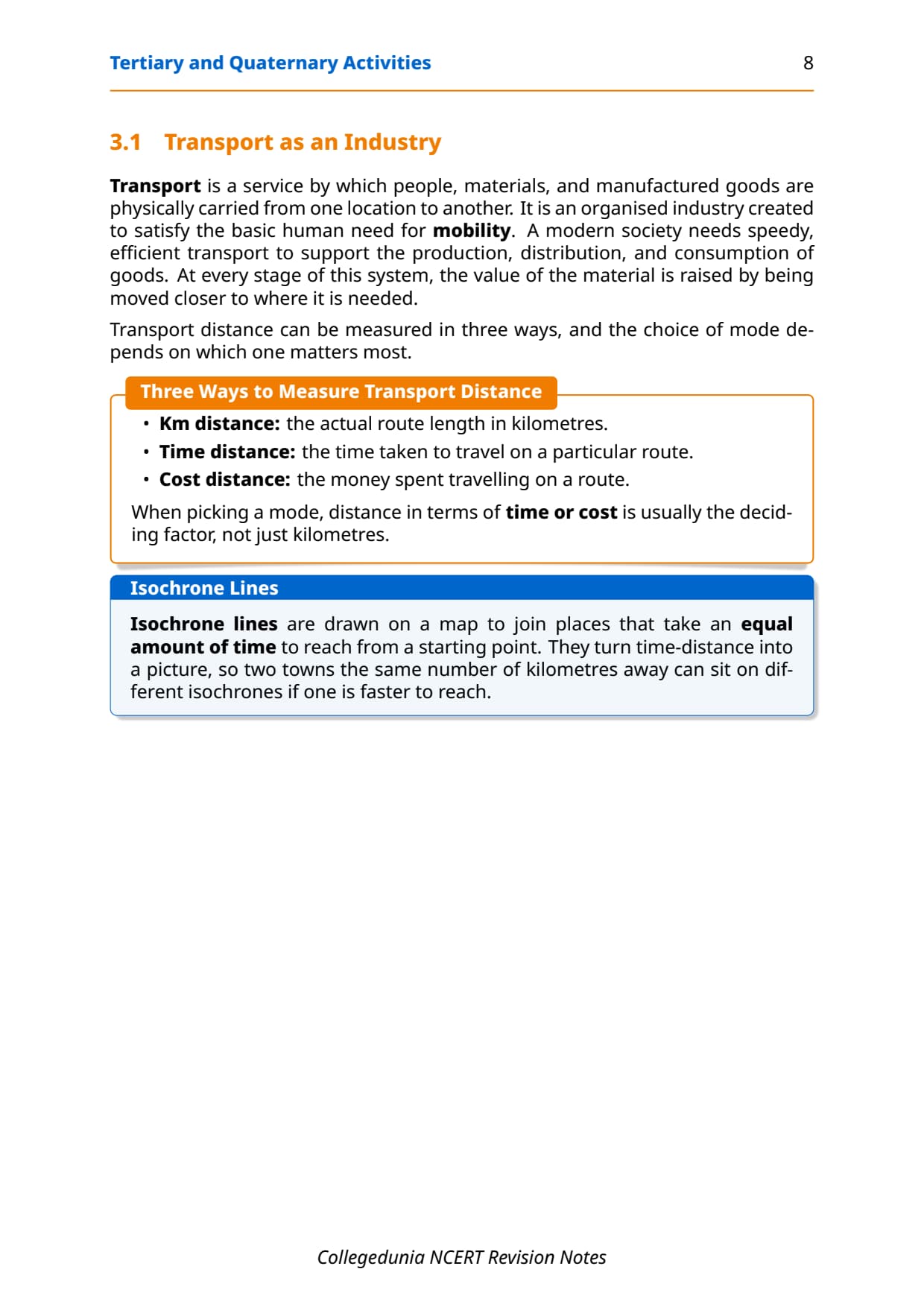
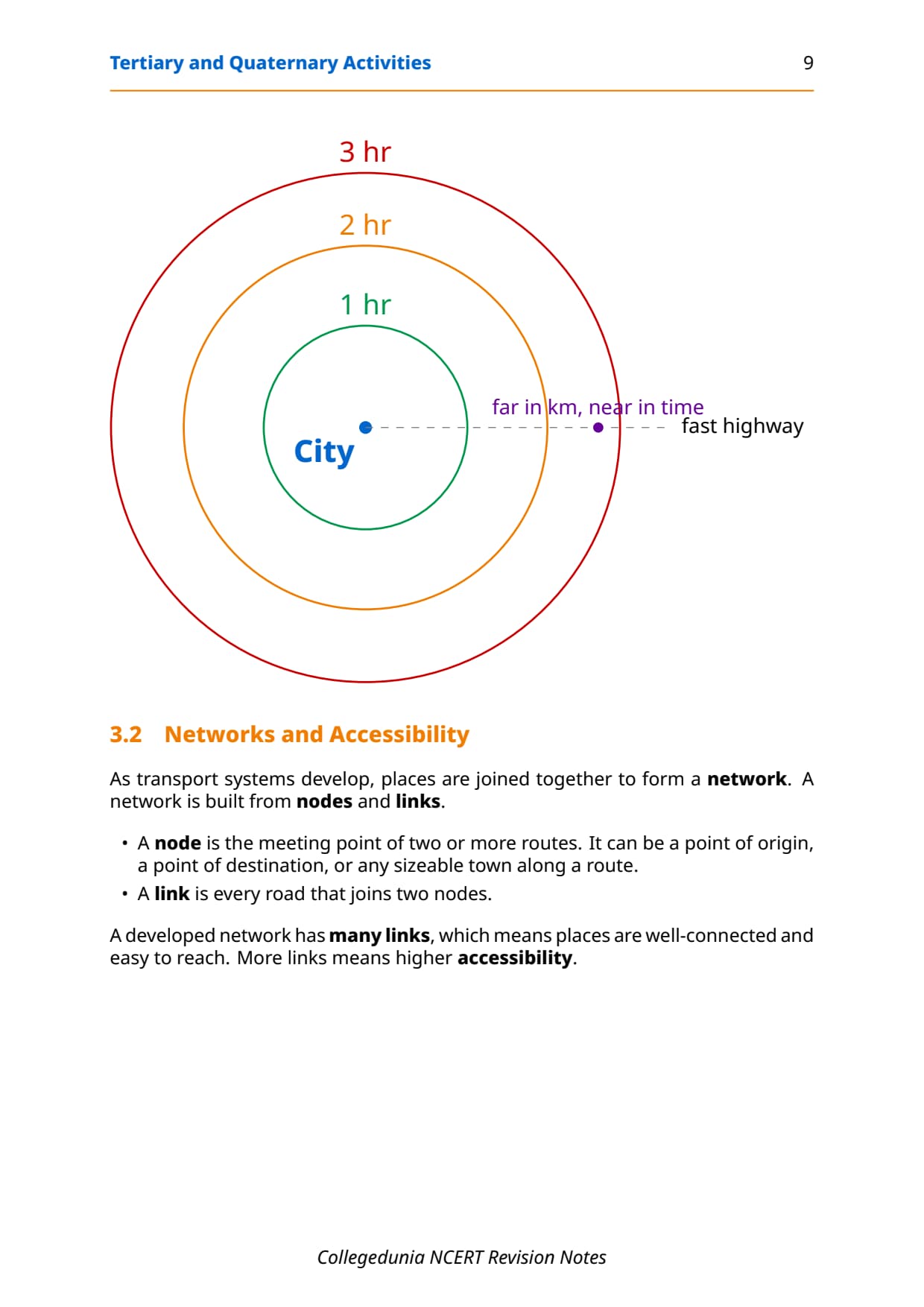
| Isochrone Lines | Lines drawn on a map joining places that are equal in terms of the time taken to reach them; used to measure time distance in transport analysis. | Section on Transport |
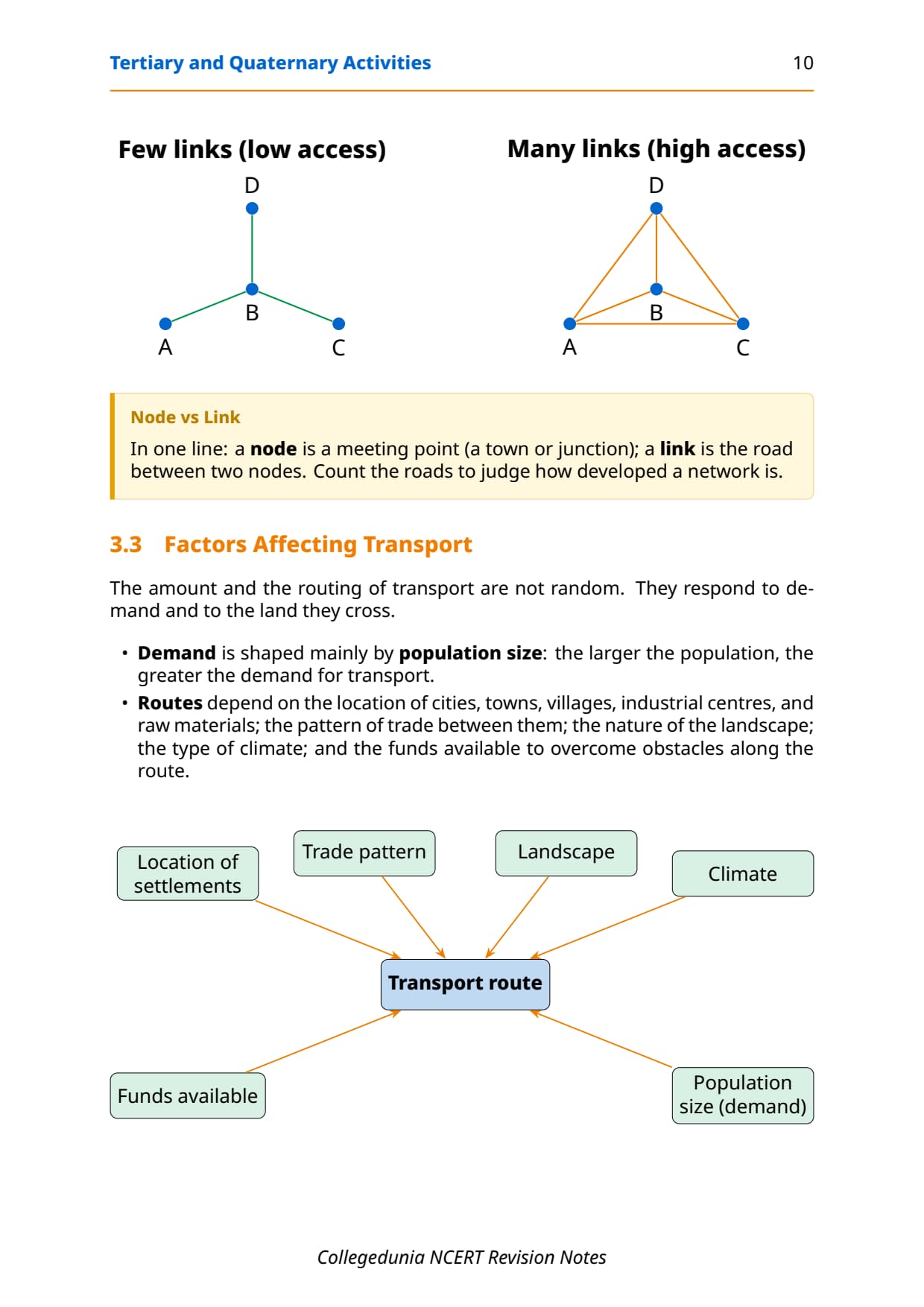
| Network and Accessibility | A transport network made up of nodes (meeting points or origin/destination points) and links (roads joining two nodes); a developed network has many links, meaning places are well-connected. | Section on Transport |
| Communication Services | Services involving the transmission of words, messages, facts and ideas; earlier tied to transport, now partly independent through mobile telephony and satellites. | Section on Communication |
| Tourism | Travel undertaken for purposes of recreation rather than business; the world's single largest tertiary activity in registered jobs (250 million) and total revenue (40 per cent of world GDP). | Section on Tourism |
| Medical Tourism | The combination of medical treatment with international travel; India, Thailand, Singapore and Malaysia are leading medical tourism destinations. | Section on Tourism |
| Quaternary Activities | Knowledge-based segment of the service sector involving the collection, production and dissemination of information, research and development; an advanced form of services requiring specialised knowledge and technical skills. | Quaternary section |
| Quinary Activities | The highest level of services focused on creation, re-arrangement and interpretation of new ideas; performed by senior executives, government officials, research scientists and top consultants; also called "gold collar" professions. | Quinary section |
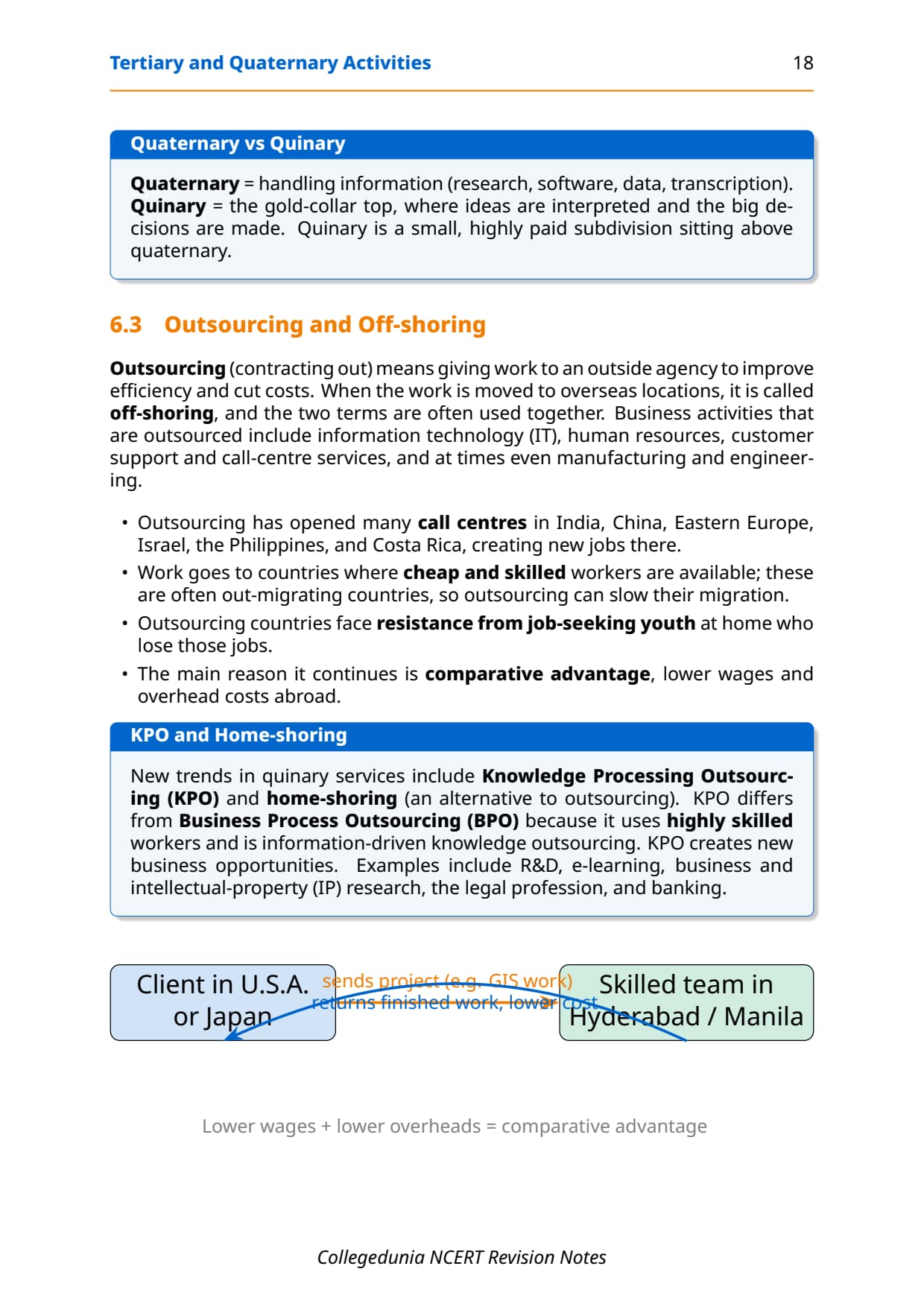
| Outsourcing | Giving work to an outside agency to improve efficiency and reduce costs; when work is transferred to overseas locations it is also called off-shoring. | Outsourcing section |
| BPO (Business Process Outsourcing) | Outsourcing of business activities such as IT, human resources, customer support and call centre services to a third party, typically in another country. | Outsourcing section |
| KPO (Knowledge Process Outsourcing) | Information-driven knowledge outsourcing involving highly skilled workers in R&D, e-learning, business research, IP research, legal services and banking; distinct from BPO which handles routine tasks. | Outsourcing section |
| Digital Divide | The uneven distribution of ICT access and benefits across and within countries; developed countries have surged ahead in digital connectivity while developing countries have lagged behind. | Digital Divide section |
Trade and Commerce: Rural, Urban, Retail and Wholesale
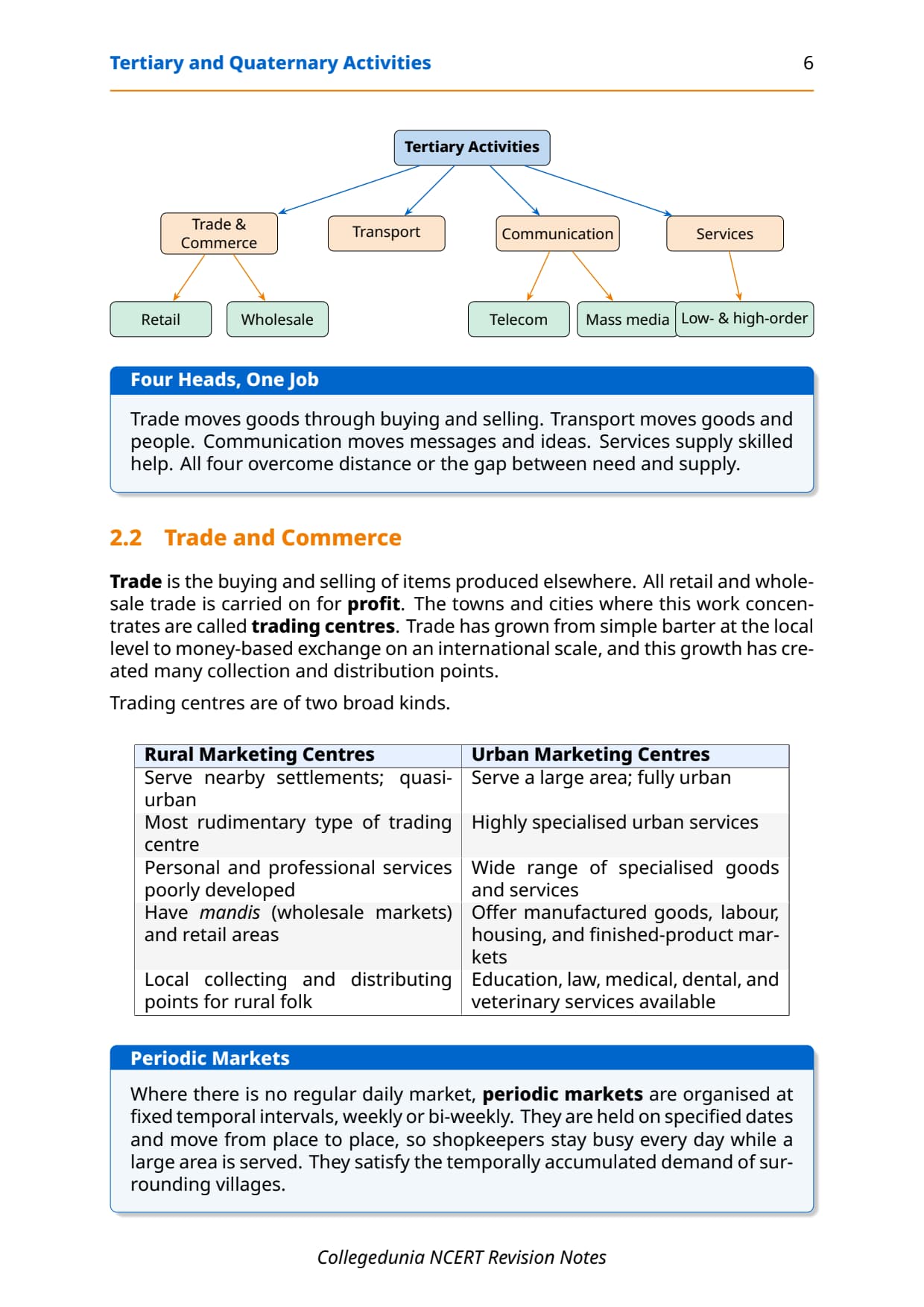
Trade is the buying and selling of items produced elsewhere. NCERT splits trading centres into rural and urban, and trading into retail and wholesale.
Rural and Urban Marketing Centres
| Feature | Rural Marketing Centres | Urban Marketing Centres |
|---|---|---|
| Population served | Nearby rural settlements | Town and city residents plus surrounding area |
| Type | Quasi-urban; most rudimentary | Fully urban with specialised services |
| Services offered | Personal and professional services not well-developed; mainly goods most frequently demanded by rural folk | Manufactured goods plus specialised markets for labour, housing, semi-finished and finished products |
| Professional services | Absent or very limited | Teachers, lawyers, consultants, physicians, dentists and vets |
| Periodic markets | Weekly or bi-weekly markets held on specified dates; move from place to place | Fixed, daily markets; no periodic nature |
Periodic markets are a classic CBSE topic: they have no fixed location and move on set dates to serve scattered rural populations.
Retail and Wholesale Trading
Retail trading sells directly to consumers, mostly in fixed stores but also non-store (peddling, door-to-door, mail-order, vending, internet). Three innovations: consumer cooperatives, departmental stores and chain stores. Wholesale trading deals in bulk through intermediary merchants. Wholesalers often extend credit to retailers, so many run on the wholesaler's capital, a key fact CBSE tests.
Transport: Modes, Distance and Network Accessibility
Transport carries people, materials and goods from place to place; modern society depends on it for production, distribution and consumption.
Measuring Transport Distance
NCERT gives three measures: km distance (route length), time distance (travel time, shown by isochrone lines) and cost distance (route expense). Time or cost distance usually decides the mode. Isochrone lines are a frequent 1-mark question.
Network, Nodes and Links
As transport develops, places join into a network. A node is a meeting point of routes or a sizeable town; a link is a road or rail line joining two nodes. More links mean better connectivity.
Factors Affecting Transport Routes
Six factors shape transport routes: location of settlements, industry and raw materials; pattern of trade; landscape; climate; and funds to overcome obstacles. A larger population means greater demand.
Communication Services and Telecommunications
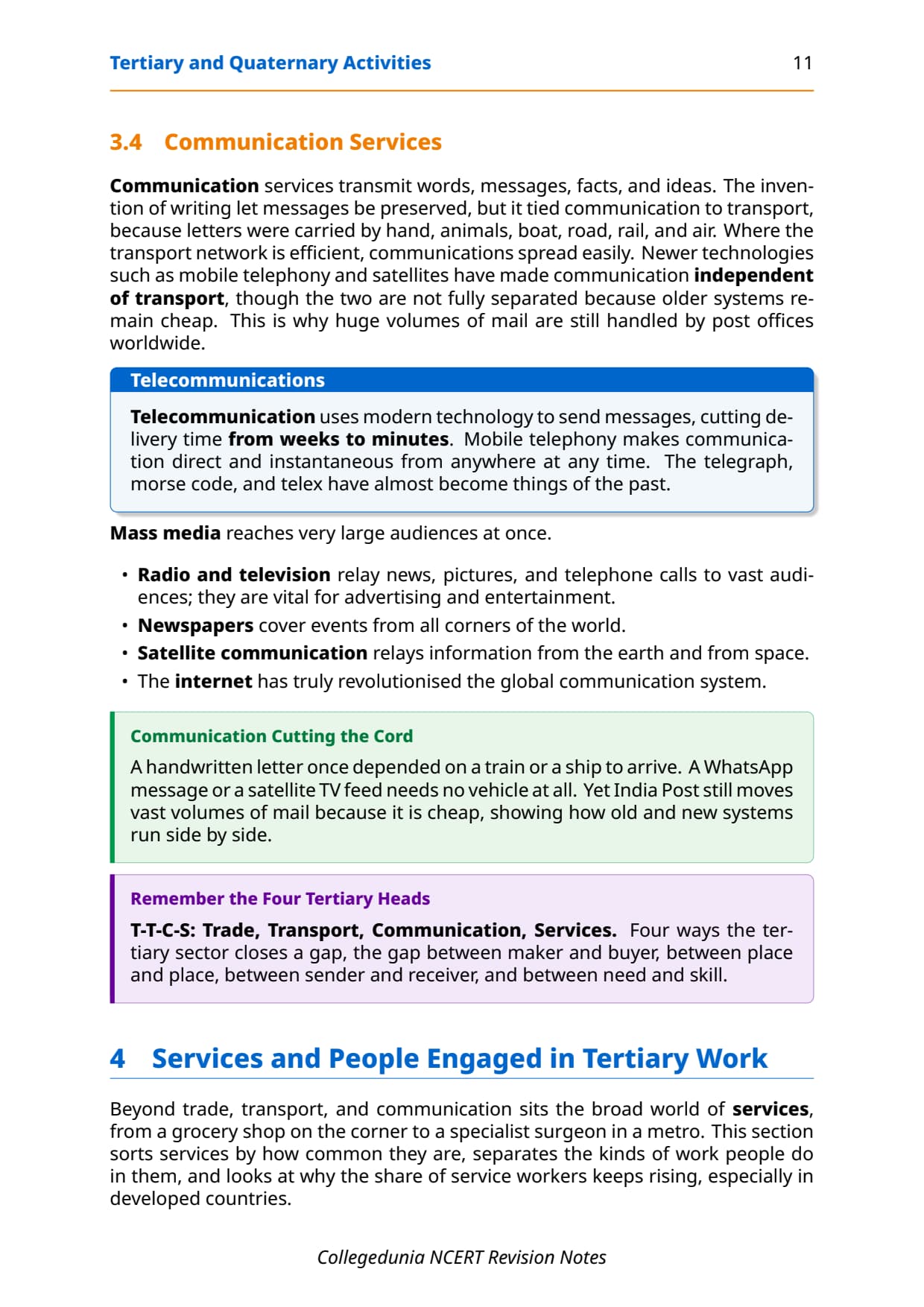
Communication services transmit words, messages, facts and ideas. They once depended on transport, but mobile telephony and satellites have partly broken this.
Telecommunications
Telecommunications changed communication through speed: messages that took weeks now take minutes. Radio and TV are mass media, satellites enable live global broadcasting, and the internet is the backbone of quaternary and quinary work. Communication is not yet fully free of transport, a common 3-mark question.
Services, Tourism and Medical Tourism
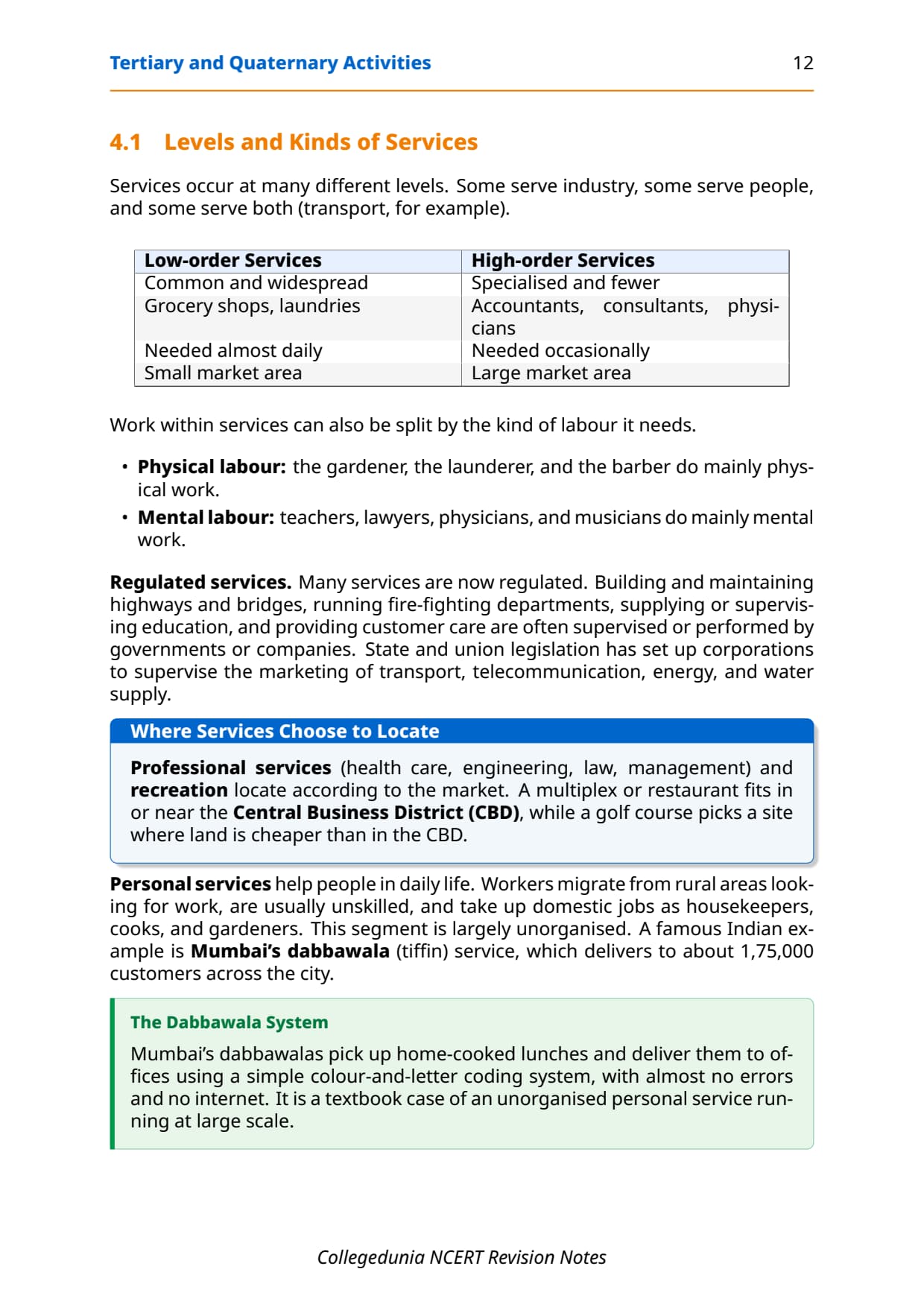
Low-order services (grocery shops, laundries) are common everywhere; high-order services (accountants, consultants, physicians) are specialised and less widespread.
Tourism
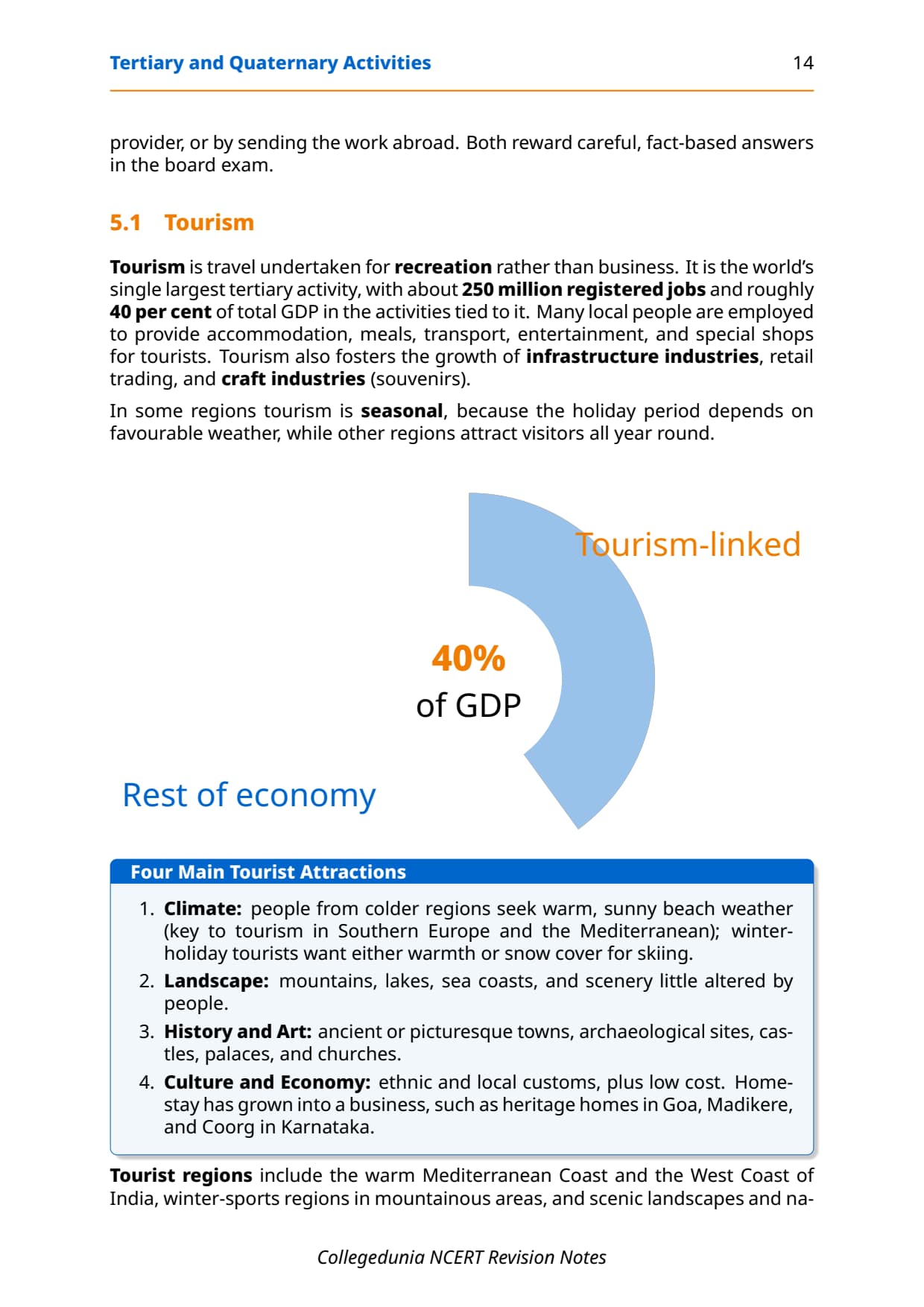
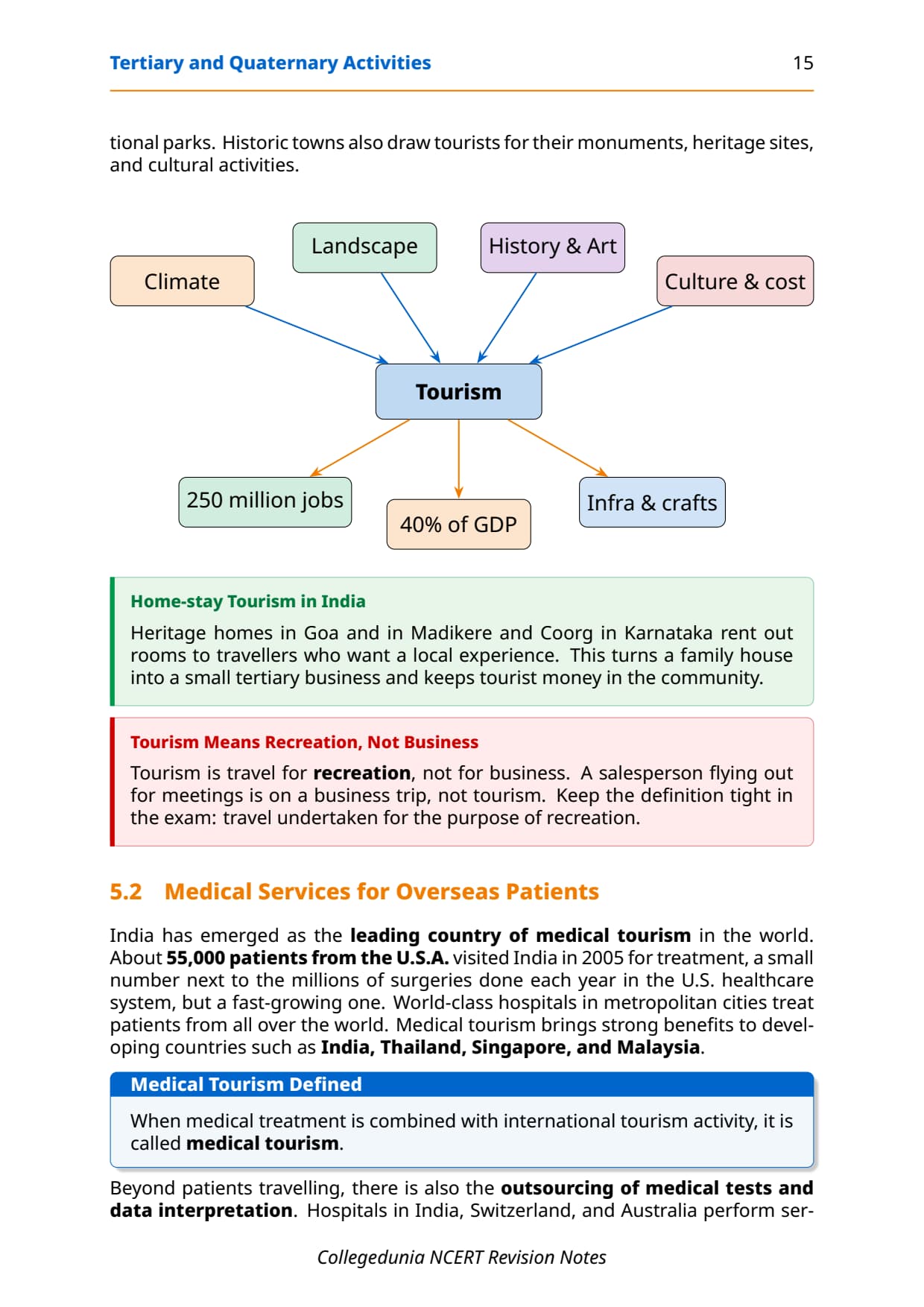
Tourism is travel for recreation, the world's single largest tertiary activity with 250 million registered jobs and about 40 per cent of world GDP, the two most-tested facts. It indirectly supports accommodation, transport, retail and craft industries.
Tourist Attractions
- Climate: warm sun for beaches, snow for skiing; Mediterranean Europe is popular for high temperatures and low peak-season rainfall.
- Landscape: mountains, lakes, sea coasts and natural environments.
- History and Art: ancient towns, sites, castles, palaces, churches.
- Culture and Economy: local customs and cheap services (home-stays in Goa, Madikere and Coorg).
Medical Tourism in India
India is a leading medical tourism destination, with metro hospitals serving global patients (about 55,000 US patients in 2005), alongside Thailand, Singapore and Malaysia. Outsourcing of medical data interpretation (radiology, MRI, ultrasound) is also growing.
Quaternary and Quinary Activities
Quaternary activities are the knowledge segment of the service sector. Over half of all workers in developed economies are now here.
Quaternary Activities
They involve the collection, production and dissemination of information, plus research and specialised work. Examples: fund managers, tax consultants, software developers, university teaching.
Key features: can be outsourced; not tied to physical resources or the natural environment; can be done from anywhere with internet, not localised near markets; workforce of office workers, researchers, educators and analysts.
Quinary Activities
Quinary activities are the highest level of decision-making, focused on the creation, re-arrangement and interpretation of ideas and evaluating new technologies. They are called "gold collar" professions, a term CBSE tests.
| Feature | Quaternary Activities | Quinary Activities |
|---|---|---|
| Nature | Knowledge-based: collect, produce and disseminate information; R&D | Highest-level decision making: create, re-arrange and interpret new ideas |
| Examples | Software developers, financial analysts, statisticians, university teachers, tax consultants | Senior business executives, government officials, research scientists, top legal and financial consultants |
| Collar term | White collar (knowledge workers in general) | Gold collar (highest-paid, highest-skill) |
| Numbers | Large; over half of all workers in developed economies | Small in number but very high importance in shaping advanced economies |
| Outsourcing possible? | Yes; can be outsourced and off-shored | Rarely; decision-making roles stay close to headquarters |
Tip: CBSE often asks students to define quinary activities and "gold collar" in 3-mark questions. Memorise the collar colour and the "creation and re-arrangement of ideas" phrase.
Outsourcing, BPO, KPO and the Digital Divide
Outsourcing means giving work to an outside agency to cut costs; overseas it is off-shoring. Lower wages and skilled workers in India, the Philippines, China and Eastern Europe make it attractive.
BPO vs KPO
NCERT distinguishes two levels; the key is the skill required.
- BPO (Business Process Outsourcing): routine tasks (IT support, HR, customer support, call centres); moderate skills.
- KPO (Knowledge Process Outsourcing): highly skilled, information-driven tasks (R&D, e-learning, business research, legal, banking); higher-value.
A common NCERT exercise asks if BPOs have better opportunities than KPOs; the answer is NO, since KPOs are higher-skill, higher-value.
New Trends: Home Shoring
"Home shoring" is domestic outsourcing where remote workers handle tasks from home, emerging partly in response to youths in countries losing local jobs to overseas outsourcing.
Digital Divide
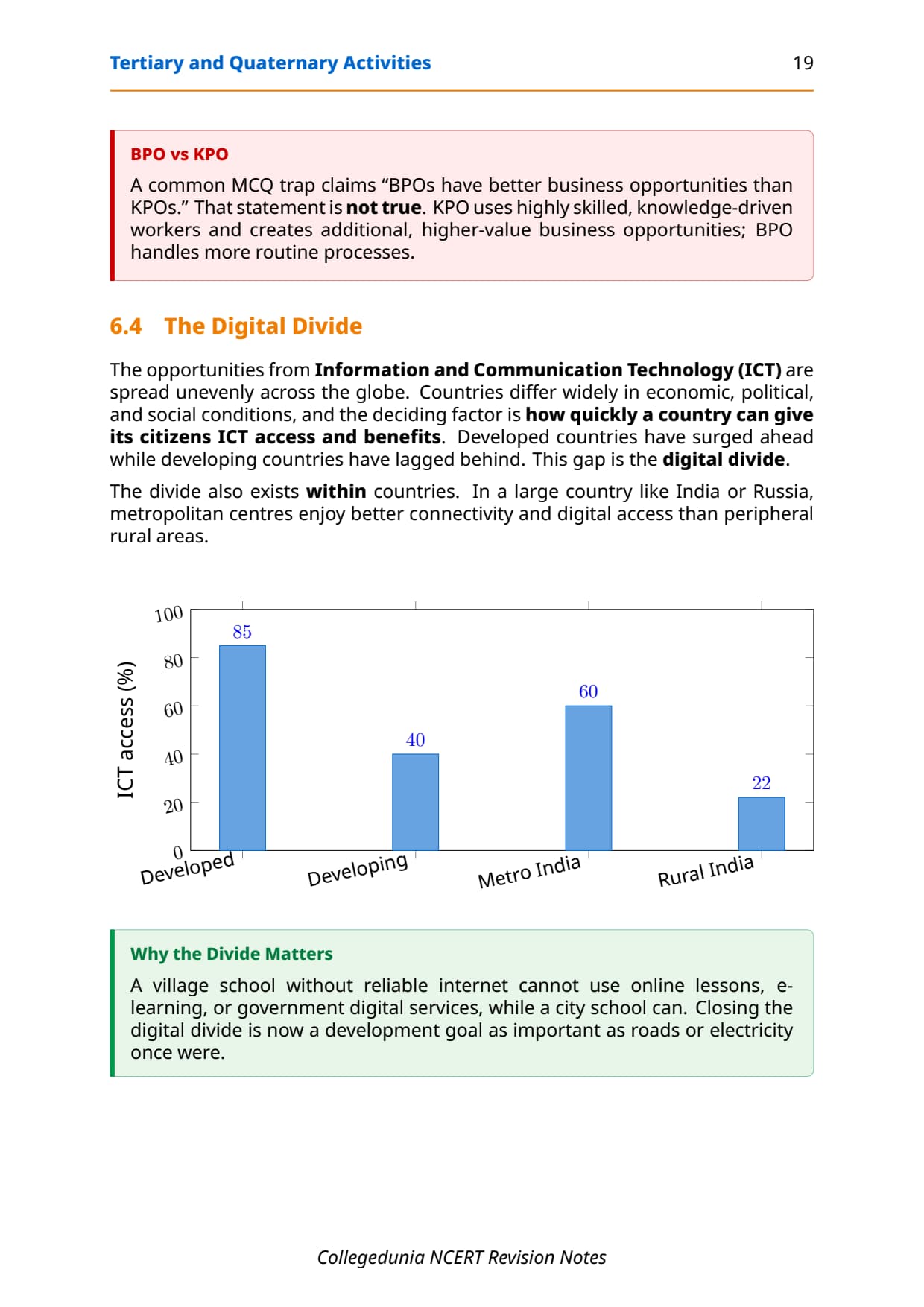
The digital divide is the uneven distribution of ICT access and benefits. Developed countries have raced ahead while developing ones lag, and the gap exists both between and within countries.
- Between countries: developing nations lack the infrastructure, capital and workforce of developed ones.
- Within countries: metros have far better connectivity than rural areas, limiting ICT-based development.
Previous Year Question Trends from Tertiary and Quaternary Activities
CBSE usually asks a couple of MCQs and descriptive questions each year. The table maps the last five years.
| Year | Question type asked | Marks | Notes section to revise |
|---|---|---|---|
| 2025 | Describe significance and growth of the service sector + MCQ on which sector provides most employment in metro cities | 5 + 1 | Services section + Quick Concept Recap |
| 2024 | Explain quaternary activities + differentiate BPO and KPO | 3 + 3 | Quaternary and Quinary section + Outsourcing section |
| 2023 | Describe tourist attractions with examples + define digital divide | 4 + 2 | Tourism section + Digital Divide section |
| 2022 | Explain retail trading + significance of transport and communication services | 3 + 5 | Trade section + Transport and Communication sections |
| 2021 | Define quinary activities + MCQ on which activity is NOT secondary sector | 3 + 1 | Quinary section + Key Definitions |
The chapter carries an effective 8 to 10 marks per year.
Other Resources for Class 12 Geography Chapter 6 Tertiary and Quaternary Activities
Pair these notes with the matching resources below.
| Resource | What it covers | Open |
|---|---|---|
| Notes | Concept-first revision notes covering definitions, trade types, transport, communication, tourism, quaternary, quinary, outsourcing, KPO vs BPO and the digital divide. | You are here |
| NCERT Solutions | Step-by-step answers to all exercise questions (MCQs, 30-word and 150-word answers) with Expert's Solution for every descriptive question. | Class 12 Geography Chapter 6 NCERT Solutions |
| Handwritten Notes | A topper's genuine handwritten revision pages for last-minute board exam practice. | Class 12 Geography Chapter 6 Handwritten Notes |
| NCERT Book PDF | Official NCERT Fundamentals of Human Geography Chapter 6 textbook in PDF form. | Class 12 Geography Chapter 6 NCERT Book PDF |
| Subject Hub | All chapters of Class 12 Geography with every resource in one place. | Class 12 Geography Subject Hub |
All Chapters Notes for Class 12 Geography Fundamentals of Human Geography
Related Links: Notes for the other Class 12 Geography (Fundamentals of Human Geography) chapters.
| Chapter | Topic | Notes link |
|---|---|---|
| Chapter 1 | Human Geography: Nature and Scope | Class 12 Geography Chapter 1 Notes |
| Chapter 2 | The World Population: Distribution, Density and Growth | Class 12 Geography Chapter 2 Notes |
| Chapter 3 | Human Development | Class 12 Geography Chapter 3 Notes |
| Chapter 4 | Primary Activities | Class 12 Geography Chapter 4 Notes |
| Chapter 5 | Secondary Activities | Class 12 Geography Chapter 5 Notes |
| Chapter 6 | Tertiary and Quaternary Activities | You are here |
| Chapter 7 | Transport and Communication | Coming soon |
| Chapter 8 | International Trade | Coming soon |
NCERT Notes Class 12 Geography Chapter 6 Tertiary and Quaternary Activities FAQs
Ques. What are tertiary activities in Class 12 Geography Chapter 6?
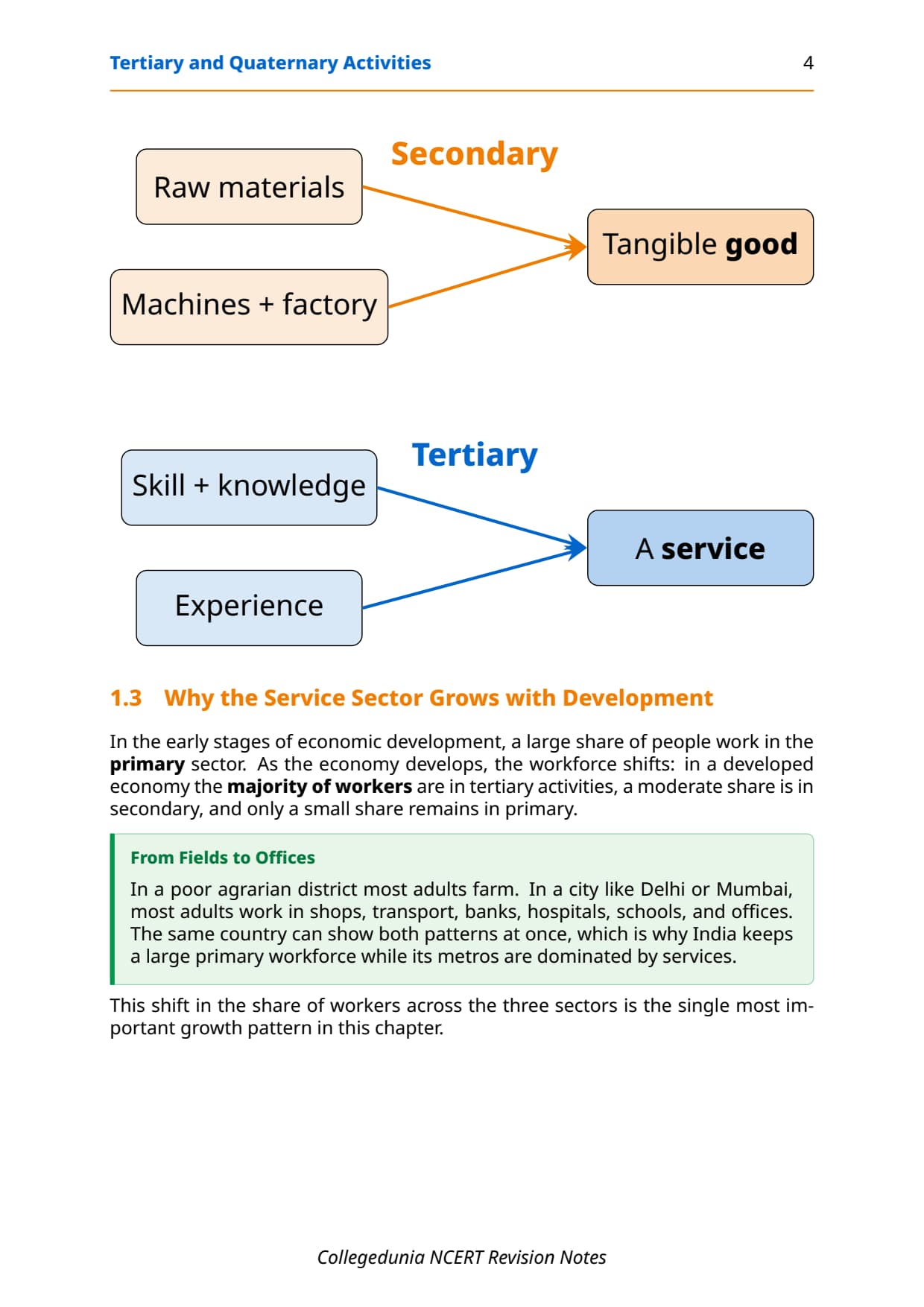
Ans. Tertiary activities are economic activities that involve the provision and exchange of services rather than the production of tangible goods. They include trade, transport, communication, education, health care, law, governance and recreation. The main difference between tertiary and secondary activities is that tertiary activities rely on specialised skills, experience and knowledge of the workers rather than on production machinery and factory processes. Common examples from Class 12 Geography include the work of a teacher, doctor, lawyer, shopkeeper, driver and publisher. In developed economies, the majority of workers are employed in tertiary activities, while developing economies still have more workers in primary and secondary sectors.
Ques. What are quaternary activities and how are they different from quinary activities?
Ans. Quaternary activities are the knowledge-based segment of the service sector. They involve the collection, production and dissemination of information, research and development, and require specialised knowledge and technical skills. Examples include software development, financial analysis, university teaching, tax consulting and statistical work. Over half of all workers in developed economies work in this sector. Quinary activities are at a higher level still - they involve the creation, re-arrangement and interpretation of new and existing ideas and the evaluation of new technologies. They are performed by the highest decision-makers such as senior executives, government officials and research scientists, and are called "gold collar" professions. Quaternary activities are broader in scope; quinary activities are fewer in number but extremely high in importance and pay.
Ques. What is the digital divide in Class 12 Geography Chapter 6?
Ans. The digital divide is the uneven distribution of ICT (Information and Communication Technology) access and benefits across the globe. While developed countries have surged forward in digital connectivity, developing countries have lagged behind due to differences in economic strength, political systems and social infrastructure. The digital divide also exists within countries: in large nations like India and Russia, metropolitan areas have far better connectivity and access to the digital world than peripheral rural areas. This internal divide limits the reach of IT-based economic development such as e-learning, online health services and digital commerce to urban centres, leaving rural populations at a disadvantage.
Ques. What is outsourcing and how does it differ from off-shoring?
Ans. Outsourcing means giving work to an outside agency to improve efficiency and reduce costs. It does not have to cross national borders. When outsourcing involves transferring work to an overseas location, it is described as off-shoring, although both terms are often used together in everyday speech. Business activities that are outsourced include IT, human resources, customer support and call centre services, and at times manufacturing and engineering. Countries like India, China, the Philippines, Israel, Costa Rica and nations in Eastern Europe have become major destinations for outsourcing because they offer cheap and skilled labour. Outsourcing can also reduce migration pressure in those countries by creating local employment without workers having to leave.
Ques. What is the difference between BPO and KPO in Class 12 Geography?
Ans. BPO stands for Business Process Outsourcing. It involves outsourcing routine business tasks such as IT support, human resources management, customer support and call centre services. BPO requires moderate skill levels and mainly processes data and handles customer interactions. KPO stands for Knowledge Process Outsourcing. It involves highly skilled workers in information-driven, complex tasks such as research and development, e-learning, business research, intellectual property research, legal services and banking. KPO is distinct from BPO because it requires much higher expertise and judgement, and enables companies to create additional business opportunities rather than merely process transactions. A common NCERT exercise statement - that BPOs have better opportunities than KPOs - is explicitly marked as NOT true in the textbook.
Ques. What are the factors that attract tourists to a region in Class 12 Geography?
Ans. The NCERT textbook identifies four main tourist attractions. Climate is the most powerful draw: people from colder regions seek warm, sunny weather for beach holidays, while those seeking winter holidays want either snow cover for skiing or warmer destinations than their homeland. The Mediterranean region is popular because of its consistently high temperatures and low rainfall during peak season. Landscape attracts tourists who want mountains, lakes, spectacular sea coasts and relatively natural environments. History and art draw visitors to ancient towns, archaeological sites, castles, palaces and churches. Culture and economy attract tourists interested in ethnic and local customs; regions that offer cheap, quality tourism services (like heritage home-stays in Goa, Madikere and Coorg in Karnataka) become very popular.
Ques. Why is tourism called the world's largest tertiary activity?
Ans. The NCERT textbook states that tourism is the world's single largest tertiary activity in total registered jobs and total revenue. It accounts for approximately 250 million registered jobs globally and contributes about 40 per cent of world GDP. Beyond direct employment in accommodation, transport and entertainment, tourism creates indirect jobs in infrastructure industries, retail trading and craft industries (souvenirs). It stimulates local economies, encourages infrastructure development, and in some regions drives the majority of economic activity. Its scale, reach and multiplier effect make it the dominant tertiary activity in the global economy, which is why Class 12 Geography dedicates a dedicated section to it in Chapter 6.
Ques. What are isochrone lines and how are they used in transport geography?
Ans. Isochrone lines are drawn on a map to join places that are equal in terms of the time taken to reach them from a given point. They are the time-distance equivalent of contour lines, which join places of equal elevation. In transport geography, distance can be measured in three ways: actual km distance, time distance and cost distance. When selecting a mode of transport, time or cost distance is usually more relevant than km distance alone. Isochrone lines help planners visualise which areas a transport hub can reach within a given time, making them useful for locating services, planning logistics and assessing transport network accessibility. CBSE Class 12 Geography tests the definition of isochrone lines as a 1-mark or 2-mark objective question.
Ques. What is retail trading in Class 12 Geography Chapter 6?
Ans. Retail trading is the business activity concerned with the sale of goods directly to consumers. Most retail trading takes place in fixed establishments such as stores solely devoted to selling. However, non-store retail trading is also covered in the NCERT chapter: examples include street peddling, handcarts, trucks, door-to-door selling, mail-order, telephone sales, automatic vending machines and internet shopping. The chapter also discusses three innovations in large-scale retailing: consumer cooperatives (the first innovation), departmental stores (where responsibility and authority are delegated to department heads) and chain stores (which buy merchandise at bulk rates, often specifying exactly how goods should be manufactured, and can test changes in one outlet before rolling them out across all branches).
Ques. How are nodes and links important in a transport network?
Ans. As transport systems develop, different places are linked together to form a network. A network is made up of nodes and links. A node is the meeting point of two or more routes, or a point of origin, a point of destination, or any sizeable town along a route. Every road or railway line that joins two nodes is called a link. A developed transport network has many links, which means that places are well-connected and accessible to each other. The more links a network has, the higher its accessibility. This concept is important for understanding how transport systems support economic development, because better connectivity reduces the time distance and cost distance between producers and consumers, making the movement of goods, people and services more efficient.
Ques. Is the Class 12 Geography syllabus for Chapter 6 changing in 2026-27?
Ans. No major changes in 2026-27. Chapter 6 Tertiary and Quaternary Activities in the Fundamentals of Human Geography textbook retains the same content on trade, transport, communication, services, tourism, quaternary and quinary activities, outsourcing and the digital divide. These tertiary and quaternary activities class 12 notes for the 2026-27 cycle are aligned to the unchanged textbook and the latest CBSE sample paper released for the 2026 boards. Students preparing for CUET Geography and UPSC Prelims Geography should also note that outsourcing, the digital divide and the distinction between quaternary and quinary activities from this chapter appear in both these competitive examinations.



Comments