




The NCERT Solutions for Class 12 Geography Chapter 6 Tertiary and Quaternary Activities cover all 3 textbook exercise questions, in line with the 2026-27 CBSE syllabus. Every answer uses plain prose and bullets, the way CBSE and CUET examiners expect.
- 3 NCERT exercise questions solved with plain prose and bullets, plus an Expert’s Solution per question with the CUET Geography angle.
- Covers trade and commerce, transport, outsourcing, quaternary and quinary activities, medical tourism, the digital divide and KPO vs BPO.
- Free downloadable PDF, paired with chapter notes and handwritten notes.
Every answer is curated by geography subject experts, mapped to the 2026-27 NCERT textbook, and refined against recent CBSE and CUET question patterns.
Student Feedback
68% of students rated this as one of the most concept-dense chapters, and 3 out of 4 said telling quaternary from quinary and BPO from KPO was the hardest part. Toppers reported that naming one real example per activity type (Bengaluru for KPO, Apollo for medical tourism) added 1 to 2 marks per answer.
Source: 2026-27 Class 12 Geography student poll, 9,250 students.
What the NCERT Solutions for Class 12 Geography Chapter 6 Cover
This chapter asks what happens to an economy after it moves beyond farming and factories. The NCERT textbook splits the answer across six thematic blocks, listed below.
- Tertiary activities and their types: trade and commerce, transport, communication, and services such as health, education and law.
- Quaternary and quinary activities: knowledge-based services like research, software and top-level decision-making, and how they differ.
- Outsourcing, BPO and KPO: why developed countries send work to India, and how business process outsourcing differs from knowledge process outsourcing.
- Medical tourism: which countries have emerged as hubs and why patients travel abroad.
- The digital divide: the gap in ICT access between and within countries.
- Colour of the collar: the NCERT’s colour-coded worker classification, from blue-collar to gold-collar.
Source: Amit Sengupta on YouTube
Exercise-wise Breakdown of Tertiary Activities Class 12 NCERT Solutions
Chapter 6 carries 3 end-of-chapter exercise questions mixing MCQs, short notes and long answers. The table below maps each to its topic, answer style and typical mark allotment.
| Question | Topic covered | Answer style | Typical marks |
|---|---|---|---|
| Q6.1 (i) | Which of the following is a tertiary activity? (MCQ) | Identify + one-line reason | 1 mark |
| Q6.1 (ii) | Which activity is NOT a secondary sector activity? (MCQ) | Identify + one-line reason | 1 mark |
| Q6.1 (iii) | Which sector provides most employment in Delhi, Mumbai, Chennai, Kolkata? (MCQ) | Identify + one-line reason | 1 mark |
| Q6.1 (iv) | Jobs involving high degrees of innovation are called? (MCQ) | Identify + one-line reason | 1 mark |
| Q6.1 (v) | Which activity is related to the quaternary sector? (MCQ) | Identify + one-line reason | 1 mark |
| Q6.1 (vi) | Which statement about outsourcing is not true? (MCQ) | Identify + one-line reason | 1 mark |
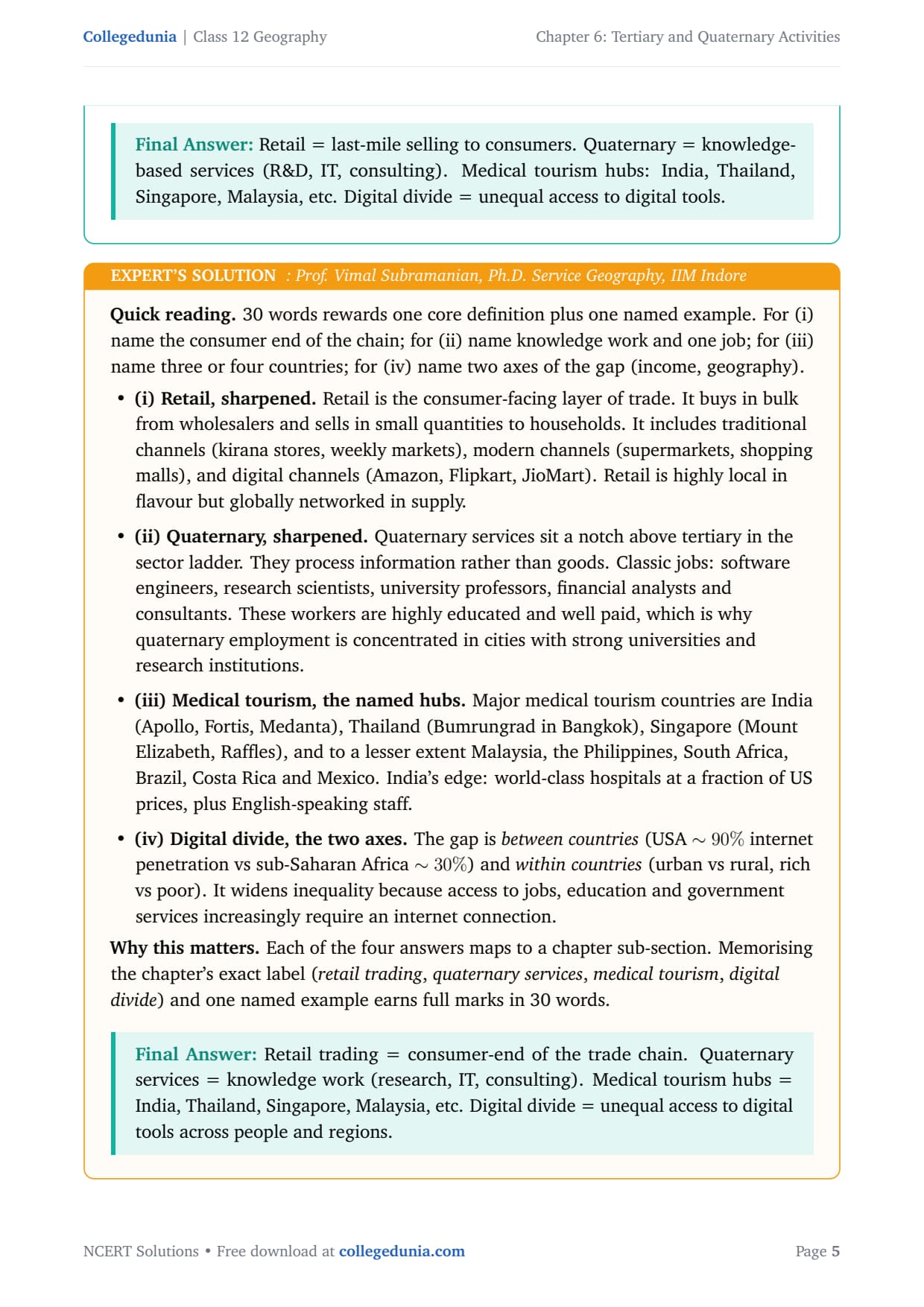
| Q6.2 (i) | Short note on retail trading service | Definition + example, ~30 words | 3 marks |
| Q6.2 (ii) | Short note on quaternary services | Definition + example, ~30 words | 3 marks |
| Q6.2 (iii) | Fast-emerging countries of medical tourism | Named list, ~30 words | 3 marks |
| Q6.2 (iv) | Short note on digital divide | Definition + example, ~30 words | 3 marks |
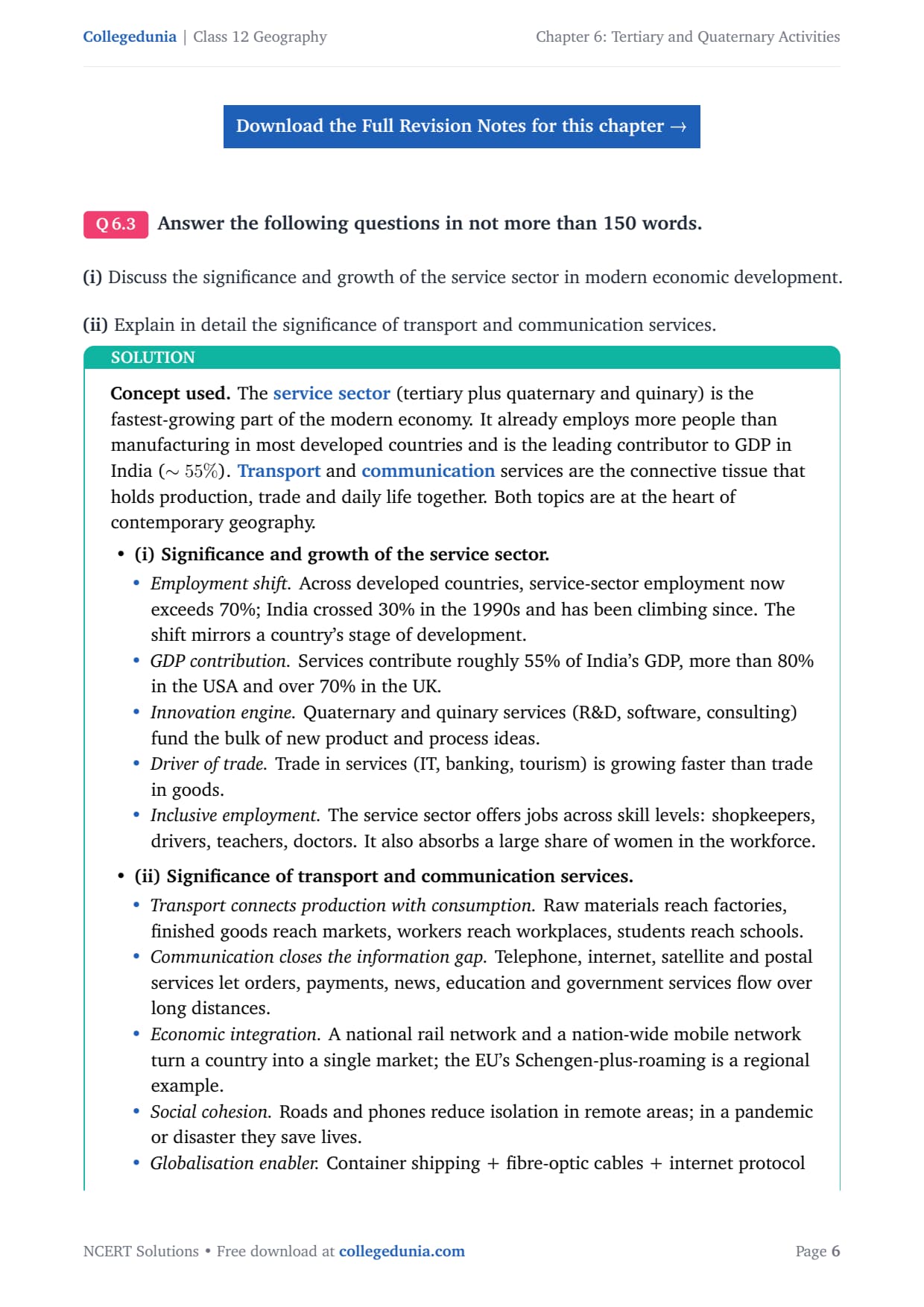
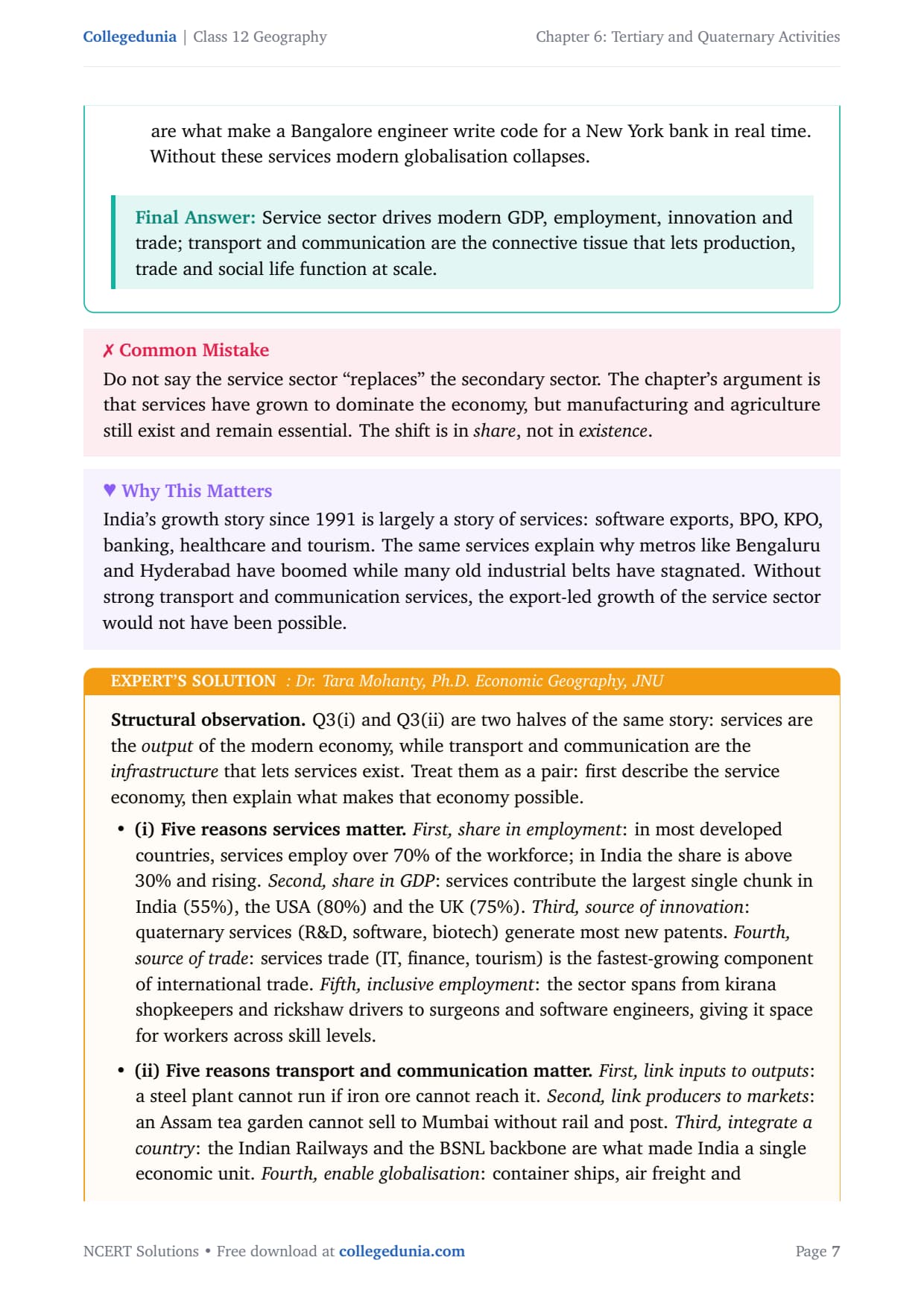
| Q6.3 (i) | Significance and growth of the service sector | Prose + bullets, 150 words | 5 marks |
| Q6.3 (ii) | Significance of transport and communication services | Prose + bullets, 150 words | 5 marks |
Q6.3 (i) and Q6.3 (ii) carry the most marks, so treat the five-sector idea as a structure, not just definitions.
Tertiary and Quaternary Activities Class 12: Key Concepts
Every question traces back to one idea: as economies develop, they shift from primary to secondary to service-based activities. Knowing what the service sector contains is where students recover the most marks.
What Are Tertiary Activities? The Core Idea
Tertiary activities are services. They do not make physical goods; they provide services consumed as they are produced. A doctor’s advice, a teacher’s lesson, a bus journey, a phone call are all tertiary. The key point is that they rely on the skills, knowledge and experience of workers, not on machinery.
- Trade and commerce: buying and selling goods. Rural marketing centres (mandis) serve villages; urban ones serve wider specialised markets.
- Retail trading: selling directly to consumers in small quantities (kirana stores, supermarkets, e-commerce).
- Wholesale trading: bulk business through intermediary merchants, supplying retailers not consumers.
- Transport: moving people and goods; mode choice depends on time, cost and physical distance.
- Communication: sending information across space by telephone, internet, satellite and post.
From Tertiary to Quaternary: Knowledge-Based Work
Quaternary activities are knowledge work: producing, processing or transmitting information rather than goods. Research scientists, university teachers, software engineers, financial analysts and consultants all fit here. These are white-collar jobs needing long education and high wages.
Quinary activities sit at the very top, done by senior decision-makers: CEOs, top government officials and research directors who create ideas and make decisions that shape whole industries. The NCERT calls them “gold-collar” professions, whose importance far outweighs their numbers.
Outsourcing and the Geography of Knowledge Work
Outsourcing means giving a task to an outside agency to cut costs. When the work is sent to another country it is called off-shoring. High-wage countries like the USA and UK outsource to India, the Philippines and China because skilled workers cost less there.
| Type | What it involves | Skill level | Examples |
|---|---|---|---|
| BPO (Business Process Outsourcing) | Routine back-office tasks outsourced to a third party | Moderate | Call centres, data entry, customer support |
| KPO (Knowledge Process Outsourcing) | High-value knowledge tasks requiring specialist expertise | High | Legal research, equity analysis, biotech R&D, e-learning |
| Home shoring | Alternative to outsourcing: work done domestically by remote workers at home | Varies | Remote customer support, content moderation |
Key exam point: KPO is NOT the same as BPO. KPO uses highly skilled workers and generates more value. The NCERT states KPOs have higher business opportunity than BPOs, which is why statement (c) in Q6.1(vi) is false.
Five-Sector Activity Framework: One-Glance Sheet
Every MCQ in the chapter boils down to correctly placing an activity in this ladder. Use the table for a quick revision before the board exam or CUET paper.
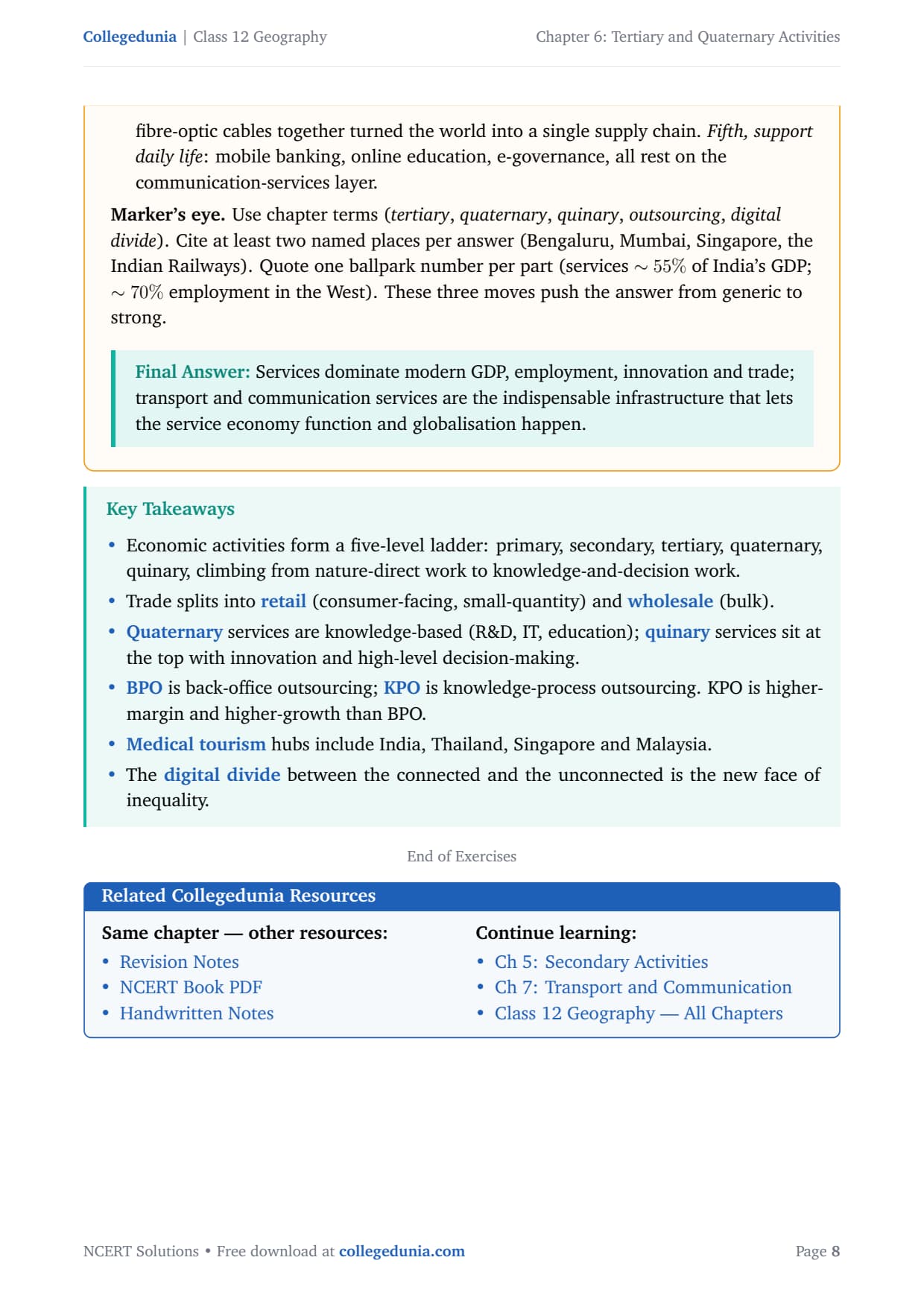
| Sector | What it produces | Collar colour | Examples |
|---|---|---|---|
| Primary | Raw materials from nature | Red / Green | Farming, fishing, mining, forestry |
| Secondary | Manufactured goods (transforms raw materials) | Blue | Steel plants, garment factories, bakeries |
| Tertiary | Services (trade, transport, communication) | Pink / Grey | Shopkeepers, teachers, doctors, drivers |
| Quaternary | Knowledge and information (research, IT, consulting) | White | Software engineers, researchers, financial analysts |
| Quinary | High-level decisions and innovation | Gold | CEOs, top government officials, research directors |
Exam tip: when an MCQ says “high degree of innovation” or “top-level decision-making,” pick quinary, not quaternary. Quaternary processes knowledge; quinary creates it. This resolves Q6.1(iv) every time.
Outsourcing, BPO and KPO: What Students Confuse
This topic produces the most mark-losses in the chapter. Here is the reasoning for why outsourcing happens and what BPO and KPO actually mean.
Why do developed countries outsource to India?
- Skilled workers are available at much lower wages than in the USA or UK.
- A large English-speaking educated workforce, important for voice-based BPO and legal KPO.
- Overhead costs (office space, electricity, staff) are far lower.
- The time-zone gap lets Indian teams work while US clients sleep, giving a 24-hour cycle.
- World-class IT hubs in Bengaluru, Hyderabad and Pune.
Result: over half a million Indians work in BPO or KPO for overseas firms. This creates jobs but also makes India dependent on decisions made in another country’s boardrooms.
The digital divide runs alongside this. Countries that gain from outsourcing need reliable internet, skilled workers and English ability; those without, mostly in sub-Saharan Africa, are shut out. Even within India, a worker in rural Bihar has far less access to KPO jobs than one in Bengaluru.
Common Mistakes Students Make on Tertiary Activities Questions
Five repeat-offender mistakes the CBSE examiner sees each year:
- Confusing quaternary with quinary: the MCQ word “innovation” always points to quinary; quaternary is knowledge processing.
- Saying BPO beats KPO: the NCERT says the opposite. KPO has higher value and margins (tested in Q6.1(vi)).
- Listing only India for medical tourism: name four or five (India, Thailand, Singapore, Malaysia, the Philippines).
- Treating retail and wholesale as the same: retail sells to consumers in small lots; wholesale sells in bulk to retailers.
- Ignoring the domestic digital divide: students cite the developed-vs-developing gap but forget the urban-vs-rural one, which CBSE and CUET both test.
Previous Year Question Trends from Tertiary and Quaternary Activities
The CBSE pattern for this chapter has stayed consistent. The table below maps the question types asked across recent board papers.
| Year | Question type asked | Marks |
|---|---|---|
| 2025 | Significance of the service sector + definition of digital divide | 5 + 3 |
| 2024 | MCQs on sector classification + short note on quaternary services | 1×3 + 3 |
| 2023 | Distinguish BPO from KPO + explain outsourcing and off-shoring | 3 + 5 |
| 2022 | Significance of transport and communication + medical tourism countries | 5 + 3 |
| 2021 | Define retail trading + short note on quinary activities | 3 + 3 |
Also Check: the full questions PDF ships with the downloadable PDF above, updated annually after each board paper.
Other Resources for Class 12 Geography Chapter 6 Tertiary and Quaternary Activities
Pair this NCERT Solutions PDF with the matching notes, handwritten notes and official NCERT book chapter, all linked below.
| Resource | What it covers | Open |
|---|---|---|
| NCERT Solutions | Step-by-step answers to all 3 exercise questions, with Expert’s Solution alternatives. | You are here |
| Notes | Concept-first revision notes covering all five activity sectors, outsourcing, BPO vs KPO, medical tourism and the digital divide. | Class 12 Geography Chapter 6 Notes |
| Handwritten Notes | Topper’s handwritten revision pages for last-minute board exam practice. | Class 12 Geography Chapter 6 Handwritten Notes |
| NCERT Book PDF | Official NCERT Fundamentals of Human Geography Chapter 6 textbook in PDF form. | Class 12 Geography Chapter 6 NCERT Book PDF |
| Subject Hub | All chapters of Class 12 Geography with every resource in one place. | Class 12 Geography Subject Hub |
Fundamentals of Human Geography: All Chapters NCERT Solutions
Related Links: Use the table below for the NCERT Solutions to the other chapters of Class 12 Fundamentals of Human Geography.
| Chapter | Topic | NCERT Solutions link |
|---|---|---|
| Chapter 1 | Human Geography: Nature and Scope | NCERT Solutions for Class 12 Geography Human Geography Nature and Scope |
| Chapter 2 | The World Population: Distribution, Density and Growth | NCERT Solutions for Class 12 Geography World Population |
| Chapter 3 | Human Development | NCERT Solutions for Class 12 Geography Human Development |
| Chapter 4 | Primary Activities | NCERT Solutions for Class 12 Geography Primary Activities |
| Chapter 5 | Secondary Activities | NCERT Solutions for Class 12 Geography Secondary Activities |
| Chapter 6 | Tertiary and Quaternary Activities | You are here |
| Chapter 7 | Transport and Communication | NCERT Solutions for Class 12 Geography Transport and Communication |
| Chapter 8 | International Trade | NCERT Solutions for Class 12 Geography International Trade |
All NCERT Solutions for Class 12 Geography Chapter 6 Tertiary and Quaternary Activities with Step-by-Step Solutions
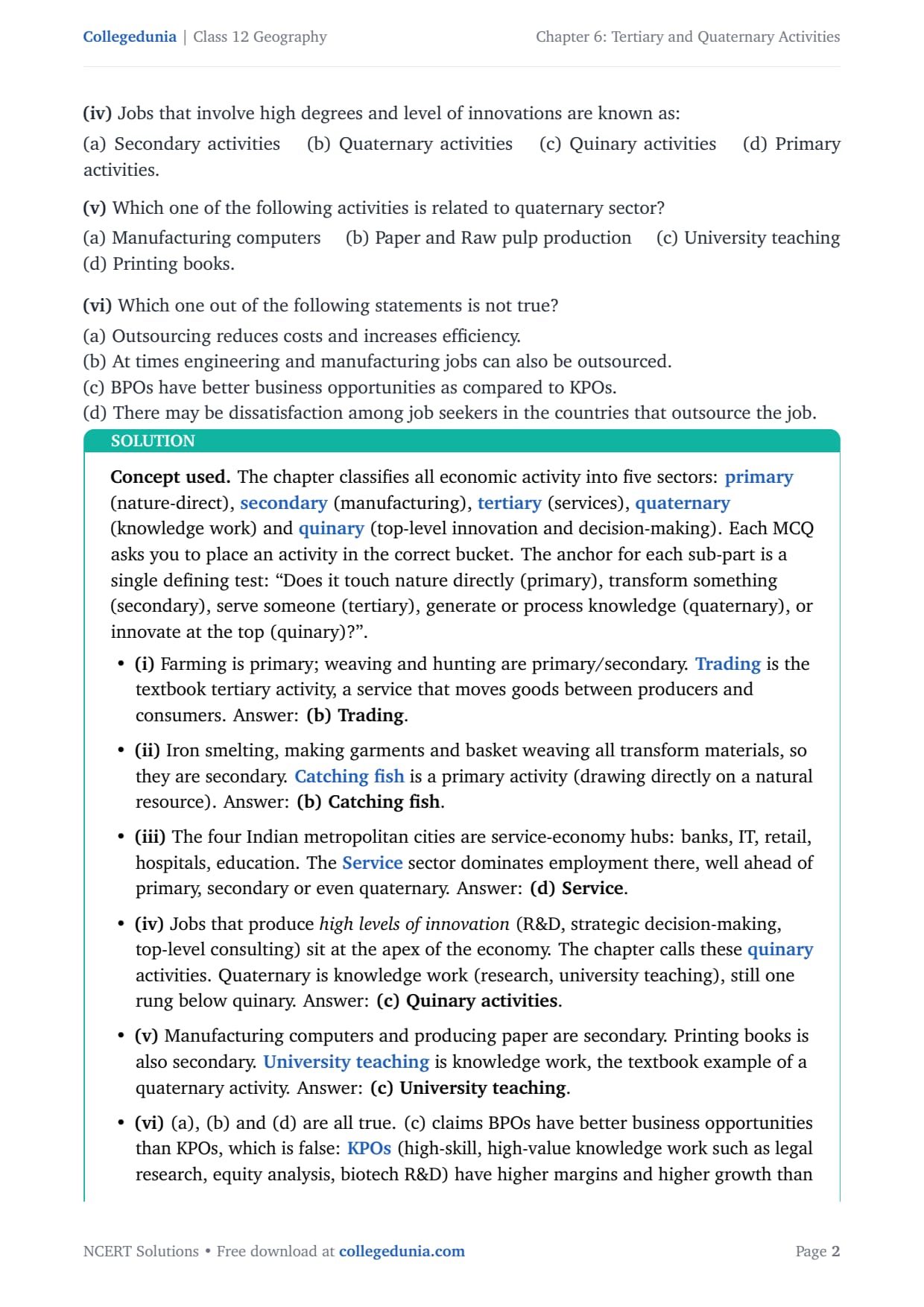
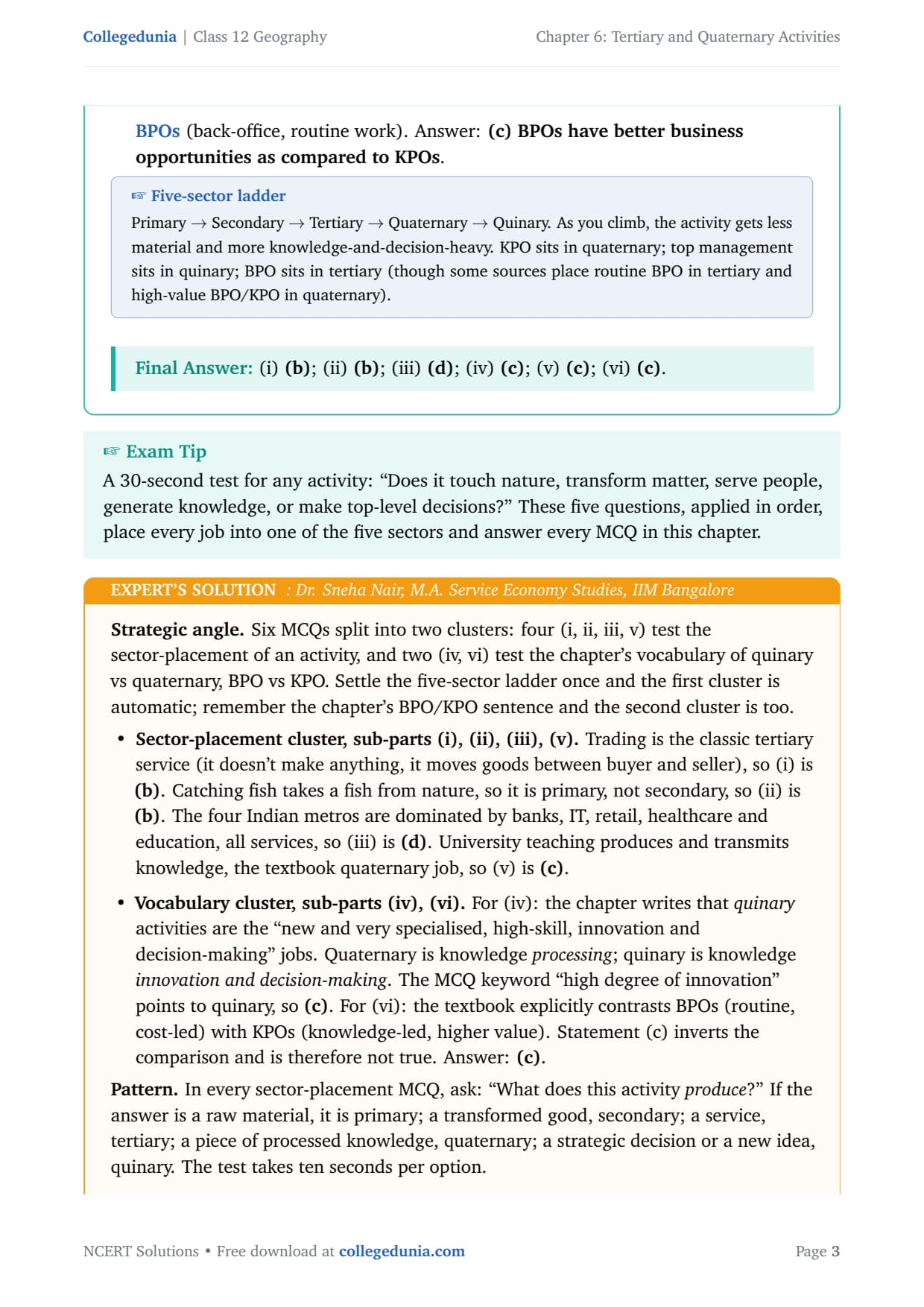
Choose the right answer from the four alternatives given below.
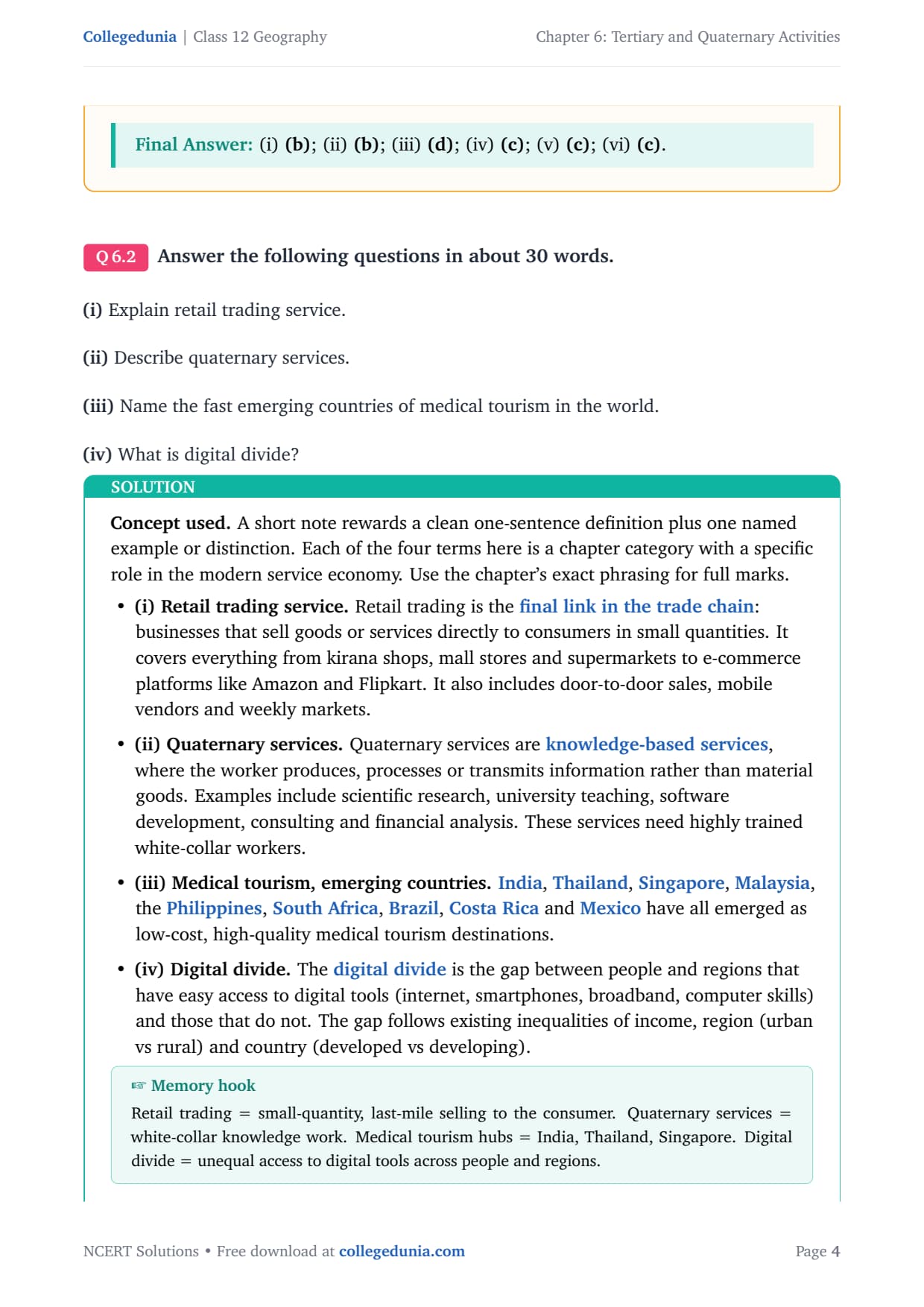
Answer the following questions in about 30 words.
Answer the following questions in not more than 150 words.
FAQs on NCERT Solutions for Class 12 Geography Chapter 6 Tertiary and Quaternary Activities
Ques. What are tertiary activities in Class 12 Geography?
Ans. Tertiary activities are service activities that provide useful services to producers and consumers rather than directly producing physical goods. They include trade and commerce, transport, communication, and professional services such as health, education, banking and law. The NCERT textbook emphasises that tertiary activities rely on the specialised skills, knowledge and experience of workers rather than on machinery or physical transformation of raw materials. Common examples are the work of a teacher, doctor, lawyer, shopkeeper, driver, cashier and publisher. Tertiary activities are the dominant sector in developed economies, employing over 70% of the workforce in countries like the USA, UK and Japan.
Ques. What is the difference between quaternary and quinary activities in Class 12?
Ans. Quaternary activities are knowledge-based service activities that involve collecting, producing and disseminating information. Examples include scientific research, university teaching, software development, financial consulting and data analysis. Quinary activities are a further subset at the very top of the hierarchy. They focus on the creation, re-arrangement and interpretation of new and existing ideas and involve senior decision-makers such as CEOs, top government officials, research directors and high-level legal and financial consultants. The NCERT textbook calls them “gold-collar” professions. The key difference: quaternary workers process knowledge; quinary workers create new knowledge and make strategic decisions with it.
Ques. What is outsourcing? How is it different from off-shoring?
Ans. Outsourcing means giving a task or business process to an outside agency to improve efficiency and reduce costs. When this outsourcing involves transferring the work to a location in another country, it is called off-shoring. In everyday use, both terms are often used together to describe companies in developed countries (USA, UK) sending work to countries like India, the Philippines and China where skilled workers cost less. Business activities that are outsourced include IT, customer support, call centre services, human resources and at times also manufacturing and engineering. India has benefited enormously from outsourcing, especially in information technology and knowledge process outsourcing.
Ques. What is the digital divide? Give one example from India.
Ans. The digital divide is the gap between people, regions and countries that have easy access to digital tools such as the internet, smartphones, broadband and computers, and those that do not. The gap follows existing inequalities of income, geography and education. Globally, developed countries have much higher internet penetration than developing countries. Within India, metropolitan cities like Delhi, Mumbai, Bengaluru and Hyderabad have excellent broadband and mobile connectivity, while many rural areas in states like Bihar, Jharkhand and Odisha still have poor or no broadband access. This inner-country divide means that rural students and workers cannot access online education, e-government services or remote work opportunities that urban people take for granted.
Ques. Which countries are the top medical tourism destinations?
Ans. The NCERT chapter names several countries that have emerged as medical tourism hubs because they combine high-quality healthcare with significantly lower costs than Western countries. The main destinations are India (Apollo, Fortis, Medanta hospitals), Thailand (Bumrungrad International in Bangkok), Singapore (Mount Elizabeth, Raffles Medical), Malaysia, the Philippines, South Africa, Brazil, Costa Rica and Mexico. India stands out because its best hospitals match international standards, English-speaking staff are widely available, and the cost of a procedure is often 10 to 20% of what it would cost in the USA or UK.
Ques. Is Tertiary and Quaternary Activities Chapter 6 important for CBSE Class 12 boards?
Ans. Yes, this is one of the most consistently tested chapters in Class 12 Geography. Every CBSE board paper from 2021 to 2025 has carried at least one question from this chapter, ranging from 1-mark MCQs on sector classification to 3-mark short notes on retail trading, quaternary services or the digital divide, to 5-mark long answers on the significance of the service sector and the role of transport and communication. Knowing the five-sector ladder, the BPO versus KPO distinction, the outsourcing geography and the digital divide is essential for full marks. CUET Geography also tests this chapter annually.
Ques. What is the difference between BPO and KPO?
Ans. BPO stands for Business Process Outsourcing. It involves outsourcing routine, back-office business tasks such as customer support, data entry and call centre operations to a third-party agency, often in another country. KPO stands for Knowledge Process Outsourcing. It involves outsourcing high-value tasks that require specialist expertise, deep knowledge and analytical skills, such as legal research, equity analysis, biotech research, e-learning content and intellectual property research. KPO workers are more highly skilled and better paid than BPO workers. The NCERT textbook states clearly that KPO has better business opportunities and higher margins than BPO, which is why the MCQ statement that “BPOs have better business opportunities than KPOs” is explicitly false.



Comments