




Land, labour and military protection shaped life in medieval Europe. The NCERT Solutions for Class 11 History Chapter 4 The Three Orders explain these links through six textbook exercise answers. For the 2026-27 session, use the answers to compare social groups, trace changes in population and explain how towns and stronger monarchies changed feudal society.
- Four brief answers and two short essays from the NCERT exercise
- Compare clergy, nobles, free peasants, serfs and Roman slaves
- Explain causes and effects using examples from medieval France and England
The Collegedunia explanations follow the six exercise questions and historical evidence in the NCERT chapter.
After writing an answer, ask a classmate to check your evidence. Can they identify the cause, the change and its effect? Use their comments to improve any missing link. Share feedback on the Collegedunia answers with your teacher.
The Three Orders: What the Six NCERT Questions Ask
The exercise moves from brief explanations to longer comparisons. Four questions require brief answers; two require short essays. Read the command word before choosing your facts.
| Question | Focus | What your answer needs |
|---|---|---|
| 1 | Early feudal France | Two features, each explained through land or personal dependence |
| 2 | Population change | Effects of growth and decline on farming, trade and labour |
| 3 | Knights | Their military role, support through fiefs and later decline |
| 4 | Monasteries | Prayer, study, manual work and their wider social role |
| 5 | A craftsman's day | A plausible town setting, workshop routine and guild rules |
| 6 | French serf and Roman slave | Compare legal status, work, family life and freedom |
Open The Three Orders questions and detailed answers.
The Three Orders: Society and Feudalism
Source: Magnet Brains on YouTube
The lecture uses older chapter numbering. Its topic matches Chapter 4 in the current textbook.
The Three Orders: Social Groups and Terms to Keep Separate
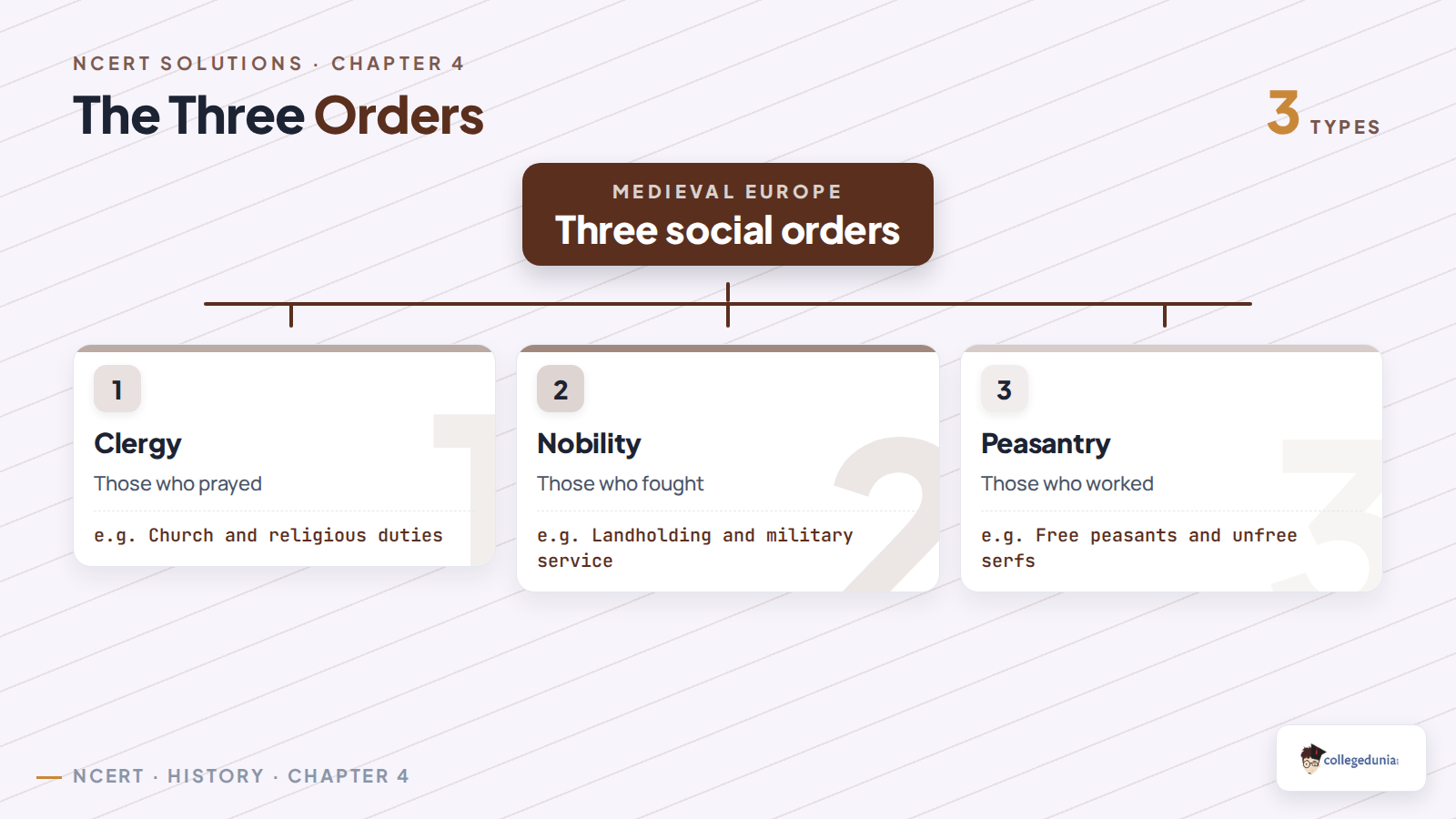
The three orders described an ideal social division, not every occupation in Europe. Townspeople and merchants became increasingly important. Landownership gave nobles power over both work and justice.
| Term | Meaning in the chapter |
|---|---|
| Clergy | The first order, responsible for religious duties; the Church also held land and collected tithes. |
| Nobility | The second order, whose land and military power supported their privileged position. |
| Peasantry | The third order, including free peasants and serfs who cultivated land. |
| Fief | Land granted to support a vassal's obligations, including a knight's military service. |
| Manor | A lord's estate with fields, dwellings and facilities for production. |
A tithe was the Church's claim to a tenth of agricultural produce. Do not confuse it with every payment peasants owed lords.
The Three Orders: How Population Changed Work and Power
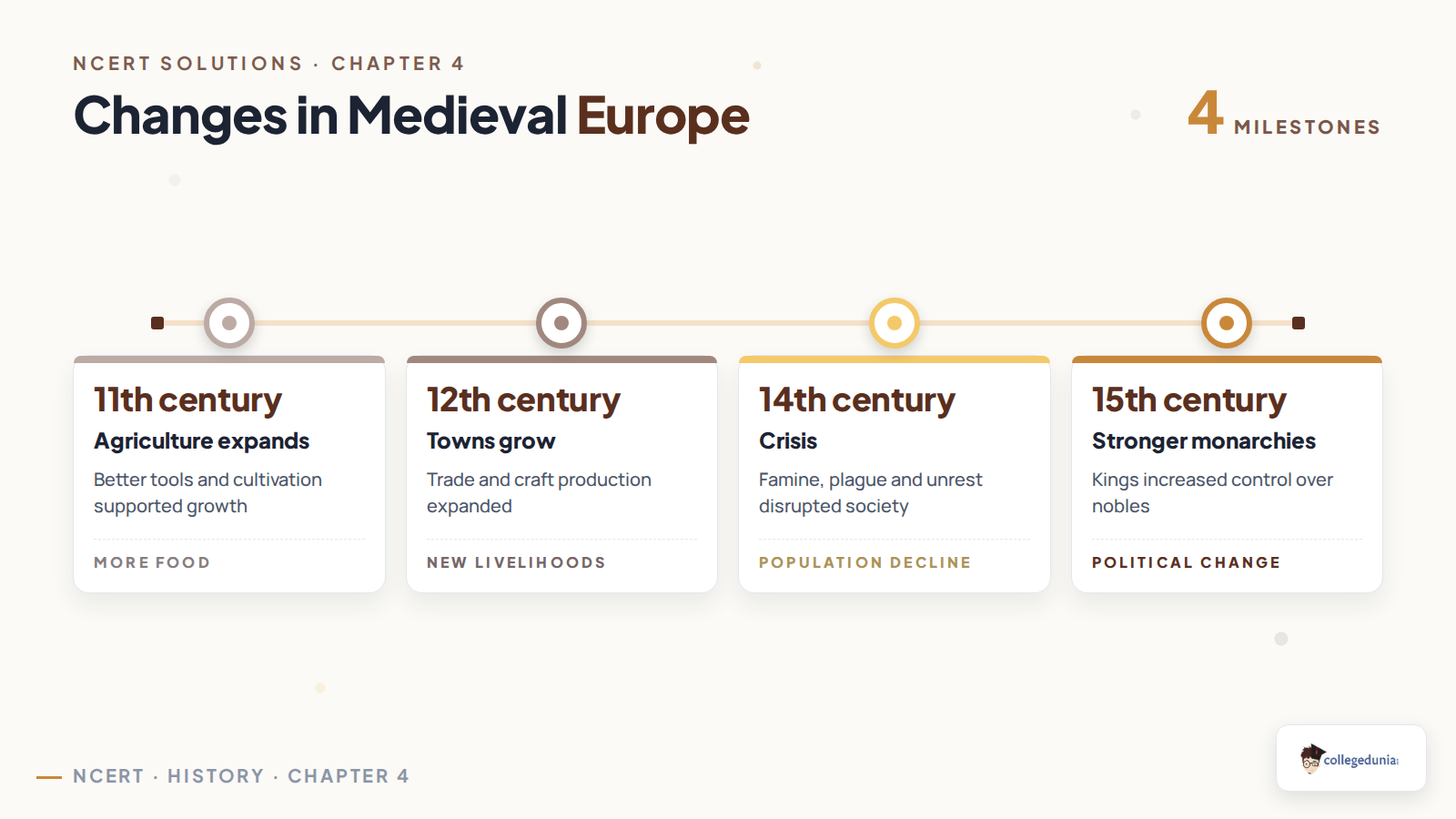
Population growth increased demand for food and encouraged cultivation on more land. Agricultural improvements helped support this growth. Surplus produce and trade also supported towns.
- More cultivated land increased output, but pressure on resources later caused difficulties.
- Fourteenth-century crises included crop failures, famine and the Black Death.
- Population decline reduced the supply of labour and weakened demand for agricultural produce.
- Surviving workers could demand better terms; lords tried to restore older labour obligations.
Explain the direction of change before listing its effects. Population growth and population decline did not produce the same results.
The Three Orders: Improve Comparisons and Historical Essays
A comparison needs shared headings. A serf was tied to the lord's land; a slave could be bought and sold. Both faced coercion, but their legal positions differed.
- Begin with status and personal freedom, then compare duties and control over work.
- Explain serfs' access to plots and family households without presenting them as independent farmers.
- For the craftsman essay, include tools, materials, a workshop and guild standards.
- Keep imagined details consistent with medieval town life. Avoid modern factories, wages or working hours without evidence.
The Three Orders: All Six NCERT Exercise Answers
Expert sections present alternative editorial approaches, not separately verified contributors.
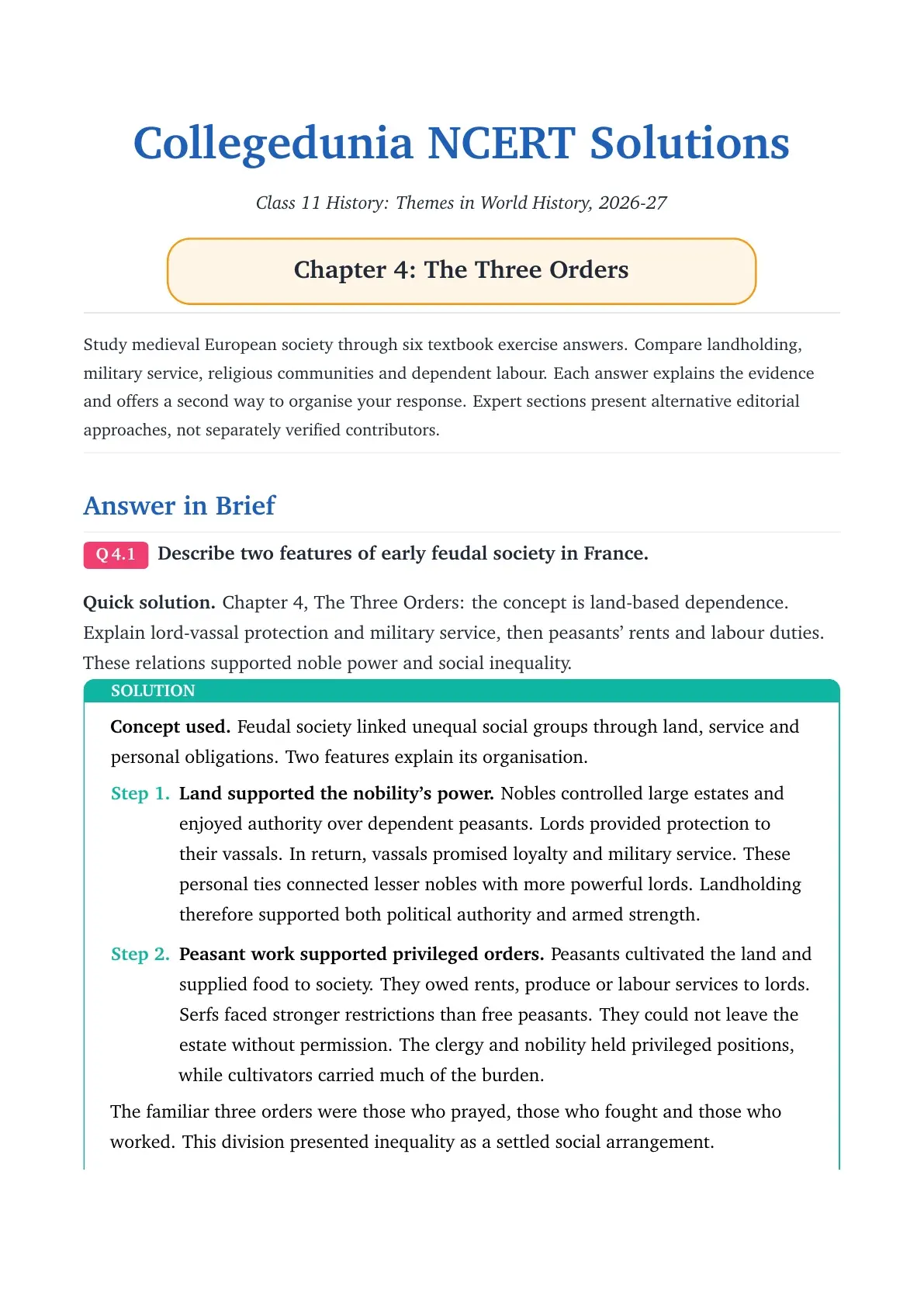
Answer in Brief
Describe two features of early feudal society in France.
Check Solution
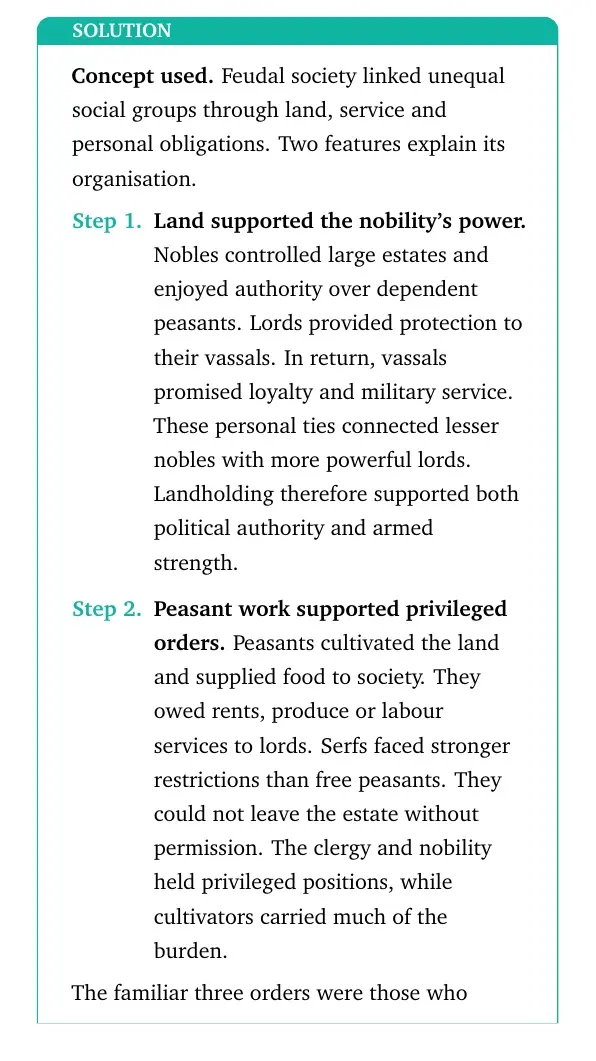
Concept used. Feudal society linked unequal social groups through land, service and personal obligations. Two features explain its organisation.
- Land supported the nobility's power. Nobles controlled large estates and enjoyed authority over dependent peasants. Lords provided protection to their vassals. In return, vassals promised loyalty and military service. These personal ties connected lesser nobles with more powerful lords. Landholding therefore supported both political authority and armed strength.
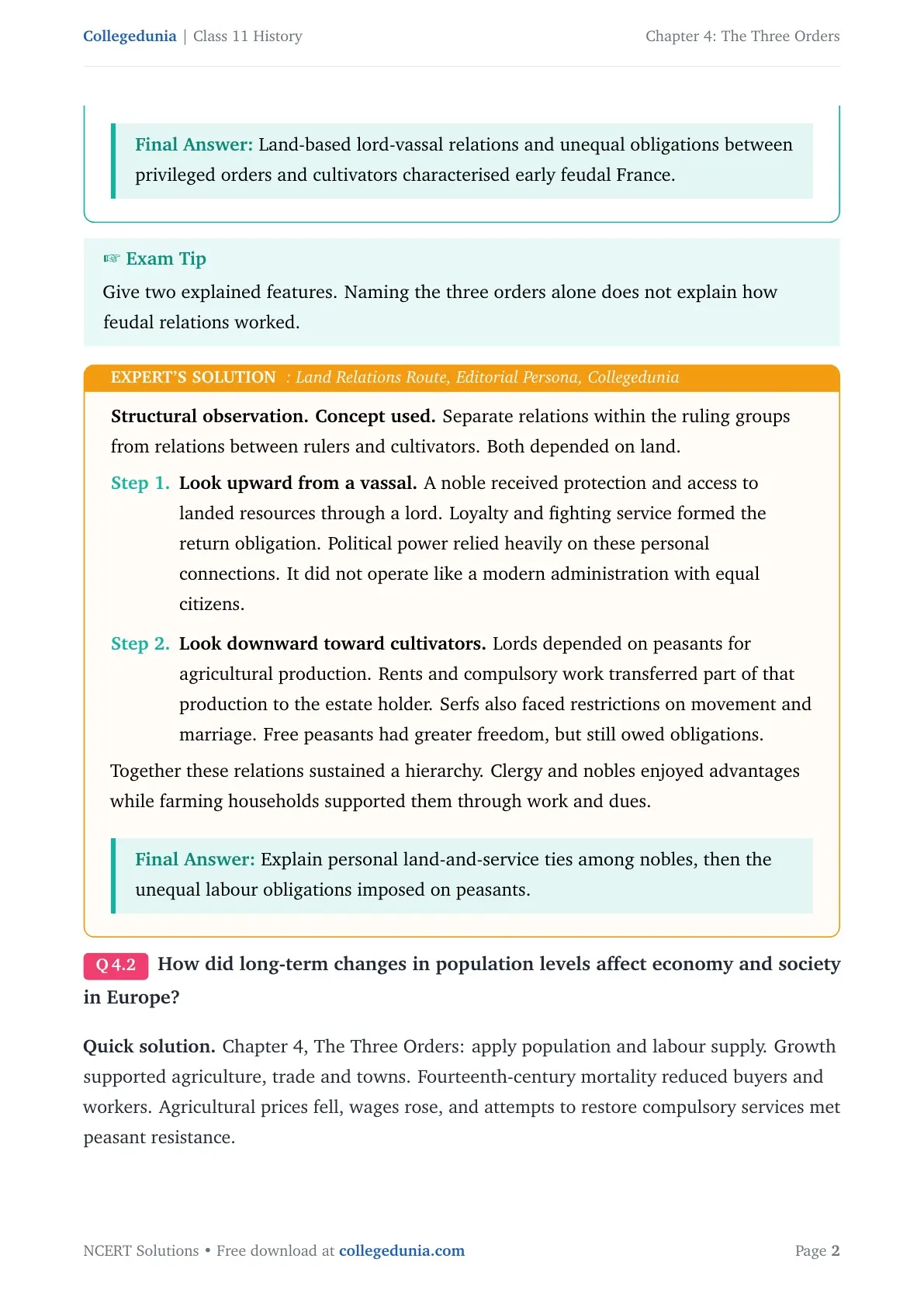
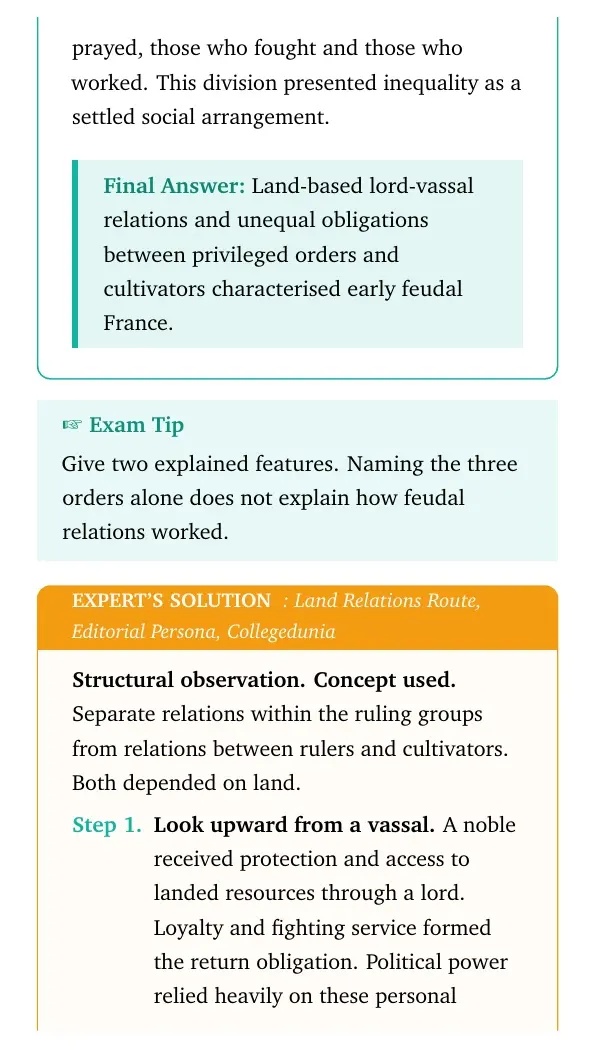
- Peasant work supported privileged orders. Peasants cultivated the land and supplied food to society. They owed rents, produce or labour services to lords. Serfs faced stronger restrictions than free peasants. They could not leave the estate without permission. The clergy and nobility held privileged positions, while cultivators carried much of the burden.
Expert Solution
Structural observation. Concept used. Separate relations within the ruling groups from relations between rulers and cultivators. Both depended on land.
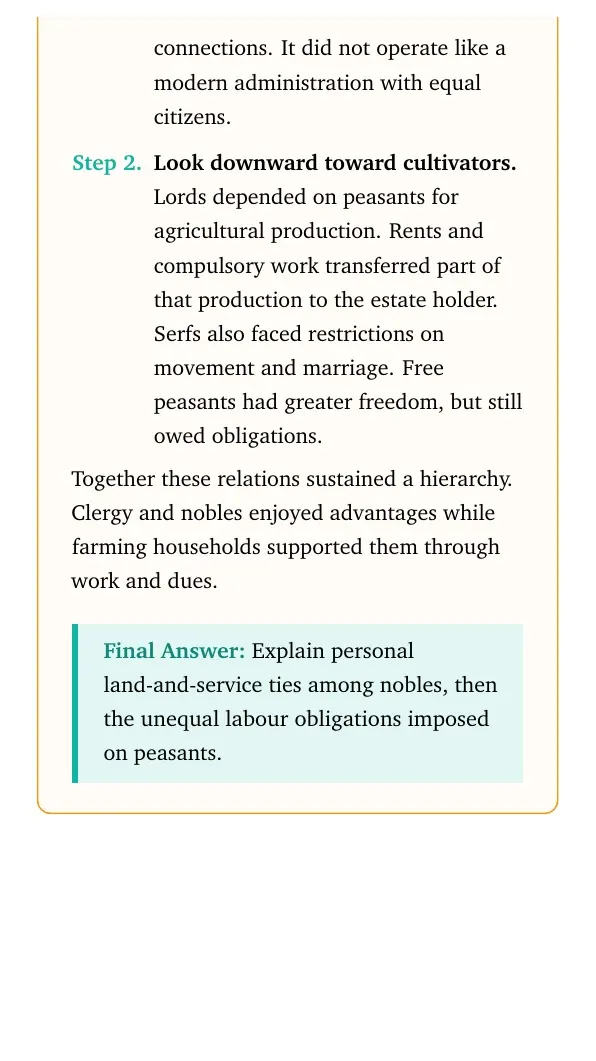
- Look upward from a vassal. A noble received protection and access to landed resources through a lord. Loyalty and fighting service formed the return obligation. Political power relied heavily on these personal connections. It did not operate like a modern administration with equal citizens.
- Look downward toward cultivators. Lords depended on peasants for agricultural production. Rents and compulsory work transferred part of that production to the estate holder. Serfs also faced restrictions on movement and marriage. Free peasants had greater freedom, but still owed obligations.
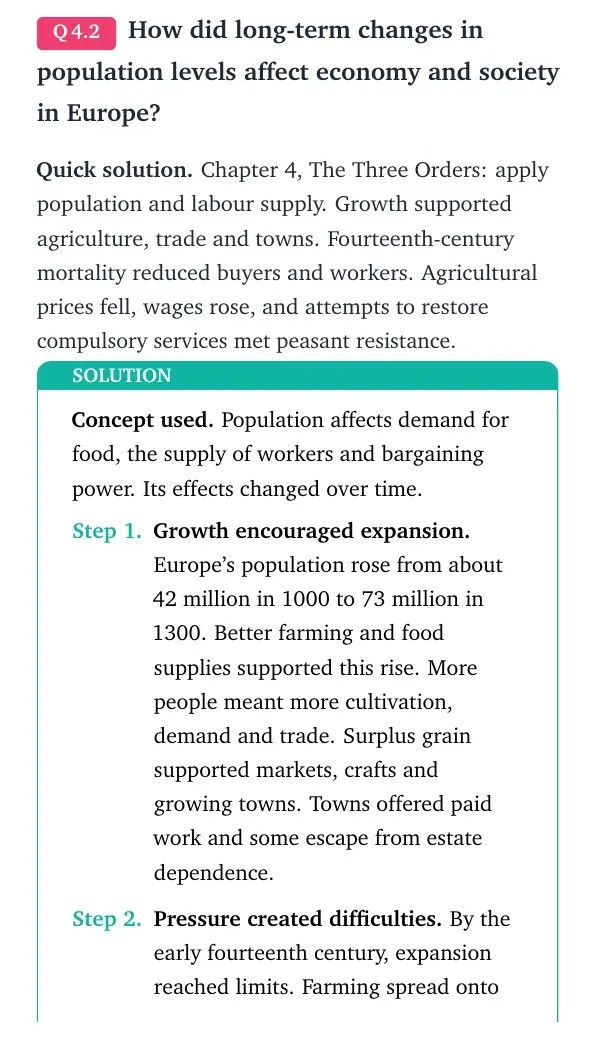
How did long-term changes in population levels affect economy and society in Europe?
Check Solution
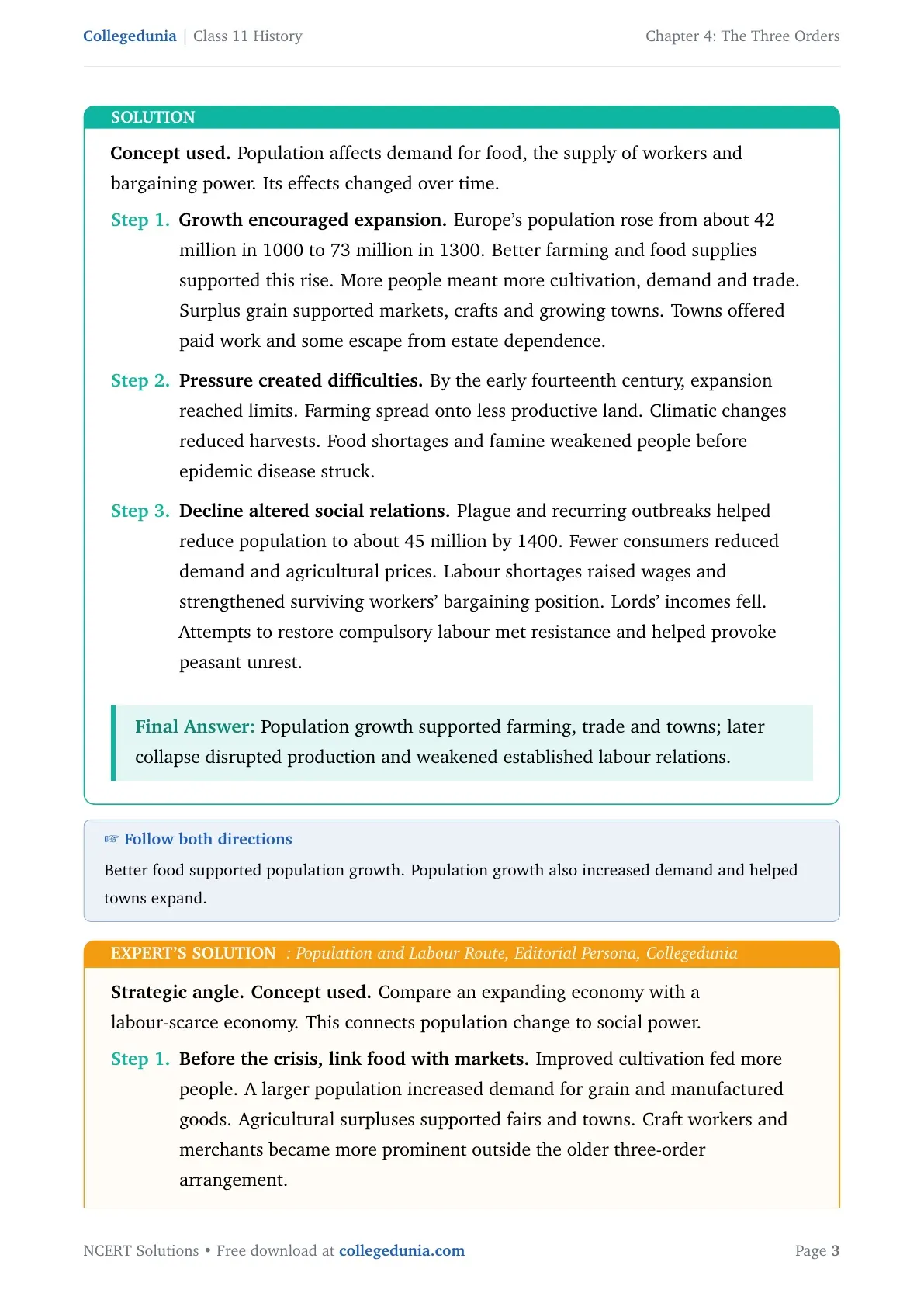
Concept used. Population affects demand for food, the supply of workers and bargaining power. Its effects changed over time.
- Growth encouraged expansion. Europe's population rose from about 42 million in 1000 to 73 million in 1300. Better farming and food supplies supported this rise. More people meant more cultivation, demand and trade. Surplus grain supported markets, crafts and growing towns. Towns offered paid work and some escape from estate dependence.
- Pressure created difficulties. By the early fourteenth century, expansion reached limits. Farming spread onto less productive land. Climatic changes reduced harvests. Food shortages and famine weakened people before epidemic disease struck.
- Decline altered social relations. Plague and recurring outbreaks helped reduce population to about 45 million by 1400. Fewer consumers reduced demand and agricultural prices. Labour shortages raised wages and strengthened surviving workers' bargaining position. Lords' incomes fell. Attempts to restore compulsory labour met resistance and helped provoke peasant unrest.
Expert Solution
Strategic angle. Concept used. Compare an expanding economy with a labour-scarce economy. This connects population change to social power.
- Before the crisis, link food with markets. Improved cultivation fed more people. A larger population increased demand for grain and manufactured goods. Agricultural surpluses supported fairs and towns. Craft workers and merchants became more prominent outside the older three-order arrangement.
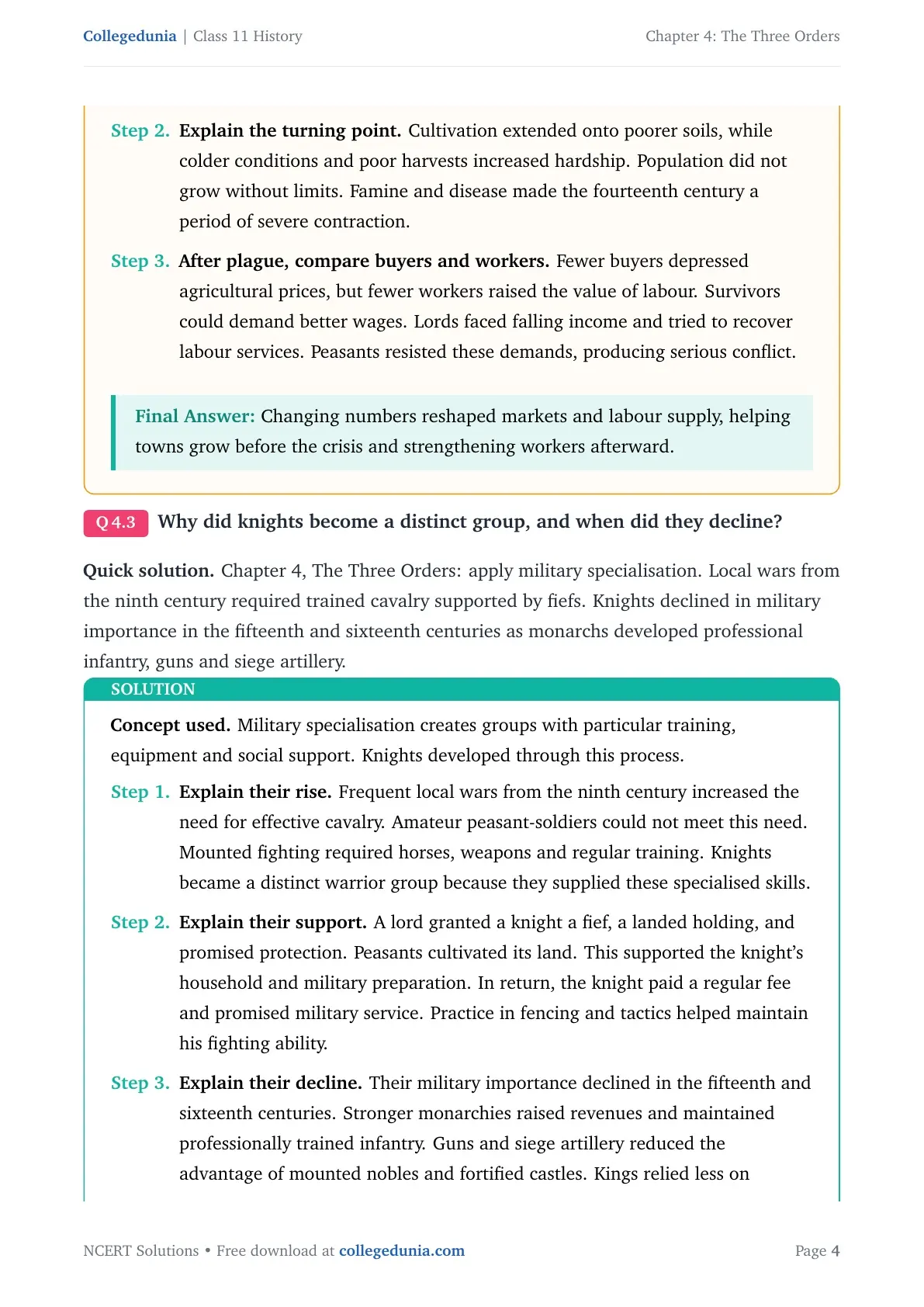
- Explain the turning point. Cultivation extended onto poorer soils, while colder conditions and poor harvests increased hardship. Population did not grow without limits. Famine and disease made the fourteenth century a period of severe contraction.
- After plague, compare buyers and workers. Fewer buyers depressed agricultural prices, but fewer workers raised the value of labour. Survivors could demand better wages. Lords faced falling income and tried to recover labour services. Peasants resisted these demands, producing serious conflict.
Why did knights become a distinct group, and when did they decline?
Check Solution
Concept used. Military specialisation creates groups with particular training, equipment and social support. Knights developed through this process.
- Explain their rise. Frequent local wars from the ninth century increased the need for effective cavalry. Amateur peasant-soldiers could not meet this need. Mounted fighting required horses, weapons and regular training. Knights became a distinct warrior group because they supplied these specialised skills.
- Explain their support. A lord granted a knight a fief, a landed holding, and promised protection. Peasants cultivated its land. This supported the knight's household and military preparation. In return, the knight paid a regular fee and promised military service. Practice in fencing and tactics helped maintain his fighting ability.
- Explain their decline. Their military importance declined in the fifteenth and sixteenth centuries. Stronger monarchies raised revenues and maintained professionally trained infantry. Guns and siege artillery reduced the advantage of mounted nobles and fortified castles. Kings relied less on personal feudal levies.
Expert Solution
Quick reading. Concept used. Read the question as a change in the organisation of warfare. Explain both demand and replacement.
- Ask who could fight effectively. Repeated local wars required trained mounted warriors. Peasants could not easily provide sustained cavalry service. Knights developed fighting skills through regular practice. This gave them a separate military identity from ordinary cultivators.
- Ask who paid for that service. A fief provided the resources needed by a knight and his dependants. The lord's grant tied the knight to personal military obligations. Land, protection and loyalty therefore helped turn military skill into a recognised social position.
- Ask what changed later. In the fifteenth and sixteenth centuries, monarchs used taxes to support trained infantry, guns and artillery. These forces weakened aristocratic military resistance. Royal armies increasingly replaced dependence on feudal cavalry levies, though nobles could retain influence through court and administrative service.
What was the function of medieval monasteries?
Check Solution
Concept used. A monastery was a religious community whose members followed a disciplined shared life. Its functions extended beyond worship.
- Religious life. Monks and nuns devoted themselves to prayer, study and manual work. They lived in separate religious communities and did not marry. Many monasteries stood away from ordinary settlements. Their routines offered an alternative to clerics living among townspeople and villagers.
- Work and learning. Members farmed and maintained their communities. Large monasteries owned estates and included schools or colleges. Study and copying manuscripts helped preserve learning. Their activities connected religious discipline with practical work and education.
- Care and culture. Some monasteries had hospitals and provided care. They also supported arts and religious music. Community singing formed an important part of worship. As communities expanded, their buildings and landed resources made them influential institutions.
Expert Solution
Structural observation. Concept used. Group monastic functions into spiritual, educational and social work. This avoids a narrow answer about prayer alone.
- Begin with the religious purpose. Monks and nuns withdrew into organised communities. Prayer, study and manual labour shaped their lives. They accepted disciplined routines and celibacy. Men's and women's communities were usually separate.
- Connect discipline with learning and production. Farming supported the community's needs. Study and manuscript work preserved religious and other learning. Larger monasteries developed attached schools or colleges. Their estates and buildings supported these expanding activities.
- Include service and artistic contributions. Hospitals provided care in some monastic establishments. Music and the arts also developed within religious communities. Singing prayers linked artistic practice directly to worship. These functions gave monasteries a wider influence beyond their own members.
Answer in a Short Essay
Imagine and describe a day in the life of a craftsman in a medieval French town.
Check Solution
Concept used. Historical reconstruction combines textbook evidence with a clearly identified imagined experience. The following account imagines a shoemaker's day.
- Morning work. I open my workshop near the market square after the morning bells. My family helps prepare the shop. I inspect leather and arrange tools before cutting material for shoes. Town life gives me customers beyond one village, but I must still find enough buyers.
- Guild and trade. My craft belongs to a guild, an association of workers in the same occupation. Its rules control quality, prices and sales. I check my work carefully before displaying it. Customers visit the shop, and traders bring supplies from other places. I exchange news about markets while bargaining over leather.
- Town obligations. The town occupies a lord's land, so townspeople pay taxes instead of the older labour services. Guards patrol the walls. The square, church and workshops bring together merchants, labourers and craftspeople. Civic ceremonies sometimes take place at the guild-hall.
- Evening life. I close my stall, count earnings and share a meal with my family. My livelihood depends on skilled work and customers. Towns offer greater independence than estate labour, although taxes and guild restrictions still shape my day.
Expert Solution
Picture-first. Concept used. Build an imagined day around three real features: workshop production, guild organisation and urban exchange.
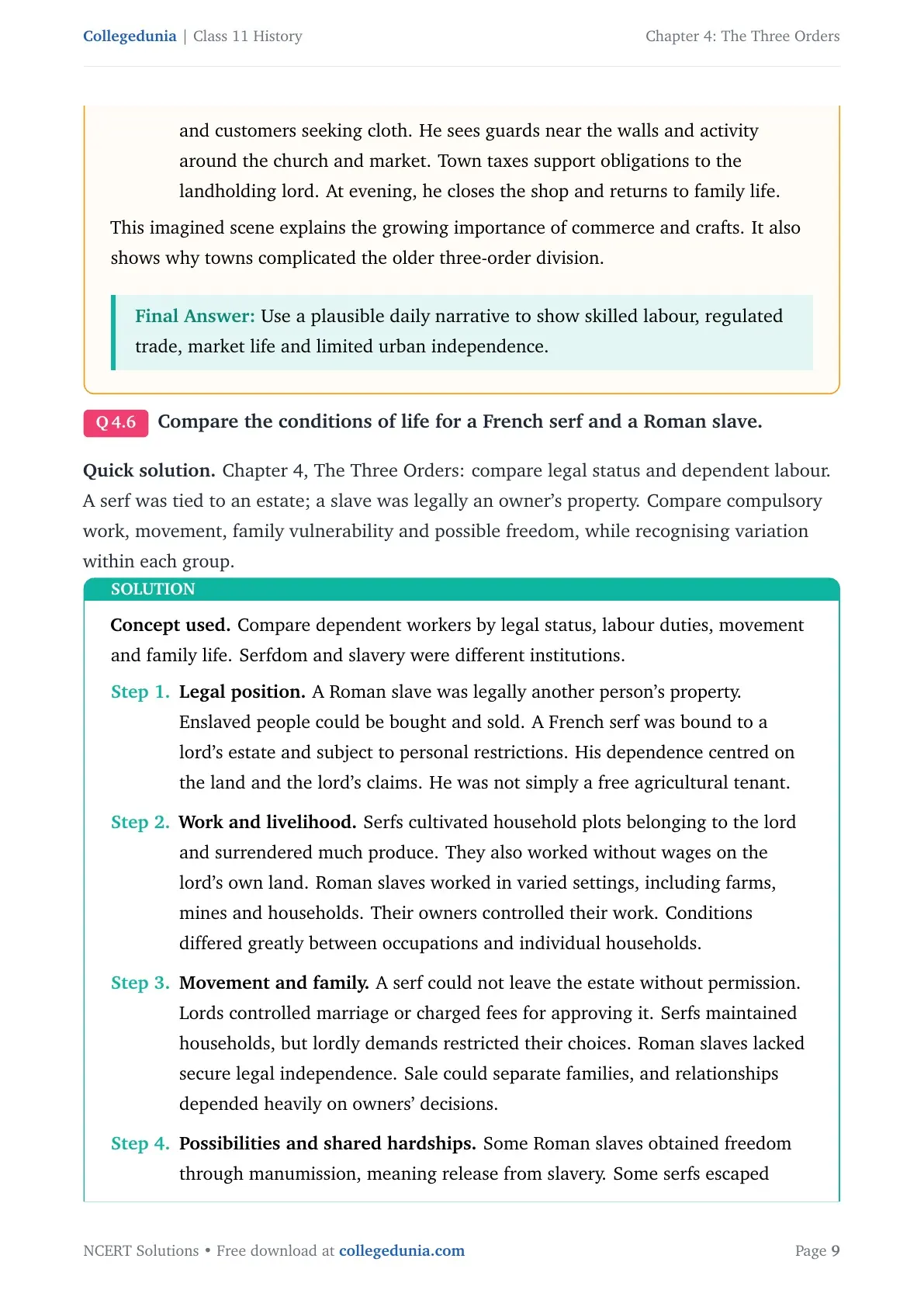
- Place the narrator in a workshop. Imagine a French weaver opening a small shop near the town square. He examines thread and begins weaving cloth. He works for buyers, rather than giving compulsory unpaid labour on a lord's estate. His income depends on both skill and demand.
- Show the guild's presence. The weaver belongs to an association regulating his craft. Quality standards, prices and sales rules affect what he produces. He cannot describe town work as complete freedom from authority. Rules protect recognised standards while limiting individual choices.
- Connect the shop with the town. He meets merchants bringing materials and customers seeking cloth. He sees guards near the walls and activity around the church and market. Town taxes support obligations to the landholding lord. At evening, he closes the shop and returns to family life.
Compare the conditions of life for a French serf and a Roman slave.
Check Solution
Concept used. Compare dependent workers by legal status, labour duties, movement and family life. Serfdom and slavery were different institutions.
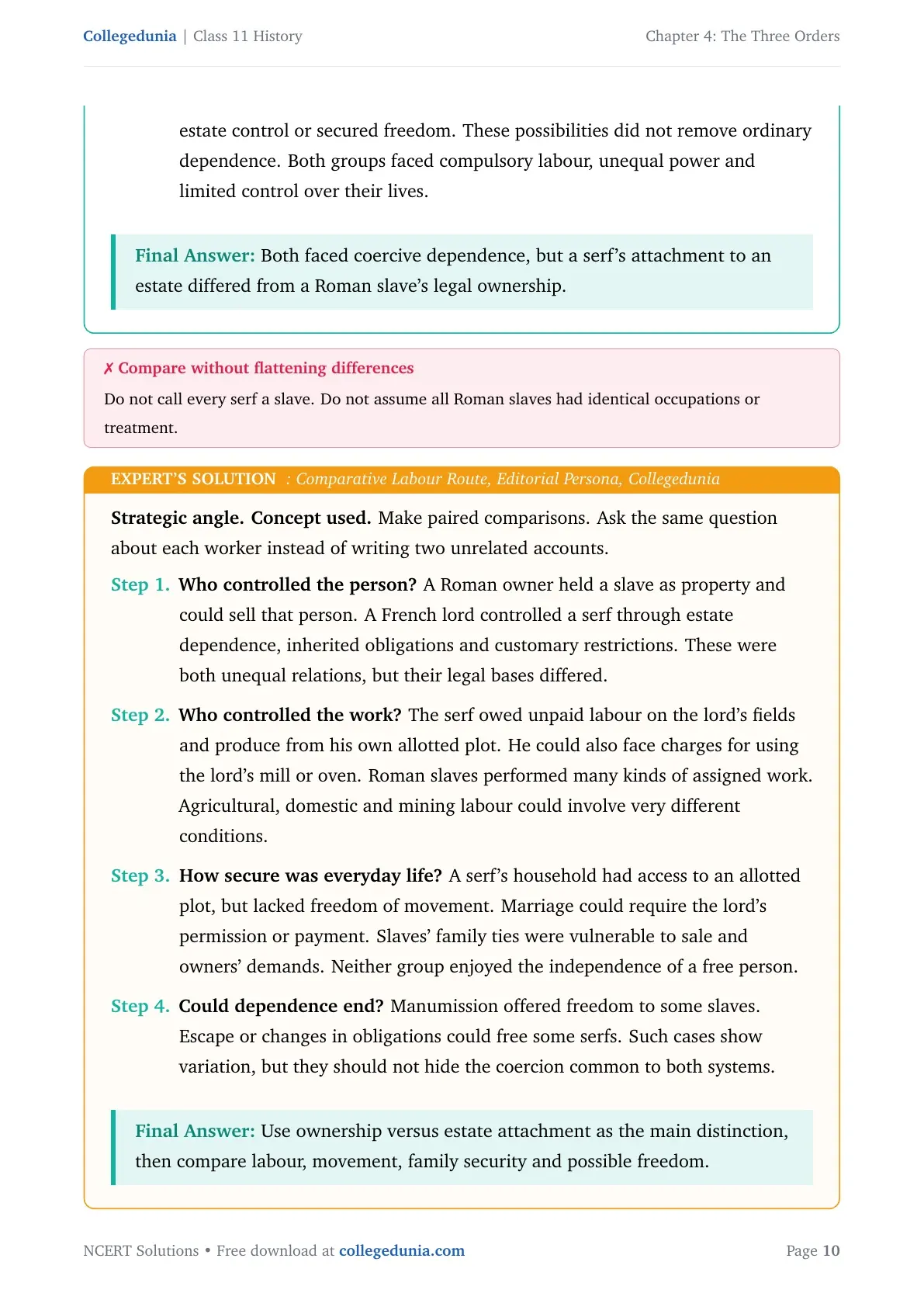
- Legal position. A Roman slave was legally another person's property. Enslaved people could be bought and sold. A French serf was bound to a lord's estate and subject to personal restrictions. His dependence centred on the land and the lord's claims. He was not simply a free agricultural tenant.
- Work and livelihood. Serfs cultivated household plots belonging to the lord and surrendered much produce. They also worked without wages on the lord's own land. Roman slaves worked in varied settings, including farms, mines and households. Their owners controlled their work. Conditions differed greatly between occupations and individual households.
- Movement and family. A serf could not leave the estate without permission. Lords controlled marriage or charged fees for approving it. Serfs maintained households, but lordly demands restricted their choices. Roman slaves lacked secure legal independence. Sale could separate families, and relationships depended heavily on owners' decisions.
- Possibilities and shared hardships. Some Roman slaves obtained freedom through manumission, meaning release from slavery. Some serfs escaped estate control or secured freedom. These possibilities did not remove ordinary dependence. Both groups faced compulsory labour, unequal power and limited control over their lives.
Expert Solution
Strategic angle. Concept used. Make paired comparisons. Ask the same question about each worker instead of writing two unrelated accounts.
- Who controlled the person? A Roman owner held a slave as property and could sell that person. A French lord controlled a serf through estate dependence, inherited obligations and customary restrictions. These were both unequal relations, but their legal bases differed.
- Who controlled the work? The serf owed unpaid labour on the lord's fields and produce from his own allotted plot. He could also face charges for using the lord's mill or oven. Roman slaves performed many kinds of assigned work. Agricultural, domestic and mining labour could involve very different conditions.
- How secure was everyday life? A serf's household had access to an allotted plot, but lacked freedom of movement. Marriage could require the lord's permission or payment. Slaves' family ties were vulnerable to sale and owners' demands. Neither group enjoyed the independence of a free person.
- Could dependence end? Manumission offered freedom to some slaves. Escape or changes in obligations could free some serfs. Such cases show variation, but they should not hide the coercion common to both systems.
The Three Orders Resources for Reading and Revision
Choose the textbook for evidence and notes for recall. Return to the exercise answers to practise explaining a historical argument.
| Resource | Use it for |
|---|---|
| The Three Orders Class 11 Notes (not yet available) | Revise institutions, agriculture and political change |
| The Three Orders NCERT Book PDF | Read the evidence and activities before answering |
| The Three Orders Handwritten Notes (not yet available) | Review terms and the sequence of changes |
NCERT Solutions for Class 11 History: All Chapters
Compare medieval European society with the Roman and Mongol worlds. The neighbouring themes also help explain later cultural and political changes.
| Chapter | NCERT Solutions |
|---|---|
| 1 | Writing and City Life Class 11 NCERT Solutions (not yet available) |
| 2 | An Empire Across Three Continents Class 11 NCERT Solutions (not yet available) |
| 3 | Nomadic Empires Class 11 NCERT Solutions |
| 4 | The Three Orders Class 11 NCERT Solutions |
| 5 | Changing Cultural Traditions Class 11 NCERT Solutions (not yet available) |
| 6 | Displacing Indigenous Peoples Class 11 NCERT Solutions (not yet available) |
| 7 | Paths to Modernisation Class 11 NCERT Solutions (not yet available) |
| Ncert Solutions Class 12 History Chapter 3 T1 Kinship Caste And Class | Further history study: Class 12 NCERT Solutions |
| Ncert Solutions Class 12 History Chapter 5 T2 Through The Eyes Of Travellers | Further history study: Class 12 NCERT Solutions |
| Ncert Solutions Class 12 History Chapter 9 T3 Colonialism And The Countryside | Further history study: Class 12 NCERT Solutions |
The Three Orders Class 11 History NCERT Solutions FAQs
Ques. How many exercise questions are in The Three Orders?
Ans. The NCERT exercise contains six questions: four brief answers and two short essays. The essays cover a craftsman’s day and a serf-slave comparison.
Ques. Where can I download The Three Orders solutions PDF?
Ans. Use the PDF section near the top of this page. Read the official textbook first, write your answer, then compare its facts and explanation with the solution.
Ques. Are The Three Orders solutions useful for the 2026-27 session?
Ans. These answers follow the exercise in the NCERT chapter marked Reprint 2026-27. Check your school’s prescribed syllabus and assessment instructions.
Ques. Why did knights become a distinct group?
Ans. Frequent local wars created demand for trained cavalry. Lords gave knights fiefs to support them in return for military service. Better infantry and firearms later weakened their role.
Ques. What did medieval monasteries do?
Ans. Monasteries organised prayer, study and manual labour. Monks copied manuscripts, worked on land and supported learning. Some communities also ran schools or hospitals.
Ques. Were manors fully self-sufficient?
Ans. No. They produced many daily necessities, but needed items such as salt, millstones and metalware from outside.
Ques. What were the three orders?
Ans. They were the clergy, nobility and peasantry. Medieval churchmen described their roles as praying, fighting and working.
Ques. How is feudalism defined in this chapter?
Ans. Feudalism describes medieval relationships based on land, labour obligations, protection and authority. Lords controlled land and exercised judicial power over dependent peasants.
Ques. What are serfs?
Ans. Serfs were dependent peasants tied to the lord’s land. They cultivated plots for their families and performed labour services on the lord’s land. Their movement and other choices were restricted.



Comments