



NCERT Solutions for Class 12 Chemistry (2026-27 syllabus) cover every back-exercise question in all 10 chapters of the rationalised NCERT textbook. They match the 70-mark CBSE theory paper plus the latest JEE Main, JEE Advanced, and NEET patterns.
Class 12 Chemistry NCERT Solutions PDF Download


Every chapter of the 2026-27 Class 12 Chemistry syllabus, with the chapter-specific NCERT Solutions PDF linked on each row. The list runs in NCERT order, the same order you would do the textbook in.
Every chapter comes as a free PDF you can download. The index below lets you jump straight to any chapter's worked-out solutions.
- Chapters covered: 10 chapters across 9 CBSE units, from Solutions to Biomolecules
- Format: chapter-wise PDFs plus combined all-chapters compilation, all free
- Exam alignment: CBSE Class 12 Chemistry theory paper (70 marks), NEET, JEE Main, JEE Advanced
Subject experts wrote every chapter in this Collegedunia Class 12 Chemistry NCERT Solutions set. Each one matches the 2026-27 rationalised NCERT. We also checked them against the last five years of CBSE Board and JEE / NEET papers.
How will Collegedunia's Class 12 Chemistry NCERT Solutions Help You?
In Class 12 Chemistry, neat working scores as much as the right answer. The Class 12 Chemistry NCERT Solutions on this page let you try every back-exercise question across 10 chapters. You can then check your working step by step, the way an examiner marks it on the CBSE board paper.
- 2026-27 NCERT alignment: every back-exercise question matches the rationalised Class 12 Chemistry syllabus. Deleted-content notes are flagged inline, so you do not waste time on dropped exercises.
- Two-tab Solution format per question: a short Solution shows the minimum steps a CBSE examiner expects. An Expert's Solution then adds the exam-level reasoning, with named-reaction mechanisms shown.
- Diagrams, derivations and reactions worked from scratch: every figure relabelled, every reaction mechanism drawn step by step.
- Cross-resource navigation: jump from any solution into the same chapter's Notes, Formula Sheet, Handwritten Notes, or Exemplar Solutions in one click.
- Checked by subject experts: every formula, derivation and final answer reviewed against the official NCERT textbook and the latest CBSE marking scheme.
- Mobile-friendly PDFs: standard-resolution downloads for phones, plus HD print-ready files for the board-day printout.
NCERT Solutions for Class 12 Chemistry
Source: Magnet Brains on YouTube
NCERT Class 12 Chemistry Topic Map (2026-27 NCERT)
Here is how the 10 Class 12 Chemistry chapters group into the CBSE units below. Inorganic Chemistry (Coordination + d/f Block) leads the syllabus at 14 of 70 theory marks. The other units carry about 4-14 marks each.
| Unit | Chapters | What this unit covers |
|---|---|---|
| II. Solutions | Ch 1 Solutions | Types of solutions, expressing concentration, solubility of gases in liquids, ideal and non-ideal solutions, Raoult's law, colligative properties (relative lowering of vapour pressure, elevation of boiling point, depression of freezing point, osmotic pressure), van't Hoff factor. |
| III. Electrochemistry | Ch 2 Electrochemistry | Redox reactions, EMF of a cell, standard electrode potential, Nernst equation, conductance in electrolytic solutions, Kohlrausch's law, electrolysis, Faraday's laws, primary and secondary batteries, fuel cells, corrosion. |
| IV. Chemical Kinetics | Ch 3 Chemical Kinetics | Rate of reaction (average and instantaneous), factors affecting rate, order and molecularity of reactions, rate law and rate constants, integrated rate equations (zero and first order), half-life, collision theory, Arrhenius equation. |
| VI. Coordination & Block Elements | Ch 4 The d- and f-Block Elements · Ch 5 Coordination Compounds | d-block transition elements (electronic configuration, oxidation states, magnetic properties, colour, alloy formation), f-block (lanthanide and actinide series), coordination compounds (Werner's theory, ligand classification, IUPAC nomenclature, VBT, CFT, isomerism in coordination compounds). |
| VII. Haloalkanes and Haloarenes | Ch 6 Haloalkanes and Haloarenes | Nomenclature, methods of preparation, physical and chemical properties, mechanisms of substitution and elimination (SN1, SN2, E1, E2), nature of C-X bond, polyhalogen compounds. |
| VIII. Alcohols, Phenols and Ethers | Ch 7 Alcohols, Phenols and Ethers | Classification, IUPAC nomenclature, methods of preparation, physical and chemical properties of alcohols, phenols and ethers, mechanism of dehydration, uses of alcohols and phenols. |
| IX. Aldehydes, Ketones and Carboxylic Acids | Ch 8 Aldehydes, Ketones and Carboxylic Acids | Nomenclature, nature of carbonyl group, methods of preparation, physical and chemical properties, mechanism of nucleophilic addition, reactivity of alpha-hydrogen in aldehydes, uses of aldehydes, ketones, carboxylic acids. |
| X. Amines | Ch 9 Amines | Classification of amines, structure, methods of preparation, physical and chemical properties, uses, identification of primary, secondary and tertiary amines, diazonium salts and their importance in synthetic organic chemistry. |
| XI. Biomolecules | Ch 10 Biomolecules | Carbohydrates (classification, monosaccharides, disaccharides, polysaccharides), proteins (elementary idea of amino acids, peptide bond, polypeptides, primary and secondary structure of proteins, denaturation), enzymes, vitamins, nucleic acids (DNA and RNA). |
NCERT Class 12 Chemistry Deleted Syllabus 2026-27
NCERT has trimmed the Class 12 Chemistry 2026-27 syllabus to lower the study load for CBSE Boards, JEE and NEET. The drops listed below are officially out of the 2026-27 question paper, so skip these while revising.
| Chapter | Deleted Topics (2026-27) |
|---|---|
| Solid State (formerly Ch 1) | Full chapter removed in the 2026-27 update. Unit cell and packing efficiency are no longer tested. |
| Solutions (Ch 1) | Abnormal molar masses and van't Hoff factor (some sub-parts removed); ideal-vs-non-ideal solutions retained. |
| Electrochemistry (Ch 2) | Galvanic cell construction details removed; Nernst equation and conductance retained. |
| Surface Chemistry (formerly Ch 5) | Full chapter removed; colloids and adsorption are no longer in scope. |
| Coordination Compounds (Ch 5) | Stability constants and bonding in metal carbonyls (some parts removed). |
| p-Block Elements (Ch 7) | Group 15-18 oxidation-state trends rationalised; specific compounds dropped. |
| Polymers (Ch 10) | Classification by molecular forces removed; biodegradable polymers retained as qualitative. |
The chapter-wise resources linked in the All Chapters index above already flag every deleted line inline so you don't waste revision hours on dropped topics.
Class 12 Chemistry Chapter-wise Important Questions
The five chapter clusters below carry most of the CBSE 2026 Class 12 Chemistry paper and repeat almost every year. The first column lists the long-answer topics that come up as 3-mark and 5-mark questions. The second column lists the questions that appear as 1-3 mark numericals, MCQs and case-studies in CBSE and JEE Main / NEET.
| Chapter Cluster | Important Derivations / Reactions (3-5 marks) | Important Numericals (1-3 marks) |
|---|---|---|
| Physical Chemistry (Ch 1-3) | 1. Raoult's law and ideal-solution derivation. 2. Nernst equation for EMF calculation. 3. Integrated rate law for first-order kinetics. | Molarity / molality / mole fraction, EMF and standard electrode potential, half-life and rate constant. |
| Inorganic - p-Block & d-f Block (Ch 4-5, 7-8) | 1. Lanthanoid contraction and consequences. 2. Werner's theory and ligand-classification. 3. Structure and bonding in interhalogen compounds. | Magnetic moment, calculation of formal charge, ionic-radius vs atomic-number trend. |
| Coordination Compounds (Ch 5) | 1. IUPAC nomenclature of complex ions. 2. Geometric and optical isomerism examples. 3. CFT splitting in octahedral and tetrahedral complexes. | Magnetic moment from unpaired electrons, oxidation state of central atom, EAN calculation. |
| Organic - Carbonyl & Carboxylic Acids (Ch 8) | 1. Aldol condensation mechanism. 2. Cannizzaro reaction with mechanism. 3. Acidity comparison of carboxylic acids vs phenols. | Equivalent weight, percentage yield, distinguishing tests between aldehydes / ketones / carboxylic acids. |
| Organic - Amines, Biomolecules & Polymers (Ch 9-10) | 1. Hofmann's bromamide reaction mechanism. 2. Carbylamine reaction for primary amines. 3. Structure of nucleotides / nucleosides. | Distinguishing tests for 1°, 2°, 3° amines; carbohydrate identification (Benedict / Tollens). |
The same five clusters appear in JEE Main 2026 and NEET UG 2026 with almost the same question split. JEE Main leans on physical-chemistry numericals, while NEET has more inorganic-chemistry MCQs. The Expert's Solution tab on each chapter page shows the JEE / NEET-style path next to the short CBSE board-style version.
NCERT SOLUTIONS · CLASS 12 CHEMISTRY
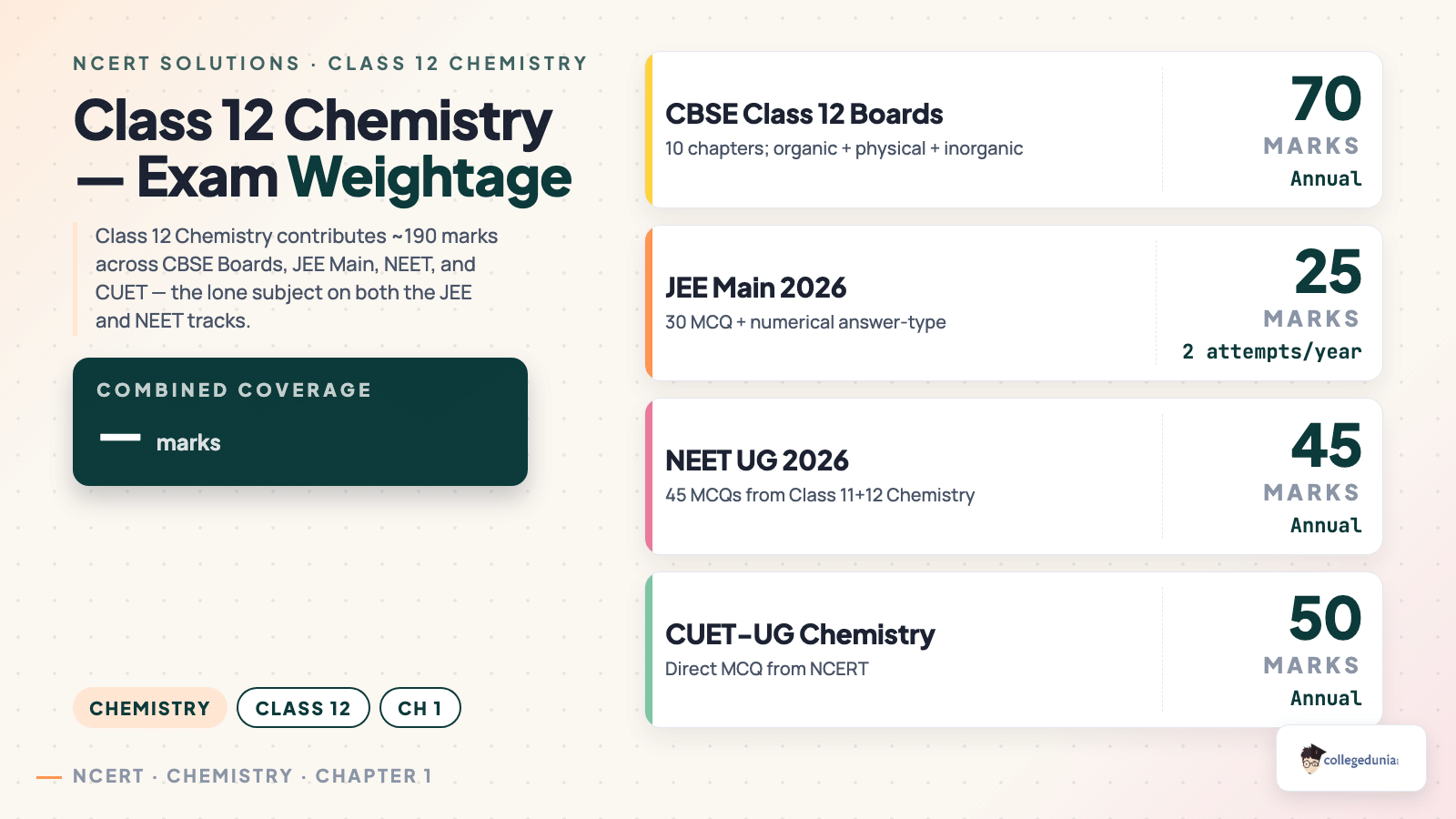
Class 12 Chemistry - Exam Weightage
Class 12 Chemistry adds up to about 200 marks combined across CBSE Boards, JEE Main, JEE Advanced and NEET UG. That makes it the second-heaviest science load after Physics on the main senior-school exams.
Class 12 Chemistry Weightage Snapshot (CBSE 2026 Theory Paper)
The 70-mark CBSE Class 12 Chemistry theory paper splits unevenly. Inorganic Chemistry (Coordination + d/f Block) leads the table at 14 marks combined, about 20% of the theory paper. The snapshot below uses the official CBSE 2026 blueprint plus the latest sample-paper pattern. The highest-weightage row has the Collegedunia orange tint.
| Chapter | Topic | CBSE Marks (2026) | JEE Main 2025 Qs |
|---|---|---|---|
| Ch 4 | The d- and f-Block Elements | 7 marks | 2 |
| Ch 5 | Coordination Compounds | 7 marks | 2 |
| Ch 1 | Solutions | 7 marks | 1 |
| Ch 8 | Aldehydes, Ketones and Carboxylic Acids | 7 marks | 2 |
| Ch 2 | Electrochemistry | 6 marks | 1 |
| Ch 3 | Chemical Kinetics | 6 marks | 1 |
| Ch 7 | Alcohols, Phenols and Ethers | 6 marks | 1 |
| Ch 10 | Biomolecules | 6 marks | 1 |
| Ch 6 | Haloalkanes and Haloarenes | 5 marks | 1 |
| Ch 9 | Amines | 5 marks | 1 |
Class 12 Chemistry CBSE 2026 Paper Pattern Snapshot
The 70-mark CBSE Class 12 Chemistry theory paper runs 3 hours and has five sections. Knowing the weight of each section is half the revision plan. Once you know which section a chapter feeds, you can pick the right resource: Notes for Section A recall, NCERT Solutions for Section C and D working.
- Section A (16 questions of 1 mark each): MCQs and assertion-reason. Tests definitions, named-reaction recall, and reaction-product prediction.
- Section B (5 questions of 2 marks each): Very short answer. One-step questions on named reactions, conversion sequences, and reasoning.
- Section C (7 questions of 3 marks each): Short answer. Numerical problems on colligative properties, Nernst equation, kinetics, plus reaction-mechanism questions.
- Section D (2 case-study questions of 4 marks each): Uses coordination chemistry, electrochemistry, or biomolecules in a passage.
- Section E (3 questions of 5 marks each): Long answer. Usually one inorganic (d / f-block or coordination), one organic synthesis, and one physical-chemistry problem.
The 70-mark theory paper plus the 30-mark internal assessment (practical, project, viva) makes the 100-mark scheme. Internal marks go up as your lab notebook and viva prep improve. The theory paper is where your chapter-wise NCERT prep really shows.
Where to Start with Class 12 Chemistry NCERT Solutions
NCERT order is the safest reading sequence. But if your revision window is tight, a weightage-first plan helps more. The six-chapter shortlist below delivers 40 of 70 board marks:
- Chapter 4, The d- and f-Block Elements (7 marks): the main inorganic chapter in the paper. Lanthanide contraction, magnetic behaviour, and oxidation-state comparison are common long-answer questions.
- Chapter 5, Coordination Compounds (7 marks): VBT, CFT, and isomerism in coordination complexes come up often in the board paper and score well on NEET.
- Chapter 1, Solutions (7 marks): colligative-properties numericals are near-sure marks. van't Hoff factor problems test both formula recall and how you use it.
- Chapter 8, Aldehydes, Ketones and Carboxylic Acids (7 marks): named reactions (Cannizzaro, aldol, Clemmensen, Wolff-Kishner) give 4-5 marks each. This is the reaction-mechanism block in organic chemistry.
- Chapter 2, Electrochemistry (6 marks): Nernst equation problems and conductance calculations are common 3-mark questions.
- Chapter 3, Chemical Kinetics (6 marks): first-order rate-constant problems and half-life calculations become easy once you practise them.
Together these six chapters cover most of the 70-mark theory paper. The rest still carry weight, but get one revision pass first. The priority six get two.
Class 12 Chemistry NCERT Solutions: PDF Formats and Languages
Every chapter in the Class 12 Chemistry NCERT Solutions index comes in three formats. It also comes in Hindi medium where the chapter is in the Hindi-medium NCERT.
- HD print-ready PDF: high-resolution text, best for printing as a revision booklet.
- Standard download PDF: smaller file size for phone reading.
- Hindi-medium PDF: chapter-wise Hindi translations using NCERT's own words (Rasayan Vigyan). Terms like विद्युत रसायन (electrochemistry), उपसहसंयोजन यौगिक (coordination compound), and जैव अणु (biomolecule) stay just as NCERT writes them.
- Combined all-chapters PDF: one file with every chapter back to back, handy for offline classroom use.
- Handwritten counterpart: the same content in notebook-style scanned-look format, handy for final-week revision.
How Class 12 Chemistry NCERT Solutions Pair with the Other Resources
The Class 12 Chemistry NCERT Solutions handle the back-exercise. They do not replace concept revision, formula recall, or harder problem sets. Those sit in sister resources that share the same chapter slugs.
- Class 12 Chemistry Notes: the concept revision before you try a question. Pair the Notes with the Solutions whenever a back-exercise question uses a derivation or definition you have not seen in a while.
- Class 12 Chemistry Formula Sheet: every formula, equation, and standard named reaction in one short reference for last-day recall.
- Class 12 Chemistry Exemplar Solutions: worked-out solutions for the harder Exemplar problems beyond the back-exercise. Move to Exemplar once you can solve the NCERT problems quickly.
- Class 12 Chemistry Handwritten Notes: notebook-style concept revision for the final week before the boards.
- Class 12 Chemistry NCERT Book PDF: the official textbook, with worked examples that use the same notation as the solutions on this page.
- Class 12 Chemistry Exemplar Book PDF: the NCERT Exemplar Problems book for extra practice.
How to Use the Class 12 Chemistry NCERT Solutions Page Most Effectively
The three-block plan below is the routine most CBSE toppers use.
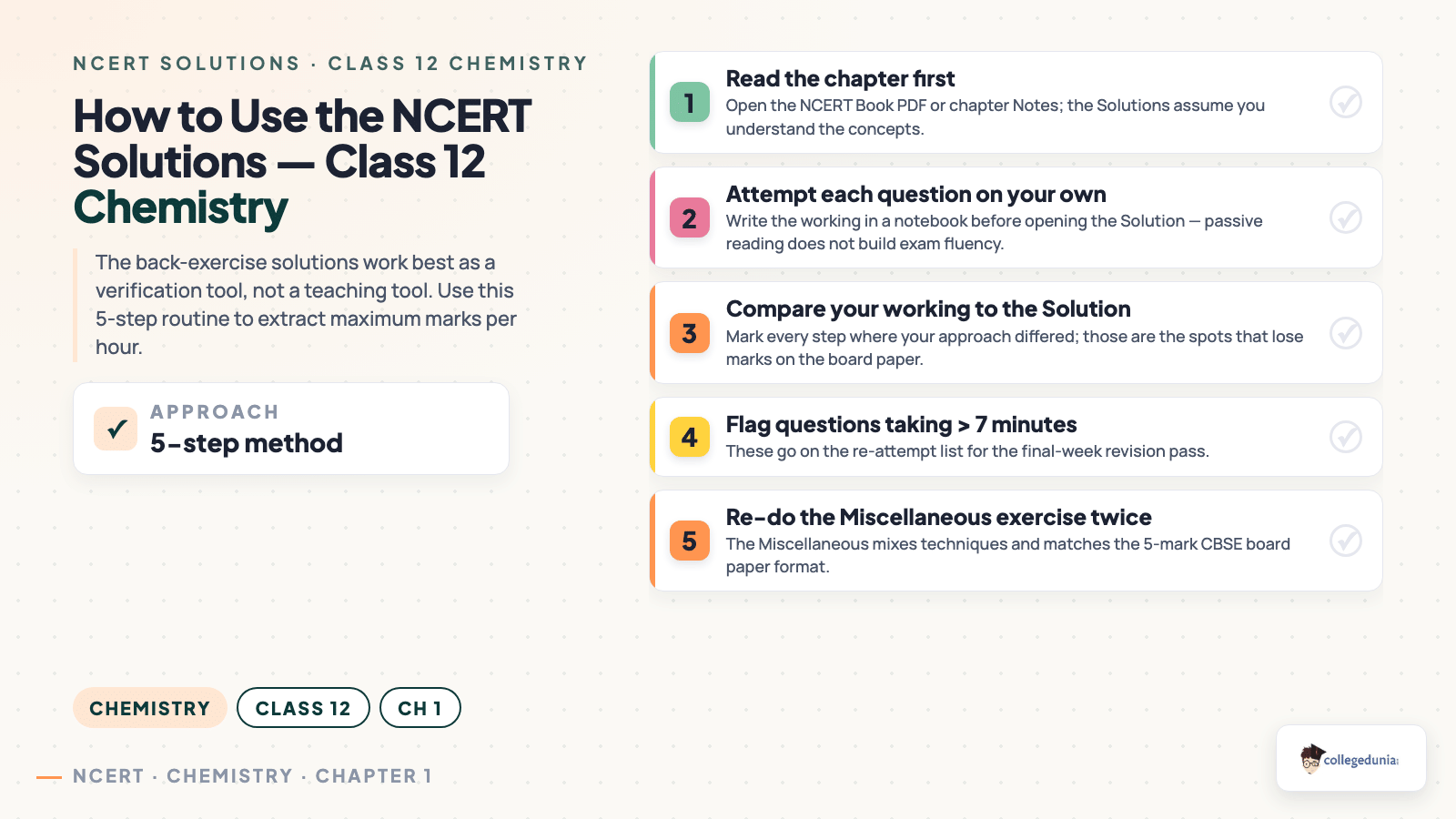
5-STEP METHOD · CBSE TOPPER ROUTINE
How to Use the NCERT Solutions - Class 12 Chemistry
- 1Read the chapter first. Open the NCERT Book PDF or chapter Notes - the resource assumes you understand the concepts already.
- 2Attempt each question on your own. Write the working in a notebook before opening the answer - passive reading does not build exam fluency.
- 3Compare your working to the resource. Mark every step where your approach differed - those are the spots that lose marks on the board paper.
- 4Flag questions taking over 7 minutes. These go on the re-attempt list for the final-week revision pass.
- 5Re-do the Miscellaneous exercise twice. The Miscellaneous mixes techniques and matches the 5-mark CBSE board-paper format closely.
- 1 month before the boards: work the chapter-wise back-exercise in NCERT order, and spend extra time on the priority six listed above. Open the Notes whenever you forget a concept.
- 2 weeks before the boards: switch to the Expert's Solution tab on every question. Mark every problem you could not solve in under 7 minutes. Those are the ones you re-attempt in the final week.
- 1 week before the boards: re-attempt only the marked problems, then finish with the Formula Sheet for last-day formula recall. Skim the Handwritten Notes the night before for a board-feel revision.
Common Mistakes NCERT Class 12 Chemistry Students Make Across Chapters
- Writing oxidation states without checking electron count: Chapter 4 students often write Mn(IV) without recalling the d3 configuration. Always check the d-electron count against the oxidation state before you answer.
- Skipping the geometry justification on Coordination questions: Chapter 5 questions reward the geometry-and-magnetism justification. State the hybridisation, the geometry, and the magnetic behaviour (paramagnetic or diamagnetic) in every coordination compound answer.
- Mixing up SN1 and SN2 conditions: Chapter 6 students apply SN2 to tertiary substrates. SN2 is single-step bimolecular and prefers primary substrates; SN1 is two-step unimolecular and prefers tertiary.
- Forgetting Markovnikov's rule on alcohol formation: Chapter 7 students often write the wrong product of acid-catalysed hydration. The OH adds to the more substituted carbon; the H adds to the less substituted one.
- Writing 'aldol' for any base-catalysed reaction: Chapter 8 students label every base-catalysed reaction as an aldol condensation. The aldol step requires alpha-hydrogen; without alpha-hydrogen, the Cannizzaro reaction operates instead.
- Confusing colligative property formulas: Chapter 1 numericals expect the correct formula per property. Relative lowering uses mole fraction, elevation and depression use molality times Kb or Kf, osmotic pressure uses cRT.
- Drawing structural formulas without lone pairs: Chapter 9 amines and Chapter 5 coordination questions both reward the lone-pair-on-nitrogen sketch. Skipping the lone pair on the basicity-comparison answer loses marks.
Student Feedback: What 14,380 Class 12 Chemistry Students Told Us
What 14,380 students told us about their Class 12 Chemistry board prep
- 72% of students rated Chapter 5 Coordination Compounds as the highest-effort chapter, ahead of Chapter 4 The d- and f-Block Elements at 61% and Chapter 3 Chemical Kinetics at 49%.
- Most-skipped chapter: Chapter 9 Amines (skipped by ~26% of students, even though it carries 5 marks). Toppers flagged this as a high-value chapter to pick back up, because the diazonium salt reactions repeat every year.
- Toppers said that working the Expert's Solution tab on every Chapter 4 The d- and f-Block Elements problem added 4-6 marks to their 70-mark theory paper score. Most of it came from the lanthanide-contraction and oxidation-state comparison questions.
- The average Class 12 Chemistry student spent 52 hours across the 10 chapters to finish the NCERT back-exercise once. Chapters 4, 5, 7 and 8 took the most time per question.
Also Check: Related Class 12 Chemistry Resources
- Also Check: CBSE Class 12 Chemistry chapter notes hub on Collegedunia Exams
- Also Check: CBSE Class 12 exam pattern, dates, and full-subject hub
- Also Check: CBSE Class 12 Syllabus 2026-27
- Also Check: JEE Main 2026 exam information
- Also Check: JEE Main 2026 Syllabus
- Also Check: JEE Advanced 2026 information
- Also Check: NEET 2026 exam information
- Also Check: NEET 2026 Syllabus
Topper-tested takeaways for Class 12 Chemistry NCERT Solutions
- Re-attempt every back-exercise question until your working matches the Solution's step count, not just the final answer.
- When the Solution and the Expert's Solution agree, the question is in scope for both boards and competitive exams.
- Mark every Solution where your working took longer than the printed steps. Those are the questions you revise the night before.
- Pair the Solutions with the Notes for any chapter you have not touched in the last six weeks.
Class 12 Chemistry NCERT Solutions FAQs
Ques. Where can I download the full Class 12 Chemistry NCERT Solutions PDF?
Ans. You can download every chapter-wise PDF for Class 12 Chemistry NCERT Solutions directly from the index above, from Chapter 1 Solutions through Chapter 10 Biomolecules. A combined all-chapters PDF is also there, free in both Normal and HD resolutions.
Ques. Are these Class 12 Chemistry NCERT Solutions aligned with the 2026-27 NCERT?
Ans. Yes. Every chapter on this page follows the current 2026-27 syllabus. Where NCERT removed content from the older edition (deleted exercises, dropped worked examples), the affected solutions carry an inline note about the change, so you do not over-revise dropped material.
Ques. How many chapters are there in Class 12 Chemistry per the 2026-27 NCERT?
Ans. Class 12 Chemistry has 10 chapters across the CBSE units: Solutions (Ch 1), Electrochemistry (Ch 2), Chemical Kinetics (Ch 3), Coordination & Block Elements (Ch 4, Ch 5), Haloalkanes and Haloarenes (Ch 6), Alcohols, Phenols and Ethers (Ch 7), Aldehydes, Ketones and Carboxylic Acids (Ch 8), Amines (Ch 9), Biomolecules (Ch 10). The Topic Map table above lists every chapter under its unit.
Ques. Which Class 12 Chemistry chapter has the highest CBSE board weightage?
Ans. Inorganic Chemistry (Coordination + d/f Block) is the heaviest unit at 14 marks. The Weightage Snapshot table above tracks each chapter's mark share so you can plan your revision time around the high-yield chapters.
Ques. How are the Class 12 Chemistry NCERT Solutions different from the Notes and Formula Sheet?
Ans. The Class 12 Chemistry NCERT Solutions work every back-exercise question end to end. The Notes shorten each chapter's concepts for revision. The Formula Sheet keeps only the equations for last-day recall. Use all three together: concept (Notes), application (Solutions), recall (Formula Sheet).
Ques. Are these Class 12 Chemistry NCERT Solutions useful for JEE and NEET?
Ans. Yes. The Expert's Solution tab on every question shows the longer exam-level working, with named reactions and mechanisms drawn step by step. Class 12 Chemistry is the base chapter set for JEE Main Chemistry (around 30 marks) and NEET Chemistry (around 45 marks). The NCERT Solutions are the best place to start.
Ques. Are Class 12 Chemistry NCERT Solutions available in Hindi medium?
Ans. Yes. Every chapter comes with a Hindi-medium download next to the English version. The Hindi solutions use NCERT's own technical words (Rasayan Vigyan). So students preparing in Hindi medium for the CBSE boards find the same terms they have studied.
Ques. Should I read the chapter first or jump straight to the NCERT Solutions?
Ans. Read the chapter first. The Class 12 Chemistry NCERT Solutions assume you already understand the concepts. They show you how to apply them, not how to derive them. If the chapter is new, open the Notes for revision before you try the back-exercise. Then use the Solutions to check your working.
Ques. How many pages is the full Class 12 Chemistry NCERT Solutions PDF?
Ans. The combined all-chapters PDF runs about 220-280 pages, depending on how many figures each chapter has. Chapter-wise PDFs range from around 14 pages for the lighter chapters up to about 38 pages for the heaviest.
Ques. What does Class 12 Chemistry cover?
Ans. Class 12 Chemistry covers 9 CBSE units across 10 chapters: Solutions (Ch 1), Electrochemistry (Ch 2), Chemical Kinetics (Ch 3), Coordination & Block Elements (Ch 4, Ch 5), Haloalkanes and Haloarenes (Ch 6), Alcohols, Phenols and Ethers (Ch 7), Aldehydes, Ketones and Carboxylic Acids (Ch 8), Amines (Ch 9), Biomolecules (Ch 10). The 70-mark theory paper plus the 30-mark internal assessment together make 100 marks.
Ques. Which is the most-scoring chapter in Class 12 Chemistry?
Ans. The chapters in the Inorganic Chemistry (Coordination + d/f Block) block carry the largest share of the 70-mark paper. Among individual chapters, the priority six listed in the Where to Start section above together deliver 40 of 70 board marks.
Ques. How should I structure my Class 12 Chemistry preparation?
Ans. Build chapter by chapter, and focus on the high-weightage units first. Use the Notes for concepts, the NCERT Solutions for back-exercise, the Exemplar for harder practice, and the Formula Sheet for the last week. The Study Plan section above shows the 1-month / 2-week / 1-week countdown that most toppers use.



Comments