NCERT Solutions for Class 12 English (Suppl.) Chapter 20 Kaleidoscope: Chandalika cover every Thinking about the Play and Appreciation question from the latest 2026-27 NCERT book. The PDF explains Prakriti's awakening, Ananda's role, caste injustice, the mother, the mirror and the play's imagery in exam-ready language.
Includes 10 solved question blocks from the full Chandalika chapter.
Covers self-realisation, dignity, desire, caste hierarchy, dramatic technique and contrast imagery.
Uses Solution and Expert Solution tabs so students can move from a direct answer to a fuller interpretation.
Each answer follows the 2026-27 NCERT exercise order and keeps Tagore's social and spiritual conflict useful for school exam writing.
Student Feedback: In a Collegedunia student survey of 11,480 Class 12 English Elective students before the 2026 boards, many students said this chapter became easier when they separated Prakriti's healthy dignity from her possessive desire.
The chapter asks students to read a dramatic conflict at two levels. At the social level, Prakriti is wounded by birth-based caste discrimination. At the personal level, Ananda's request gives her dignity but also triggers desire, confusion and repentance.
Exercise area
Questions
What it checks
Thinking about the Play
6 questions
Water as dignity, Prakriti's name, self-realisation, mirror, mother and social imbalance
Appreciation
4 questions
Dramatic technique, individual conflict, interplay of opposites and contrast imagery
The PDF solves all 10 tasks in the same order as the NCERT chapter. This keeps the source sequence clear while revising the play.
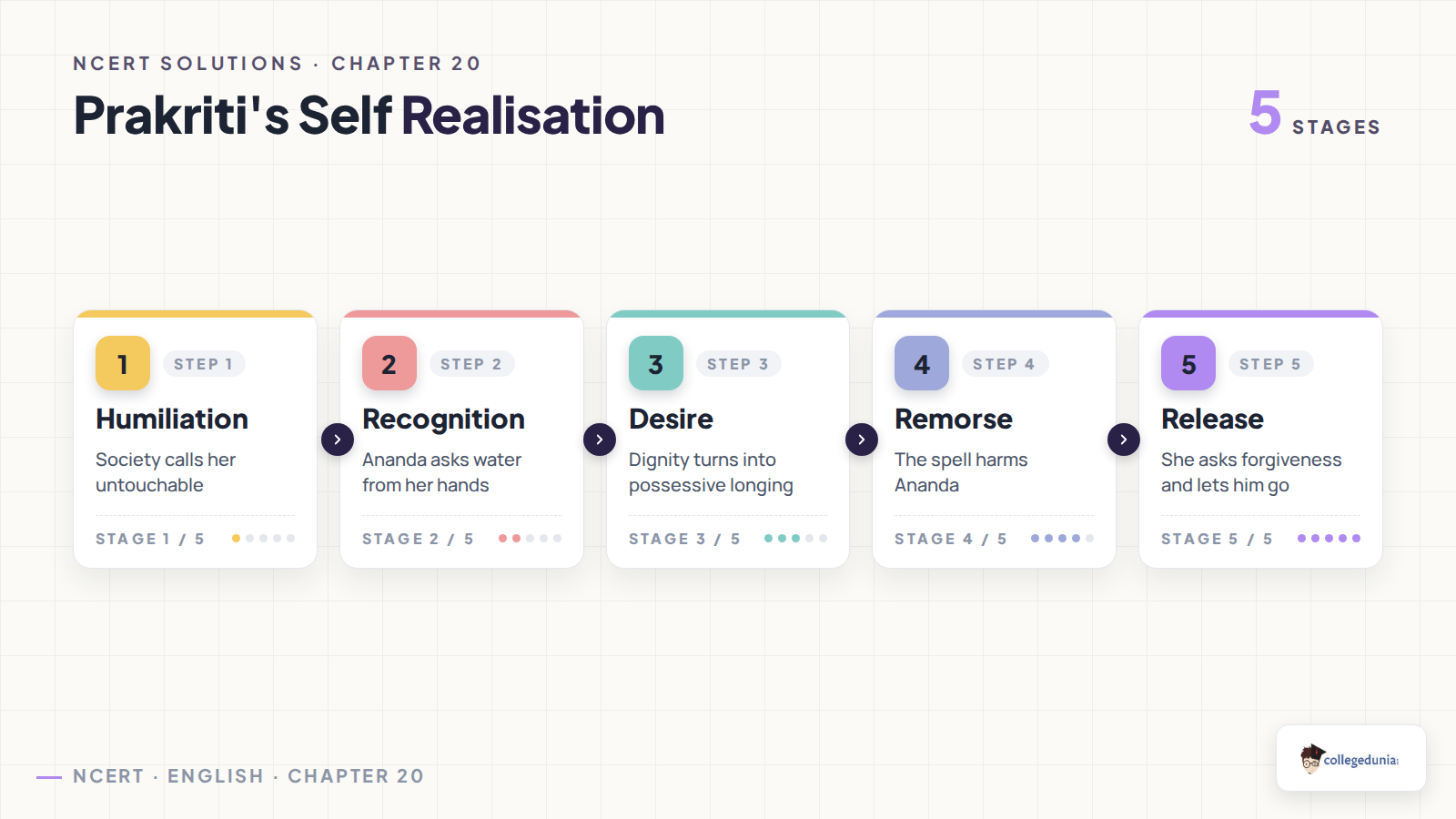
Prakriti's journey is not a simple move from sadness to happiness. She first moves from shame to dignity, then from dignity to possessive desire, and finally from guilt to self-knowledge.
Shame: society calls her untouchable and makes her distrust her own worth.
Dignity: Ananda's request for water treats her as a human being.
Possession: her awakened self turns toward a desire to own Ananda.
Repentance: seeing the spell's damage teaches her that freedom cannot violate another will.
Dignity and Possessive Desire Compared
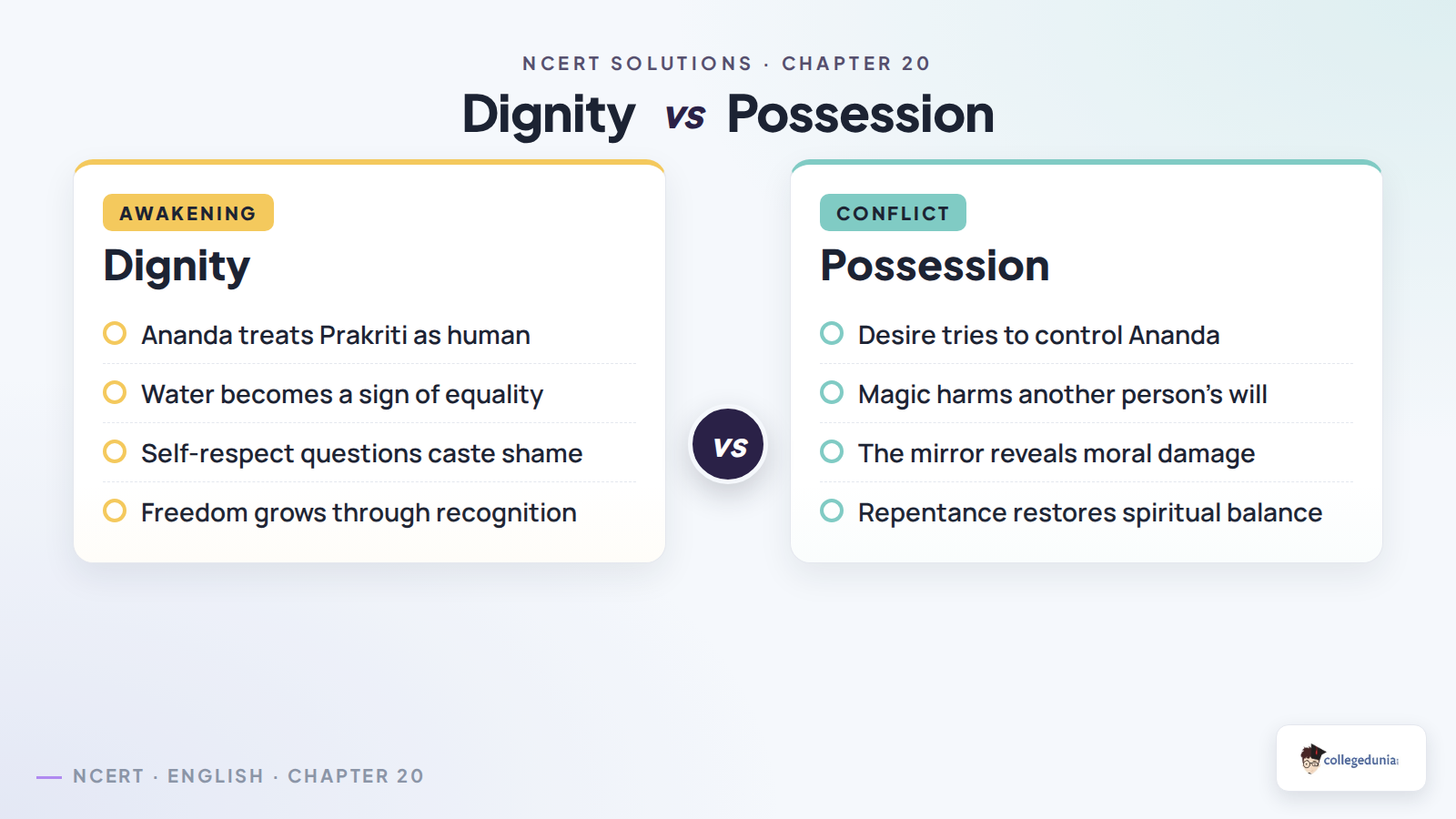
Most answers in Chandalika become stronger when students show the difference between dignity and possession. The play supports Prakriti's right to reject caste shame, but it does not support forcing Ananda through magic.
Idea
Healthy form
Dangerous form
Self-respect
Prakriti learns that she is not polluted by birth
She begins to demand Ananda as proof of her worth
Love
Recognition gives her new life and courage
The spell turns desire into control
Power
Speech and awareness help her question caste injustice
Magic damages Ananda and drains the mother
Common Mistakes in Chandalika Answers
Watch Out: Weak answers often turn the play into a simple love story. Tagore's play is about dignity, caste injustice, desire and moral awakening together.
Do not say the act of giving water matters only because Ananda is thirsty.
Do not describe the mother as only evil; she is loving, fearful and flawed.
Do not miss the mirror's double role: it shows Ananda's pain and Prakriti's conscience.
Do not list images of storm, shadow or fire without explaining their emotional effect.
Practice cue: Write each answer with one theme statement, one dramatic detail and one sentence on Prakriti's inner change.
Chandalika Symbols and Dramatic Technique
Tagore uses stage devices to make inner conflict visible. Water becomes dignity, the mirror becomes conscience, ritual makes desire dangerous, and contrasting images of shadow, mist, storm, flame and fire create a charged stage atmosphere.
Water: a simple act becomes a sign of human equality.
Mirror: Prakriti sees the monk's suffering and cannot hide from guilt.
Mother's ritual: private desire turns into visible and destructive action.
Contrasts: shame and joy, darkness and flame, destruction and rebirth show a divided mind.
More Class 12 English Supplementary Chapter 20 Resources
Use these related resources when you want the same chapter in another format. The table is placed above the FAQ so students can move from solutions to notes, book PDF and handwritten revision without losing the chapter context.
All NCERT Solutions for Class 12 English Supplementary Chapters
The table below keeps the same resource type together, so students can move chapter by chapter through the Class 12 English supplementary Kaleidoscope question set.
All NCERT Solutions for Class 12 English (Suppl.) Chapter 20 Kaleidoscope: Chandalika with Step-by-Step Solutions
The expandable cards below reproduce the full solution set from the PDF. Use the Solution tab for a direct exam-ready answer and the Expert Solution tab for deeper notes on Prakriti's dignity, Ananda's influence, the mother's role and Tagore's dramatic technique.
Each card separates the direct answer and expert explanation.
The literature cards keep the play's caste, desire and repentance themes visible for revision.
The appreciation cards connect dramatic technique with theme and imagery.
Q 20.1
Why does something so ordinary and commonplace as giving water to a wayfarer become so significant to Prakriti?
Concept used. The question asks how a small act becomes life-changing because it breaks caste shame and gives Prakriti human dignity.
Start with caste
The answer works best when water is linked with dignity, not only kindness.
Giving water is ordinary in daily life.
For Prakriti, it becomes extraordinary because society has taught her that she is untouchable.
She is used to rejection and humiliation.
When Ananda asks her for water, he treats her as a human being.
He does not see her caste as pollution.
His request gives her a sense of worth for the first time.
The act also awakens desire, pride and rebellion in her.
Water therefore becomes a symbol of recognition.
It changes Prakriti from a passive sufferer into a person who questions her imposed identity.
The act becomes significant because Ananda's request gives Prakriti dignity. A simple cup of water becomes proof that she is human, worthy and not defined by caste.
AM
Ananya Menon
M.A English, University of Delhi
Verified Expert
Symbol-first reading. The question asks how a small act becomes life-changing because it breaks caste shame and gives Prakriti human dignity.
The event matters because the play begins inside a social wound.
Prakriti has not merely been refused respect.
She has been told that her touch itself is impure.
Ananda's request reverses that belief in one instant.
He needs water from her hands.
That need makes her visible to herself.
The physical act is small, but its emotional force is huge.
It turns water into a sign of equality and self-awakening.
The answer should avoid calling the act romantic at first; its first meaning is human recognition.
The act becomes significant because Ananda's request gives Prakriti dignity. A simple cup of water becomes proof that she is human, worthy and not defined by caste.
Q 20.2
Why is the girl named Prakriti in the play? What are the images in the play that relate to this theme?
Concept used. Prakriti means nature. The name connects the girl with elemental life, instinct, growth, water, earth, flowers, storm and rebirth.
Meaning of the name
Prakriti means nature, so track natural images across the play.
The name Prakriti means nature or natural being.
Tagore gives her this name because she represents elemental human life.
She is not a lifeless caste label.
She has desire, anger, shame, tenderness and hunger for dignity.
Images of water link her with purification and life.
Images of earth, dust and birth connect her with the natural world.
Rice, pomegranate blossoms, vermilion, flowers and green cloth appear during the ritual.
Storm, thunder and trembling earth show the violent movement of her emotions.
These images make her inner change feel like a force of nature.
She is named Prakriti because she stands for natural human life beneath caste labels. Water, earth, flowers, rice, storm, thunder and rebirth images all support this theme.
RI
Rohit Iyer
M.A English, EFLU Hyderabad
Verified Expert
Name as theme. Prakriti means nature. The name connects the girl with elemental life, instinct, growth, water, earth, flowers, storm and rebirth.
Prakriti is not named casually.
The name pushes the students to look beyond social rank.
Nature does not create untouchability.
Society creates it.
The play surrounds Prakriti with water, dust, flowers and storm to show a living self struggling under artificial rules.
The ritual scene also uses natural objects.
Those objects show both fertility and danger.
Her awakening is therefore natural, but it becomes destructive when desire turns into possession.
The answer should connect images to her inner life, not list images mechanically.
She is named Prakriti because she stands for natural human life beneath caste labels. Water, earth, flowers, rice, storm, thunder and rebirth images all support this theme.
Q 20.3
How does the churning of emotions bring about self-realisation in Prakriti even if at the cost of her mother's life?
Concept used. Prakriti's emotions move from humiliation to pride, desire, obsession, guilt and release. This painful movement creates self-knowledge.
Trace the stages
Use the emotional order: shame, dignity, desire, obsession, remorse.
Prakriti first suffers from shame because society calls her untouchable.
Ananda's request for water gives her pride and self-respect.
That pride soon turns into personal desire.
She wants Ananda not only as a spiritual liberator, but as someone she can possess.
Her mother uses magic to bring him back.
When Prakriti sees the monk weakened by the spell, her desire turns into horror.
She realises that love cannot be forced.
She also realises that her freedom cannot be built on another person's suffering.
The mother dies after spending her life force on the spell.
This tragic cost deepens Prakriti's self-realisation and makes her ask for forgiveness.
The storm of emotions makes Prakriti see the difference between dignity and possession. Her mother's death makes the lesson tragic, but it also completes Prakriti's self-realisation.
MN
Meera Nair
Ph.D English, JNU
Verified Expert
Emotional sequence. Prakriti's emotions move from humiliation to pride, desire, obsession, guilt and release. This painful movement creates self-knowledge.
The play does not give Prakriti instant wisdom.
It makes her pass through conflicting states.
The first awakening is healthy because she rejects caste shame.
The second movement is dangerous because she tries to own Ananda.
Her mother's magic gives outward shape to that inner violence.
When Ananda appears broken, Prakriti sees the ugliness of her demand.
The mother's death shows the price of misused power.
Prakriti's final surrender is therefore earned through pain.
The answer should show both sides: liberation from caste shame and release from possessive desire.
The storm of emotions makes Prakriti see the difference between dignity and possession. Her mother's death makes the lesson tragic, but it also completes Prakriti's self-realisation.
Q 20.4
How does the mirror reflect the turmoil experienced by the monk as a result of the working of the spell?
Concept used. The mirror works as a dramatic device. It makes the invisible effect of the spell visible to Prakriti and the students.
Mirror as stage device
The mirror lets the students see inner damage without a long explanation.
The spell works at a distance, so the monk's struggle is not directly visible at first.
The mirror allows Prakriti to see what the spell is doing to him.
At first, she waits with excitement and fear.
Later, the mirror shows Ananda drained, defeated and burdened.
His spiritual radiance appears dimmed.
The mirror therefore reflects his inner turmoil through outward signs.
It also reflects Prakriti's own moral turmoil.
Once she sees his suffering, she cannot hide behind desire.
She throws the mirror away and asks her mother to undo the spell.
The mirror shows Ananda's suffering under the spell. It also forces Prakriti to see the moral damage caused by her desire, so it reflects both his turmoil and her awakening.
AR
Aditi Rao
M.A English, Jadavpur University
Verified Expert
Double reflection. The mirror works as a dramatic device. It makes the invisible effect of the spell visible to Prakriti and the students.
The mirror is more than a prop.
It is the play's way of showing an unseen spiritual injury.
Ananda is being pulled against his will.
The mirror turns that hidden pull into a visible image.
Prakriti expects radiance, but sees exhaustion and defeat.
That shock breaks the illusion that her desire is justified.
The mirror therefore reflects the monk's pain and Prakriti's conscience at the same time.
Its rejection marks the beginning of repentance.
The answer should mention the mirror's dramatic and moral function.
The mirror shows Ananda's suffering under the spell. It also forces Prakriti to see the moral damage caused by her desire, so it reflects both his turmoil and her awakening.
Q 20.5
What is the role of the mother in Prakriti's self-realisation? What are her hopes and fears for her daughter?
Concept used. The mother is both protector and enabler. She understands caste pain, fears danger, yet helps Prakriti act on desire through magic.
Avoid one-sided judgement
The mother is loving and flawed, not simply villainous.
The mother is Prakriti's closest companion and protector.
She knows the humiliation that caste society has placed on her daughter.
She hopes Prakriti will gain confidence and not remain crushed by shame.
She also hopes to satisfy Prakriti's desperate longing.
At the same time, she fears the consequences of disturbing a holy monk.
She fears that desire may bring a curse rather than fulfilment.
Her magic gives Prakriti's inner turmoil outward force.
Through the destructive effect of that force, Prakriti learns the limits of desire.
The mother's death becomes a tragic part of Prakriti's self-realisation.
The mother helps Prakriti's self-realisation by exposing the danger in possessive desire. She hopes her daughter will be fulfilled, but fears the moral and spiritual cost of the spell.
KS
Karan Sharma
M.A English, University of Mumbai
Verified Expert
Protective yet dangerous love. The mother is both protector and enabler. She understands caste pain, fears danger, yet helps Prakriti act on desire through magic.
The mother acts from love, but her love is mixed with fear and social bitterness.
She wants Prakriti to stop feeling worthless.
She also sees how intense Prakriti's desire has become.
That is why she agrees to use magic even while warning her.
Her hopes are personal: she wants her daughter to be happy and recognised.
Her fears are moral and spiritual: the spell may destroy both the monk and themselves.
By dying, she becomes the final cost of Prakriti's error.
Her role is therefore tragic, necessary and deeply human.
The answer should balance sympathy for the mother with criticism of the spell.
The mother helps Prakriti's self-realisation by exposing the danger in possessive desire. She hopes her daughter will be fulfilled, but fears the moral and spiritual cost of the spell.
Q 20.6
'Acceptance of one's fate is easy. Questioning the imbalance of the human social order is tumultuous.' Discuss with reference to the play.
Concept used. The statement contrasts passive acceptance with painful resistance. Prakriti's awakening shows how questioning caste injustice disturbs the whole self.
Use the quote directly
Explain both parts of the quotation before applying it to Prakriti.
Acceptance is easy because it avoids conflict.
Prakriti could have continued to accept the identity of a chandalini.
That would have kept social order undisturbed.
Ananda's words disturb this acceptance.
He makes her feel that she is not impure by birth.
Once she questions caste imbalance, her mind enters turmoil.
She feels pride, anger, desire and revolt together.
The play shows that social injustice damages the inner life of the oppressed.
Questioning it is necessary, but it is also painful.
Prakriti's journey proves that self-respect is born through conflict, not passive submission.
The play shows that accepting caste fate is socially easy but spiritually deadening. Prakriti's questioning brings turmoil, yet it also gives her self-respect and human identity.
SK
Sanya Kapoor
M.A English, University of Hyderabad
Verified Expert
Social theme. The statement contrasts passive acceptance with painful resistance. Prakriti's awakening shows how questioning caste injustice disturbs the whole self.
The line captures the play's social argument.
A fixed hierarchy survives by making people accept their place.
Prakriti initially lives under that pressure.
Ananda's request breaks the false peace of acceptance.
After that moment, she cannot return to silent submission.
Her revolt is confused and even destructive, but it exposes the cruelty of the order itself.
Tagore shows that real awakening is rarely calm.
It unsettles the person because it also unsettles society.
The answer should not romanticise turmoil; it should show why turmoil becomes necessary.
The play shows that accepting caste fate is socially easy but spiritually deadening. Prakriti's questioning brings turmoil, yet it also gives her self-respect and human identity.
Q 20.7
How does the dramatic technique suit the theme of the play?
Concept used. The play uses dialogue, song, dance, ritual, mirror imagery and stage directions to turn inner conflict into visible action.
Drama makes emotion visible
Name the techniques and link each one with inner conflict.
The theme of Chandalika is inner awakening under social oppression.
Drama suits this theme because conflict can be shown directly on stage.
Dialogue reveals Prakriti's shame, anger and desire.
The mother's warnings create dramatic tension.
Song and dance show emotional states that ordinary speech cannot hold.
The ritual scene makes desire, power and danger visible.
The mirror shows the effect of the spell without long narration.
Stage directions mark sudden changes in mood and action.
These techniques make Prakriti's self-realisation immediate for the viewer or reader.
The dramatic technique suits the theme because it makes Prakriti's inner struggle visible through dialogue, song, dance, ritual, the mirror and sharp stage action.
DP
Devika Pillai
Ph.D English, IIT Madras
Verified Expert
Technique with purpose. The play uses dialogue, song, dance, ritual, mirror imagery and stage directions to turn inner conflict into visible action.
The play's theme is not an abstract lecture on caste.
It is a lived emotional crisis.
Drama is ideal for this because the students hears the conflict in voices.
Prakriti and her mother speak from different fears and desires.
The ritual gives the invisible spell a stage shape.
The mirror gives distant suffering a visible form.
Song and movement intensify the emotional rhythm.
Form and theme therefore work together: awakening becomes performance.
The answer should connect each device to the theme, not list stage elements alone.
The dramatic technique suits the theme because it makes Prakriti's inner struggle visible through dialogue, song, dance, ritual, the mirror and sharp stage action.
Q 20.8
By focusing attention on the consciousness of an outcast girl, the play sensitises the viewer/reader to the injustice of distinctions based on the accidents of human birth. Discuss how individual conflict is highlighted against the backdrop of social reality.
Concept used. The play places Prakriti's private emotional conflict against caste discrimination, a larger social reality based on birth.
Private pain, public cause
Show how the personal story exposes the social system.
Prakriti's conflict is individual because it happens inside her consciousness.
She struggles with shame, pride, desire and guilt.
Yet these feelings are not merely personal.
They come from a social order that marks her as untouchable by birth.
The accident of birth decides her value in society.
Ananda's request challenges that false value system.
The students feels injustice because the play does not discuss caste from a distance.
It shows how caste enters one person's heart and damages her self-image.
Prakriti's personal turmoil therefore becomes evidence of a larger social wrong.
The play highlights individual conflict by showing Prakriti's wounded consciousness. Her shame and revolt expose the social injustice of judging people by birth.
RS
Rahul Sen
M.A English, Presidency University
Verified Expert
Consciousness as social evidence. The play places Prakriti's private emotional conflict against caste discrimination, a larger social reality based on birth.
Tagore makes social reality visible through one inner life.
Prakriti's pain is not private in origin.
It is produced by caste rules that classify her before she acts.
The students enters that injustice through her mind.
Her desire for recognition is therefore more than a personal longing.
It is a protest against being reduced to birth.
The background is social, but the drama is psychological.
This blend makes the injustice feel immediate and human.
The answer should explain how caste becomes emotional conflict inside Prakriti.
The play highlights individual conflict by showing Prakriti's wounded consciousness. Her shame and revolt expose the social injustice of judging people by birth.
Q 20.9
'I will enthrone you on the summit of all my dishonour, and build your royal seat of my shame, my fear and my joy.' Pick out more such examples of the interplay of opposites from the text. What does this device succeed in conveying?
Concept used. The interplay of opposites shows Prakriti's divided mind. Shame and joy, fear and worship, curse and rebirth exist together.
Opposites show conflict
Do not only quote examples; explain what the contrast does.
The quoted line joins dishonour with enthronement, and shame with a royal seat.
Similar opposites appear when Prakriti calls the coming of Ananda both fearful and joyful.
She says the event brings no curse, but the gift of new birth.
She calls him her All-destroyer and All-in-all.
She speaks of death's gates opening into liberation.
She drags him down to earth so that he may raise her to heaven.
These contrasts show that Prakriti's experience is not simple.
Her shame becomes a place of worship.
Her desire destroys, but it also leads to self-knowledge.
The device conveys emotional intensity and inner contradiction.
The opposites convey Prakriti's divided and intense state of mind. Shame, fear, joy, destruction and rebirth are mixed because her awakening is painful and transformative.
PV
Priya Verma
M.A English, Banaras Hindu University
Verified Expert
Paradox and inner conflict. The interplay of opposites shows Prakriti's divided mind. Shame and joy, fear and worship, curse and rebirth exist together.
The language of opposites is central to the play's emotional force.
Prakriti is not moving from darkness to light in a straight line.
Her awakening carries both dignity and danger.
That is why shame can become a throne and fear can mix with joy.
The monk's arrival appears as both destruction and fulfilment.
This paradox suits a character who is discovering herself through crisis.
The device also lifts the language above ordinary realism.
It makes the inner storm sound ceremonial and tragic.
The answer should use at least two textual examples and connect them with Prakriti's divided consciousness.
The opposites convey Prakriti's divided and intense state of mind. Shame, fear, joy, destruction and rebirth are mixed because her awakening is painful and transformative.
Q 20.10
"Shadow, mist, storm" on the one hand, "flames, fire," on the other. Comment on the effect of these and similar images of contrast on the viewer/reader.
Concept used. Contrasting images of obscurity and heat create the atmosphere of emotional conflict, ritual power and spiritual crisis.
Group the images
Explain shadow and mist together, then flames and fire together.
Shadow and mist suggest uncertainty, confusion and hidden movement.
They suit Prakriti's unclear state of mind.
Storm suggests violent emotional upheaval.
It also makes Ananda's forced return feel dangerous.
Flames and fire suggest passion, ritual energy, purification and destruction.
Together, these images create a charged atmosphere.
The viewer or reader feels that ordinary life has entered a spiritual crisis.
The contrasts also show Prakriti's divided experience.
She moves between darkness and illumination, fear and desire, destruction and release.
The contrasting images make the play intense and unsettling. Shadow, mist and storm show confusion and turmoil, while flames and fire suggest passion, ritual force and destructive purification.
AM
Arjun Mehta
M.A English, University of Calcutta
Verified Expert
Atmosphere and psychology. Contrasting images of obscurity and heat create the atmosphere of emotional conflict, ritual power and spiritual crisis.
The imagery works almost like stage lighting.
Shadow and mist blur moral and emotional certainty.
Storm gives sound and movement to Prakriti's inner disturbance.
Flame and fire add heat, danger and ritual power.
The viewer senses that the action is not merely domestic.
It has spiritual and psychological pressure.
The contrast also mirrors the main conflict.
Prakriti seeks light, but passes through darkness, heat and destruction first.
The answer should show the effect on mood and on the reader's understanding of Prakriti.
The contrasting images make the play intense and unsettling. Shadow, mist and storm show confusion and turmoil, while flames and fire suggest passion, ritual force and destructive purification.
Chandalika Class 12 English NCERT Solutions FAQs
Ques. How many questions are solved in Class 12 English Supplementary Chapter 20 Chandalika?
Ans. The PDF solves all 10 question blocks from the 2026-27 NCERT chapter, including six Thinking about the Play questions and four Appreciation questions.
Ques. What is the main theme of Chandalika?
Ans. The main theme is Prakriti's movement from caste shame to dignity, followed by her painful realisation that desire cannot become possession.
Ques. Why is giving water important in Chandalika?
Ans. Giving water matters because Ananda accepts water from Prakriti and makes her feel human, worthy and free from the label of untouchability.
Ques. Does this page include Appreciation answers for Chandalika?
Ans. Yes. The solutions include dramatic technique, social reality, interplay of opposites and contrast imagery from the official Appreciation section.





Chapter20Kaleidoscope:ChandalikaSolutions.pdf?page=1&dpi=150)
Chapter20Kaleidoscope:ChandalikaSolutions.pdf?page=2&dpi=150)
Chapter20Kaleidoscope:ChandalikaSolutions.pdf?page=3&dpi=150)
Chapter20Kaleidoscope:ChandalikaSolutions.pdf?page=4&dpi=150)
Chapter20Kaleidoscope:ChandalikaSolutions.pdf?page=5&dpi=150)
Chapter20Kaleidoscope:ChandalikaSolutions.pdf?page=6&dpi=150)
Chapter20Kaleidoscope:ChandalikaSolutions.pdf?page=7&dpi=150)
Chapter20Kaleidoscope:ChandalikaSolutions.pdf?page=8&dpi=150)
Chapter20Kaleidoscope:ChandalikaSolutions.pdf?page=9&dpi=150)
Chapter20Kaleidoscope:ChandalikaSolutions.pdf?page=10&dpi=150)
Chapter20Kaleidoscope:ChandalikaSolutions.pdf?page=11&dpi=150)
Chapter20Kaleidoscope:ChandalikaSolutions.pdf?page=12&dpi=150)
Chapter20Kaleidoscope:ChandalikaSolutions.pdf?page=13&dpi=150)
Chapter20Kaleidoscope:ChandalikaSolutions.pdf?page=14&dpi=150)
Chapter20Kaleidoscope:ChandalikaSolutions.pdf?page=15&dpi=150)
Chapter20Kaleidoscope:ChandalikaSolutions.pdf?page=16&dpi=150)
Chapter20Kaleidoscope:ChandalikaSolutions.pdf?page=17&dpi=150)
Chapter20Kaleidoscope:ChandalikaSolutions.pdf?page=18&dpi=150)
Chapter20Kaleidoscope:ChandalikaSolutions_flat_MobileCard.pdf?page=1&dpi=150)
Chapter20Kaleidoscope:ChandalikaSolutions_flat_MobileCard.pdf?page=2&dpi=150)
Chapter20Kaleidoscope:ChandalikaSolutions_flat_MobileCard.pdf?page=3&dpi=150)
Chapter20Kaleidoscope:ChandalikaSolutions_flat_MobileCard.pdf?page=4&dpi=150)
Chapter20Kaleidoscope:ChandalikaSolutions_flat_MobileCard.pdf?page=5&dpi=150)
Chapter20Kaleidoscope:ChandalikaSolutions_flat_MobileCard.pdf?page=6&dpi=150)
Chapter20Kaleidoscope:ChandalikaSolutions_flat_MobileCard.pdf?page=7&dpi=150)
Chapter20Kaleidoscope:ChandalikaSolutions_flat_MobileCard.pdf?page=8&dpi=150)
Chapter20Kaleidoscope:ChandalikaSolutions_flat_MobileCard.pdf?page=9&dpi=150)
Chapter20Kaleidoscope:ChandalikaSolutions_flat_MobileCard.pdf?page=10&dpi=150)
Chapter20Kaleidoscope:ChandalikaSolutions_flat_MobileCard.pdf?page=11&dpi=150)
Chapter20Kaleidoscope:ChandalikaSolutions_flat_MobileCard.pdf?page=12&dpi=150)
Chapter20Kaleidoscope:ChandalikaSolutions_flat_MobileCard.pdf?page=13&dpi=150)
Chapter20Kaleidoscope:ChandalikaSolutions_flat_MobileCard.pdf?page=14&dpi=150)
Chapter20Kaleidoscope:ChandalikaSolutions_flat_MobileCard.pdf?page=15&dpi=150)
Chapter20Kaleidoscope:ChandalikaSolutions_flat_MobileCard.pdf?page=16&dpi=150)
Chapter20Kaleidoscope:ChandalikaSolutions_flat_MobileCard.pdf?page=17&dpi=150)
Chapter20Kaleidoscope:ChandalikaSolutions_flat_MobileCard.pdf?page=18&dpi=150)
Chapter20Kaleidoscope:ChandalikaSolutions_flat_MobileCard.pdf?page=19&dpi=150)
Chapter20Kaleidoscope:ChandalikaSolutions_flat_MobileCard.pdf?page=20&dpi=150)
Chapter20Kaleidoscope:ChandalikaSolutions_flat_MobileCard.pdf?page=21&dpi=150)
Chapter20Kaleidoscope:ChandalikaSolutions_flat_MobileCard.pdf?page=22&dpi=150)
Chapter20Kaleidoscope:ChandalikaSolutions_flat_MobileCard.pdf?page=23&dpi=150)
Chapter20Kaleidoscope:ChandalikaSolutions_flat_MobileCard.pdf?page=24&dpi=150)
Chapter20Kaleidoscope:ChandalikaSolutions_flat_MobileCard.pdf?page=25&dpi=150)
Chapter20Kaleidoscope:ChandalikaSolutions_flat_MobileCard.pdf?page=26&dpi=150)
Chapter20Kaleidoscope:ChandalikaSolutions_flat_MobileCard.pdf?page=27&dpi=150)
Chapter20Kaleidoscope:ChandalikaSolutions_flat_MobileCard.pdf?page=28&dpi=150)
Chapter20Kaleidoscope:ChandalikaSolutions_flat_MobileCard.pdf?page=29&dpi=150)
Chapter20Kaleidoscope:ChandalikaSolutions_flat_MobileCard.pdf?page=30&dpi=150)
Chapter20Kaleidoscope:ChandalikaSolutions_flat_MobileCard.pdf?page=31&dpi=150)
Chapter20Kaleidoscope:ChandalikaSolutions_flat_MobileCard.pdf?page=32&dpi=150)
Chapter20Kaleidoscope:ChandalikaSolutions_flat_MobileCard.pdf?page=33&dpi=150)
Chapter20Kaleidoscope:ChandalikaSolutions_flat_MobileCard.pdf?page=34&dpi=150)
Chapter20Kaleidoscope:ChandalikaSolutions_flat_MobileCard.pdf?page=35&dpi=150)
Chapter20Kaleidoscope:ChandalikaSolutions_flat_MobileCard.pdf?page=36&dpi=150)



Comments