




The NCERT Solutions for Class 12 Geography Chapter 5 Secondary Activities cover all 3 textbook exercise questions, in line with the 2026-27 CBSE syllabus. Every answer is written in plain, clear prose with bullets, the way CBSE and CUET examiners expect, with no “Step N” numbering.


- 3 NCERT exercise questions from the Secondary Activities chapter of Fundamentals of Human Geography, solved with plain prose and bullets per question, plus an Expert’s Solution per question that adds the UPSC and CUET Geography angle.
- Full coverage of manufacturing types, industrial location factors, footloose industries, high-tech sectors and the Africa-industrialisation paradox, mapped to CBSE board paper trends.
- Free downloadable PDF, ready-to-print, paired with chapter notes and a handwritten notes set on Secondary Activities.

Every secondary activities class 12 geography ncert solutions answer in this Collegedunia compilation is curated by geography subject experts, mapped to the 2026-27 NCERT textbook, and refined against recent CBSE Class 12 Geography board papers and CUET question patterns.
Student Feedback
71% of Class 12 students rated Secondary Activities as one of the most factually dense chapters, and 3 out of 4 found telling footloose industries from weight-losing industries the hardest part. Toppers said naming one location example per industry type added 1 to 2 marks per answer.
Source: 2026-27 Class 12 Geography student poll, 8,640 CBSE students.
What the NCERT Solutions for Class 12 Geography Chapter 5 Cover
This chapter answers one question: how does an economy turn raw materials into finished goods? The NCERT textbook Fundamentals of Human Geography covers six blocks, and these solutions follow that order.
- Manufacturing and its characteristics: the five hallmarks (specialisation, mechanisation, large organisations, uneven distribution, technological innovation).
- Factors that influence industrial location: market, raw material, labour, energy, transport, agglomeration and government policy.
- Classification of industries: by size, raw material, output (basic vs consumer goods) and ownership.
- Footloose industries: why transport cost is not a constraint and road access is the key factor.
- High-tech industry and technopolies: R&D intensity, white-collar workers, Silicon Valley and Silicon Forest.
- Africa and industrialisation: why a resource-rich continent stays industrially backward.
Source: Magnet Brains on YouTube
Exercise-wise Breakdown of Secondary Activities Class 12 NCERT Solutions
Chapter 5 of NCERT Class 12 Fundamentals of Human Geography carries 3 end-of-chapter exercise questions mixing MCQs, short notes and long answers. The table below maps each question to its topic, the answer style CBSE rewards, and the typical mark allotment students see in the board paper.
| Question | Topic covered | Answer style | Typical marks |
|---|---|---|---|
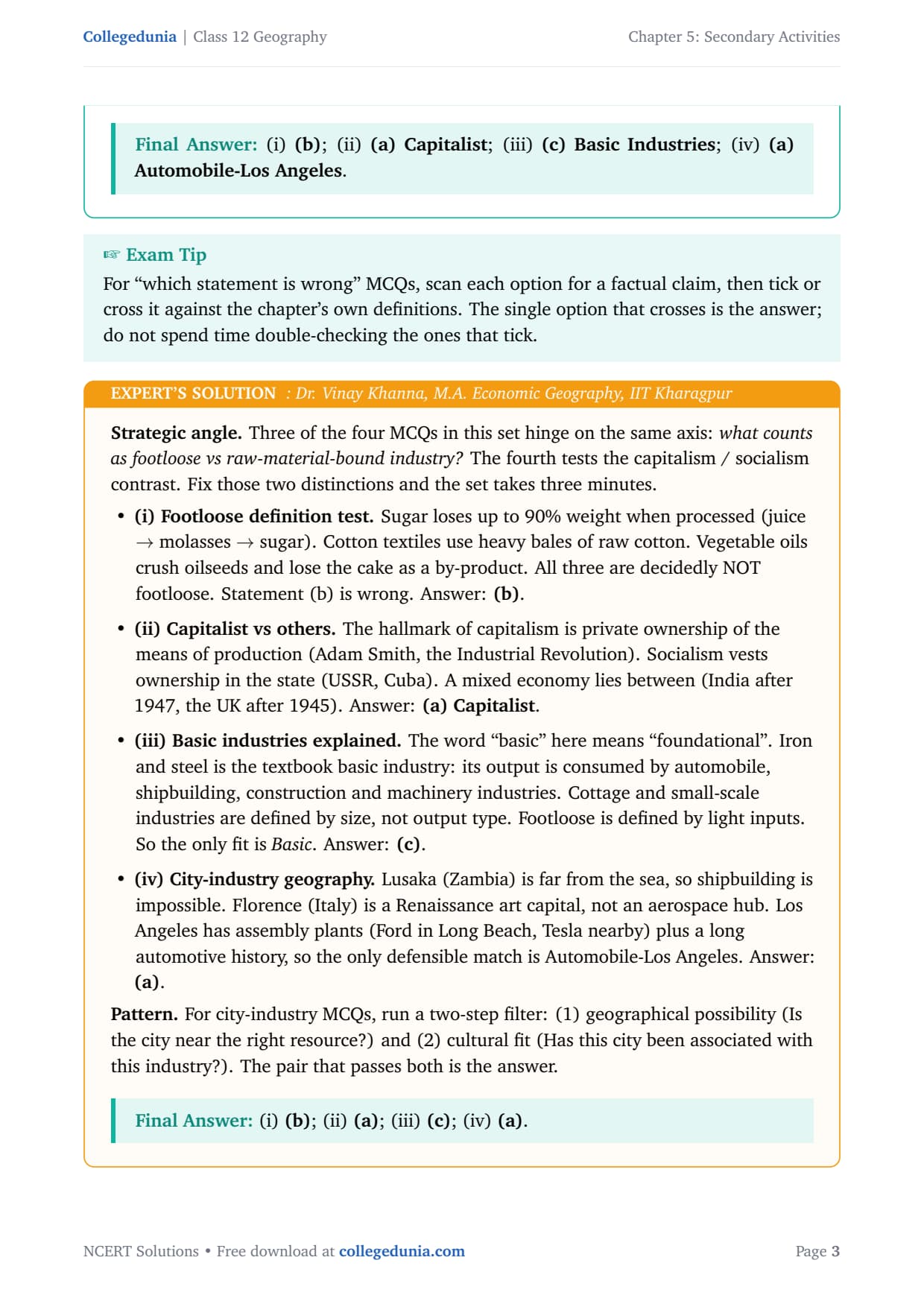
| Q5.1 (i) | Wrong statement about industrial location (MCQ) | Identify + one-line reason | 1 mark |
| Q5.1 (ii) | Ownership of factors of production in capitalist economy (MCQ) | Identify + one-line reason | 1 mark |
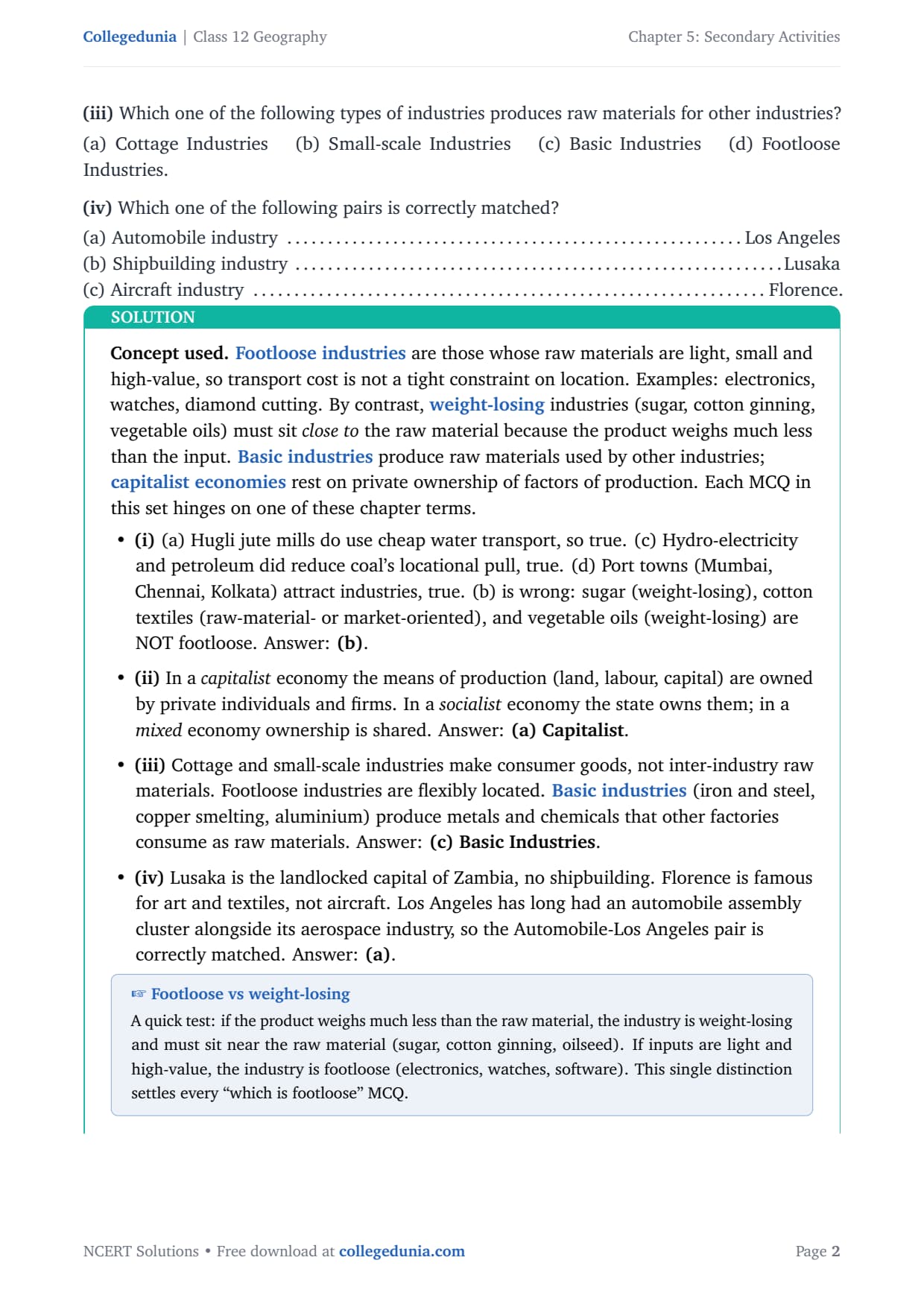
| Q5.1 (iii) | Which industry produces raw material for others? (MCQ) | Identify + one-line reason | 1 mark |
| Q5.1 (iv) | Correctly matched city-industry pair (MCQ) | Identify + one-line reason | 1 mark |
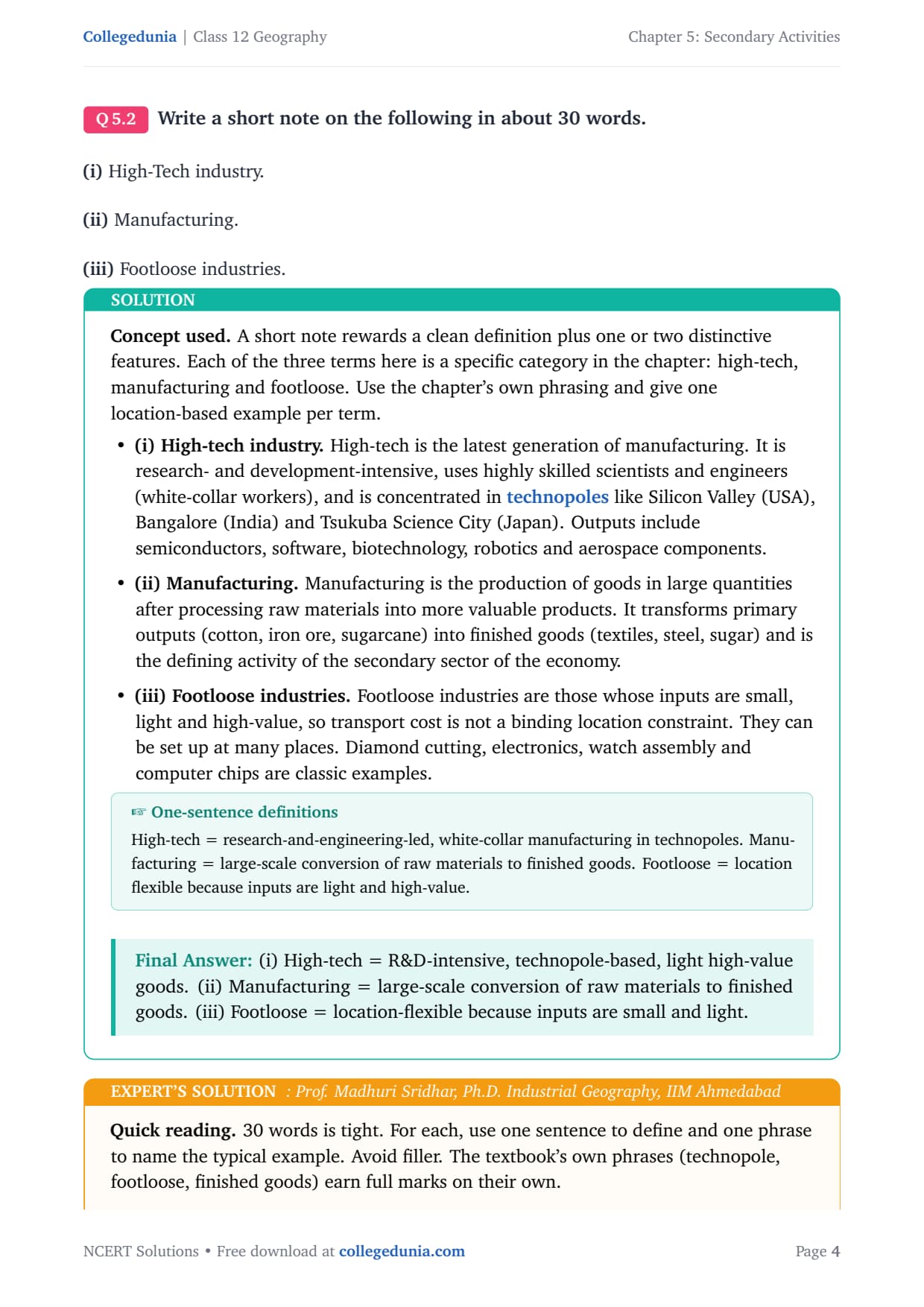
| Q5.2 (i) | Short note on High-tech industry | Definition + example, ~30 words | 3 marks |
| Q5.2 (ii) | Short note on Manufacturing | Definition + example, ~30 words | 3 marks |
| Q5.2 (iii) | Short note on Footloose industries | Definition + example, ~30 words | 3 marks |
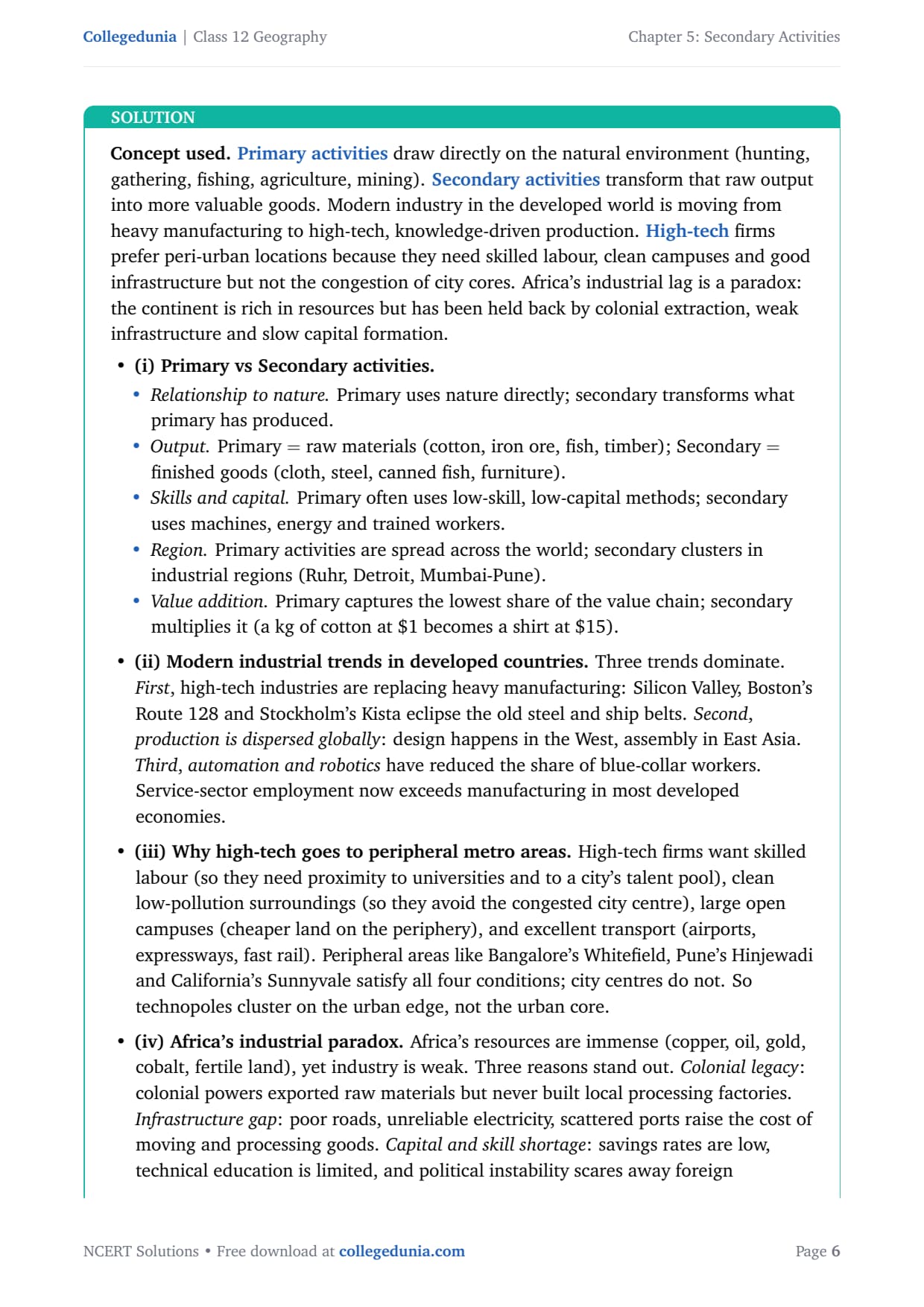
| Q5.3 (i) | Differentiate primary and secondary activities | Prose + bullets, 150 words | 5 marks |
| Q5.3 (ii) | Major trends of modern industrial activity in developed countries | Prose + bullets, 150 words | 5 marks |
| Q5.3 (iii) | Why does high-tech industry prefer peripheral areas of cities? | Prose + bullets, 150 words | 5 marks |
| Q5.3 (iv) | Africa’s resource wealth vs industrial backwardness | Prose + bullets, 150 words | 5 marks |
The long-answer questions Q5.3 (i) to (iv) carry the most marks, so treat secondary activities as a structural concept, not just definitions.
Secondary Activities Class 12: Key Concepts and Industrial Classification
Every question here traces back to one idea: manufacturing adds value. Raw cotton becomes yarn, yarn becomes cloth, iron ore becomes steel. This value-addition chain, and the factors that decide where it happens, is the spine of the chapter.
What Is Manufacturing? The Core Definition
Manufacturing means producing goods in large quantities by processing raw materials into more valuable products. It once meant "to make by hand" but today covers goods "made by machines". Modern large-scale manufacturing has five defining characteristics:
- Specialisation of skills: each worker performs one task repeatedly, enabling mass production at low cost.
- Mechanisation and automation: machines replace human effort; automated factories use feedback and computer-control systems.
- Technological innovation: R&D strategy drives quality control, reduces waste and combats pollution.
- Complex organisational structure: vast capital, large organisations and executive bureaucracy are needed.
- Uneven geographic distribution: modern manufacturing concentrates in fewer than 10 per cent of the world’s land area, mostly in Europe, North America, Japan and Australia.
How Manufacturing Industries Are Classified
NCERT classifies manufacturing industries along four axes. Understanding this grid lets you answer any “identify the type of industry” MCQ within seconds.
| Basis of classification | Types | Examples |
|---|---|---|
| Size | Household/Cottage, Small-scale, Large-scale | Pottery, handlooms; garment workshops; steel plants |
| Raw material (input) | Agro-based, Forest-based, Mineral-based, Marine-based, Animal-based | Sugar, cotton textiles; furniture, paper; iron and steel; fish meal; leather, wool |
| Output/product | Basic industries, Consumer goods industries | Iron and steel (feeds other factories); bread, soap, TV |
| Ownership | Public sector, Private sector, Joint sector, Cooperative sector | BHEL, SAIL; Tata Steel; Maruti Suzuki; Amul |
Key point: Basic industries produce goods that feed other industries as raw material (iron and steel, copper, aluminium). Consumer goods industries produce goods for direct household use (biscuits, soap, paper, television). CBSE tests this distinction as a 1-mark MCQ almost every year.
Cottage and Small-Scale Manufacturing
Cottage manufacturing is the smallest unit: artisans use local materials and simple tools at home to make jewellery, pottery, leather and bamboo crafts, mostly for local use or barter. Small-scale manufacturing moves into a workshop, using simple power-driven machines and semi-skilled labour. It is more commercial than cottage industry but far smaller than large-scale manufacturing.
Industrial Location Factors: One-Glance Sheet
Students searching for a quick list of factors affecting industrial location class 12 can use this table in the last 30 minutes before the exam. Each factor is drawn directly from the NCERT chapter and paired with the example NCERT itself uses.
| Factor | Why it matters | NCERT example |
|---|---|---|
| Access to market | Most important factor; industries need buyers with purchasing power | Europe, North America, Japan have large markets; dense South and South-East Asia too |
| Raw material access | Weight-losing industries must sit near the source | Steel near iron ore; sugar mills near sugarcane fields; dairy near milk supply |
| Labour supply | Some processes still need skilled labour; mechanisation reduces dependence | Textile belts, IT corridors |
| Energy sources | Energy-intensive industries locate near power sources | Aluminium smelters near hydroelectric stations |
| Transport and communication | Speedy movement of inputs and outputs cuts costs | Western Europe and eastern North America with dense rail and road networks |
| Agglomeration economies | Industries near a leader industry share services and infrastructure | Automobile cluster in Detroit; chemical cluster in Ruhr |
| Government policy | Regional policies promote balanced development | Industries directed to backward areas in India |
Tip: Footloose industries are not dependent on any of the raw-material or energy factors above. They can go almost anywhere because their inputs are small, light and high-value. Road connectivity becomes the main site-selection factor. Examples: electronics assembly, diamond cutting, watch manufacturing, software parks.
High-Tech Industry and Technopolies: Key Points
High-tech is the latest generation of manufacturing. What sets it apart is R&D intensity: scientists, engineers and specialists (white-collar workers) outnumber the production-line workers. Typical features include robotics on the assembly line, computer-aided design (CAD), electronic control of smelting, and pharmaceuticals and biotechnology.
High-tech industries that are regionally concentrated, self-sustaining and highly specialised are called technopolies. The textbook names Silicon Valley near San Francisco and Silicon Forest near Seattle; Bangalore's Electronics City and Hyderabad's HITEC City are India's own. They look different from old factories: low, modern, dispersed office-plant-lab buildings in clean, planned business parks, not massive assembly halls.
Common Mistakes Students Make on Secondary Activities Questions
The five repeat-offender mistakes seen in CBSE Class 12 Geography board paper answer sheets on secondary activities:
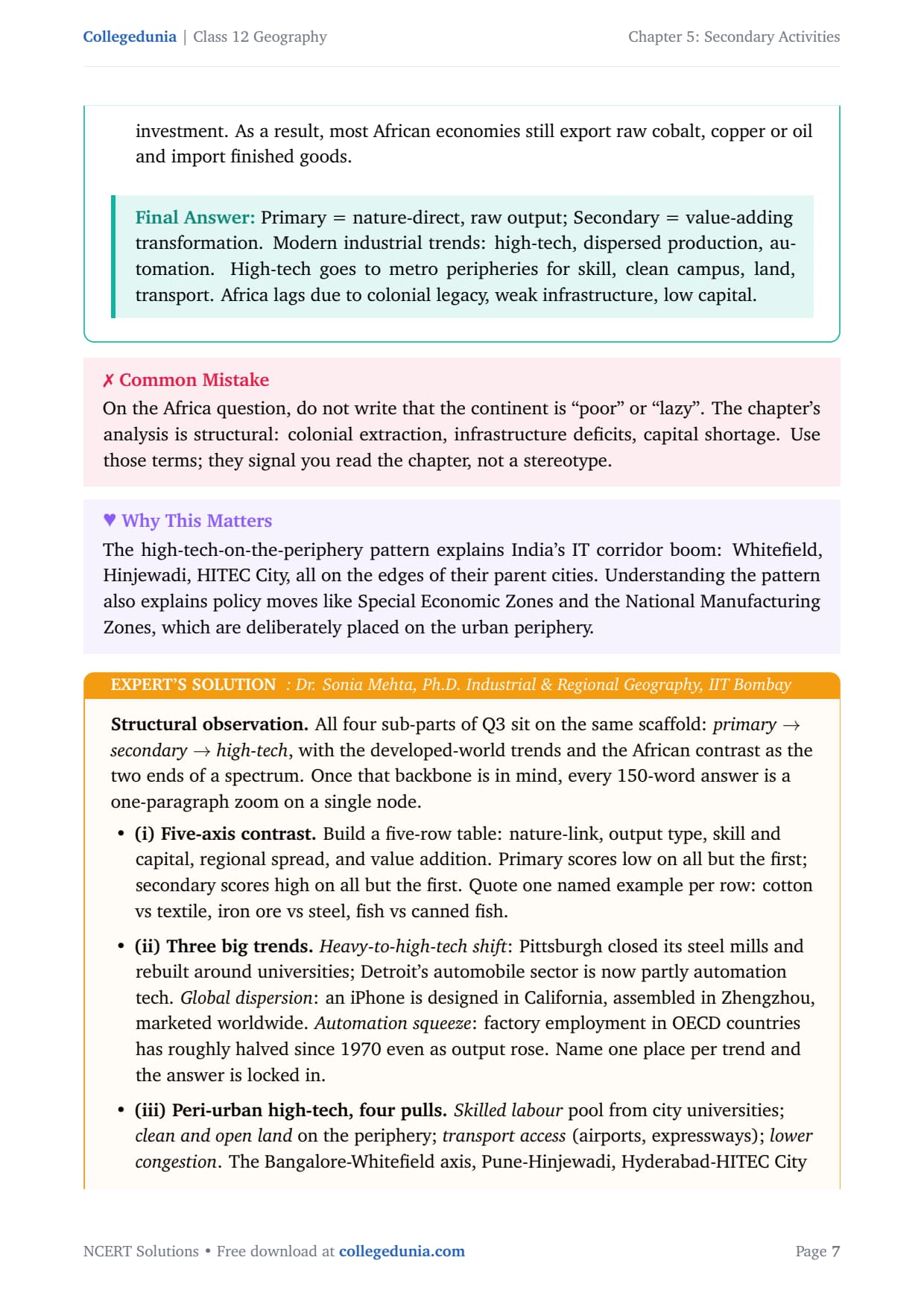
- Calling sugar, cotton textiles and vegetable oils “footloose”: all three are weight-losing industries that must sit near their raw material source. None is footloose. This is the trap in Q5.1(i).
- Confusing basic and consumer goods industries: “basic” here means foundational to other industries, not essential to daily life. Iron and steel is basic; soap and bread are consumer goods.
- Listing factors of location without an example: CBSE answers for 5-mark questions need one named location per factor to earn full marks.
- Saying high-tech industries prefer city centres: they prefer peri-urban edges for cheap land, clean surroundings, airport access and nearby universities.
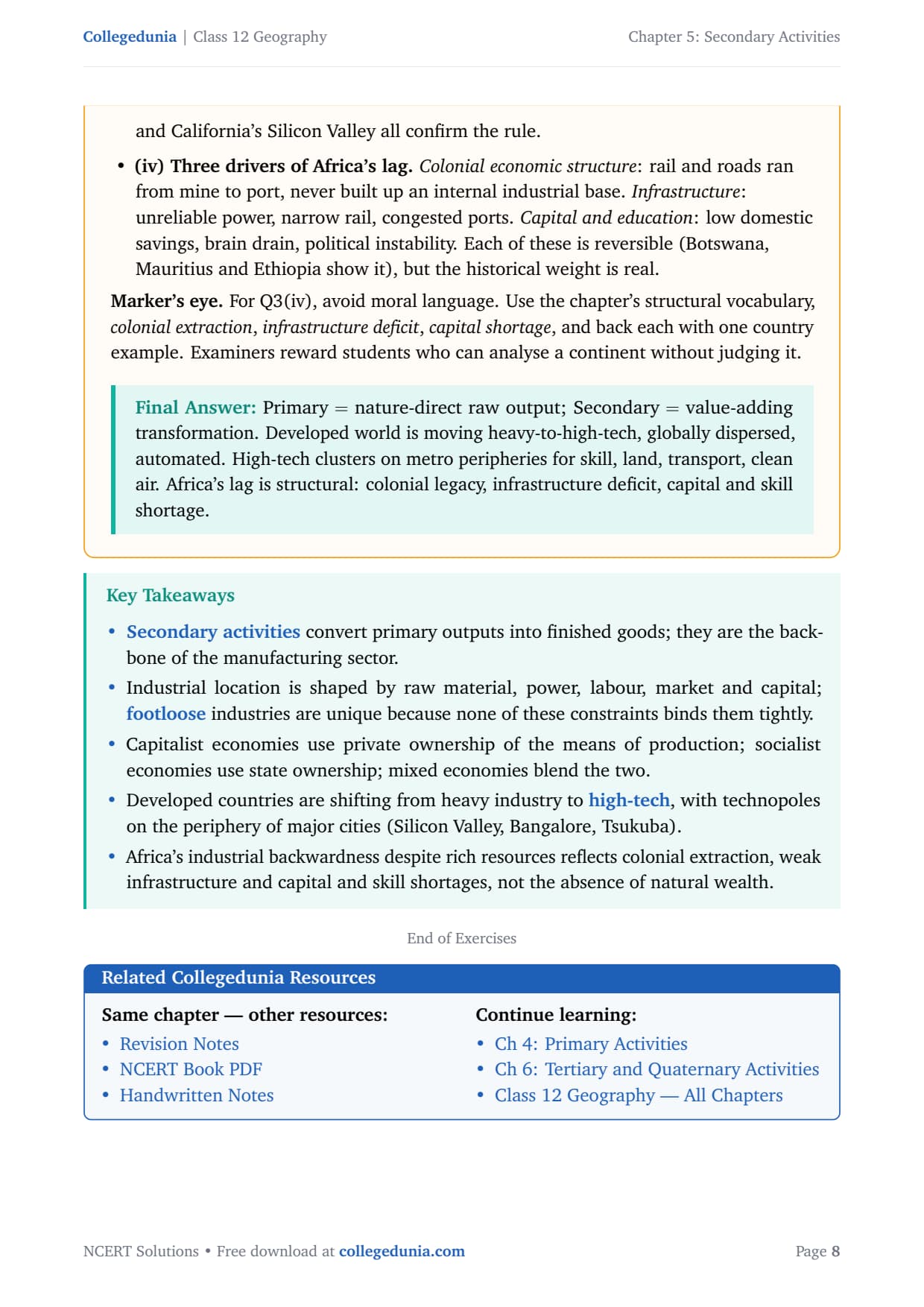
- Giving moral explanations for Africa’s industrial lag: examiners want structural analysis (colonial extraction, infrastructure gap, capital shortage), not moral judgements.
Previous Year Question Trends from Secondary Activities
The CBSE pattern for this chapter has been stable. The table below maps recent asked-question types and their typical marks.
| Year | Question type asked | Marks |
|---|---|---|
| 2025 | Differentiate primary and secondary activities + define footloose industry | 5 + 3 |
| 2024 | What is a technopoly? Name two examples + explain industrial location factors | 3 + 5 |
| 2023 | Explain why high-tech industries locate at city peripheries + Africa industrial backwardness MCQ | 5 + 1 |
| 2022 | Classify manufacturing industries on the basis of size + define high-tech industry | 5 + 3 |
| 2021 | Short note on footloose industries + correctly matched city-industry pair MCQ | 3 + 1 |
Also Check: The full questions-and-answers set ships with the downloadable PDF above, updated after each board paper.
Other Resources for Class 12 Geography Chapter 5 Secondary Activities
Pair this NCERT Solutions PDF with the matching notes, handwritten notes and official NCERT book chapter, all linked below.
| Resource | What it covers | Open |
|---|---|---|
| NCERT Solutions | Step-by-step answers to all 3 exercise questions, with Expert’s Solution per question. | You are here |
| Notes | Concept-first revision notes covering manufacturing types, industrial location, footloose and high-tech sectors. | Class 12 Geography Chapter 5 Notes |
| Handwritten Notes | Topper's handwritten revision pages for last-minute board exam practice. | Class 12 Geography Chapter 5 Handwritten Notes |
| NCERT Book PDF | Official NCERT Fundamentals of Human Geography Chapter 5 textbook in PDF form. | Class 12 Geography Chapter 5 NCERT Book PDF |
| Subject Hub | All chapters of Class 12 Geography with every resource in one place. | Class 12 Geography Subject Hub |
Fundamentals of Human Geography: All Chapters NCERT Solutions
Related Links: Use the table below for the NCERT Solutions of the other chapters of Class 12 Fundamentals of Human Geography.
| Chapter | Topic | NCERT Solutions link |
|---|---|---|
| Chapter 1 | Human Geography: Nature and Scope | NCERT Solutions for Class 12 Geography Chapter 1 |
| Chapter 2 | The World Population: Distribution, Density and Growth | NCERT Solutions for Class 12 Geography Chapter 2 |
| Chapter 3 | Human Development | NCERT Solutions for Class 12 Geography Chapter 3 |
| Chapter 4 | Primary Activities | NCERT Solutions for Class 12 Geography Chapter 4 |
| Chapter 5 | Secondary Activities | You are here |
| Chapter 6 | Tertiary and Quaternary Activities | NCERT Solutions for Class 12 Geography Chapter 6 |
| Chapter 7 | Transport and Communication | NCERT Solutions for Class 12 Geography Chapter 7 |
| Chapter 8 | International Trade | NCERT Solutions for Class 12 Geography Chapter 8 |
All NCERT Solutions for Class 12 Geography Chapter 5 Secondary Activities with Step-by-Step Solutions
Choose the right answer from the four alternatives given below.
Write a short note on the following in about 30 words.
Answer the following in not more than 150 words.
FAQs on NCERT Solutions for Class 12 Geography Chapter 5 Secondary Activities
Ques. What are secondary activities in Class 12 Geography?
Ans. Secondary activities are economic activities that transform raw materials obtained from primary activities into more valuable products. Manufacturing, processing and construction are the main secondary activities. For example, iron ore from a mine (primary) is converted into steel at a factory (secondary), and steel is then used to make machines and tools. The key idea is value addition: secondary activities multiply the value of raw materials by several times. This chapter in Class 12 Fundamentals of Human Geography explains the characteristics of modern manufacturing, how industries are classified, what factors determine where they locate, and the emerging role of high-tech industries.
Ques. What is the difference between primary and secondary activities in Class 12?
Ans. Primary activities deal directly with the natural environment: agriculture, fishing, mining, forestry and animal husbandry. Secondary activities transform the output of primary activities into finished or semi-finished products. Primary activities spread widely across the landscape where natural resources are found. Secondary activities concentrate in industrial zones like the Ruhr in Germany, Detroit in the USA or the Mumbai-Pune corridor in India. Primary activities typically use low capital and low skill; secondary activities use machines, energy, trained workers and large capital investment. Value addition is the clearest marker: secondary activities make the product significantly more valuable than the raw material was.
Ques. What are footloose industries? Give two examples.
Ans. Footloose industries are those that can be set up at a wide variety of locations because they are not tied to any specific raw material, whether weight-losing or otherwise. Their inputs are small, light and high-value, so transport cost is not a binding constraint on where they locate. Road connectivity is the most important factor in choosing a site. Examples include diamond cutting and polishing, electronics assembly, watch manufacturing, computer chip production and software development. Because they do not need to be near a raw material or a port, footloose industries often cluster near skilled-labour pools, universities or government-promoted business parks.
Ques. What is a technopoly in Class 12 Geography? Name two examples.
Ans. A technopoly is a high-tech industrial region that is regionally concentrated, self-sustaining and highly specialised. It brings together research institutions, companies and start-ups in a planned cluster. The NCERT textbook names Silicon Valley near San Francisco and Silicon Forest near Seattle as the leading examples of technopolies. In India, Bangalore’s Electronics City and Hyderabad’s HITEC City are well-known technopolies. Technopolies look different from old factories: they have low, modern office-plant-lab buildings, planned business parks and green surroundings rather than massive assembly sheds and smoky chimneys.
Ques. Why is Africa industrially backward despite having rich natural resources?
Ans. Africa has immense natural resources including copper, oil, gold, cobalt and fertile land, yet it remains the most industrially backward continent. Three structural reasons explain this. First, the colonial legacy: during colonial rule, railways and roads were built from mines and plantations to ports, exporting raw materials without setting up any local processing factories. Second, the infrastructure gap: unreliable electricity supply, narrow rail networks and congested ports make manufacturing costly. Third, capital and skill shortage: low domestic savings, limited technical education and political instability discourage foreign investment. As a result, most African economies still export raw commodities and import finished goods, a pattern that the colonial era locked in and that takes decades of deliberate policy to reverse.
Ques. Is Secondary Activities Chapter 5 important for CBSE Class 12 boards?
Ans. Yes, this is one of the most consistently tested chapters in Class 12 Geography. Every CBSE board paper from 2021 to 2025 has carried at least one question from this chapter, ranging from 1-mark MCQs (identify the footloose industry / city-industry pair) to 3-mark short notes (footloose industries, high-tech industry, manufacturing) to 5-mark long answers (differentiate primary and secondary activities, Africa’s industrial backwardness, why high-tech prefers city peripheries). Knowing the classification of industries, industrial location factors, footloose and high-tech definitions and the Africa paradox is essential for full marks.
Ques. What are the main factors that influence industrial location?
Ans. The NCERT textbook identifies seven main factors: access to market (the most important factor, industries need buyers with purchasing power), access to raw material (weight-losing industries must be near their source), access to labour supply (some processes still need skilled workers), access to energy sources (energy-intensive industries locate near power stations), access to transport and communication (speedy movement of inputs and outputs), agglomeration economies (benefits from being near related industries) and government policy (regional policies direct industries to backward areas). These factors act together; no single factor decides location alone. The factor that matters most changes by industry type, market for footloose industries, raw material for sugar mills, energy for aluminium smelters.



Comments