




The NCERT Solutions for Class 12 Geography Chapter 4 Primary Activities cover all 3 textbook exercise questions, in line with the 2026-27 CBSE syllabus. Every answer is written in plain English for a Class 12 student, following the Fundamentals of Human Geography textbook's own sequence: types of primary activities, agricultural systems, and the shift from subsistence to commercial farming.
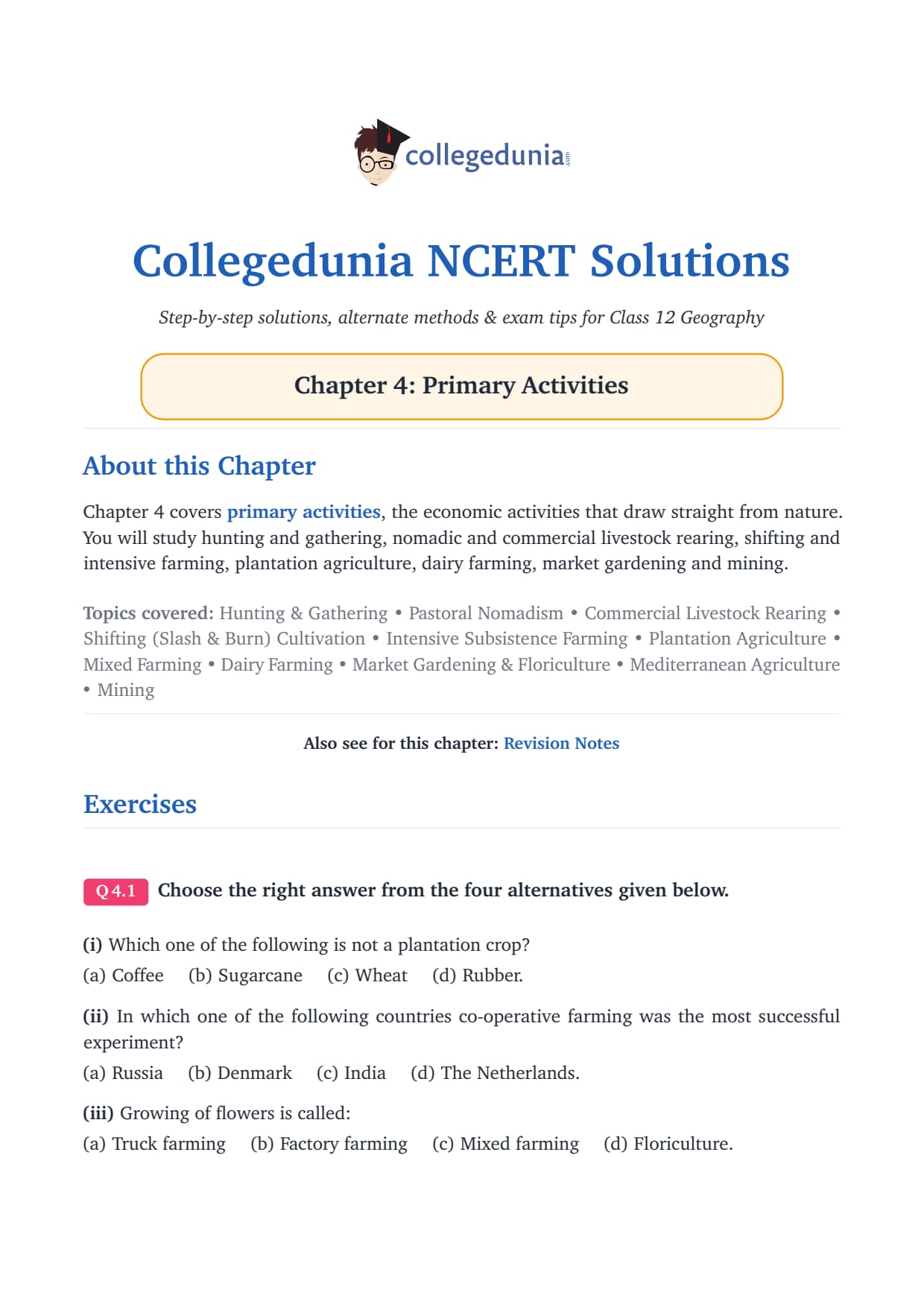
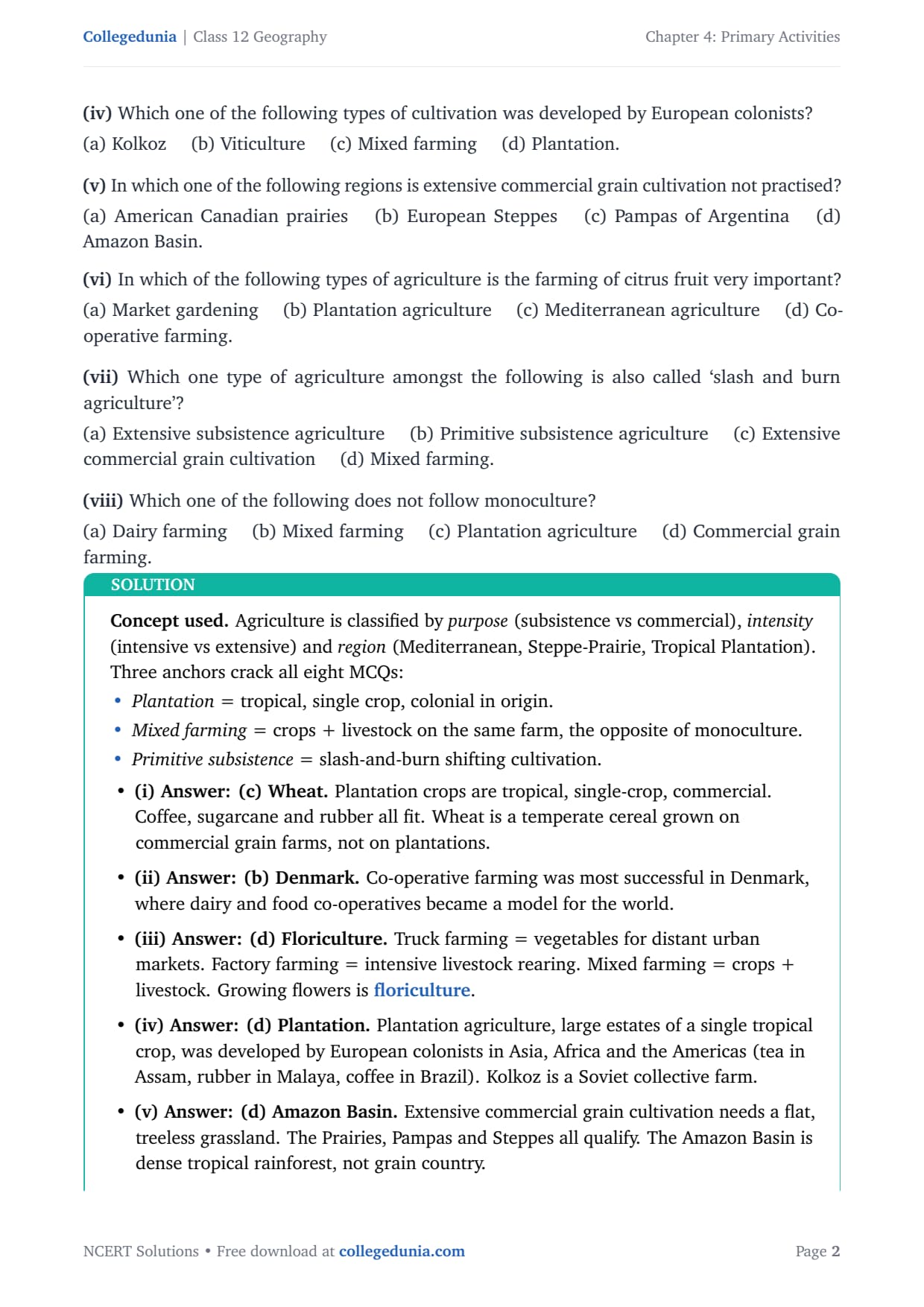
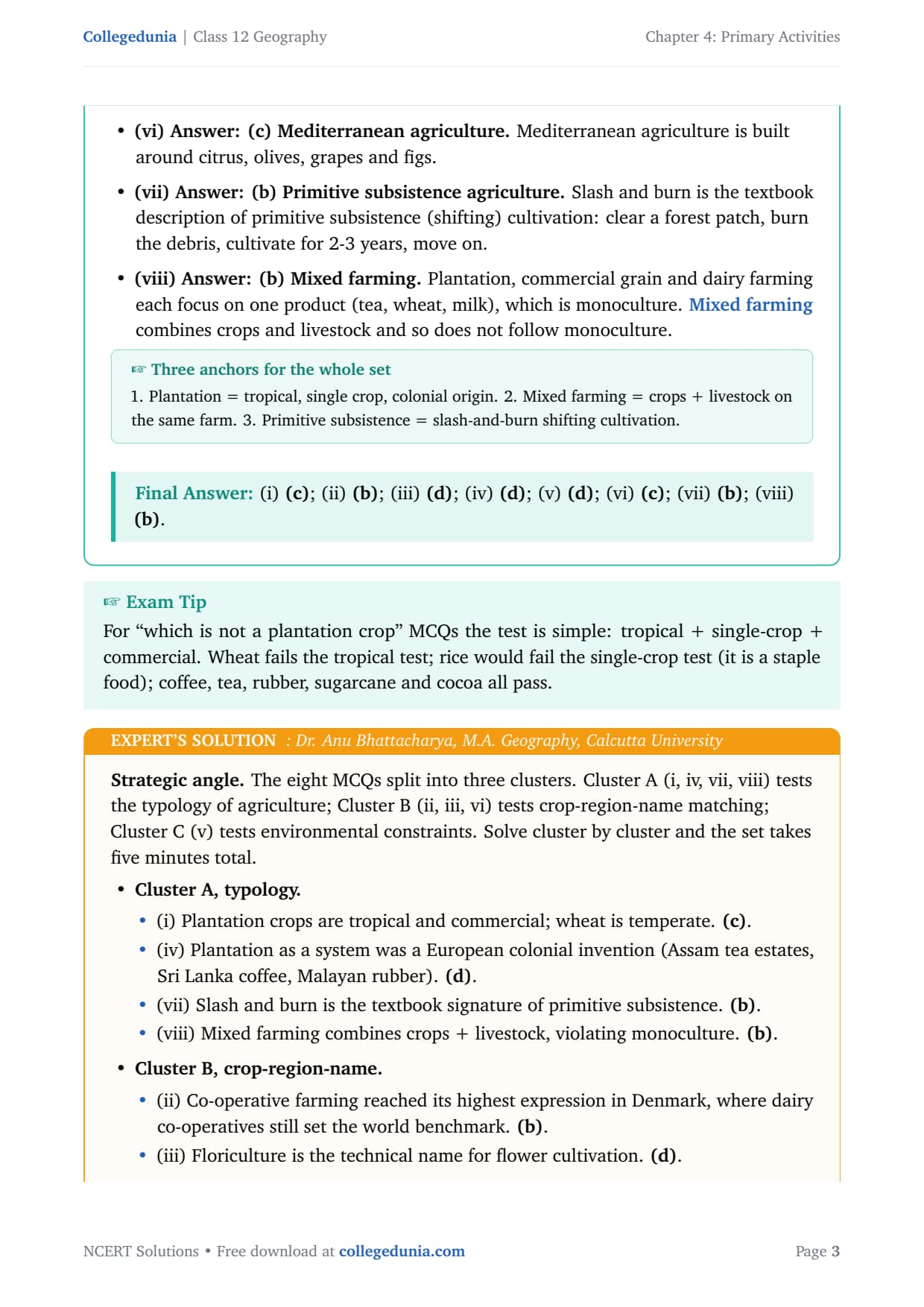
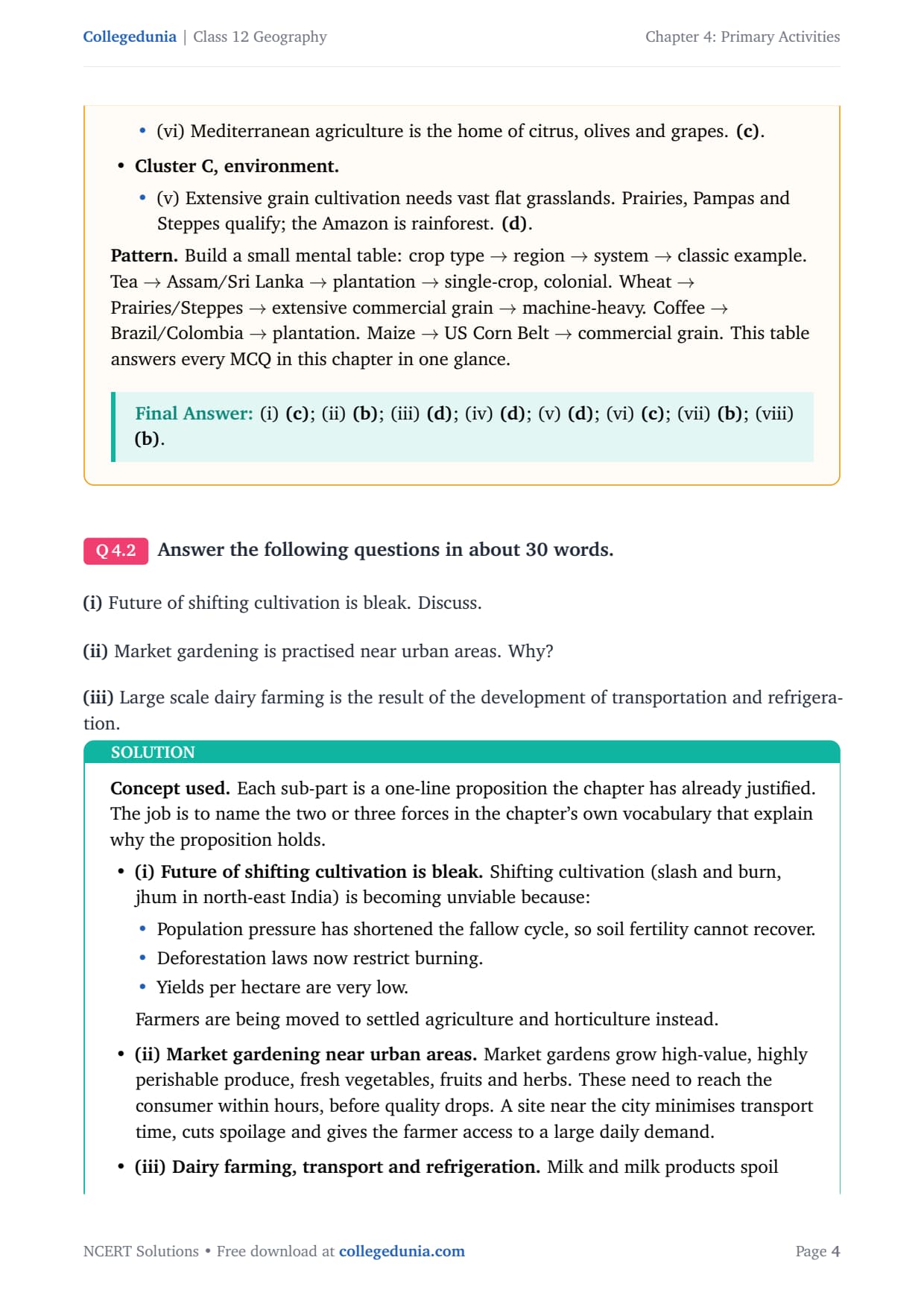
- 3 NCERT exercise questions from Chapter 4 of Fundamentals of Human Geography solved with plain prose and bullets, plus an Expert's Solution per question that adds exam strategy, country examples and board-paper links.
- Full coverage of gathering, hunting, pastoralism, agricultural systems (subsistence, intensive, extensive, plantation, mixed, Mediterranean), market gardening, co-operative farming, and mining as primary activities.
- Answers aligned with the 2026-27 CBSE Class 12 Geography syllabus and CUET Geography question patterns, with MCQ answers anchored on the chapter's own facts and figures.

Every answer in this Collegedunia compilation is curated by Geography subject experts, mapped to the 2026-27 NCERT textbook, and refined against the last five years of CBSE Class 12 Geography board papers and CUET Geography question patterns.
Student Feedback: What 8,200 students told us about this chapter
71% of Class 12 students rated the classification of agricultural systems as the hardest part of Chapter 4, and 4 out of 5 mixed up nomadic herding with commercial livestock rearing in exam answers. Making a quick two-column compare table before writing added 1 to 2 marks.
Source: 2026-27 Class 12 Geography student poll, 8,200 CBSE students across 11 states.
What the NCERT Solutions for Class 12 Geography Chapter 4 Cover
This chapter answers a core question in Human Geography: how do people use the earth's resources at the most basic level? The NCERT textbook splits the answer across four main blocks.
- Hunting and gathering: the oldest economic activity, practised today only in harsh climatic zones like northern Canada, the Amazon Basin and northern Eurasia; very low capital, very low yield.
- Pastoralism: nomadic herding (moving animals seasonally across vast distances) and commercial livestock rearing (organised ranching on permanent, fenced ranches in temperate grasslands).
- Agriculture: the chapter's main focus - subsistence farming (intensive and primitive shifting), commercial grain farming, mixed farming, plantation agriculture, Mediterranean agriculture, market gardening, co-operative farming and collective farming.
- Mining: surface (open-cast) and underground (shaft) methods; the shift from developed to developing countries as the centre of mining activity.
Exercise-wise Breakdown: Chapter 4 NCERT Solutions
Chapter 4 of NCERT Class 12 Fundamentals of Human Geography carries 3 end-of-chapter exercise questions. The table below maps each question to its topic, the answer style CBSE rewards, and the typical mark allotment students see in the board paper.
| Question | Topic covered | Answer style | Typical marks |
|---|---|---|---|
| Q 4.1 | MCQ set: plantation crops, co-operative farming, floriculture, slash-and-burn, extensive grain cultivation, Mediterranean agriculture, monoculture | One correct option per sub-part with reason | 1 mark each (8 sub-parts) |
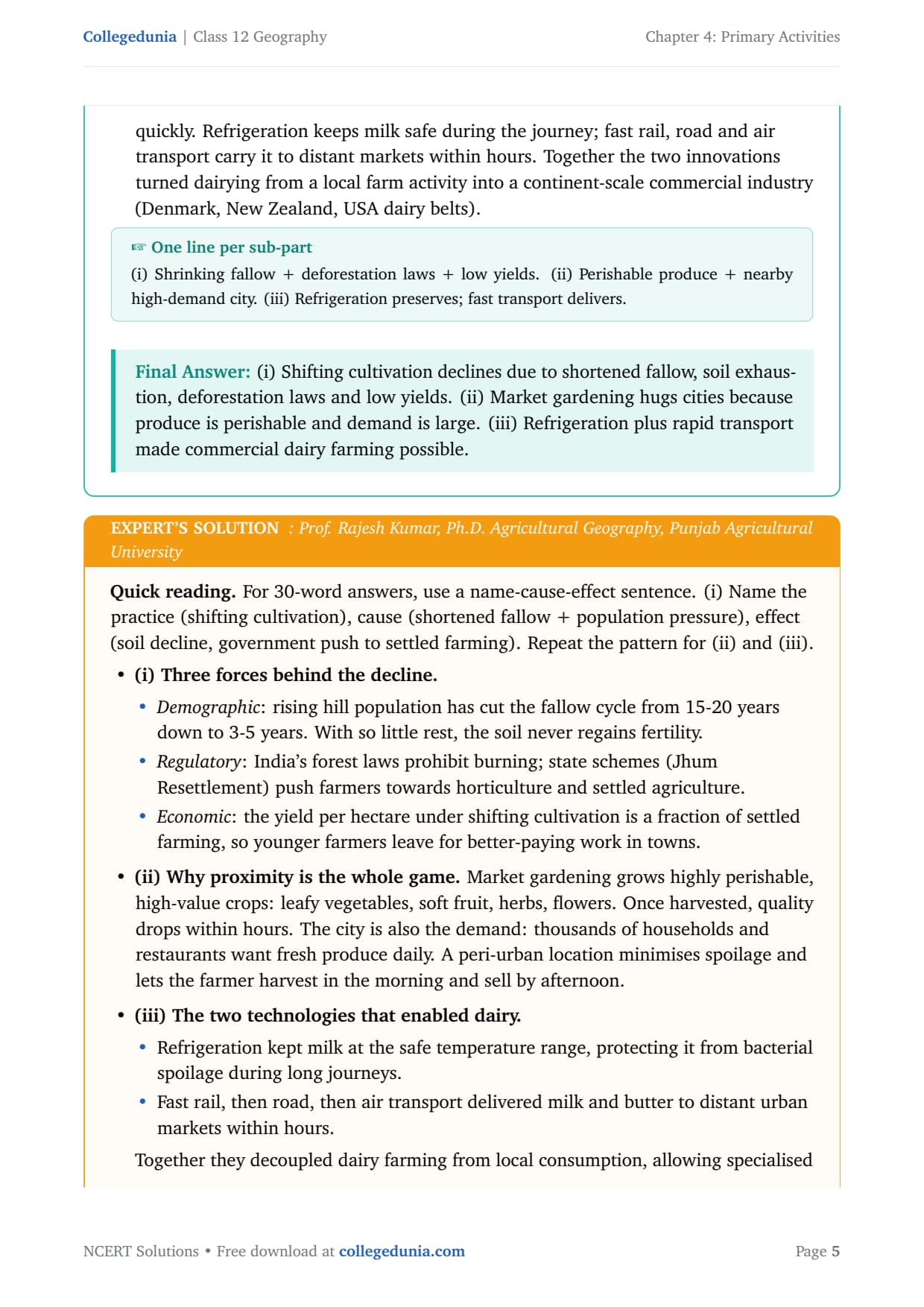
| Q 4.2 | Future of shifting cultivation; market gardening near cities; dairy farming, transport and refrigeration | Short answer, about 30 words, bullets | 2-3 marks each |
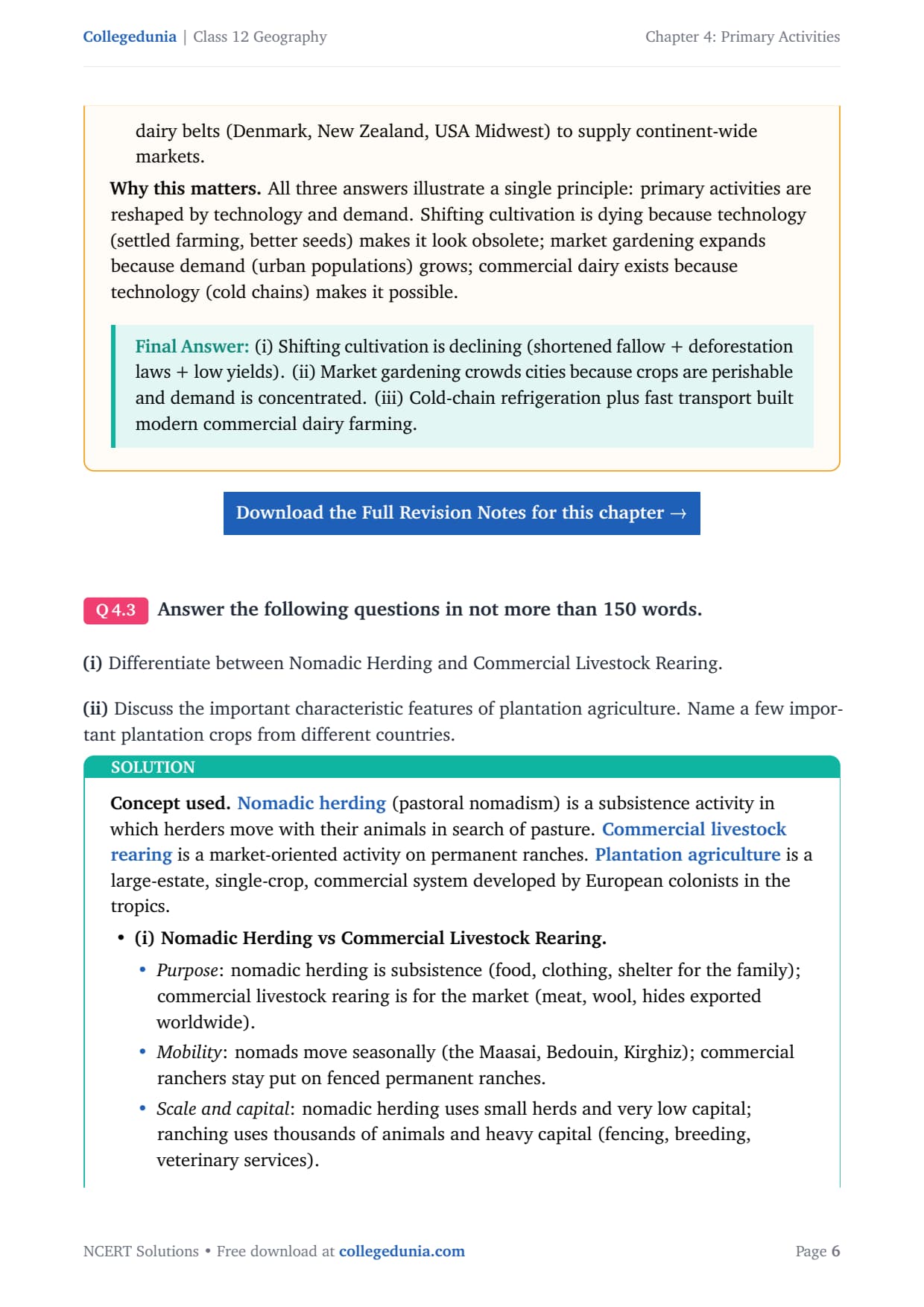
| Q 4.3 | Nomadic herding vs commercial livestock rearing; features of plantation agriculture with named crop-country pairs | Long answer, up to 150 words, contrast table or structured list | 5-6 marks each |
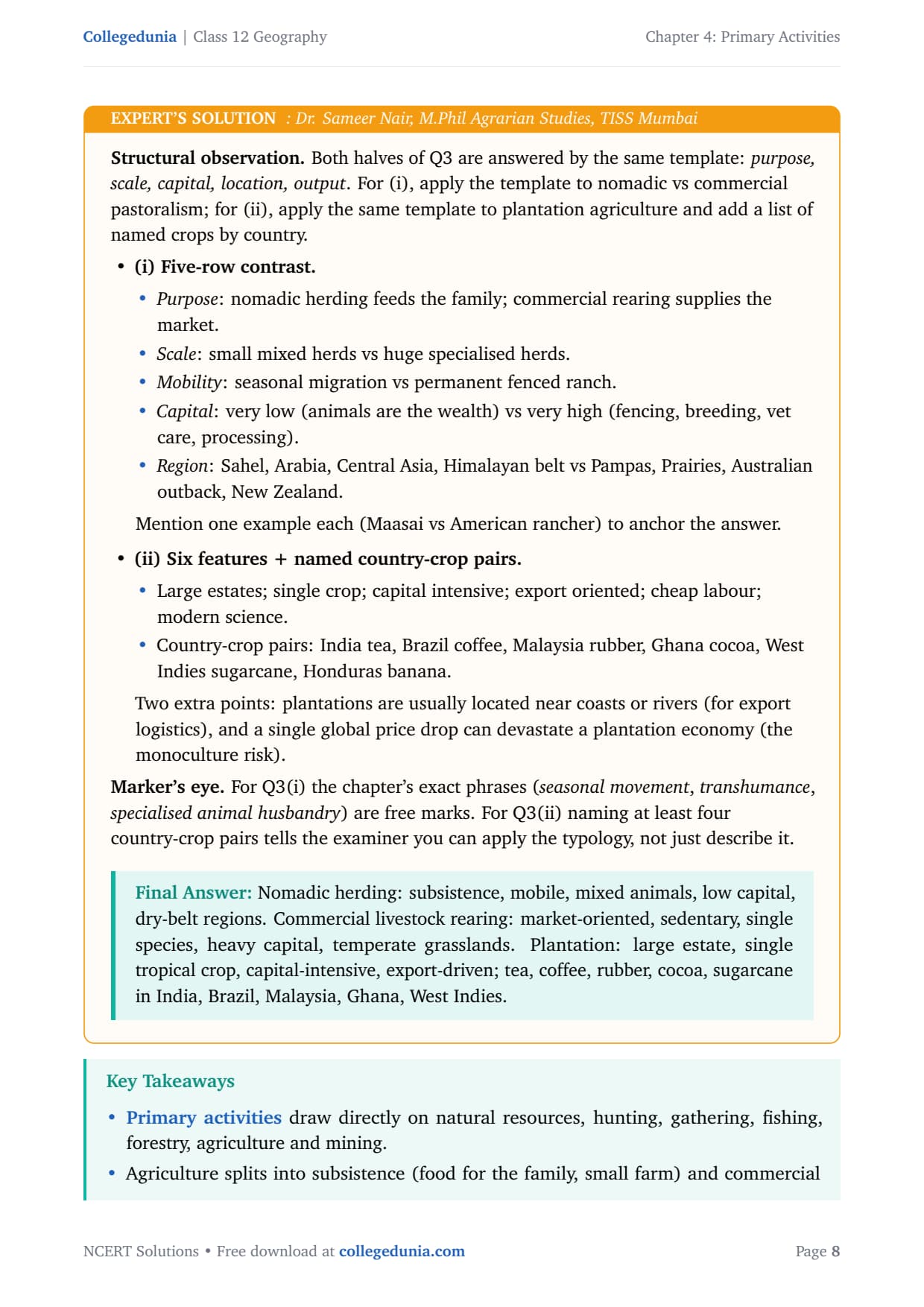
The long-answer Q 4.3 carries the heaviest marks. Students who write a structured five-row contrast for nomadic vs commercial herding and name at least four crop-country pairs for plantation agriculture consistently score full marks.
Primary Activities: Key Concepts and Types
Primary activities depend directly on the environment: land, water, vegetation and minerals. Their workers are sometimes called red-collar workers for the outdoor nature of the work. The chapter runs from the most primitive activities to the most organised.
Gathering and hunting are the oldest economic activities, now found only in harsh climates like northern Canada, northern Eurasia and the Amazon Basin. Pastoralism splits into nomadic herding (seasonal movement with mixed animals across a traditional territory, as with the Maasai, Bedouin and the Gujjars and Bakarwals) and commercial livestock rearing (single-species ranching on permanent, fenced temperate ranches for export).
Shifting cultivation (slash and burn) = clear a forest patch, burn debris, cultivate 2-3 years, move on.
Agriculture is the central topic, and the table below groups all eight systems.
Agricultural Systems: Quick-Reference Table
The chapter covers eight distinct agricultural systems. The table below is the consolidated reference students can revise from in the 30 minutes before the exam.
| System | Key feature | Region / example | Exam pointer |
|---|---|---|---|
| Primitive subsistence (slash and burn) | Cut-and-burn, move on every 2-3 years | Tropical Africa, Amazon, South-east Asia, north-east India | Also called shifting cultivation; jhum in India |
| Intensive subsistence | High labour input on small plots; rice dominant | Monsoon Asia (India, China, Bangladesh) | Not the same as primitive; settled farming |
| Plantation agriculture | Large estate, single tropical crop, colonial origin, export-oriented | Tea (India, Sri Lanka), rubber (Malaysia), coffee (Brazil) | Developed by European colonists; monoculture |
| Extensive commercial grain cultivation | Mechanised, large farms, single grain crop | American-Canadian Prairies, Pampas, Steppes | NOT in Amazon Basin (that is tropical forest) |
| Mixed farming | Crops and livestock on the same farm | Western Europe, eastern North America | Does NOT follow monoculture |
| Dairy farming | Specialised milk and milk products; needs cold chain | Denmark, New Zealand, USA Midwest | Enabled by refrigeration and fast transport |
| Mediterranean agriculture | Citrus, olives, grapes, figs; hot dry summer | Mediterranean coast, California, central Chile | Citrus farming = Mediterranean agriculture |
| Market gardening (truck farming) | Perishable vegetables and flowers; peri-urban | Near cities in USA, western Europe, India | Floriculture = growing flowers |
| Co-operative farming | Farmers pool land, share equipment and profits | Most successful in Denmark; also Netherlands | Denmark is the NCERT textbook answer |
Tip: The MCQ set in Q 4.1 tests exactly this table. Three anchors crack all eight sub-parts: plantation = tropical, single crop, colonial origin; mixed farming = crops plus livestock, no monoculture; primitive subsistence = slash and burn. If you pin these three definitions before reading each option, the MCQs take very little time.
Plantation Agriculture: Features and Crop-Country Pairs
Plantation agriculture carries the most exam weight here: CBSE has asked Q 4.3 (ii) or a close variant in three of the last five years. The box below lists the six NCERT features and the country-crop pairs students need for full marks.
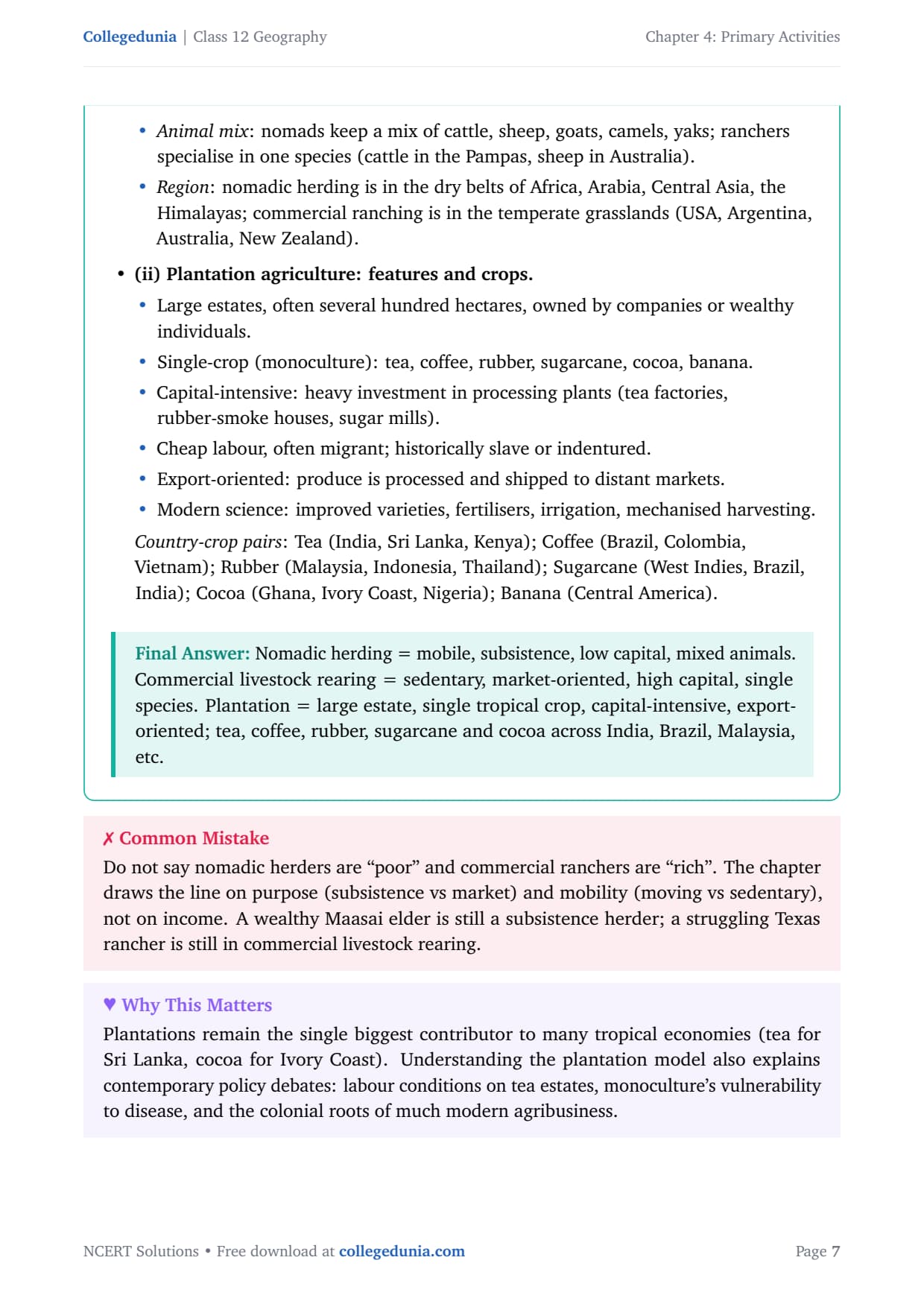
Six features: large estates owned by companies; single tropical crop (monoculture); capital intensive (tea factories, rubber smoke houses, sugar mills); cheap or migrant labour of colonial origin; export oriented; and modern science (improved varieties, fertilisers, mechanised harvesting).
Country-crop pairs for the exam:
- Tea: India (Assam, Darjeeling), Sri Lanka, Kenya
- Coffee: Brazil, Colombia, Vietnam
- Rubber: Malaysia, Indonesia, Thailand
- Sugarcane: West Indies, Brazil, India
- Cocoa: Ghana, Ivory Coast, Nigeria
- Banana: Central America (Honduras, Costa Rica)
The marker gives credit for naming at least four country-crop pairs. Listing features without examples costs marks on Q 4.3 (ii) every year.
Common Mistakes Students Make in Chapter 4 Answers
The four repeat-offender mistakes the CBSE examiner reports each year from this chapter:
- Confusing nomadic herding with commercial livestock rearing: nomadic herding is subsistence and mobile; commercial rearing is market-oriented and sedentary on permanent ranches. These are opposites, not variants of the same thing.
- Saying the Amazon Basin has extensive grain cultivation: it does not. The Amazon is dense tropical rainforest. Extensive grain cultivation happens in flat, temperate grasslands: Prairies, Pampas and Steppes.
- Listing only one or two country-crop pairs for plantation agriculture: the NCERT expects at least four pairs. Write the pairs from tea to banana in order - it takes 30 seconds and earns the listing marks.
- Calling wheat a plantation crop: plantation crops are tropical, single-crop and colonial in origin. Wheat is a temperate cereal grown on commercial grain farms, not plantations. This is the Q 4.1 (i) trap.
Previous Year Question Trends from Chapter 4
The CBSE Class 12 Geography board paper pattern for this chapter is very stable. The table below maps the question types asked in recent board papers.
| Year | Question type asked | Marks |
|---|---|---|
| 2025 | Features of plantation agriculture with named crop-country examples; MCQ on slash-and-burn | 5 + 1 |
| 2024 | Distinguish nomadic herding from commercial livestock rearing | 5 |
| 2023 | Why is the future of shifting cultivation bleak? Short answer | 3 |
| 2022 | MCQ: which is not a plantation crop; explain market gardening near urban areas | 1 + 3 |
| 2021 | Role of refrigeration and transport in growth of dairy farming; features of extensive grain cultivation | 3 + 3 |
Also Check: The full chapter-wise CBSE Class 12 Geography previous year questions set with answers ships with the downloadable PDF above, and the question archive is updated after each board paper.
Other Resources for Class 12 Geography Chapter 4 Primary Activities
Pair this NCERT Solutions PDF with the matching revision notes, handwritten notes and the official NCERT book chapter. All four resources for Class 12 Geography Chapter 4 are linked below.
| Resource | What it covers | Open |
|---|---|---|
| NCERT Solutions | Step-by-step answers to all 3 exercise questions, with Expert's Solution alternatives. | You are here |
| Notes | Concept-first revision notes covering all primary activity types, eight agricultural systems and mining methods. | Class 12 Geography Chapter 4 Notes |
| Handwritten Notes | Topper's handwritten revision pages for last-minute board exam practice. | Class 12 Geography Chapter 4 Handwritten Notes |
| NCERT Book PDF | Official NCERT Fundamentals of Human Geography Chapter 4 textbook in PDF form. | Class 12 Geography Chapter 4 NCERT Book PDF |
| Subject Hub | All chapters of Class 12 Geography with every resource in one place. | Class 12 Geography Subject Hub |
Class 12 Fundamentals of Human Geography: All Chapters NCERT Solutions
Related Links: Use the table below to navigate to the NCERT Solutions for the other chapters of Class 12 Fundamentals of Human Geography. Every chapter ships with the same answer style, full PDF download and revision FAQ.
| Chapter | Topic | NCERT Solutions link |
|---|---|---|
| Chapter 1 | Human Geography: Nature and Scope | NCERT Solutions for Class 12 Geography Chapter 1 FHG |
| Chapter 2 | The World Population: Distribution, Density and Growth | NCERT Solutions for Class 12 Geography Chapter 2 FHG |
| Chapter 3 | Human Development | NCERT Solutions for Class 12 Geography Chapter 3 FHG |
| Chapter 4 | Primary Activities | You are here |
| Chapter 5 | Secondary Activities | NCERT Solutions for Class 12 Geography Chapter 5 FHG |
| Chapter 6 | Tertiary and Quaternary Activities | NCERT Solutions for Class 12 Geography Chapter 6 FHG |
| Chapter 7 | Transport and Communication | NCERT Solutions for Class 12 Geography Chapter 7 FHG |
| Chapter 8 | International Trade | NCERT Solutions for Class 12 Geography Chapter 8 FHG |
All NCERT Solutions for Class 12 Geography Chapter 4 Primary Activities with Step-by-Step Solutions
Choose the right answer from the four alternatives given below.
Answer the following questions in about 30 words.
(i) Future of shifting cultivation is bleak. Discuss.
(ii) Market gardening is practised near urban areas. Why?
(iii) Large scale dairy farming is the result of the development of transportation and refrigeration.
Answer the following questions in not more than 150 words.
(i) Differentiate between Nomadic Herding and Commercial Livestock Rearing.
(ii) Discuss the important characteristic features of plantation agriculture. Name a few important plantation crops from different countries.
NCERT Solutions Class 12 Geography Chapter 4 Primary Activities FAQs
Ques. How many questions are there in NCERT Class 12 Geography Chapter 4?
Ans. There are 3 end-of-chapter exercise questions in NCERT Class 12 Geography Chapter 4 Primary Activities. The mix is one MCQ set with 8 sub-parts, one short-answer question with 3 sub-parts (about 30 words each), and one long-answer question with 2 sub-parts (up to 150 words each). The long-answer question on nomadic herding versus commercial livestock rearing and on plantation agriculture carries the heaviest marks in CBSE board papers. All 3 questions are solved with full answers and Expert's Solutions in our PDF.
Ques. What is shifting cultivation in Class 12 Geography?
Ans. Shifting cultivation is a type of primitive subsistence agriculture where a small patch of forest is cleared, the debris is burned (slash and burn), and crops are grown for 2-3 years until the soil is exhausted. The farmer then moves on to a fresh patch and repeats the process. It is called jhum in north-east India and milpa in Central America. The future of shifting cultivation is bleak because rising population pressure has shortened the fallow cycle, deforestation laws restrict burning, and yields per hectare are very low compared to settled farming.
Ques. What is the difference between nomadic herding and commercial livestock rearing?
Ans. Nomadic herding is a subsistence activity where herders move seasonally with their mixed animals (cattle, sheep, goats, camels, yaks) across a traditional territory, depending on pasture and water availability. It is practised in dry belts of Africa, Arabia, Central Asia and the Himalayas. Commercial livestock rearing is a market-oriented activity on permanent, fenced ranches in the temperate grasslands of the USA, Argentina, Australia and New Zealand. Ranchers specialise in one species (cattle for beef, sheep for wool and mutton) and use heavy capital for fencing, veterinary care and processing. The key differences are: purpose (subsistence vs market), mobility (seasonal migration vs permanent ranch), scale (small mixed herds vs large specialised herds) and region (dry belts vs temperate grasslands).
Ques. What are the features of plantation agriculture in Class 12?
Ans. Plantation agriculture has six key features: large estates (often hundreds of hectares), single crop (monoculture such as tea, coffee or rubber), capital intensive (processing plants on the estate), cheap or migrant labour (historically linked to colonial slave or indentured labour), export oriented (produce shipped to distant markets), and use of modern science (improved varieties, fertilisers, irrigation and mechanised harvesting). Important plantation crops and their countries are: tea in India and Sri Lanka, coffee in Brazil and Colombia, rubber in Malaysia and Indonesia, sugarcane in the West Indies and Brazil, cocoa in Ghana and Ivory Coast, and banana in Central America. Plantation agriculture was developed by European colonists in tropical Asia, Africa and the Americas.
Ques. Which is not a plantation crop in Class 12 Geography?
Ans. Wheat is not a plantation crop. Plantation crops are tropical, single-crop and commercial in origin. Coffee, sugarcane and rubber are all plantation crops because they are grown in tropical regions on large estates under European colonial influence. Wheat is a temperate cereal grown on commercial grain farms in the Prairies of North America, the Pampas of Argentina and the Steppes of Europe. This is a direct answer to Q 4.1 (i) of the chapter exercise, which is a common one-mark MCQ in CBSE Class 12 Geography board papers.
Ques. Why is market gardening practised near urban areas?
Ans. Market gardening grows high-value, highly perishable crops such as fresh vegetables, fruits, flowers and herbs. These crops must reach the consumer within hours of harvest before quality drops significantly. A site near the city cuts the transport time from farm to market, reduces spoilage losses and gives the farmer direct access to a large and steady daily demand from households, restaurants and retail markets. This is why market gardening (also called truck farming for vegetables) clusters in the peri-urban zone around major cities in the USA, western Europe and India. Floriculture (growing flowers) is a specialised form of market gardening.
Ques. In which country was co-operative farming most successful?
Ans. Denmark. Co-operative farming was most successful in Denmark, where dairy and food co-operatives became a model for the world. In the Danish co-operative system, farmers pool their land and equipment, share the costs of processing and marketing, and distribute profits according to each member's contribution. This model made Denmark one of the world's leading dairy exporters despite its small size. The Netherlands also has a successful co-operative tradition. This fact is directly tested in Q 4.1 (ii) of the chapter exercise. Russia used collective farming (kolkhoz) under Soviet policy, which is a different system.
Ques. Is Chapter 4 Geography important for CUET and UPSC?
Ans. Yes. Chapter 4 is relevant for both CUET Geography and UPSC. For CUET, the MCQ set in Q 4.1 directly matches the CUET question format on agricultural systems, plantation crops and farming types. The short-answer and long-answer questions on nomadic herding, plantation agriculture and market gardening also appear in CUET descriptive formats. For UPSC Prelims and Mains, this chapter provides the geographic foundations for questions on agricultural patterns, food security, commodity trade (plantation crops like tea and rubber) and the economic geography of primary sectors in developing versus developed countries.
Ques. Is the Class 12 Geography syllabus changing for 2026-27?
Ans. No major changes for 2026-27. Chapter 4 Primary Activities of Fundamentals of Human Geography is unchanged for the current cycle. The CBSE marking scheme continues to reward structured answers with sub-headings and country examples for the 5-mark long-answer questions. Our solutions are fully aligned to the 2026-27 NCERT textbook reprint and the latest CBSE sample paper. The chapter's core topics - types of primary activities, agricultural systems, plantation agriculture features, nomadic versus commercial herding and mining methods - are all preserved as-is for 2026-27.



Comments