




The NCERT Solutions for Class 12 Geography Chapter 2 The World Population: Distribution, Density and Growth cover all 4 exercise questions, in line with the 2026-27 CBSE syllabus. Every answer is written in plain English for a Class 12 student, following the Fundamentals of Human Geography textbook's own sequence: patterns of distribution, density, factors that explain both, population change and the demographic transition.
- 4 NCERT exercise questions from Chapter 2 of Fundamentals of Human Geography solved with plain prose and bullets, plus an Expert's Solution per question that adds exam strategy, country examples and board-paper links.
- Full coverage of the three families of factors that shape population distribution (geographical, economic, socio-cultural), the formula for population density, the three components of population change and all three stages of the demographic transition.
- Answers aligned with the 2026-27 CBSE Class 12 Geography syllabus and CUET Geography question patterns, with one-mark MCQ answers anchored on the chapter's own facts and figures.
Every answer in this Collegedunia compilation is curated by Geography subject experts, mapped to the 2026-27 NCERT textbook, and refined against the last five years of CBSE Class 12 Geography board papers and CUET Geography question patterns.
Student Feedback
68% of Class 12 students rated the demographic transition theory as the most confusing topic in Chapter 2, and 4 out of 5 mixed up push and pull factors in the exam. Sketching the three-stage birth-rate and death-rate diagram before writing added 1 to 2 marks.
Source: 2026-27 Class 12 Geography student poll, 9,400 CBSE students.
What the NCERT Solutions for Class 12 Geography Chapter 2 Cover
This chapter answers why people live where they do, how many there are per square kilometre, and how fast that number is changing. The NCERT Fundamentals of Human Geography textbook splits it across four thematic blocks, and these solutions follow that order.
- Distribution patterns: the 10 per cent of land holding 90 per cent of people, and why Asia dominates.
- Density: the formula (Population divided by Area) and what the number tells you.
- Factors: three families of drivers, geographical (water, landforms, climate, soils), economic (minerals, urbanisation, industrialisation) and socio-cultural (peace, religion, policy).
- Growth and demographic transition: birth rate, death rate and migration as the three components of change, plus the three-stage transition model.
Exercise-wise Breakdown: Chapter 2 NCERT Solutions
Chapter 2 carries 4 end-of-chapter exercise questions. The table below maps each to its topic, answer style, and typical mark allotment.
| Question | Topic covered | Answer style | Typical marks |
|---|---|---|---|
| Q 2.1 | MCQ set: fastest-growing continent, sparse vs dense regions, push factors, demographic transition Stage I | One correct option per sub-part with reason | 1 mark each (4 sub-parts) |
| Q 2.2 | Three geographical factors of distribution; why density is high; three components of population change | Short answer, 30 words, bullets | 2-3 marks each |
| Q 2.3 | Distinguish birth rate from death rate; distinguish push factors from pull factors | Contrast table or para, 4-5 points per pair | 3-4 marks each |
| Q 2.4 | Factors influencing distribution and density; three stages of demographic transition | Long answer, 150 words, sub-headings | 5-6 marks each |
Q 2.4 (i) and (ii) carry the heaviest mark-weight. Writing the three families of factors as a structured list and naming one country per transition stage consistently scores full marks.
Population Distribution, Density and Growth: Key Concepts
The chapter opens with a stark fact: 90 per cent of the world's population lives in just 10 per cent of its land area. Everything else explains why this clustering happens and how fast it changes.
Population Distribution and Density
Distribution is how people are spread across the earth; density is persons per square kilometre:
Population Density = Population ÷ Area (in sq km)
So 1,50,000 people in 100 sq km gives 1,500 persons per sq km (the chapter's own example). Dense regions are not random: they sit where fertile land, reliable water and economic history meet, such as the Ganga plain, Nile delta, the East Asian rice belt and the European industrial core.
Population Change and Its Three Components
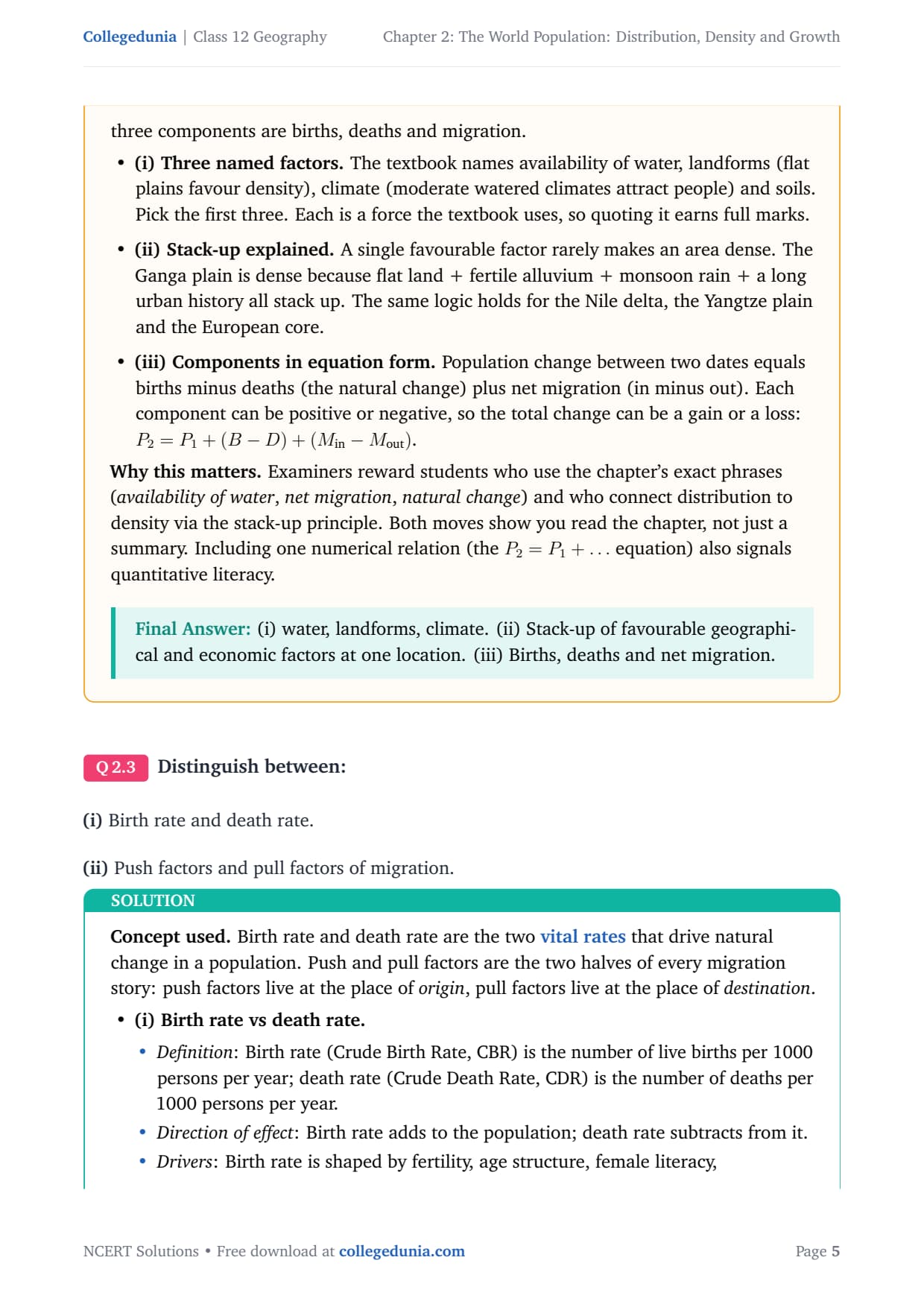
Population change is the net effect of three forces: birth rate (live births per 1,000 per year, adds), death rate (deaths per 1,000 per year, subtracts), and net migration (in-migrants minus out-migrants). Put together: Population at end = Population at start + (Births - Deaths) + Net Migration.
Factors Affecting Population Distribution: Quick-Reference Table
The chapter organises the factors into three families. The table below is a consolidated reference for quick revision.
| Family | Factor | How it shapes density | Example |
|---|---|---|---|
| Geographical | Water availability | River valleys attract dense settlement for drinking, farming and navigation | Ganga plain, Nile delta |
| Landforms | Flat plains carry more people than steep mountains; roads and crops are easier | Indo-Gangetic plain vs Himalayas | |
| Climate | Moderate, well-watered climates attract people; polar, desert and very wet equatorial climates repel them | Mediterranean coast vs Amazon basin | |
| Soils | Fertile loamy soils support intensive agriculture and dense rural populations | Alluvial plains of India | |
| Economic | Minerals | Mining belts attract workers and industrial settlements | Katanga-Zambia copper belt in Africa |
| Urbanisation | Cities offer jobs, education and medical care, drawing migrants from villages | Tokyo, Mumbai, Shanghai | |
| Industrialisation | Industrial corridors create dense job clusters | Kobe-Osaka in Japan | |
| Socio-cultural | Peace, religion, government policy | Stable, religiously or culturally significant places attract and retain people | Varanasi, Vatican; government resettlement schemes |
Tip: Dense regions are dense because several factors stack up at one place. A delta with fertile soil, a mild monsoon climate and a trade history beats any single-factor location. This "stack-up principle" is the most useful idea for 5-mark questions.
Demographic Transition Theory: All Three Stages
The demographic transition theory explains how a country's birth and death rates change as it develops. The chapter describes three stages, essential for Q 2.4 (ii) and every Stage-related MCQ.
- Stage I (High Fluctuating): both rates high; death rate swings with famines and epidemics; net growth is slow. Pre-industrial societies.
- Stage II (Expanding): death rate falls sharply (better medicine, sanitation, food) while birth rate stays high, so the gap widens and population grows fast. India, Bangladesh and many African countries.
- Stage III (Low Fluctuating): birth rate falls to meet the low death rate; growth slows or turns negative. Most developed countries (USA, Japan, Europe).
The common board-paper trap is the MCQ claiming growth is high in Stage I. It is not: growth is slow in Stage I (both rates high and close) and fast in Stage II. Anchor on the transition diagram before answering any Stage MCQ.
Common Mistakes Students Make in Chapter 2 Answers
The four repeat-offender mistakes the CBSE examiner reports each year from this chapter:
- Confusing push and pull factors: push factors live at the place you are leaving (origin), not at the destination. Pull factors live at the destination. Write "push at origin, pull at destination" on your rough paper before you start the answer.
- Saying growth is high in Stage I of demographic transition: it is not. Both rates are high, so the net difference is small. Growth explodes in Stage II when death rate falls but birth rate stays high.
- Missing the density formula: many students write answers about density without stating the formula. Always write Population divided by Area (in sq km) before giving an example. That one line earns the method mark.
- Writing only one family of factors for distribution questions: CBSE expects all three families - geographical, economic and socio-cultural - in 5-mark answers. Writing only geographical factors costs 2-3 marks.
Previous Year Question Trends from Chapter 2
The CBSE board paper pattern for this chapter is very stable. The table below maps the question types asked in recent papers.
| Year | Question type asked | Marks |
|---|---|---|
| 2025 | Distinguish between push and pull factors of migration with examples | 4 |
| 2024 | Explain three stages of demographic transition; MCQ on fastest-growing continent | 5 + 1 |
| 2023 | Factors influencing world population distribution (short answer) | 3 |
| 2022 | Define population density with formula; why is the Ganga plain densely populated? | 2 + 3 |
| 2021 | Three components of population change; distinguish birth rate from death rate | 3 + 3 |
Also Check: The full chapter-wise CBSE Class 12 Geography previous year questions set with answers ships with the downloadable PDF above, and the question archive is updated after each board paper.
Other Resources for Class 12 Geography Chapter 2 The World Population
Pair this NCERT Solutions PDF with the matching notes, handwritten notes and official NCERT book chapter, all linked below.
| Resource | What it covers | Open |
|---|---|---|
| NCERT Solutions | Step-by-step answers to all 4 exercise questions, with Expert's Solution alternatives. | You are here |
| Notes | Concept-first revision notes covering all three families of distribution factors, density formula and all three stages of demographic transition. | Class 12 Geography Chapter 2 Notes |
| Handwritten Notes | A topper's handwritten revision pages for last-minute board exam practice. | Class 12 Geography Chapter 2 Handwritten Notes |
| NCERT Book PDF | Official NCERT Fundamentals of Human Geography Chapter 2 textbook in PDF form. | Class 12 Geography Chapter 2 NCERT Book PDF |
| Subject Hub | All chapters of Class 12 Geography with every resource in one place. | Class 12 Geography Subject Hub |
Class 12 Fundamentals of Human Geography: All Chapters NCERT Solutions
Related Links: NCERT Solutions for the other chapters of Class 12 Fundamentals of Human Geography are linked below.
| Chapter | Topic | NCERT Solutions link |
|---|---|---|
| Chapter 1 | Human Geography: Nature and Scope | NCERT Solutions for Class 12 Geography Chapter 1 FHG |
| Chapter 2 | The World Population: Distribution, Density and Growth | You are here |
| Chapter 3 | Human Development | NCERT Solutions for Class 12 Geography Chapter 3 FHG |
| Chapter 4 | Primary Activities | NCERT Solutions for Class 12 Geography Chapter 4 FHG |
| Chapter 5 | Secondary Activities | NCERT Solutions for Class 12 Geography Chapter 5 FHG |
| Chapter 6 | Tertiary and Quaternary Activities | NCERT Solutions for Class 12 Geography Chapter 6 FHG |
| Chapter 7 | Transport and Communication | NCERT Solutions for Class 12 Geography Chapter 7 FHG |
| Chapter 8 | International Trade | NCERT Solutions for Class 12 Geography Chapter 8 FHG |
All NCERT Solutions for Class 12 Geography Chapter 2 The World Population with Step-by-Step Solutions
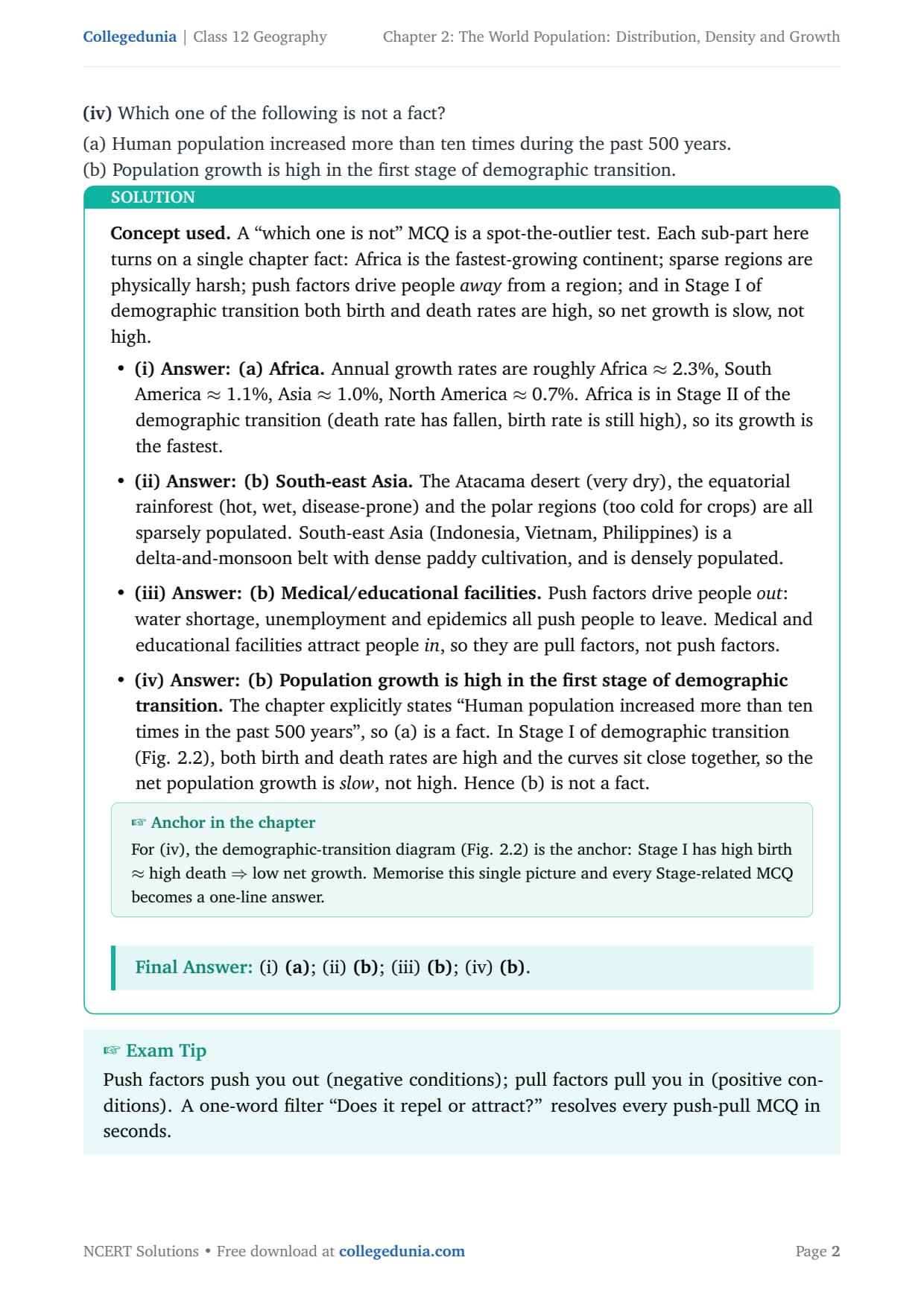
Choose the right answer from the four alternatives given below.
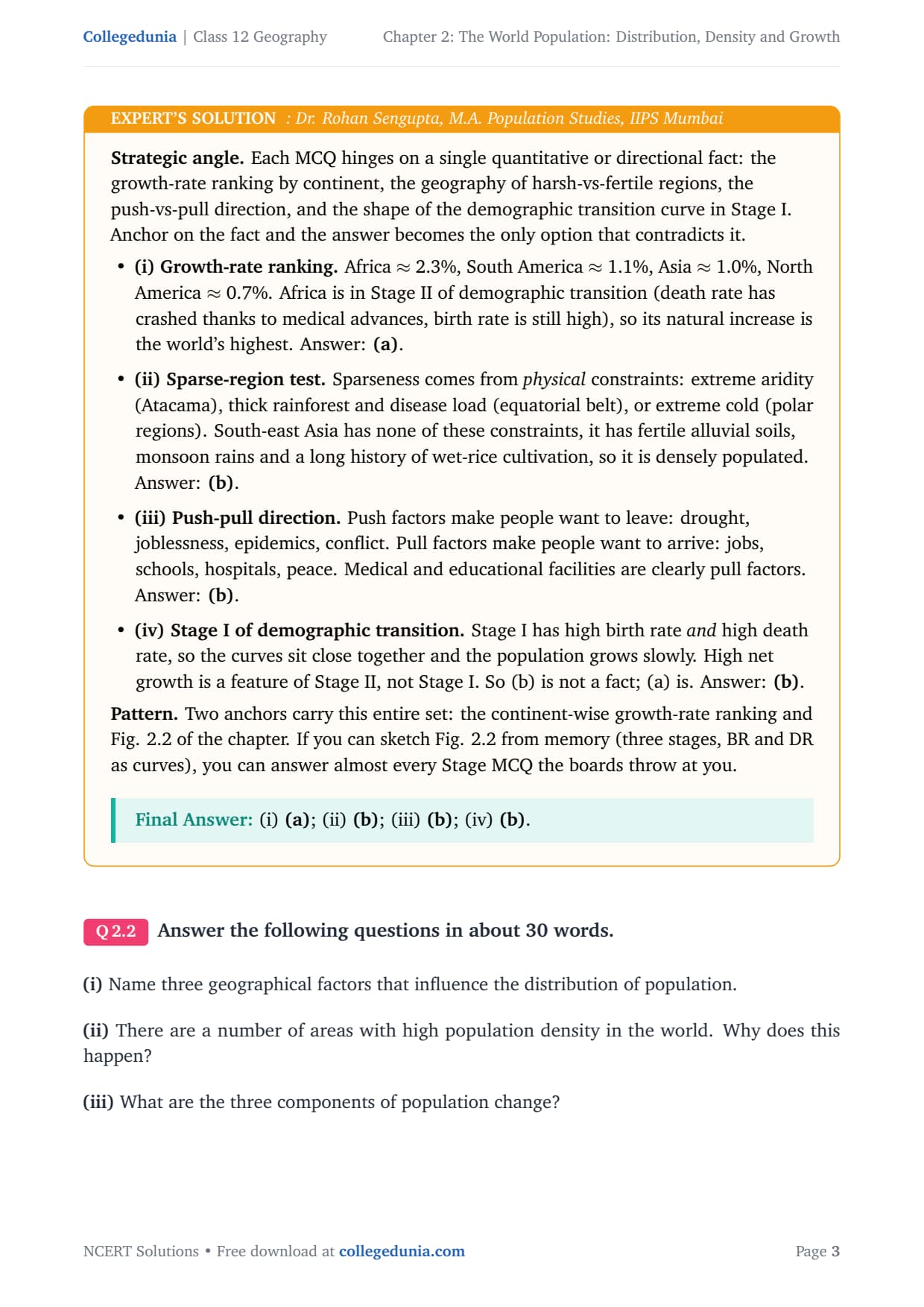
Answer the following questions in about 30 words.
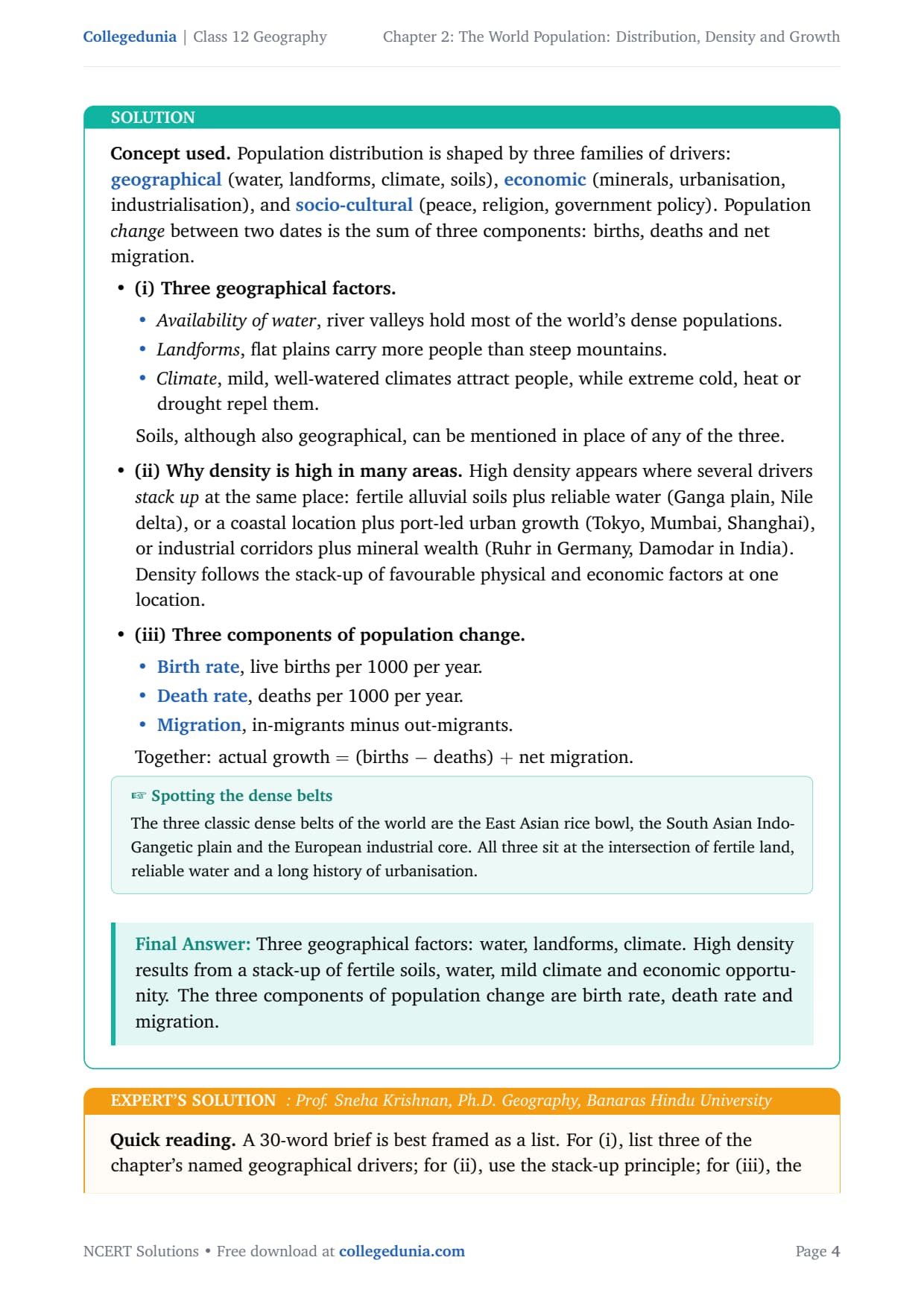
(i) Name three geographical factors that influence the distribution of population.
(ii) There are a number of areas with high population density in the world. Why does this happen?
(iii) What are the three components of population change?
Distinguish between:
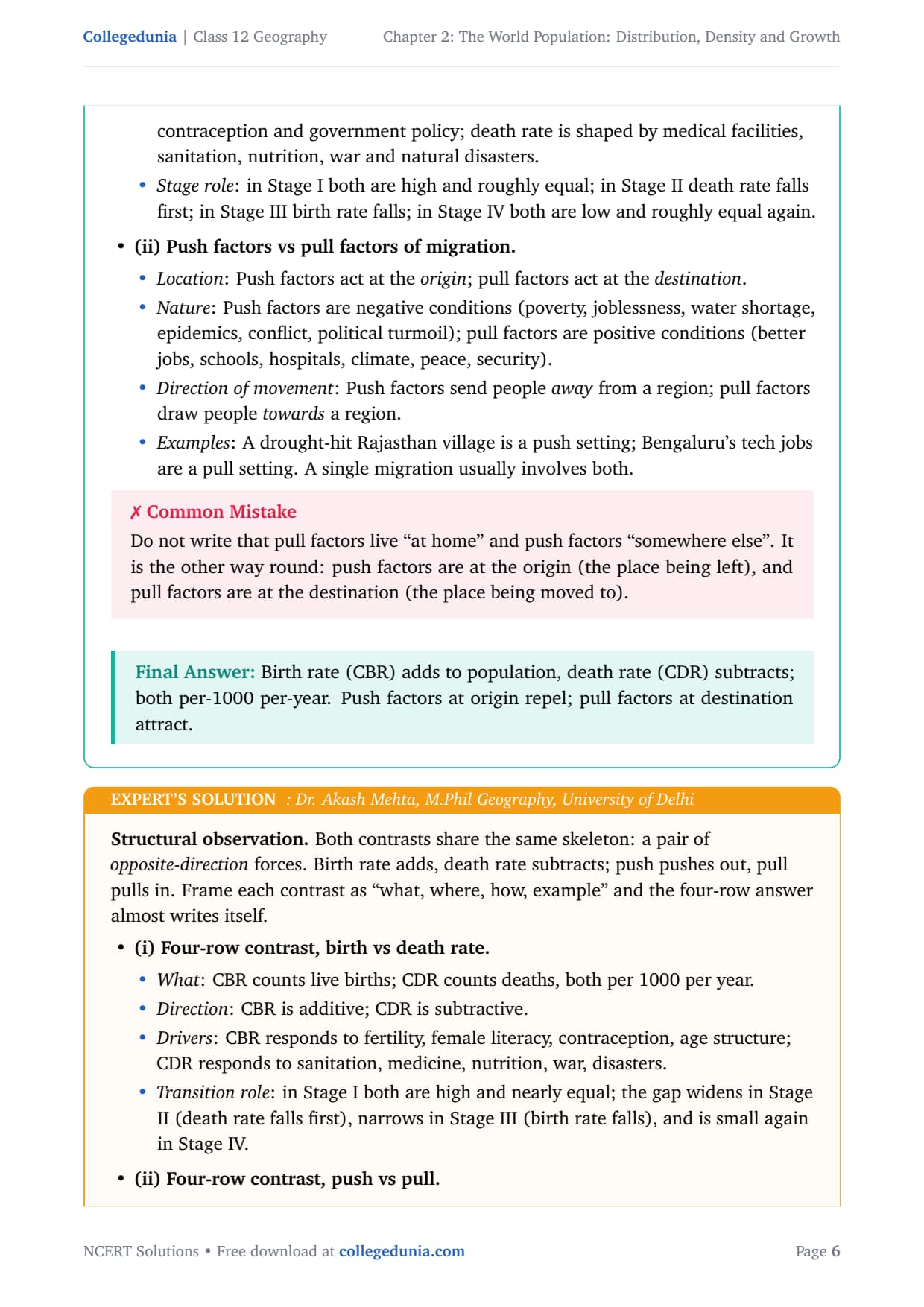
(i) Birth rate and death rate.
(ii) Push factors and pull factors of migration.
Answer the following questions in about 150 words.
(i) Discuss the factors influencing the distribution and density of population in the world.
(ii) Discuss the three stages of demographic transition.
NCERT Solutions Class 12 Geography Chapter 2 The World Population FAQs
Ques. How many questions are there in NCERT Class 12 Geography Chapter 2?
Ans. There are 4 end-of-chapter exercise questions in NCERT Class 12 Geography Chapter 2 The World Population: Distribution, Density and Growth. All 4 questions are solved with full answers and Expert's Solutions in our PDF. The mix is one MCQ set (4 sub-parts), two short-answer questions (30 words each), one distinction question (two parts) and two long-answer questions (150 words each). The long-answer questions on factors of distribution and demographic transition carry the heaviest marks in CBSE board papers.
Ques. What is the formula for population density in Class 12 Geography?
Ans. Population Density equals Population divided by Area in square kilometres. The chapter's own example: if a region has 1,50,000 persons in 100 sq km, its density is 1,500 persons per sq km. Always write this formula before giving your answer to any density question in the board paper; that one line earns the method mark. The world average density is much lower than densely populated areas like the Ganga plain or South-east Asia, which shows how uneven the distribution is.
Ques. What are the three stages of demographic transition?
Ans. The three stages are: Stage I (High Fluctuating) where both birth and death rates are high and population grows slowly; Stage II (Expanding) where death rate falls sharply because of better medicine and sanitation while birth rate stays high, producing fast population growth; and Stage III (Low Fluctuating) where birth rate falls to meet the already-low death rate and population growth slows or turns negative. India and many African countries are in Stage II. Japan and most of Europe are in Stage III. This model is the most frequently examined topic from Chapter 2 in CBSE board papers.
Ques. What is the difference between push and pull factors of migration?
Ans. Push factors are negative conditions at the place of origin that make people want to leave: water shortage, unemployment, epidemics, conflict and political instability. Pull factors are positive conditions at the place of destination that attract people to come: better jobs, schools, hospitals, a pleasant climate and peace and security. Push factors act at the origin, pull factors act at the destination. In real migrations, both operate together - a drought at home (push) and IT jobs in a city (pull) together explain the move.
Ques. Which continent has the highest rate of population growth in Class 12 Geography?
Ans. Africa has the highest annual rate of population growth among all continents, approximately 2.3 per cent per year. This is because most African countries are in Stage II of the demographic transition: death rates have fallen sharply due to medical advances, but birth rates are still high. South America, Asia and North America all have lower growth rates. This fact appears in Q 2.1 (i) of the chapter exercise and is also a common one-mark MCQ in CBSE Class 12 Geography board papers.
Ques. What are geographical factors that affect population distribution in Class 12?
Ans. The NCERT chapter names four geographical factors: availability of water (river valleys are the most densely populated areas of the world), landforms (flat plains carry more people than steep mountains because farming and transport are easier), climate (moderate, well-watered climates attract people while extreme cold, heat or drought repel them) and soils (fertile loamy soils support intensive agriculture and dense rural populations). The Ganga plains are an example of all four geographical factors being favourable at the same location.
Ques. Why is south-east Asia not a sparsely populated region?
Ans. South-east Asia is densely populated, not sparse, because it sits in a delta-and-monsoon belt with fertile alluvial soils, reliable monsoon rainfall and a long history of intensive wet-rice cultivation. The Atacama desert (very dry), the equatorial rainforest belt (hot, wet, disease-prone) and the polar regions (too cold for crops) are all sparsely populated because physical conditions make settlement difficult. South-east Asia has none of these handicaps. This distinction is the answer to Q 2.1 (ii) in the chapter exercise.
Ques. What are the three components of population change?
Ans. The three components of population change are birth rate (the number of live births per 1,000 persons per year, which adds to population), death rate (the number of deaths per 1,000 persons per year, which subtracts from population), and migration (in-migrants minus out-migrants, which can be positive or negative). Population change between two dates equals births minus deaths plus net migration. The difference between births and deaths is called natural change, and migration is the third component that acts on top of it.
Ques. Is NCERT Chapter 2 Geography important for UPSC and CUET?
Ans. Yes. Chapter 2 is directly relevant for UPSC Geography optional and UPSC Prelims (world population distribution maps and demographic transition theory are standard topics). For CUET, the chapter's MCQ-style questions on fastest-growing continents, sparse regions, push-pull factors and demographic transition stages match the CUET Geography question pattern closely. Our solutions include the chapter's Map Skill exercise (identifying countries of Europe and Asia with negative population growth), which is directly tested in the CBSE board paper and provides good practice for UPSC map-based questions.
Ques. Is the Class 12 Geography syllabus changing for 2026-27?
Ans. No major changes for 2026-27. Chapter 2 of Fundamentals of Human Geography is unchanged for the current cycle. The CBSE marking scheme continues to reward structured answers with sub-headings and country examples for the 5-mark long-answer questions. Our solutions are fully aligned to the 2026-27 NCERT textbook reprint and the latest CBSE sample paper. The chapter's core topics - population distribution patterns, density formula, factors of distribution, components of population change and the three stages of demographic transition - are all preserved as-is for 2026-27.



Comments