




The NCERT Solutions for Class 12 Geography Chapter 1 Human Geography: Nature and Scope cover all 3 exercise questions, in line with the 2026-27 CBSE syllabus. Every answer is written in plain English for a Class 12 student, following the Fundamentals of Human Geography textbook's own sequence: definitions of human geography, its sub-fields and scope, naturalisation of humans versus humanisation of nature, and the four approaches in human geography.
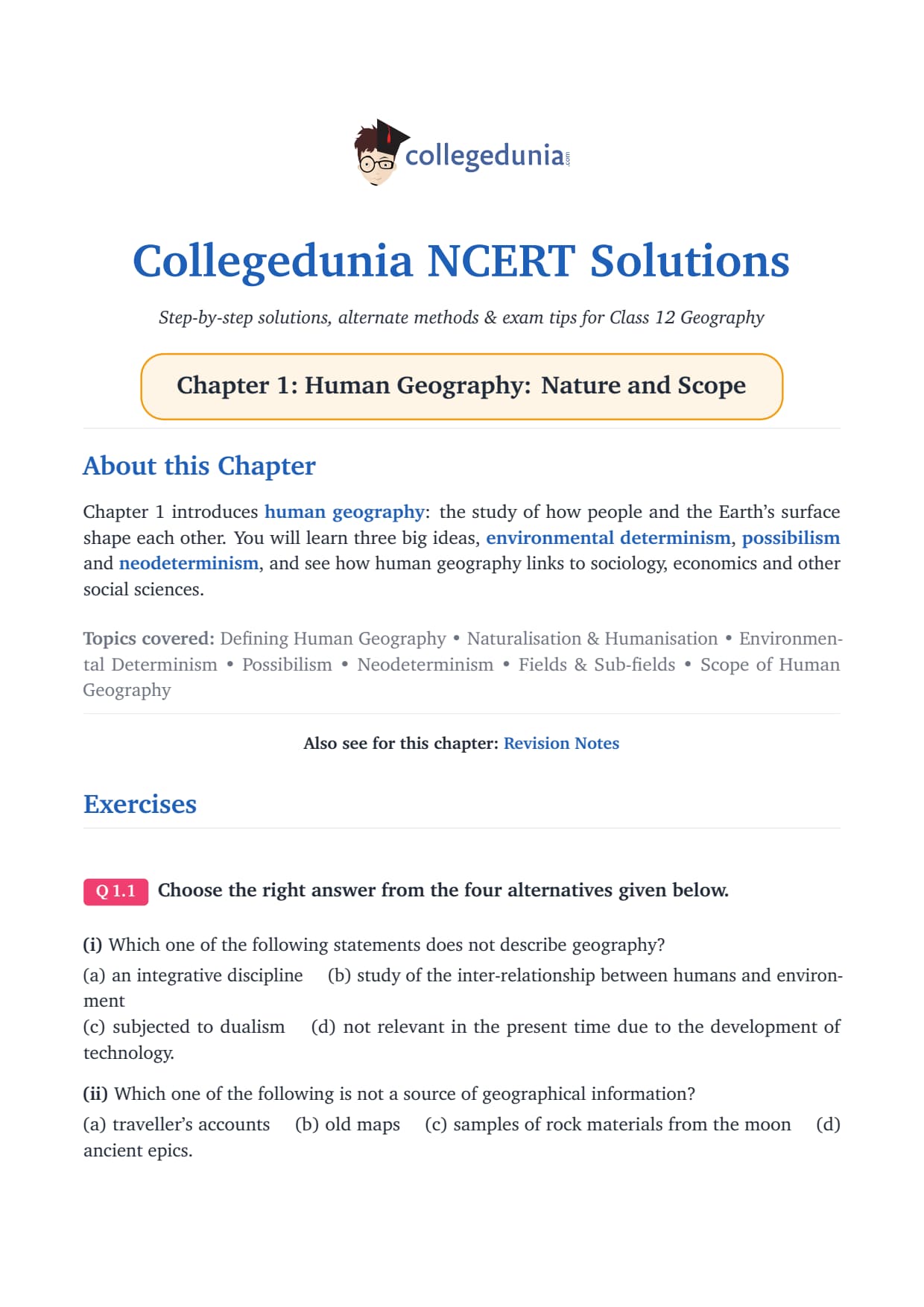
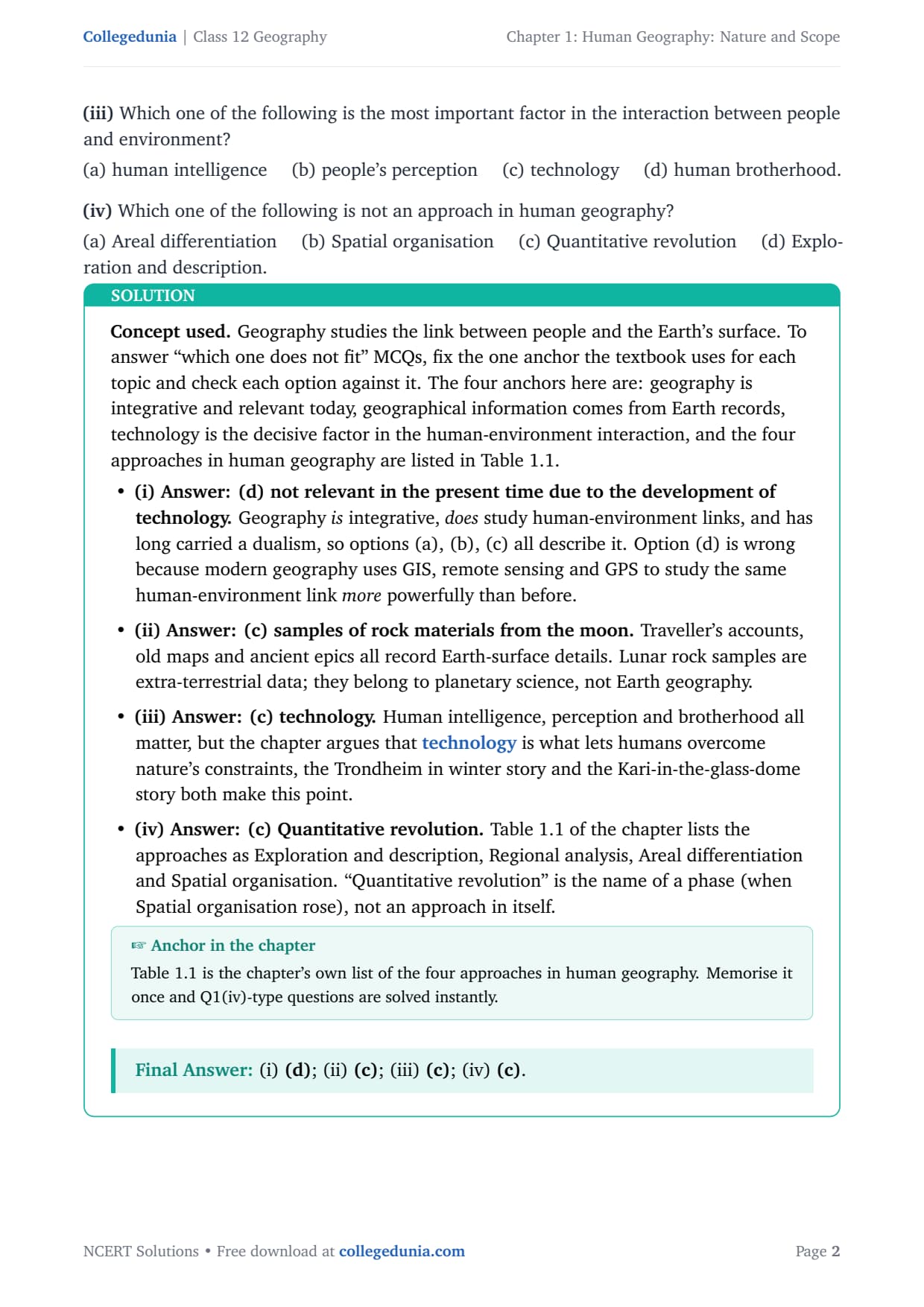
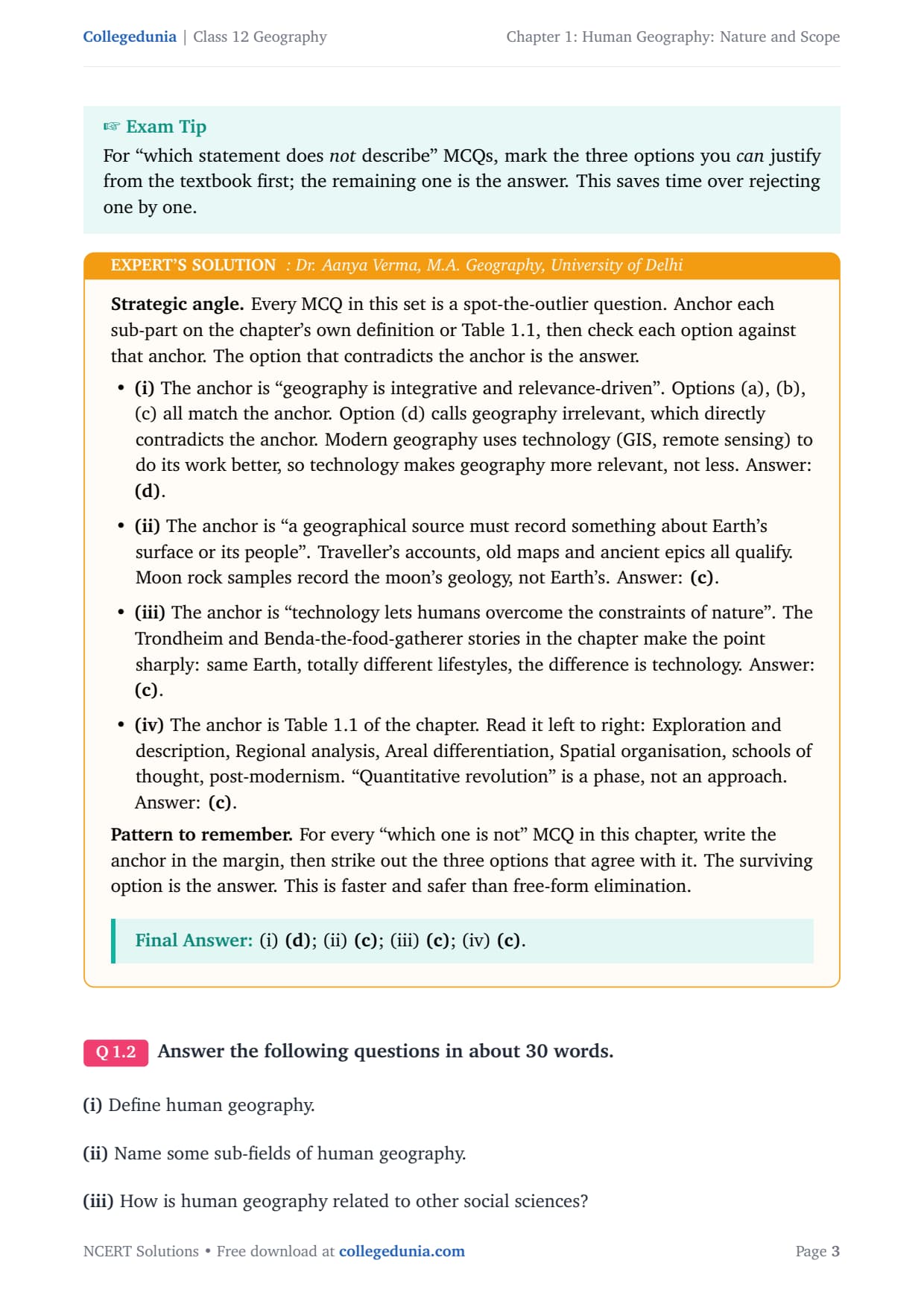
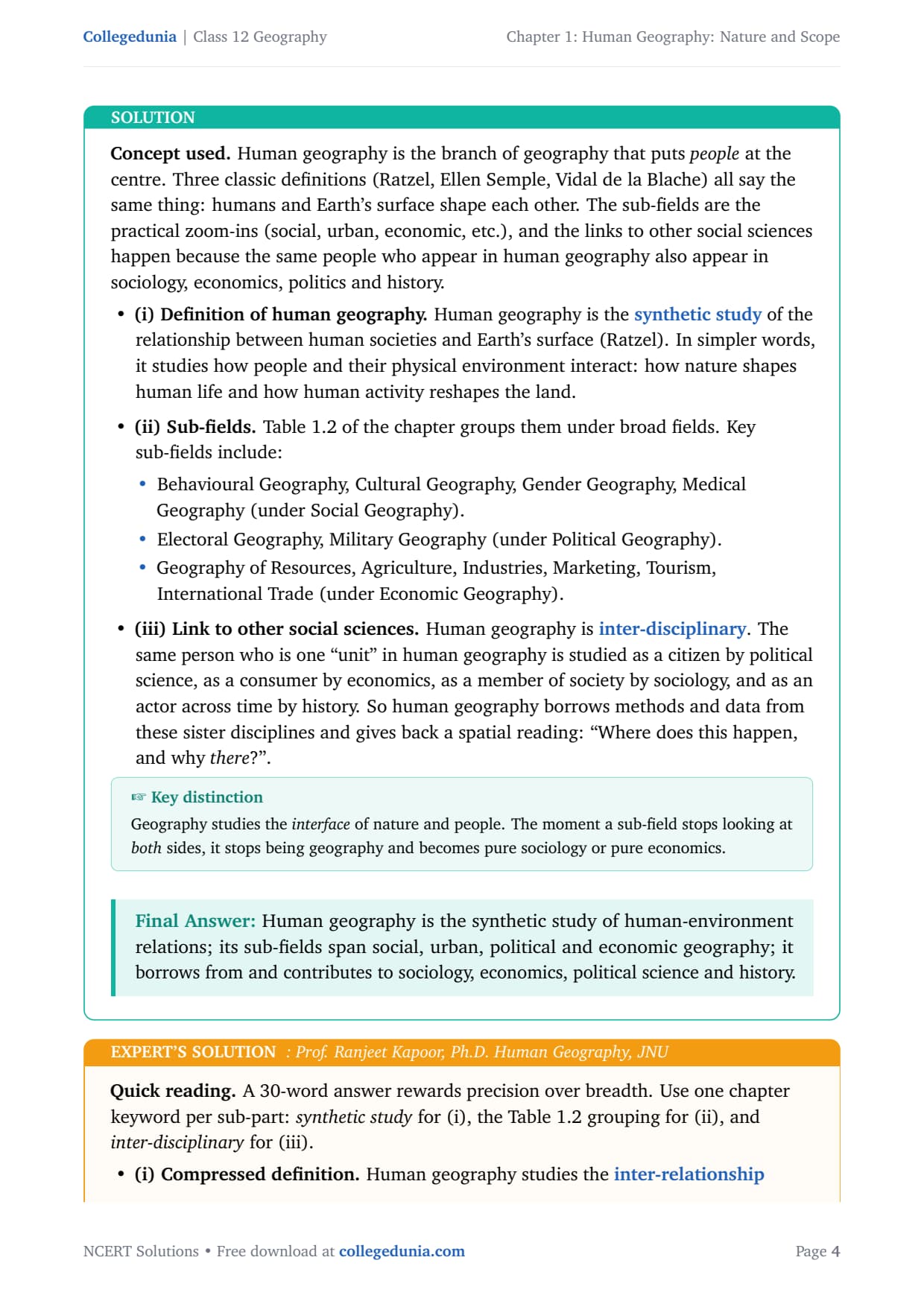
- 3 NCERT exercise questions from Chapter 1 of Fundamentals of Human Geography solved with plain prose and bullets, plus an Expert's Solution per question that adds exam strategy, board-paper links and UPSC angles.
- Full coverage of environmental determinism, possibilism, the nature-human interface, the four approaches in human geography and the seven broad fields of Table 1.2 that the CBSE paper tests directly.
- Answers aligned with the 2026-27 CBSE Class 12 Geography syllabus and CUET Geography question patterns; no JEE or NEET references because Geography is a Humanities subject.
Every answer in this Collegedunia compilation is curated by Geography subject experts, mapped to the 2026-27 NCERT textbook, and refined against the last five years of CBSE Class 12 Geography board papers and CUET Geography question patterns.
Student Feedback
71% of Class 12 students rated the determinism-versus-possibilism distinction as the most confusing part of Chapter 1, and 4 out of 5 struggled to fill a 150-word answer on the scope of human geography. Toppers who built the scope answer around Table 1.2's seven broad fields gained 1 to 2 marks.
Source: 2026-27 Class 12 Geography student poll, 8,200 CBSE students.
What the NCERT Solutions for Class 12 Geography Chapter 1 Cover
This chapter answers one question: what is human geography and what does it study? NCERT builds the answer in four blocks, and our solutions follow that order.
- Definitions: three classic definitions by Ratzel, Ellen Semple and Vidal de la Blache, all centred on the human-environment relationship.
- Nature of human geography: naturalisation of humans (environmental determinism), humanisation of nature (possibilism), and technology as the bridge between them.
- Sub-fields and scope: Table 1.2 groups the scope into seven broad fields, each with its own sister social science.
- Approaches: Table 1.1 lists the four approaches (exploration and description, regional analysis, areal differentiation, spatial organisation), tested directly in the chapter MCQ.
Source: Magnet Brains on YouTube
Exercise-wise Breakdown: Chapter 1 NCERT Solutions
Chapter 1 of NCERT Class 12 Fundamentals of Human Geography carries 3 end-of-chapter exercise questions. The table below maps each question to its topic, the answer style CBSE rewards, and the typical mark allotment students see in the board paper.
| Question | Topic covered | Answer style | Typical marks |
|---|---|---|---|
| Q 1.1 | MCQ set: which statement does not describe geography, sources of geographical information, most important factor in human-environment interaction, approaches not in human geography | One correct option per sub-part with a one-line reason | 1 mark each (4 sub-parts) |
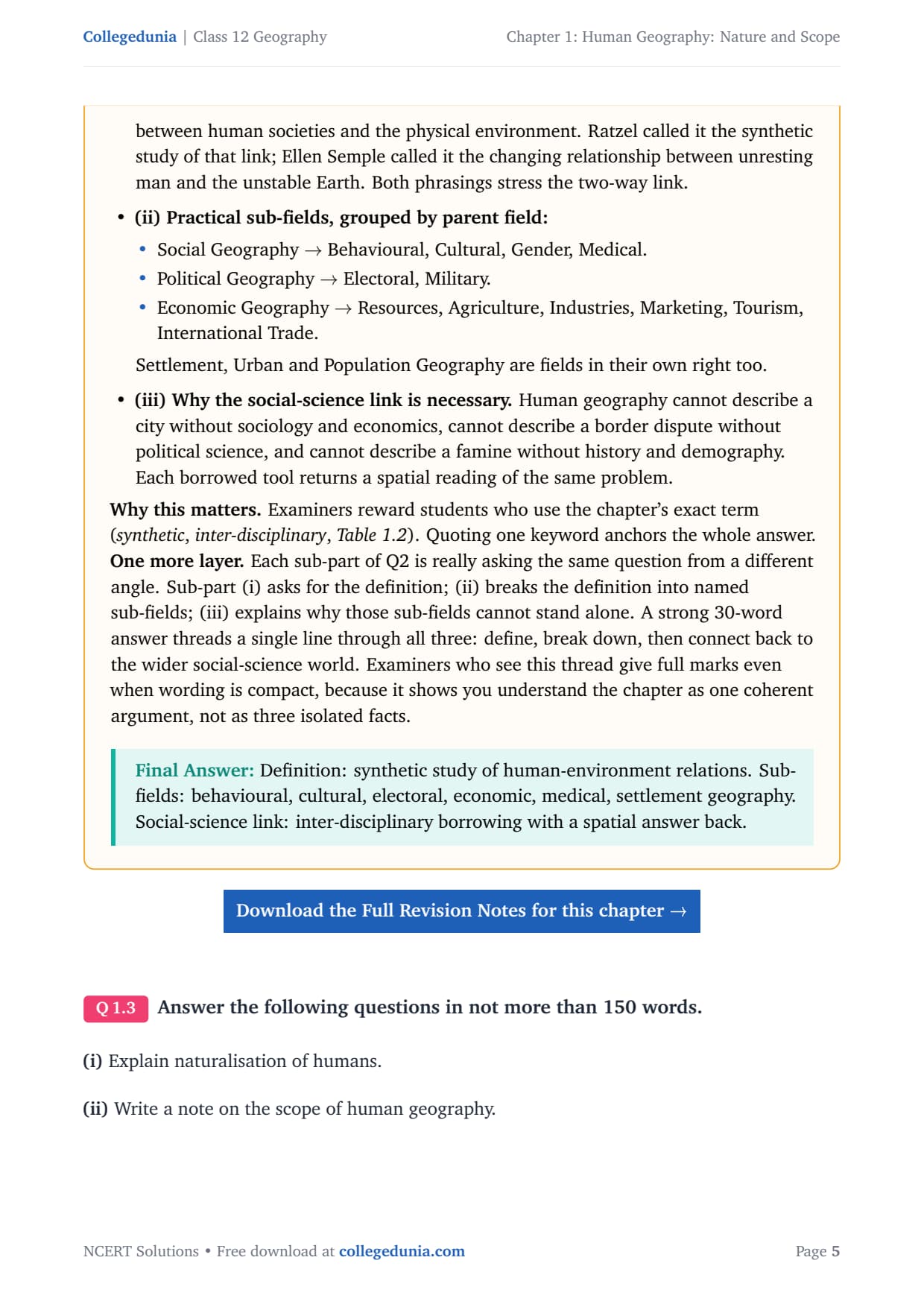
| Q 1.2 | Define human geography; name some sub-fields; how human geography relates to other social sciences | Short answer, about 30 words per sub-part, bullets or prose | 2-3 marks each |
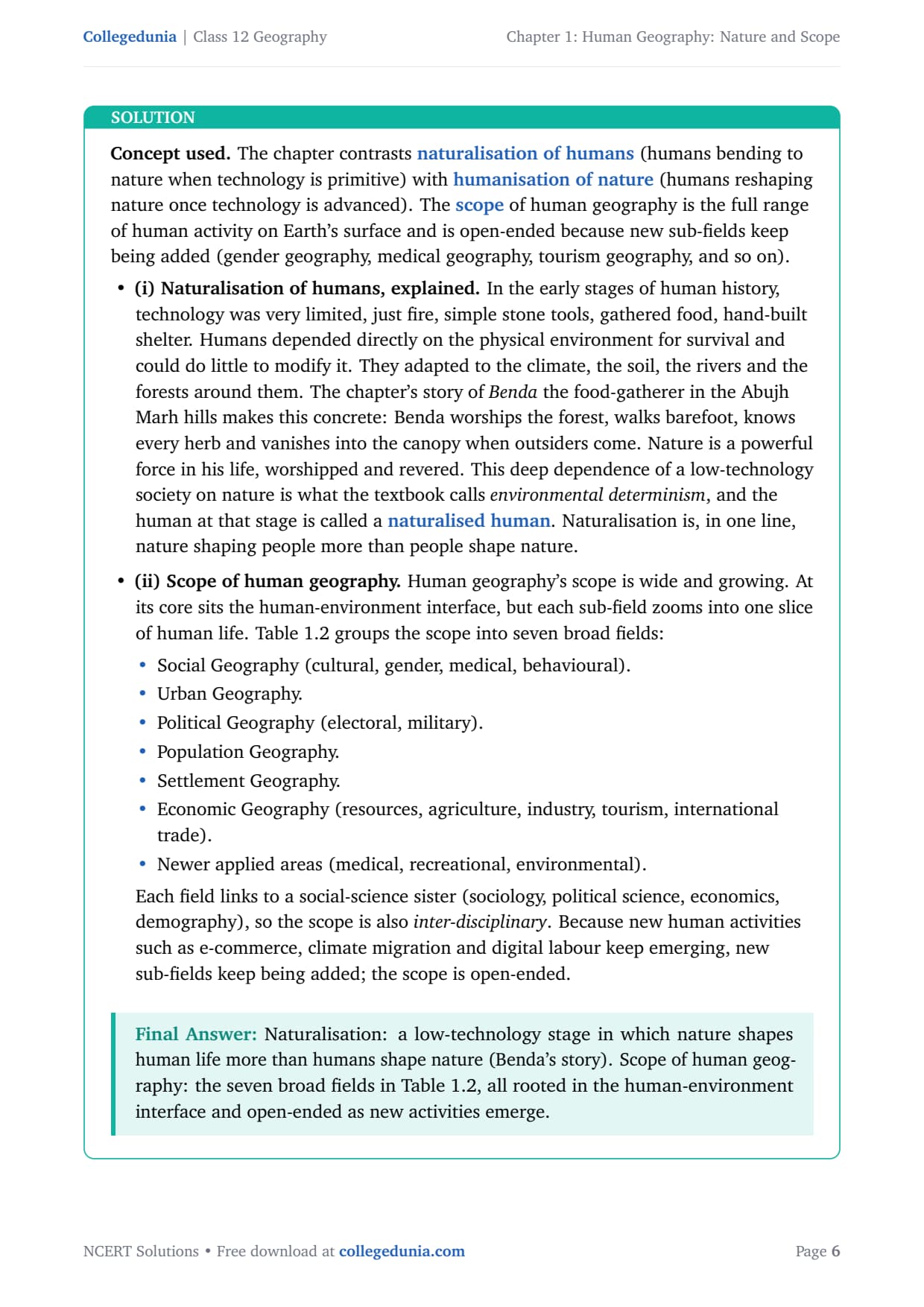
| Q 1.3 | Explain naturalisation of humans; write a note on the scope of human geography | Long answer, not more than 150 words per sub-part, sub-headings help | 5-6 marks each |
The two long-answer sub-parts of Q 1.3 carry the heaviest marks. Anchor the naturalisation answer on Benda's story and structure the scope answer around Table 1.2's seven broad fields to score full marks.
Human Geography: Key Concepts and Definitions
Geography is integrative, empirical and practical. Human geography is the sub-discipline that puts people and their relationship with the physical environment at the centre. Three classic definitions frame the whole chapter.
Three Classic Definitions You Must Know
| Scholar | Definition (paraphrased) | Keyword in the definition |
|---|---|---|
| Ratzel | Human geography is the synthetic study of the relationship between human societies and Earth's surface. | Synthesis |
| Ellen C. Semple | Human geography is the study of the changing relationship between the unresting man and the unstable Earth. | Dynamism |
| Paul Vidal de la Blache | A conception resulting from a more synthetic knowledge of physical laws governing Earth and the relations between living beings inhabiting it. | Inter-relationships |
The board paper most often asks students to match the scholar to the keyword: Ratzel owns synthesis, Semple owns dynamism, Vidal de la Blache owns inter-relationships. Memorise this triplet and any 1-mark MCQ on definitions is solved.
The Role of Technology in the Human-Environment Interface
Technology is the decisive factor in how strongly humans and nature interact. When it is primitive, humans adapt to nature (the naturalisation of humans): Benda, a food-gatherer in the Abujh Marh hills, walks barefoot, gathers herbs and worships the forest. As technology improves, humans modify nature instead (the humanisation of nature): in Trondheim, Norway, people build heated roads and glass domes to live comfortably in extreme cold.
Tip: Q 1.1 (iii) asks the most important factor in the human-environment interaction. The answer is technology, not intelligence or perception, because NCERT uses the Benda and Trondheim stories to make exactly this point.
Environmental Determinism vs Possibilism
These two terms describe opposite ends of the human-environment relationship and are the most frequently examined theory pair from Chapter 1 in CBSE board papers and CUET Geography.
Environmental Determinism: At the early stage of human history, the physical environment controlled human life completely. Where people lived, what they ate and how they organised their society were all dictated by nature. The human had no real choice. This complete dependence is called environmental determinism. Benda the food-gatherer is the chapter's own example.
Possibilism: As technology grew, humans began to see the physical environment not as a controller but as a collection of possibilities. Nature provides raw materials; what humans make of them depends on their knowledge, tools and creativity. The imprints of human activity appear everywhere: hill stations on highlands, ports on coasts, farms on plains, and satellites in space. This is possibilism: nature offers options, humans choose and create.
The shift from determinism to possibilism is gradual, tied to technological development: a society moves from being naturalised (shaped by nature) to humanising nature (reshaping it) as technology improves. This is the core narrative of the chapter, and both Q 1.3 long-answer parts draw on it.
Scope of Human Geography: Table 1.2 at a Glance
Table 1.2 is the chapter's own map of the scope of human geography. The board often asks students to name sub-fields or explain the inter-disciplinary links, so this table is the best revision tool.
| Broad Field | Key Sub-fields | Sister Social Science |
|---|---|---|
| Social Geography | Behavioural Geography, Cultural Geography, Gender Geography, Medical Geography, Welfare Geography | Sociology, Anthropology, Women's Studies, Epidemiology |
| Urban Geography | Urban and Rural Planning | Urban Studies and Planning |
| Political Geography | Electoral Geography, Military Geography | Political Science, Psephology, Military Science |
| Population Geography | Demography | Demography |
| Settlement Geography | Urban/Rural Planning | Urban Studies and Planning |
| Economic Geography | Geography of Resources, Agriculture, Industries, Marketing, Tourism, International Trade | Economics, Agricultural Sciences, Industrial Economics, Business Studies, Tourism Management |
| Historical Geography | Historical landscapes | History |
The scope is open-ended: every new human activity creates a new sub-field. Gender Geography emerged with women's studies, Tourism Geography with the travel industry, Medical Geography with epidemiology.
Common Mistakes Students Make in Chapter 1 Answers
The five repeat-offender mistakes in Chapter 1 board answers:
- Confusing determinism with possibilism: anchor determinism on Benda (nature controls) and possibilism on "nature provides opportunities".
- Mixing up scholar keywords: Ratzel = synthesis, Semple = dynamism. Do not swap them.
- Listing sub-fields flat: group them under the seven broad fields from Table 1.2; the board rewards structure.
- Saying technology makes geography irrelevant: it makes geography more relevant (GIS, remote sensing are geographical tools). Option (d) in Q 1.1 (i) is the odd one out for saying otherwise.
- Numbering theory answers as "Step 1, Step 2": geography answers use plain prose and bullets, not numbered steps.
Previous Year Question Trends from Chapter 1
Chapter 1 is tested mainly through 1-mark MCQ or VSA questions, with occasional 3-mark or 5-mark theory questions on naturalisation or scope.
| Year | Question type asked | Marks |
|---|---|---|
| 2025 | Define human geography; name two sub-fields of social geography | 1 + 2 |
| 2024 | Explain naturalisation of humans with a suitable example | 3 |
| 2023 | What is possibilism? How is it different from environmental determinism? | 3 |
| 2022 | MCQ: which factor is most important in human-environment interaction; write a note on the scope of human geography | 1 + 5 |
| 2021 | Define human geography according to Ratzel; name the four approaches in human geography | 1 + 2 |
Also Check: The full set of CBSE board paper questions for this chapter is included in the downloadable PDF above, updated for the 2026-27 cycle.
Other Resources for Class 12 Geography Chapter 1 Human Geography: Nature and Scope
Pair this NCERT Solutions PDF with the matching notes, handwritten notes and the official NCERT book chapter, all linked below.
| Resource | What it covers | Open |
|---|---|---|
| NCERT Solutions | Plain-English answers to all 3 exercise questions, with Expert's Solution alternatives for each. | You are here |
| Notes | Concept-first revision notes covering the three definitions, determinism vs possibilism, and the full scope from Table 1.2. | Class 12 Geography Chapter 1 Notes |
| Handwritten Notes | Topper's handwritten revision pages for last-minute board exam practice. | Class 12 Geography Chapter 1 Handwritten Notes |
| NCERT Book PDF | Official NCERT Fundamentals of Human Geography Chapter 1 textbook in PDF form. | Class 12 Geography Chapter 1 NCERT Book PDF |
| Subject Hub | All chapters of Class 12 Geography with every resource in one place. | Class 12 Geography Subject Hub |
Fundamentals of Human Geography: All Chapters NCERT Solutions
Related Links: Navigate to the NCERT Solutions for the other chapters of Class 12 Fundamentals of Human Geography below. Every chapter ships with the same plain-English answers, PDF download and FAQ.
| Chapter | Topic | NCERT Solutions link |
|---|---|---|
| Chapter 1 | Human Geography: Nature and Scope | You are here |
| Chapter 2 | The World Population: Distribution, Density and Growth | NCERT Solutions for Class 12 Geography Chapter 2 |
| Chapter 3 | Human Development | NCERT Solutions for Class 12 Geography Chapter 3 |
| Chapter 4 | Primary Activities | NCERT Solutions for Class 12 Geography Chapter 4 |
| Chapter 5 | Secondary Activities | NCERT Solutions for Class 12 Geography Chapter 5 |
| Chapter 6 | Tertiary and Quaternary Activities | NCERT Solutions for Class 12 Geography Chapter 6 |
| Chapter 7 | Transport and Communication | NCERT Solutions for Class 12 Geography Chapter 7 |
| Chapter 8 | International Trade | NCERT Solutions for Class 12 Geography Chapter 8 |
All NCERT Solutions for Class 12 Geography Chapter 1 Human Geography: Nature and Scope with Step-by-Step Solutions
Choose the right answer from the four alternatives given below.
Answer the following questions in about 30 words.
(i) Define human geography.
(ii) Name some sub-fields of human geography.
(iii) How is human geography related to other social sciences?
Answer the following questions in not more than 150 words.
(i) Explain naturalisation of humans.
(ii) Write a note on the scope of human geography.
NCERT Solutions Class 12 Geography Chapter 1 Human Geography: Nature and Scope FAQs
Ques. How many questions are there in NCERT Class 12 Geography Chapter 1?
Ans. There are 3 end-of-chapter exercise questions in NCERT Class 12 Geography Chapter 1 Human Geography: Nature and Scope. All 3 questions are solved with full answers and Expert's Solutions in our PDF. The mix is one MCQ set with 4 sub-parts, one short-answer question with 3 sub-parts (about 30 words each), and one long-answer question with 2 sub-parts (not more than 150 words each). The long-answer sub-parts on naturalisation of humans and the scope of human geography carry the heaviest marks in CBSE board papers.
Ques. What is the definition of human geography for Class 12?
Ans. According to Ratzel, human geography is the synthetic study of the relationship between human societies and Earth's surface. Ellen Semple defined it as the study of the changing relationship between the unresting man and the unstable Earth. Vidal de la Blache described it as a conception resulting from synthetic knowledge of physical laws governing Earth and the relations between living beings inhabiting it. For board exam purposes, Ratzel's definition with the keyword "synthetic" is the most commonly tested. Write the definition and the scholar's name together to score the full mark.
Ques. What is the difference between environmental determinism and possibilism?
Ans. Environmental determinism is the idea that at the early stage of human development, the physical environment completely controlled human life: where people lived, what they ate and how they organised their society were all dictated by nature. Possibilism is the opposite idea: as technology improved, humans began to see nature as a collection of possibilities and used available resources creatively to shape their own cultural landscape. The shift from determinism to possibilism is driven by technology. Benda the food-gatherer represents the determinist stage; the Trondheim story of humans living comfortably in extreme cold represents the possibilist stage.
Ques. What are the sub-fields of human geography for Class 12?
Ans. Table 1.2 of NCERT Chapter 1 groups the sub-fields under seven broad fields. Social Geography includes Behavioural Geography, Cultural Geography, Gender Geography, Medical Geography and Welfare Geography. Political Geography includes Electoral Geography and Military Geography. Economic Geography includes Geography of Resources, Agriculture, Industries, Marketing, Tourism and International Trade. Urban Geography and Settlement Geography deal with urban and rural planning. Population Geography links to demography and Historical Geography links to history. The scope keeps growing because every new human activity can seed a new sub-field.
Ques. What are the four approaches in human geography mentioned in the NCERT chapter?
Ans. Table 1.1 of NCERT Chapter 1 lists the four approaches as Exploration and description, Regional analysis, Areal differentiation and Spatial organisation. These four are the answer to Q 1.1 (iv) of the chapter exercise, which asks which is not an approach in human geography. "Quantitative revolution" is not an approach; it is the name of a phase during which the Spatial organisation approach rose to prominence. Memorise the four approach names from Table 1.1 exactly as they appear in the textbook to avoid losing the MCQ mark.
Ques. What is the scope of human geography for Class 12?
Ans. The scope of human geography is the full range of human activity on Earth's surface as studied through a spatial lens. It covers seven broad fields: Social Geography, Urban Geography, Political Geography, Population Geography, Settlement Geography, Economic Geography and Historical Geography, as shown in Table 1.2 of the NCERT chapter. Each field links to a sister social science, so the scope is inter-disciplinary. The scope is also open-ended: new sub-fields keep emerging as new forms of human activity (digital labour, climate migration, space tourism) create new geographical questions. A 150-word board answer should name at least four broad fields and mention the inter-disciplinary and open-ended characteristics.
Ques. What is the naturalisation of humans in Class 12 Geography?
Ans. Naturalisation of humans refers to the stage in early human history when technology was so primitive that people depended entirely on the physical environment for survival. They adapted to the dictates of nature: they ate what the forest provided, lived where the land and climate allowed, and worshipped forces they could not control. This complete dependence is called environmental determinism, and the human at that stage is called a naturalised human. The NCERT chapter illustrates this with the story of Benda, a food-gatherer in the Abujh Marh hills of central India, who walks barefoot, gathers herbs and vanishes into the forest canopy when outsiders come. Include Benda's story in your board answer to score the example mark.
Ques. Why is technology the most important factor in the human-environment interaction?
Ans. Technology is the most important factor because it determines how much control humans have over their physical environment. When technology is primitive, nature dictates human life (environmental determinism). As technology improves, humans gain the ability to modify nature rather than merely adapt to it (possibilism). The same latitude can support very different lifestyles depending on the level of technology available. The chapter's two stories, Benda gathering food in central India and Kari living comfortably in a glass dome in Trondheim, Norway, show this contrast directly. This is why Q 1.1 (iii) has technology as its answer and not human intelligence or brotherhood.
Ques. Is Class 12 Geography Chapter 1 important for CUET and UPSC?
Ans. Yes. For CUET Geography, Chapter 1 provides the foundational definitions and classification questions that CUET tests directly. The four approaches in Table 1.1 and the sub-fields in Table 1.2 are exactly the kind of factual recall CUET expects. For UPSC, the determinism-possibilism debate is a core topic in Geography optional Paper I and also appears in Prelims. The chapter's three classic definitions (Ratzel, Semple, Vidal de la Blache) are quoted directly in standard UPSC reference texts, so knowing them from NCERT gives you a head start. No JEE or NEET preparation requires this chapter; it is relevant only for CBSE boards, CUET and UPSC.
Ques. Is the Class 12 Geography syllabus changing for 2026-27?
Ans. No major changes for 2026-27. Chapter 1 of Fundamentals of Human Geography is unchanged for the current cycle. The CBSE marking scheme continues to reward structured answers with sub-headings and specific examples (such as Benda's story) for the 5-mark long-answer questions. Our solutions are fully aligned to the 2026-27 NCERT textbook reprint and the latest CBSE sample paper. The chapter's core topics, the definitions, the determinism-possibilism debate, the four approaches and the seven broad fields of scope, are all preserved as-is for 2026-27.



Comments