



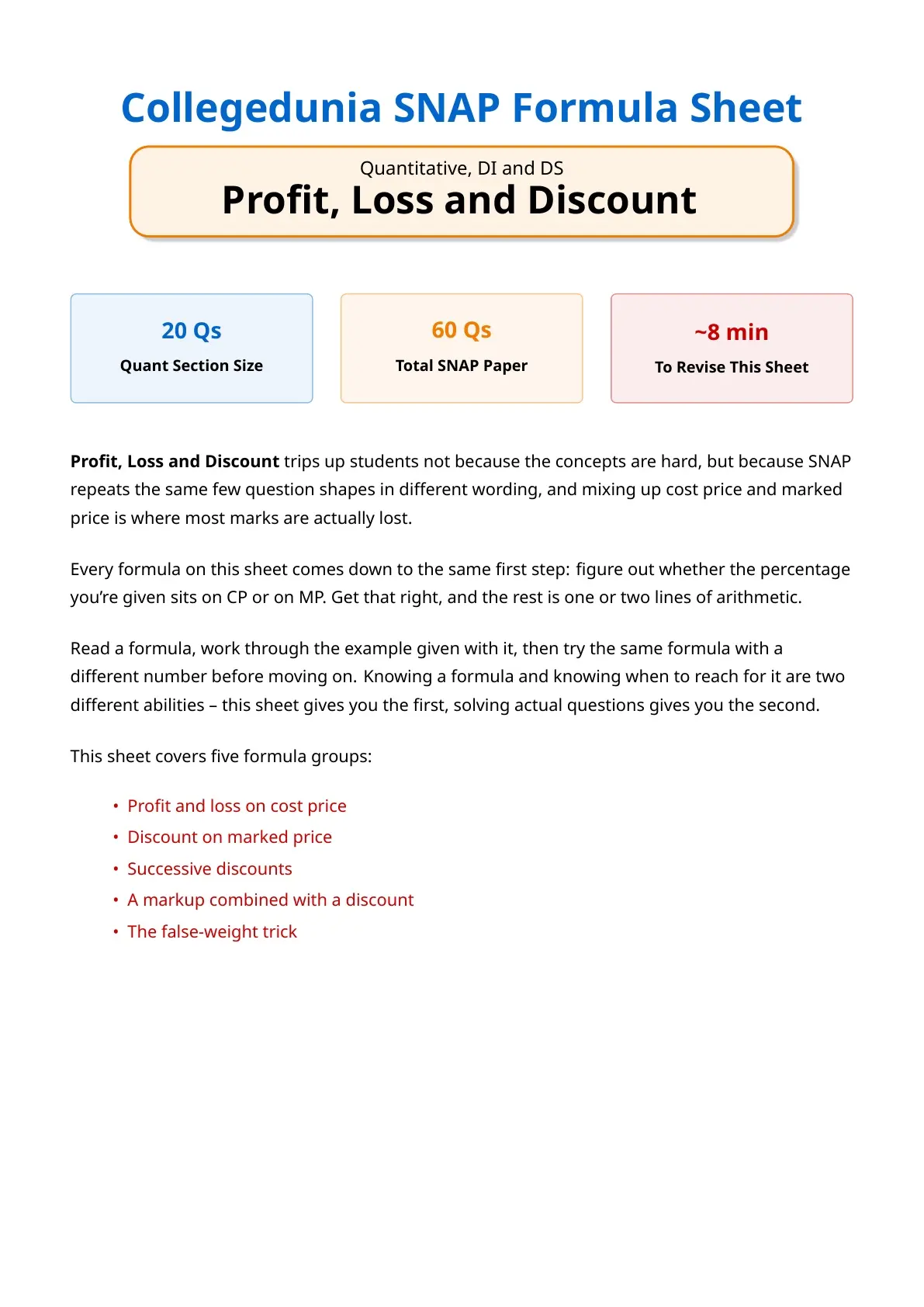
SNAP Profit, Loss and Discount formula sheet, free to download as a 4-page PDF. Profit, Loss and Discount questions sit inside SNAP's 20-question Quant, DI and DS section, and this sheet takes roughly eight minutes to work through, so it belongs in your final revision.
The sheet covers all five formula groups in real notation, and a concept video walks through the same rules with worked examples.
Built for revision, so every line trades explanation for speed. Read the working behind each formula in the full Profit, Loss and Discount notes before leaning on this sheet.
Profit and Loss Formula for SNAP: CP, SP and Discount, Which Base to Use
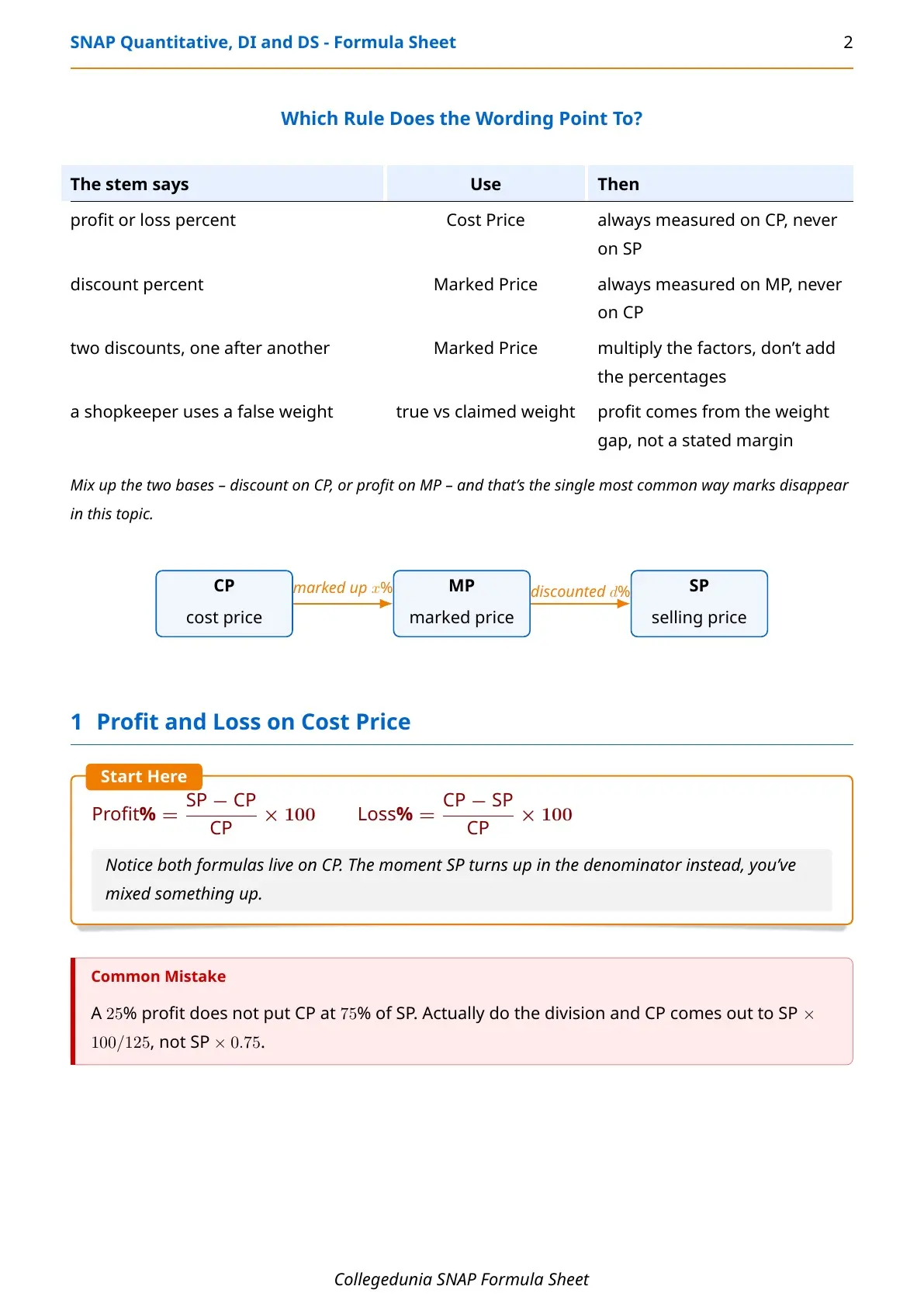
Every Profit and Loss question is built on one of two bases − Cost Price for profit and loss, and Marked Price for discount − and mixing the two up is the single most common way marks are lost in this topic.
A 25% profit does not put CP at 75% of SP − the actual division gives CP = SP × 100/125, not SP × 0.75.
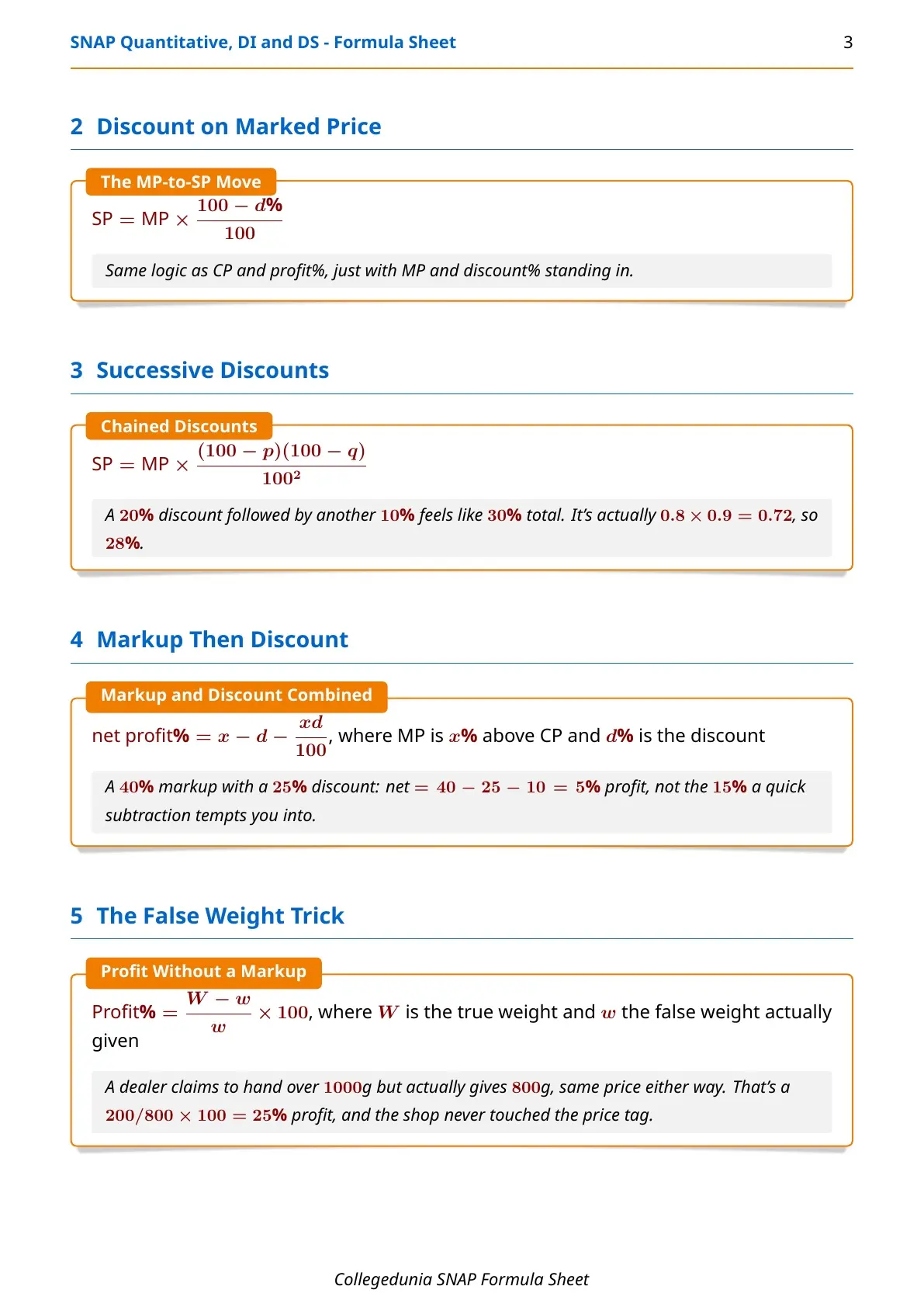
Discount is read the same way, but off Marked Price instead:
Successive Discount Formula for SNAP: How to Chain Two Discounts
Two discounts applied one after another never simply add:
A 20% discount followed by another 10% feels like 30% total. It's actually 0.8 × 0.9 = 0.72, so 28% − the order never changes the result, since multiplication commutes.
The same logic covers a markup followed by a discount:
A 40% markup with a 25% discount nets 40 − 25 − 10 = 5% profit, not the 15% a quick subtraction tempts you into.
False Weight Trick in Profit and Loss: How Shopkeepers Profit Without a Markup
A shop can advertise no markup at all and still profit, by handing over less than the stated weight:
Claiming 1000g but delivering 800g gives a 25% profit at the same sticker price, with no stated markup at all.
Profit, Loss and Discount Concept Video for SNAP with Solved Examples
Source: MBA Pathshala
How to Revise Profit, Loss and Discount Before SNAP
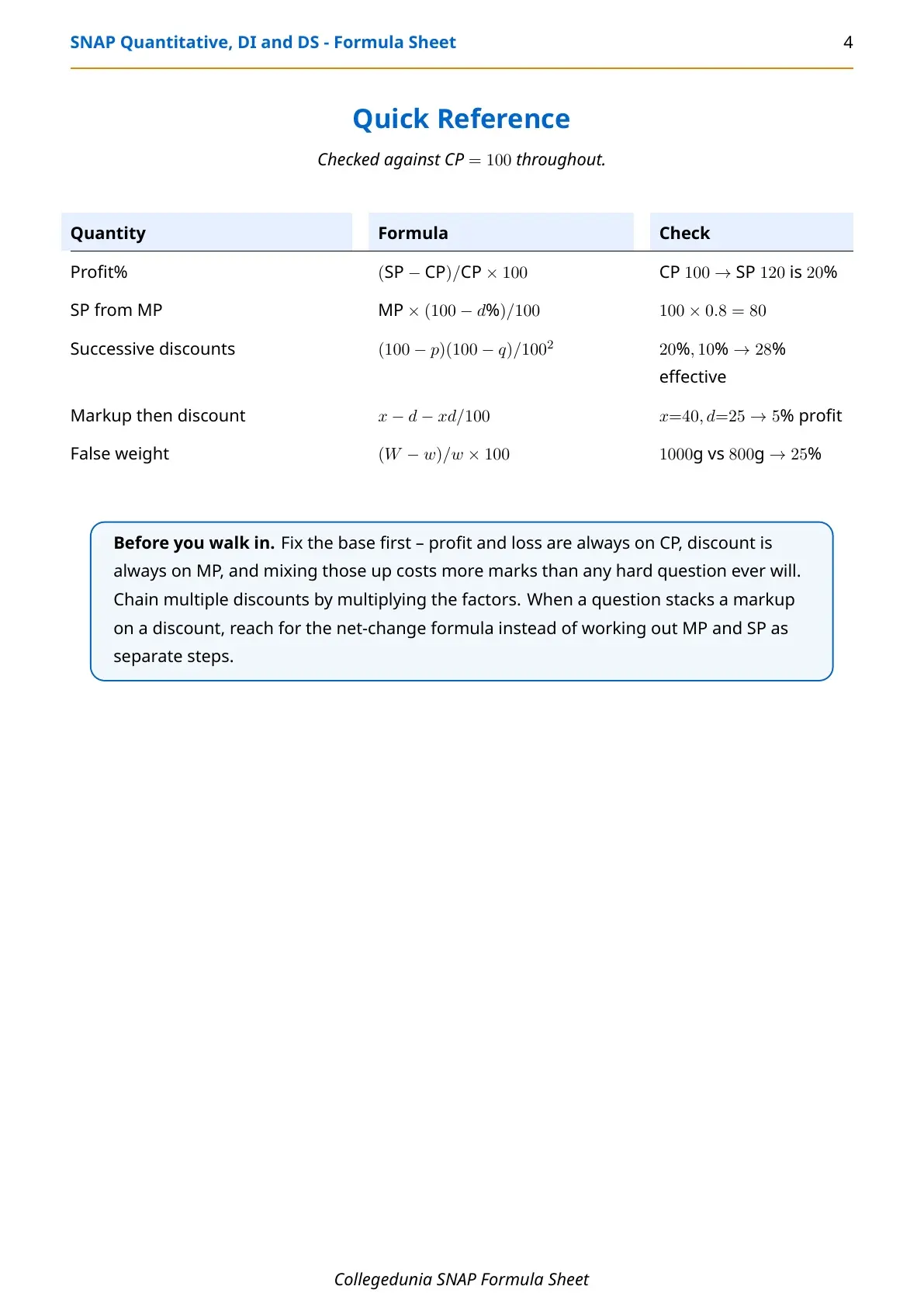
The closing page repeats every formula in one table, each checked against a cost price of 100.
- Cover the formula column and reproduce it from the quantity name
- Fix which base each line uses before writing anything down
- Re-derive the markup-then-discount formula rather than memorising the final expression alone
- Check for a false-weight trick whenever a question mentions weights or measures
SNAP Profit, Loss and Discount Formula Sheet FAQs
Ques. Is discount always calculated on cost price?
Ans. No. Discount is always calculated on marked price, while profit and loss are always calculated on cost price. Mixing the two bases is the single most common error in this topic.
Ques. Do two successive discounts of 20% and 10% add up to 30% off?
Ans. No. The discounts multiply as factors: 0.8 times 0.9 gives 0.72, an effective 28% off. Successive discounts always give a smaller total than adding the two percentages.
Ques. How common is the false weight trick in exam questions?
Ans. It appears regularly inside profit and loss sets, usually disguised as a shop selling at cost price while using a lighter weight. The profit comes entirely from the weight gap.
Ques. How many questions does SNAP's Quant, DI and DS section carry?
Ans. SNAP's Quant, DI and DS section carries 20 questions out of the paper's total 60, based on the exam's current three-section structure.
Ques. Can the PDF be downloaded for free?
Ans. Yes. All 4 pages can be read on this page or downloaded at no cost, so it can be printed or kept on a phone for last-minute revision.



Comments