




SNAP Ratio, Proportion and Partnership formula sheet, free to download as a 4-page PDF. Ratio and Partnership questions sit inside SNAP's 20-question Quant, DI and DS section, and this sheet takes roughly eight minutes to work through, so it belongs in your final revision.
The sheet covers all five formula groups in real notation, and a concept video walks through the same rules with worked examples.
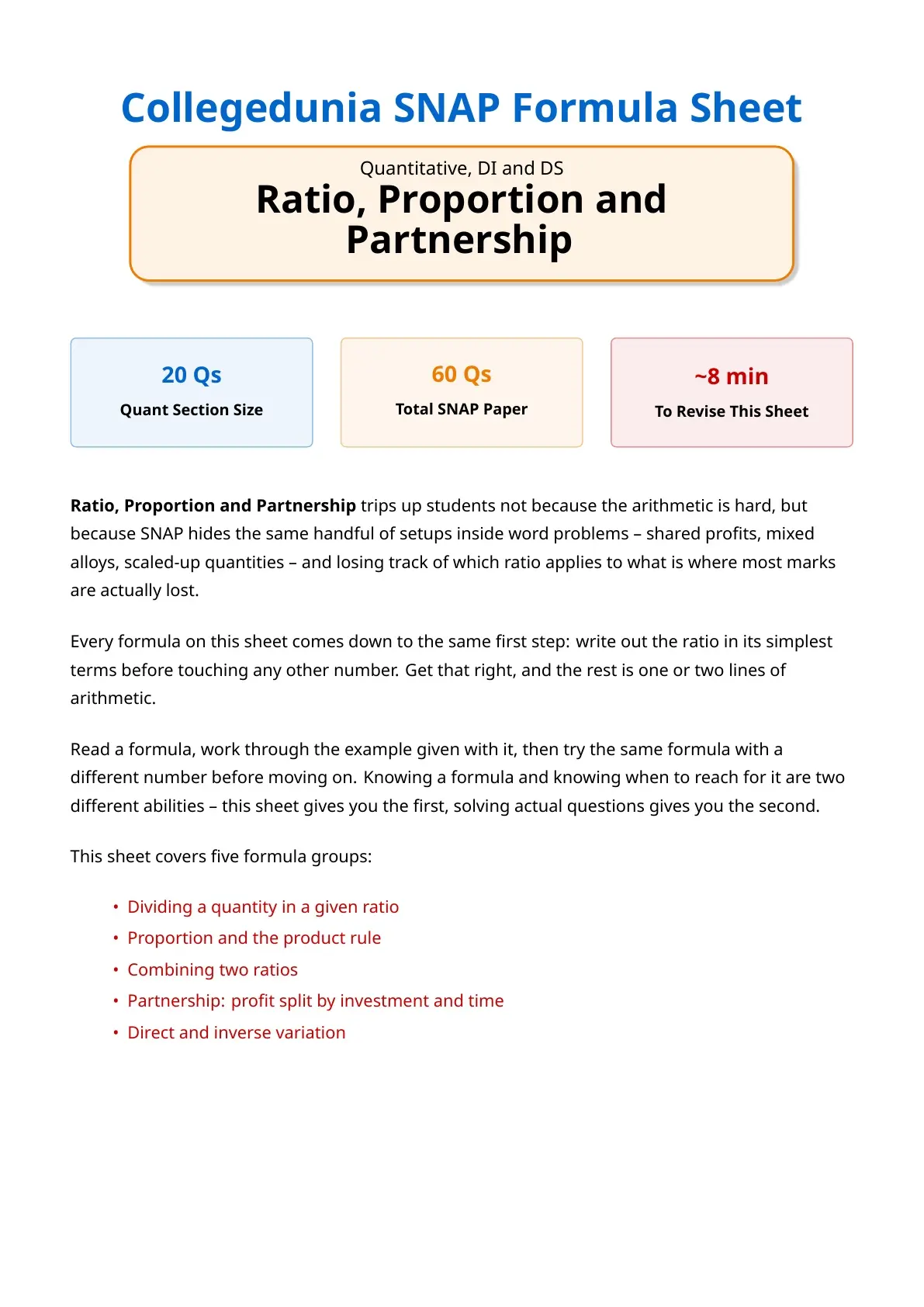
Built for revision, so every line trades explanation for speed. Read the working behind each formula in the full Ratio, Proportion and Partnership notes before leaning on this sheet.
Ratio Formula for SNAP: Dividing a Quantity and Proportion
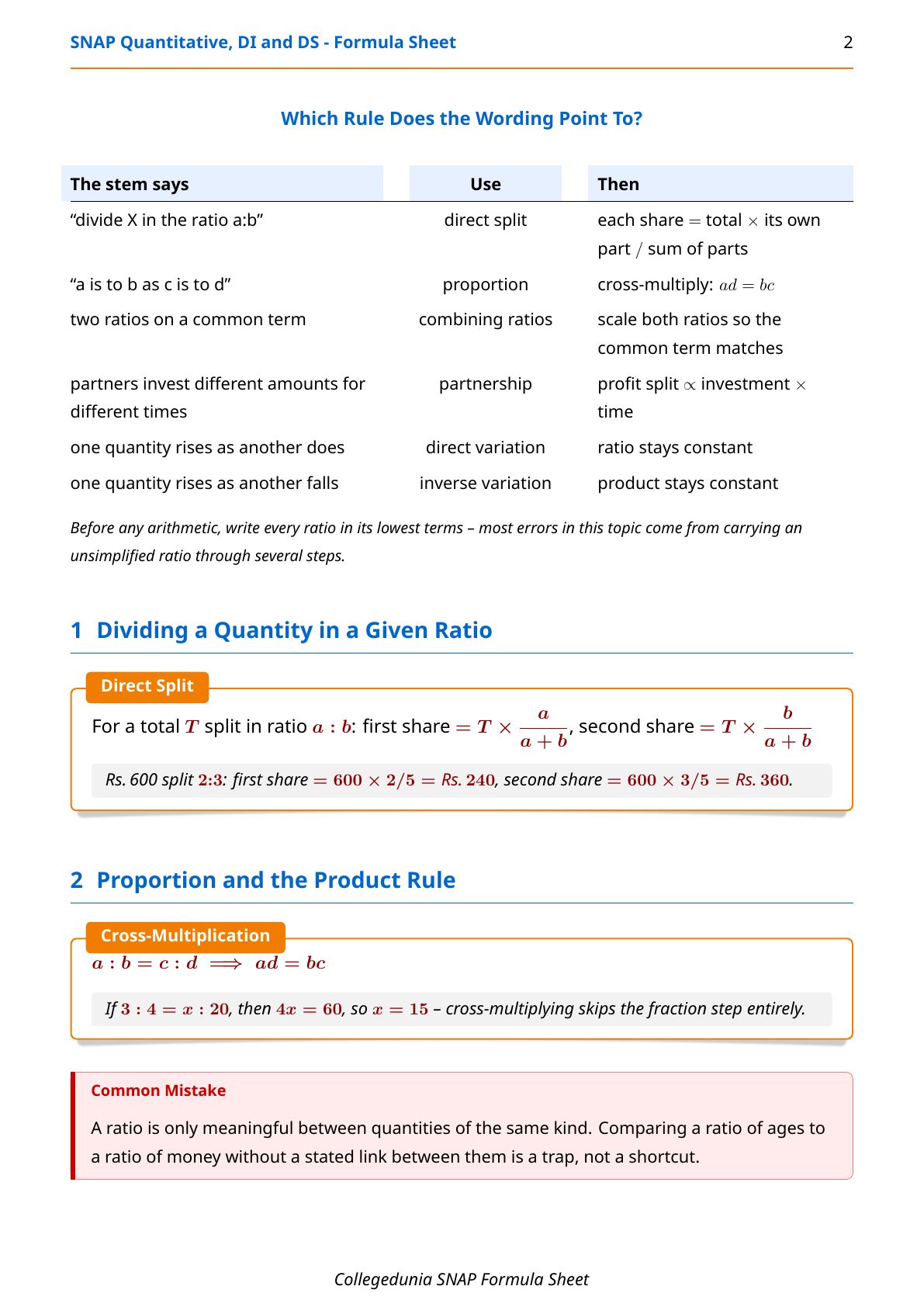
Splitting a total in a given ratio always comes down to the same setup:
Rs.600 split 2:3 gives shares of Rs.240 and Rs.360 − each part scaled by its own fraction of the total number of parts.
A proportion turns into a direct equation the moment it's cross-multiplied:
If 3:4 = x:20, then 4x = 60, so x = 15 − cross-multiplying skips the fraction step entirely.
Combining Two Ratios Formula for SNAP Quantitative Aptitude
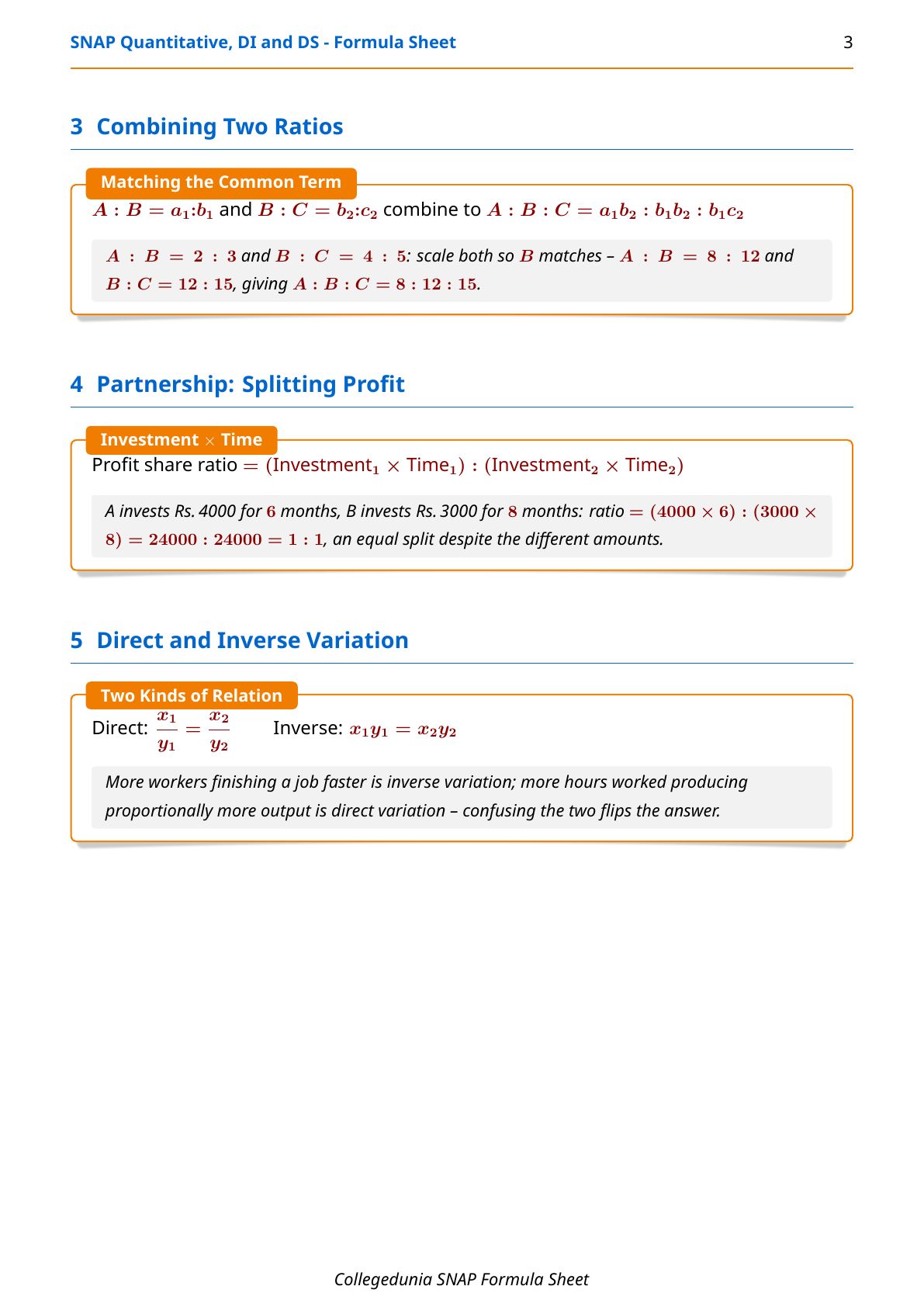
When two ratios share a common term, that term has to be scaled to match before they can be combined into one:
A:B = 2:3 and B:C = 4:5: scaling both so B matches gives A:B = 8:12 and B:C = 12:15, so A:B:C = 8:12:15.
Partnership Formula for SNAP: Splitting Profit by Investment and Time
When partners invest different amounts for different durations, profit is never split by the investment amount alone:
A invests Rs.4000 for 6 months, B invests Rs.3000 for 8 months: the ratio works out to (4000×6):(3000×8) = 24000:24000 = 1:1, an equal split despite the different amounts invested.
Direct and inverse variation follow two opposite rules that are easy to swap by mistake:
More workers finishing a job faster is inverse variation; more hours worked producing proportionally more output is direct variation − confusing the two flips the answer.
Ratio, Proportion and Partnership Concept Video for SNAP with Solved Examples
Source: MBA Express by Unacademy
How to Revise Ratio, Proportion and Partnership Before SNAP
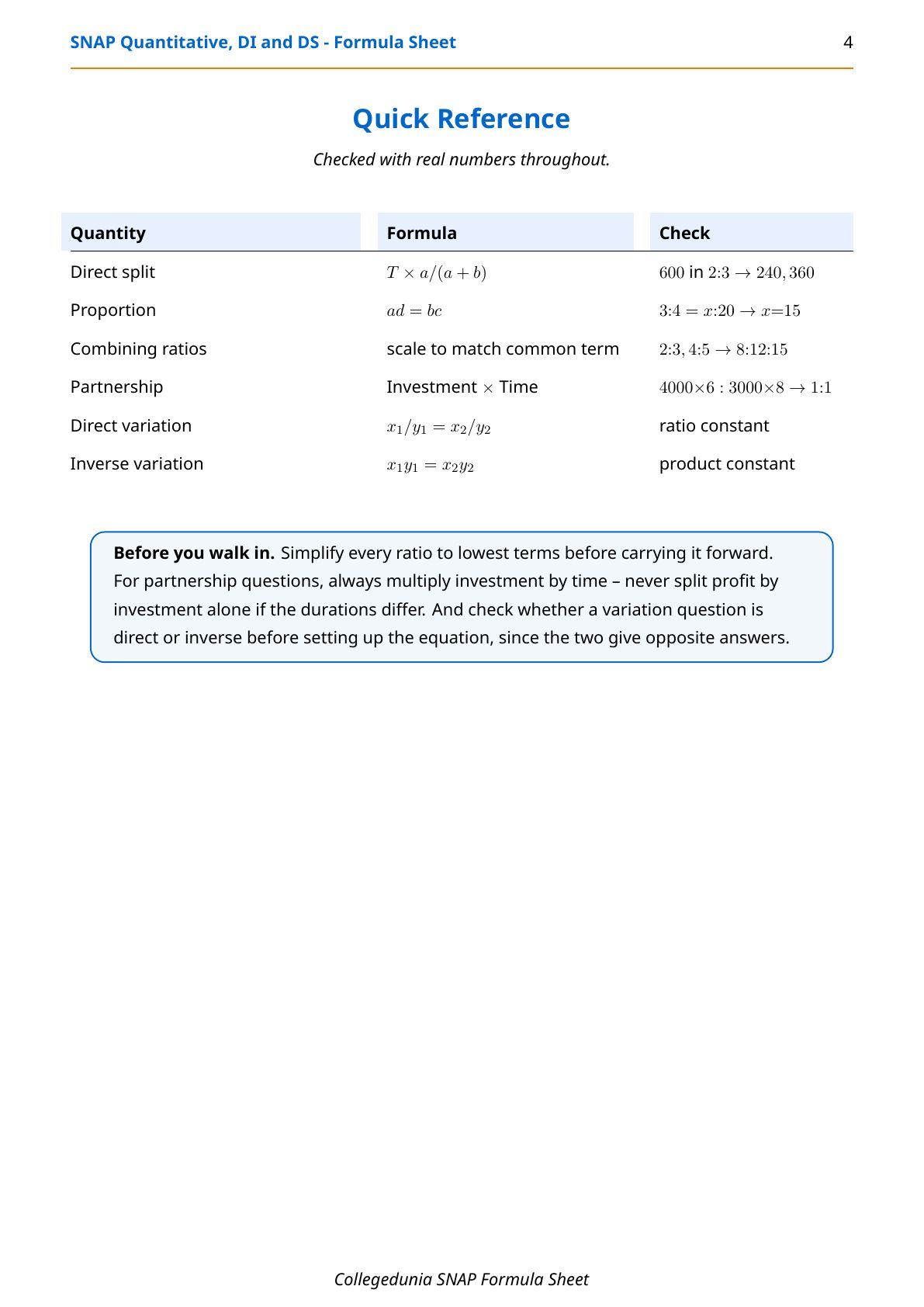
The closing page repeats every formula in one table, each checked with real numbers.
- Cover the formula column and reproduce it from the quantity name
- Simplify every ratio to lowest terms before carrying it forward through the problem
- In partnership questions, multiply investment by time − never split profit by investment alone if durations differ
- Check whether a variation question is direct or inverse before setting up the equation
SNAP Ratio, Proportion and Partnership Formula Sheet FAQs
Ques. How do I split a total amount in a given ratio?
Ans. Divide the total by the sum of the ratio's parts, then multiply by each individual part. For Rs.600 in a 2:3 ratio, that gives shares of Rs.240 and Rs.360.
Ques. Why does partnership profit depend on time, not just investment amount?
Ans. Because capital invested for a longer period contributes more to the business than the same amount invested for a shorter period. The fair split is investment multiplied by time, not investment alone.
Ques. What is the difference between direct and inverse variation?
Ans. In direct variation, the ratio of the two quantities stays constant as both change together. In inverse variation, their product stays constant as one rises while the other falls.
Ques. How many questions does SNAP's Quant, DI and DS section carry?
Ans. SNAP's Quant, DI and DS section carries 20 questions out of the paper's total 60, based on the exam's current three-section structure.
Ques. Can the PDF be downloaded for free?
Ans. Yes. All 4 pages can be read on this page or downloaded at no cost, so it can be printed or kept on a phone for last-minute revision.



Comments