



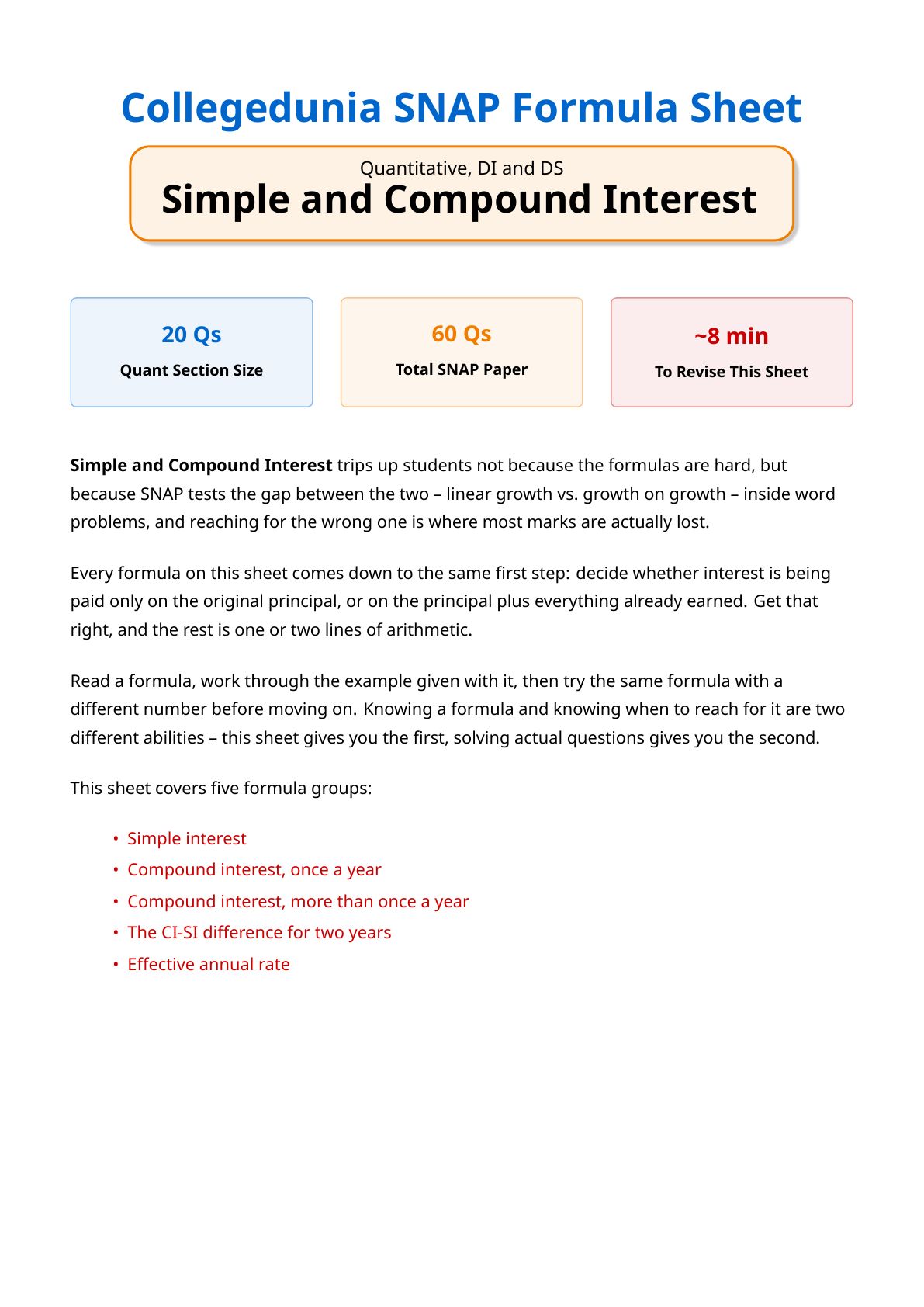
SNAP Simple and Compound Interest formula sheet, free to download as a 4-page PDF. Interest questions sit inside SNAP's 20-question Quant, DI and DS section, and this sheet takes roughly eight minutes to work through, so it belongs in your final revision.
The sheet covers all five formula groups in real notation, and a concept video walks through the same rules with worked examples.
Built for revision, so every line trades explanation for speed. Read the working behind each formula in the full Simple and Compound Interest notes before leaning on this sheet.
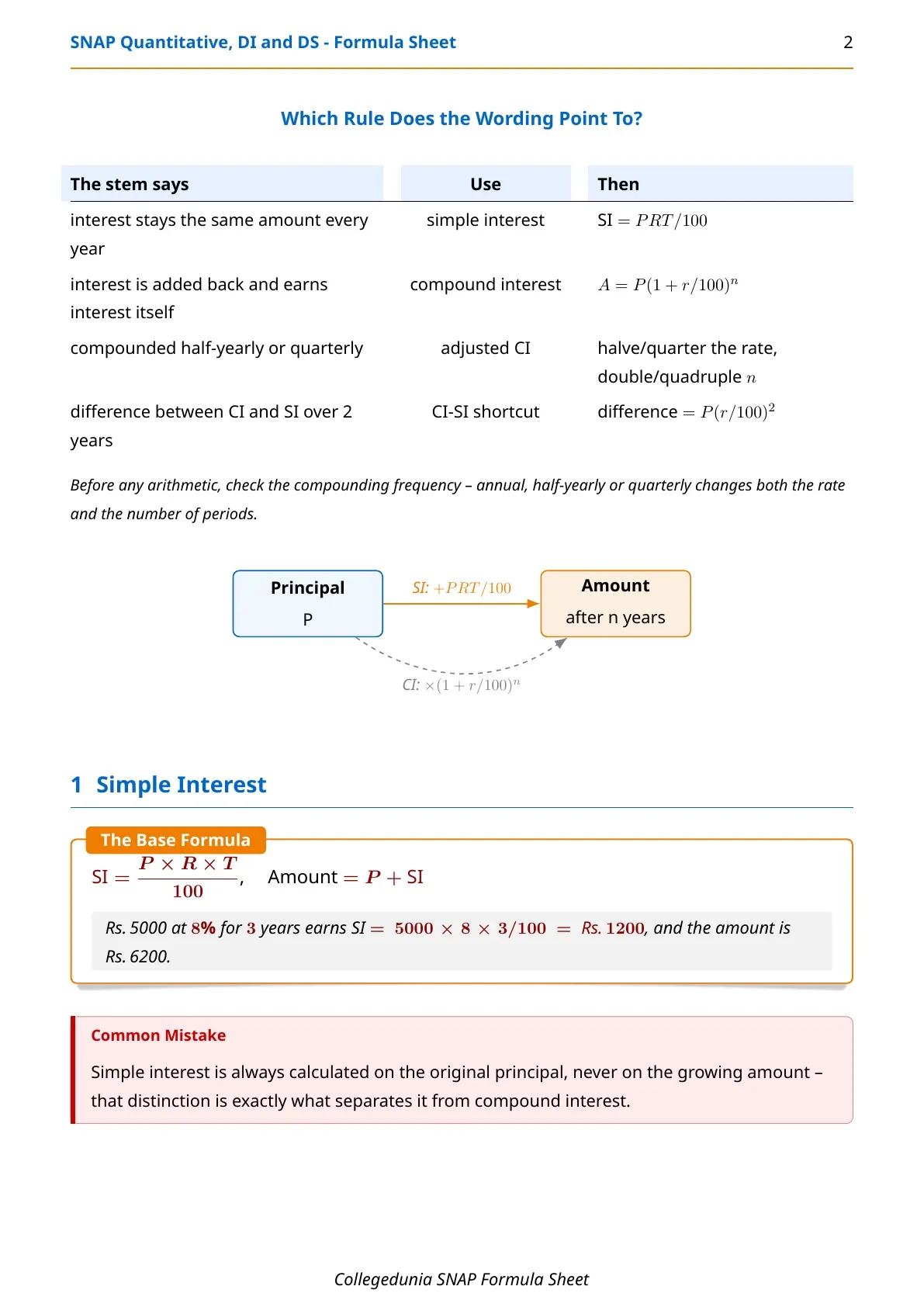
Simple Interest Formula for SNAP: The Base Case
Simple interest is always calculated on the original principal, never on the growing amount − that is exactly what separates it from compound interest:
Rs.5000 at 8% for 3 years earns SI = 5000 × 8 × 3 / 100 = Rs.1200, and the amount is Rs.6200.
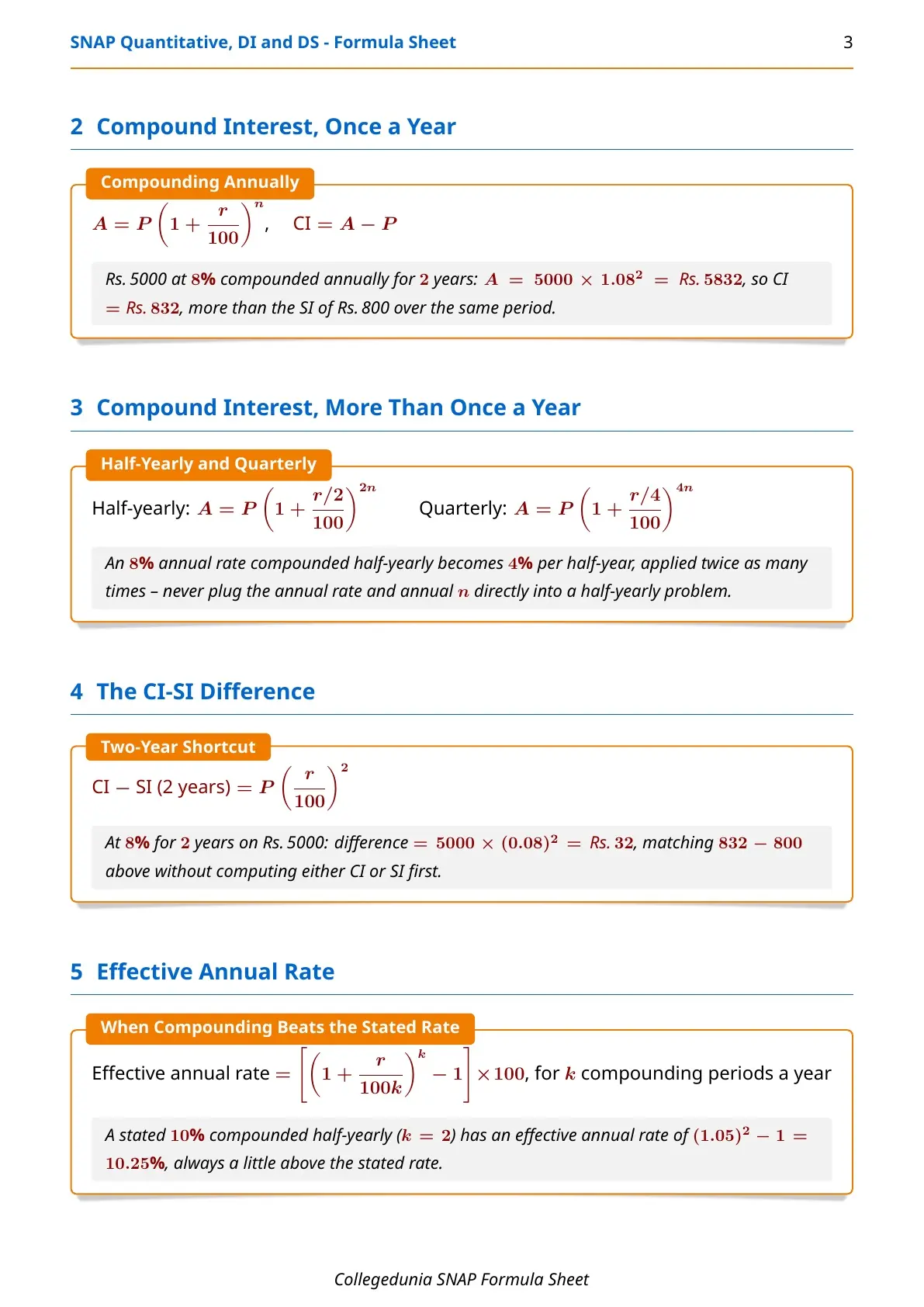
Compound Interest Formula for SNAP: Annual, Half-Yearly and Quarterly
Compound interest grows on the principal plus everything already earned:
Rs.5000 at 8% compounded annually for 2 years: A = 5000 × 1.08² = Rs.5832, so CI = Rs.832, more than the SI of Rs.800 over the same period.
When compounding happens more than once a year, both the rate and the number of periods change:
An 8% annual rate compounded half-yearly becomes 4% per half-year, applied twice as many times − never plug the annual rate and annual n directly into a half-yearly problem.
CI-SI Difference Formula for SNAP: The Two-Year Shortcut
Comparing CI and SI over exactly two years has a direct shortcut that skips computing either value in full:
At 8% for 2 years on Rs.5000, the difference is 5000 × (0.08)² = Rs.32, matching 832 minus 800 without computing either CI or SI first.
Compounding more often than the stated period also pushes the effective rate above the stated one:
A stated 10% compounded half-yearly (k=2) has an effective annual rate of (1.05)² − 1 = 10.25%, always a little above the stated rate.
Simple and Compound Interest Concept Video for SNAP with Solved Examples
Source: MBA Wallah
How to Revise Simple and Compound Interest Before SNAP
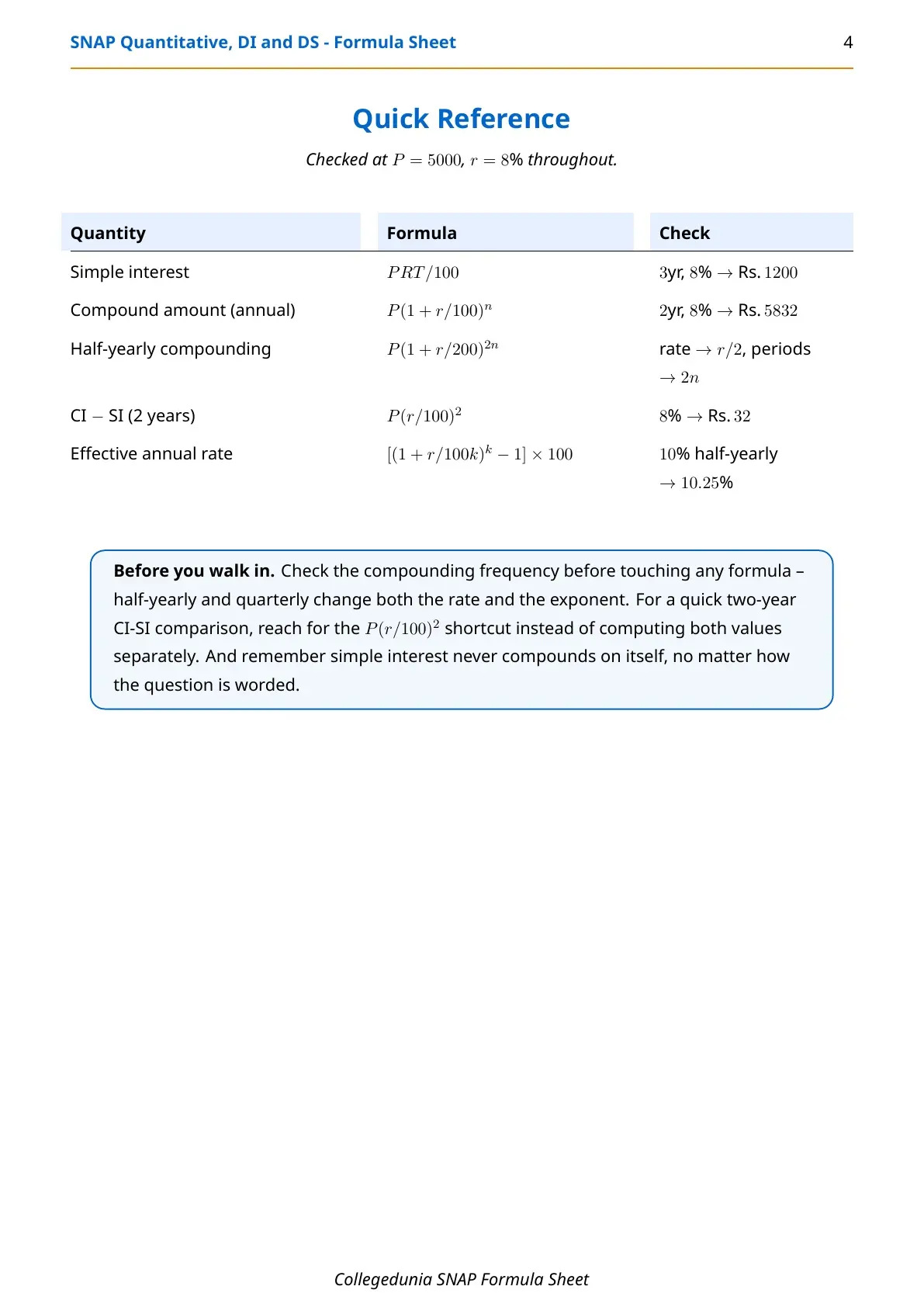
The closing page repeats every formula in one table, each checked at a fixed principal and rate.
- Cover the formula column and reproduce it from the quantity name
- Check the compounding frequency first − half-yearly and quarterly change both the rate and the exponent
- Use the CI-SI shortcut for two-year comparisons instead of computing both values separately
- Remember simple interest never compounds on itself, no matter how the question is worded
SNAP Simple and Compound Interest Formula Sheet FAQs
Ques. What is the direct shortcut for the CI-SI difference over 2 years?
Ans. CI minus SI over exactly 2 years equals P times (r/100) squared. This skips computing CI and SI separately and works only for the 2-year case.
Ques. How does half-yearly compounding change the formula?
Ans. The annual rate is halved and the number of compounding periods is doubled: A = P(1 + r/200)^2n instead of P(1 + r/100)^n.
Ques. Is compound interest always higher than simple interest?
Ans. For the same principal, rate and time beyond one year, yes − compound interest earns on top of previously earned interest, which simple interest never does.
Ques. How many questions does SNAP's Quant, DI and DS section carry?
Ans. SNAP's Quant, DI and DS section carries 20 questions out of the paper's total 60, based on the exam's current three-section structure.
Ques. Can the PDF be downloaded for free?
Ans. Yes. All 4 pages can be read on this page or downloaded at no cost, so it can be printed or kept on a phone for last-minute revision.



Comments