GRE 2024 Quantitative Reasoning Practice Test 2 Question Paper with Solutions PDF

GRE 2024 Quantitative Reasoning Practice Test 2 Question Paper with Solutions PDF is available for download. The overall test time is about 1 hour and 58 minutes. GRE has total 5 sections:

  • Analytical Writing  (One "Analyze an Issue" task, Alloted time 30 minutes)
  • Verbal Reasoning  (Two Sections, with 12 questions and 15 questions respectively)
  • Quantitative Reasoning (Two Sections, with 12 questions and 15 questions respectively)

GRE 2024 Qantitative Reasoning Practice Test 2 Question Paper with Solutions PDF

GRE 2024 Quantitative Reasoning Question Paper with Solutions PDF download iconDownload Check Solutions
GRE 2024 Qantitative Reasoning Practice Test 2 Question Paper with Solutions PDF

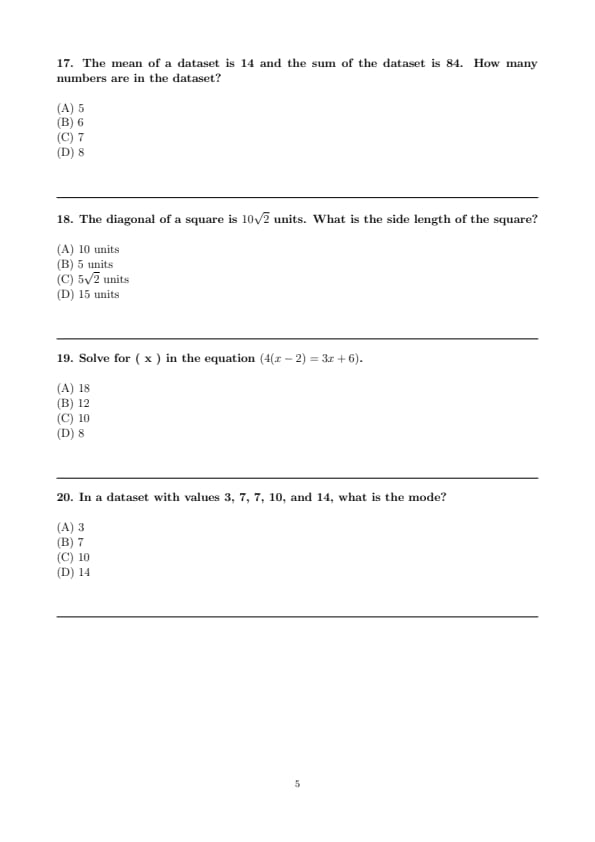
Question 1:

What is the value of \(4^2\)?

  • (A) 10
  • (B) 12
  • (C) 16
  • (D) 20

Question 2:

If a shirt originally costs 50 and is discounted by 30%, what is the sale price?

  • (A)35
  • (B)40
  • (C)45
  • (D)50

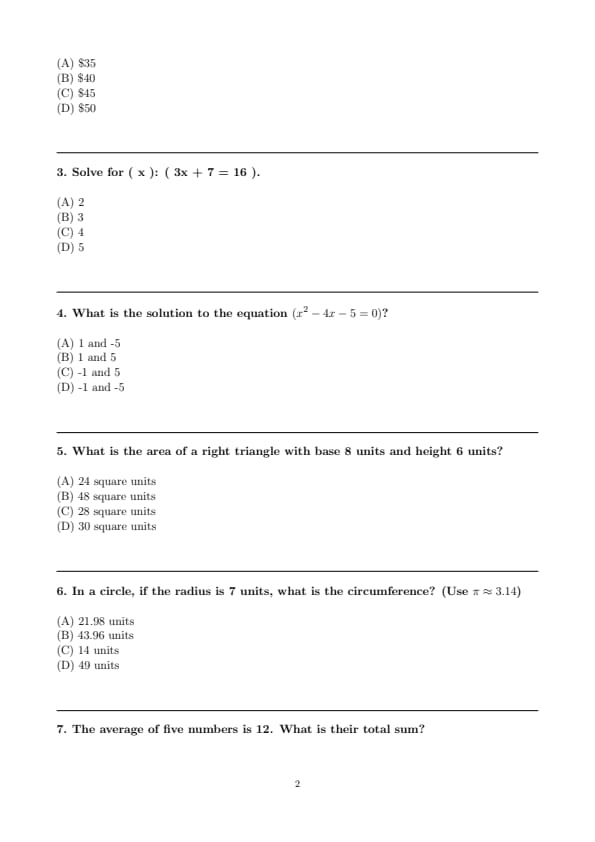
Question 3:

Solve for ( x ): ( 3x + 7 = 16 ).

  • (A) 2
  • (B) 3
  • (C) 4
  • (D) 5

Question 4:

What is the solution to the equation \( (x^2 - 4x - 5 = 0) \)?

  • (A) 1 and -5
  • (B) 1 and 5
  • (C) -1 and 5
  • (D) -1 and -5

Question 5:

What is the area of a right triangle with base 8 units and height 6 units?

  • (A) 24 square units
  • (B) 48 square units
  • (C) 28 square units
  • (D) 30 square units

Question 6:

In a circle, if the radius is 7 units, what is the circumference? (Use \(\pi \approx 3.14\))

  • (A) 21.98 units
  • (B) 43.96 units
  • (C) 14 units
  • (D) 49 units

Question 7:

The average of five numbers is 12. What is their total sum?

  • (A) 60
  • (B) 48
  • (C) 54
  • (D) 72

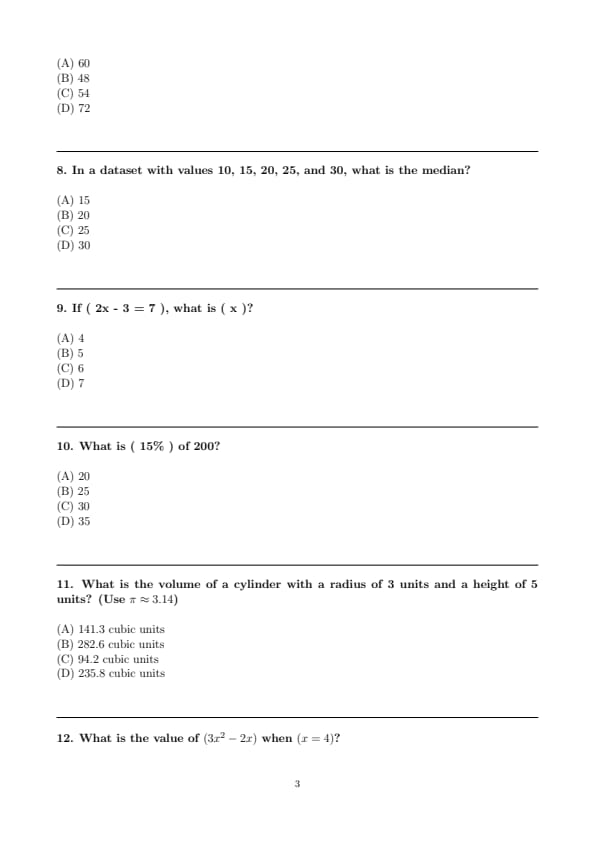
Question 8:

In a dataset with values 10, 15, 20, 25, and 30, what is the median?

  • (A) 15
  • (B) 20
  • (C) 25
  • (D) 30

Question 9:

If ( 2x - 3 = 7 ), what is ( x )?

  • (A) 4
  • (B) 5
  • (C) 6
  • (D) 7

Question 10:

What is ( 15% ) of 200?

  • (A) 20
  • (B) 25
  • (C) 30
  • (D) 35

Question 11:

What is the volume of a cylinder with a radius of 3 units and a height of 5 units? (Use \(\pi \approx 3.14\))

  • (A) 141.3 cubic units
  • (B) 282.6 cubic units
  • (C) 94.2 cubic units
  • (D) 235.8 cubic units

Question 12:

What is the value of \( (3x^2 - 2x) \) when \( (x = 4) \)?

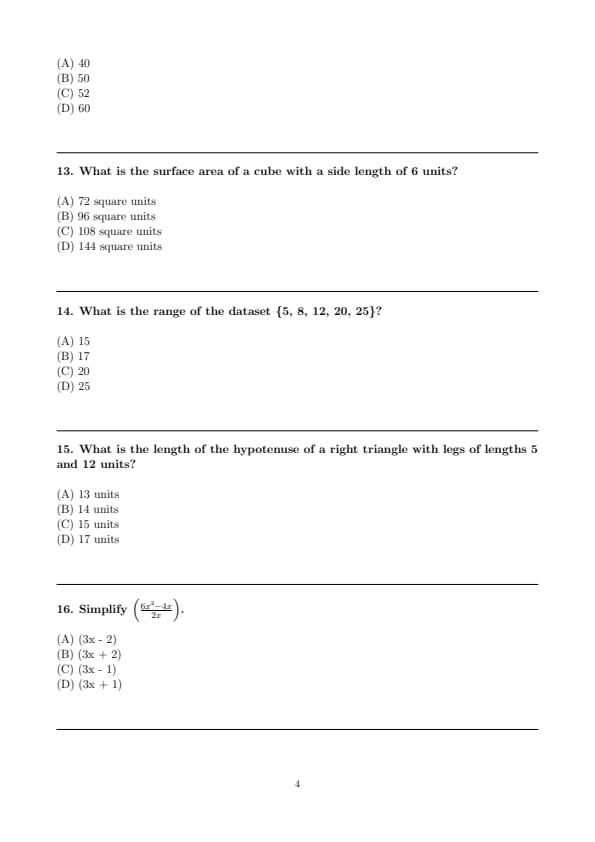
  • (A) 40
  • (B) 50
  • (C) 52
  • (D) 60

Question 13:

What is the surface area of a cube with a side length of 6 units?

  • (A) 72 square units
  • (B) 96 square units
  • (C) 108 square units
  • (D) 144 square units

Question 14:

What is the range of the dataset {5, 8, 12, 20, 25}?

  • (A) 15
  • (B) 17
  • (C) 20
  • (D) 25

Question 15:

What is the length of the hypotenuse of a right triangle with legs of lengths 5 and 12 units?

  • (A) 13 units
  • (B) 14 units
  • (C) 15 units
  • (D) 17 units

Question 16:

Simplify \( \left( \frac{6x^2 - 4x}{2x} \right) \).

  • (A) (3x - 2)
  • (B) (3x + 2)
  • (C) (3x - 1)
  • (D) (3x + 1)

Question 17:

The mean of a dataset is 14 and the sum of the dataset is 84. How many numbers are in the dataset?

  • (A) 5
  • (B) 6
  • (C) 7
  • (D) 8

Question 18:

The diagonal of a square is \(10\sqrt{2}\) units. What is the side length of the square?

  • (A) 10 units
  • (B) 5 units
  • (C) \(5\sqrt{2}\) units
  • (D) 15 units

Question 19:

Solve for ( x ) in the equation \( (4(x - 2) = 3x + 6) \).

  • (A) 18
  • (B) 12
  • (C) 10
  • (D) 8

Question 20:

In a dataset with values 3, 7, 7, 10, and 14, what is the mode?
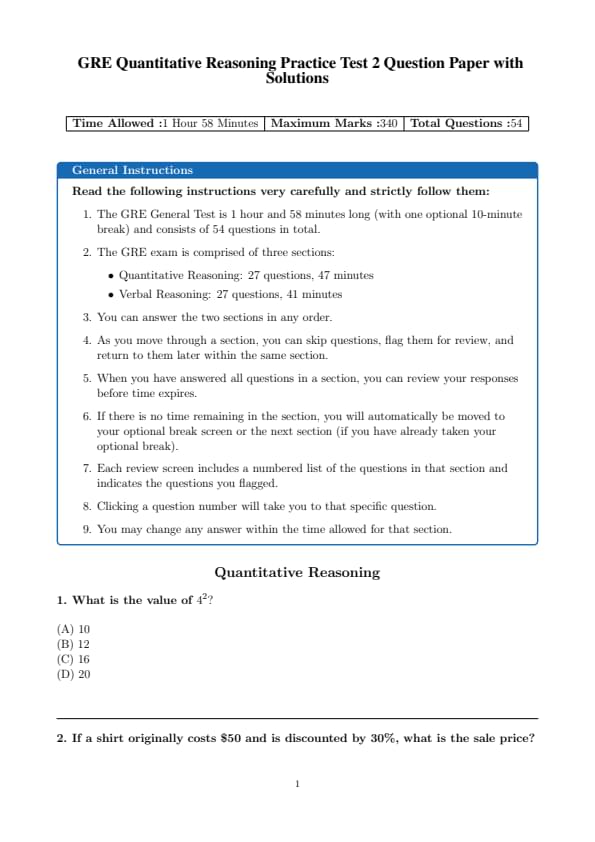
  • (A) 3
  • (B) 7
  • (C) 10
  • (D) 14

GRE Questions

  • 1.
    “Claim: A person in authority should always encourage those under him or her to share their thoughts and ideas. Reason: A leader’s main goal should be to promote innovation and change.”

      • Agree, as open dialogue fosters creativity and innovation.
      • Disagree, as not all ideas are practical or beneficial to share.
      • Agree, but only when it is necessary for progress.
      • Disagree, as promoting change without evaluating all ideas can be harmful.

    • 2.
      The following appeared in a memorandum from the manager of WWAC radio station.
      “To reverse a decline in listener numbers, our owners have decided that WWAC must change from its current rock-music format. The decline has occurred despite population growth in our listening area, but that growth has resulted mainly from people moving here after their retirement. We must make listeners of these new residents. We could try playing music tailored to their tastes, but a continuing decline in local sales of recorded music suggests limited interest in music. Instead, we should change to a news and talk format, a form of radio that is increasingly popular in our area.”
      Write a response in which you discuss one or more alternative explanations that could rival the proposed explanation and explain how your explanation(s) can plausibly account for the facts presented in the argument.


        • 3.
          Three years ago, because of flooding at the Western Palean Wildlife Preserve, 100 lions and 100 western gazelles were moved to the East Palean Preserve, an area that is home to most of the same species that are found in the western preserve, though in larger numbers, and to the eastern gazelle, a close relative of the western gazelle.
          Write a response in which you discuss one or more alternative explanations that could rival the proposed explanation and explain how your explanation(s) can plausibly account for the facts presented in the argument.


            • 4.
              The following appeared as a letter to the editor from the owner of a skate shop in Central Plaza.
              "Two years ago the city council voted to prohibit skateboarding in Central Plaza. They claimed that skateboard users were responsible for litter and vandalism that were keeping other visitors from coming to the plaza. In the past two years, however, there has been only a small increase in the number of visitors to Central Plaza, and litter and vandalism are still problematic. Skateboarding is permitted in Monroe Park, however, and there is no problem with litter or vandalism there. In order to restore Central Plaza to its former glory, then, we recommend that the city lift its prohibition on skateboarding in the plaza."

                • What is the current level of litter and vandalism in Central Plaza?
                • How much foot traffic has increased in Monroe Park compared to Central Plaza?
                • Has the local economy in the plaza improved since the ban on skateboarding?
                • How successful has the Monroe Park skateboarding program been in other cities?

              • 5.
                Should we really care for the greatest actors of the past could we have them before us? Should we find them too different from our accent of thought, of feeling, of speech, in a thousand minute particulars which are of the essence of all three? Dr. Doran's long and interesting records of the triumphs of Garrick, and other less familiar, but in their day hardly less astonishing, players, do not relieve one of the doubt. Garrick himself, as sometimes happens with people who have been the subject of much anecdote and other conversation, here as elsewhere, bears no very distinct figure. One hardly sees the wood for the trees. On the other hand, the account of Betterton, "perhaps the greatest of English actors," is delightfully fresh. That intimate friend of Dryden, Tillatson, Pope, who executed a copy of the actor's portrait by Kneller which is still extant, was worthy of their friendship; his career brings out the best elements in stage life. The stage in these volumes presents itself indeed not merely as a mirror of life, but as an illustration of the utmost intensity of life, in the fortunes and characters of the players. Ups and downs, generosity, dark fates, the most delicate goodness, have nowhere been more prominent than in the private existence of those devoted to the public mimicry of men and women. Contact with the stage, almost throughout its history, presents itself as a kind of touchstone, to bring out the bizarrerie, the theatrical tricks and contrasts, of the actual world.


                  • 6.
                    “Reviving the practice of using elements of popular music in classical composition, an approach that had been in hibernation in the United States during the 1960s, composer Philip Glass (born 1937) embraced the ethos of popular music in his compositions. Glass based two symphonies on music by rock musicians David Bowie and Brian Eno, but the symphonies' sound is distinctively his. Popular elements do not appear out of place in Glass's classical music, which from its early days has shared certain harmonies and rhythms with rock music. Yet this use of popular elements has not made Glass a composer of popular music. His music is not a version of popular music packaged to attract classical listeners; it is high art for listeners steeped in rock rather than the classics.

                      Comments


                      No Comments To Show