GRE 2024 Quantitative Reasoning Practice Test 3 Question Paper with Solutions PDF

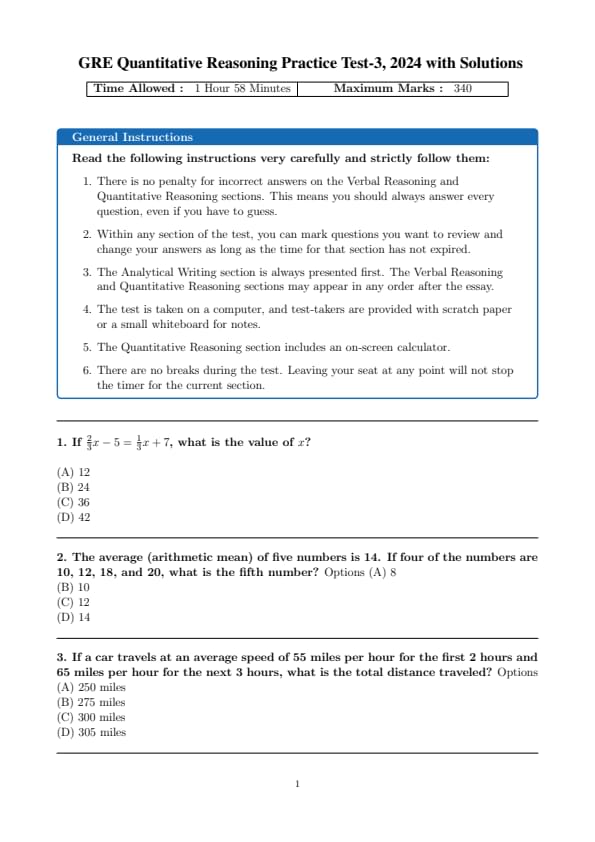
GRE 2024 Quantitative Reasoning Practice Test 3 Question Paper with Solutions PDF is available for download. The overall test time is about 1 hour and 58 minutes. GRE has total 5 sections:

  • Analytical Writing  (One "Analyze an Issue" task, Alloted time 30 minutes)
  • Verbal Reasoning  (Two Sections, with 12 questions and 15 questions respectively)
  • Quantitative Reasoning (Two Sections, with 12 questions and 15 questions respectively)

GRE 2024 Qantitative Reasoning Practice Test 3 Question Paper with Solutions PDF

GRE 2024 Quantitative Reasoning Question Paper with Solutions PDF download iconDownload Check Solutions
GRE 2024 Qantitative Reasoning Practice Test 3 Question Paper with Solutions PDF

Question 1:

If \( \frac{2}{3}x - 5 = \frac{1}{3}x + 7 \), what is the value of \( x \)?

  • (A) 12
  • (B) 24
  • (C) 36
  • (D) 42

Question 2:

The average (arithmetic mean) of five numbers is 14. If four of the numbers are 10, 12, 18, and 20, what is the fifth number?
Options

  • (A) 8
  • (B) 10
  • (C) 12
  • (D) 14

Question 3:

If a car travels at an average speed of 55 miles per hour for the first 2 hours and 65 miles per hour for the next 3 hours, what is the total distance traveled?
Options

  • (A) 250 miles
  • (B) 275 miles
  • (C) 300 miles
  • (D) 305 miles

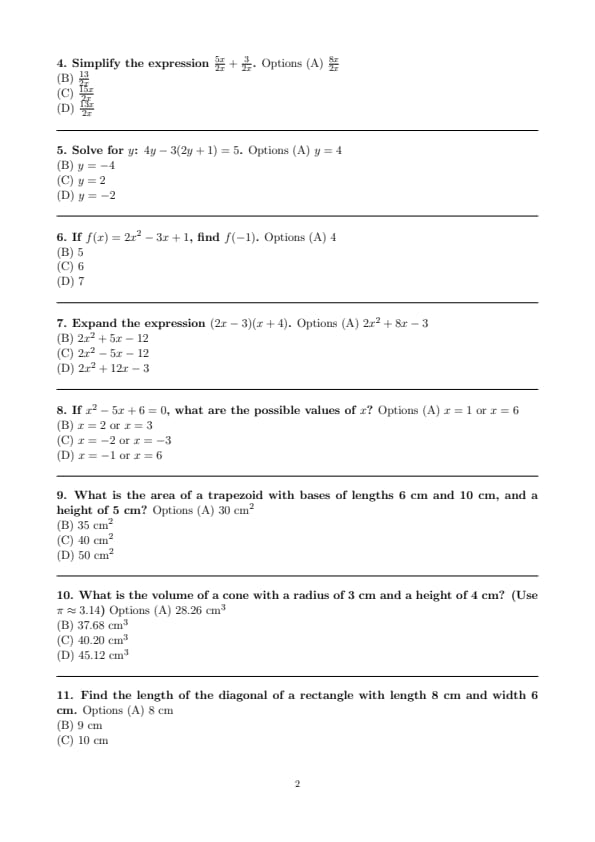
Question 4:

Simplify the expression \( \frac{5x}{2x} + \frac{3}{2x} \).
Options

  • (A) \( \frac{8x}{2x} \)
  • (B) \( \frac{13}{2x} \)
  • (C) \( \frac{15x}{2x} \)
  • (D) \( \frac{13x}{2x} \)

Question 5:

Solve for \( y \): \( 4y - 3(2y + 1) = 5 \).
Options

  • (A) \( y = 4 \)
  • (B) \( y = -4 \)
  • (C) \( y = 2 \)
  • (D) \( y = -2 \)

Question 6:

If \( f(x) = 2x^2 - 3x + 1 \), find \( f(-1) \).
Options

  • (A) 4
  • (B) 5
  • (C) 6
  • (D) 7

Question 7:

Expand the expression \( (2x - 3)(x + 4) \).
Options

  • (A) \( 2x^2 + 8x - 3 \)
  • (B) \( 2x^2 + 5x - 12 \)
  • (C) \( 2x^2 - 5x - 12 \)
  • (D) \( 2x^2 + 12x - 3 \)

Question 8:

If \( x^2 - 5x + 6 = 0 \), what are the possible values of \( x \)?
Options

  • (A) \( x = 1 \) or \( x = 6 \)
  • (B) \( x = 2 \) or \( x = 3 \)
  • (C) \( x = -2 \) or \( x = -3 \)
  • (D) \( x = -1 \) or \( x = 6 \)

Question 9:

What is the area of a trapezoid with bases of lengths 6 cm and 10 cm, and a height of 5 cm?
Options

  • (A) 30 cm\(^2\)
  • (B) 35 cm\(^2\)
  • (C) 40 cm\(^2\)
  • (D) 50 cm\(^2\)

Question 10:

What is the volume of a cone with a radius of 3 cm and a height of 4 cm? (Use \( \pi \approx 3.14 \))
Options

  • (A) 28.26 cm\(^3\)
  • (B) 37.68 cm\(^3\)
  • (C) 40.20 cm\(^3\)
  • (D) 45.12 cm\(^3\)

Question 11:

Find the length of the diagonal of a rectangle with length 8 cm and width 6 cm.
Options

  • (A) 8 cm
  • (B) 9 cm
  • (C) 10 cm
  • (D) 12 cm

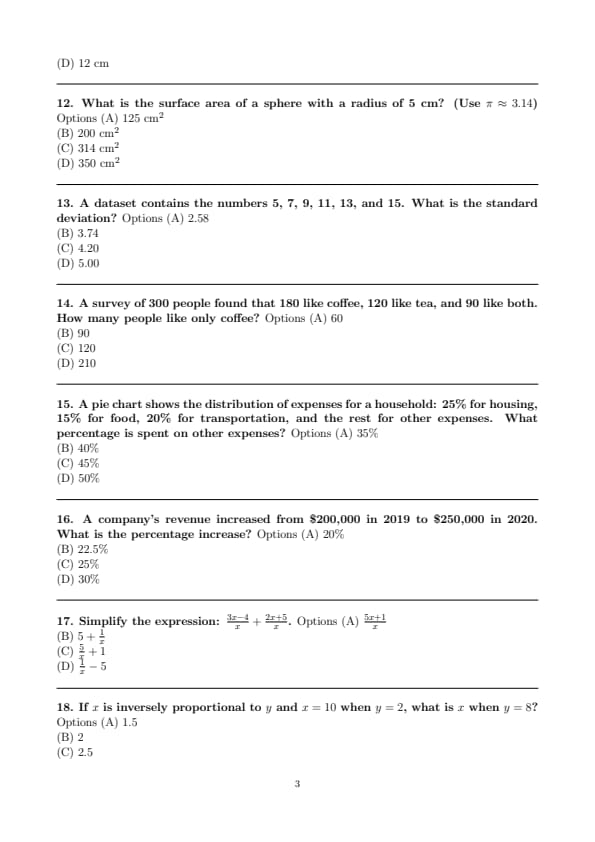
Question 12:

What is the surface area of a sphere with a radius of 5 cm? (Use \( \pi \approx 3.14 \))
Options

  • (A) 125 cm\(^2\)
  • (B) 200 cm\(^2\)
  • (C) 314 cm\(^2\)
  • (D) 350 cm\(^2\)

Question 13:

A dataset contains the numbers 5, 7, 9, 11, 13, and 15. What is the standard deviation?
Options

  • (A) 2.58
  • (B) 3.74
  • (C) 4.20
  • (D) 5.00

Question 14:

A survey of 300 people found that 180 like coffee, 120 like tea, and 90 like both. How many people like only coffee?
Options

  • (A) 60
  • (B) 90
  • (C) 120
  • (D) 210

Question 15:

A pie chart shows the distribution of expenses for a household: 25% for housing, 15% for food, 20% for transportation, and the rest for other expenses. What percentage is spent on other expenses?
Options

  • (A) 35%
  • (B) 40%
  • (C) 45%
  • (D) 50%

Question 16:

A company's revenue increased from
(200{,}000 in 2019 to
)250{,}000 in 2020. What is the percentage increase?
Options

  • (A) 20%
  • (B) 22.5%
  • (C) 25%
  • (D) 30%

Question 17:

Simplify the expression: \( \frac{3x - 4}{x} + \frac{2x + 5}{x} \).
Options

  • (A) \( \frac{5x + 1}{x} \)
  • (B) \( 5 + \frac{1}{x} \)
  • (C) \( \frac{5}{x} + 1 \)
  • (D) \( \frac{1}{x} - 5 \)

Question 18:

If \( x \) is inversely proportional to \( y \) and \( x = 10 \) when \( y = 2 \), what is \( x \) when \( y = 8 \)?
Options

  • (A) 1.5
  • (B) 2
  • (C) 2.5
  • (D) 4

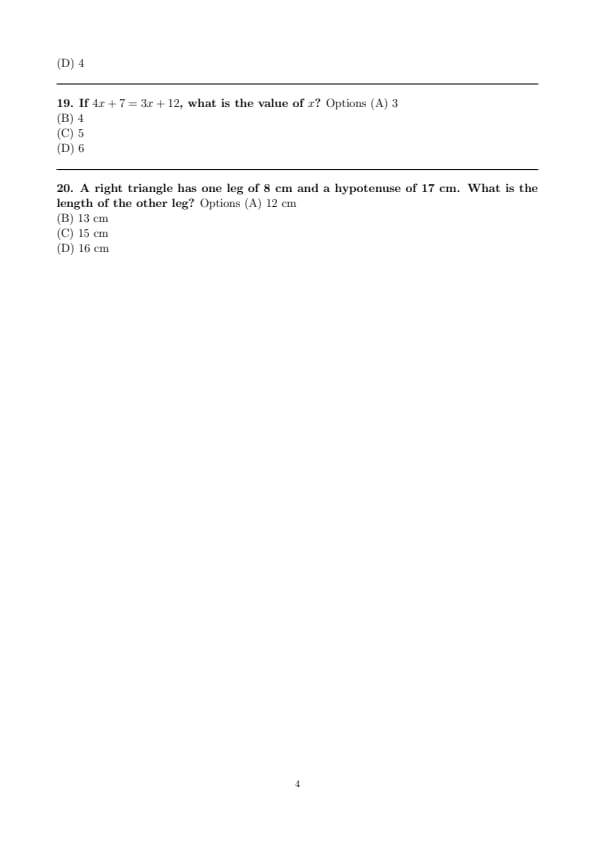
Question 19:

If \( 4x + 7 = 3x + 12 \), what is the value of \( x \)?
Options

  • (A) 3
  • (B) 4
  • (C) 5
  • (D) 6

Question 20:

A right triangle has one leg of 8 cm and a hypotenuse of 17 cm. What is the length of the other leg?
Options
  • (A) 12 cm
  • (B) 13 cm
  • (C) 15 cm
  • (D) 16 cm

GRE Questions

  • 1.
    The following appeared in a memorandum from the manager of WWAC radio station.
    “To reverse a decline in listener numbers, our owners have decided that WWAC must change from its current rock-music format. The decline has occurred despite population growth in our listening area, but that growth has resulted mainly from people moving here after their retirement. We must make listeners of these new residents. We could try playing music tailored to their tastes, but a continuing decline in local sales of recorded music suggests limited interest in music. Instead, we should change to a news and talk format, a form of radio that is increasingly popular in our area.”
    Write a response in which you discuss one or more alternative explanations that could rival the proposed explanation and explain how your explanation(s) can plausibly account for the facts presented in the argument.


      • 2.
        Complete the paragraph from the given words. It is refreshing to read a book about our planet by an author who does not allow facts to be (i) _________ by politics: well aware of the political disputes about the effects of human activities on climate and biodiversity, this author does not permit them to (ii) _________ his comprehensive description of what we know about our biosphere. He emphasizes the enormous gaps in our knowledge, the sparseness of our observations, and the (iii) _________, calling attention to the many aspects of planetary evolution that must be better understood before we can accurately diagnose the condition of our planet. Fill in the blanks from the following:

          • overshadowed
          • invalidated
          • illuminated
          • enhance
          • obscure

        • 3.
          Called by some the “island that time forgot,” Madagascar is home to a vast array of unique, exotic creatures. One such animal is the aye-aye. First described by western science in 1782, it was initially categorized as a member of the order Rodentia. Further research then revealed that it was more closely related to the lemur, a member of the primate order. Since the aye-aye is so different from its fellow primates, however, it was given its own family: Daubentoniidae. The aye-aye has been listed as an endangered species and, as a result, the government of Madagascar has designated an island off the northeastern coast of Madagascar as a protected reserve for aye-ayes and other wildlife.
          Long before Western science became enthralled with this nocturnal denizen of Madagascar’s jungles, the aye-aye had its own reputation with the local people. The aye aye is perhaps best known for its large, round eyes and long, extremely thin middle finger. These adaptations are quite sensible, allowing the aye-aye to see well at night and retrieve grubs, which are one of its primary food sources, from deep within hollow branches. However, the aye-aye’s striking appearance may end up causing its extinction. The people of Madagascar believe that the aye-aye is a type of spirit animal, and that its appearance is an omen of death. Whenever one is sighted, it is immediately killed. When combined with the loss of large swaths of jungle habitat, this practice may result in the loss of a superb .


            • 4.
              Three years ago, because of flooding at the Western Palean Wildlife Preserve, 100 lions and 100 western gazelles were moved to the East Palean Preserve, an area that is home to most of the same species that are found in the western preserve, though in larger numbers, and to the eastern gazelle, a close relative of the western gazelle.
              Write a response in which you discuss one or more alternative explanations that could rival the proposed explanation and explain how your explanation(s) can plausibly account for the facts presented in the argument.


                • 5.
                  Should we really care for the greatest actors of the past could we have them before us? Should we find them too different from our accent of thought, of feeling, of speech, in a thousand minute particulars which are of the essence of all three? Dr. Doran's long and interesting records of the triumphs of Garrick, and other less familiar, but in their day hardly less astonishing, players, do not relieve one of the doubt. Garrick himself, as sometimes happens with people who have been the subject of much anecdote and other conversation, here as elsewhere, bears no very distinct figure. One hardly sees the wood for the trees. On the other hand, the account of Betterton, "perhaps the greatest of English actors," is delightfully fresh. That intimate friend of Dryden, Tillatson, Pope, who executed a copy of the actor's portrait by Kneller which is still extant, was worthy of their friendship; his career brings out the best elements in stage life. The stage in these volumes presents itself indeed not merely as a mirror of life, but as an illustration of the utmost intensity of life, in the fortunes and characters of the players. Ups and downs, generosity, dark fates, the most delicate goodness, have nowhere been more prominent than in the private existence of those devoted to the public mimicry of men and women. Contact with the stage, almost throughout its history, presents itself as a kind of touchstone, to bring out the bizarrerie, the theatrical tricks and contrasts, of the actual world.


                    • 6.
                      Claim: Though often considered an objective pursuit, learning about the historical past requires creativity.
                      Reason: Because we can never know the past directly, we must reconstruct it by imaginatively interpreting historical accounts, documents, and artifacts.
                      Write a response in which you discuss the extent to which you agree or disagree with the claim and the reason on which the claim is based.

                        Comments


                        No Comments To Show