GRE 2024 Quantitative Reasoning Practice Test 4 Question Paper with Solutions PDF

GRE 2024 Quantitative Reasoning Practice Test 4 Question Paper with Solutions PDF is available for download. The overall test time is about 1 hour and 58 minutes. GRE has total 5 sections:

  • Analytical Writing  (One "Analyze an Issue" task, Alloted time 30 minutes)
  • Verbal Reasoning  (Two Sections, with 12 questions and 15 questions respectively)
  • Quantitative Reasoning (Two Sections, with 12 questions and 15 questions respectively)

GRE 2024 Qantitative Reasoning Practice Test 4 Question Paper with Solutions PDF

GRE 2024 Quantitative Reasoning Question Paper with Solutions PDF download iconDownload Check Solutions
GRE 2024 Qantitative Reasoning Practice Test 4 Question Paper with Solutions PDF

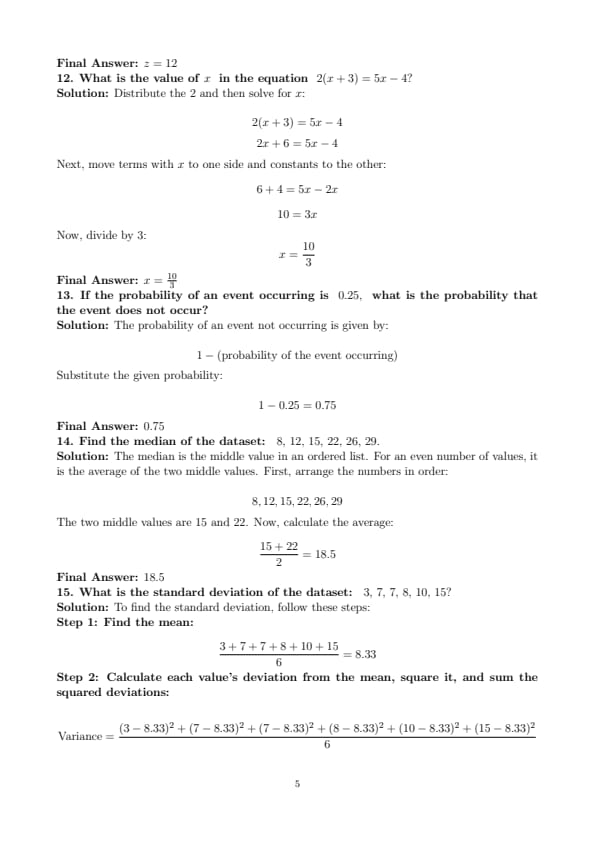
Question 1:

If \( \frac{3}{5}x - 2 = 1 \), what is \( x \)?

  • (A) 3
  • (B) 4
  • (C) 5
  • (D) 6

Question 2:

What is the sum of the first 20 positive integers?

  • (A) 190
  • (B) 200
  • (C) 210
  • (D) 220

Question 3:

Solve for \( y \): \( y^2 - 9 = 0 \).

  • (A) \( y = 3 \)
  • (B) \( y = -3 \)
  • (C) \( y = 0 \)
  • (D) No solution

Question 4:

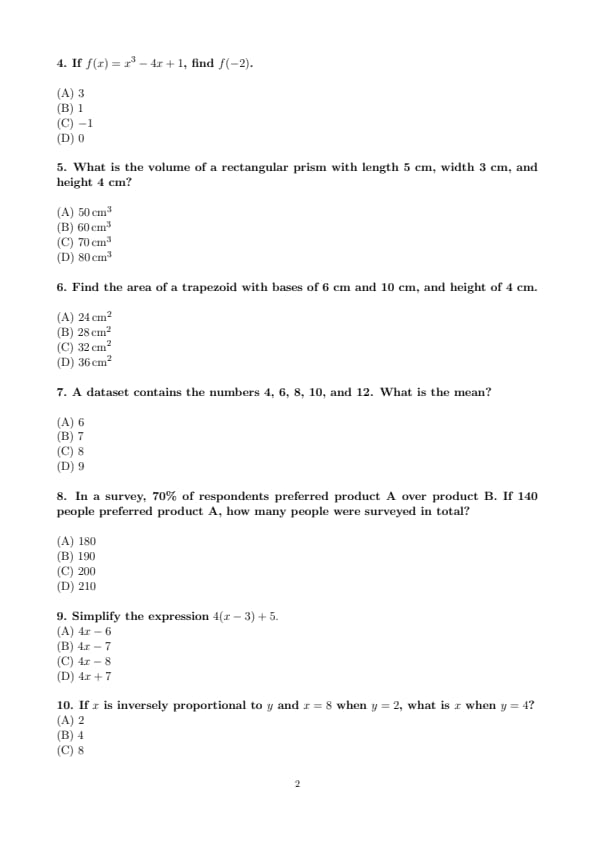
If \( f(x) = x^3 - 4x + 1 \), find \( f(-2) \).

  • (A) \( 3 \)
  • (B) \( 1 \)
  • (C) \( -1 \)
  • (D) \( 0 \)

Question 5:

What is the volume of a rectangular prism with length 5 cm, width 3 cm, and height 4 cm?
 

  • (A) \( 50 \, cm^3 \)
  • (B) \( 60 \, cm^3 \)
  • (C) \( 70 \, cm^3 \)
  • (D) \( 80 \, cm^3 \)

Question 6:

Find the area of a trapezoid with bases of 6 cm and 10 cm, and height of 4 cm.

  • (A) \( 24 \, cm^2 \)
  • (B) \( 28 \, cm^2 \)
  • (C) \( 32 \, cm^2 \)
  • (D) \( 36 \, cm^2 \)

Question 7:

A dataset contains the numbers 4, 6, 8, 10, and 12. What is the mean?

  • (A) 6
  • (B) 7
  • (C) 8
  • (D) 9

Question 8:

In a survey, 70% of respondents preferred product A over product B. If 140 people preferred product A, how many people were surveyed in total?

  • (A) 180
  • (B) 190
  • (C) 200
  • (D) 210

Question 9:

Simplify the expression \( 4(x - 3) + 5 \).


Question 10:

If \( x \) is inversely proportional to \( y \) and \( x = 8 \) when \( y = 2 \), what is \( x \) when \( y = 4 \)?


Question 11:

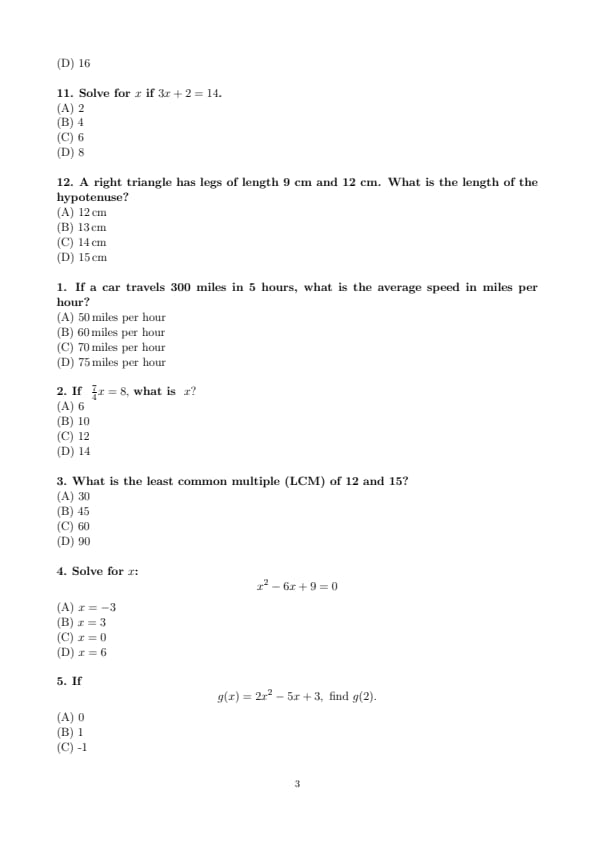
Solve for \( x \) if \( 3x + 2 = 14 \).


Question 12:

A right triangle has legs of length 9 cm and 12 cm. What is the length of the hypotenuse?


Question 13:

If a car travels 300 miles in 5 hours, what is the average speed in miles per hour?


Question 14:

If \( \frac{7}{4} x = 8 \), what is \( x \)?


Question 15:

What is the least common multiple (LCM) of 12 and 15?


Question 16:

Solve for \( x \): \[ x^2 - 6x + 9 = 0 \]


Question 17:

If \[ g(x) = 2x^2 - 5x + 3, find g(2). \]


Question 18:

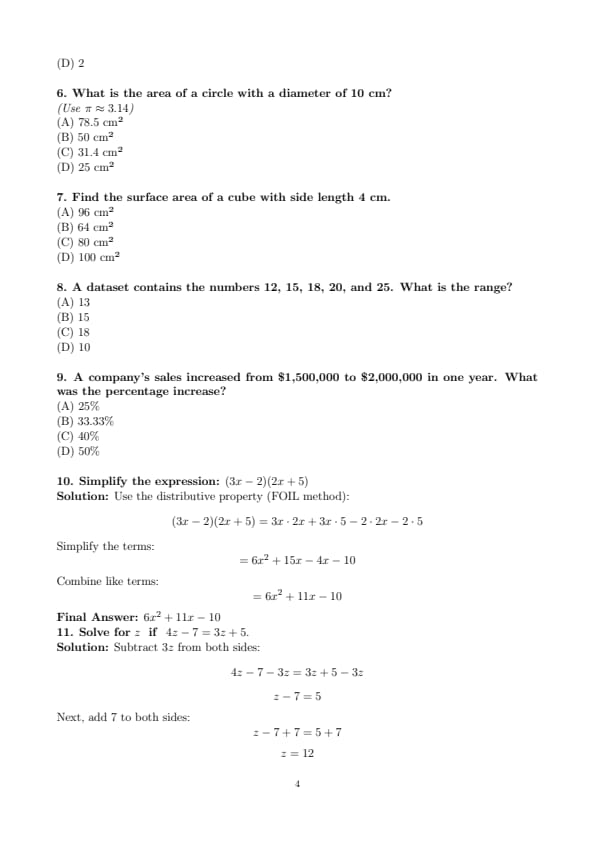
What is the area of a circle with a diameter of 10 cm?

(Use \( \pi \approx 3.14 )


Question 19:

Find the surface area of a cube with side length 4 cm.


Question 20:

A dataset contains the numbers 12, 15, 18, 20, and 25. What is the range?


Question 21:

A company's sales increased from $1,500,000 to $2,000,000 in one year. What was the percentage increase?


Question 22:

Simplify the expression: \( (3x - 2)(2x + 5) \)


Question 23:

Solve for \( z \) if \( 4z - 7 = 3z + 5 \).


Question 24:

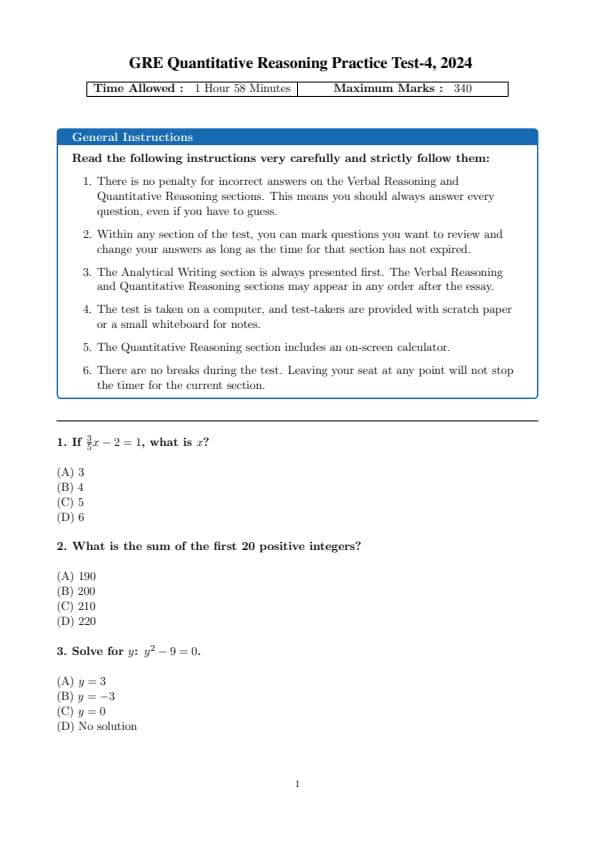
What is the value of \( x \) in the equation \( 2(x + 3) = 5x - 4 \)?


Question 25:

If the probability of an event occurring is 0.25, what is the probability that the event does not occur?


Question 26:

Find the median of the dataset: 8, 12, 15, 22, 26, 29.


Question 27:

What is the standard deviation of the dataset: 3, 7, 7, 8, 10, 15?
GRE Questions

  • 1.
    “Claim: A person in authority should always encourage those under him or her to share their thoughts and ideas. Reason: A leader’s main goal should be to promote innovation and change.”

      • Agree, as open dialogue fosters creativity and innovation.
      • Disagree, as not all ideas are practical or beneficial to share.
      • Agree, but only when it is necessary for progress.
      • Disagree, as promoting change without evaluating all ideas can be harmful.

    • 2.
      “Reviving the practice of using elements of popular music in classical composition, an approach that had been in hibernation in the United States during the 1960s, composer Philip Glass (born 1937) embraced the ethos of popular music in his compositions. Glass based two symphonies on music by rock musicians David Bowie and Brian Eno, but the symphonies' sound is distinctively his. Popular elements do not appear out of place in Glass's classical music, which from its early days has shared certain harmonies and rhythms with rock music. Yet this use of popular elements has not made Glass a composer of popular music. His music is not a version of popular music packaged to attract classical listeners; it is high art for listeners steeped in rock rather than the classics.


        • 3.
          Jean Valjean, the protagonist in Victor Hugo’s novel Les Misérables, spends the bulk of his lengthy _______ plotting a very clever set of revenge schemes, which he executes upon his escape.

            • ruination
            • peregrination
            • immolation
            • rumination

          • 4.
            It has been suggested that long-term prisoners, on release from jail, be given a reasonable state pension to reduce the likelihood of their resorting to crime. Most people instinctively reject the suggestion as they feel it would be like rewarding criminal activity. The supporters of the prisoners' pension scheme have criticized those who reject this possibility, by claiming that for the critics...
            Which of the following is the most logical completion of the sentence above?

              • emotion is more important than justice
              • punishment for criminals is more important than crime prevention
              • crime prevention is not an important issue
              • money has too high a value
              • the law should not be concerned with what happens after jail

            • 5.
              Claim: Though often considered an objective pursuit, learning about the historical past requires creativity.
              Reason: Because we can never know the past directly, we must reconstruct it by imaginatively interpreting historical accounts, documents, and artifacts.
              Write a response in which you discuss the extent to which you agree or disagree with the claim and the reason on which the claim is based.


                • 6.
                  The following appeared in a memorandum from the manager of WWAC radio station.
                  “To reverse a decline in listener numbers, our owners have decided that WWAC must change from its current rock-music format. The decline has occurred despite population growth in our listening area, but that growth has resulted mainly from people moving here after their retirement. We must make listeners of these new residents. We could try playing music tailored to their tastes, but a continuing decline in local sales of recorded music suggests limited interest in music. Instead, we should change to a news and talk format, a form of radio that is increasingly popular in our area.”
                  Write a response in which you discuss one or more alternative explanations that could rival the proposed explanation and explain how your explanation(s) can plausibly account for the facts presented in the argument.

                    Comments


                    No Comments To Show