GRE 2024 Quantitative Reasoning Practice Test 5 Question Paper with Solutions PDF

GRE 2024 Quantitative Reasoning Practice Test 5 Question Paper with Solutions PDF is available for download. The overall test time is about 1 hour and 58 minutes. GRE has total 5 sections:

  • Analytical Writing  (One "Analyze an Issue" task, Alloted time 30 minutes)
  • Verbal Reasoning  (Two Sections, with 12 questions and 15 questions respectively)
  • Quantitative Reasoning (Two Sections, with 12 questions and 15 questions respectively)

GRE 2024 Qantitative Reasoning Practice Test 5 Question Paper with Solutions PDF

GRE 2024 Quantitative Reasoning Question Paper with Solutions PDF download iconDownload Check Solutions
GRE 2024 Qantitative Reasoning Practice Test 5 Question Paper with Solutions PDF

Question 1:

If \( 3x + 2 = 11 \), what is the value of \( x \)?

  • (A) \( 5 \)
  • (B) \( 3 \)
  • (C) \( 4 \)
  • (D) \( 2 \)

Question 2:

The average (arithmetic mean) of 5, 10, 15, and 20 is:

  • (A) \( 12.5 \)
  • (B) \( 15 \)
  • (C) \( 10 \)
  • (D) \( 13 \)

Question 3:

If a car travels 150 miles in 2.5 hours, what is the average speed in miles per hour?

  • (A) \( 50 \) miles per hour
  • (B) \( 55 \) miles per hour
  • (C) \( 60 \) miles per hour
  • (D) \( 65 \) miles per hour

Question 4:

Solve for \( y \): \( 2y - 7 = 3y + 4 \).
 

  • (A) \( -11 \)
  • (B) \( 11 \)
  • (C) \( -7 \)
  • (D) \( 7 \)

Question 5:

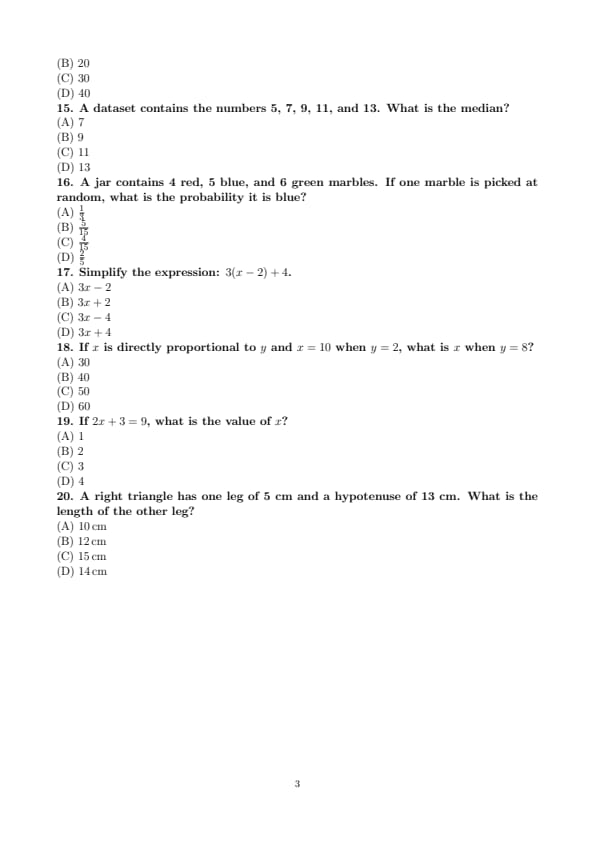
If \( f(x) = x^2 - 3x + 2 \), find \( f(2) \).
 

  • (A) \( 0 \)
  • (B) \( 2 \)
  • (C) \( -2 \)
  • (D) \( 4 \)

Question 6:

Expand the expression \( (x + 3)(x - 2) \).
 

  • (A) \( x^2 + x - 6 \)
  • (B) \( x^2 - x - 6 \)
  • (C) \( x^2 + 6x - 6 \)
  • (D) \( x^2 - 6x - 6 \)

Question 7:

If \( x^2 = 16 \), what are the possible values of \( x \)?
 

  • (A) \( 4 \)
  • (B) \( -4 \)
  • (C) \( 4 \) or \( -4 \)
  • (D) \( 0 \)

Question 8:

What is the area of a triangle with a base of 8 cm and a height of 5 cm?
 

  • (A) \( 20 \, cm^2 \)
  • (B) \( 30 \, cm^2 \)
  • (C) \( 40 \, cm^2 \)
  • (D) \( 10 \, cm^2 \)

Question 9:

What is the circumference of a circle with a radius of 7 cm?
 

  • (A) \( 43.96 \, cm \)
  • (B) \( 44.96 \, cm \)
  • (C) \( 40.96 \, cm \)
  • (D) \( 38.96 \, cm \)

Question 10:

Find the length of the hypotenuse of a right triangle with legs of length 6 cm and 8 cm.
 

  • (A) \( 12 \, cm \)
  • (B) \( 10 \, cm \)
  • (C) \( 8 \, cm \)
  • (D) \( 6 \, cm \)

Question 11:

What is the volume of a cylinder with a radius of 3 cm and a height of 5 cm?
 

  • (A) \( 141.3 \, cm^3 \)
  • (B) \( 120.5 \, cm^3 \)
  • (C) \( 135.5 \, cm^3 \)
  • (D) \( 150.5 \, cm^3 \)

Question 12:

The mean of five numbers is 8. If four of the numbers are 7, 9, 12, and 5, what is the fifth number?
 

  • (A) \( 7 \)
  • (B) \( 8 \)
  • (C) \( 9 \)
  • (D) \( 10 \)

Question 13:

A survey of 200 people found that 120 like coffee, 150 like tea, and 80 like both. How many people do not like either coffee or tea?
 

  • (A) \( 10 \)
  • (B) \( 20 \)
  • (C) \( 30 \)
  • (D) \( 40 \)

Question 14:

A dataset contains the numbers 5, 7, 9, 11, and 13. What is the median?
 

  • (A) \( 7 \)
  • (B) \( 9 \)
  • (C) \( 11 \)
  • (D) \( 13 \)

Question 15:

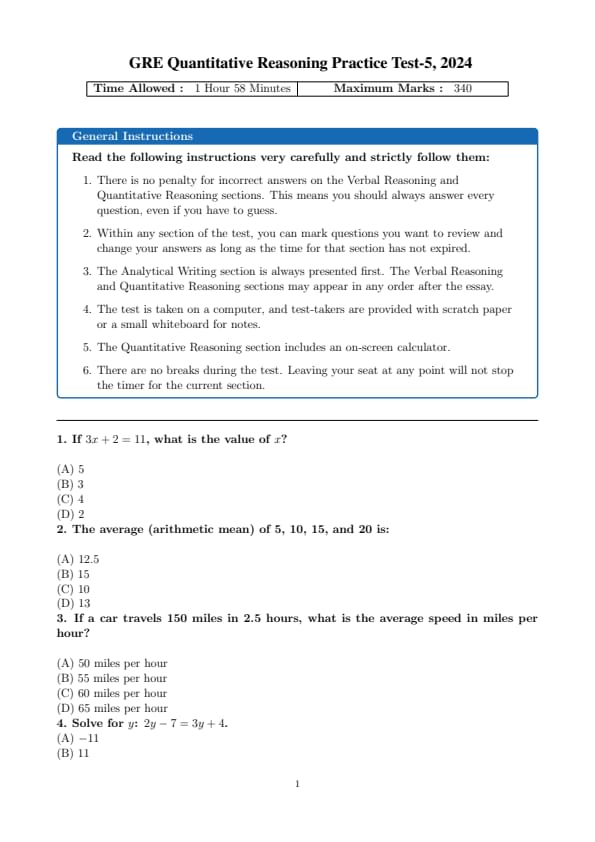
A jar contains 4 red, 5 blue, and 6 green marbles. If one marble is picked at random, what is the probability it is blue?
 

  • (A) \( \frac{1}{3} \)
  • (B) \( \frac{5}{15} \)
  • (C) \( \frac{4}{15} \)
  • (D) \( \frac{2}{5} \)

Question 16:

Simplify the expression: \( 3(x - 2) + 4 \).
 

  • (A) \( 3x - 2 \)
  • (B) \( 3x + 2 \)
  • (C) \( 3x - 4 \)
  • (D) \( 3x + 4 \)

Question 17:

If \( x \) is directly proportional to \( y \) and \( x = 10 \) when \( y = 2 \), what is \( x \) when \( y = 8 \)?
 

  • (A) \( 30 \)
  • (B) \( 40 \)
  • (C) \( 50 \)
  • (D) \( 60 \)

Question 18:

If \( 2x + 3 = 9 \), what is the value of \( x \)?
 

  • (A) \( 1 \)
  • (B) \( 2 \)
  • (C) \( 3 \)
  • (D) \( 4 \)

Question 19:

A right triangle has one leg of 5 cm and a hypotenuse of 13 cm. What is the length of the other leg?
 

  • (A) \( 10 \, cm \)
  • (B) \( 12 \, cm \)
  • (C) \( 15 \, cm \)
  • (D) \( 14 \, cm \)

GRE Questions

  • 1.
    Should we really care for the greatest actors of the past could we have them before us? Should we find them too different from our accent of thought, of feeling, of speech, in a thousand minute particulars which are of the essence of all three? Dr. Doran's long and interesting records of the triumphs of Garrick, and other less familiar, but in their day hardly less astonishing, players, do not relieve one of the doubt. Garrick himself, as sometimes happens with people who have been the subject of much anecdote and other conversation, here as elsewhere, bears no very distinct figure. One hardly sees the wood for the trees. On the other hand, the account of Betterton, "perhaps the greatest of English actors," is delightfully fresh. That intimate friend of Dryden, Tillatson, Pope, who executed a copy of the actor's portrait by Kneller which is still extant, was worthy of their friendship; his career brings out the best elements in stage life. The stage in these volumes presents itself indeed not merely as a mirror of life, but as an illustration of the utmost intensity of life, in the fortunes and characters of the players. Ups and downs, generosity, dark fates, the most delicate goodness, have nowhere been more prominent than in the private existence of those devoted to the public mimicry of men and women. Contact with the stage, almost throughout its history, presents itself as a kind of touchstone, to bring out the bizarrerie, the theatrical tricks and contrasts, of the actual world.


      • 2.
        Jean Valjean, the protagonist in Victor Hugo’s novel Les Misérables, spends the bulk of his lengthy _______ plotting a very clever set of revenge schemes, which he executes upon his escape.

          • ruination
          • peregrination
          • immolation
          • rumination

        • 3.
          Claim: Though often considered an objective pursuit, learning about the historical past requires creativity.
          Reason: Because we can never know the past directly, we must reconstruct it by imaginatively interpreting historical accounts, documents, and artifacts.
          Write a response in which you discuss the extent to which you agree or disagree with the claim and the reason on which the claim is based.


            • 4.
              Melvin’s little sister was so ________ that she would believe anything he told her, and his burgeoning sense of maturity rendered him increasingly loath to gull her.

                • dogged
                • tenable
                • fractious
                • frivolous
                • credulous

              • 5.
                “Reviving the practice of using elements of popular music in classical composition, an approach that had been in hibernation in the United States during the 1960s, composer Philip Glass (born 1937) embraced the ethos of popular music in his compositions. Glass based two symphonies on music by rock musicians David Bowie and Brian Eno, but the symphonies' sound is distinctively his. Popular elements do not appear out of place in Glass's classical music, which from its early days has shared certain harmonies and rhythms with rock music. Yet this use of popular elements has not made Glass a composer of popular music. His music is not a version of popular music packaged to attract classical listeners; it is high art for listeners steeped in rock rather than the classics.


                  • 6.
                    The following appeared in a memorandum from the manager of WWAC radio station.
                    “To reverse a decline in listener numbers, our owners have decided that WWAC must change from its current rock-music format. The decline has occurred despite population growth in our listening area, but that growth has resulted mainly from people moving here after their retirement. We must make listeners of these new residents. We could try playing music tailored to their tastes, but a continuing decline in local sales of recorded music suggests limited interest in music. Instead, we should change to a news and talk format, a form of radio that is increasingly popular in our area.”
                    Write a response in which you discuss one or more alternative explanations that could rival the proposed explanation and explain how your explanation(s) can plausibly account for the facts presented in the argument.

                      Comments


                      No Comments To Show