GRE 2024 Quantitative Reasoning Practice Test 7 Question Paper with Solutions PDF

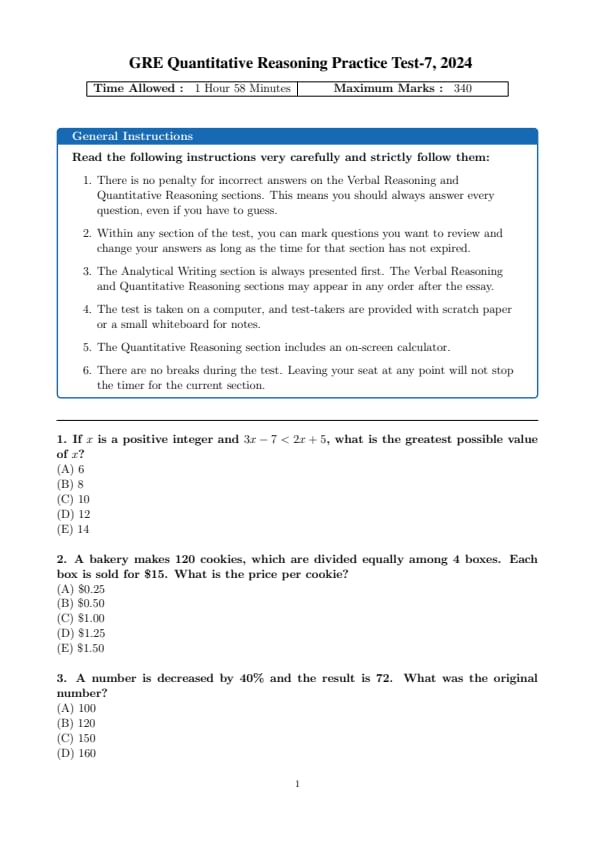
GRE 2024 Quantitative Reasoning Practice Test 7 Question Paper with Solutions PDF is available for download. The overall test time is about 1 hour and 58 minutes. GRE has total 5 sections:

  • Analytical Writing  (One "Analyze an Issue" task, Alloted time 30 minutes)
  • Verbal Reasoning  (Two Sections, with 12 questions and 15 questions respectively)
  • Quantitative Reasoning (Two Sections, with 12 questions and 15 questions respectively)

GRE 2024 Qantitative Reasoning Practice Test 7 Question Paper with Solutions PDF

GRE 2024 Quantitative Reasoning Question Paper with Solutions PDF download iconDownload Check Solutions
GRE 2024 Qantitative Reasoning Practice Test 7 Question Paper with Solutions PDF

Question 1:

If \( x \) is a positive integer and \( 3x - 7 < 2x + 5 \), what is the greatest possible value of \( x \)?

  • (A) 6
  • (B) 8
  • (C) 10
  • (D) 12
  • (E) 14

Question 2:

A bakery makes 120 cookies, which are divided equally among 4 boxes. Each box is sold for 15. What is the price per cookie?

  • (A)0.25
  • (B)0.50
  • (C)1.00
  • (D)1.25
  • (E)1.50

Question 3:

A number is decreased by 40% and the result is 72. What was the original number?

  • (A) 100
  • (B) 120
  • (C) 150
  • (D) 160
  • (E) 180

Question 4:

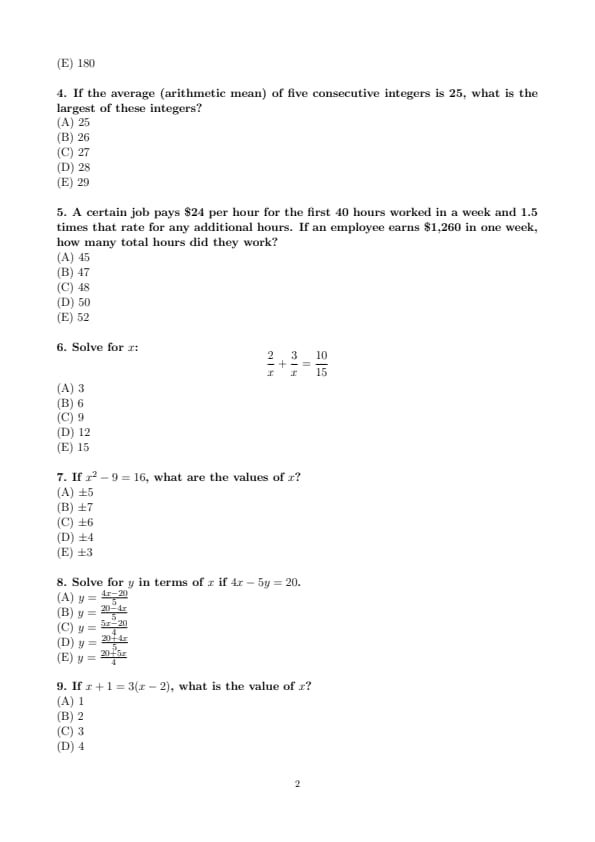
If the average (arithmetic mean) of five consecutive integers is 25, what is the largest of these integers?

  • (A) 25
  • (B) 26
  • (C) 27
  • (D) 28
  • (E) 29

Question 5:

A certain job pays 24 per hour for the first 40 hours worked in a week and 1.5 times that rate for any additional hours. If an employee earns
1,260 in one week, how many total hours did they work?

  • (A) 45
  • (B) 47
  • (C) 48
  • (D) 50
  • (E) 52

Question 6:

Solve for \( x \): \[ \frac{2}{x} + \frac{3}{x} = \frac{10}{15} \]

  • (A) 3
  • (B) 6
  • (C) 9
  • (D) 12
  • (E) 15

Question 7:

If \( x^2 - 9 = 16 \), what are the values of \( x \)?

  • (A) \( \pm 5 \)
  • (B) \( \pm 7 \)
  • (C) \( \pm 6 \)
  • (D) \( \pm 4 \)
  • (E) \( \pm 3 \)

Question 8:

Solve for \( y \) in terms of \( x \) if \( 4x - 5y = 20 \).

  • (A) \( y = \frac{4x - 20}{5} \)
  • (B) \( y = \frac{20 - 4x}{5} \)
  • (C) \( y = \frac{5x - 20}{4} \)
  • (D) \( y = \frac{20 + 4x}{5} \)
  • (E) \( y = \frac{20 + 5x}{4} \)

Question 9:

If \( x + 1 = 3(x - 2) \), what is the value of \( x \)?

  • (A) 1
  • (B) 2
  • (C) 3
  • (D) 4
  • (E) 5

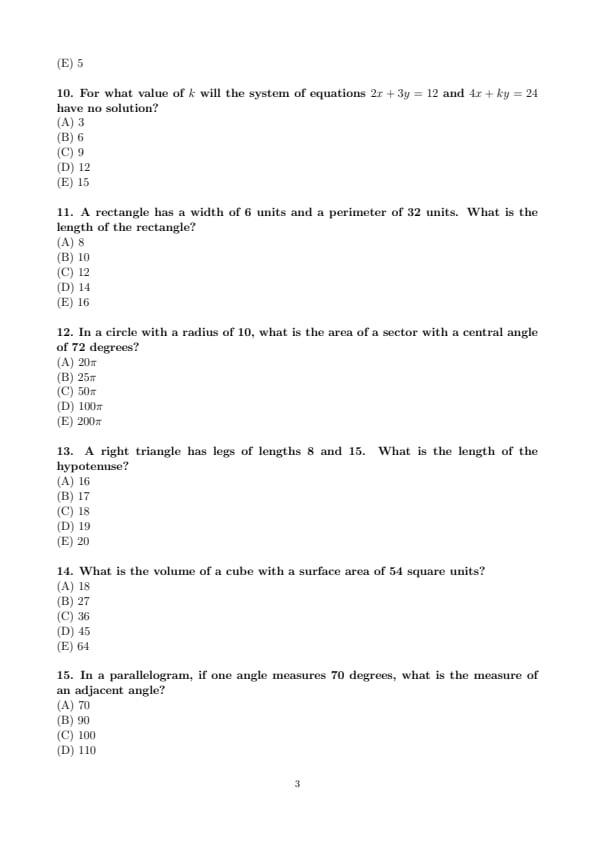
Question 10:

For what value of \( k \) will the system of equations \( 2x + 3y = 12 \) and \( 4x + ky = 24 \) have no solution?

  • (A) 3
  • (B) 6
  • (C) 9
  • (D) 12
  • (E) 15

Question 11:

A rectangle has a width of 6 units and a perimeter of 32 units. What is the length of the rectangle?

  • (A) 8
  • (B) 10
  • (C) 12
  • (D) 14
  • (E) 16

Question 12:

In a circle with a radius of 10, what is the area of a sector with a central angle of 72 degrees?

  • (A) \( 20\pi \)
  • (B) \( 25\pi \)
  • (C) \( 50\pi \)
  • (D) \( 100\pi \)
  • (E) \( 200\pi \)

Question 13:

A right triangle has legs of lengths 8 and 15. What is the length of the hypotenuse?

  • (A) 16
  • (B) 17
  • (C) 18
  • (D) 19
  • (E) 20

Question 14:

What is the volume of a cube with a surface area of 54 square units?

  • (A) 18
  • (B) 27
  • (C) 36
  • (D) 45
  • (E) 64

Question 15:

In a parallelogram, if one angle measures 70 degrees, what is the measure of an adjacent angle?

  • (A) 70
  • (B) 90
  • (C) 100
  • (D) 110
  • (E) 120

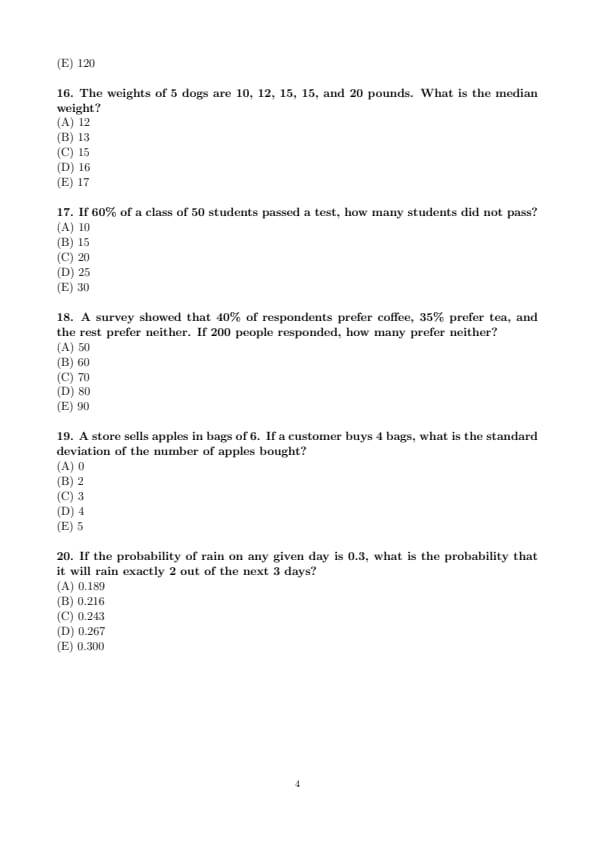
Question 16:

The weights of 5 dogs are 10, 12, 15, 15, and 20 pounds. What is the median weight?

  • (A) 12
  • (B) 13
  • (C) 15
  • (D) 16
  • (E) 17

Question 17:

If 60% of a class of 50 students passed a test, how many students did not pass?

  • (A) 10
  • (B) 15
  • (C) 20
  • (D) 25
  • (E) 30

Question 18:

A survey showed that 40% of respondents prefer coffee, 35% prefer tea, and the rest prefer neither. If 200 people responded, how many prefer neither?

  • (A) 50
  • (B) 60
  • (C) 70
  • (D) 80
  • (E) 90

Question 19:

A store sells apples in bags of 6. If a customer buys 4 bags, what is the standard deviation of the number of apples bought?

  • (A) 0
  • (B) 2
  • (C) 3
  • (D) 4
  • (E) 5

Question 20:

If the probability of rain on any given day is 0.3, what is the probability that it will rain exactly 2 out of the next 3 days?
  • (A) 0.189
  • (B) 0.216
  • (C) 0.243
  • (D) 0.267
  • (E) 0.300

GRE Questions

  • 1.
    Jean Valjean, the protagonist in Victor Hugo’s novel Les Misérables, spends the bulk of his lengthy _______ plotting a very clever set of revenge schemes, which he executes upon his escape.

      • ruination
      • peregrination
      • immolation
      • rumination

    • 2.
      Called by some the “island that time forgot,” Madagascar is home to a vast array of unique, exotic creatures. One such animal is the aye-aye. First described by western science in 1782, it was initially categorized as a member of the order Rodentia. Further research then revealed that it was more closely related to the lemur, a member of the primate order. Since the aye-aye is so different from its fellow primates, however, it was given its own family: Daubentoniidae. The aye-aye has been listed as an endangered species and, as a result, the government of Madagascar has designated an island off the northeastern coast of Madagascar as a protected reserve for aye-ayes and other wildlife.
      Long before Western science became enthralled with this nocturnal denizen of Madagascar’s jungles, the aye-aye had its own reputation with the local people. The aye aye is perhaps best known for its large, round eyes and long, extremely thin middle finger. These adaptations are quite sensible, allowing the aye-aye to see well at night and retrieve grubs, which are one of its primary food sources, from deep within hollow branches. However, the aye-aye’s striking appearance may end up causing its extinction. The people of Madagascar believe that the aye-aye is a type of spirit animal, and that its appearance is an omen of death. Whenever one is sighted, it is immediately killed. When combined with the loss of large swaths of jungle habitat, this practice may result in the loss of a superb .


        • 3.
          Complete the paragraph from the given words. It is refreshing to read a book about our planet by an author who does not allow facts to be (i) _________ by politics: well aware of the political disputes about the effects of human activities on climate and biodiversity, this author does not permit them to (ii) _________ his comprehensive description of what we know about our biosphere. He emphasizes the enormous gaps in our knowledge, the sparseness of our observations, and the (iii) _________, calling attention to the many aspects of planetary evolution that must be better understood before we can accurately diagnose the condition of our planet. Fill in the blanks from the following:

            • overshadowed
            • invalidated
            • illuminated
            • enhance
            • obscure

          • 4.
            “Claim: A person in authority should always encourage those under him or her to share their thoughts and ideas. Reason: A leader’s main goal should be to promote innovation and change.”

              • Agree, as open dialogue fosters creativity and innovation.
              • Disagree, as not all ideas are practical or beneficial to share.
              • Agree, but only when it is necessary for progress.
              • Disagree, as promoting change without evaluating all ideas can be harmful.

            • 5.
              Melvin’s little sister was so ________ that she would believe anything he told her, and his burgeoning sense of maturity rendered him increasingly loath to gull her.

                • dogged
                • tenable
                • fractious
                • frivolous
                • credulous

              • 6.
                “Reviving the practice of using elements of popular music in classical composition, an approach that had been in hibernation in the United States during the 1960s, composer Philip Glass (born 1937) embraced the ethos of popular music in his compositions. Glass based two symphonies on music by rock musicians David Bowie and Brian Eno, but the symphonies' sound is distinctively his. Popular elements do not appear out of place in Glass's classical music, which from its early days has shared certain harmonies and rhythms with rock music. Yet this use of popular elements has not made Glass a composer of popular music. His music is not a version of popular music packaged to attract classical listeners; it is high art for listeners steeped in rock rather than the classics.

                  Comments


                  No Comments To Show