GRE 2024 Quantitative Reasoning Practice Test Set 19 Question Paper with Solutions PDF

GRE 2024 Quantitative Reasoning Practice Test Set 19 Question Paper with Solutions PDF is available for download. The overall test time is about 1 hour and 58 minutes. GRE has total 5 sections:

  • Analytical Writing  (One "Analyze an Issue" task, Alloted time 30 minutes)
  • Verbal Reasoning  (Two Sections, with 12 questions and 15 questions respectively)
  • Quantitative Reasoning (Two Sections, with 12 questions and 15 questions respectively)

GRE 2024 Qantitative Reasoning Practice Test Set 19 Question Paper with Solutions PDF

GRE 2024 Quantitative Reasoning Set 19 Question Paper with Solutions PDF download iconDownload Check Solutions
GRE 2024 Qantitative Reasoning Practice Test Set 19 Question Paper with Solutions PDF

Question 1:


Quantity A: \(2^{60}\)

Quantity B: \(8^{20}\)


  • (A) if Quantity A is greater;
  • (B) if Quantity B is greater;
  • (C) if the two quantities are equal;
  • (D) if the relationship cannot be determined from the information given.

Question 2:


Given the equation \(x^2 - 5x = 6 - y^2 + 3y = 9y + 9\).

Quantity A: \(x\)

Quantity B: \(y\)


  • (A) if Quantity A is greater;
  • (B) if Quantity B is greater;
  • (C) if the two quantities are equal;
  • (D) if the relationship cannot be determined from the information given.

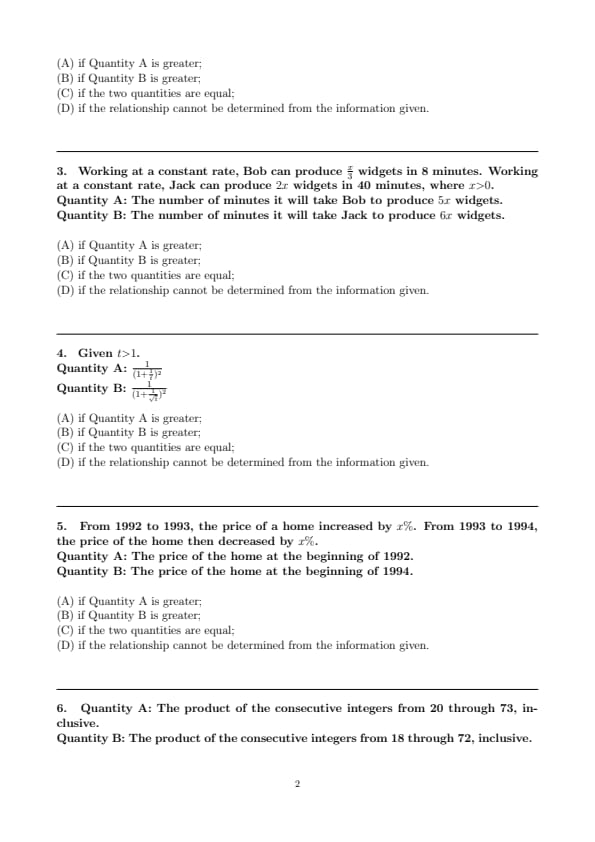
Question 3:


Working at a constant rate, Bob can produce \(\frac{x}{3}\) widgets in 8 minutes. Working at a constant rate, Jack can produce \(2x\) widgets in 40 minutes, where \(x > 0\).

Quantity A: The number of minutes it will take Bob to produce \(5x\) widgets.

Quantity B: The number of minutes it will take Jack to produce \(6x\) widgets.


  • (A) if Quantity A is greater;
  • (B) if Quantity B is greater;
  • (C) if the two quantities are equal;
  • (D) if the relationship cannot be determined from the information given.

Question 4:


Given \(t > 1\).

Quantity A: \(\frac{1}{(1 + \frac{1}{t})^2}\)

Quantity B: \(\frac{1}{(1 + \frac{1}{\sqrt{t}})^2}\)


  • (A) if Quantity A is greater;
  • (B) if Quantity B is greater;
  • (C) if the two quantities are equal;
  • (D) if the relationship cannot be determined from the information given.

Question 5:


From 1992 to 1993, the price of a home increased by \(x%\). From 1993 to 1994, the price of the home then decreased by \(x%\).

Quantity A: The price of the home at the beginning of 1992.

Quantity B: The price of the home at the beginning of 1994.


  • (A) if Quantity A is greater;
  • (B) if Quantity B is greater;
  • (C) if the two quantities are equal;
  • (D) if the relationship cannot be determined from the information given.

Question 6:


Quantity A: The product of the consecutive integers from 20 through 73, inclusive.

Quantity B: The product of the consecutive integers from 18 through 72, inclusive.


  • (A) if Quantity A is greater;
  • (B) if Quantity B is greater;
  • (C) if the two quantities are equal;
  • (D) if the relationship cannot be determined from the information given.

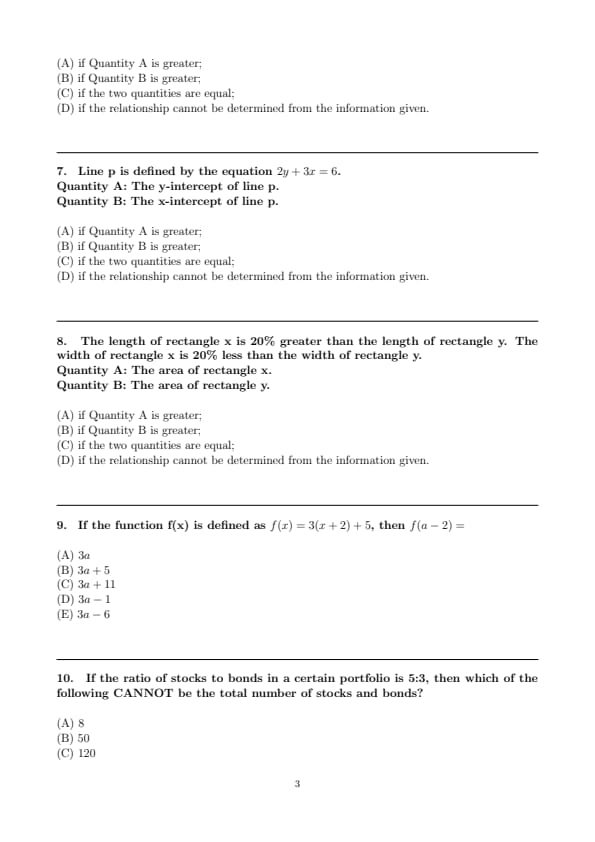
Question 7:


Line p is defined by the equation \(2y + 3x = 6\).

Quantity A: The y-intercept of line p.

Quantity B: The x-intercept of line p.


  • (A) if Quantity A is greater;
  • (B) if Quantity B is greater;
  • (C) if the two quantities are equal;
  • (D) if the relationship cannot be determined from the information given.

Question 8:


The length of rectangle x is 20% greater than the length of rectangle y. The width of rectangle x is 20% less than the width of rectangle y.

Quantity A: The area of rectangle x.

Quantity B: The area of rectangle y.


  • (A) if Quantity A is greater;
  • (B) if Quantity B is greater;
  • (C) if the two quantities are equal;
  • (D) if the relationship cannot be determined from the information given.

Question 9:


If the function f(x) is defined as \(f(x) = 3(x + 2) + 5\), then \(f(a - 2) =\)
 

  • (A) \(3a\)
  • (B) \(3a + 5\)
  • (C) \(3a + 11\)
  • (D) \(3a - 1\)
  • (E) \(3a - 6\)

Question 10:


If the ratio of stocks to bonds in a certain portfolio is 5:3, then which of the following CANNOT be the total number of stocks and bonds?
 

  • (A) 8
  • (B) 50
  • (C) 120
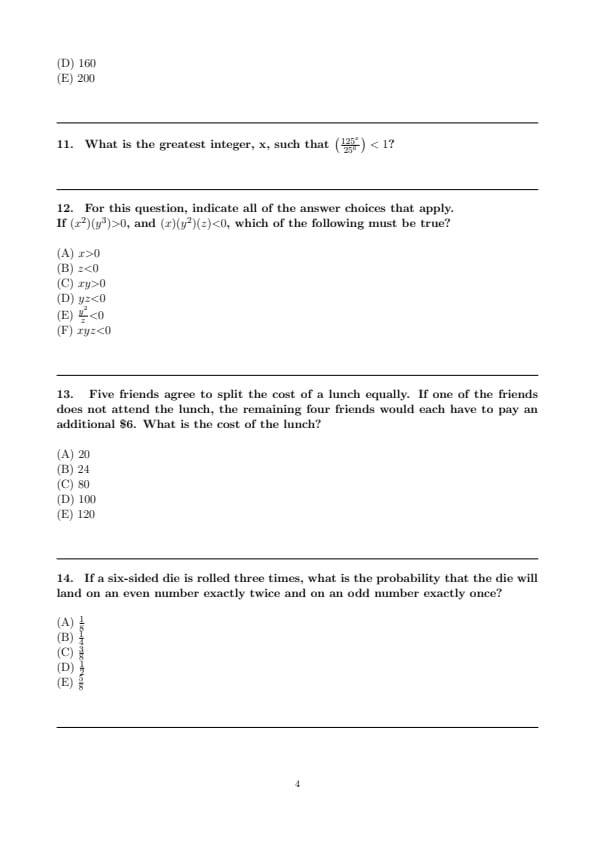
  • (D) 160
  • (E) 200

Question 11:


What is the greatest integer, x, such that \( \left( \frac{125^x}{25^6} \right) < 1 \)?


Question 12:


For this question, indicate all of the answer choices that apply.

If \((x^2)(y^3) \textgreater 0\), and \((x)(y^2)(z) \textless 0\), which of the following must be true?


  • (A) \(x > 0\)
  • (B) \(z < 0\)
  • (C) \(xy > 0\)
  • (D) \(yz < 0\)
  • (E) \(\frac{y^2}{z} < 0\)
  • (F) \(xyz < 0\)

Question 13:


Five friends agree to split the cost of a lunch equally. If one of the friends does not attend the lunch, the remaining four friends would each have to pay an additional
(6. What is the cost of the lunch?


  • (A) 20
  • (B) 24
  • (C) 80
  • (D) 100
  • (E) 120

Question 14:


If a six-sided die is rolled three times, what is the probability that the die will land on an even number exactly twice and on an odd number exactly once?
 

  • (A) \(\frac{1}{8}\)
  • (B) \(\frac{1}{4}\)
  • (C) \(\frac{3}{8}\)
  • (D) \(\frac{1}{2}\)
  • (E) \(\frac{5}{8}\)

Question 15:


For how many years did expenses exceed revenue?

  • (A) 1
  • (B) 2
  • (C) 3
  • (D) 7
  • (E) 8

Question 16:


The percent change in profit from 2007 to 2008 is approximately what percent greater than the percent change in profit from 2008 to 2009?

  • (A) 500%
  • (B) 6%
  • (C) 1,500%
  • (D) 1,600%
  • (E) 1,700%

Question 17:


If the revenues in 2009 were $3 million less, and the expenses for 2009 were $4 million more, then the average (arithmetic mean) annual profit for the 10 years shown would be approximately how much less?

  • (A)300,000
  • (B)400,000
  • (C)600,000
  • (D)700,000
  • (E)1,000,000

Question 18:


In 1998, the list price of a home was \(\frac{1}{3}\) greater than the original price. In 2008, the list price of the home was \(\frac{1}{2}\) greater than the original price. By what percent did the list price of the home increase from 1998 to 2008? (Note: The fractions were missing in the text and have been inferred).
 

  • (A) 10%
  • (B) 12.5%
  • (C) \(16\frac{2}{3}\)%
  • (D) \(33\frac{1}{3}\)%
  • (E) 50%

Question 19:


The figure above represents a square photograph bordered by a frame that has a uniform width of 3 inches. If the frame and the picture have the same area, and each of the photograph's sides measures x inches, which of the following equations is true?
 

  • (A) \(x^2 = 6x + 9\)
  • (B) \(x^2 = 3x^2 + 2x\)
  • (C) \(x^2 = 12x + 36\)
  • (D) \(x^2 = 6x + 36\)
  • (E) \(x^2 = 6x^2 + 4x\)

Question 20:


On the xy-plane, the center of circle C is at point (3, -2). If the point (10, -2) lies outside of the circle and the point (3, 3) lies inside of the circle, which of the following could be the radius of the circle?
 

  • (A) 5
  • (B) 5.5
  • (C) 6
  • (D) 6.5
  • (E) 7

GRE Questions

  • 1.
    Called by some the “island that time forgot,” Madagascar is home to a vast array of unique, exotic creatures. One such animal is the aye-aye. First described by western science in 1782, it was initially categorized as a member of the order Rodentia. Further research then revealed that it was more closely related to the lemur, a member of the primate order. Since the aye-aye is so different from its fellow primates, however, it was given its own family: Daubentoniidae. The aye-aye has been listed as an endangered species and, as a result, the government of Madagascar has designated an island off the northeastern coast of Madagascar as a protected reserve for aye-ayes and other wildlife.
    Long before Western science became enthralled with this nocturnal denizen of Madagascar’s jungles, the aye-aye had its own reputation with the local people. The aye aye is perhaps best known for its large, round eyes and long, extremely thin middle finger. These adaptations are quite sensible, allowing the aye-aye to see well at night and retrieve grubs, which are one of its primary food sources, from deep within hollow branches. However, the aye-aye’s striking appearance may end up causing its extinction. The people of Madagascar believe that the aye-aye is a type of spirit animal, and that its appearance is an omen of death. Whenever one is sighted, it is immediately killed. When combined with the loss of large swaths of jungle habitat, this practice may result in the loss of a superb .


      • 2.
        “Reviving the practice of using elements of popular music in classical composition, an approach that had been in hibernation in the United States during the 1960s, composer Philip Glass (born 1937) embraced the ethos of popular music in his compositions. Glass based two symphonies on music by rock musicians David Bowie and Brian Eno, but the symphonies' sound is distinctively his. Popular elements do not appear out of place in Glass's classical music, which from its early days has shared certain harmonies and rhythms with rock music. Yet this use of popular elements has not made Glass a composer of popular music. His music is not a version of popular music packaged to attract classical listeners; it is high art for listeners steeped in rock rather than the classics.


          • 3.
            Jean Valjean, the protagonist in Victor Hugo’s novel Les Misérables, spends the bulk of his lengthy _______ plotting a very clever set of revenge schemes, which he executes upon his escape.

              • ruination
              • peregrination
              • immolation
              • rumination

            • 4.
              “Claim: A person in authority should always encourage those under him or her to share their thoughts and ideas. Reason: A leader’s main goal should be to promote innovation and change.”

                • Agree, as open dialogue fosters creativity and innovation.
                • Disagree, as not all ideas are practical or beneficial to share.
                • Agree, but only when it is necessary for progress.
                • Disagree, as promoting change without evaluating all ideas can be harmful.

              • 5.
                It has been suggested that long-term prisoners, on release from jail, be given a reasonable state pension to reduce the likelihood of their resorting to crime. Most people instinctively reject the suggestion as they feel it would be like rewarding criminal activity. The supporters of the prisoners' pension scheme have criticized those who reject this possibility, by claiming that for the critics...
                Which of the following is the most logical completion of the sentence above?

                  • emotion is more important than justice
                  • punishment for criminals is more important than crime prevention
                  • crime prevention is not an important issue
                  • money has too high a value
                  • the law should not be concerned with what happens after jail

                • 6.
                  “Color photography has eliminated the need for realism in artistic painting, in the opinion of a number of art scholars and artists. At the same time, many members of the art community still feel that realistic artwork is still valuable and worthwhile.”

                    • Agree, because color photography has eliminated the need for realistic art.
                    • Disagree, as realism in art serves as an important expression of human creativity.
                    • Agree, but only in some cases, color photography does not affect all artistic forms.
                    • Disagree, as traditional forms of art hold inherent value independent of color photography.

                  Comments


                  No Comments To Show