GRE 2024 Verbal Reasoning Test 3 Question Paper with Solutions PDF

GRE 2024 Verbal Reasoning Test 3 Question Paper with Solutions PDF is available for download. The overall test time is about 1 hour and 58 minutes. GRE has total 5 sections:

  • Analytical Writing  (One "Analyze an Issue" task, Alloted time 30 minutes)
  • Verbal Reasoning  (Two Sections, with 12 questions and 15 questions respectively)
  • Quantitative Reasoning (Two Sections, with 12 questions and 15 questions respectively)

GRE 2024 Verbal Reasoning Practice Test 3 Question Paper with Solutions PDF

GRE 2024 Verbal Reasoning Question Paper with Solutions PDF download iconDownload Check Solutions

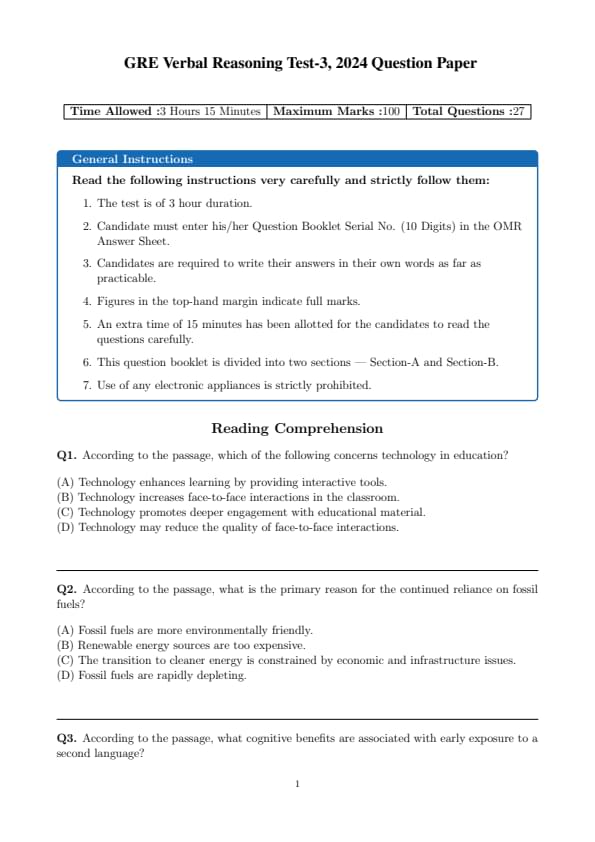
Question 1:

According to the passage, which of the following concerns technology in education?

  • (A) Technology enhances learning by providing interactive tools.
  • (B) Technology increases face-to-face interactions in the classroom.
  • (C) Technology promotes deeper engagement with educational material.
  • (D) Technology may reduce the quality of face-to-face interactions.

Question 2:

According to the passage, what is the primary reason for the continued reliance on fossil fuels?

  • (A) Fossil fuels are more environmentally friendly.
  • (B) Renewable energy sources are too expensive.
  • (C) The transition to cleaner energy is constrained by economic and infrastructure issues.
  • (D) Fossil fuels are rapidly depleting.

Question 3:

According to the passage, what cognitive benefits are associated with early exposure to a second language?

  • (A) Improved memory retention
  • (B) Enhanced problem-solving skills and multitasking abilities
  • (C) Increased creativity
  • (D) Better physical coordination

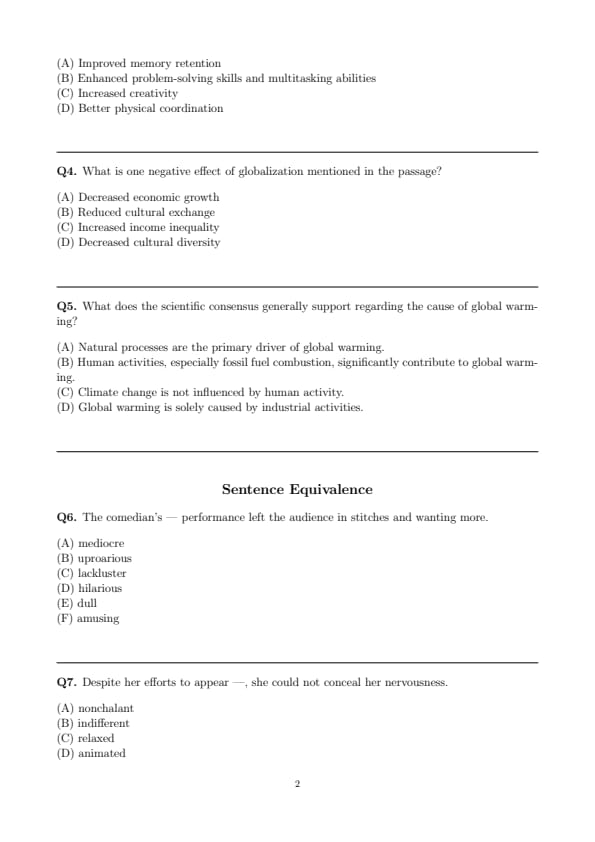
Question 4:

What is one negative effect of globalization mentioned in the passage?

  • (A) Decreased economic growth
  • (B) Reduced cultural exchange
  • (C) Increased income inequality
  • (D) Decreased cultural diversity

Question 5:

What does the scientific consensus generally support regarding the cause of global warming?

  • (A) Natural processes are the primary driver of global warming.
  • (B) Human activities, especially fossil fuel combustion, significantly contribute to global warming.
  • (C) Climate change is not influenced by human activity.
  • (D) Global warming is solely caused by industrial activities.

Question 6:

The comedian’s --- performance left the audience in stitches and wanting more.

  • (A) mediocre
  • (B) uproarious
  • (C) lackluster
  • (D) hilarious
  • (E) dull
  • (F) amusing

Question 7:

Despite her efforts to appear ---, she could not conceal her nervousness.

  • (A) nonchalant
  • (B) indifferent
  • (C) relaxed
  • (D) animated
  • (E) uneasy
  • (F) enthusiastic

Question 8:

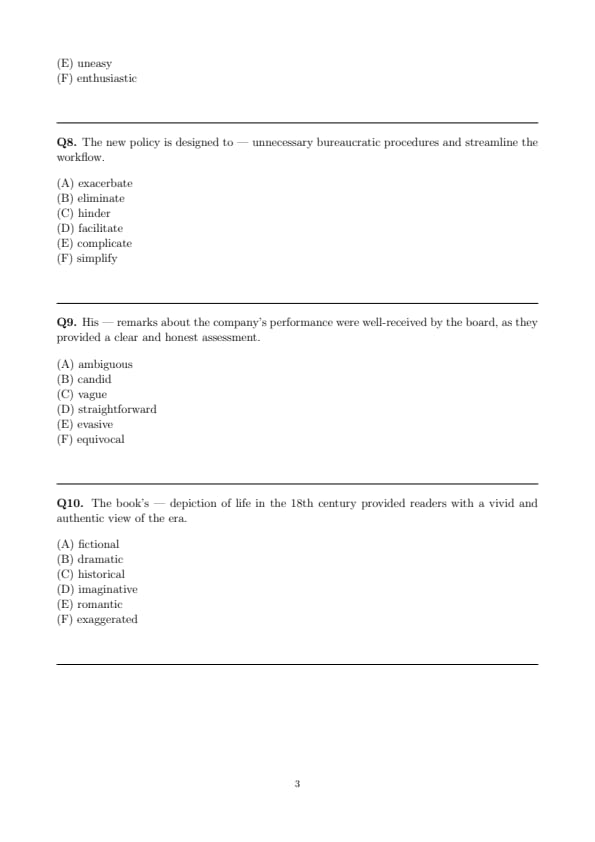
The new policy is designed to --- unnecessary bureaucratic procedures and streamline the workflow.

  • (A) exacerbate
  • (B) eliminate
  • (C) hinder
  • (D) facilitate
  • (E) complicate
  • (F) simplify

Question 9:

His --- remarks about the company’s performance were well-received by the board, as they provided a clear and honest assessment.

  • (A) ambiguous
  • (B) candid
  • (C) vague
  • (D) straightforward
  • (E) evasive
  • (F) equivocal

Question 10:

The book’s --- depiction of life in the 18th century provided readers with a vivid and authentic view of the era.

  • (A) fictional
  • (B) dramatic
  • (C) historical
  • (D) imaginative
  • (E) romantic
  • (F) exaggerated

Question 11:

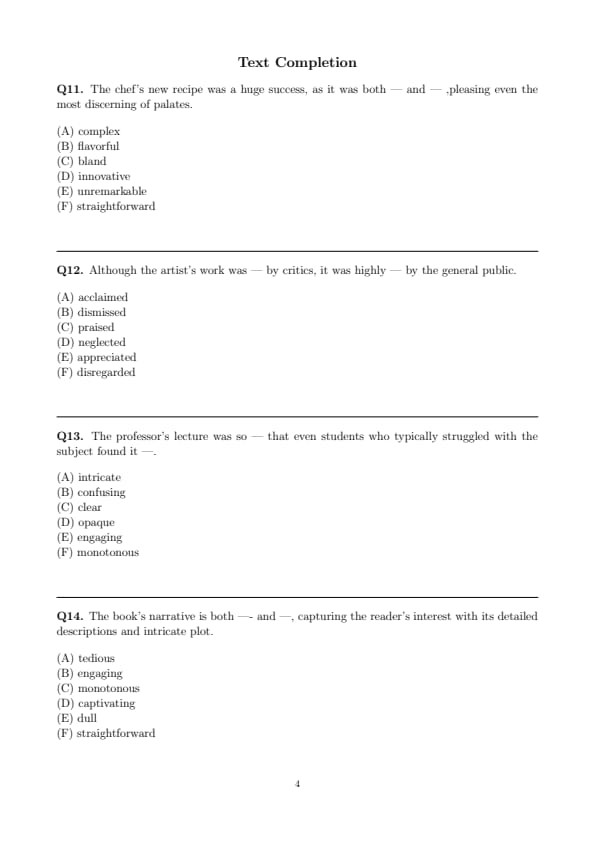
The chef’s new recipe was a huge success, as it was both --- and --- ,pleasing even the most discerning of palates.

  • (A) complex
  • (B) flavorful
  • (C) bland
  • (D) innovative
  • (E) unremarkable
  • (F) straightforward

Question 12:

Although the artist’s work was --- by critics, it was highly --- by the general public.

  • (A) acclaimed
  • (B) dismissed
  • (C) praised
  • (D) neglected
  • (E) appreciated
  • (F) disregarded

Question 13:

The professor’s lecture was so --- that even students who typically struggled with the subject found it ---.

  • (A) intricate
  • (B) confusing
  • (C) clear
  • (D) opaque
  • (E) engaging
  • (F) monotonous

Question 14:

The book’s narrative is both ---- and ---, capturing the reader’s interest with its detailed descriptions and intricate plot.

  • (A) tedious
  • (B) engaging
  • (C) monotonous
  • (D) captivating
  • (E) dull
  • (F) straightforward

Question 15:

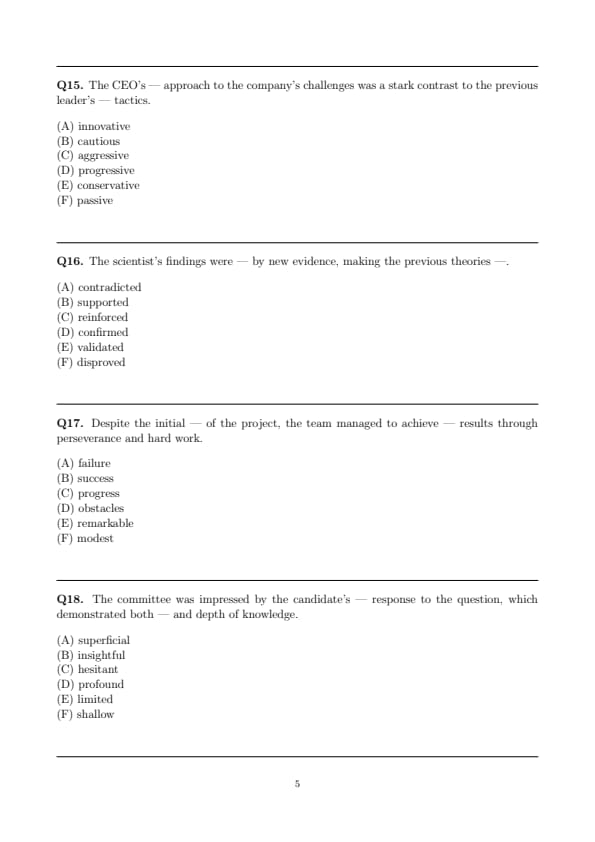
The CEO’s --- approach to the company’s challenges was a stark contrast to the previous leader’s --- tactics.

  • (A) innovative
  • (B) cautious
  • (C) aggressive
  • (D) progressive
  • (E) conservative
  • (F) passive

Question 16:

The scientist’s findings were --- by new evidence, making the previous theories ---.

  • (A) contradicted
  • (B) supported
  • (C) reinforced
  • (D) confirmed
  • (E) validated
  • (F) disproved

Question 17:

Despite the initial --- of the project, the team managed to achieve --- results through perseverance and hard work.

  • (A) failure
  • (B) success
  • (C) progress
  • (D) obstacles
  • (E) remarkable
  • (F) modest

Question 18:

The committee was impressed by the candidate’s --- response to the question, which demonstrated both --- and depth of knowledge.

  • (A) superficial
  • (B) insightful
  • (C) hesitant
  • (D) profound
  • (E) limited
  • (F) shallow

Question 19:

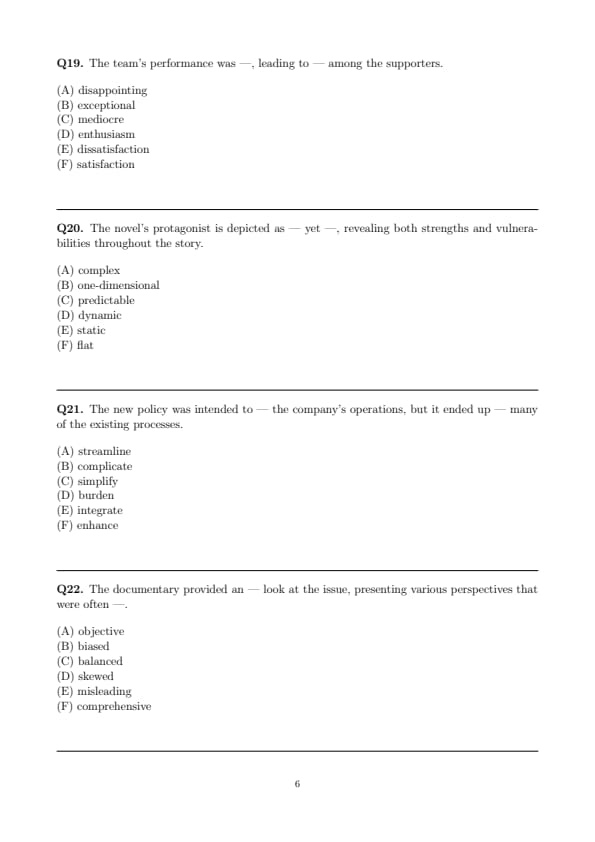
The team’s performance was ---, leading to --- among the supporters.

  • (A) disappointing
  • (B) exceptional
  • (C) mediocre
  • (D) enthusiasm
  • (E) dissatisfaction
  • (F) satisfaction

Question 20:

The novel’s protagonist is depicted as --- yet ---, revealing both strengths and vulnerabilities throughout the story.

  • (A) complex
  • (B) one-dimensional
  • (C) predictable
  • (D) dynamic
  • (E) static
  • (F) flat

Question 21:

The new policy was intended to --- the company’s operations, but it ended up --- many of the existing processes.

  • (A) streamline
  • (B) complicate
  • (C) simplify
  • (D) burden
  • (E) integrate
  • (F) enhance

Question 22:

The documentary provided an --- look at the issue, presenting various perspectives that were often ---.

  • (A) objective
  • (B) biased
  • (C) balanced
  • (D) skewed
  • (E) misleading
  • (F) comprehensive

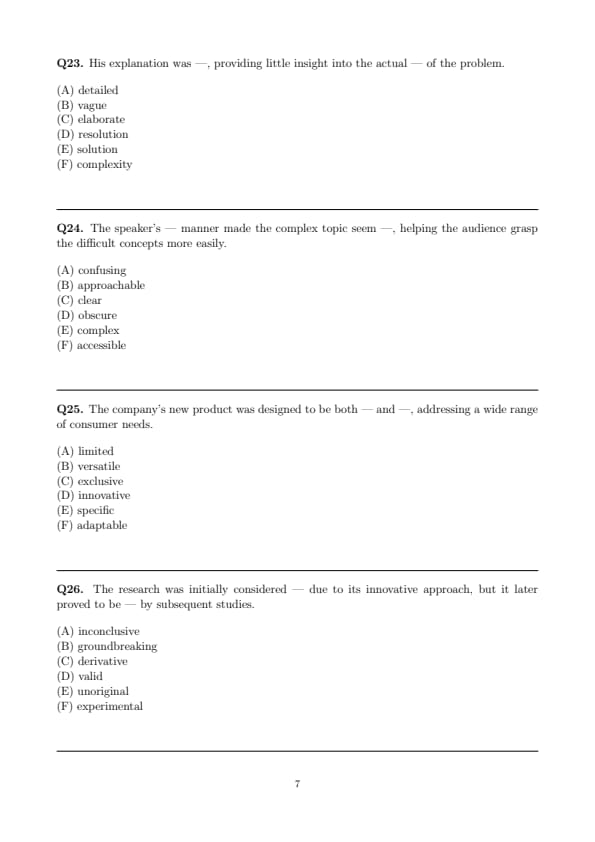
Question 23:

His explanation was ---, providing little insight into the actual --- of the problem.

  • (A) detailed
  • (B) vague
  • (C) elaborate
  • (D) resolution
  • (E) solution
  • (F) complexity

Question 24:

The speaker’s --- manner made the complex topic seem ---, helping the audience grasp the difficult concepts more easily.

  • (A) confusing
  • (B) approachable
  • (C) clear
  • (D) obscure
  • (E) complex
  • (F) accessible

Question 25:

The company’s new product was designed to be both --- and ---, addressing a wide range of consumer needs.

  • (A) limited
  • (B) versatile
  • (C) exclusive
  • (D) innovative
  • (E) specific
  • (F) adaptable

Question 26:

The research was initially considered --- due to its innovative approach, but it later proved to be --- by subsequent studies.

  • (A) inconclusive
  • (B) groundbreaking
  • (C) derivative
  • (D) valid
  • (E) unoriginal
  • (F) experimental

Question 27:

The historian’s account was ---, offering a --- interpretation of the events that shaped the era.
  • (A) controversial
  • (B) biased
  • (C) objective
  • (D) subjective
  • (E) balanced
  • (F) partial

GRE Questions

  • 1.
    Three years ago, because of flooding at the Western Palean Wildlife Preserve, 100 lions and 100 western gazelles were moved to the East Palean Preserve, an area that is home to most of the same species that are found in the western preserve, though in larger numbers, and to the eastern gazelle, a close relative of the western gazelle.
    Write a response in which you discuss one or more alternative explanations that could rival the proposed explanation and explain how your explanation(s) can plausibly account for the facts presented in the argument.


      • 2.
        The following appeared in a health newsletter.
        "Nosinia is an herb that many users report to be as effective as prescription medications at fighting allergy symptoms. Researchers recently compared Nosinia to a placebo in 95 men and women with seasonal allergies to ragweed pollen. Participants in the study reported that neither Nosinia nor the placebo offered significant relief. However, for the most severe allergy symptoms, the researchers reported that Nosinia was more effective than the placebo in providing relief. Furthermore, at the end of the study, participants given Nosinia were more likely than participants given a placebo to report feeling healthier. We, therefore, recommend using Nosinia to help with your severe allergy symptoms."

          • How reliable is the study's sample size?
          • How does the severity of symptoms affect the results?
          • Was the placebo truly effective in reducing allergy symptoms?
          • Is there any independent evidence for Nosinia’s effectiveness?

        • 3.
          “Claim: A person in authority should always encourage those under him or her to share their thoughts and ideas. Reason: A leader’s main goal should be to promote innovation and change.”

            • Agree, as open dialogue fosters creativity and innovation.
            • Disagree, as not all ideas are practical or beneficial to share.
            • Agree, but only when it is necessary for progress.
            • Disagree, as promoting change without evaluating all ideas can be harmful.

          • 4.
            It has been suggested that long-term prisoners, on release from jail, be given a reasonable state pension to reduce the likelihood of their resorting to crime. Most people instinctively reject the suggestion as they feel it would be like rewarding criminal activity. The supporters of the prisoners' pension scheme have criticized those who reject this possibility, by claiming that for the critics...
            Which of the following is the most logical completion of the sentence above?

              • emotion is more important than justice
              • punishment for criminals is more important than crime prevention
              • crime prevention is not an important issue
              • money has too high a value
              • the law should not be concerned with what happens after jail

            • 5.
              Jean Valjean, the protagonist in Victor Hugo’s novel Les Misérables, spends the bulk of his lengthy _______ plotting a very clever set of revenge schemes, which he executes upon his escape.

                • ruination
                • peregrination
                • immolation
                • rumination

              • 6.
                “Reviving the practice of using elements of popular music in classical composition, an approach that had been in hibernation in the United States during the 1960s, composer Philip Glass (born 1937) embraced the ethos of popular music in his compositions. Glass based two symphonies on music by rock musicians David Bowie and Brian Eno, but the symphonies' sound is distinctively his. Popular elements do not appear out of place in Glass's classical music, which from its early days has shared certain harmonies and rhythms with rock music. Yet this use of popular elements has not made Glass a composer of popular music. His music is not a version of popular music packaged to attract classical listeners; it is high art for listeners steeped in rock rather than the classics.

                  Comments


                  No Comments To Show