




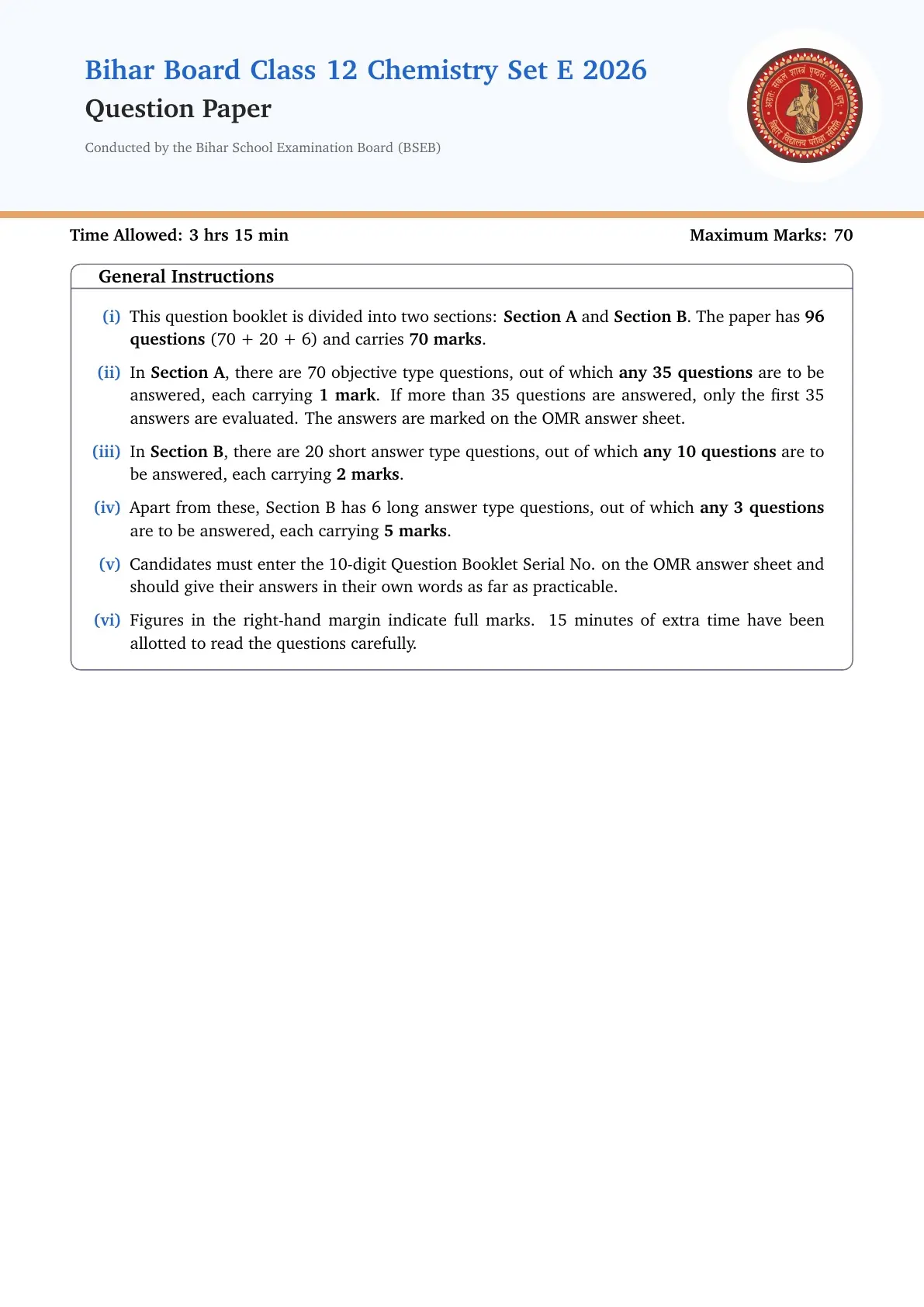
Bihar Board Class 12 Chemistry Set E 2026 Question Paper with Solutions PDF is available here for download. The exam was conducted by the BSEB on 7th Feb 2026 in the first shift (09:30 AM-12:45 PM) for a duration of 3 hours 15 min and carried a total of 70 Marks. The question paper PDF given below is of Set E, one of the sets in which the paper was issued. It has 96 questions, and every question has a detailed solution.
The Chemistry question paper includes the following types of questions:
- Objective type (MCQ) questions: 1 mark each (any 35 out of 70)
- Short answer type questions: 2 marks each (any 10 out of 20)
- Long answer type questions: 5 marks each (any 3 out of 6)
Bihar Board Class 12 Chemistry Set E 2026 Question Paper with Solution PDF
| BSEB Official PDF | Question Paper PDF | Solutions PDF |
|---|---|---|
| Download official PDF 0.95 MB | Download Collegedunia question paper PDF 0.49 MB | Download solutions PDF 0.72 MB |
Also Check: Download Bihar Board Class 12 Previous Year Papers for Free
Bihar Board Class 12 Chemistry Set E 2026 Questions with Solutions
Section A - Objective Questions (1 mark each, any 35 to be answered)
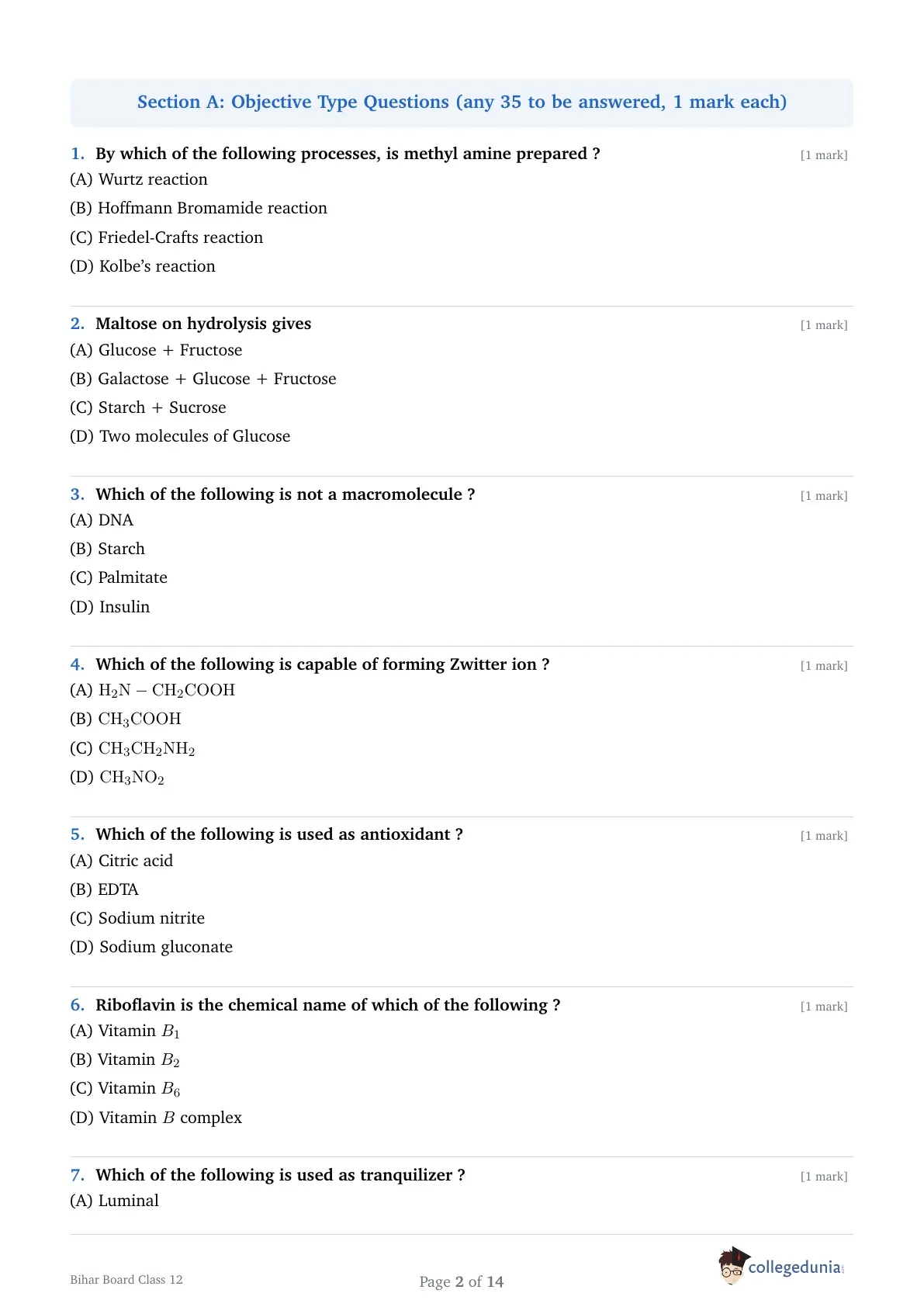
By which of the following processes, is methyl amine prepared ?
Maltose on hydrolysis gives
Which of the following is not a macromolecule ?
Which of the following is capable of forming Zwitter ion ?
Which of the following is used as antioxidant ?
Riboflavin is the chemical name of which of the following ?
Which of the following is used as tranquilizer ?
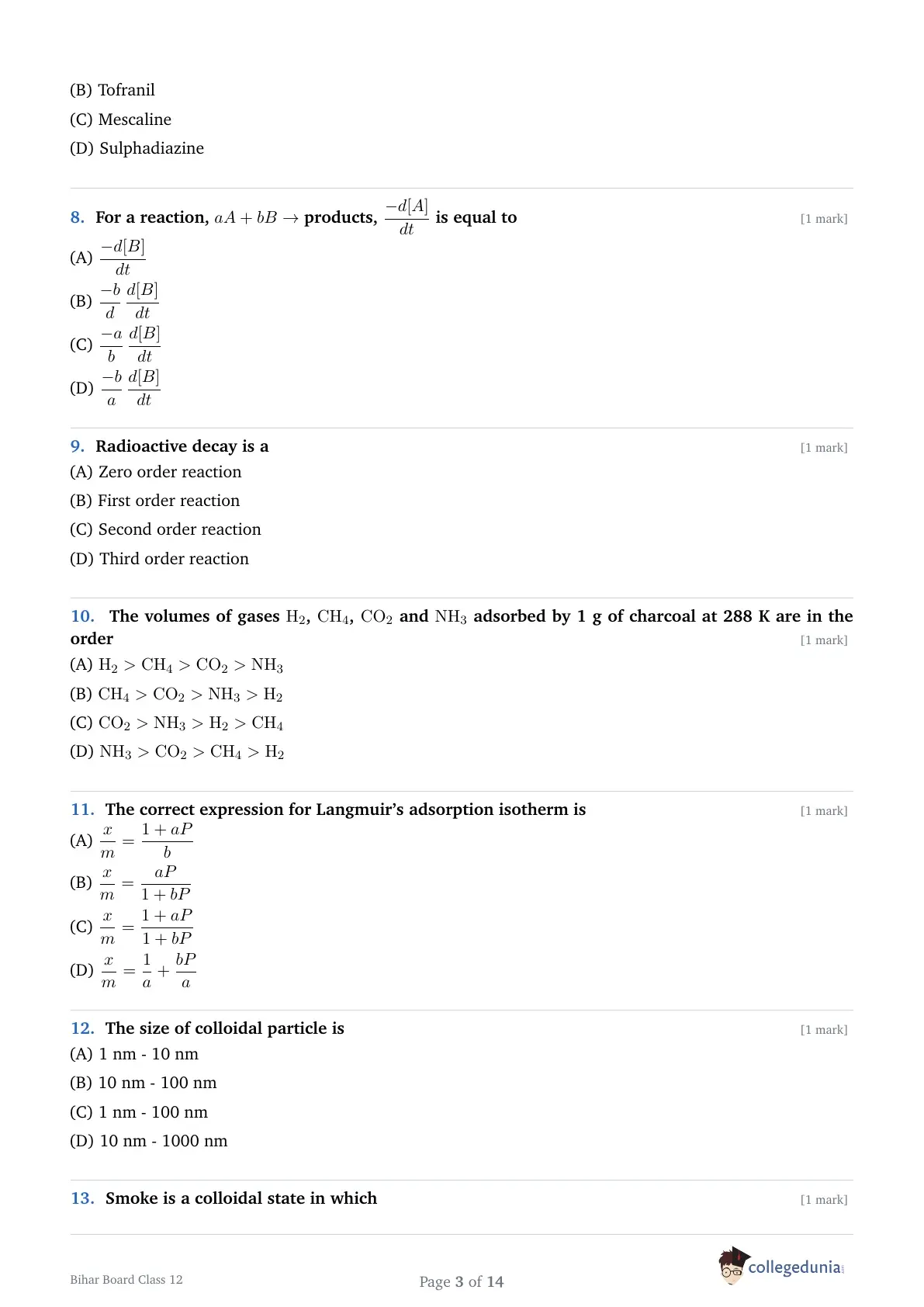
For a reaction, \( aA + bB \rightarrow \) products, \( \dfrac{-d[A]}{dt} \) is equal to
Radioactive decay is a
The volumes of gases \( \mathrm{H_2} \), \( \mathrm{CH_4} \), \( \mathrm{CO_2} \) and \( \mathrm{NH_3} \) adsorbed by 1 g of charcoal at 288 K are in the order
The correct expression for Langmuir's adsorption isotherm is
The size of colloidal particle is
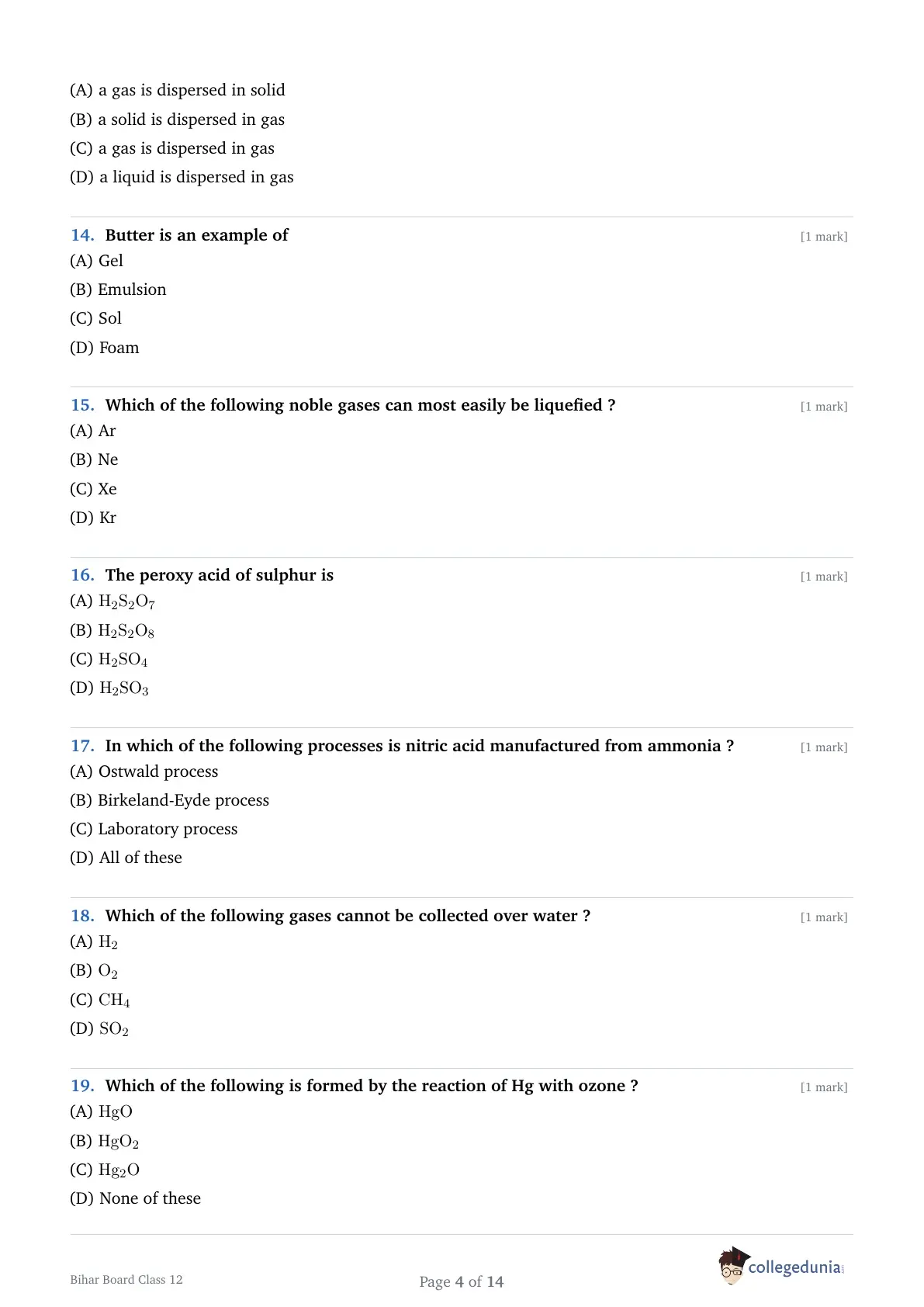
Smoke is a colloidal state in which
Butter is an example of
Which of the following noble gases can most easily be liquefied ?
The peroxy acid of sulphur is
In which of the following processes is nitric acid manufactured from ammonia ?
Which of the following gases cannot be collected over water ?
Which of the following is formed by the reaction of Hg with ozone ?
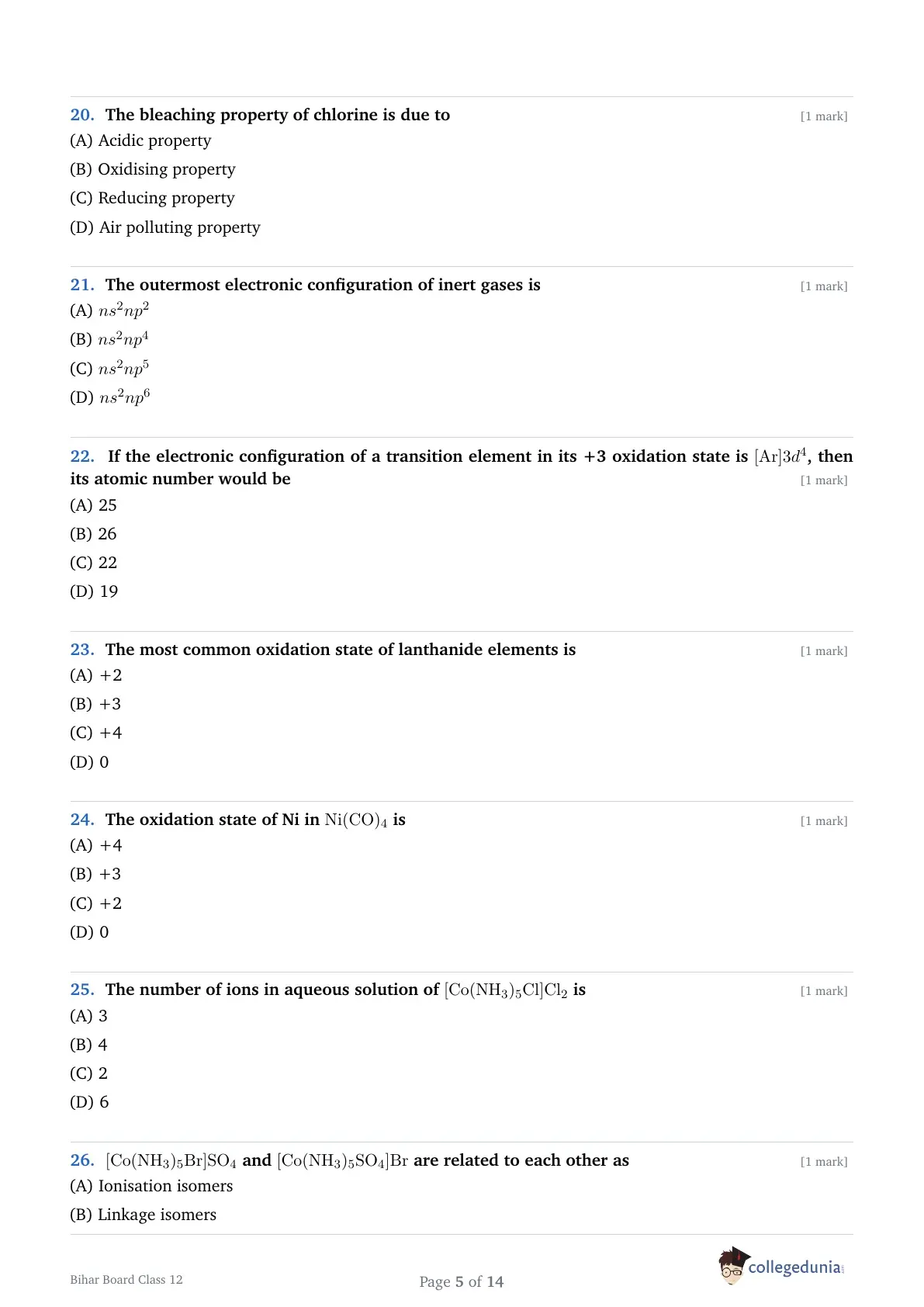
The bleaching property of chlorine is due to
The outermost electronic configuration of inert gases is
If the electronic configuration of a transition element in its +3 oxidation state is \( [\mathrm{Ar}]3d^4 \), then its atomic number would be
The oxidation state of Ni in \( \mathrm{Ni(CO)_4} \) is
The number of ions in aqueous solution of \( [\mathrm{Co(NH_3)_5Cl}]\mathrm{Cl_2} \) is
\( [\mathrm{Co(NH_3)_5Br}]\mathrm{SO_4} \) and \( [\mathrm{Co(NH_3)_5SO_4}]\mathrm{Br} \) are related to each other as
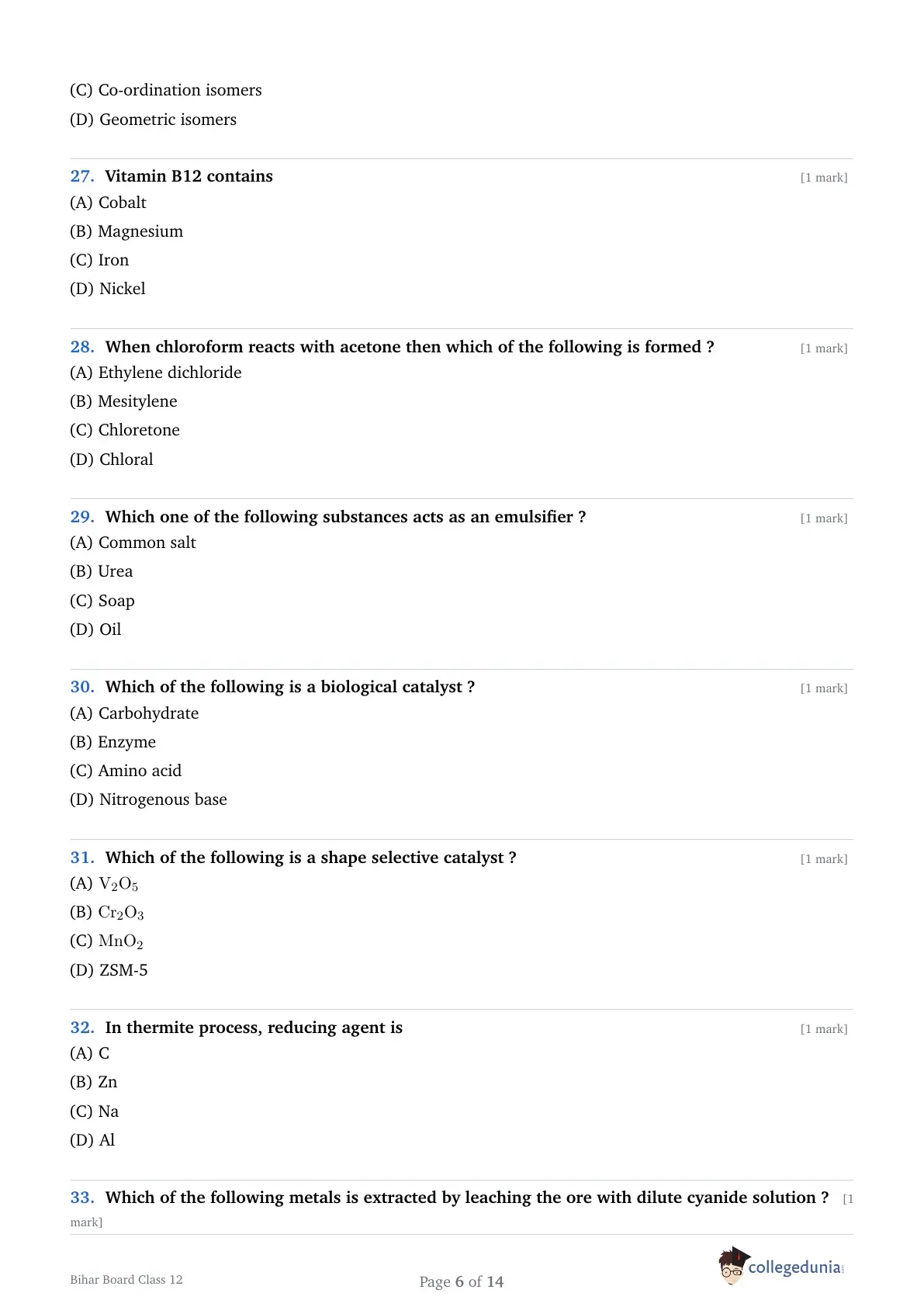
Vitamin B12 contains
When chloroform reacts with acetone then which of the following is formed ?
Which one of the following substances acts as an emulsifier ?
Which of the following is a biological catalyst ?
Which of the following is a shape selective catalyst ?
In thermite process, reducing agent is
Which of the following metals is extracted by leaching the ore with dilute cyanide solution ?
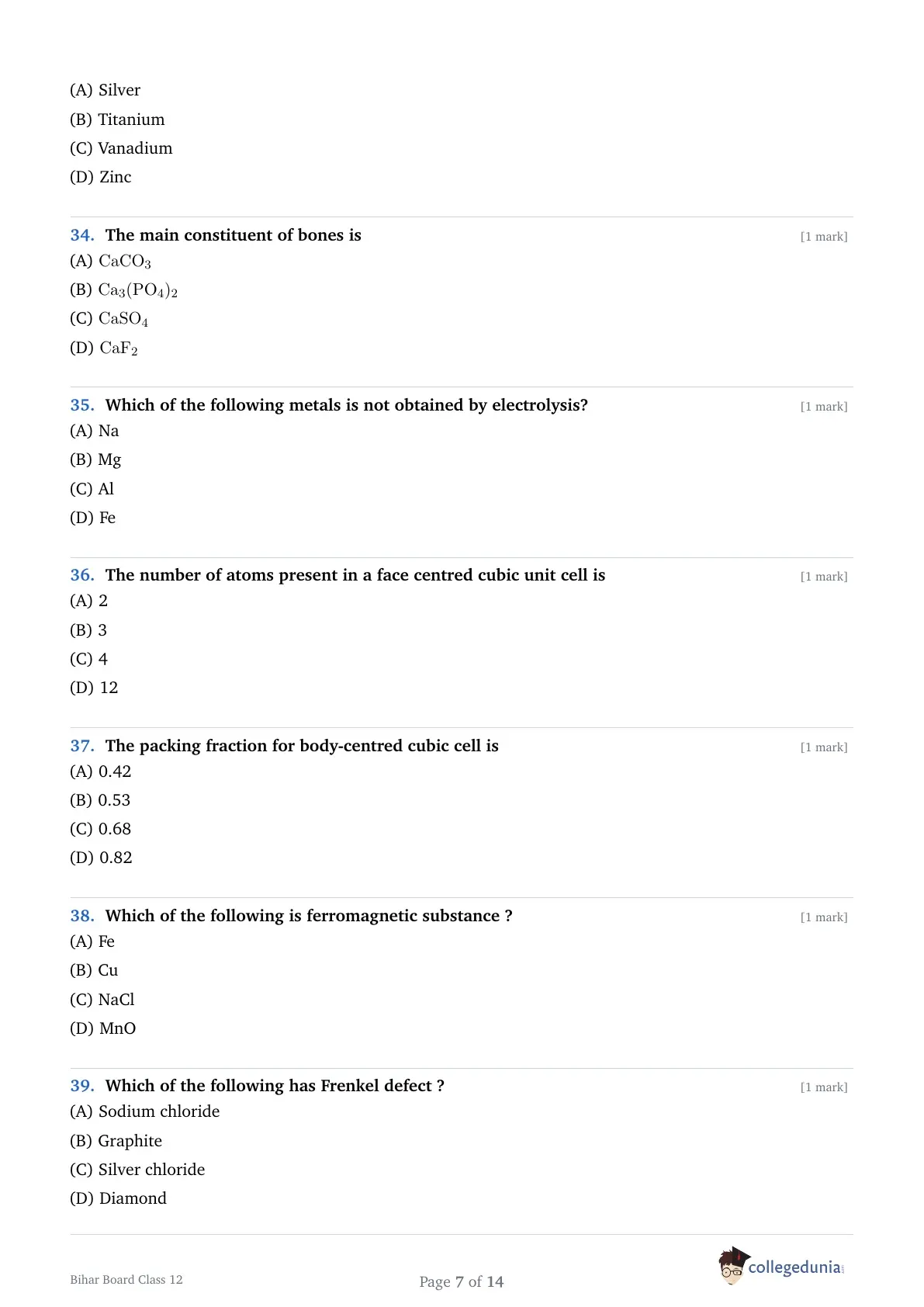
The main constituent of bones is
Which of the following metals is not obtained by electrolysis?
The number of atoms present in a face centred cubic unit cell is
The packing fraction for body-centred cubic cell is
Which of the following is ferromagnetic substance ?
Which of the following has Frenkel defect ?
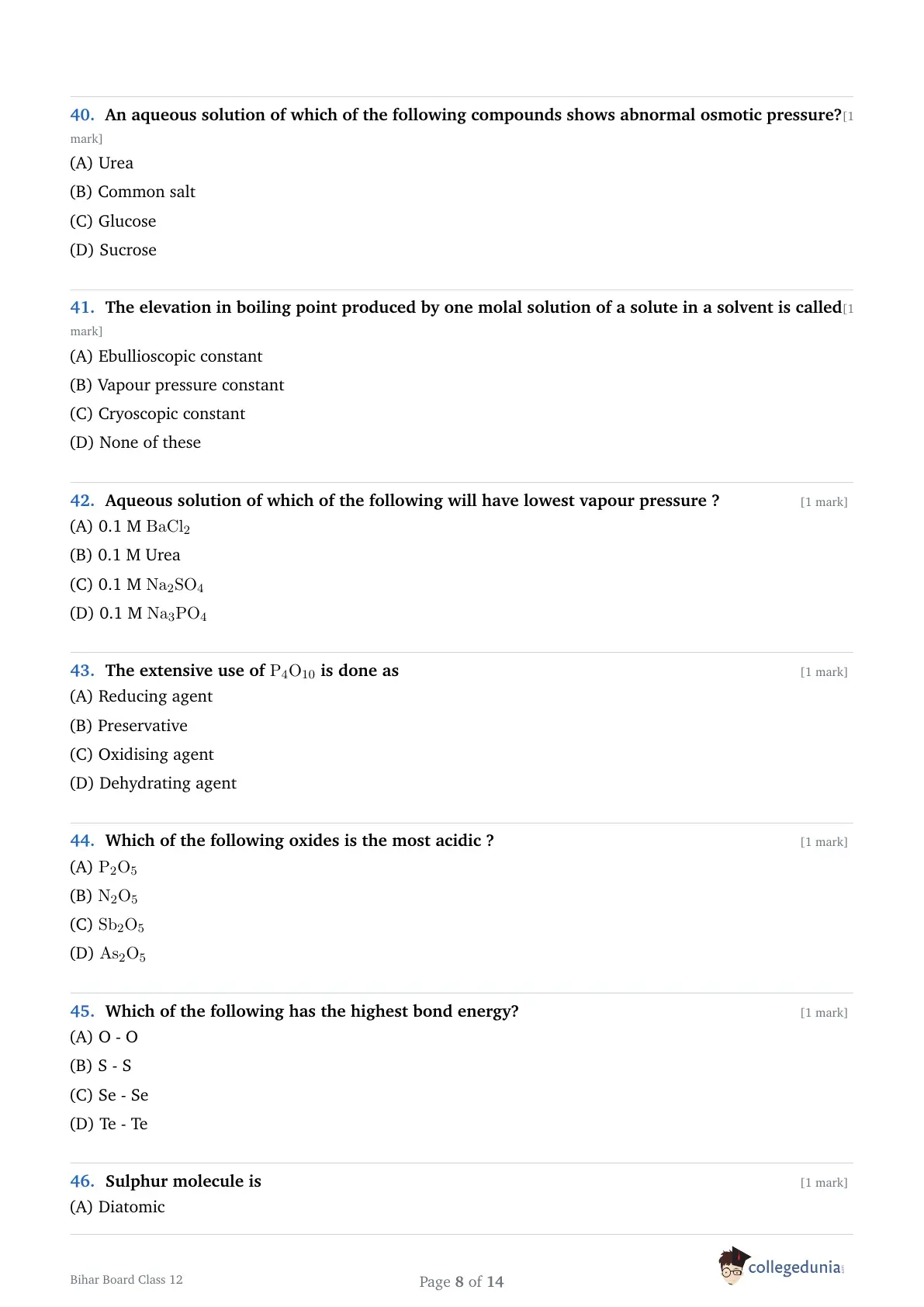
An aqueous solution of which of the following compounds shows abnormal osmotic pressure?
The elevation in boiling point produced by one molal solution of a solute in a solvent is called
Aqueous solution of which of the following will have lowest vapour pressure ?
The extensive use of \( \mathrm{P_4O_{10}} \) is done as
Which of the following oxides is the most acidic ?
Which of the following has the highest bond energy?
Sulphur molecule is
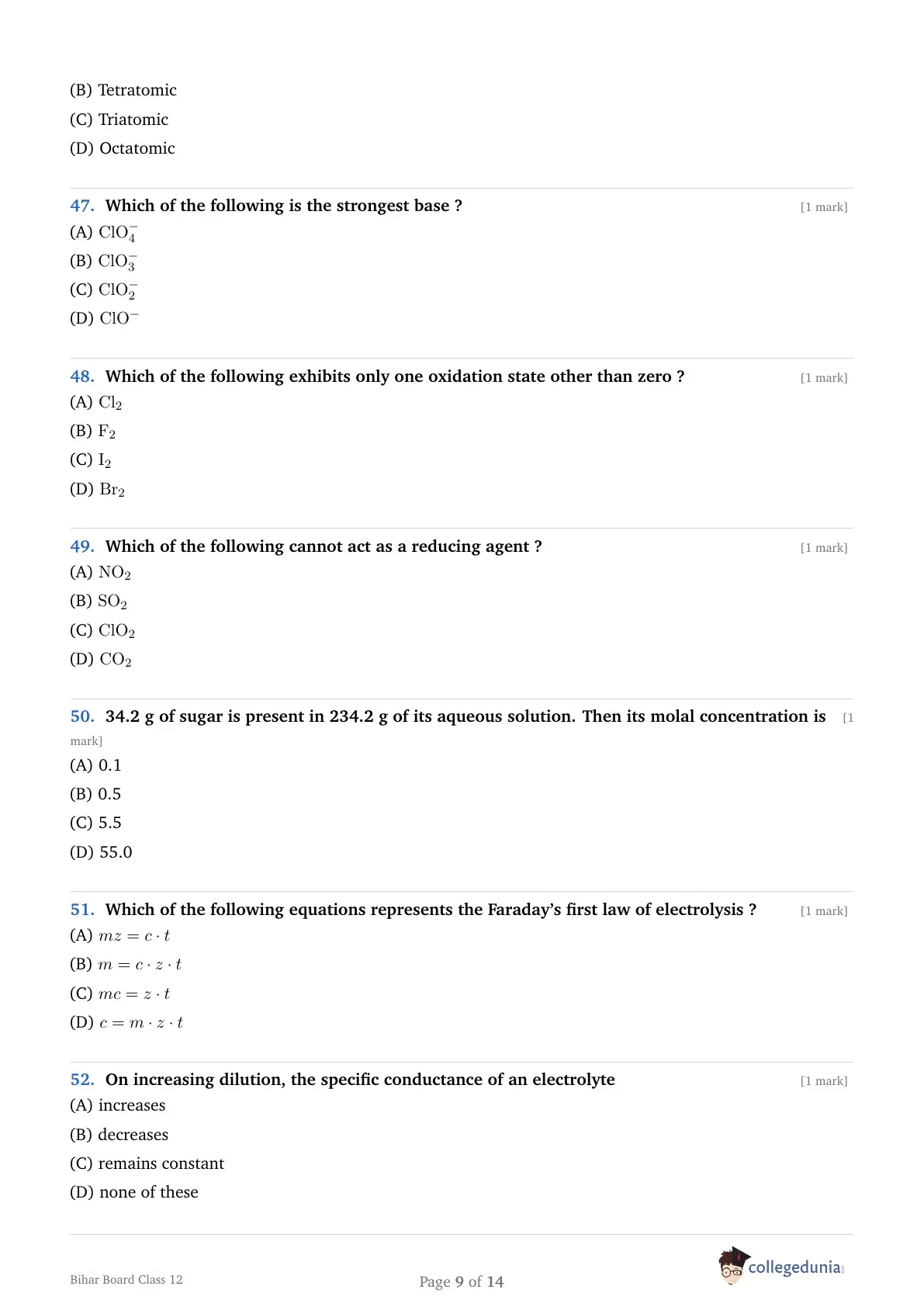
Which of the following exhibits only one oxidation state other than zero ?
34.2 g of sugar is present in 234.2 g of its aqueous solution. Then its molal concentration is
Which of the following equations represents the Faraday's first law of electrolysis ?
On increasing dilution, the specific conductance of an electrolyte
The standard electrode potentials of metals A, B, C and D are $-3.05\,\mathrm{V}$, $-1.66\,\mathrm{V}$, $-0.40\,\mathrm{V}$ and $+0.8\,\mathrm{V}$ respectively. Which of the following would have the highest reducing power?
Which of the following is a secondary cell ?
Which of the following represents the effect of temperature on reaction rate ?
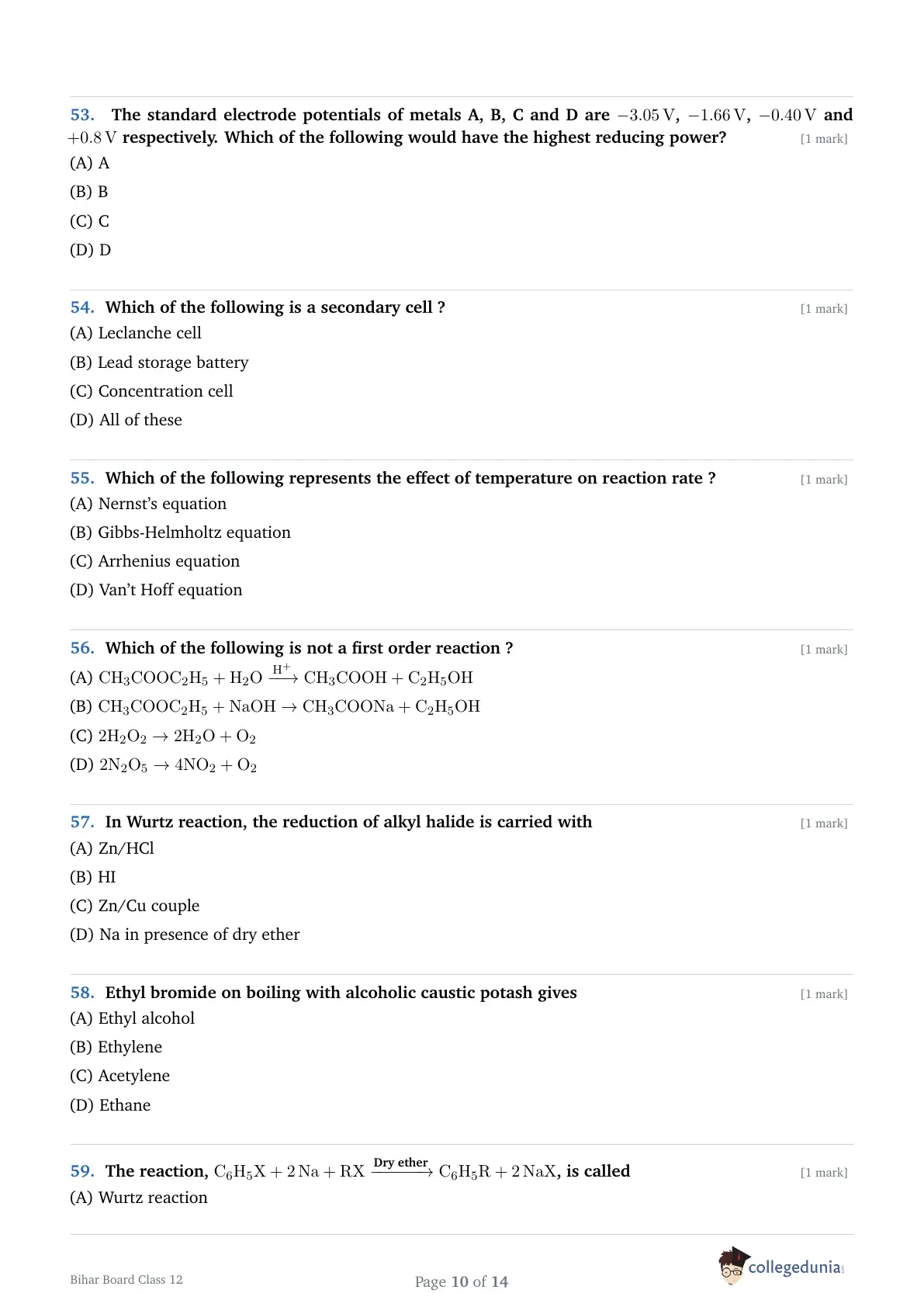
Which of the following is not a first order reaction ?
In Wurtz reaction, the reduction of alkyl halide is carried with
Ethyl bromide on boiling with alcoholic caustic potash gives
The reaction, \( \mathrm{C_6H_5X} + 2\,\mathrm{Na} + \mathrm{RX} \xrightarrow{\text{Dry ether}} \mathrm{C_6H_5R} + 2\,\mathrm{NaX} \), is called
Which of the following reagents reacts with ethyl amine to give ethyl alcohol ?
Which of the following is known as wood spirit ?
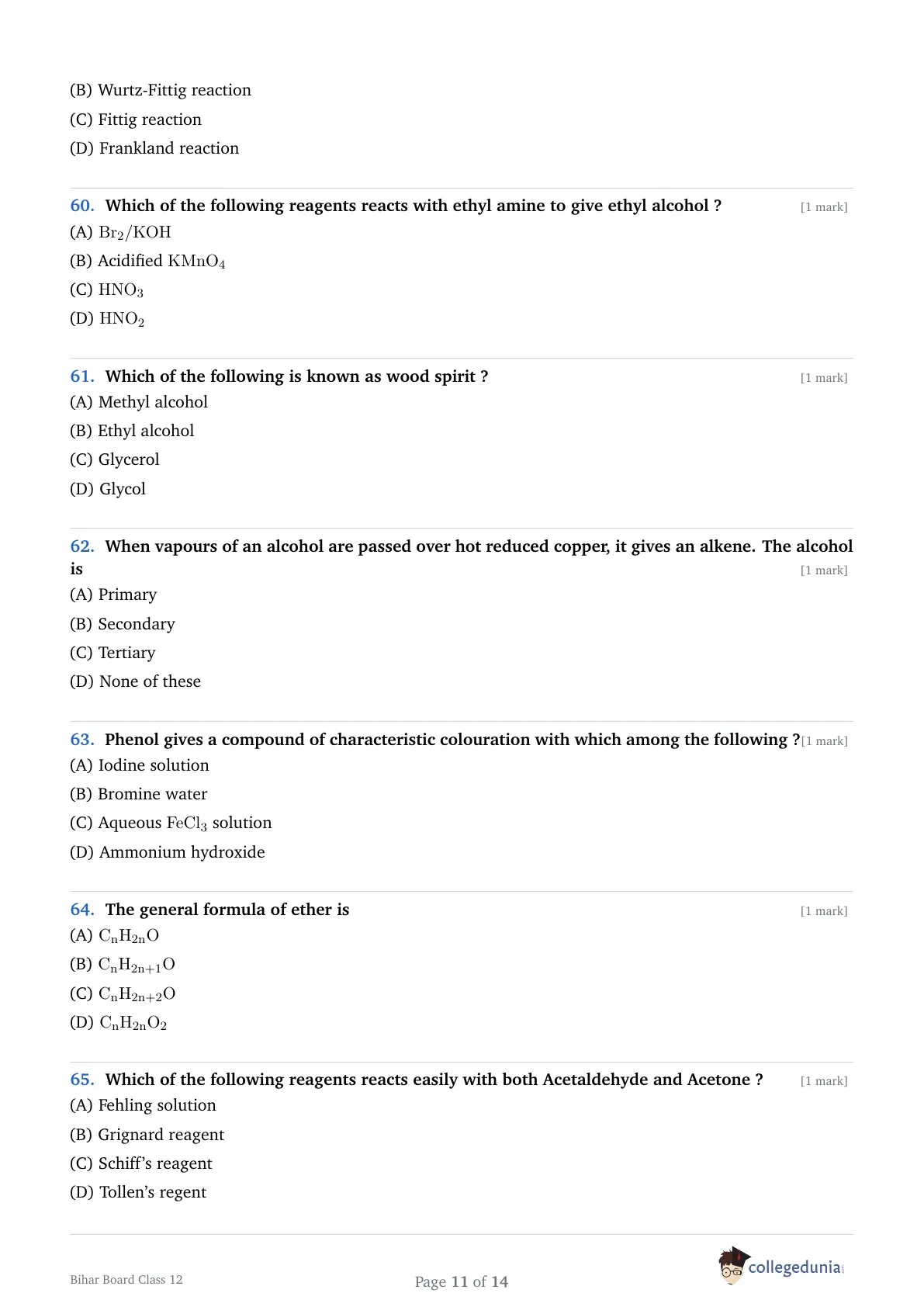
When vapours of an alcohol are passed over hot reduced copper, it gives an alkene. The alcohol is
Phenol gives a compound of characteristic colouration with which among the following ?
The general formula of ether is
Which of the following reagents reacts easily with both Acetaldehyde and Acetone ?
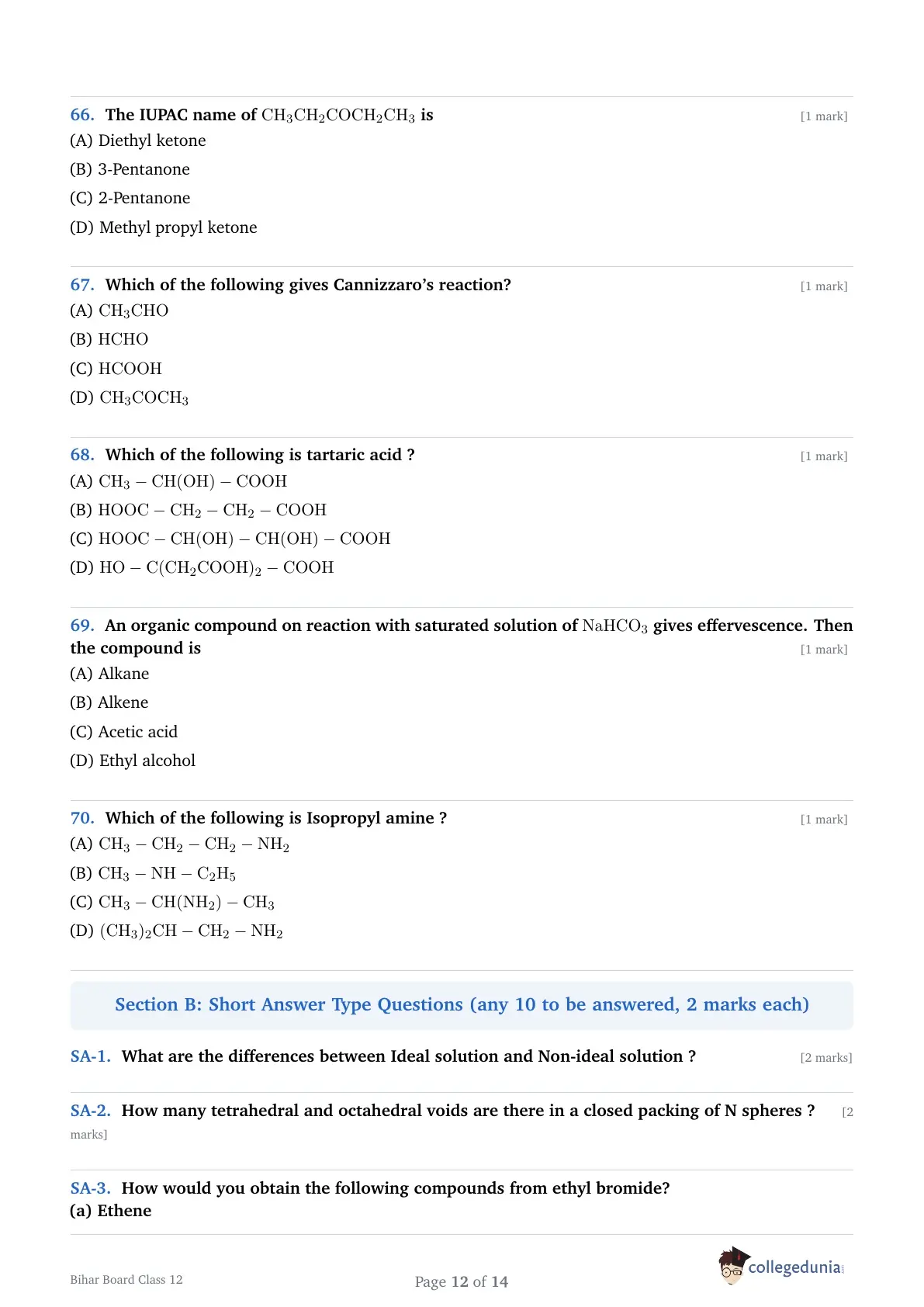
The IUPAC name of \( \mathrm{CH_3CH_2COCH_2CH_3} \) is
Which of the following gives Cannizzaro's reaction?
Which of the following is tartaric acid ?
An organic compound on reaction with saturated solution of \( \mathrm{NaHCO_3} \) gives effervescence. Then the compound is
Which of the following is Isopropyl amine ?
Section B - Short Answer Questions (2 marks each, any 10 to be answered)
What are the differences between Ideal solution and Non-ideal solution ?
How many tetrahedral and octahedral voids are there in a closed packing of N spheres ?
How would you obtain the following compounds from ethyl bromide?
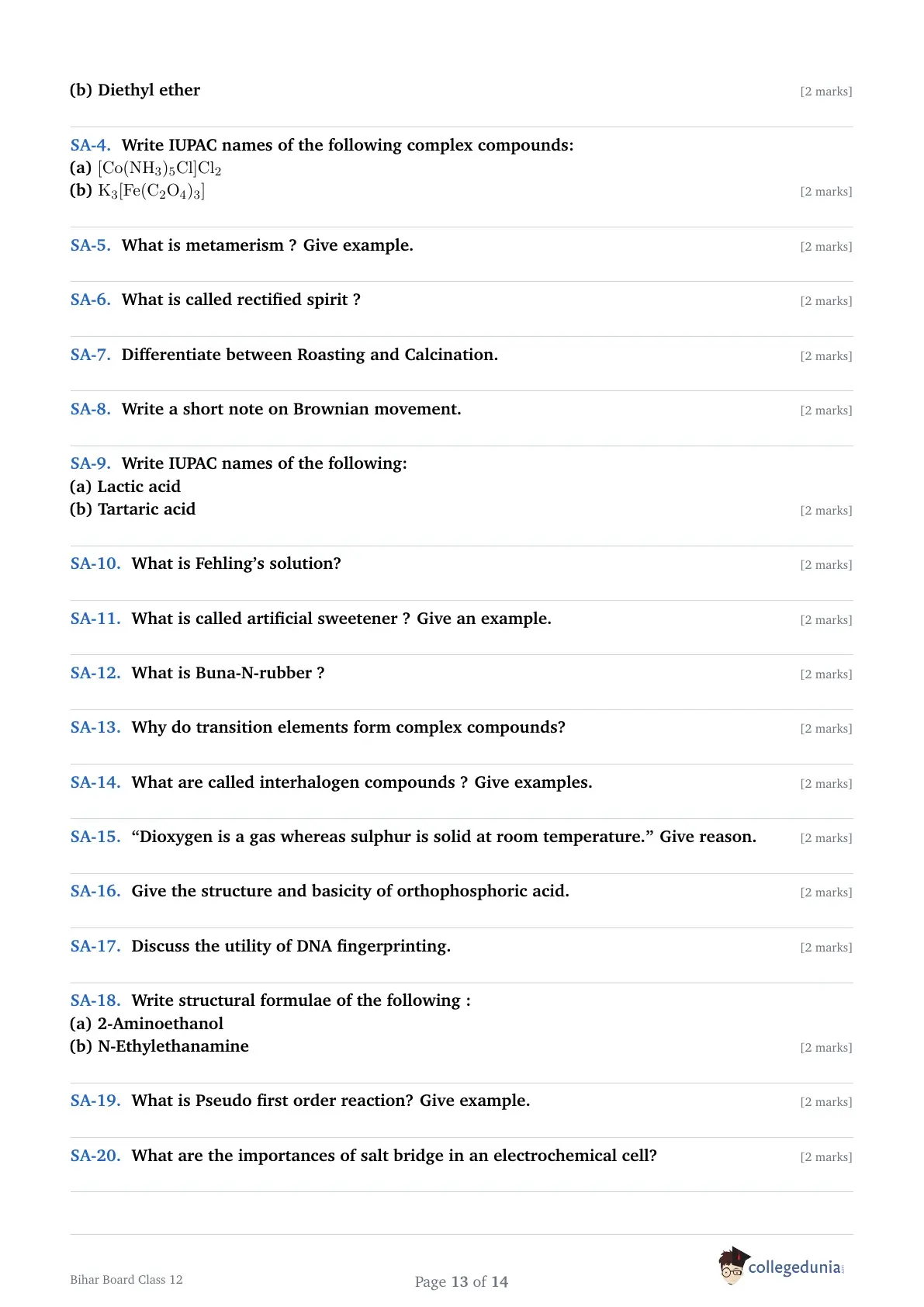
(a) Ethene
(b) Diethyl ether
Write IUPAC names of the following complex compounds:
(a) \( [\mathrm{Co(NH_3)_5Cl}]\mathrm{Cl_2} \)
(b) \( \mathrm{K_3[Fe(C_2O_4)_3]} \)
What is metamerism ? Give example.
What is called rectified spirit ?
Differentiate between Roasting and Calcination.
Write a short note on Brownian movement.
Write IUPAC names of the following:
(a) Lactic acid
(b) Tartaric acid
What is Fehling's solution?
What is called artificial sweetener ? Give an example.
What is Buna-N-rubber ?
Why do transition elements form complex compounds?
What are called interhalogen compounds ? Give examples.
"Dioxygen is a gas whereas sulphur is solid at room temperature." Give reason.
Give the structure and basicity of orthophosphoric acid.
Discuss the utility of DNA fingerprinting.
Write structural formulae of the following :
(a) 2-Aminoethanol
(b) N-Ethylethanamine
What is Pseudo first order reaction? Give example.
What are the importances of salt bridge in an electrochemical cell?
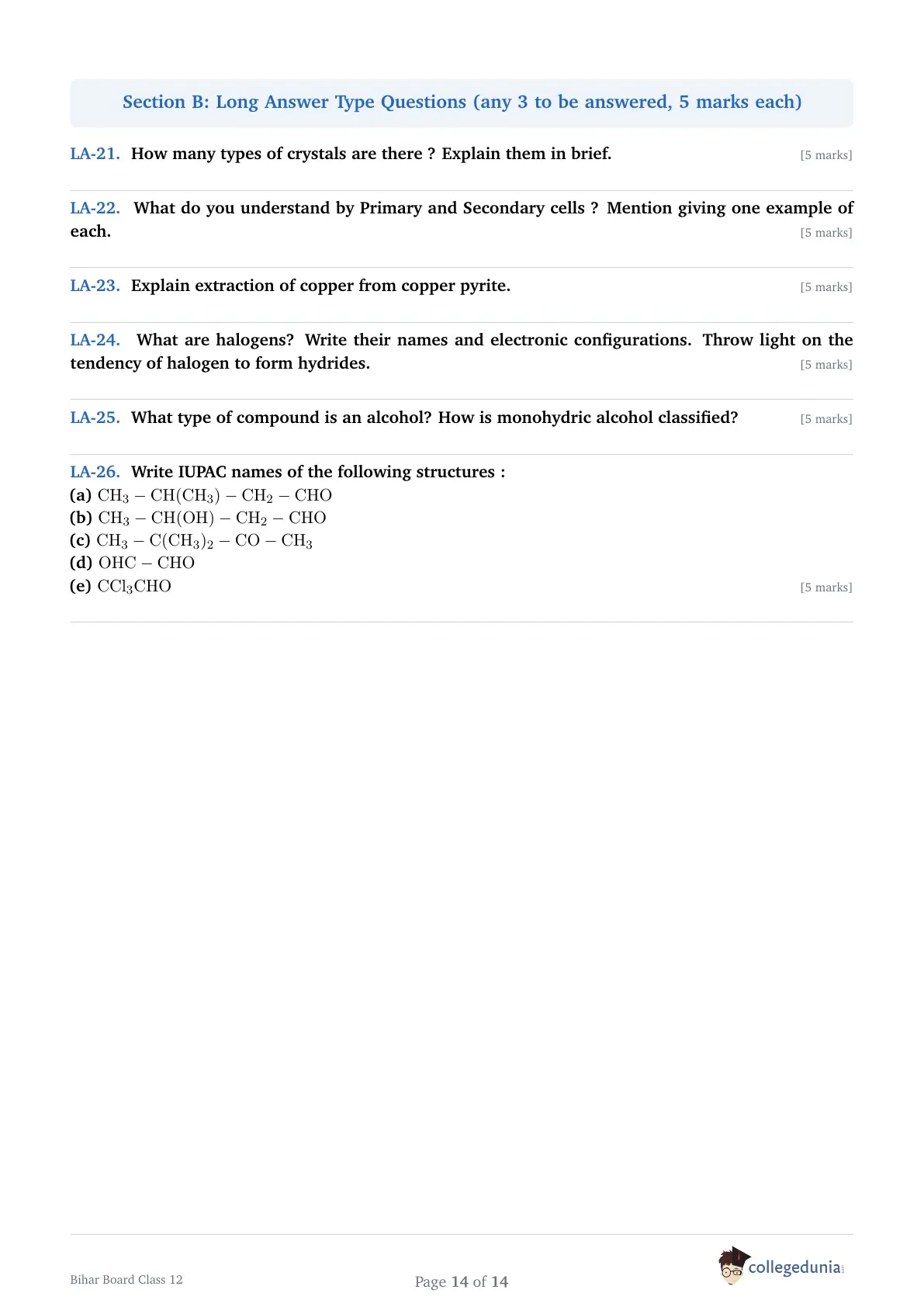
Section B - Long Answer Questions (5 marks each, any 3 to be answered)
How many types of crystals are there ? Explain them in brief.
What do you understand by Primary and Secondary cells ? Mention giving one example of each.
Explain extraction of copper from copper pyrite.
What are halogens? Write their names and electronic configurations. Throw light on the tendency of halogen to form hydrides.
What type of compound is an alcohol? How is monohydric alcohol classified?
Write IUPAC names of the following structures :
(a) \( \mathrm{CH_3-CH(CH_3)-CH_2-CHO} \)
(b) \( \mathrm{CH_3-CH(OH)-CH_2-CHO} \)
(c) \( \mathrm{CH_3-C(CH_3)_2-CO-CH_3} \)
(d) \( \mathrm{OHC-CHO} \)
(e) \( \mathrm{CCl_3CHO} \)
Bihar Board Class 12 Chemistry Question Paper Pattern and Marking Scheme 2026
The Bihar Board (BSEB) Class 12 Chemistry 2026 question paper carries 70 marks and has 96 questions (70 + 20 + 6) in two sections, A and B. The time allowed is 3 hours 15 minutes, which includes 15 minutes of extra time to read the questions carefully. The paper is bilingual (Hindi and English). The table below gives the section-wise pattern from the official question paper.
| Section | Questions | Question Type | Total Questions | To Be Answered | Marks per Question | Marks |
|---|---|---|---|---|---|---|
| A | Q1 - Q70 | Objective type (OMR) | 70 | 35 | 1 | 35 |
| B | SA-1 - SA-20 | Short answer | 20 | 10 | 2 | 20 |
| B | LA-21 - LA-26 | Long answer | 6 | 3 | 5 | 15 |
| Total | 96 | 48 | 70 |
The marking scheme printed in the instructions of the question paper is as follows:
- Section A has 70 objective questions, each with four options of which only one is correct. Any 35 questions are to be answered, each carrying 1 mark, and the answers are marked on the OMR answer sheet with a blue or black ball pen.
- If more than 35 questions of Section A are answered, only the first 35 answers are evaluated by the computer.
- Section B has 20 short answer type questions, of which any 10 are to be answered, each carrying 2 marks.
- Section B also has 6 long answer type questions, of which any 3 are to be answered, each carrying 5 marks.
- Use of whitener, liquid, blade, nail or similar material on the OMR sheet makes the result invalid, and the use of any electronic appliance is strictly prohibited.



Comments