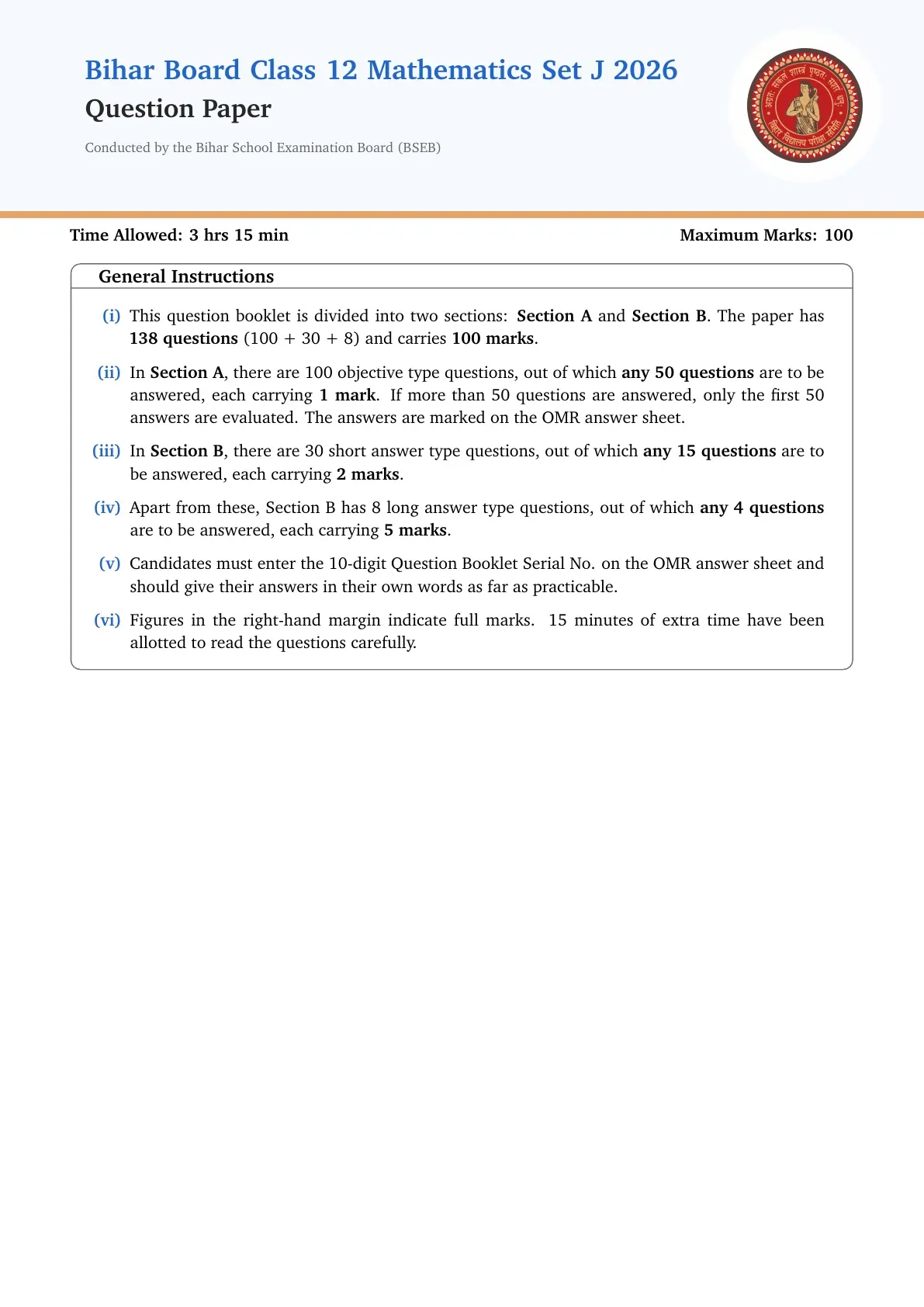
Bihar Board Class 12 Mathematics Set J 2026 Question Paper with Solutions PDF is available here for download. The exam was conducted by the BSEB on 3rd Feb 2026 in the first shift (09:30 AM-12:45 PM) for a duration of 3 hours 15 min and carried a total of 100 Marks. The question paper PDF given below is of Set J, one of the sets in which the paper was issued. It has 138 questions, and every question has a detailed solution.

The Mathematics question paper includes the following types of questions:

  • Objective type (MCQ) questions: 1 mark each (any 50 out of 100)
  • Short answer type questions: 2 marks each (any 15 out of 30)
  • Long answer type questions: 5 marks each (any 4 out of 8)

Bihar Board Class 12 Mathematics Set J 2026 Question Paper with Solution PDF

Also Check: Download Bihar Board Class 12 Previous Year Papers for Free

Bihar Board Class 12 Mathematics Set J 2026 Question Paper

Bihar Board Class 12 Mathematics Set J 2026 Questions with Solutions

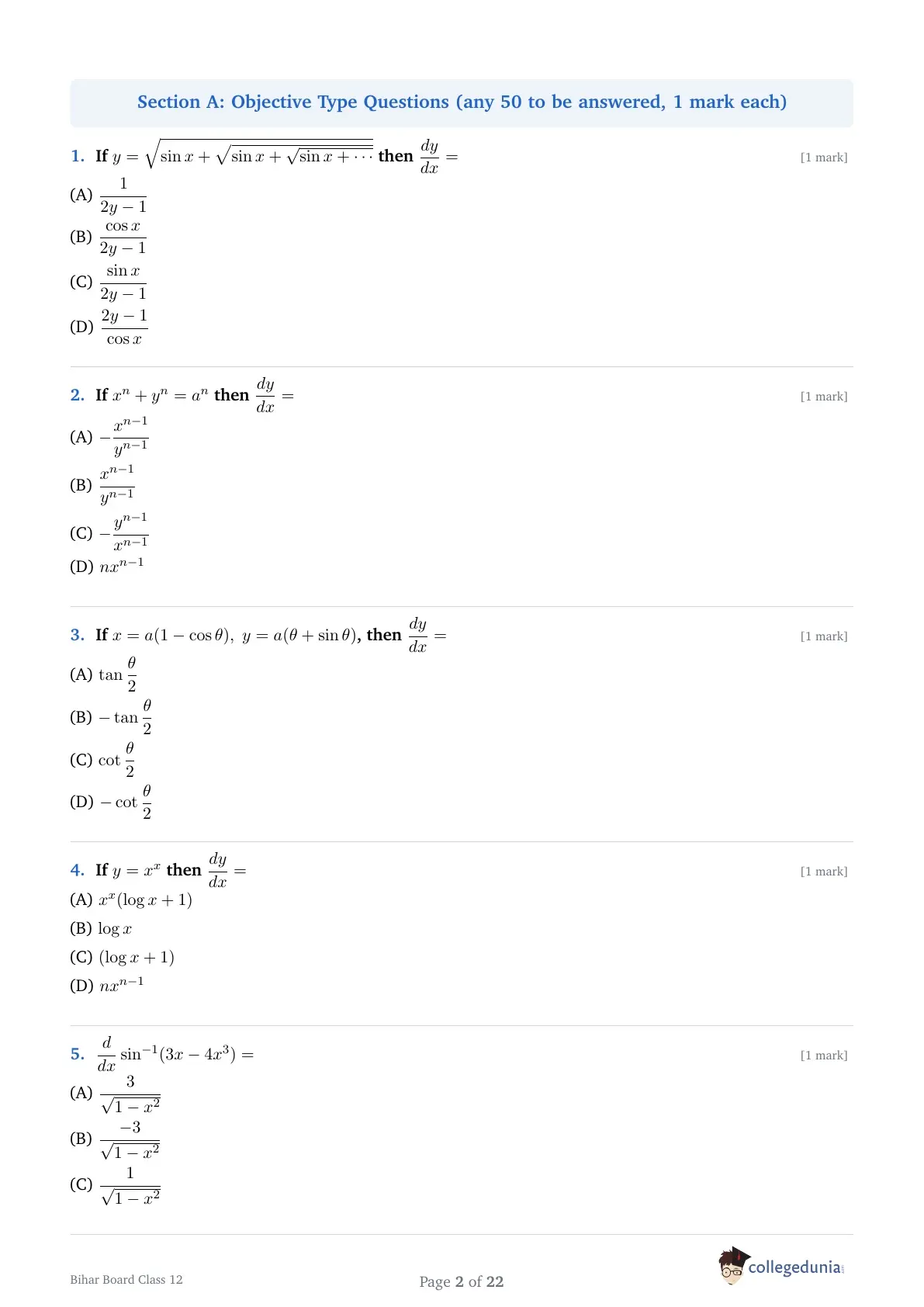
Section A - Objective Questions (1 mark each, any 50 to be answered)

Question 1:

If \( y = \sqrt{\sin x + \sqrt{\sin x + \sqrt{\sin x + \cdots}}} \) then \( \dfrac{dy}{dx} = \)

  • (A) \( \dfrac{1}{2y-1} \)
  • (B) \( \dfrac{\cos x}{2y-1} \)
  • (C) \( \dfrac{\sin x}{2y-1} \)
  • (D) \( \dfrac{2y-1}{\cos x} \)

Question 2:

If \( x^n + y^n = a^n \) then \( \frac{dy}{dx} = \)

  • (A) \( -\frac{x^{n-1}}{y^{n-1}} \)
  • (B) \( \frac{x^{n-1}}{y^{n-1}} \)
  • (C) \( -\frac{y^{n-1}}{x^{n-1}} \)
  • (D) \( nx^{n-1} \)

Question 3:

If \( x = a(1 - \cos\theta),\ y = a(\theta + \sin\theta) \), then \( \frac{dy}{dx} = \)

  • (A) \( \tan\frac{\theta}{2} \)
  • (B) \( -\tan\frac{\theta}{2} \)
  • (C) \( \cot\frac{\theta}{2} \)
  • (D) \( -\cot\frac{\theta}{2} \)

Question 4:

If \( y = x^x \) then \( \frac{dy}{dx} = \)

  • (A) \( x^x(\log x + 1) \)
  • (B) \( \log x \)
  • (C) \( (\log x + 1) \)
  • (D) \( nx^{n-1} \)

Question 5:

\( \frac{d}{dx}\sin^{-1}(3x - 4x^3) = \)

  • (A) \( \frac{3}{\sqrt{1-x^2}} \)
  • (B) \( \frac{-3}{\sqrt{1-x^2}} \)
  • (C) \( \frac{1}{\sqrt{1-x^2}} \)
  • (D) \( \frac{-1}{\sqrt{1-x^2}} \)

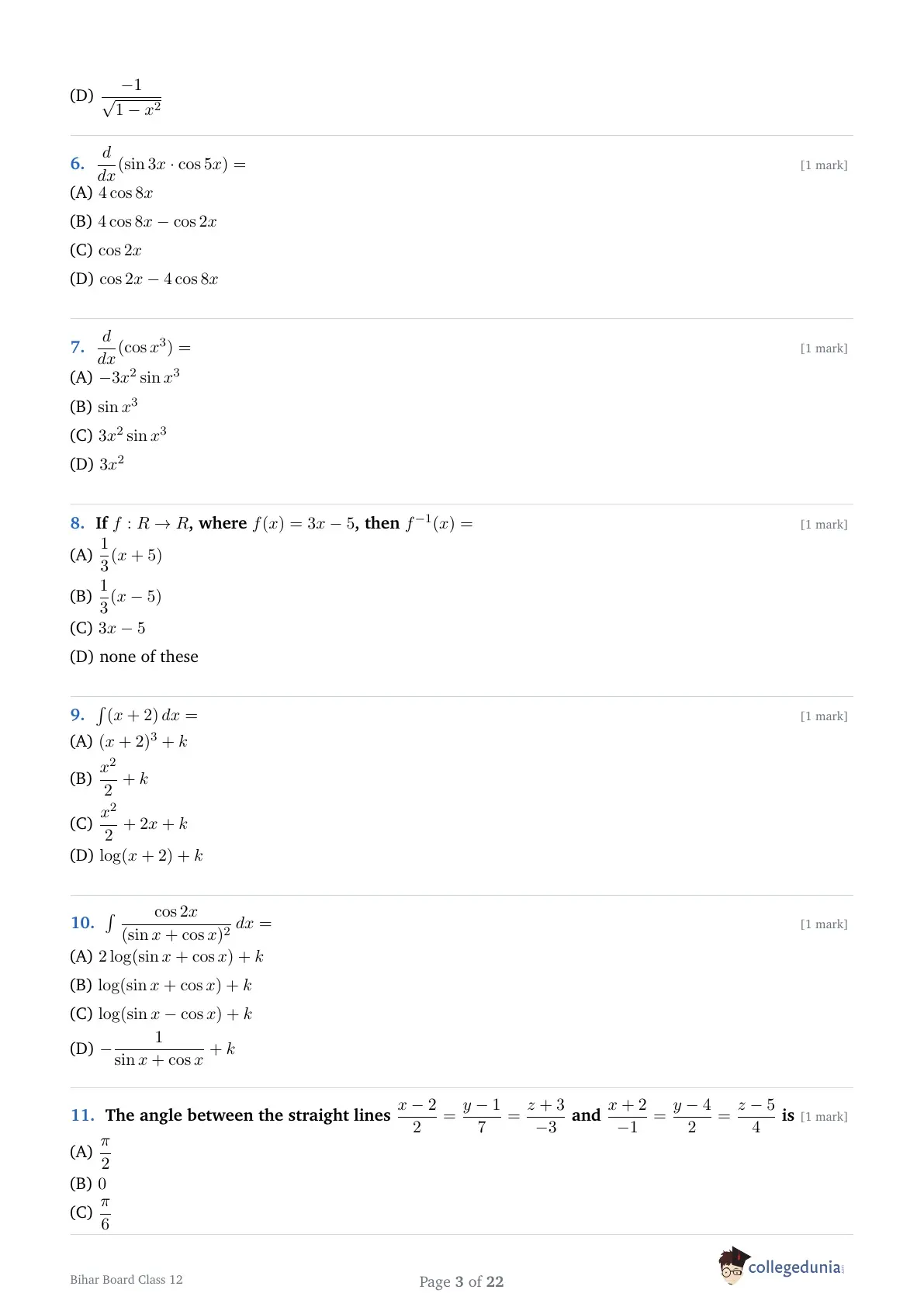
Question 6:

\( \frac{d}{dx}(\sin 3x \cdot \cos 5x) = \)

  • (A) \( 4\cos 8x \)
  • (B) \( 4\cos 8x - \cos 2x \)
  • (C) \( \cos 2x \)
  • (D) \( \cos 2x - 4\cos 8x \)

Question 7:

\( \frac{d}{dx}(\cos x^3) = \)

  • (A) \( -3x^2\sin x^3 \)
  • (B) \( \sin x^3 \)
  • (C) \( 3x^2\sin x^3 \)
  • (D) \( 3x^2 \)

Question 8:

If \( f: R \to R \), where \( f(x) = 3x-5 \), then \( f^{-1}(x) = \)

  • (A) \( \frac{1}{3}(x+5) \)
  • (B) \( \frac{1}{3}(x-5) \)
  • (C) \( 3x-5 \)
  • (D) none of these

Question 9:

\( \int (x+2)\,dx = \)

  • (A) \( (x+2)^3+k \)
  • (B) \( \frac{x^2}{2}+k \)
  • (C) \( \frac{x^2}{2}+2x+k \)
  • (D) \( \log(x+2)+k \)

Question 10:

\( \int \frac{\cos 2x}{(\sin x+\cos x)^2}\,dx = \)

  • (A) \( 2\log(\sin x+\cos x)+k \)
  • (B) \( \log(\sin x+\cos x)+k \)
  • (C) \( \log(\sin x-\cos x)+k \)
  • (D) \( -\frac{1}{\sin x+\cos x}+k \)

Question 11:

The angle between the straight lines \( \frac{x-2}{2} = \frac{y-1}{7} = \frac{z+3}{-3} \) and \( \frac{x+2}{-1} = \frac{y-4}{2} = \frac{z-5}{4} \) is

  • (A) \( \frac{\pi}{2} \)
  • (B) \( 0 \)
  • (C) \( \frac{\pi}{6} \)
  • (D) \( \frac{\pi}{4} \)

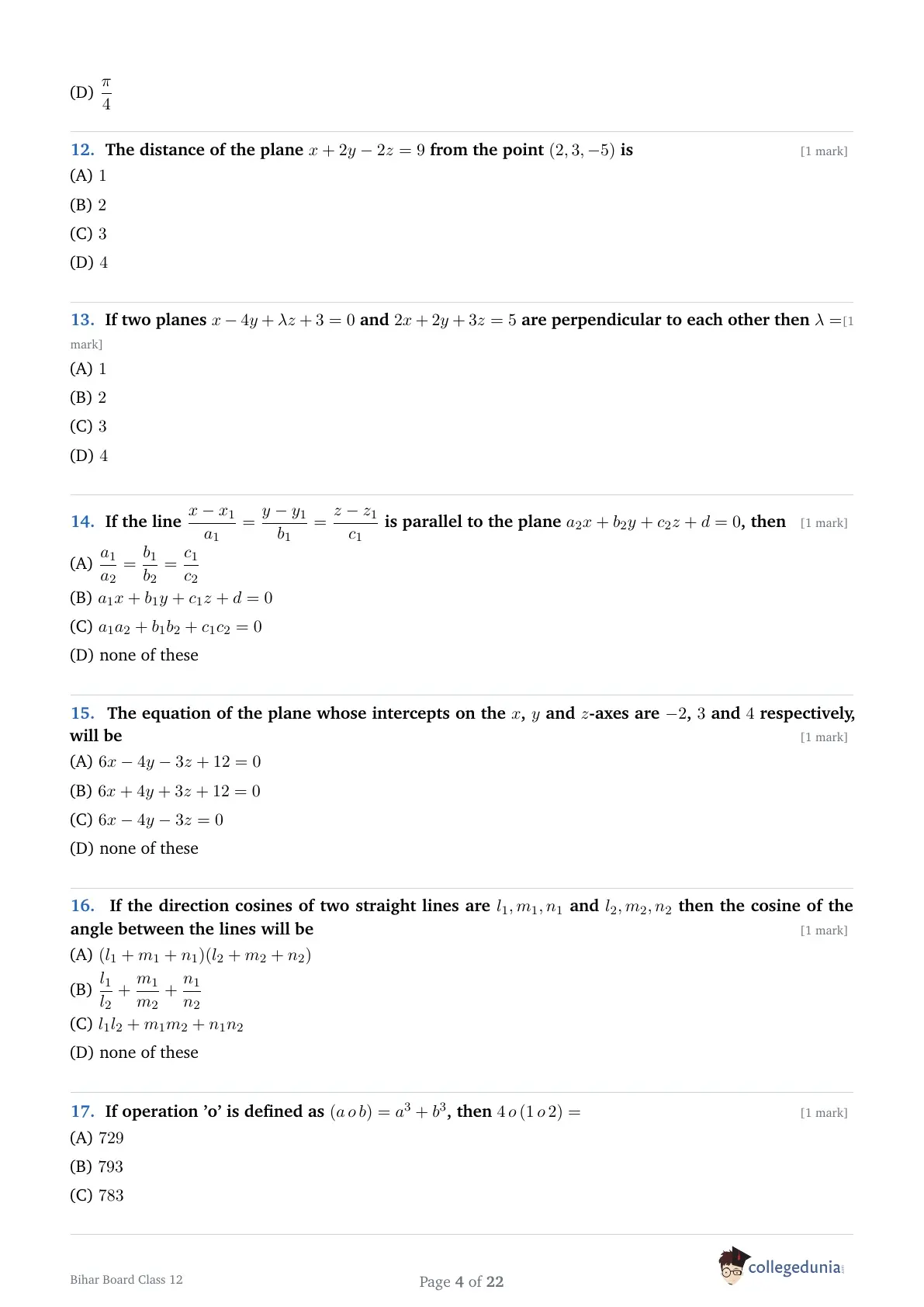
Question 12:

The distance of the plane \( x+2y-2z=9 \) from the point \( (2, 3, -5) \) is

  • (A) \( 1 \)
  • (B) \( 2 \)
  • (C) \( 3 \)
  • (D) \( 4 \)

Question 13:

If two planes \( x-4y+\lambda z+3=0 \) and \( 2x+2y+3z=5 \) are perpendicular to each other then \( \lambda = \)

  • (A) \( 1 \)
  • (B) \( 2 \)
  • (C) \( 3 \)
  • (D) \( 4 \)

Question 14:

If the line \( \frac{x-x_1}{a_1} = \frac{y-y_1}{b_1} = \frac{z-z_1}{c_1} \) is parallel to the plane \( a_2x+b_2y+c_2z+d=0 \), then

  • (A) \( \frac{a_1}{a_2} = \frac{b_1}{b_2} = \frac{c_1}{c_2} \)
  • (B) \( a_1x+b_1y+c_1z+d=0 \)
  • (C) \( a_1a_2+b_1b_2+c_1c_2=0 \)
  • (D) none of these

Question 15:

The equation of the plane whose intercepts on the \( x \), \( y \) and \( z \)-axes are \( -2 \), \( 3 \) and \( 4 \) respectively, will be

  • (A) \( 6x-4y-3z+12=0 \)
  • (B) \( 6x+4y+3z+12=0 \)
  • (C) \( 6x-4y-3z=0 \)
  • (D) none of these

Question 16:

If the direction cosines of two straight lines are \( l_1, m_1, n_1 \) and \( l_2, m_2, n_2 \) then the cosine of the angle between the lines will be

  • (A) \( (l_1+m_1+n_1)(l_2+m_2+n_2) \)
  • (B) \( \frac{l_1}{l_2}+\frac{m_1}{m_2}+\frac{n_1}{n_2} \)
  • (C) \( l_1l_2+m_1m_2+n_1n_2 \)
  • (D) none of these

Question 17:

If operation 'o' is defined as \( (a\,o\,b)=a^3+b^3 \), then \( 4\,o\,(1\,o\,2) = \)

  • (A) \( 729 \)
  • (B) \( 793 \)
  • (C) \( 783 \)
  • (D) \( 792 \)

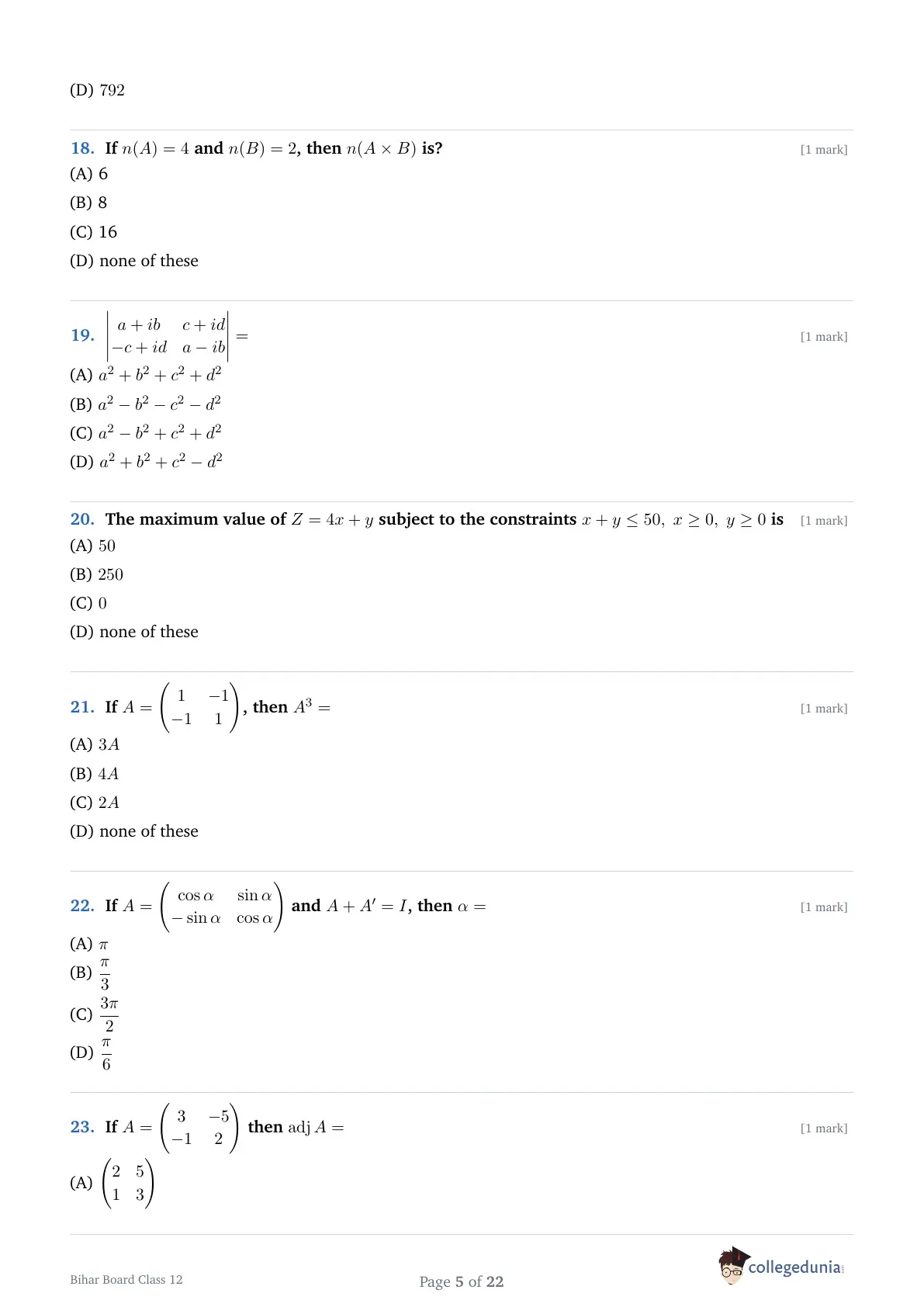
Question 18:

If \( n(A) = 4 \) and \( n(B) = 2 \), then \( n(A \times B) \) is?

  • (A) 6
  • (B) 8
  • (C) 16
  • (D) none of these

Question 19:

\( \begin{vmatrix} a+ib & c+id \\ -c+id & a-ib \end{vmatrix} = \)

  • (A) \( a^2+b^2+c^2+d^2 \)
  • (B) \( a^2-b^2-c^2-d^2 \)
  • (C) \( a^2-b^2+c^2+d^2 \)
  • (D) \( a^2+b^2+c^2-d^2 \)

Question 20:

The maximum value of \( Z = 4x + y \) subject to the constraints \( x + y \le 50,\ x \ge 0,\ y \ge 0 \) is

  • (A) \( 50 \)
  • (B) \( 250 \)
  • (C) \( 0 \)
  • (D) none of these

Question 21:

If \( A = \begin{pmatrix} 1 & -1 \\ -1 & 1 \end{pmatrix} \), then \( A^3 = \)

  • (A) \( 3A \)
  • (B) \( 4A \)
  • (C) \( 2A \)
  • (D) none of these

Question 22:

If \( A = \begin{pmatrix} \cos\alpha & \sin\alpha \\ -\sin\alpha & \cos\alpha \end{pmatrix} \) and \( A + A' = I \), then \( \alpha = \)

  • (A) \( \pi \)
  • (B) \( \frac{\pi}{3} \)
  • (C) \( \frac{3\pi}{2} \)
  • (D) \( \frac{\pi}{6} \)

Question 23:

If \( A = \begin{pmatrix} 3 & -5 \\ -1 & 2 \end{pmatrix} \) then \( \mathrm{adj}\,A = \)

  • (A) \( \begin{pmatrix} 2 & 5 \\ 1 & 3 \end{pmatrix} \)
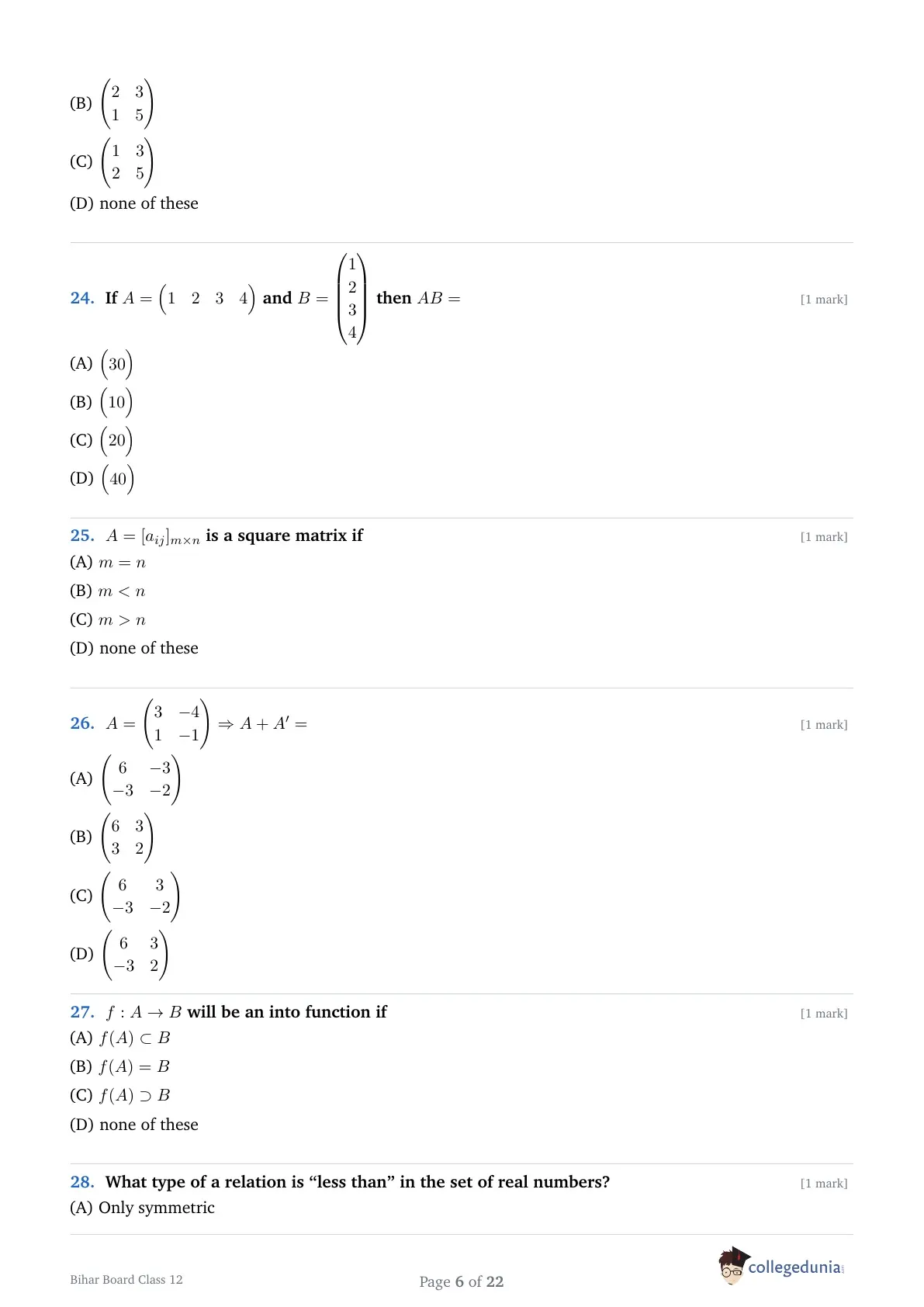
  • (B) \( \begin{pmatrix} 2 & 3 \\ 1 & 5 \end{pmatrix} \)
  • (C) \( \begin{pmatrix} 1 & 3 \\ 2 & 5 \end{pmatrix} \)
  • (D) none of these

Question 24:

If \( A = \begin{pmatrix} 1 & 2 & 3 & 4 \end{pmatrix} \) and \( B = \begin{pmatrix} 1 \\ 2 \\ 3 \\ 4 \end{pmatrix} \) then \( AB = \)

  • (A) \( \begin{pmatrix} 30 \end{pmatrix} \)
  • (B) \( \begin{pmatrix} 10 \end{pmatrix} \)
  • (C) \( \begin{pmatrix} 20 \end{pmatrix} \)
  • (D) \( \begin{pmatrix} 40 \end{pmatrix} \)

Question 25:

\( A = [a_{ij}]_{m \times n} \) is a square matrix if

  • (A) \( m = n \)
  • (B) \( m < n \)
  • (C) \( m > n \)
  • (D) none of these

Question 26:

\( A = \begin{pmatrix} 3 & -4 \\ 1 & -1 \end{pmatrix} \Rightarrow A + A' = \)

  • (A) \( \begin{pmatrix} 6 & -3 \\ -3 & -2 \end{pmatrix} \)
  • (B) \( \begin{pmatrix} 6 & 3 \\ 3 & 2 \end{pmatrix} \)
  • (C) \( \begin{pmatrix} 6 & 3 \\ -3 & -2 \end{pmatrix} \)
  • (D) \( \begin{pmatrix} 6 & 3 \\ -3 & 2 \end{pmatrix} \)

Question 27:

\( f: A \to B \) will be an into function if

  • (A) \( f(A) \subset B \)
  • (B) \( f(A) = B \)
  • (C) \( f(A) \supset B \)
  • (D) none of these

Question 28:

What type of a relation is "less than" in the set of real numbers?

  • (A) Only symmetric
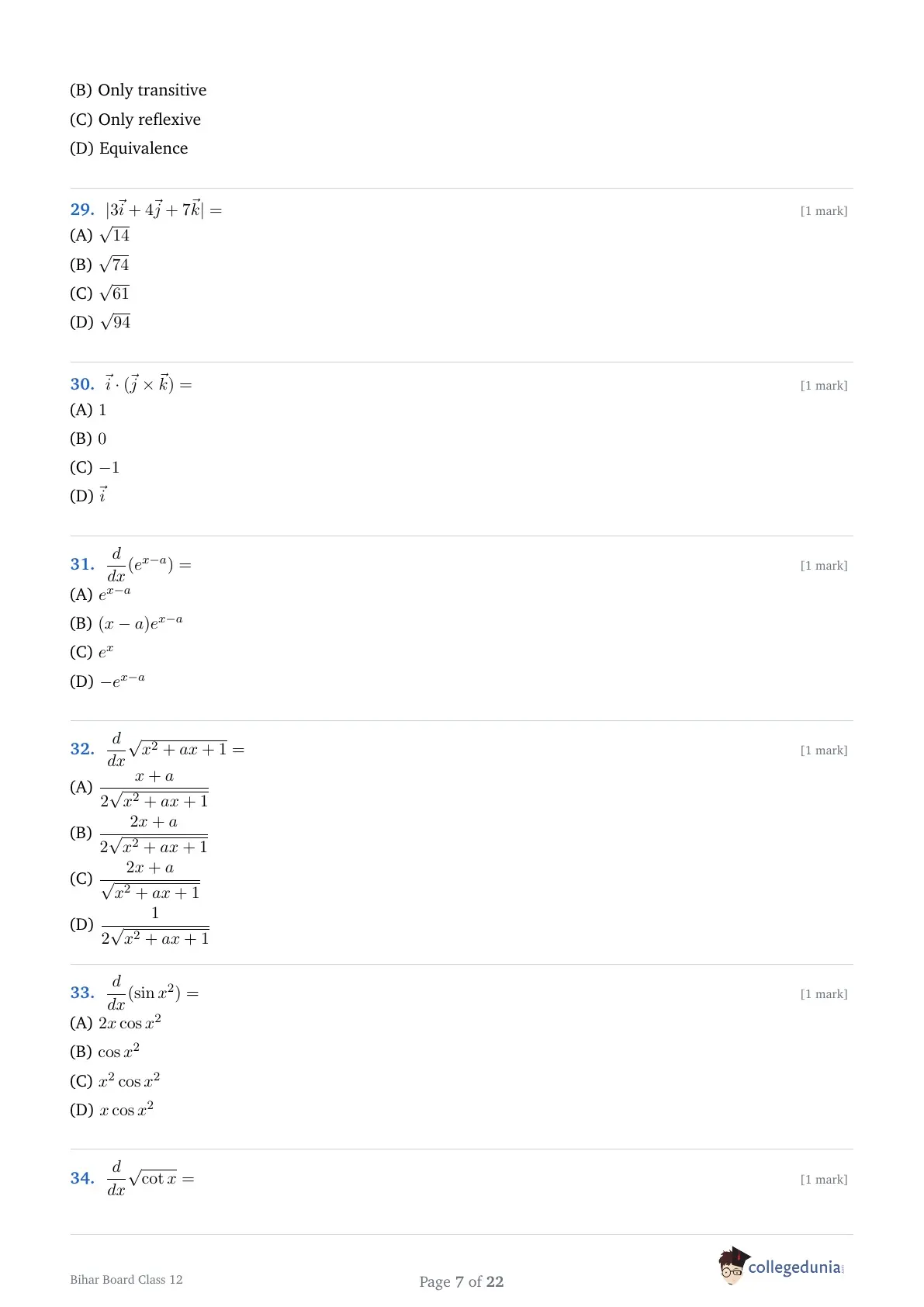
  • (B) Only transitive
  • (C) Only reflexive
  • (D) Equivalence

Question 29:

\( |3\vec{i}+4\vec{j}+7\vec{k}| = \)

  • (A) \( \sqrt{14} \)
  • (B) \( \sqrt{74} \)
  • (C) \( \sqrt{61} \)
  • (D) \( \sqrt{94} \)

Question 30:

\( \vec{i} \cdot (\vec{j} \times \vec{k}) = \)

  • (A) \( 1 \)
  • (B) \( 0 \)
  • (C) \( -1 \)
  • (D) \( \vec{i} \)

Question 31:

\( \frac{d}{dx}(e^{x-a}) = \)

  • (A) \( e^{x-a} \)
  • (B) \( (x-a)e^{x-a} \)
  • (C) \( e^{x} \)
  • (D) \( -e^{x-a} \)

Question 32:

\( \frac{d}{dx}\sqrt{x^2+ax+1} = \)

  • (A) \( \frac{x+a}{2\sqrt{x^2+ax+1}} \)
  • (B) \( \frac{2x+a}{2\sqrt{x^2+ax+1}} \)
  • (C) \( \frac{2x+a}{\sqrt{x^2+ax+1}} \)
  • (D) \( \frac{1}{2\sqrt{x^2+ax+1}} \)

Question 33:

\( \frac{d}{dx}(\sin x^2) = \)

  • (A) \( 2x\cos x^2 \)
  • (B) \( \cos x^2 \)
  • (C) \( x^2\cos x^2 \)
  • (D) \( x\cos x^2 \)

Question 34:

\( \frac{d}{dx}\sqrt{\cot x} = \)

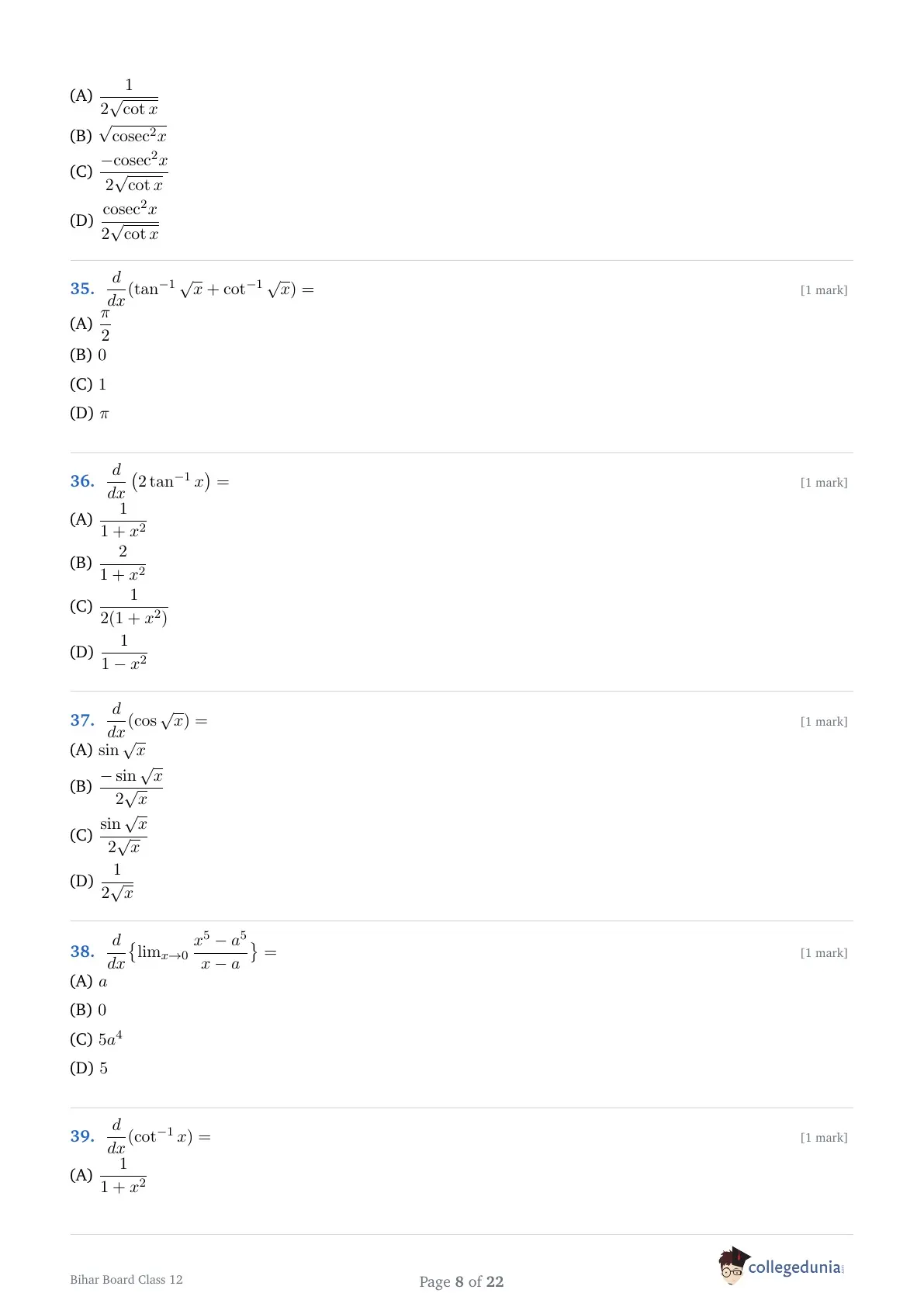
  • (A) \( \frac{1}{2\sqrt{\cot x}} \)
  • (B) \( \sqrt{\mathrm{cosec}^2 x} \)
  • (C) \( \frac{-\mathrm{cosec}^2 x}{2\sqrt{\cot x}} \)
  • (D) \( \frac{\mathrm{cosec}^2 x}{2\sqrt{\cot x}} \)

Question 35:

\( \frac{d}{dx}(\tan^{-1}\sqrt{x} + \cot^{-1}\sqrt{x}) = \)

  • (A) \( \frac{\pi}{2} \)
  • (B) \( 0 \)
  • (C) \( 1 \)
  • (D) \( \pi \)

Question 36:

\( \dfrac{d}{dx}\left(2\tan^{-1}x\right) = \)

  • (A) \( \dfrac{1}{1+x^2} \)
  • (B) \( \dfrac{2}{1+x^2} \)
  • (C) \( \dfrac{1}{2(1+x^2)} \)
  • (D) \( \dfrac{1}{1-x^2} \)

Question 37:

\( \frac{d}{dx}(\cos\sqrt{x}) = \)

  • (A) \( \sin\sqrt{x} \)
  • (B) \( \frac{-\sin\sqrt{x}}{2\sqrt{x}} \)
  • (C) \( \frac{\sin\sqrt{x}}{2\sqrt{x}} \)
  • (D) \( \frac{1}{2\sqrt{x}} \)

Question 38:

\( \frac{d}{dx}\left\{\lim_{x \to 0}\frac{x^5-a^5}{x-a}\right\} = \)

  • (A) \( a \)
  • (B) \( 0 \)
  • (C) \( 5a^4 \)
  • (D) \( 5 \)

Question 39:

\( \frac{d}{dx}(\cot^{-1}x) = \)

  • (A) \( \frac{1}{1+x^2} \)
  • (B) \( \frac{-1}{1+x^2} \)
  • (C) \( \frac{1}{x} \)
  • (D) \( \frac{-1}{x} \)

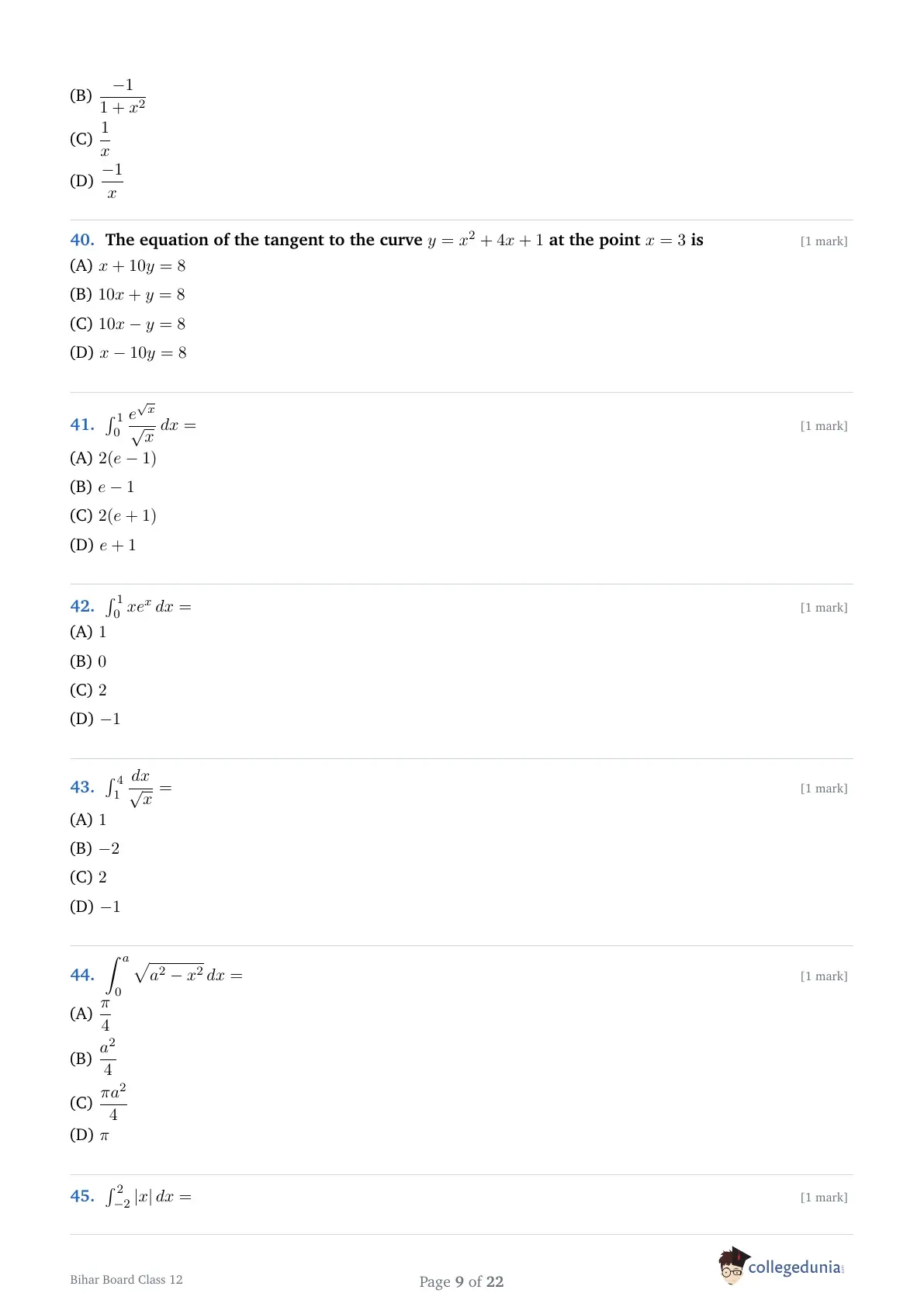
Question 40:

The equation of the tangent to the curve \( y = x^2 + 4x + 1 \) at the point \( x = 3 \) is

  • (A) \( x + 10y = 8 \)
  • (B) \( 10x + y = 8 \)
  • (C) \( 10x - y = 8 \)
  • (D) \( x - 10y = 8 \)

Question 41:

\( \int_0^1 \frac{e^{\sqrt{x}}}{\sqrt{x}}\,dx = \)

  • (A) \( 2(e-1) \)
  • (B) \( e-1 \)
  • (C) \( 2(e+1) \)
  • (D) \( e+1 \)

Question 42:

\( \int_0^1 x e^x\,dx = \)

  • (A) \( 1 \)
  • (B) \( 0 \)
  • (C) \( 2 \)
  • (D) \( -1 \)

Question 43:

\( \int_1^4 \frac{dx}{\sqrt{x}} = \)

  • (A) \( 1 \)
  • (B) \( -2 \)
  • (C) \( 2 \)
  • (D) \( -1 \)

Question 44:

\( \displaystyle\int_0^a \sqrt{a^2-x^2}\,dx = \)

  • (A) \( \dfrac{\pi}{4} \)
  • (B) \( \dfrac{a^2}{4} \)
  • (C) \( \dfrac{\pi a^2}{4} \)
  • (D) \( \pi \)

Question 45:

\( \int_{-2}^{2} |x|\,dx = \)

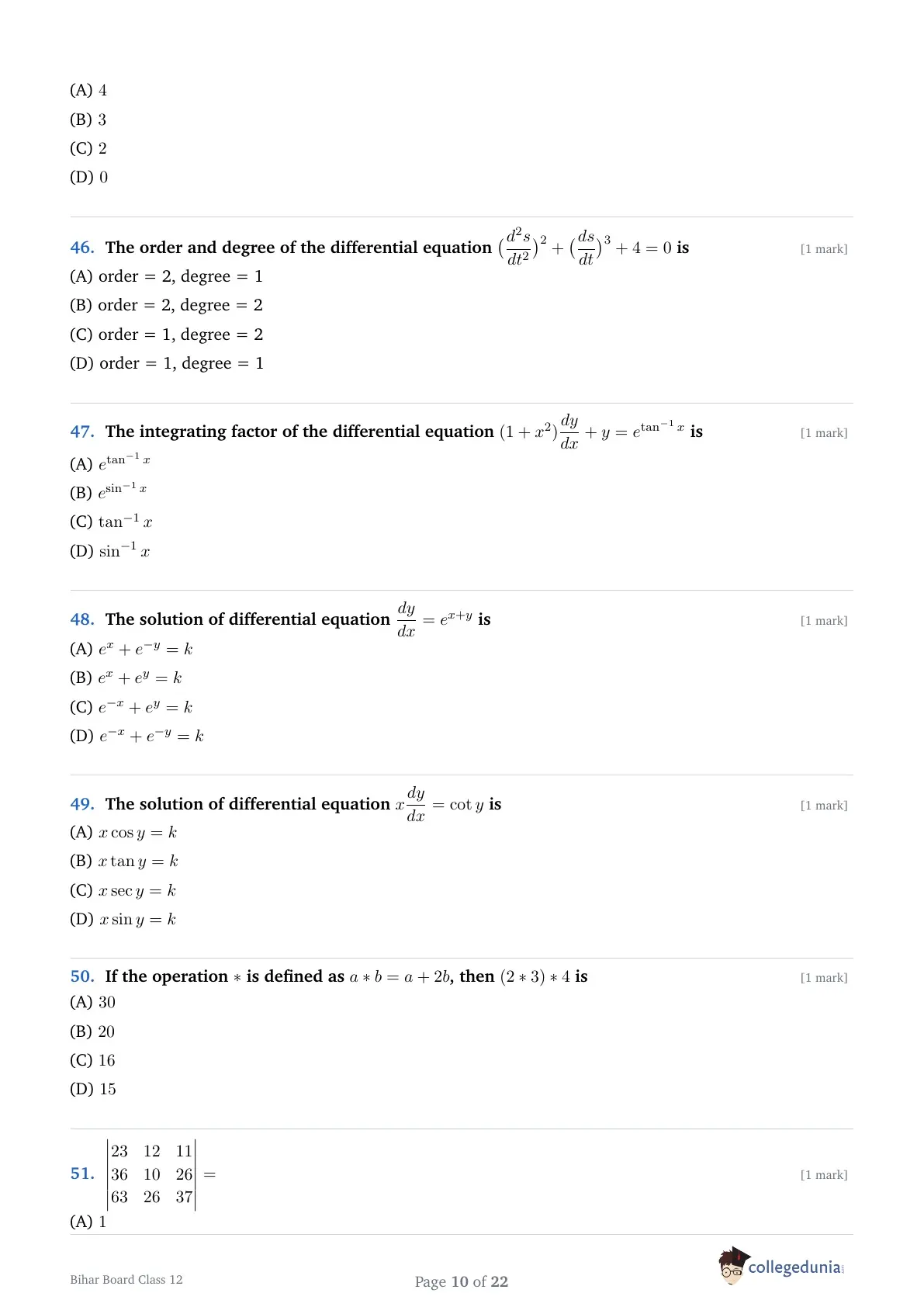
  • (A) \( 4 \)
  • (B) \( 3 \)
  • (C) \( 2 \)
  • (D) \( 0 \)

Question 46:

The order and degree of the differential equation \( \left(\frac{d^2s}{dt^2}\right)^2 + \left(\frac{ds}{dt}\right)^3 + 4 = 0 \) is

  • (A) order = 2, degree = 1
  • (B) order = 2, degree = 2
  • (C) order = 1, degree = 2
  • (D) order = 1, degree = 1

Question 47:

The integrating factor of the differential equation \( (1+x^2)\frac{dy}{dx} + y = e^{\tan^{-1}x} \) is

  • (A) \( e^{\tan^{-1}x} \)
  • (B) \( e^{\sin^{-1}x} \)
  • (C) \( \tan^{-1}x \)
  • (D) \( \sin^{-1}x \)

Question 48:

The solution of differential equation \( \frac{dy}{dx} = e^{x+y} \) is

  • (A) \( e^x+e^{-y}=k \)
  • (B) \( e^x+e^y=k \)
  • (C) \( e^{-x}+e^y=k \)
  • (D) \( e^{-x}+e^{-y}=k \)

Question 49:

The solution of differential equation \( x\frac{dy}{dx} = \cot y \) is

  • (A) \( x\cos y=k \)
  • (B) \( x\tan y=k \)
  • (C) \( x\sec y=k \)
  • (D) \( x\sin y=k \)

Question 50:

If the operation \( * \) is defined as \( a * b = a + 2b \), then \( (2 * 3) * 4 \) is

  • (A) \( 30 \)
  • (B) \( 20 \)
  • (C) \( 16 \)
  • (D) \( 15 \)

Question 51:

\( \begin{vmatrix} 23 & 12 & 11 \\ 36 & 10 & 26 \\ 63 & 26 & 37 \end{vmatrix} = \)

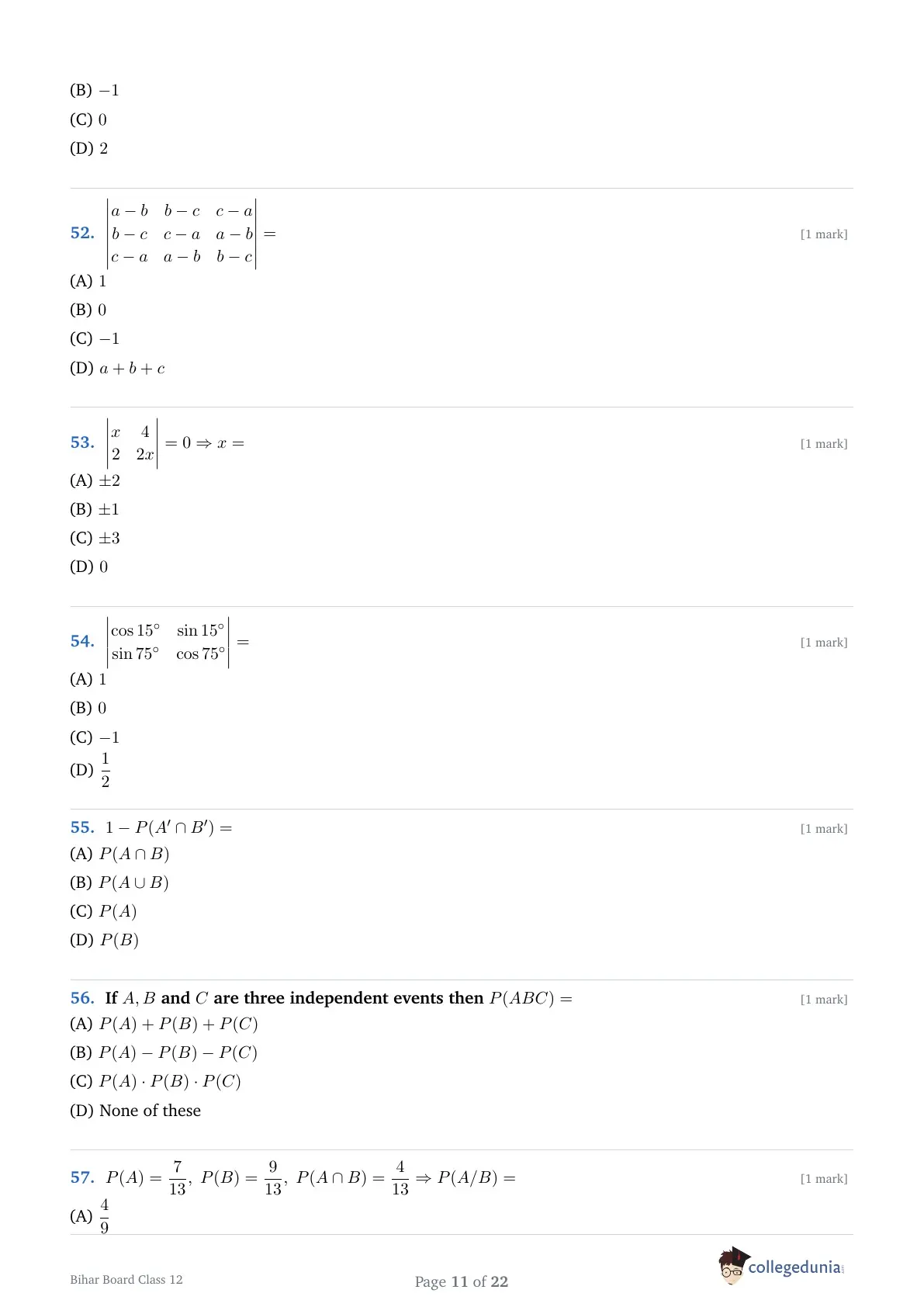
  • (A) \( 1 \)
  • (B) \( -1 \)
  • (C) \( 0 \)
  • (D) \( 2 \)

Question 52:

\( \begin{vmatrix} a-b & b-c & c-a \\ b-c & c-a & a-b \\ c-a & a-b & b-c \end{vmatrix} = \)

  • (A) \( 1 \)
  • (B) \( 0 \)
  • (C) \( -1 \)
  • (D) \( a+b+c \)

Question 53:

\( \begin{vmatrix} x & 4 \\ 2 & 2x \end{vmatrix} = 0 \Rightarrow x = \)

  • (A) \( \pm 2 \)
  • (B) \( \pm 1 \)
  • (C) \( \pm 3 \)
  • (D) \( 0 \)

Question 54:

\( \begin{vmatrix} \cos 15^{\circ} & \sin 15^{\circ} \\ \sin 75^{\circ} & \cos 75^{\circ} \end{vmatrix} = \)

  • (A) \( 1 \)
  • (B) \( 0 \)
  • (C) \( -1 \)
  • (D) \( \frac{1}{2} \)

Question 55:

\( 1 - P(A' \cap B') = \)

  • (A) \( P(A \cap B) \)
  • (B) \( P(A \cup B) \)
  • (C) \( P(A) \)
  • (D) \( P(B) \)

Question 56:

If \( A, B \) and \( C \) are three independent events then \( P(ABC) = \)

  • (A) \( P(A) + P(B) + P(C) \)
  • (B) \( P(A) - P(B) - P(C) \)
  • (C) \( P(A) \cdot P(B) \cdot P(C) \)
  • (D) None of these

Question 57:

\( P(A) = \frac{7}{13},\ P(B) = \frac{9}{13},\ P(A \cap B) = \frac{4}{13} \Rightarrow P(A/B) = \)

  • (A) \( \frac{4}{9} \)
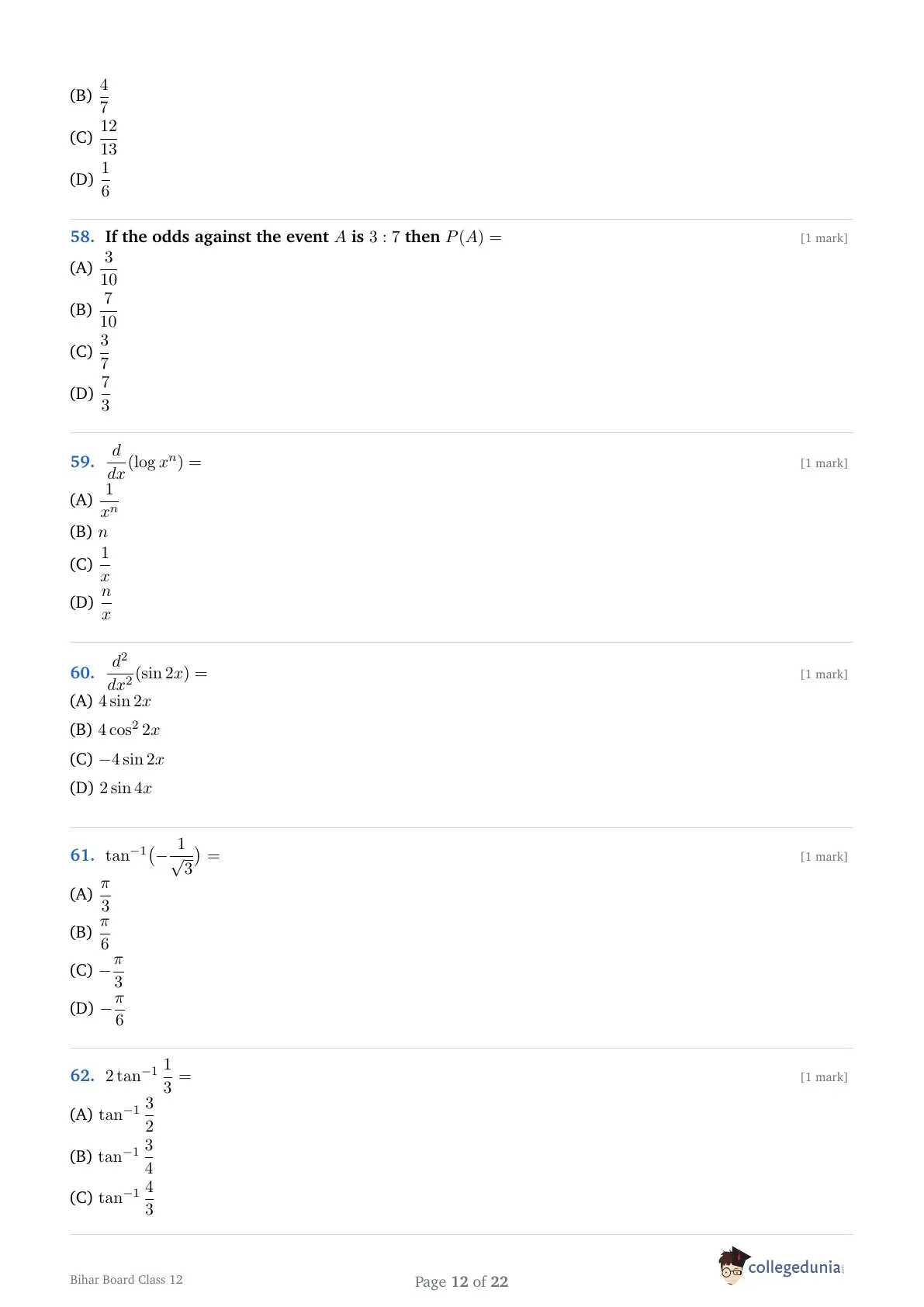
  • (B) \( \frac{4}{7} \)
  • (C) \( \frac{12}{13} \)
  • (D) \( \frac{1}{6} \)

Question 58:

If the odds against the event \( A \) is \( 3 : 7 \) then \( P(A) = \)

  • (A) \( \frac{3}{10} \)
  • (B) \( \frac{7}{10} \)
  • (C) \( \frac{3}{7} \)
  • (D) \( \frac{7}{3} \)

Question 59:

\( \frac{d}{dx}(\log x^n) = \)

  • (A) \( \frac{1}{x^n} \)
  • (B) \( n \)
  • (C) \( \frac{1}{x} \)
  • (D) \( \frac{n}{x} \)

Question 60:

\( \frac{d^2}{dx^2}(\sin 2x) = \)

  • (A) \( 4\sin 2x \)
  • (B) \( 4\cos^2 2x \)
  • (C) \( -4\sin 2x \)
  • (D) \( 2\sin 4x \)

Question 61:

\( \tan^{-1}\left(-\frac{1}{\sqrt{3}}\right) = \)

  • (A) \( \frac{\pi}{3} \)
  • (B) \( \frac{\pi}{6} \)
  • (C) \( -\frac{\pi}{3} \)
  • (D) \( -\frac{\pi}{6} \)

Question 62:

\( 2\tan^{-1}\frac{1}{3} = \)

  • (A) \( \tan^{-1}\frac{3}{2} \)
  • (B) \( \tan^{-1}\frac{3}{4} \)
  • (C) \( \tan^{-1}\frac{4}{3} \)
  • (D) \( \tan^{-1}\frac{2}{3} \)

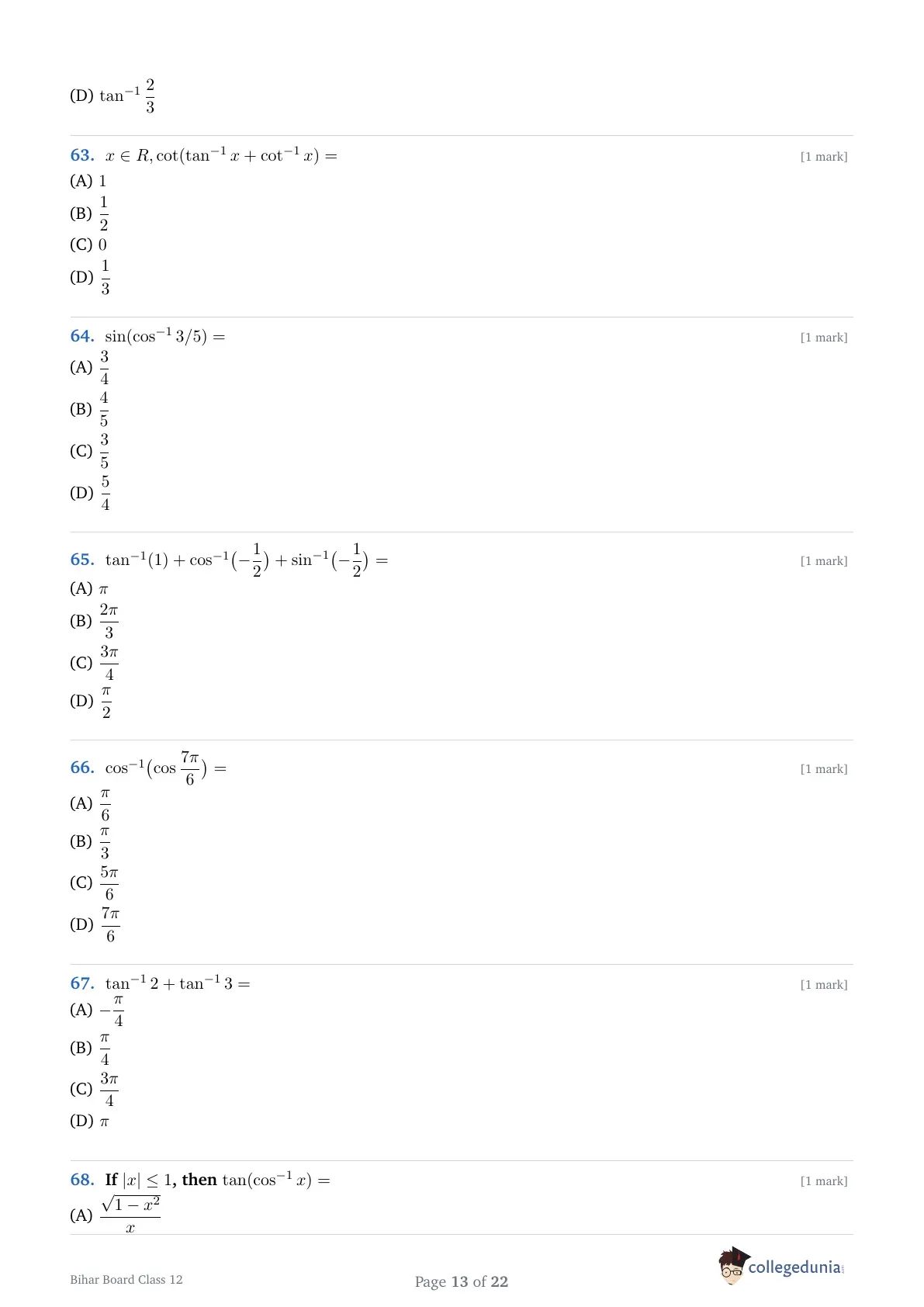
Question 63:

\( x \in R, \cot(\tan^{-1}x + \cot^{-1}x) = \)

  • (A) \( 1 \)
  • (B) \( \frac{1}{2} \)
  • (C) \( 0 \)
  • (D) \( \frac{1}{3} \)

Question 64:

\( \sin(\cos^{-1} 3/5) = \)

  • (A) \( \frac{3}{4} \)
  • (B) \( \frac{4}{5} \)
  • (C) \( \frac{3}{5} \)
  • (D) \( \frac{5}{4} \)

Question 65:

\( \tan^{-1}(1) + \cos^{-1}\left(-\frac{1}{2}\right) + \sin^{-1}\left(-\frac{1}{2}\right) = \)

  • (A) \( \pi \)
  • (B) \( \frac{2\pi}{3} \)
  • (C) \( \frac{3\pi}{4} \)
  • (D) \( \frac{\pi}{2} \)

Question 66:

\( \cos^{-1}\left(\cos\frac{7\pi}{6}\right) = \)

  • (A) \( \frac{\pi}{6} \)
  • (B) \( \frac{\pi}{3} \)
  • (C) \( \frac{5\pi}{6} \)
  • (D) \( \frac{7\pi}{6} \)

Question 67:

\( \tan^{-1}2 + \tan^{-1}3 = \)

  • (A) \( -\frac{\pi}{4} \)
  • (B) \( \frac{\pi}{4} \)
  • (C) \( \frac{3\pi}{4} \)
  • (D) \( \pi \)

Question 68:

If \( |x| \leq 1 \), then \( \tan(\cos^{-1}x) = \)

  • (A) \( \frac{\sqrt{1-x^2}}{x} \)
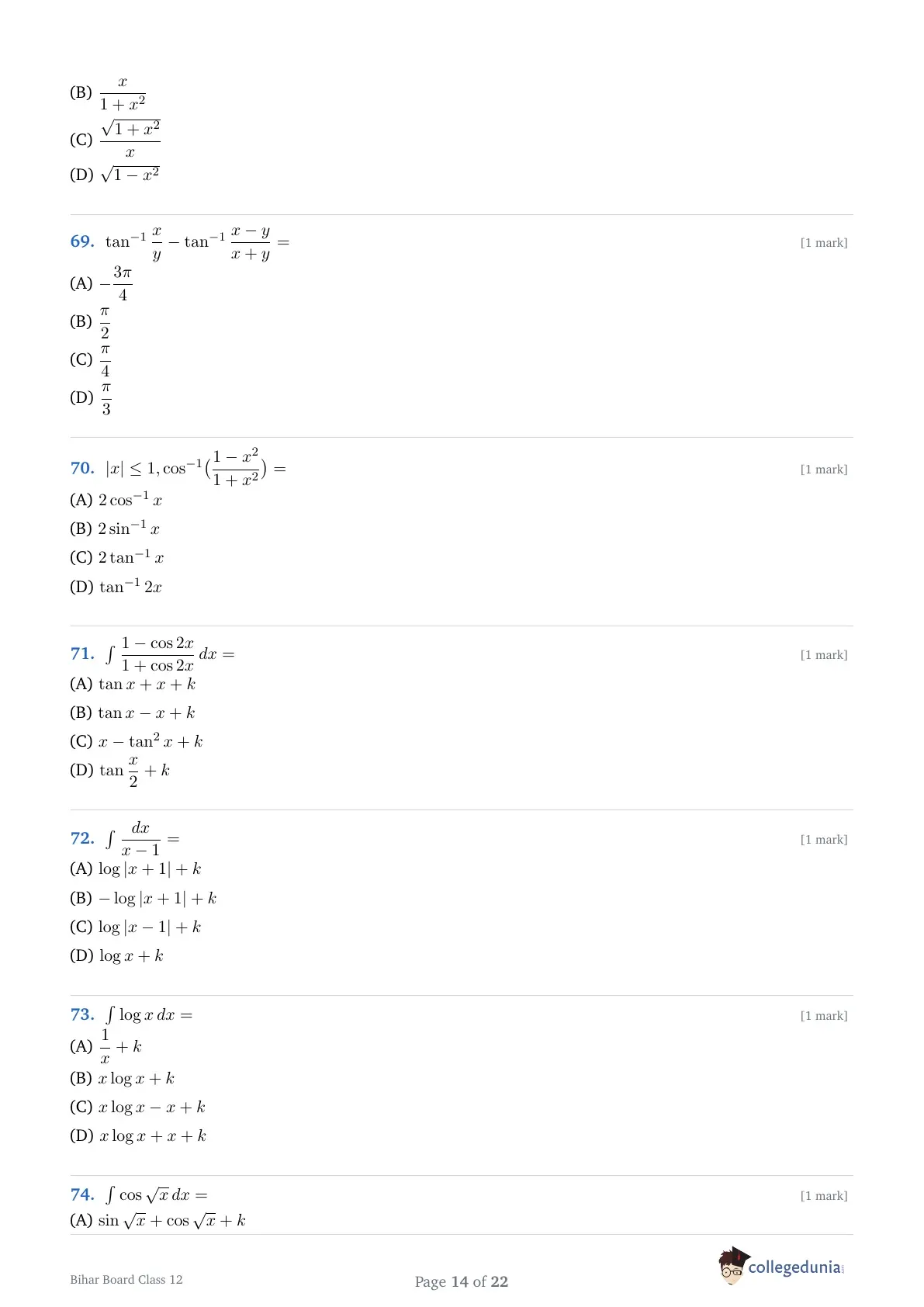
  • (B) \( \frac{x}{1+x^2} \)
  • (C) \( \frac{\sqrt{1+x^2}}{x} \)
  • (D) \( \sqrt{1-x^2} \)

Question 69:

\( \tan^{-1}\frac{x}{y} - \tan^{-1}\frac{x-y}{x+y} = \)

  • (A) \( -\frac{3\pi}{4} \)
  • (B) \( \frac{\pi}{2} \)
  • (C) \( \frac{\pi}{4} \)
  • (D) \( \frac{\pi}{3} \)

Question 70:

\( |x| \leq 1, \cos^{-1}\left(\frac{1-x^2}{1+x^2}\right) = \)

  • (A) \( 2\cos^{-1}x \)
  • (B) \( 2\sin^{-1}x \)
  • (C) \( 2\tan^{-1}x \)
  • (D) \( \tan^{-1}2x \)

Question 71:

\( \int \frac{1-\cos 2x}{1+\cos 2x}\,dx = \)

  • (A) \( \tan x + x + k \)
  • (B) \( \tan x - x + k \)
  • (C) \( x - \tan^2 x + k \)
  • (D) \( \tan\frac{x}{2} + k \)

Question 72:

\( \int \frac{dx}{x-1} = \)

  • (A) \( \log|x+1|+k \)
  • (B) \( -\log|x+1|+k \)
  • (C) \( \log|x-1|+k \)
  • (D) \( \log x+k \)

Question 73:

\( \int \log x\,dx = \)

  • (A) \( \frac{1}{x}+k \)
  • (B) \( x\log x+k \)
  • (C) \( x\log x-x+k \)
  • (D) \( x\log x+x+k \)

Question 74:

\( \int \cos\sqrt{x}\,dx = \)

  • (A) \( \sin\sqrt{x}+\cos\sqrt{x}+k \)
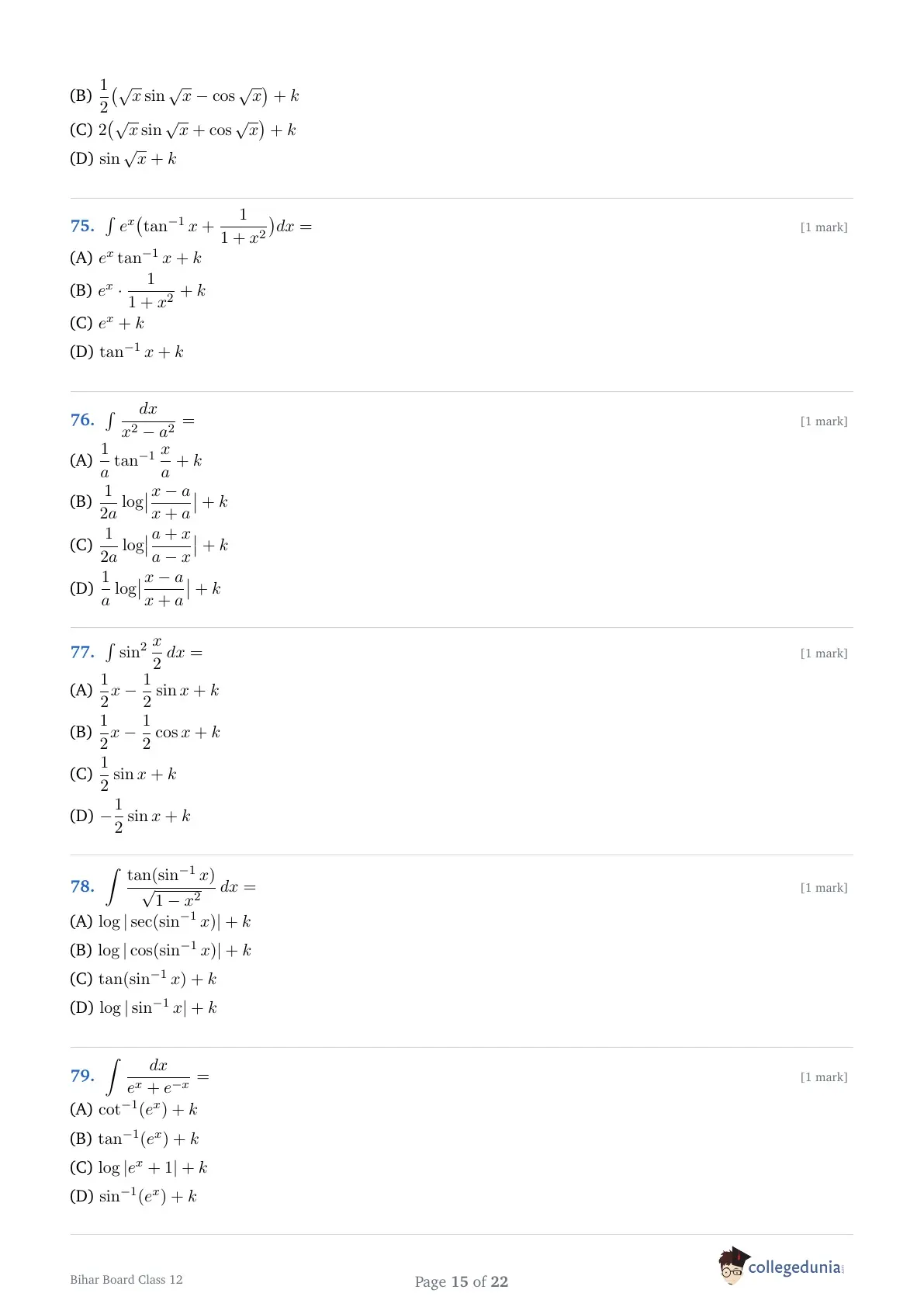
  • (B) \( \frac{1}{2}\left(\sqrt{x}\sin\sqrt{x}-\cos\sqrt{x}\right)+k \)
  • (C) \( 2\left(\sqrt{x}\sin\sqrt{x}+\cos\sqrt{x}\right)+k \)
  • (D) \( \sin\sqrt{x}+k \)

Question 75:

\( \int e^x\left(\tan^{-1}x+\frac{1}{1+x^2}\right)dx = \)

  • (A) \( e^x\tan^{-1}x+k \)
  • (B) \( e^x \cdot \frac{1}{1+x^2}+k \)
  • (C) \( e^x+k \)
  • (D) \( \tan^{-1}x+k \)

Question 76:

\( \int \frac{dx}{x^2-a^2} = \)

  • (A) \( \frac{1}{a}\tan^{-1}\frac{x}{a}+k \)
  • (B) \( \frac{1}{2a}\log\left|\frac{x-a}{x+a}\right|+k \)
  • (C) \( \frac{1}{2a}\log\left|\frac{a+x}{a-x}\right|+k \)
  • (D) \( \frac{1}{a}\log\left|\frac{x-a}{x+a}\right|+k \)

Question 77:

\( \int \sin^2\frac{x}{2}\,dx = \)

  • (A) \( \frac{1}{2}x-\frac{1}{2}\sin x+k \)
  • (B) \( \frac{1}{2}x-\frac{1}{2}\cos x+k \)
  • (C) \( \frac{1}{2}\sin x+k \)
  • (D) \( -\frac{1}{2}\sin x+k \)

Question 78:

\( \displaystyle \int \frac{\tan(\sin^{-1}x)}{\sqrt{1-x^2}}\,dx = \)

  • (A) \( \log|\sec(\sin^{-1}x)|+k \)
  • (B) \( \log|\cos(\sin^{-1}x)|+k \)
  • (C) \( \tan(\sin^{-1}x)+k \)
  • (D) \( \log|\sin^{-1}x|+k \)

Question 79:

\( \displaystyle \int \frac{dx}{e^x+e^{-x}} = \)

  • (A) \( \cot^{-1}(e^x)+k \)
  • (B) \( \tan^{-1}(e^x)+k \)
  • (C) \( \log|e^x+1|+k \)
  • (D) \( \sin^{-1}(e^x)+k \)

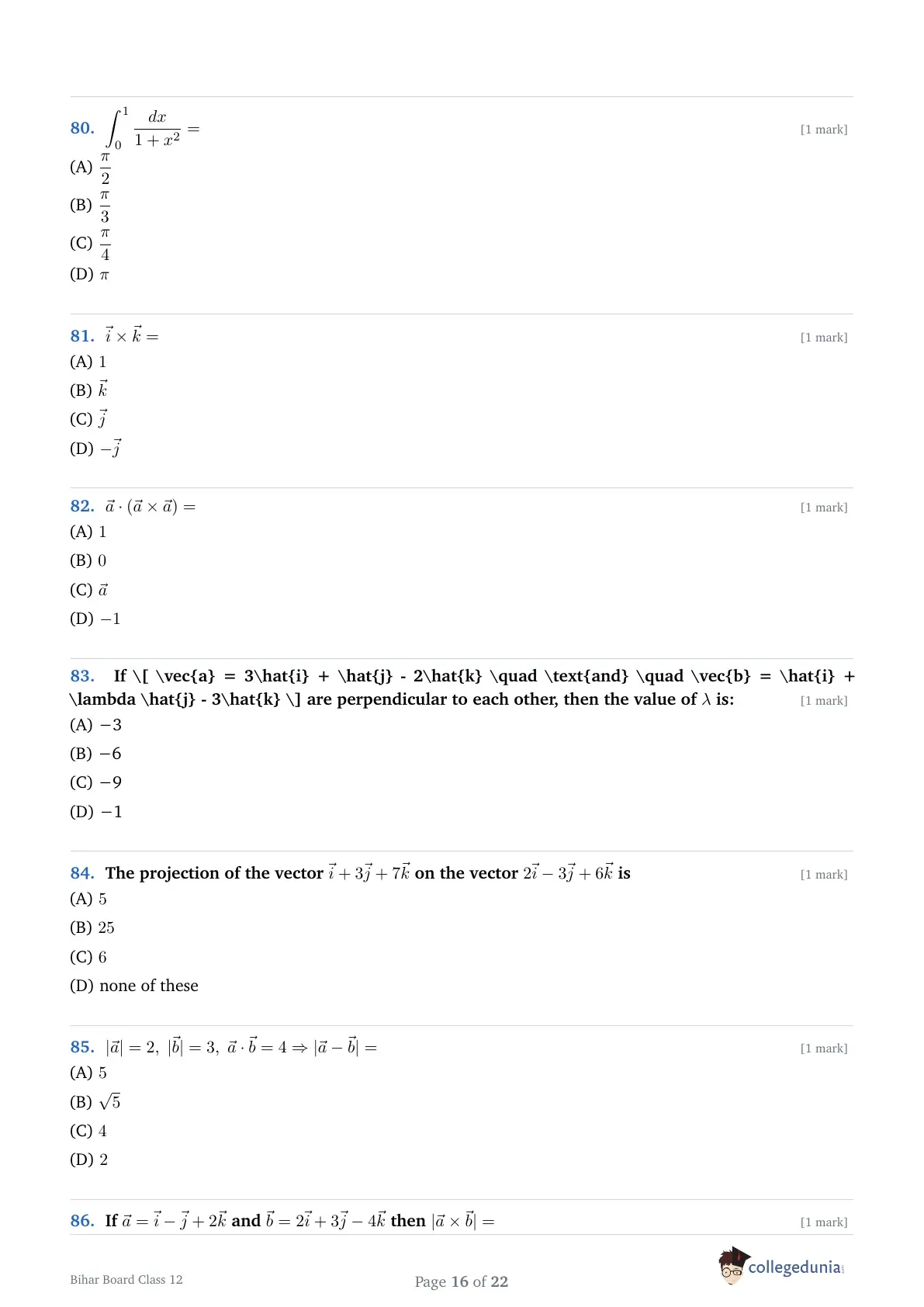
Question 80:

\( \displaystyle \int_0^1 \frac{dx}{1+x^2} = \)

  • (A) \( \dfrac{\pi}{2} \)
  • (B) \( \dfrac{\pi}{3} \)
  • (C) \( \dfrac{\pi}{4} \)
  • (D) \( \pi \)

Question 81:

\( \vec{i} \times \vec{k} = \)

  • (A) \( 1 \)
  • (B) \( \vec{k} \)
  • (C) \( \vec{j} \)
  • (D) \( -\vec{j} \)

Question 82:

\( \vec{a} \cdot (\vec{a} \times \vec{a}) = \)

  • (A) \( 1 \)
  • (B) \( 0 \)
  • (C) \( \vec{a} \)
  • (D) \( -1 \)

Question 83:

If \[ \vec{a} = 3\hat{i} + \hat{j} - 2\hat{k} \quad \text{and} \quad \vec{b} = \hat{i} + \lambda \hat{j} - 3\hat{k} \] are perpendicular to each other, then the value of \( \lambda \) is:

  • (A) -3
  • (B) -6
  • (C) -9
  • (D) -1

Question 84:

The projection of the vector \( \vec{i}+3\vec{j}+7\vec{k} \) on the vector \( 2\vec{i}-3\vec{j}+6\vec{k} \) is

  • (A) \( 5 \)
  • (B) \( 25 \)
  • (C) \( 6 \)
  • (D) none of these

Question 85:

\( |\vec{a}| = 2,\ |\vec{b}| = 3,\ \vec{a} \cdot \vec{b} = 4 \Rightarrow |\vec{a}-\vec{b}| = \)

  • (A) \( 5 \)
  • (B) \( \sqrt{5} \)
  • (C) \( 4 \)
  • (D) \( 2 \)

Question 86:

If \( \vec{a} = \vec{i}-\vec{j}+2\vec{k} \) and \( \vec{b} = 2\vec{i}+3\vec{j}-4\vec{k} \) then \( |\vec{a} \times \vec{b}| = \)

  • (A) \( \sqrt{174} \)
  • (B) \( \sqrt{87} \)
  • (C) \( \sqrt{93} \)
  • (D) none of these

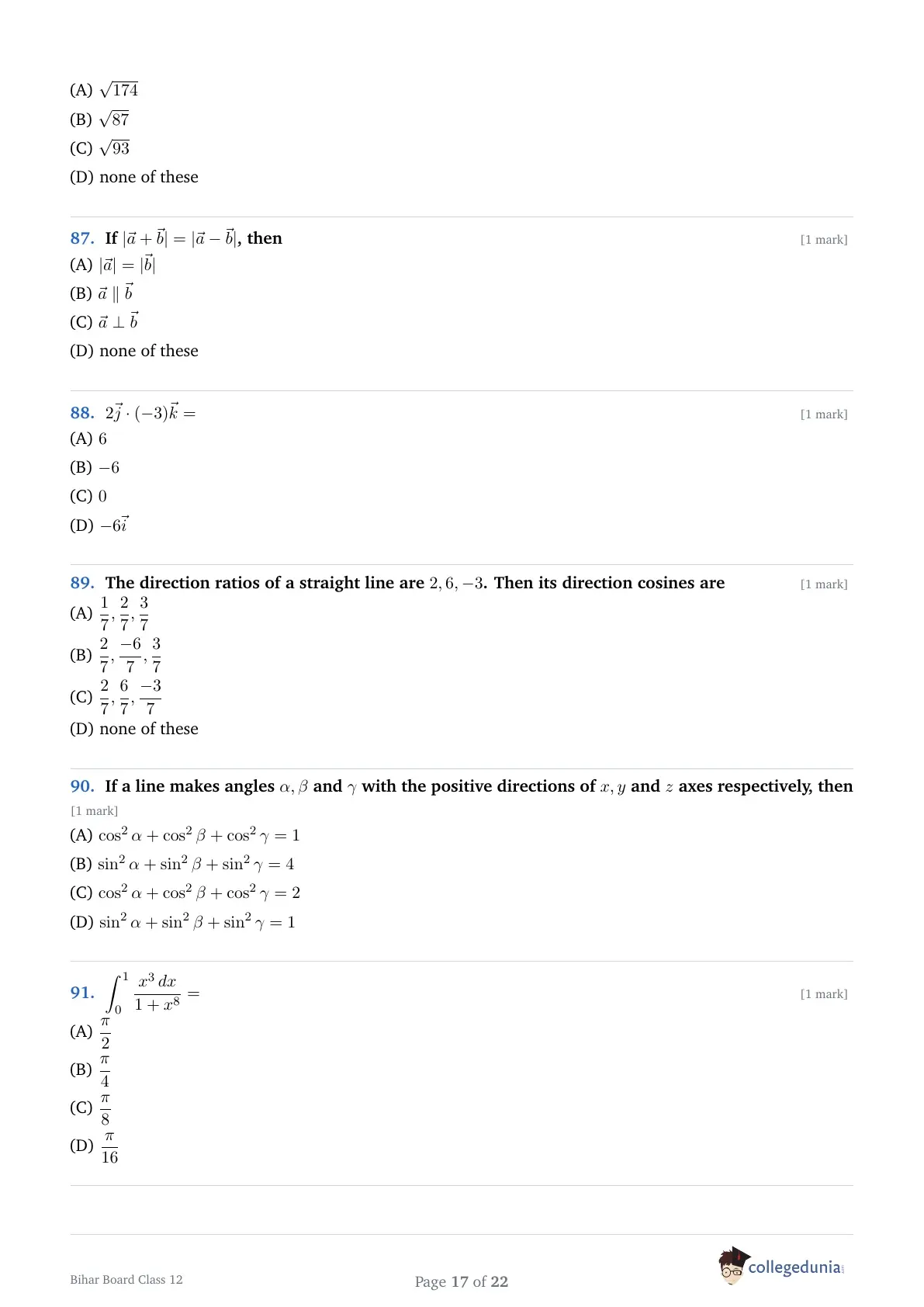
Question 87:

If \( |\vec{a}+\vec{b}| = |\vec{a}-\vec{b}| \), then

  • (A) \( |\vec{a}| = |\vec{b}| \)
  • (B) \( \vec{a} \parallel \vec{b} \)
  • (C) \( \vec{a} \perp \vec{b} \)
  • (D) none of these

Question 88:

\( 2\vec{j} \cdot (-3)\vec{k} = \)

  • (A) \( 6 \)
  • (B) \( -6 \)
  • (C) \( 0 \)
  • (D) \( -6\vec{i} \)

Question 89:

The direction ratios of a straight line are \( 2, 6, -3 \). Then its direction cosines are

  • (A) \( \frac{1}{7}, \frac{2}{7}, \frac{3}{7} \)
  • (B) \( \frac{2}{7}, \frac{-6}{7}, \frac{3}{7} \)
  • (C) \( \frac{2}{7}, \frac{6}{7}, \frac{-3}{7} \)
  • (D) none of these

Question 90:

If a line makes angles \( \alpha, \beta \) and \( \gamma \) with the positive directions of \( x, y \) and \( z \) axes respectively, then

  • (A) \( \cos^2\alpha+\cos^2\beta+\cos^2\gamma=1 \)
  • (B) \( \sin^2\alpha+\sin^2\beta+\sin^2\gamma=4 \)
  • (C) \( \cos^2\alpha+\cos^2\beta+\cos^2\gamma=2 \)
  • (D) \( \sin^2\alpha+\sin^2\beta+\sin^2\gamma=1 \)

Question 91:

\( \displaystyle \int_0^1 \frac{x^3\,dx}{1+x^8} = \)

  • (A) \( \dfrac{\pi}{2} \)
  • (B) \( \dfrac{\pi}{4} \)
  • (C) \( \dfrac{\pi}{8} \)
  • (D) \( \dfrac{\pi}{16} \)

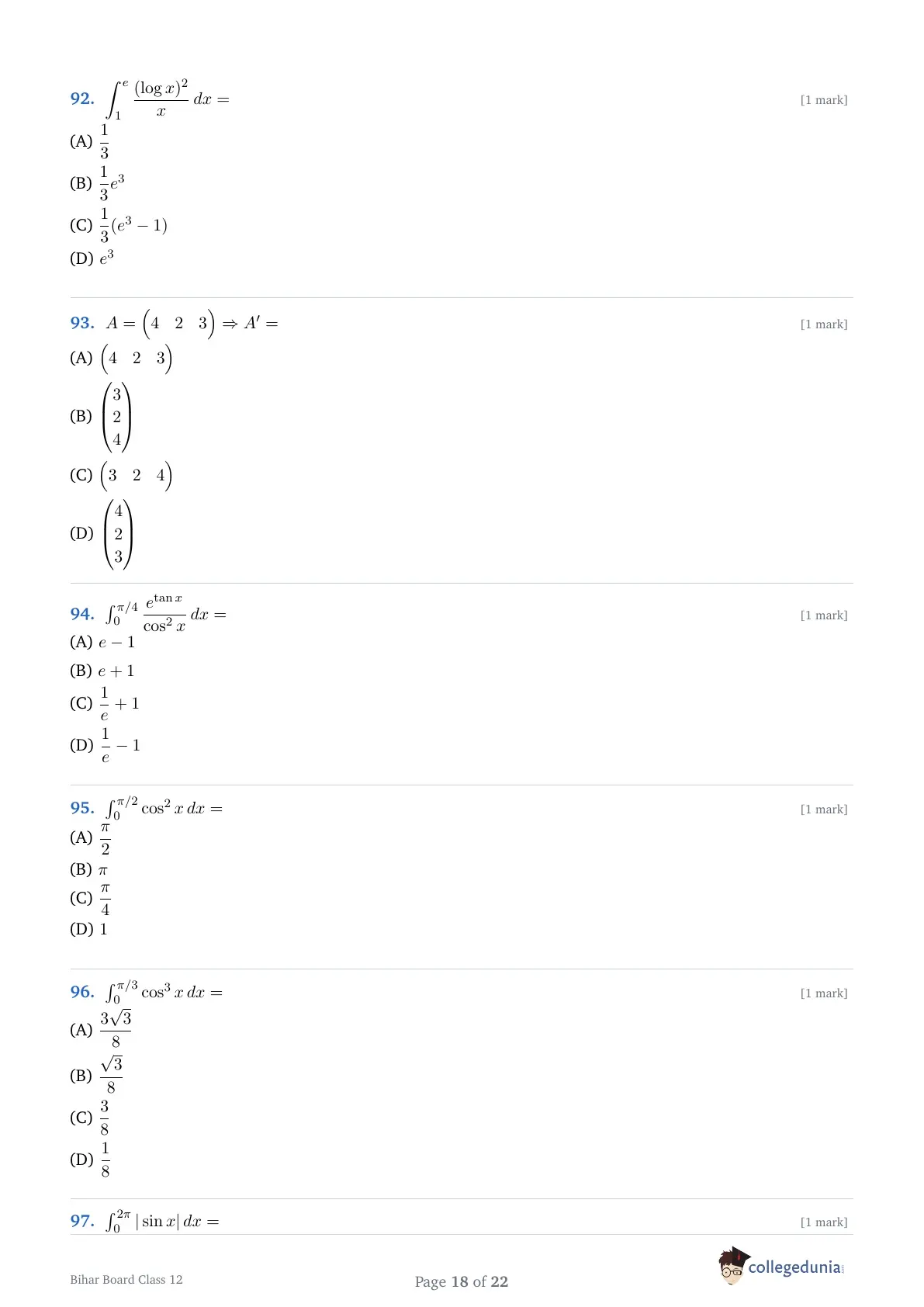
Question 92:

\( \displaystyle \int_1^e \frac{(\log x)^2}{x}\,dx = \)

  • (A) \( \dfrac{1}{3} \)
  • (B) \( \dfrac{1}{3}e^3 \)
  • (C) \( \dfrac{1}{3}(e^3-1) \)
  • (D) \( e^3 \)

Question 93:

\( A = \begin{pmatrix} 4 & 2 & 3 \end{pmatrix} \Rightarrow A' = \)

  • (A) \( \begin{pmatrix} 4 & 2 & 3 \end{pmatrix} \)
  • (B) \( \begin{pmatrix} 3 \\ 2 \\ 4 \end{pmatrix} \)
  • (C) \( \begin{pmatrix} 3 & 2 & 4 \end{pmatrix} \)
  • (D) \( \begin{pmatrix} 4 \\ 2 \\ 3 \end{pmatrix} \)

Question 94:

\( \int_0^{\pi/4} \frac{e^{\tan x}}{\cos^2 x}\,dx = \)

  • (A) \( e-1 \)
  • (B) \( e+1 \)
  • (C) \( \frac{1}{e}+1 \)
  • (D) \( \frac{1}{e}-1 \)

Question 95:

\( \int_0^{\pi/2} \cos^2 x\,dx = \)

  • (A) \( \frac{\pi}{2} \)
  • (B) \( \pi \)
  • (C) \( \frac{\pi}{4} \)
  • (D) \( 1 \)

Question 96:

\( \int_0^{\pi/3} \cos^3 x\,dx = \)

  • (A) \( \frac{3\sqrt{3}}{8} \)
  • (B) \( \frac{\sqrt{3}}{8} \)
  • (C) \( \frac{3}{8} \)
  • (D) \( \frac{1}{8} \)

Question 97:

\( \int_0^{2\pi} |\sin x|\,dx = \)

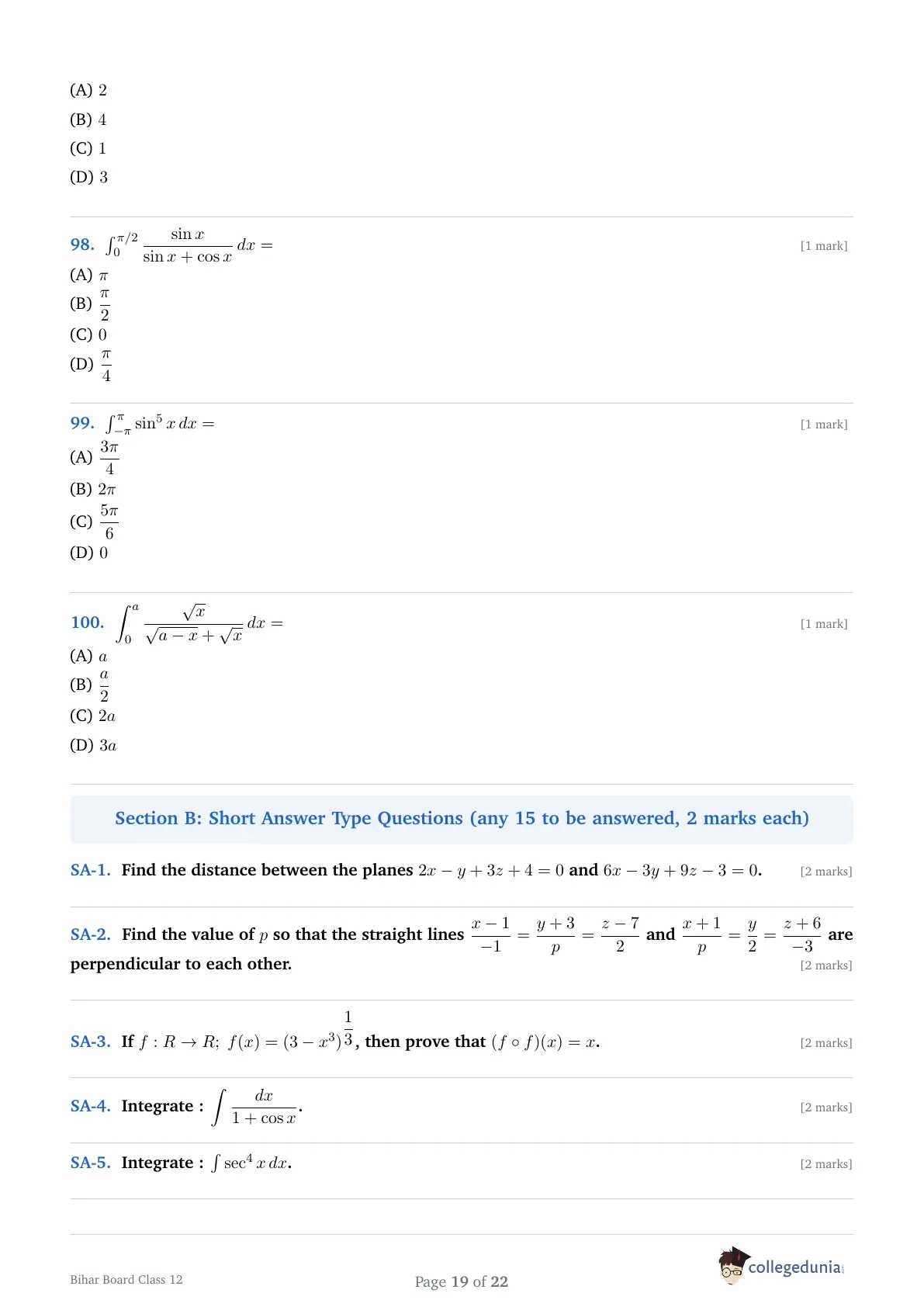
  • (A) \( 2 \)
  • (B) \( 4 \)
  • (C) \( 1 \)
  • (D) \( 3 \)

Question 98:

\( \int_0^{\pi/2} \frac{\sin x}{\sin x+\cos x}\,dx = \)

  • (A) \( \pi \)
  • (B) \( \frac{\pi}{2} \)
  • (C) \( 0 \)
  • (D) \( \frac{\pi}{4} \)

Question 99:

\( \int_{-\pi}^{\pi} \sin^5 x\,dx = \)

  • (A) \( \frac{3\pi}{4} \)
  • (B) \( 2\pi \)
  • (C) \( \frac{5\pi}{6} \)
  • (D) \( 0 \)

Question 100:

\( \displaystyle \int_0^a \frac{\sqrt{x}}{\sqrt{a-x}+\sqrt{x}}\,dx = \)

  • (A) \( a \)
  • (B) \( \frac{a}{2} \)
  • (C) \( 2a \)
  • (D) \( 3a \)

Section B - Short Answer Questions (2 marks each, any 15 to be answered)


Question SA-1:

Find the distance between the planes \( 2x - y + 3z + 4 = 0 \) and \( 6x - 3y + 9z - 3 = 0 \).


Question SA-2:

Find the value of \( p \) so that the straight lines \( \frac{x - 1}{-1} = \frac{y + 3}{p} = \frac{z - 7}{2} \) and \( \frac{x + 1}{p} = \frac{y}{2} = \frac{z + 6}{-3} \) are perpendicular to each other.


Question SA-3:

If \( f : R \to R;\ f(x) = (3 - x^3)^{\frac{1}{3}} \), then prove that \( (f \circ f)(x) = x \).


Question SA-4:

Integrate : \( \displaystyle\int \dfrac{dx}{1+\cos x} \).


Question SA-5:

Integrate : \( \int \sec^4 x \, dx \).


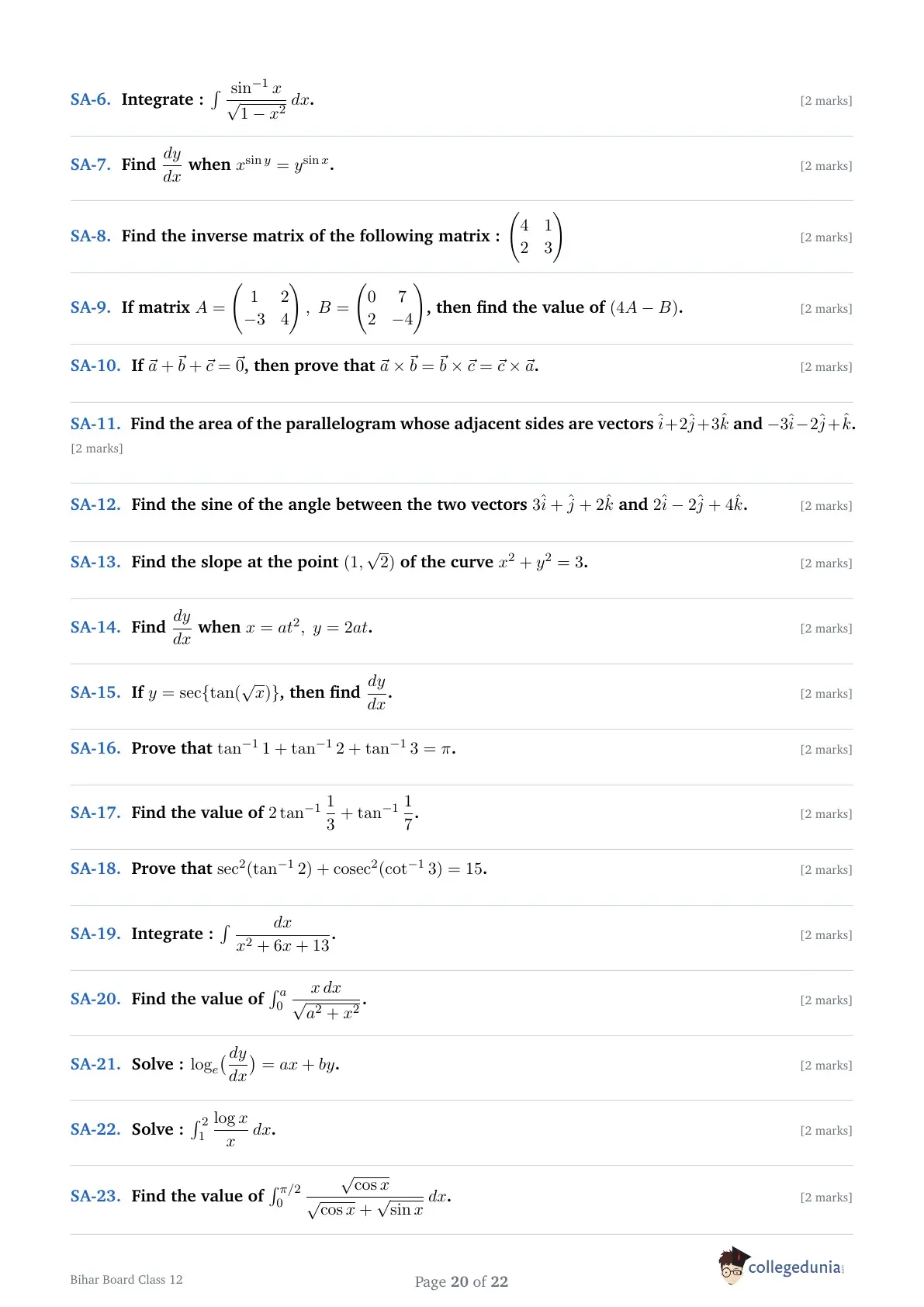
Question SA-6:

Integrate : \( \int \frac{\sin^{-1} x}{\sqrt{1 - x^2}} \, dx \).


Question SA-7:

Find \( \dfrac{dy}{dx} \) when \( x^{\sin y} = y^{\sin x} \).


Question SA-8:

Find the inverse matrix of the following matrix : \( \begin{pmatrix} 4 & 1 \\ 2 & 3 \end{pmatrix} \)


Question SA-9:

If matrix \( A = \begin{pmatrix} 1 & 2 \\ -3 & 4 \end{pmatrix},\ B = \begin{pmatrix} 0 & 7 \\ 2 & -4 \end{pmatrix} \), then find the value of \( (4A - B) \).


Question SA-10:

If \( \vec{a} + \vec{b} + \vec{c} = \vec{0} \), then prove that \( \vec{a} \times \vec{b} = \vec{b} \times \vec{c} = \vec{c} \times \vec{a} \).


Question SA-11:

Find the area of the parallelogram whose adjacent sides are vectors \( \hat{i} + 2\hat{j} + 3\hat{k} \) and \( -3\hat{i} - 2\hat{j} + \hat{k} \).


Question SA-12:

Find the sine of the angle between the two vectors \( 3\hat{i} + \hat{j} + 2\hat{k} \) and \( 2\hat{i} - 2\hat{j} + 4\hat{k} \).


Question SA-13:

Find the slope at the point \( (1, \sqrt{2}) \) of the curve \( x^2 + y^2 = 3 \).


Question SA-14:

Find \( \dfrac{dy}{dx} \) when \( x = at^2,\ y = 2at \).


Question SA-15:

If \( y = \sec\{\tan(\sqrt{x})\} \), then find \( \dfrac{dy}{dx} \).


Question SA-16:

Prove that \( \tan^{-1} 1 + \tan^{-1} 2 + \tan^{-1} 3 = \pi \).


Question SA-17:

Find the value of \( 2\tan^{-1}\dfrac{1}{3} + \tan^{-1}\dfrac{1}{7} \).


Question SA-18:

Prove that \( \sec^2(\tan^{-1}2) + \operatorname{cosec}^2(\cot^{-1}3) = 15 \).


Question SA-19:

Integrate : \( \int \frac{dx}{x^2 + 6x + 13} \).


Question SA-20:

Find the value of \( \int_0^a \frac{x \, dx}{\sqrt{a^2 + x^2}} \).


Question SA-21:

Solve : \( \log_e\left(\frac{dy}{dx}\right) = ax + by \).


Question SA-22:

Solve : \( \int_1^2 \frac{\log x}{x} \, dx \).


Question SA-23:

Find the value of \( \int_0^{\pi/2} \frac{\sqrt{\cos x}}{\sqrt{\cos x} + \sqrt{\sin x}} \, dx \).


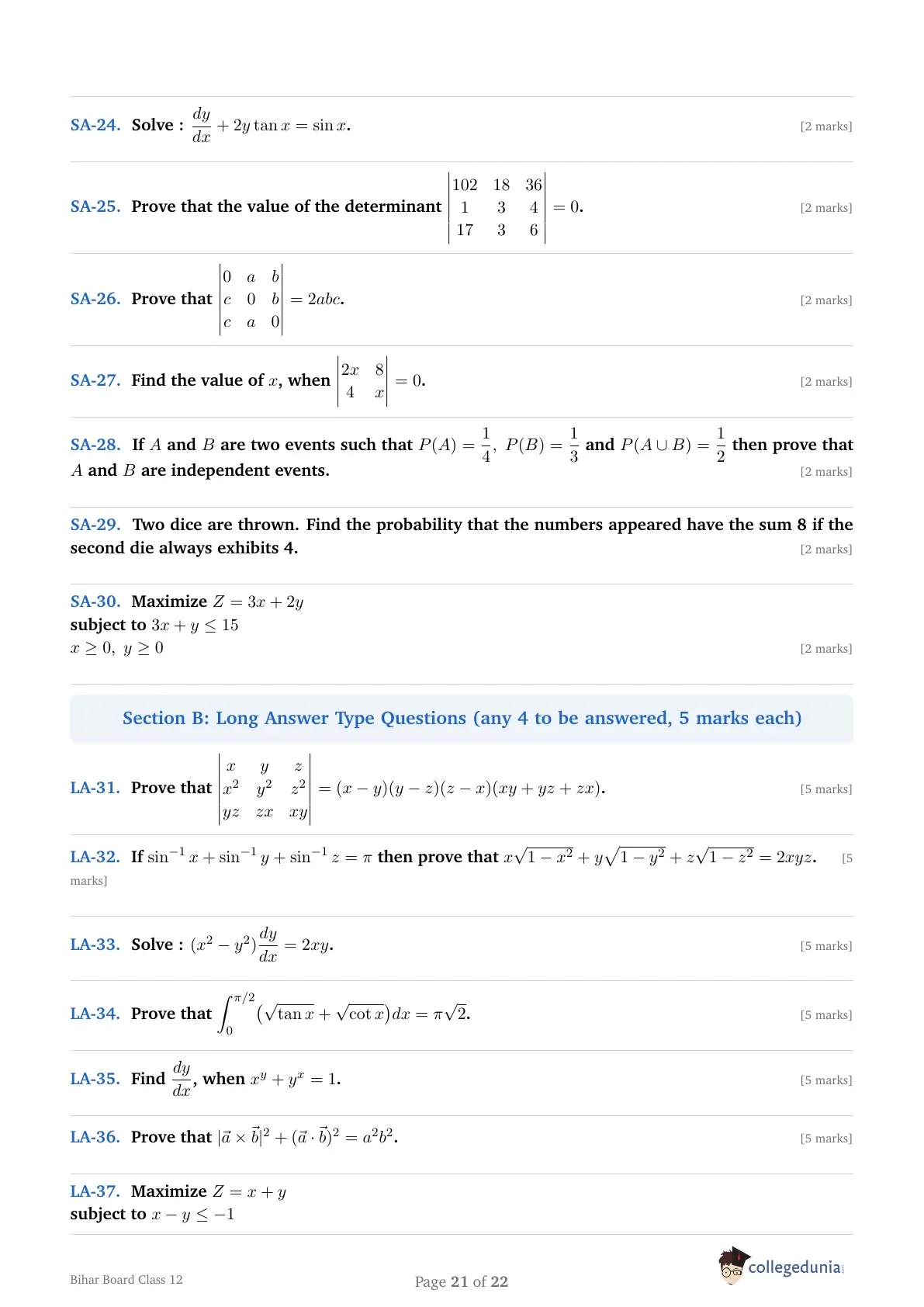
Question SA-24:

Solve : \( \frac{dy}{dx} + 2y \tan x = \sin x \).


Question SA-25:

Prove that the value of the determinant \( \begin{vmatrix} 102 & 18 & 36 \\ 1 & 3 & 4 \\ 17 & 3 & 6 \end{vmatrix} = 0 \).


Question SA-26:

Prove that \( \begin{vmatrix} 0 & a & b \\ c & 0 & b \\ c & a & 0 \end{vmatrix} = 2abc \).


Question SA-27:

Find the value of \( x \), when \( \begin{vmatrix} 2x & 8 \\ 4 & x \end{vmatrix} = 0 \).


Question SA-28:

If \( A \) and \( B \) are two events such that \( P(A) = \frac{1}{4},\ P(B) = \frac{1}{3} \) and \( P(A \cup B) = \frac{1}{2} \) then prove that \( A \) and \( B \) are independent events.


Question SA-29:

Two dice are thrown. Find the probability that the numbers appeared have the sum 8 if the second die always exhibits 4.


Question SA-30:

Maximize \( Z = 3x + 2y \)
subject to \( 3x + y \leq 15 \)
\( x \geq 0,\ y \geq 0 \)

Section B - Long Answer Questions (5 marks each, any 4 to be answered)


Question LA-31:

Prove that \( \begin{vmatrix} x & y & z \\ x^2 & y^2 & z^2 \\ yz & zx & xy \end{vmatrix} = (x - y)(y - z)(z - x)(xy + yz + zx) \).


Question LA-32:

If \( \sin^{-1} x + \sin^{-1} y + \sin^{-1} z = \pi \) then prove that \( x\sqrt{1 - x^2} + y\sqrt{1 - y^2} + z\sqrt{1 - z^2} = 2xyz \).


Question LA-33:

Solve : \( (x^2 - y^2)\dfrac{dy}{dx} = 2xy \).


Question LA-34:

Prove that \( \displaystyle\int_0^{\pi/2} \left(\sqrt{\tan x} + \sqrt{\cot x}\right) dx = \pi\sqrt{2} \).


Question LA-35:

Find \( \dfrac{dy}{dx} \), when \( x^y + y^x = 1 \).


Question LA-36:

Prove that \( |\vec{a} \times \vec{b}|^2 + (\vec{a} \cdot \vec{b})^2 = a^2 b^2 \).


Question LA-37:

Maximize \( Z = x + y \)
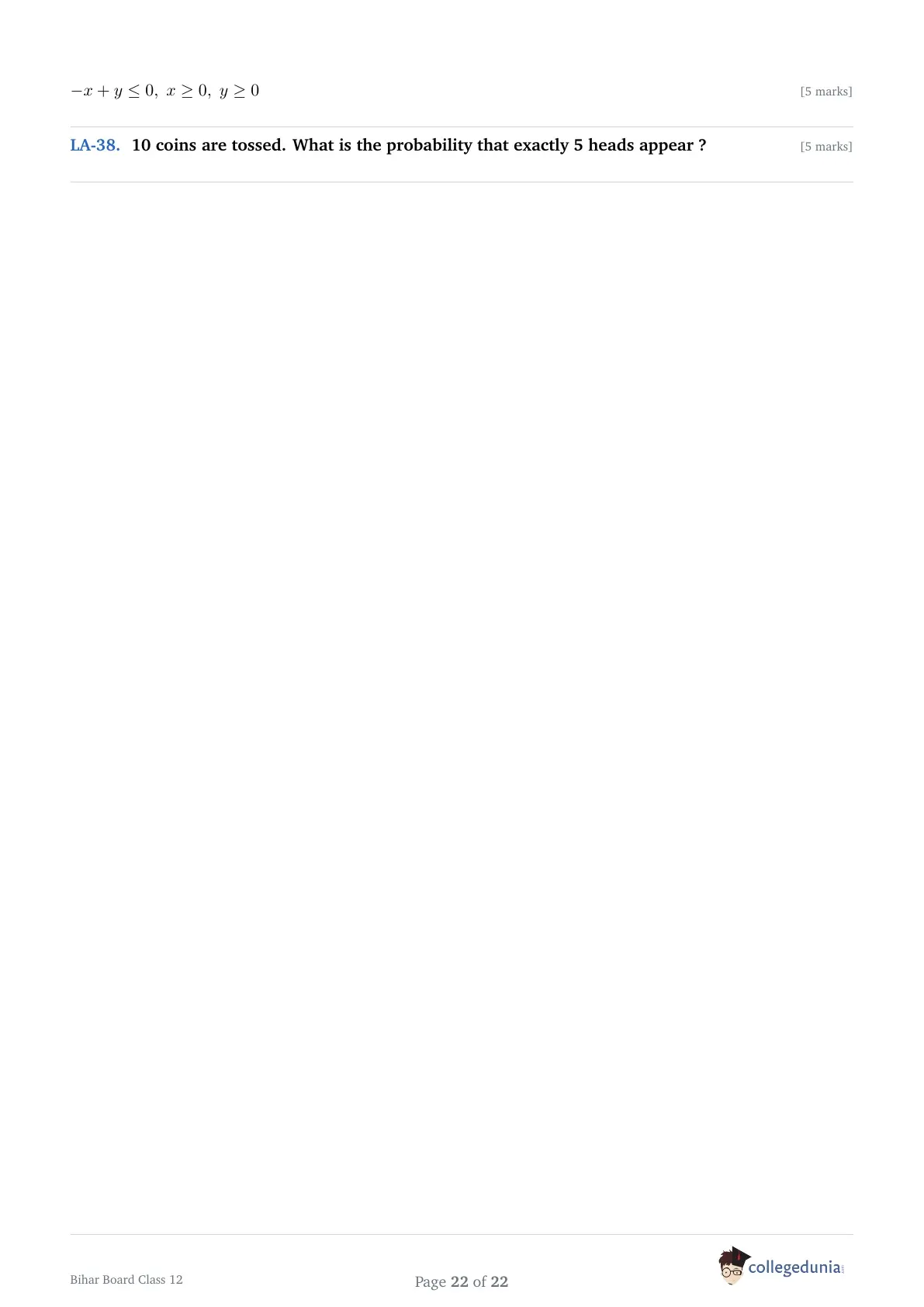
subject to \( x - y \le -1 \)
\( -x + y \le 0,\ x \ge 0,\ y \ge 0 \)


Question LA-38:

10 coins are tossed. What is the probability that exactly 5 heads appear ?

Bihar Board Class 12 Mathematics Question Paper Pattern and Marking Scheme 2026

The Bihar Board (BSEB) Class 12 Mathematics 2026 question paper carries 100 marks and has 138 questions (100 + 30 + 8) in two sections, A and B. The time allowed is 3 hours 15 minutes, which includes 15 minutes of extra time to read the questions carefully. The paper is bilingual (Hindi and English). The table below gives the section-wise pattern from the official question paper.

Section Questions Question Type Total Questions To Be Answered Marks per Question Marks
A Q1 - Q100 Objective type (OMR) 100 50 1 50
B SA-1 - SA-30 Short answer 30 15 2 30
B LA-31 - LA-38 Long answer 8 4 5 20
Total 138 69 100

The marking scheme printed in the instructions of the question paper is as follows:

  • Section A has 100 objective questions, each with four options of which only one is correct. Any 50 questions are to be answered, each carrying 1 mark, and the answers are marked on the OMR answer sheet with a blue or black ball pen.
  • If more than 50 questions of Section A are answered, only the first 50 answers are evaluated by the computer.
  • Section B has 30 short answer type questions, of which any 15 are to be answered, each carrying 2 marks.
  • Section B also has 8 long answer type questions, of which any 4 are to be answered, each carrying 5 marks.
  • Use of whitener, liquid, blade, nail or similar material on the OMR sheet makes the result invalid, and the use of any electronic appliance is strictly prohibited.