




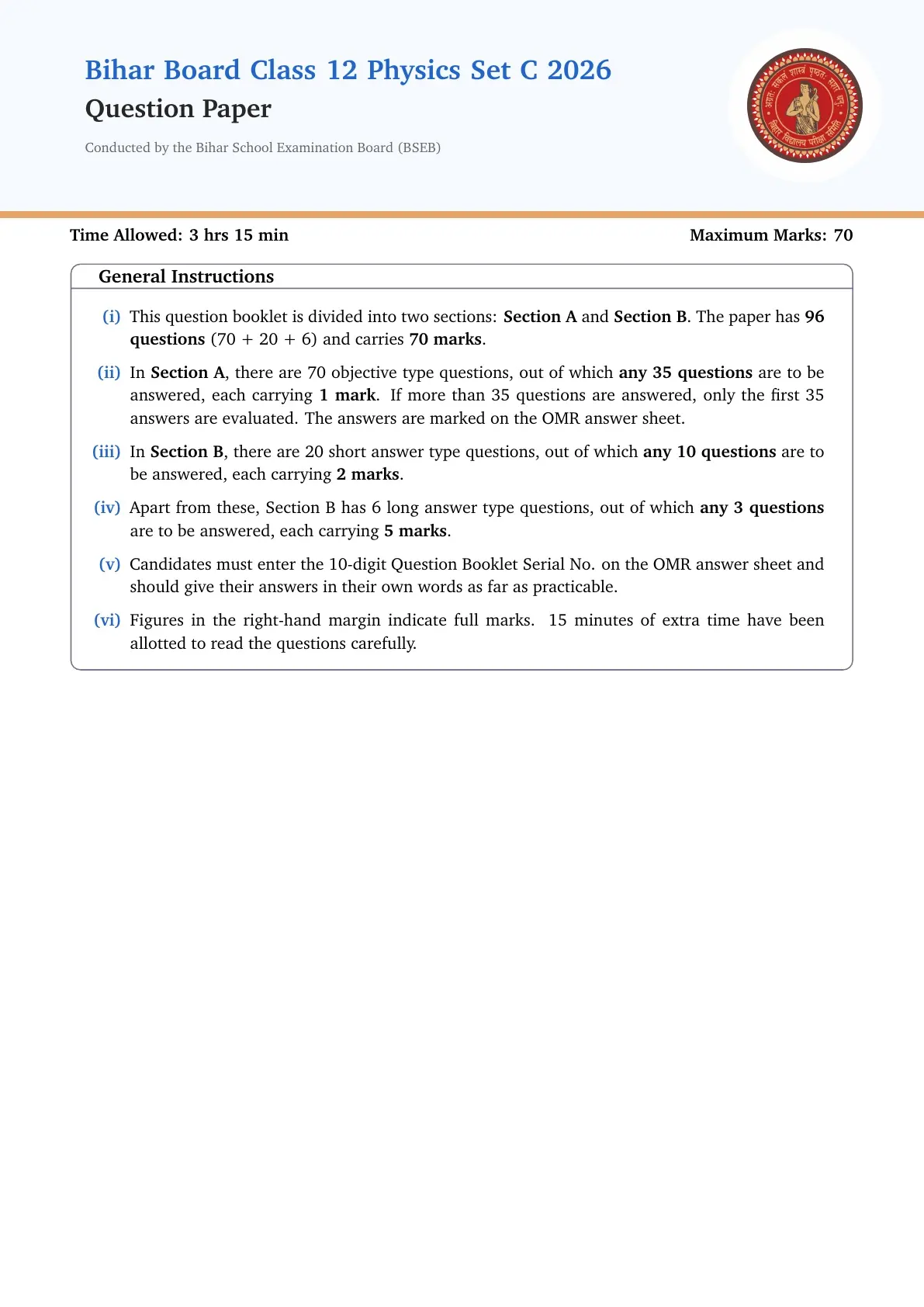
Bihar Board Class 12 Physics Set C 2026 Question Paper with Solutions PDF is available here for download. The exam was conducted by the BSEB on 5th Feb 2026 in the first shift (09:30 AM-12:45 PM) for a duration of 3 hours 15 min and carried a total of 70 Marks. The question paper PDF given below is of Set C, one of the sets in which the paper was issued. It has 96 questions, and every question has a detailed solution.
The Physics question paper includes the following types of questions:
- Objective type (MCQ) questions: 1 mark each (any 35 out of 70)
- Short answer type questions: 2 marks each (any 10 out of 20)
- Long answer type questions: 5 marks each (any 3 out of 6)
Bihar Board Class 12 Physics Set C 2026 Question Paper with Solution PDF
| BSEB Official PDF | Question Paper PDF | Solutions PDF |
|---|---|---|
| Download official PDF 0.98 MB | Download Collegedunia question paper PDF 0.49 MB | Download solutions PDF 0.74 MB |
Also Check: Download Bihar Board Class 12 Previous Year Papers for Free
Bihar Board Class 12 Physics Set C 2026 Questions with Solutions
Section A - Objective Questions (1 mark each, any 35 to be answered)
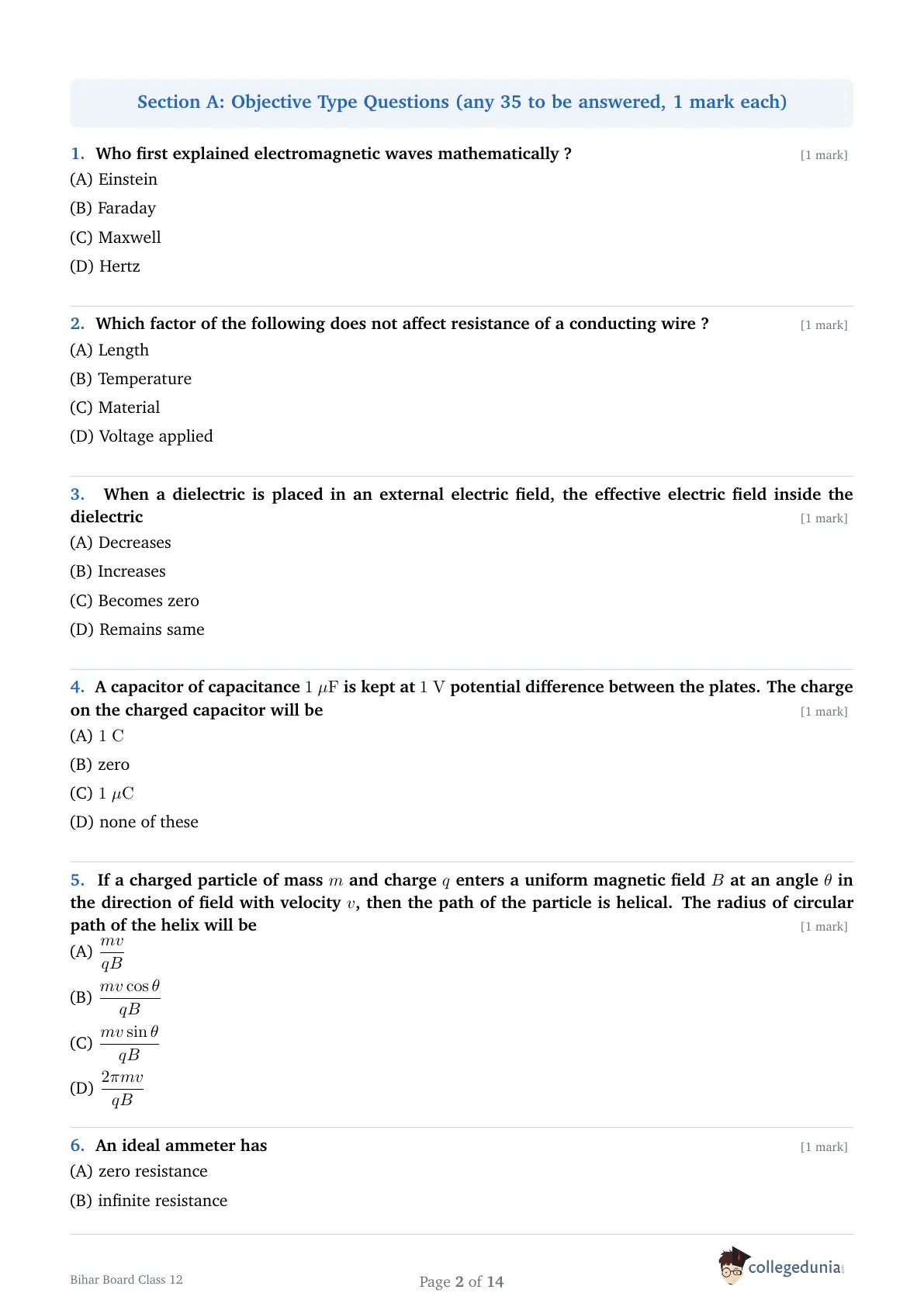
Who first explained electromagnetic waves mathematically ?
Which factor of the following does not affect resistance of a conducting wire ?
When a dielectric is placed in an external electric field, the effective electric field inside the dielectric
A capacitor of capacitance \( 1\ \mu\mathrm{F} \) is kept at \( 1\ \mathrm{V} \) potential difference between the plates. The charge on the charged capacitor will be
If a charged particle of mass \( m \) and charge \( q \) enters a uniform magnetic field \( B \) at an angle \( \theta \) in the direction of field with velocity \( v \), then the path of the particle is helical. The radius of circular path of the helix will be
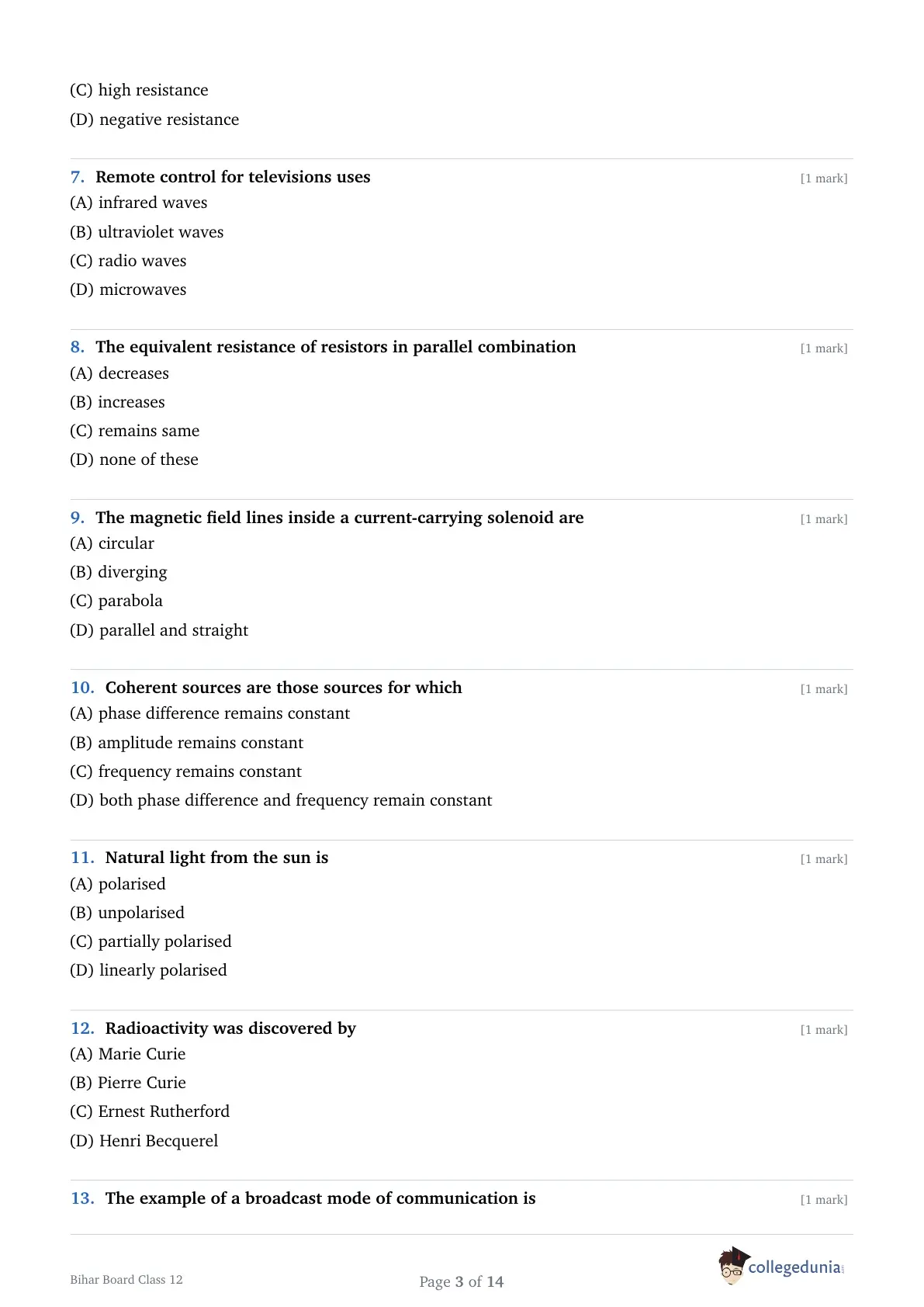
An ideal ammeter has
Remote control for televisions uses
The equivalent resistance of resistors in parallel combination
The magnetic field lines inside a current-carrying solenoid are
Coherent sources are those sources for which
Natural light from the sun is
Radioactivity was discovered by
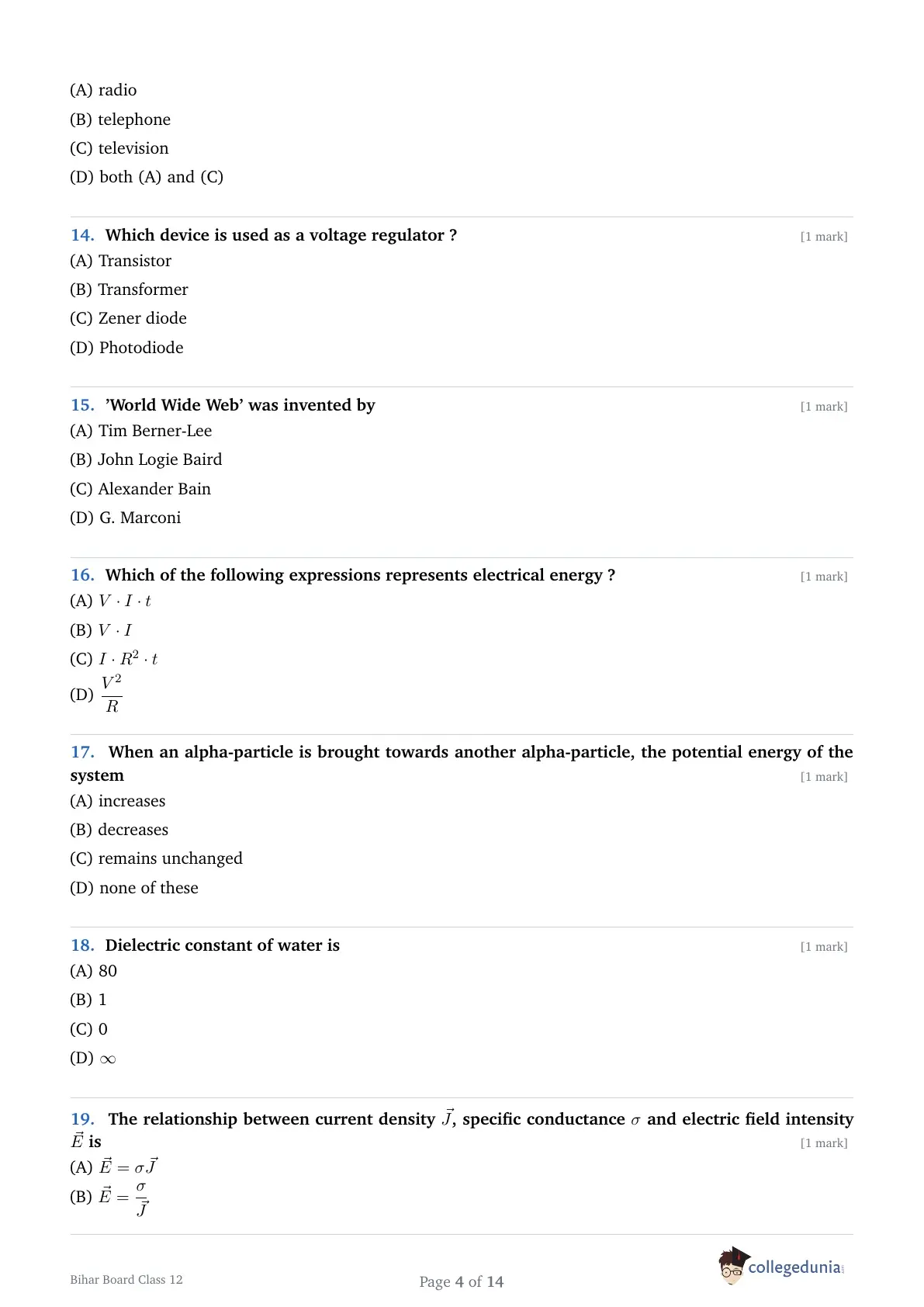
The example of a broadcast mode of communication is
Which device is used as a voltage regulator ?
'World Wide Web' was invented by
Which of the following expressions represents electrical energy ?
When an alpha-particle is brought towards another alpha-particle, the potential energy of the system
Dielectric constant of water is
The relationship between current density \( \vec{J} \), specific conductance \( \sigma \) and electric field intensity \( \vec{E} \) is
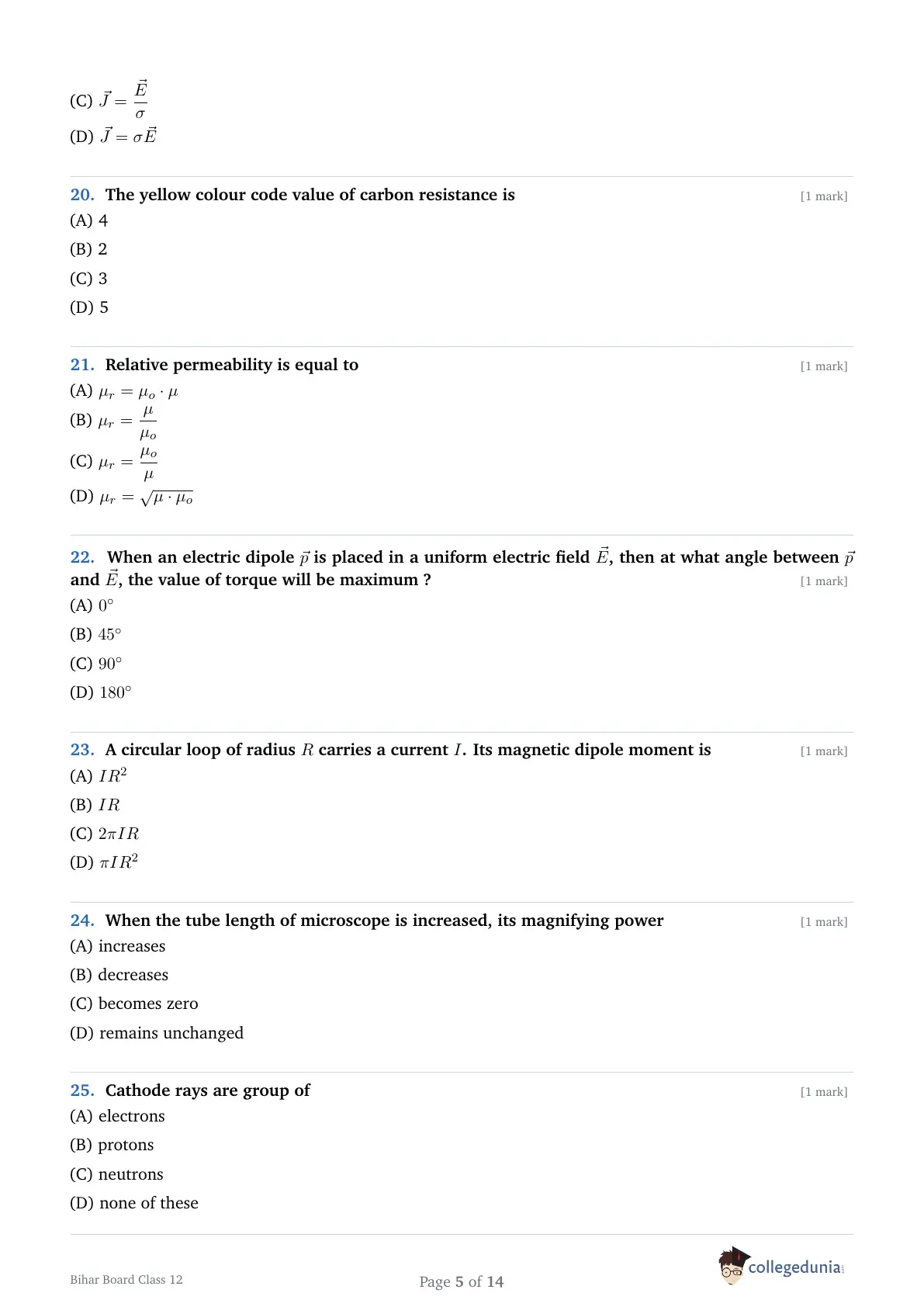
The yellow colour code value of carbon resistance is
Relative permeability is equal to
When an electric dipole \( \vec{p} \) is placed in a uniform electric field \( \vec{E} \), then at what angle between \( \vec{p} \) and \( \vec{E} \), the value of torque will be maximum ?
A circular loop of radius \( R \) carries a current \( I \). Its magnetic dipole moment is
When the tube length of microscope is increased, its magnifying power
Cathode rays are group of
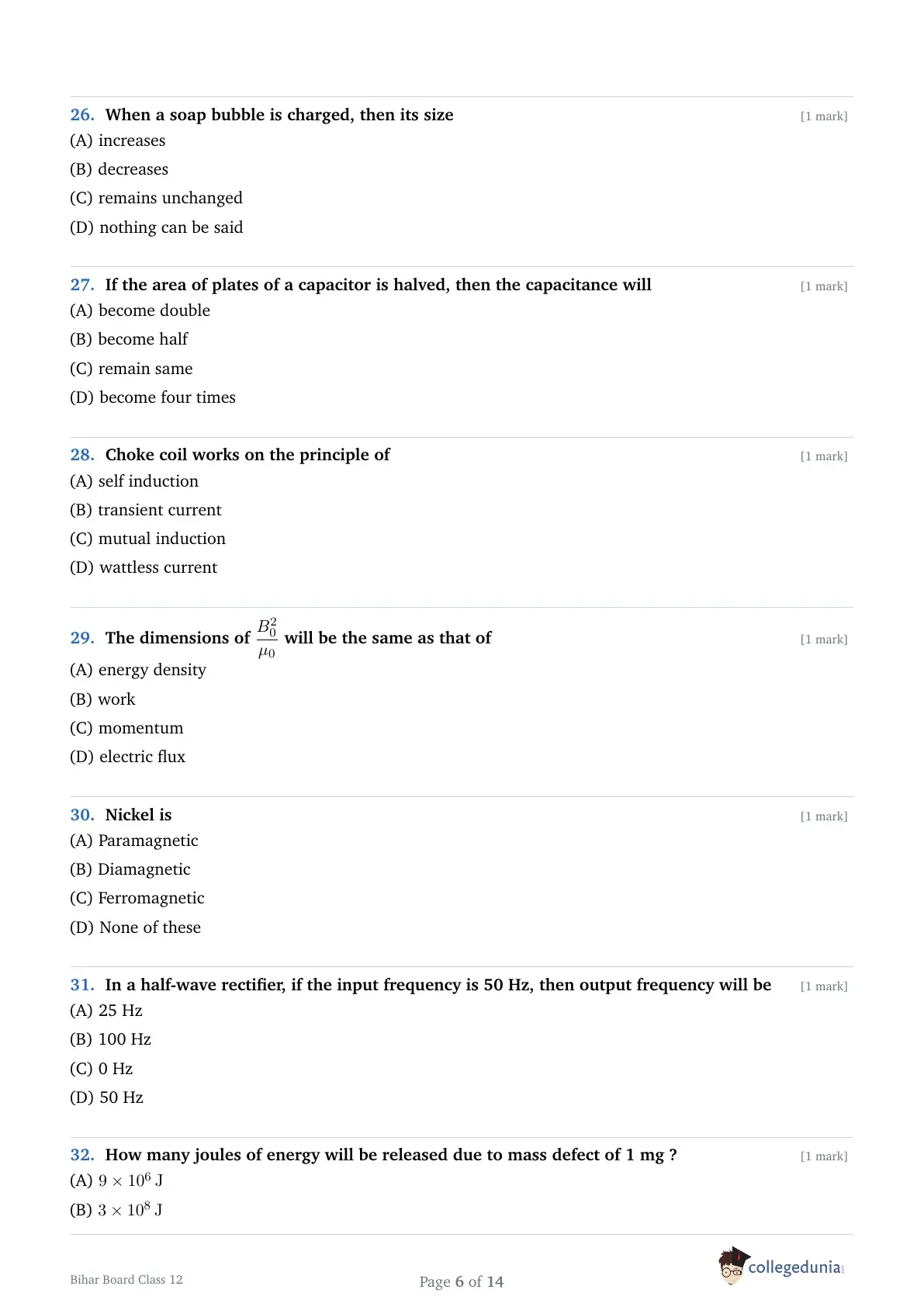
When a soap bubble is charged, then its size
If the area of plates of a capacitor is halved, then the capacitance will
Choke coil works on the principle of
The dimensions of \( \dfrac{B_0^2}{\mu_0} \) will be the same as that of
Nickel is
In a half-wave rectifier, if the input frequency is 50 Hz, then output frequency will be
How many joules of energy will be released due to mass defect of 1 mg ?
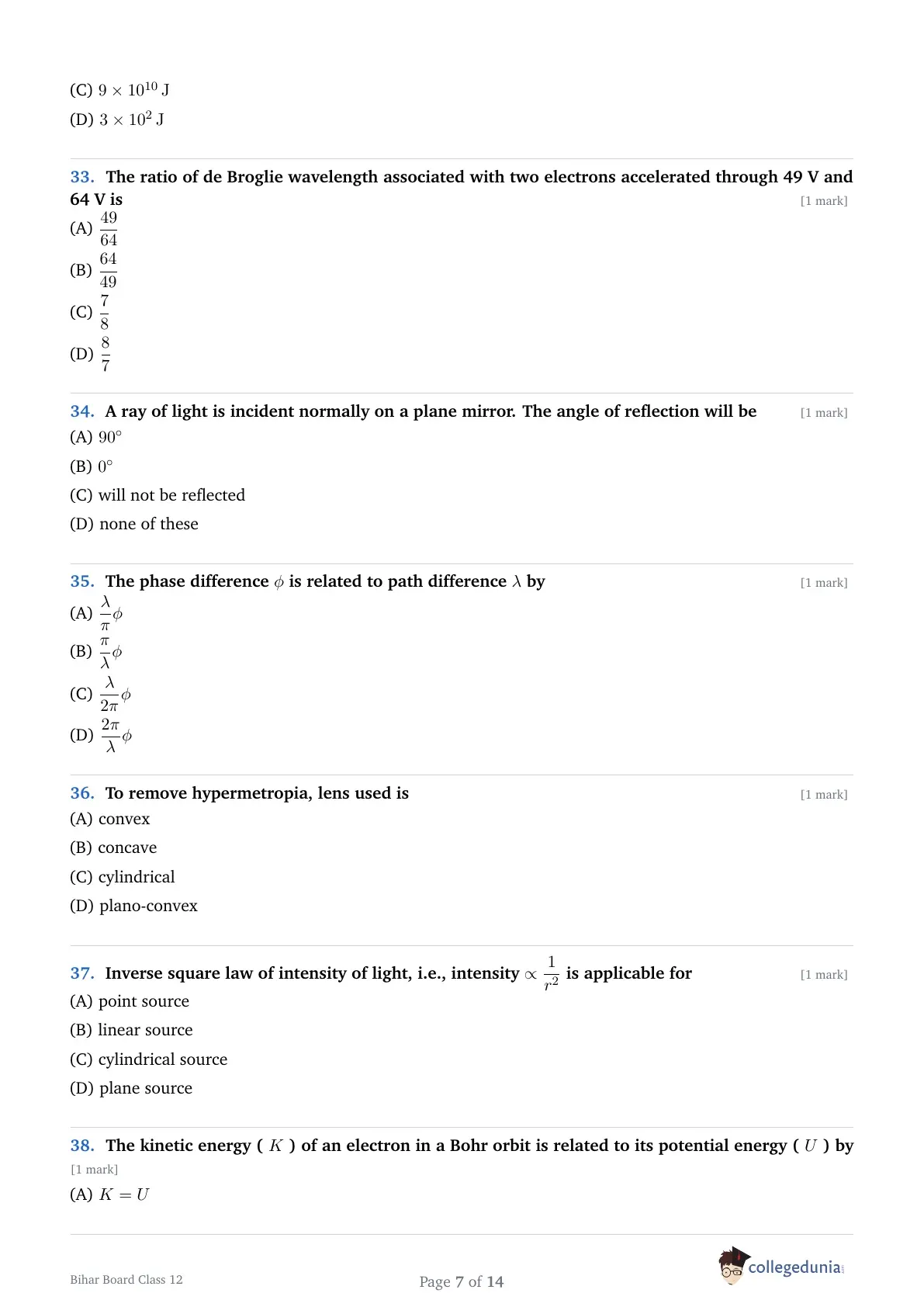
The ratio of de Broglie wavelength associated with two electrons accelerated through 49 V and 64 V is
A ray of light is incident normally on a plane mirror. The angle of reflection will be
The phase difference \( \phi \) is related to path difference \( \lambda \) by
To remove hypermetropia, lens used is
Inverse square law of intensity of light, i.e., intensity \( \propto \dfrac{1}{r^2} \) is applicable for
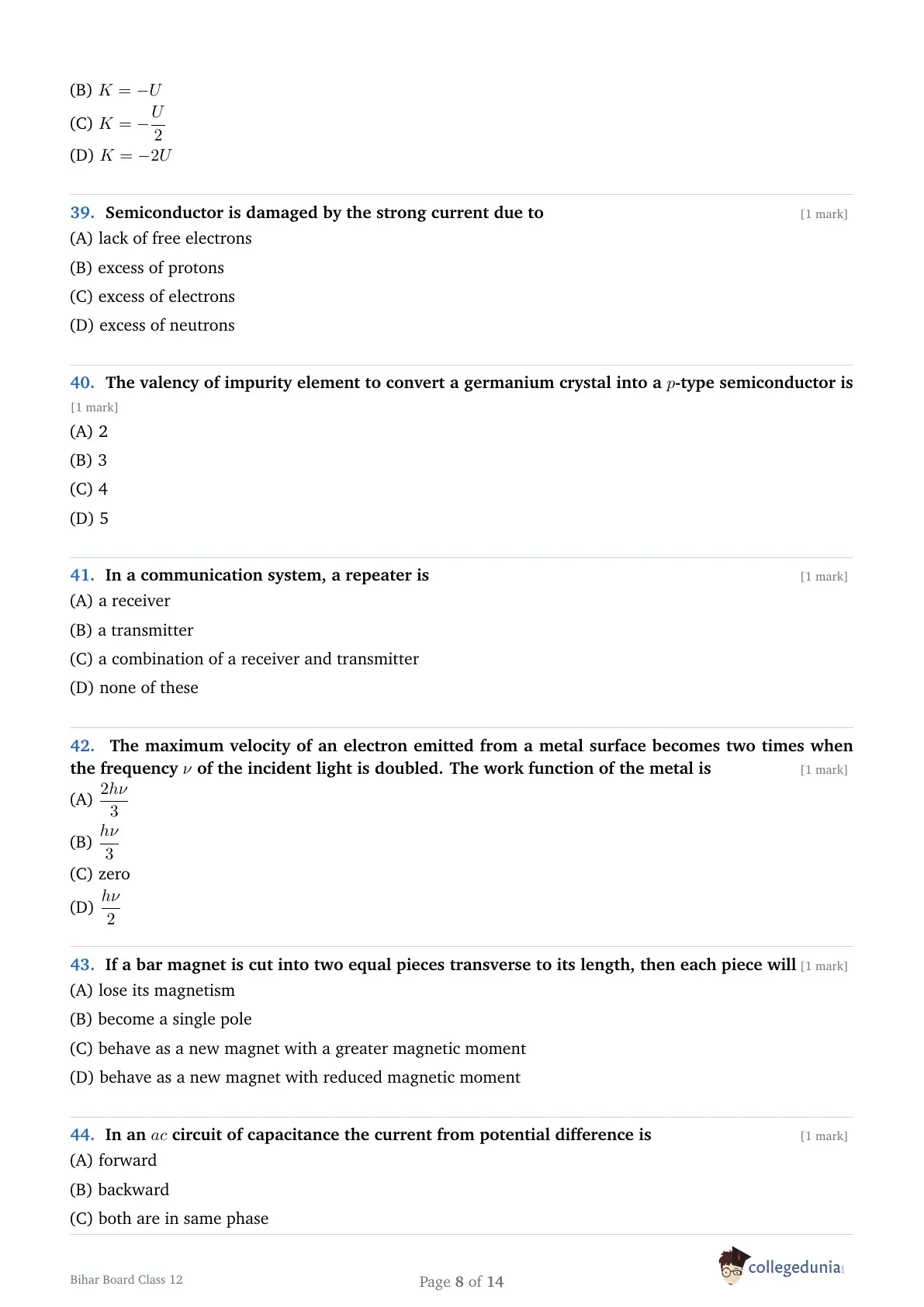
The kinetic energy ( \( K \) ) of an electron in a Bohr orbit is related to its potential energy ( \( U \) ) by
Semiconductor is damaged by the strong current due to
The valency of impurity element to convert a germanium crystal into a \( p \)-type semiconductor is
In a communication system, a repeater is
The maximum velocity of an electron emitted from a metal surface becomes two times when the frequency \( \nu \) of the incident light is doubled. The work function of the metal is
If a bar magnet is cut into two equal pieces transverse to its length, then each piece will
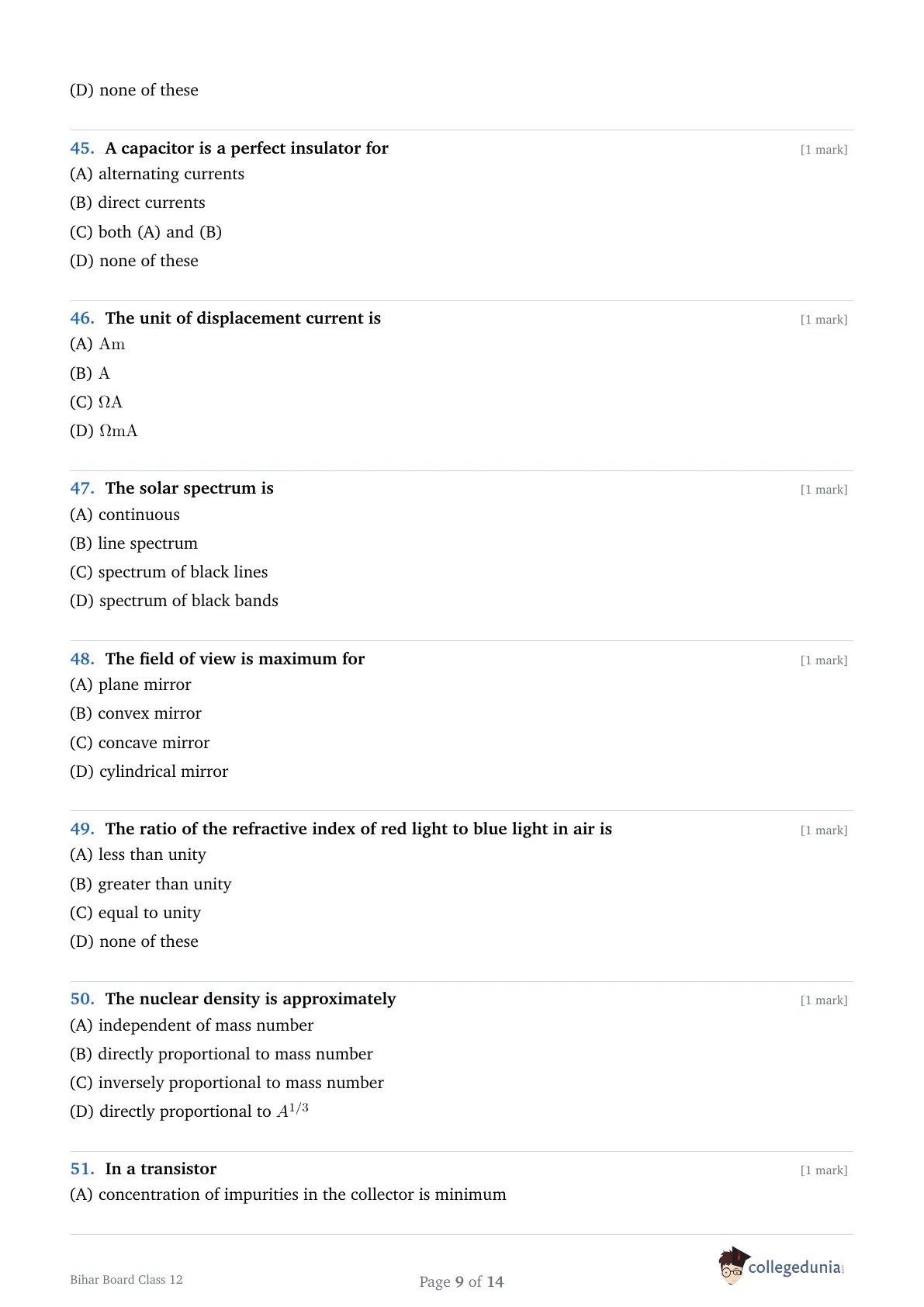
In an \( ac \) circuit of capacitance the current from potential difference is
A capacitor is a perfect insulator for
The unit of displacement current is
The solar spectrum is
The field of view is maximum for
The ratio of the refractive index of red light to blue light in air is
The nuclear density is approximately
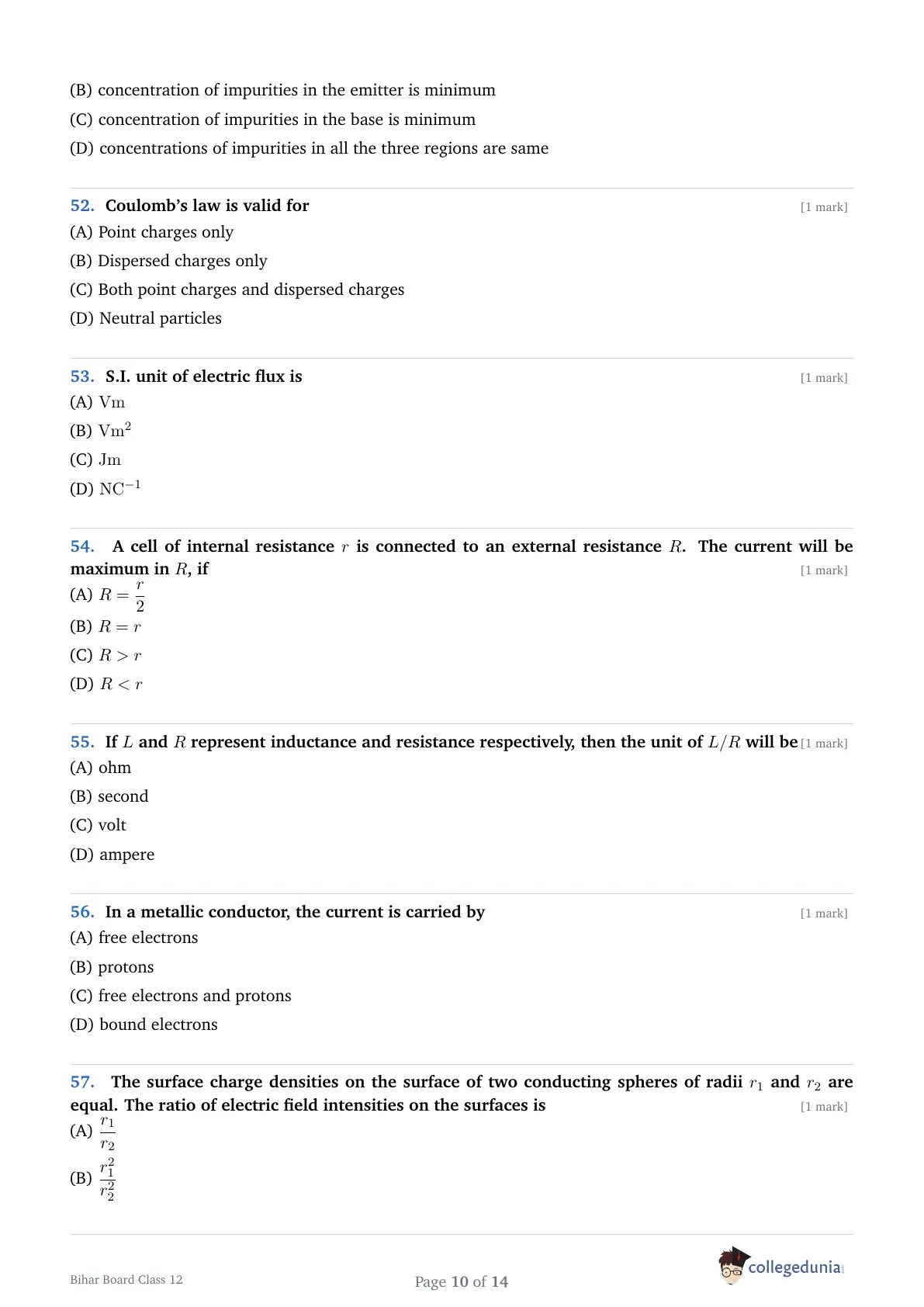
In a transistor
Coulomb's law is valid for
S.I. unit of electric flux is
A cell of internal resistance \( r \) is connected to an external resistance \( R \). The current will be maximum in \( R \), if
If \( L \) and \( R \) represent inductance and resistance respectively, then the unit of \( L/R \) will be
In a metallic conductor, the current is carried by
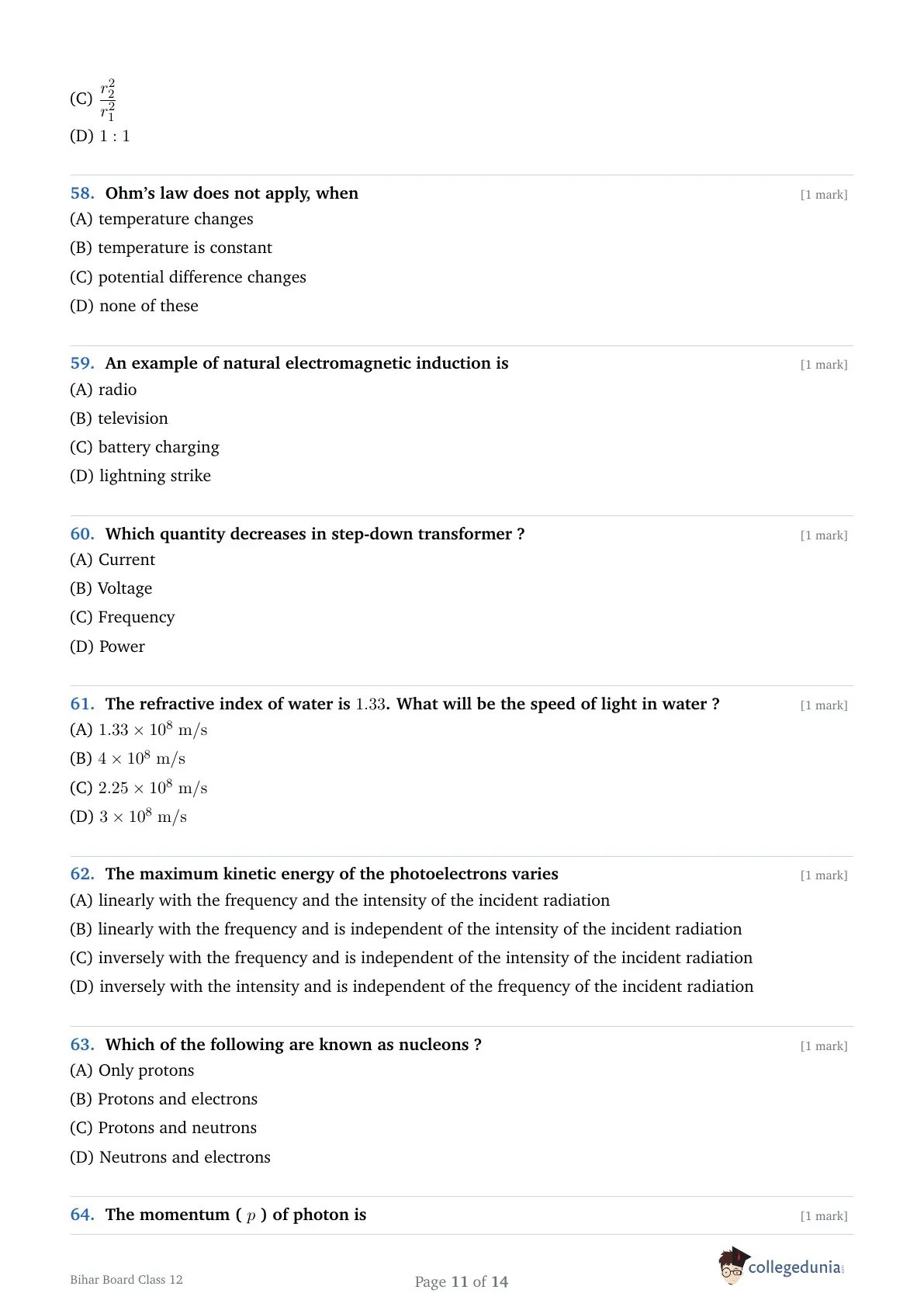
The surface charge densities on the surface of two conducting spheres of radii \( r_1 \) and \( r_2 \) are equal. The ratio of electric field intensities on the surfaces is
Ohm's law does not apply, when
An example of natural electromagnetic induction is
Which quantity decreases in step-down transformer ?
The refractive index of water is \( 1.33 \). What will be the speed of light in water ?
The maximum kinetic energy of the photoelectrons varies
Which of the following are known as nucleons ?
The momentum ( \( p \) ) of photon is
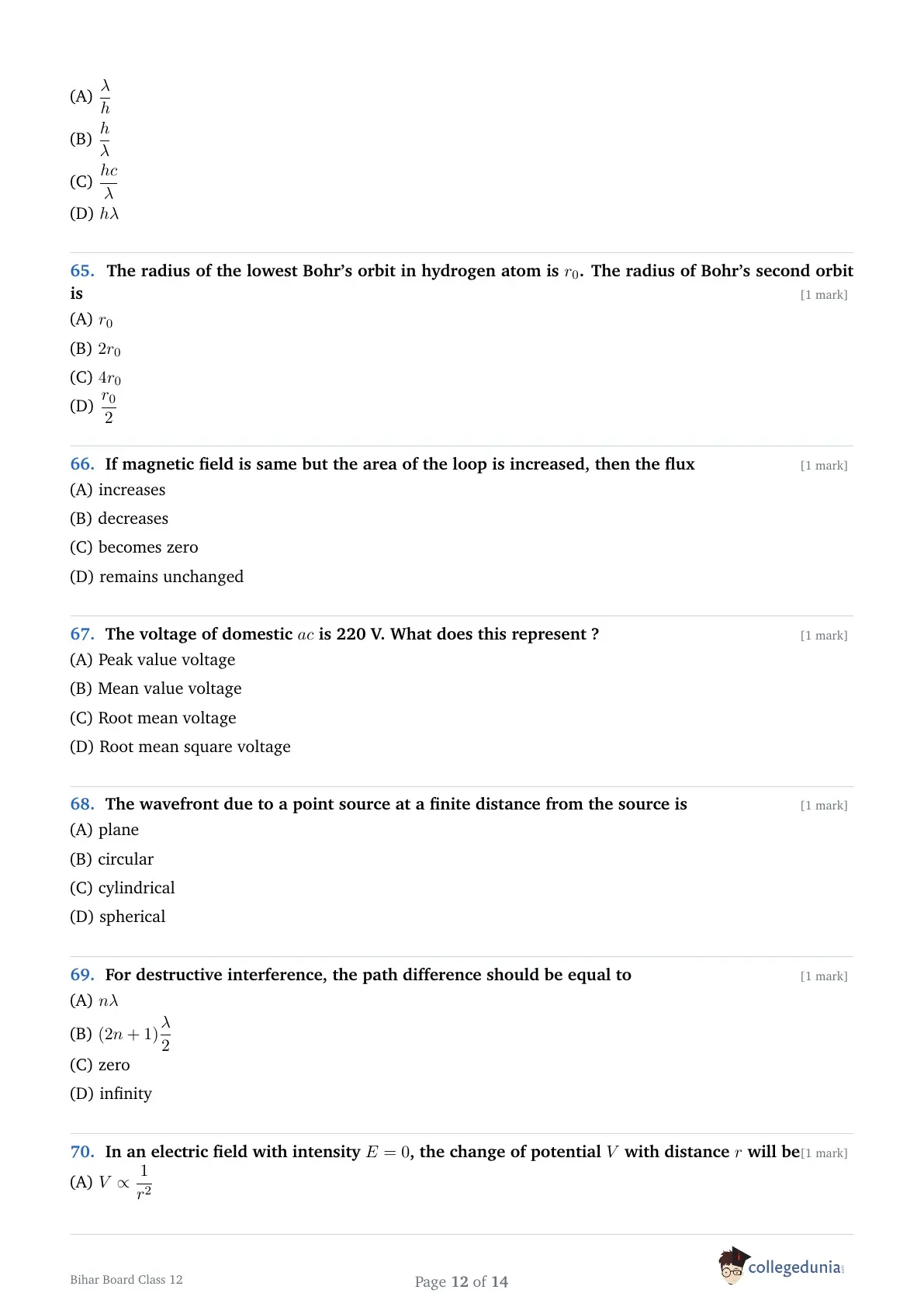
The radius of the lowest Bohr's orbit in hydrogen atom is \( r_0 \). The radius of Bohr's second orbit is
If magnetic field is same but the area of the loop is increased, then the flux
The voltage of domestic \( ac \) is 220 V. What does this represent ?
The wavefront due to a point source at a finite distance from the source is
For destructive interference, the path difference should be equal to
In an electric field with intensity \( E = 0 \), the change of potential \( V \) with distance \( r \) will be
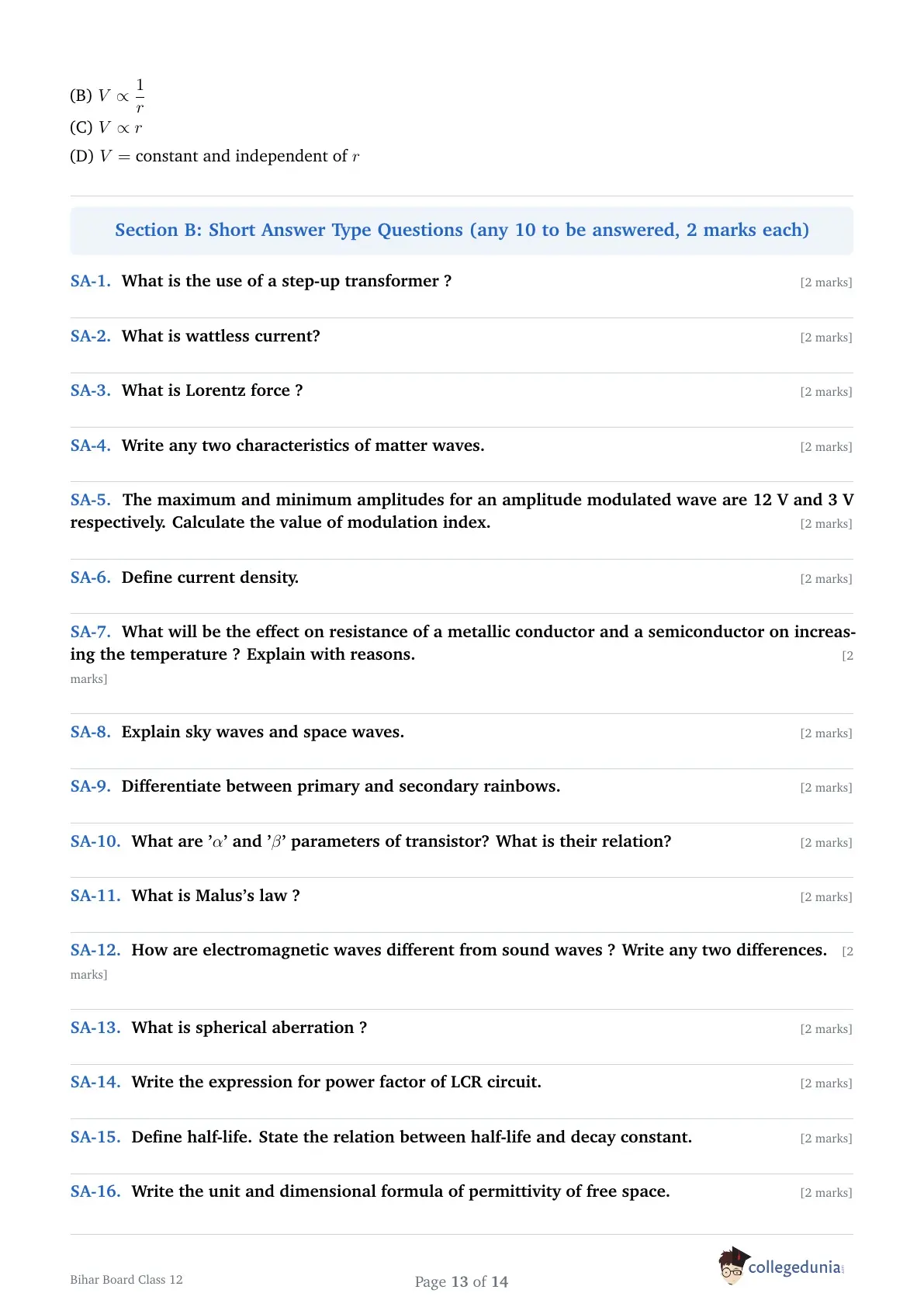
Section B - Short Answer Questions (2 marks each, any 10 to be answered)
What is the use of a step-up transformer ?
What is wattless current?
What is Lorentz force ?
Write any two characteristics of matter waves.
The maximum and minimum amplitudes for an amplitude modulated wave are 12 V and 3 V respectively. Calculate the value of modulation index.
Define current density.
What will be the effect on resistance of a metallic conductor and a semiconductor on increasing the temperature ? Explain with reasons.
Explain sky waves and space waves.
Differentiate between primary and secondary rainbows.
What are '\(\alpha\)' and '\(\beta\)' parameters of transistor? What is their relation?
What is Malus's law ?
How are electromagnetic waves different from sound waves ? Write any two differences.
What is spherical aberration ?
Write the expression for power factor of LCR circuit.
Define half-life. State the relation between half-life and decay constant.
Write the unit and dimensional formula of permittivity of free space.
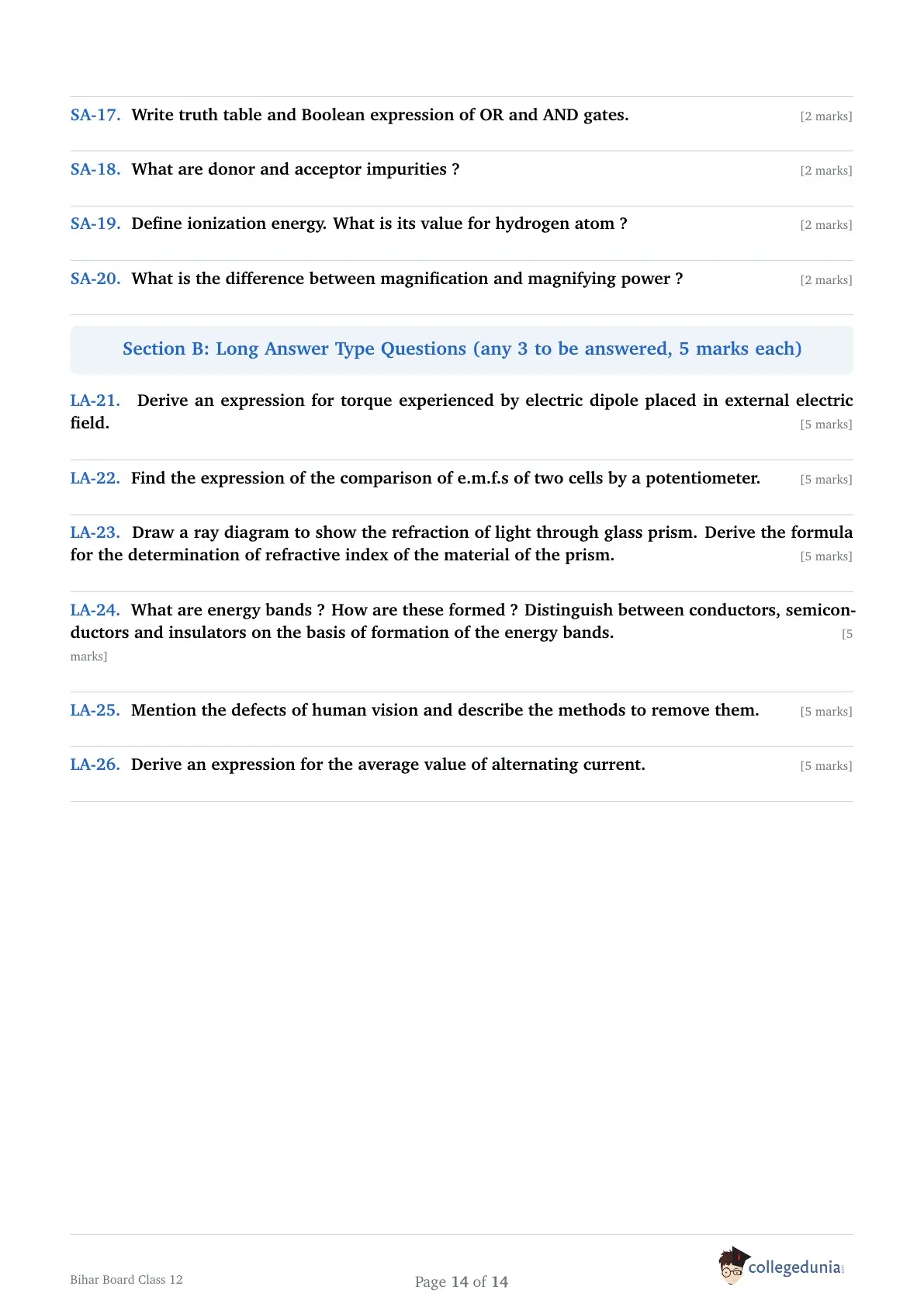
Write truth table and Boolean expression of OR and AND gates.
What are donor and acceptor impurities ?
Define ionization energy. What is its value for hydrogen atom ?
What is the difference between magnification and magnifying power ?
Section B - Long Answer Questions (5 marks each, any 3 to be answered)
Derive an expression for torque experienced by electric dipole placed in external electric field.
Find the expression of the comparison of e.m.f.s of two cells by a potentiometer.
Draw a ray diagram to show the refraction of light through glass prism. Derive the formula for the determination of refractive index of the material of the prism.
What are energy bands ? How are these formed ? Distinguish between conductors, semiconductors and insulators on the basis of formation of the energy bands.
Mention the defects of human vision and describe the methods to remove them.
Derive an expression for the average value of alternating current.
Bihar Board Class 12 Physics Question Paper Pattern and Marking Scheme 2026
The Bihar Board (BSEB) Class 12 Physics 2026 question paper carries 70 marks and has 96 questions (70 + 20 + 6) in two sections, A and B. The time allowed is 3 hours 15 minutes, which includes 15 minutes of extra time to read the questions carefully. The paper is bilingual (Hindi and English). The table below gives the section-wise pattern from the official question paper.
| Section | Questions | Question Type | Total Questions | To Be Answered | Marks per Question | Marks |
|---|---|---|---|---|---|---|
| A | Q1 - Q70 | Objective type (OMR) | 70 | 35 | 1 | 35 |
| B | SA-1 - SA-20 | Short answer | 20 | 10 | 2 | 20 |
| B | LA-21 - LA-26 | Long answer | 6 | 3 | 5 | 15 |
| Total | 96 | 48 | 70 |
The marking scheme printed in the instructions of the question paper is as follows:
- Section A has 70 objective questions, each with four options of which only one is correct. Any 35 questions are to be answered, each carrying 1 mark, and the answers are marked on the OMR answer sheet with a blue or black ball pen.
- If more than 35 questions of Section A are answered, only the first 35 answers are evaluated by the computer.
- Section B has 20 short answer type questions, of which any 10 are to be answered, each carrying 2 marks.
- Section B also has 6 long answer type questions, of which any 3 are to be answered, each carrying 5 marks.
- Use of whitener, liquid, blade, nail or similar material on the OMR sheet makes the result invalid, and the use of any electronic appliance is strictly prohibited.



Comments