



Study Abroad Expert | Updated On - Jul 24, 2026
How to apply for Australian universities in 2027: apply directly to each university, convert the offer to a CoE, and file the visa early. The February 2027 window is open through late 2026. For Indian students, the Australian process rewards sequencing: offer, CoE, OSHC, then the visa. This guide covers intakes and deadlines, the application steps, documents, the visa stage and costs.
- Australia has no central portal for international applicants: you apply to each university directly.
- February 2027 applications run August to November 2026; July 2027 is the second door.
- The visa fee rose to AUD 2,500 from July 1, 2026, with living funds of AUD 29,710.
- India sits under Evidence Level 3, so financial documentation is detailed and early filing wins.
| Parameter | Detail |
|---|---|
| Main intakes | February (Semester 1) and July (Semester 2) |
| Feb 2027 window | Apply August to November 2026 |
| How you apply | Directly to each university's portal |
| Visa | Subclass 500, AUD 2,500 (about INR 1.62 lakh) from July 1, 2026 |
| Living funds | AUD 29,710 a year (about INR 19.3 lakh) |
| India's evidence level | Evidence Level 3, detailed financial proof |
| Work rights | 48 hours a fortnight in session, unlimited in official breaks |
Currency conversions use AUD 1 = INR 65 as of July 2026, and move with the exchange rate.
Read More:
Intakes and Deadlines for 2027
Australia runs two main doors: Semester 1 from late February, the biggest, and Semester 2 from July, with a few trimester universities adding extra starts. For February 2027, applications run through late 2026. The calendar:
| Intake | Classes begin | Apply | Visa file by |
|---|---|---|---|
| Semester 1, 2027 | Late February 2027 | August to November 2026 | By about November 2026 |
| Semester 2, 2027 | July 2027 | January to April 2027 | By about March 2027 |
| Trimester universities | Extra starts through the year | Rolling, course-specific | 16 weeks before start |
What the deadline bands cover and what they do not:
- Cover: the typical direct-application windows most universities publish for international students.
- Do not: competitive programs, scholarships and courses with quotas, which close earlier, so the course listing is always the final word.
If your target is February 2027, then August to October 2026 is your working window. That means tests booked this July and applications ready when portals open.
Read More:
The Application Steps
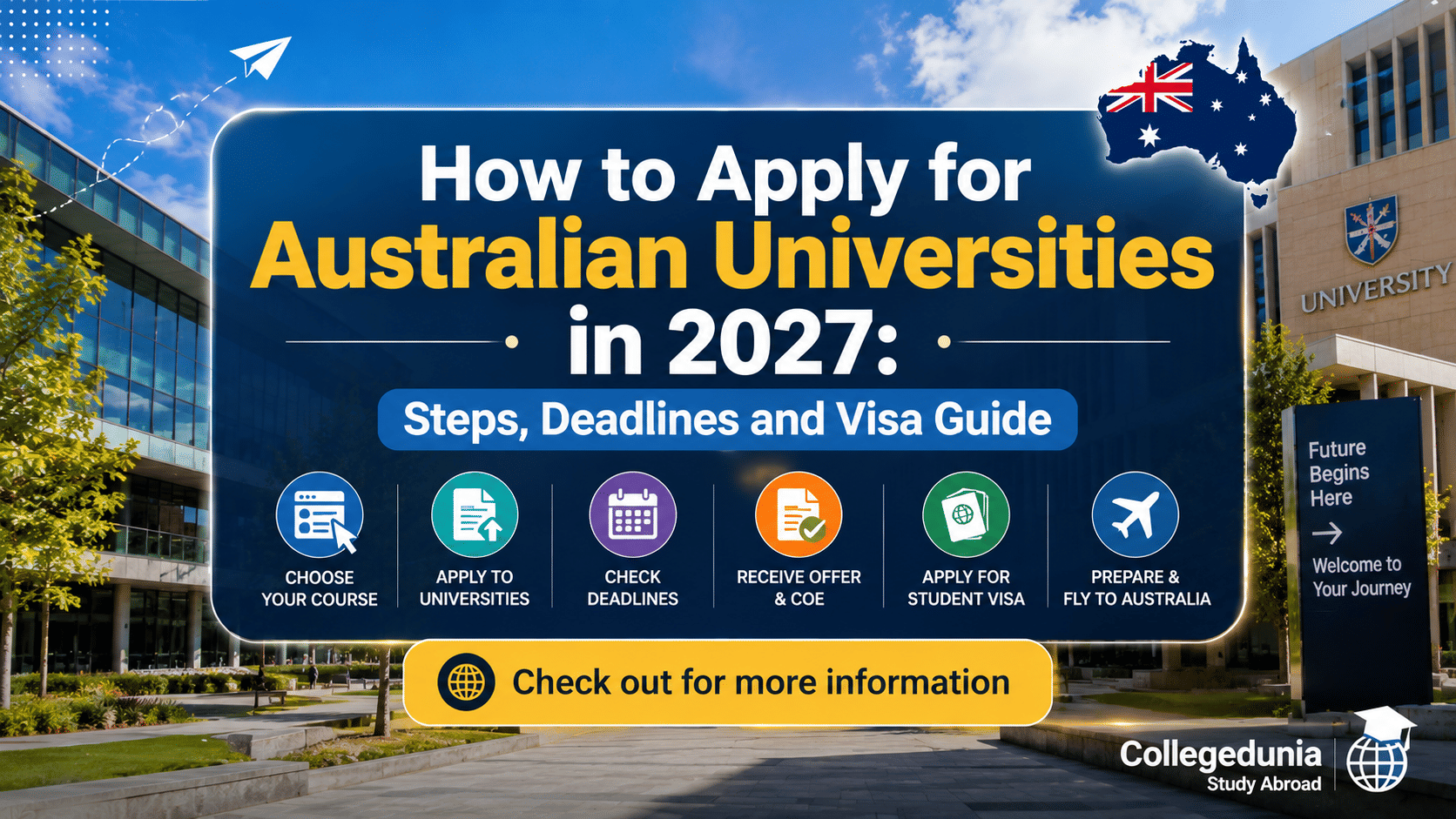
The sequence is fixed: shortlist, apply directly, convert the conditional offer, accept with the deposit and OSHC, receive the CoE, then file the visa. Each step unlocks the next. Shortlisting across bands keeps options open, using this list of top universities abroad for Indian students. The steps:
- Shortlist 4 to 6 courses on CRICOS-registered programs, checking intakes, entry bands and fees on each course listing.
- Apply directly through each university's international portal, since Australia has no UCAS-style central system for international applicants.
- Convert the conditional offer: meet the stated conditions, usually final results or English scores, to receive the full offer.
- Accept and pay the deposit, and buy Overseas Student Health Cover for the visa length, since OSHC is mandatory.
- Receive the CoE: the Confirmation of Enrolment is the document the visa system runs on.
- File the subclass 500 through ImmiAccount, ideally about 16 weeks before the course starts.
Note: The CoE is the hinge of the whole timeline. Nothing at the visa stage moves without it, and it only issues after the deposit and OSHC clear, so the week you accept an offer is the week your visa clock really starts. Treat offer acceptance as a same-week decision, not a family deliberation month.
Read More:
- How to Apply for Australian Universities: Application and Process
- Study in Australia after 12th for International Students
Documents and Requirements
The application file runs on academics, English proof and a consistent story, while the visa file adds the Genuine Student answers, the funds and health checks. Build both together. Every item below feeds both the university checklist and the later visa file. The set:
- Academics: Class 10 and 12 for undergraduate entry, plus the bachelor's transcripts and degree for postgraduate, with the course's stated equivalence for Indian boards.
- English proof: IELTS, PTE, or TOEFL at the course's band, typically IELTS 6.0 to 6.5 or PTE equivalents, and PTE's fast results suit Australia's timelines.
- SOP and references: per the university's checklist, with a CV for postgraduate files.
- Genuine Student answers: short written responses in the visa application addressing your course choice, circumstances and plans, which replaced the old GTE in 2024.
- Funds evidence: AUD 29,710 for living plus first-year tuition and travel, through bank statements, deposits and education loan sanctions, seasoned about 3 months under current scrutiny.
- Health and character: a medical exam with an approved panel physician, and police clearance where asked.
Read More:
- IELTS Exam 2026: Check Test Fee, Full Form and Syllabus
- TOEFL Essentials 2026: Fees in India, Exam Pattern, Scores
- PTE Exam 2026: Check Free Practice Tests and Test Fees
The Visa Stage: GS, Funds and EL3
The subclass 500 now costs AUD 2,500 after the July 1, 2026 rise, runs on the Genuine Student framework and treats Indian files under Evidence Level 3, where documentation depth decides speed. Early and complete wins. The wider approval climate is covered in this report on Indian student visa approval rates in 2026. The stage:
- Fee: AUD 2,500, about INR 1.62 lakh, non-refundable, up from AUD 2,000 before July 2026.
- Filing window: about 16 weeks before the course start for Evidence Level 3 applicants, with typical processing of 4 to 8 weeks stretching in the April to July peak.
- GS answers: specific, consistent responses on why this course, this institution and this point in your life, matching the SOP and documents.
- Funds under EL3: detailed, traceable evidence for 12 months of living costs plus tuition and travel, with sudden deposits and unexplained sources as the classic refusal triggers.
- Priority processing: allocations flow through institutions under the national planning system, which is one more reason early files at your chosen university matter.
Note: Evidence Level 3 changes the paperwork, not your odds by itself. It means Australia checks Indian financial files line by line, so the winning move is a boring file: three months of stable balances, a clean loan sanction, sources documented to the rupee and a GS story identical everywhere it appears.
Costs and Scholarships
Budget tuition of AUD 25,000 to 45,000 a year plus the AUD 29,710 living line, landing most Indian students at roughly INR 36 to 49 lakh a year, before scholarships cut it. Awards run early. Funding options are covered in this guide on fully funded scholarships for Indian students. The money picture:
| Head | Typical amount |
|---|---|
| Tuition a year | AUD 25,000 to 45,000 (INR 16.3 to 29.3 lakh) |
| Living proof line | AUD 29,710 (INR 19.3 lakh) |
| OSHC | About AUD 600 to 1,000 a year |
| Visa and extras | AUD 2,500 visa plus medicals and biometrics |
| Annual total | Roughly INR 36 to 49 lakh |
- University merit awards commonly cut 10 to 50% of tuition, decided with or soon after the offer.
- Destination and regional awards favour campuses outside the biggest cities.
- Research pathways fund Master's by Research and PhD students, who also carry no work-hour cap.
- Part-time work at 48 hours a fortnight funds a meaningful slice of living costs, with unlimited hours in official breaks.
Also Check:
How to apply for Australian universities in 2027 comes down to running one sequence early: direct applications from August 2026, a same-week offer acceptance, OSHC and deposit cleared so the CoE issues, then a subclass 500 filed about 16 weeks out with a boring, seasoned, Evidence Level 3-proof financial file and Genuine Student answers that match everything else. Budget the AUD 2,500 fee and the AUD 29,710 line at current rates, chase scholarships in the August to September window and let the February 2027 semester arrive with your paperwork already at rest.
FAQs
Ques. How do I apply to Australian universities for 2027?
Ans. Directly to each university's international portal, since Australia has no central system for international applicants. The sequence: apply, convert the conditional offer, accept with deposit and OSHC, receive the CoE, then file the subclass 500 visa.
Ques. When should I apply for the February 2027 intake?
Ans. Between August and November 2026, with August to October as the working window. Book tests in July 2026, apply as portals open and aim to have the visa filed by about November.
Ques. What is the Australian student visa fee now?
Ans. AUD 2,500, about INR 1.62 lakh, from July 1, 2026, up from AUD 2,000, and non-refundable. Medicals, biometrics and OSHC sit on top, so budget the visa stage as a package.
Ques. How much money must I show for the visa?
Ans. AUD 29,710 a year for living costs, about INR 19.3 lakh, plus first-year tuition and travel, evidenced in detail under Evidence Level 3. Ignore the outdated AUD 24,505 figure still circulating.
Ques. What is the Genuine Student requirement?
Ans. The framework that replaced the GTE in 2024: short written answers in the visa application on your course choice, circumstances and plans. Specific, consistent answers matching your SOP and documents are what pass it.
Ques. What does Evidence Level 3 mean for Indian applicants?
Ans. Deeper financial scrutiny: traceable funds for 12 months, statements seasoned about 3 months and documented sources. It changes the paperwork depth, and early filing about 16 weeks before the course keeps the timeline safe.
Ques. What English scores do Australian universities need?
Ans. Typically IELTS 6.0 to 6.5 or PTE equivalents, varying by course, with higher bands for competitive and professional programs. PTE's fast results pair well with Australia's compressed offer-to-CoE timelines.



Comments