



Education Journalist | Study Abroad Lead
Triangles come in a variety of shapes and sizes, including obtuse, isosceles, acute, equilateral, and so on. Only a few sorts of triangles, however, are classified as special triangles. Because the sides and angles of these triangles are constant and predictable, they are unique. The attributes of these objects can be utilised to solve a variety of geometry and trigonometry issues. A 30-60-90 triangle, which is pronounced "thirty-sixty-ninety," is a particularly unique form of a triangle. The 30-60-90 triangle is referred to as a peculiar right triangle because its angles have a unique ratio of 1:2:3. Here is the complete information about the 30-60-90 triangle, including its description, sides, area, regulations and solved examples.
| Table of Content |
Key Terms: 30-60-90 Triangle, Obtuse Triangle, Equilateral Triangle, Acute Triangle, Geometry, Trigonometry, Hypotenuse, 30-60-90 Formula
What is the 30-60-90 Triangle?
[Click Here for Sample Questions]
It's a triangle with the same angles of 30, 60, and 90. This triangle is always a right triangle since one of the angles is 90 degrees. As previously stated, it is a unique triangle with unique length and angle values.
The 30-60-90 triangle is referred to as a peculiar right triangle because its angles have a unique ratio of 1:2:3. A right triangle is defined as any triangle that has a 90° angle. A 30-60-90 triangle is a particular right triangle with angles of 30°, 60°, and 90° at all times. Here are some of the 30-60-90 triangle's variations.
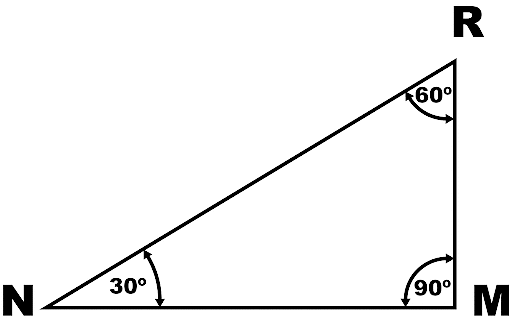
30-60-90 Triangle
Also Read: Scalene, Acute, and Obtuse Triangles
Sides of the 30-60-90 Triangle
[Click Here for Sample Questions]
The lengths of the sides of a 30-60-90 triangle are constantly in a continuous connection with one another, making it a unique triangle.
∠ N = 30°, ∠ R = 60°, and ∠ M = 90° in the 30-60-90 triangle ABC shown below. The definitions below help us comprehend the connection between the two sides:
- Because 30° is the smallest angle in this triangle, the side opposite the 30° angle, RM = x, will always be the smallest.
- Because 60° is the mid-sized degree angle in this triangle, the side opposite the 60° angle, MN = x × √3 = x√3, will be the medium length.
- Because 90° is the biggest angle, the hypotenuse RN = 2x will be the largest side on the side opposite the 90° angle.
The fundamental triangle side ratio is 30-60-90:
| The side that is on the other side of the 30° angle. | x |
| The side that is on the other side of the 60° angle. | x * √3 |
| The side that is on the other side of the 90° angle. | 2x |
The sides of a 30-60-90 triangle are always in the ratio 1:√3: 2 in a 30-60-90 triangle. For sides, this is also known as the 30-60-90 triangle formula. x:x√3:2x. In the 30-60-90 triangle proof part, we'll discover how to derive this ratio.
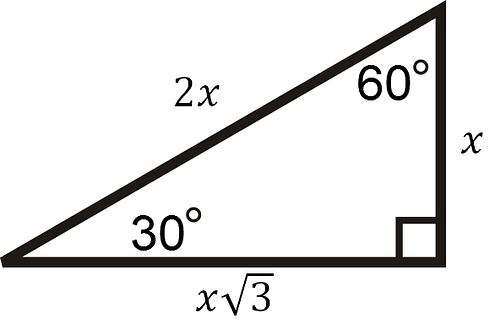
30-60-90 Triangle Formula
30-60-90 Triangle Theorem Proof
[Click Here for Sample Questions]
Consider the equilateral triangle ABC, which has a side length of 'a'.
Now, at point D of the triangle ABC, draw a perpendicular from vertex A to side BC. In an equilateral triangle, the perpendicular bisects the other side.
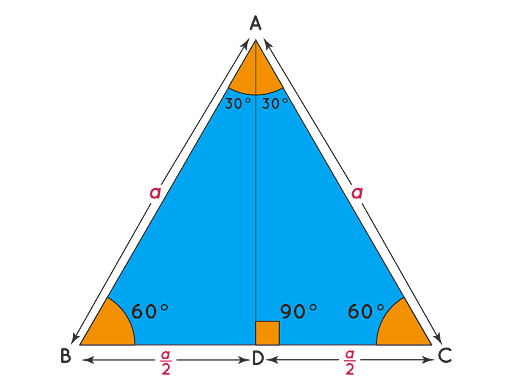
ABD Triangle & ADC consists of two 30-60-90 triangles. Both triangles are right-angled triangles and are comparable. As a result, we may use Pythagoras' theorem to calculate AD's length.
(AB)2 = (AD)2 + (BD)2
a2 = (AD)2 + (a/2)2
a2 - (a/2)2 = (AD)2
3a2/4 = (AD)2
(a√3)/2 = AD
AD = (a√3)/2
BD = a/2
AB = a
These sides have the same a/2: (a3√3)/2: a ratio as well.
Divide by 'a' and multiply by 2.
(2a)/(2a) : (2a√3)/(2a): (2a/a)
1:√3:2 is the result. The 30-60-90 triangle theorem is what it's called.
Also Read: Triangle Theorems
Examples of 30-60-90 Triangles
Consider the following instances of a triangle with side lengths of 30-60-90 degrees:
Example 1:

DEF is a 30-60-90 triangle.
Where,
∠ F = 30°, ∠ D = 60°, and ∠ E = 90°
- DE = y = 2 is the side opposite the 30° angle.
- BC = y√3 = 2√3 is the side opposite the 60° angle.
- The hypotenuse AC = 2y = 2x 2 = 4 is the side opposite the 90° angle.
Example 2:
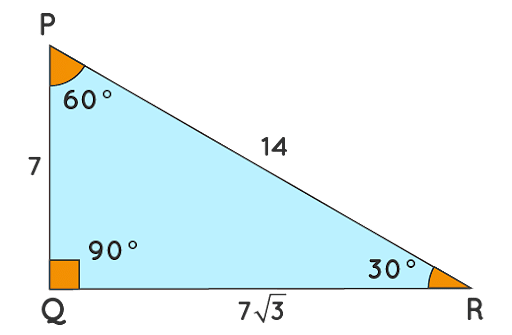
PQR is the 30-60-90 triangle.
Where,
∠ R = 30 degrees, ∠ P = 60 degrees, and ∠ Q = 90 degrees
- AB = y = 7 is the side opposite the 30° angle.
- BC = y√3 = 7√3 is the side opposite the 60° angle.
- The hypotenuse AC = 2y = 2 x 7 = 14 is the side opposite the 90° angle.
30-60-90 Triangle Rule
[Click Here for Sample Questions]
The measure of any of the three sides of a 30-60-90 triangle may be determined by knowing the measure of at least one of the triangle's sides. The 30-60-90 triangle rule is what it's called. The table below explains how to use the 30-60-90 triangle rule to get the sides of a 30-60-90 triangle:
- When Base is Given
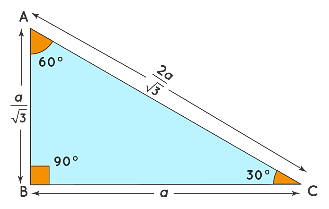
The triangle's base BC is presumed to be 'a'.
AB = (a /√3) is the perpendicular of the triangle ABC.
AC = (2a)/√3 is the hypotenuse of the triangle ABC.
- When Perpendicular is Given
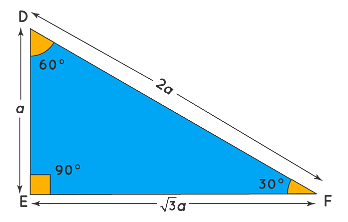
The triangle's base BC is presumed to be 'a'.
EF = √3a is the base of the triangle DEF.
DF = 2a is the hypotenuse of the triangle DEF.
- When Hypotenuse if Given

The triangle's base BC is presumed to be 'a'.
QR = (√3a)/2. is the base of the triangle PQR.
PQ= (a/2) is the perpendicular of the triangle PQR.
Also Read:
cosec cot formulaArea of 30-60-90 Triangle
[Click Here for Sample Questions]
The area of a triangle is calculated using the formula = (1/2)* base*height. The height of a right-angled triangle is the perpendicular of the triangle. As a result, the area of a right-angle triangle is calculated using the formula = (1/2) * base * perpendicular.
Let's look at how to use this formula to calculate the area of a triangle with sides of 30-60-90 degrees.
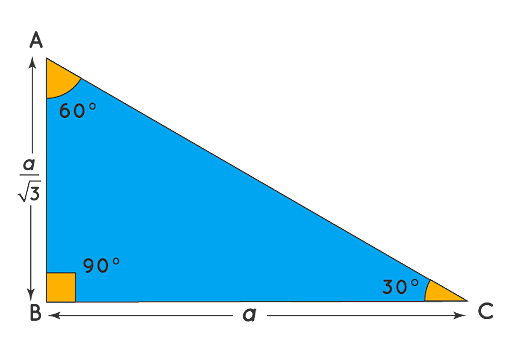
The triangle's base BC is supposed to be 'a,' while the triangle's hypotenuse ABC is believed to be AC. We learnt how to find the hypotenuse when the base is specified in the previous section.
Let's put everything we've learned about the formula to use.
As a result, the perpendicular of the triangle Equals a /√ 3
Area of triangle= 1/ 2 × a × a/ √ 3
As a result, when the base is 'a, the area of the 30-60-90 triangle is: a2/(2√3)
Also Read: Area of a Triangle
Things to Remember
- A 30-60-90 triangle, which is pronounced "thirty-sixty-ninety," is a particularly unique form of a triangle.
- Because the angles of the 30-60-90 triangle are in a unique ratio of 1:2:3 and the sides are in the ratio 1:√3: 2., this triangle is termed a special right triangle.
- A 30-60-90 triangle is a unique right triangle with 30°, 60°, and 90° angles.
- If just one side of a 30-60-90 triangle is known, all of its sides may be determined. The 30-60-90 triangle rule is what this is referred to as.
- Because 30 degrees is the shortest angle, the side opposite it is always smaller. Because 60 degrees is the mid-sized degree angle in this triangle, the side opposite the 60° angle will be the middle length. Finally, because 90 degrees is the biggest angle, the side opposite the 90° angle will always be the largest side (the hypotenuse).
Sample Questions
Ques. If the other two sides of a right-angle triangle are 8 and 8√ 3 units, find the length of the hypotenuse. (3 Marks)
Ans. Let's start by checking the ratio to see if it's appropriate for a 30-60-90 triangle.
8:8√3 ⇒ 1:√3 is the ratio of the two sides.
The triangle is a 30-60-90 triangle, according to this. The hypotenuse is 2 times the smallest side, as we know.
As a result, the hypotenuse is 2*8 = 16.
Hypotenuse = 16 units is the answer.
Ques. A right triangle's diagonal is 8 cm. Given that one of the triangle's angles is 30 degrees, get the lengths of the other two sides. (3 Marks)
Ans. This triangle must be 30°-60°-90°. As a result, we employ the x: x√3:2x..
8cm = diagonal = hypotenuse
2x Equals 8 centimetres
x = 4 cm
Substitute.
x√3 = 4√3 cm
The right triangle has a shorter side of 4 cm and a longer side of 4√3 cm.
Ques. A triangle's two sides are 5√3 mm and 5 mm. Determine the hypotenuse's length. (3 Marks)
Ans. Check the side length ratio to see if it meets the x: x√3:2x ratio.
5: 5√3:x = 1(5): √3 (5):x
As a result, x = 5
Multiply 2 by 5 to get the answer.
2x multiplied by 5 equals ten.
As a result, the hypotenuse is 10 mm.
Ques. Find the hypotenuse of a 30°- 60°- 90° triangle with a 6-inch longer side. (3 Marks)
Ans. Ratio = x: x√3:2x.
⇒ x√3 = 6 inches.
Squaring both sides
⇒ (x√3)2 = 36
⇒ 3x2 = 36
⇒ x2 = 12
⇒ x = √12
Ques. The sides of a triangle are 2√2, 2√6, and 2√8. Determine the triangle's angles. (3 Marks)
Ans. The triangle has sides of 2√2, 2√6, and 2√8.
Let's start by looking at the sides to see if they follow the 30-60-90 triangle rule.
2√2: 2√6: 2√8 can be re-written as 2√2: 2√2 × √3: 2 × 2√2
We obtain 1:√3: 2 when we divide the ratio by 2√2.
The 30-60-90 triangle rule is followed on these sides.
The angles of the triangle are 30°, 60°, and 90°, respectively.
Ques. Determine the triangle's missing side. (3 Marks)
Ans. Because it's a right triangle, the hypotenuse has the same length as one of the triangle's sides. As a result, it's known as a 30-60-90 triangle, with a smaller angle of 30. In the depicted illustration, the longer side is always opposing 60°, and the missing side measures 3√3 units.
Ques. What is the formula for the 30 60 90 triangle? (2 Marks)
Ans. The sides of a 30-60-90 triangle are always in the ratio 1:√3: 2 in a 30-60-90 triangle. For sides, this is also known as the 30-60-90 triangle formula. x:x√3:2x.
Ques. What is the 30 60 90 Triangle Theorem's application? (3 Marks)
Ans. It turns out that you can discover the measure of any of the three sides of a 30-60-90 triangle by knowing the measure of at least one of the triangle's sides. The hypotenuse is the side across from the 30-degree angle that is two times the length of the leg that is shorter than the other.
Ques. How do you solve a right triangle with a hypotenuse of 30 60 90 if you just have the hypotenuse? (2 Marks)
Ans. You may observe the following in any 30-60-90 triangle: The shortest leg is across from the 30-degree angle, the hypotenuse is always double the shortest leg's length, and the length of the long leg can be found by multiplying the short leg by the square root of 3.
Ques. How many triangles can have angles of 60, 90, and 30? (1 Marks)
Ans. Only one triangle with angles of 60, 90, and 30 may be drawn. because the measure of three angles equals 180 due to the angle sum property.
Ques. What is the length of the remaining two sides of a right triangle if one of the angles is 30 degrees and the shortest side is 7 m? (3 Marks)
Ans. The side lengths of this triangle are in the ratio x: x√3:2x, making it a 30-60-90 triangle.
For the longer leg and the hypotenuse, use x = 7m.
⇒ x √3 = 7√3
⇒ 2x = 2(7) =14
As a result, the other sides are 14 and 7√3 metres.
Ques. When should 30-60-90 Triangles be used? (5 Marks)
Ans. For geometry issues, we may readily answer for missing pieces of information, such as angle measurements and side lengths, by knowing three pieces of information, one of which is that the triangle is a right triangle. Filling in the rest of the triangle with three pieces of information, commonly two angle measures and one side length, or one angle measure and two side lengths, is possible.
For trigonometry issues, understanding the fundamental concepts of sine, cosine, and tangent makes finding the values for these in any 30-60-90 triangle quite simple. The terms sine, cosine, and tangent all refer to a ratio of a triangle's sides based on one of the angles, theta or. Because the sides of every 30-60-90 triangle are the same ratio, the sine, cosine, and tangent values are always the same, particularly the following two, which are frequently used on standardised tests:
- Sine 30 equals 1/2
- cosine 60 equals 1/2.
Check More:



Comments