



Education Journalist | Study Abroad Lead
Algebraic equations are the backbones of mathematics, and they form the foundation of many mathematical concepts. Algebraic equations are how we can express relationships between quantities using mathematical symbols. Algebraic equations are an essential part of mathematics that describe the relationships between variables and constants.
- They are used to solve problems in a wide range of fields, including science, engineering, economics, and finance.
- The study of algebraic equations is a critical component of a solid foundation in mathematics, as it provides the tools necessary to understand and solve complex problems.
- At its core, algebraic equations involve manipulating mathematical expressions to determine the value of one or more unknown variables.
- Depending on the degree of the equation, the number of variables involved, and the type of solution, there are several different types of algebraic equations.
- These equations range from simple linear equations to more complex polynomial equations, including quadratic, cubic, and higher-degree equations.
| Table of Content |
Key Terms: Variable, Constant, Term, Coefficient, Equation, Solution, Root, Polynomial, Linear equation, Quadratic equation, Cubic equation.
What are Algebraic Equations?
[Click Here for Sample Questions]
A statement demonstrating the equivalence of two algebraic expressions is known as an algebraic equation. It consists of variables, constants, and operators such as addition, subtraction, multiplication, and division.
- The variables are usually represented by letters, and the constants are fixed values.
- The operators perform arithmetic operations on the variables and constants, which are then used to form an expression.
- An algebraic equation is typically represented in the form of ax + b = c, where a, b, and c are constants, and x is the variable.
- The goal of solving an algebraic equation is to find the value of x that satisfies the equation.
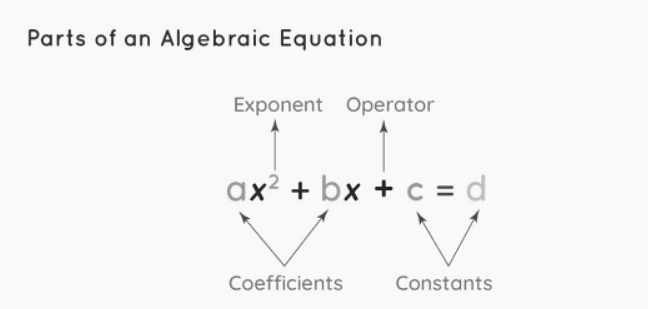
Algebraic Equations
For example, the equation 2x + 3 = 7 is an algebraic equation. In this equation, x is the variable, 2 and 3 are constants, and the operators are addition and equals. The equation states that the sum of 2x and 3 is equal to 7. The goal of solving the equation is to find the value of x that satisfies the equation.
Read More: Operations on Matrices
Types of Algebraic Equations
[Click Here for Sample Questions]
There are various types of algebraic equations, some of which include–
Linear Equations
A linear equation is an algebraic equation of the first degree, meaning the highest power of the variable is 1.
- The general form of a linear equation is ax + b = c, where a, b, and c are constants, and x is the variable.
- The goal of solving the equation is to find the value of x that satisfies the equation.
- The solution to a linear equation is a single value of x.
- Quadratic Equations: A quadratic equation is an algebraic equation of the second degree, meaning the highest power of the variable is 2.
- The general form of a quadratic equation is ax2 + bx + c = 0, where a, b, and c are constants, and x is the variable.
- The solution to a quadratic equation is usually two values of x.
- Cubic Equations: A cubic equation is an algebraic equation of the third degree, meaning the highest power of the variable is 3.
- The general form of a cubic equation is ax3 + bx2 + cx + d = 0, where a, b, c, and d are constants, and x is the variable.
- The solution to a cubic equation is usually three values of x.
- Polynomial Equations: A polynomial equation is an equation that contains one or more terms with variables raised to non-negative integer powers.
- For example, x2 + 3x + 2 = 0 is a polynomial equation of degree 2.

Polynomial Equations
Read More: Pair of Linear Equations in Two Variables Important Question
Examples of Algebraic Equations
[Click Here for Sample Questions]
Let's take a look at some examples of algebraic equations:
- Linear Equation: 3x + 4 = 10
To solve this equation, we need to isolate x on one side of the equation. We can do this by subtracting 4 from both sides and then dividing by 3. The solution is x = 2.
- Quadratic Equation: x2 + 4x + 3 = 0
To solve this equation, we can use the quadratic formula:
x = (- b ± \(\sqrt{(b^2 – 4ac)}\)) / 2a
where a = 1, b = 4, and c = 3. Plugging in these values, we get:
x = ( – 4 ± \(\sqrt{16 – 12}\)) / 2
x = ( – 4 ± \(\sqrt{4}\)) / 2
x = – 3, – 1
Therefore, the solutions to this equation are x = -3 and x = -1.
- Cubic Equation: x3 + 2x2 - 5x - 6 = 0
To solve this equation, we can use the rational root theorem to find a rational root. The rational root theorem states that if a polynomial equation has a rational root p/q (where p and q are integers and q ≠ 0), then p must be a factor of the constant term, and q must be a factor of the leading coefficient.
The constant term's factors are -6. are ±1, ±2, ±3, and ±6. 1 ±1 are the factors of the leading coefficient. From here it can be concluded that the possible rational roots are ±1, ±2, ±3, and ±6.
By testing these possible rational roots, we find that x = -2 is a root of the equation. We can use polynomial long division or synthetic division to factor out the root and get a quadratic equation:
(x + 2)(x2 + 4x - 3) = 0
To solve the quadratic equation, we can use the quadratic formula:
x = (-b ± \(\sqrt{(b^2 – 4ac)}\)) / 2a
where a = 1, b = 4, and c = -3. Plugging in these values, we get:
x = (-4 ± \(\sqrt{16+12}\)) / 2
x = (-4 ± \(\sqrt{28}\)) / 2
x = -2, -2 +\(\sqrt{7}\), -2 - \(\sqrt{7}\)
Therefore, the solutions to the cubic equation are x = -2, x = -2 + \(\sqrt{7}\), and x = -2 - \(\sqrt{7}\).
- Polynomial Equation: x4 - 7x2 + 10 = 0
To solve this equation, we can make a substitution to simplify the equation. Let y = x2, then the equation becomes:
y2 - 7y + 10 = 0
We can factor the quadratic equation to get:
(y - 5)(y - 2) = 0
Therefore, the solutions for y are y = 5 and y = 2. Substituting back, we get:
x2 = 5 or x2 = 2
Considering, the square root of both sides of the equation, we get:
x = ± \(\sqrt{5}\) or x = ± \(\sqrt{2}\)
Therefore, the solutions to the polynomial equation are x = \(\sqrt{5}\) , x = -\(\sqrt{5}\) , x = 2, and x = -\(\sqrt{2}\)..
- Rational Polynomial Equation: Ratio of two polynomials represented as a function where the denominator can’t be zero. f(x) = p(x)/q(x), where p(x) and q(x) are polynomials and q(x) ≠ 0.
For example, f(x) = (5x2 + 3x - 2) / (2x2 - 2x - 3) is a rational function because the denominator function, 2x2 - 2x - 3 ≠ 0.
Also, Such polynomials can’t be called rational polynomial functions if the denominator of a polynomial function is constant.
For example, f(x) = (x + 8) / 2 is not a rational function, but it is a linear function.
- Trigonometric Equations: All trigonometric equations are algebraic equations and polynomial equations. The angular forms of Sin, Cos, and Tan are here used as variables in such equations.
For example, sin x + 2 = 1 is an example of such a trigonometric equation.
Also Read:
Things to Remember
- Algebraic equations are how we can express relationships between quantities using mathematical symbols.
- When solving equations, the aim is to isolate the variable by performing inverse operations on both sides of the equation.
- The performed operations need to be tracked on an equation, and work needs to be checked by plugging in a solution to ensure that it satisfies the original equation.
- Using factoring, completing the square, or the quadratic formula to solve quadratic equations is important.
- Exponential equations involve exponents, logarithmic equations involve logarithms, and trigonometric equations involve trigonometric functions.
- When solving equations involving fractions, it can be helpful to clear the fractions by multiplying both sides of the equation by the least common multiple of the denominators.
Sample Questions
Ques. Solve the equation 2x + 3 = 7. (2 Marks)
Ans. 2x + 3 = 7
2x = 7 - 3
2x = 4
x = 2
Therefore, the solution of the equation is x = 2.
Ques. Solve the equation 3x + 7 = 22.(2 Marks)
Ans. 3x + 7 = 22
3x = 22 - 7
3x = 15
x = 5
Ques. Solve the equation x2 + 4x + 4 = 0. (2 Marks)
Ans. x2 + 4x + 4 = 0
(x + 2)2 = 0
x + 2 = 0
x = -2
Therefore, the solution of the equation is x = -2.
Ques. Solve the equation 2x2 + 5x - 3 = 0.(2 Marks)
Ans. 2x2 + 5x - 3 = 0
(2x - 1)(x + 3) = 0
x = 1/2 or x = -3
Therefore, the solutions of the equation are x = 1/2 and x = -3.
Ques. Solve the equation x3+ 3x2 + 2x = 0. (2 Marks)
Ans. x(x2 + 3x + 2) = 0
x(x + 1)(x + 2) = 0
x = 0, x = -1, or x = -2
Therefore, the solutions of the equation are x = 0, x = -1, and x = -2.
Ques. Solve the equation x3 - 2x2+ x = 0. (2 Marks)
Ans. x(x2 - 2x + 1) = 0
x(x - 1)2 = 0
x = 0 or x = 1
Therefore, the solutions of the equation are x = 0 and x = 1.
Ques. Solve the equation 2x = 8. (2 Marks)
Ans. 2x= 8
2x = 23
x = 3
Therefore, the solution of the equation is x = 3.
Ques. Solve the equation 4(x-1) = 16 (2 Marks)
Ans. 4(x-1) = 16
4(x-1) = 42
x - 1 = 2
x = 3
Ques. Solve the equation 3x + 7 = 16 (2 Marks)
Ans. 3x + 7 = 16
3x = 16-7
3x = 9
x = 9/3
x=3
So the solution is x = 3.
Ques. Solve the equation 2(x + 3) = 4x - 2 (2 Marks)
Ans. 2x + 6 = 4x - 2
2x -4x = -2-6
-2x = -8
x = (-8)/(-2)
x = 4
So the solution is x = 4.
For Latest Updates on Upcoming Board Exams, Click Here: https://t.me/class_10_12_board_updates
Check-Out:



Comments