



Content Writer
Angle Bisector Theorem states that an angle bisector is the other side of the triangle so that the ratio of the two line segments is equal to the ratio of the other two sides. As a result, the lengths of the other two triangle sides are equal to the relative lengths of the opposite side (divided by the angle bisector). A line that divides an angle into two congruent halves is known as an angle bisector. The two lines are considered to be perpendicular to one another if the angle of separation between them is 90 degree. The line that is perpendicular to the provided line and splits it into two identical halves is the perpendicular bisector of the identical line. All kinds of triangles can be used to prove the angle bisector theorem.
Read more: Types of angles
| Table of Content |
KeyTerms: Angle bisector theorem, Converse bisector theorem, Interior angle, External angle, Perpendicular bisector theorem
What is Angle Bisector Theorem?
[Click Here for Sample Questions]
Angle bisectors are lines that divide an angle into two equal or congruent angles and are drawn from the vertex of a triangle to its opposite side.The two fundamental characteristics the points on an angle bisector are evenly spaced from each other and divide a triangle's opposing side proportionately to its adjacent sides, that is regarded as the triangle's angle bisector property.
Angle Bisector Theorems of Triangle
[Click Here for Sample Questions]
The internal and external angle bisector theorem- related statements are listed in the table below.
| Theorem | Statement |
|---|---|
| Internal angle bisector theorem | The angle bisector of a triangle divides the opposite sides into two parts proportional to the other two sides of the triangle. |
| Converse of Internal angle bisector theorem | If the interior point of a triangle is equally spaced from its two sides, that point will be located on the angle bisector of the angle created by the two line segments. |
| Perpendicular bisector theorem | The specified line segment, to which the bisector is perpendicular, is divided into two equal halves. If a perpendicular bisector is traced from the vertex to the opposite side of a triangle, it separates the side into two congruent pieces. |
| External angle bisector theorem | In non-equilateral triangles, the external angle bisector often splits the opposing side externally in the ratio of the sides containing the angle. |
According to the angle bisector theorem, the opposite side of a triangle is divided into two portions by the angle bisector that are proportional to the other two sides.
Read more:
| Relevant Concepts | ||
|---|---|---|
| Congruent Triangles | Equilateral Triangle | Ceva’s theorem |
| Area of isosceles triangle | Corresponding angles | Angles of parallelogram |
Interior Angle Bisector Theorem
[Click Here for Sample Questions]
The angle bisector of the triangle ABC intersects side BC at point D. As mentioned in the picture below.
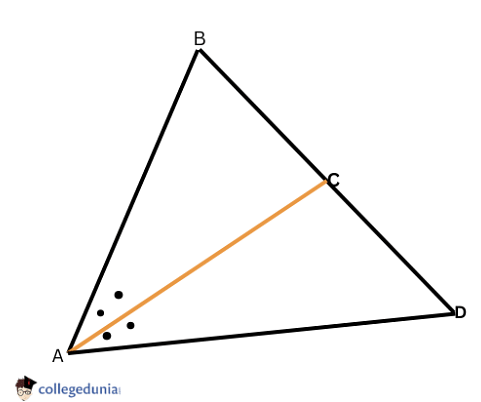
Interior Angle Bisector Theorem
According to angle bisector theorem, the ratio of the line segment BD to DC equals the ratio of the length of the side AB to AC
\(|\frac{BD}{DC}| = |\frac{AB}{AC}|\)In contrast, when a point D on the side BC divides BC in a ratio similar to the sides AC and AB, then the angle bisector of ∠ A is AD. Hence, according to the theorem, if D lies on the side BC, then,
\(|\frac{BD}{DC}| = |\frac{AB}{AC}| \)\(\frac{sin \angle DAB}{sin \angle DAC}\)If D is external to the side BC, directed angles and directed line segments are required to be applied in the calculation.
It is possible to use the angle bisector theorem when side lengths and angle bisectors are known.
Proof of Angle bisector theorem
Angle bisector theorem can be proved using trigonometry. In triangles ABD and ACD using the law of sines, can be written as;
\(\frac{AB}{BD} = \frac{sin \angle BDA}{sin \angle BAD}\)……..(1) \(\frac{AC}{DC} = \frac{sin \angle ADC}{sin \angle DAC}\)……..(2)The angles ∠ ADC and ∠ BDA make a linear pair and hence called supplementary angles.
Since, the sine of supplementary angles are equal, therefore,
Sin ∠ BDA = Sin ∠ ADC …………(3)
Also,
∠DAC = ∠BAD (AD is the angle bisector)
Thus,
Sin ∠BDA = Sin ∠ADC ………(4)
Hence, from equations 3 and 4, the RHS of equations 1 and 2 are equal, therefore, LHS will also be equal.
\(\frac{|BD|}{|DC|} = \frac{|AB|}{|AC|}\)Hence, the angle bisector theorem is proved.
Condition:
If the angles ∠DAC and ∠BAD are not equal, the equation 1 and equation 2 can be written as:
\(\frac{|AB|}{|BD|}\)sin ∠ BAD = sin ∠ BDA \(\frac{|AC|}{|DC|}\)sin ∠ DAC = sin ∠ ADCAngles ∠ ADC and ∠ BAD are supplementary, hence the RHS of the equations are still equal. Hence, we get
\(\frac{|AB|}{|BD|}\) sin ∠ BAD = \(\frac{|AC|}{|DC|}\) sin ∠ DACThis rearranges a generalized view of the theorem.
Converse of Angle Bisector Theorem
[Click Here for Sample Questions]
The converse bisector theorem of an angle states that if a triangle's interior point is equally spaced from its two sides, that point will be on the angle's bisector, which is the angle produced by the two line segments.
Triangle Angle Bisector Theorem
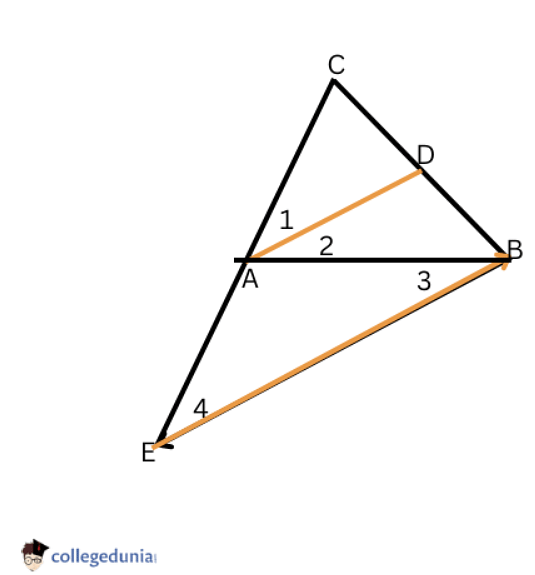
Triangle Angle Bisector Theorem
Extend the side CA to meet BE to meet at point E, such that BE//AD.
Now we can write,
CD/DB = CA/AE (since AD//BE) —-(1)
∠4 = ∠1 [corresponding angles]
∠1 = ∠2 [AD bisects angle CAB]
∠2 = ∠3 [Alternate interior angles]
∠3 = ∠4 [By transitive property]
ΔABE is an isosceles triangle with AE=AB
Now if we replace AE by AB in equation 1, we get;
CD/DB = CA/AB
Hence proved.
Perpendicular Bisector Theorem
[Click Here for Sample Questions]
This theorem states that a point is on the perpendicular bisector of a line segment if it is equally spaced from the line segment's endpoints in a triangle.
Alternatively, it can be stated that the perpendicular bisector divides the provided line segment, to which it is perpendicular, into two equal portions. If a perpendicular bisector is drawn from a triangle's vertex to the other side, it separates the segment into two congruent segments.
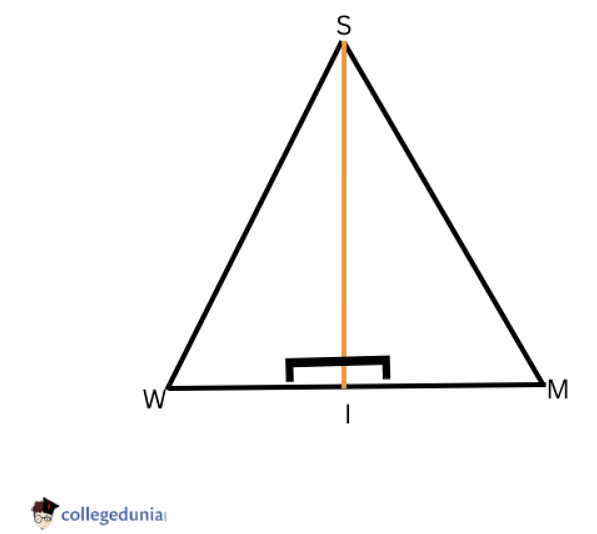
Perpendicular Bisector Theorem
As represented in the above figure, the line segment SI is the perpendicular bisector of WM.
External Angle Bisector Theorem
[Click Here for Sample Questions]
The opposite side of a triangle is divided externally by the external angle bisector in the ratio of the sides that contain the angle. Most frequently, non-equilateral triangles exhibit this property.
Proof:
Given: In ΔABC, The external bisector of ∠BAC is, which intersects BC created at D.
To prove: BD/DC = AB/AC
Construction: Draw CE ∥ DA meeting AB at E

External Angle Bisector Theorem
Since, CE ∥ DA and AC is transversal, therefore,
∠ECA = ∠CAD (alternate angles) ……(1)
Again, CE ∥ DA and BP is a transversal, therefore,
∠CEA = ∠DAP (corresponding angles) —–(2)
But AD is the bisector of ∠CAP,
∠CAD = ∠DAP —–(3)
As we know, Sides opposite to equal angles are equal, therefore,
∠CEA = ∠ECA
In ΔBDA, EC ∥ AD.
BD/DC = BA/AE [By Thales Theorem]
AE = AC,
BD/DC = BA/AC
Hence, proved.
Things to remember
- Angle Bisector theorem states that the angle bisector of a triangle bisects the opposite side in such a way that the ratio of the two lines segments is proportional to the ratio of the other two sides.
- Angle bisector theorem is applicable to all types of triangles.
- The angle bisector theorem includes interior angles and exterior angles.
- The angle bisector theorem formula is as follows: \(|\frac{BD}{DC}| = |\frac{AB}{AC}|\)
- According to the converse of the internal angle bisector theorem, the interior point of a triangle is on the angle bisector of the angle created by the two line segments if it is equally distant from the two sides of the triangle.
- The provided line segment is split in half by the perpendicular bisector into two equal parts.
Sample Questions
Ques. Nancy drew a triangle ABC on the board where AD is the line drawn on side BC, where, AB = 4 in, AC = 6 in, BD = 1.6 in, and DC = 2.4 in. Find whether AD is the angle bisector of ∠A. (3 marks)
Ans. To show whether AD is the angle bisector or not, let us use the angle bisector theorem. So, we need to prove that BD/DC = AB/AC.
Let's find the ratio AB/AC.
AB/AC = 4/6 = 2/3
Let's find the ratio BD/DC.
BD/DC = 1.6/2.4 = 2/3
Both the ratios are equal.
Therefore, in the triangle drawn by Nancy, AD bisects ∠A.
Ques. In ΔXYZ, XE is the bisector of ∠X. Let XY = 4 units, YE = 2 units, and EZ = 3 units. Can you find the length of XZ? (3 marks)
Ans. Given that, XE is the bisector of ∠X.
According to the angle bisector theorem formula,
YE/EZ = XY/XZ
2/3 = 4/XZ
XZ = 4/2 × 3
XZ = 6
Therefore, the length of XZ = 6 units.
Ques. Look at ΔABC shown below.

If BD bisects ∠B, can you find the value of x? (5 marks)
Ans. Given that, BD is the bisector of ∠B.
According to the triangle angle bisector theorem,
AB/BC = AD/DC
x/(x – 2) = (x + 2)/(x-1)
x(x − 1) = (x−2)(x+2)
x2 − x = x2 − 4
−x = −4
x = 4
Therefore, the value of x is 4.
Ques. In a triangle, AE is the bisector of the exterior ∠CAD that meets BC at E. If the value of AB = 10 cm, AC = 6 cm and BC = 12 cm, find the value of CE. (5 marks)
Ans. Given : AB = 10 cm, AC = 6 cm and BC = 12 cm
Let CE be equal to x.
By exterior angle bisector theorem, we know that,
BE / CE = AB / AC
(12 + x) / x = 10 / 6
6( 12 + x ) = 10 x [ by cross multiplication]
72 + 6x = 10x
72 = 10x – 6x
72 = 4x
x = 72/4
x = 18
CE = 18 cm
Ques. Find the value of x for the given triangle using the angle bisector theorem (5 marks)
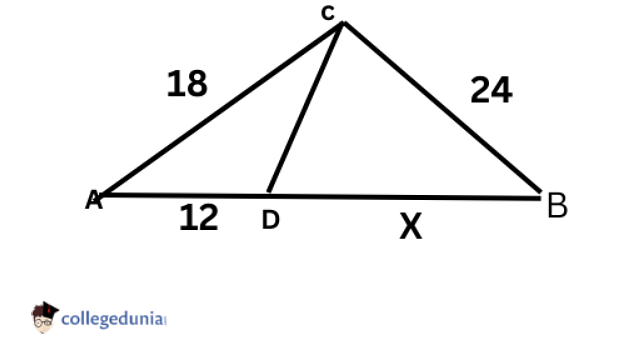
Ans. Given that,
AD = 12, AC = 18, BC=24, DB = x
According to angle bisector theorem,
AD/AC = DB/BC
Now substitute the values, we get
12/18 = x/24
X = (⅔)24
x = 2(8)
x= 16
Hence, the value of x is 16.
Ques. What is the formula of angle bisector? (1 mark)
Ans. In the triangle ABC, the angle bisector intersects side BC at point D. Thus, formula of angle bisector is as follows:
BD/DC = AB/AC
Ques. What does the angle bisector theorem state? (1 mark)
Ans. The angle bisector theorem states that a triangle's opposite side is divided into two halves by an angle bisector that is proportional to the triangle's other two sides.
Ques. The angle bisector of the vertex angle of an isosceles triangle bisects the opposite side of. State true or false and explain. (2 marks)
Ans. True. An isosceles triangle has a shared vertex and two pairs of equal sides. If the vertex angle's angle bisector is drawn, the opposing side is divided into equal pieces.
Ques. What is the converse of the angle bisector theorem? (1 mark)
Ans. The angle bisector theorem converse states that if a line or a ray AD is drawn in ΔABC such that BD/DC = AB/AC, then AD bisects the ∠A.
Ques. How are the side-splitter theorem and the angle bisector theorem similar? (1 mark)
Ans. The only connection between the angle bisector theorem and the side-splitter theorem is that both the theorems deal with the ratios of the triangle's side lengths.
Check More:



Comments