



Education Content Expert
Corresponding Angles are the angles formed in the matching or corresponding corners with the transversal. Corresponding Angles are formed when two parallel or non-parallel lines are intersected by a transversal. In simpler terms, a corresponding angle is an angle that holds on to the same correlative position simultaneously as another angle somewhere else in the figure. Corresponding angles can be of two types. The first type is formed by parallel lines and a transversal, and the other type is formed by non-parallel lines and transversal. Corresponding angles are congruent when the two lines being intersected by the transversal are parallel.
Read More: NCERT Solutions for Class 9 Maths Lines and Angles
| Table of Content |
Key Terms: Corresponding Angles, Parallel Lines, Transversal, Corresponding Angles Theorem, Vertically Opposite Angles, Angles, Intersection
What are Corresponding Angles?
[Click Here for Sample Questions]
According to the Corresponding angles definition, the angles that are formed when two parallel or non-parallel lines are intersected by a transversal are corresponding angles. They are formed in the matching or corresponding corners with the transversal. When two parallel lines are intersected by a third line, the angles that occupy the same relative position at each intersection are referred to as the corresponding angles to each other.
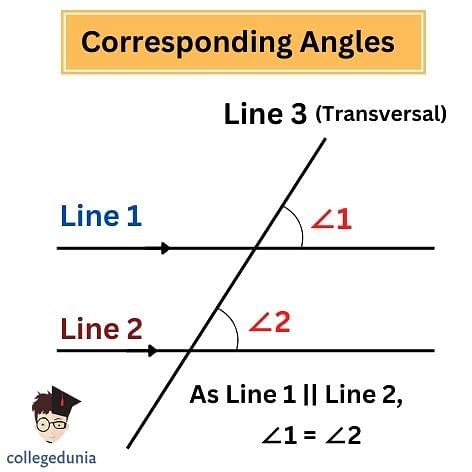
In the given figure, ∠1 and ∠2 are the corresponding angles:
Corresponding Angles
From the definition of the corresponding angles, we can say that:
- There are two parallel lines in the case of corresponding angles. Here, Lines 1 and 2 are parallel.
- Line 3 is intersecting lines 1 and 2, thus Line 3 is a transversal.
- We can see that angles 1 and 2 are occupying the same relative position which is the upper right side angles in the intersection region.
Read More:
| Related Topics | ||
|---|---|---|
| Lines and Angles | Types of Angle | Properties of Parallel Lines |
| Quadrilateral Angle Sum Property | Angle between Two Lines | Obtuse Angle |
Types of Corresponding Angles
[Click Here for Sample Questions]
In corresponding angles, the transversal can intersect either two parallel lines or two non-parallel lines. Thus, on the basis of this, there are two types of corresponding angles:
- Corresponding angles that are formed by parallel lines and transversal.
- Corresponding angles that are formed by non-parallel lines and transversal.
Corresponding Angles Formed by Parallel Lines and Transversal
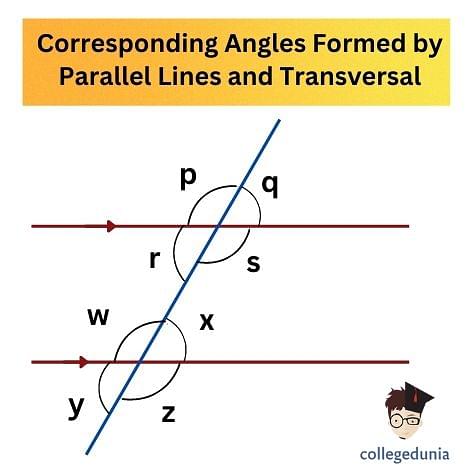
If the transversal intersects the two given parallel lines, then the corresponding angles formed have equal measure and will be congruent. In the given figure, the angles formed by the first line with the transversal have equal corresponding angles formed by the second line with the transversal.
Corresponding Angles Formed by Parallel Lines and Transversals
The corresponding angle pairs in the above figure are
- ∠p and ∠w
- ∠q and ∠x
- ∠r and ∠y
- ∠s and ∠z
Since, the corresponding angles formed by two parallel lines are always equal,
- ∠p = ∠w
- ∠q= ∠x
- ∠r = ∠y
- ∠s = ∠z
Read More: Lines and Angles Important Questions
Corresponding Angles Formed by Non-Parallel Lines and Transversal
If the transversal intersects two non-parallel lines, then the corresponding angles formed are not equal but all are corresponding to each other. There is no relationship between the interior angles, exterior angles, vertically opposite angles, and consecutive angles in this case.

Corresponding Angles Formed by Non-Parallel Lines and Transversal
How to Find Corresponding Angles?
[Click Here for Sample Questions]
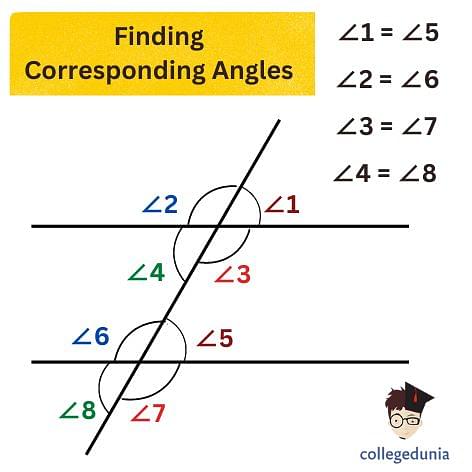
There are 4 angles at each intersection point. Each of the four angles in the first intersection region will have another one with the same relative position in the second intersection region.
Corresponding Angles
We can now separate each of these four angles into different categories to get a better understanding of the different types of corresponding angles.
| Name of Angles | Location |
|---|---|
| Angles 1 and 5 | Upper Right Side Angle |
| Angles 2 and 6 | Upper Left Side Angle |
| Angles 3 and 7 | Lower Right Side Angle |
| Angles 4 and 8 | Lower Left Side Angle |
Corresponding Angles Postulate
[Click Here for Sample Questions]
According to the corresponding angle postulate, the corresponding angles are always congruent if the transversal intersects two parallel lines.
Corresponding Angles in a Triangle
[Click Here for Sample Questions]
Corresponding angles in a triangle refer to those angles that are contained by a congruent pair of sides of two congruent triangles. Corresponding angles in a triangle are thus equal.
Corresponding Angles Theorem
[Click Here for Sample Questions]
The Corresponding Angles Theorem states that “If a line intersects two parallel lines, then the corresponding angles in the two intersection regions are congruent to each other”.
Converse of Corresponding Angles Theorem
The corresponding angles converse theorem states that “If the corresponding angles in the two regions of intersections are congruent, then the lines are parallel in nature”.
Read More: Lines and Angles MCQs
Solved Examples on Corresponding Angles
Example 1: Two corresponding angles formed between two parallel lines are ∠1 = 6x + 3 and ∠5 = 4x + 5. Find out the value of x.
Ans. The corresponding angles between two parallel lines are congruent which means that they are equal.
Equating the values of both the angles,
6x + 3 = 4x + 5
6x – 4x = 5 - 3
2x = 2
x = 2 / 2
x = 1
Thus, the value of x is 1.
Example 2: A transversal intersects two parallel lines to form corresponding angles A and B. If the value of two corresponding angles is 9y +6 and 3y + 18, then calculate the magnitude of each corresponding angle.
Ans. The values of the corresponding angles are 9y +6 and 3y + 18.
As the corresponding angles are congruent in the case of parallel lines, so we can equate the angles,
9y +6 = 3y + 18
9y – 3y = 18 - 6
6y = 12
y = 12 / 6 = 2
Thus, the magnitude of each corresponding angle is
9y +6 = 9 x 2 + 6 = 24
3y + 18 = 3 x 2 + 18 = 24
Important Points on Corresponding Angles
[Click Here for Sample Questions]
Here are a few important points about the corresponding angles:
- When two parallel lines are intersected by a third one, the angles that occupy the same relative position at each intersection are referred to as the corresponding angles to each other.
- Corresponding angles are congruent in nature to each other.
- If the corresponding angles in the two regions of intersections are congruent, then the two lines are said to be parallel.
Read More:
Different Types of Angles
[Click Here for Sample Questions]
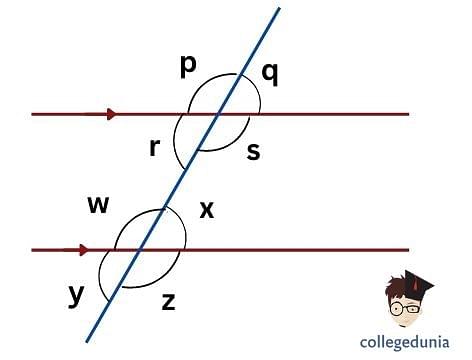
Apart from corresponding angles, there are a few other types of angles that are formed, when a transversal intersects two lines. Consider the given figure,
Different Types of Angles
Referring to the figure given below, the various angles are as follows:
| Type of Angles | Definition | Angle Relationships |
|---|---|---|
| Vertically Opposite Angles | The angles that are formed opposite to each other by a transversal are known as Vertically Opposite Angles. | ∠p = ∠s, ∠q = ∠r, ∠w = ∠ z, ∠x = ∠y |
| Alternate Interior Angles | The angles that are formed at the interior side of the two parallel lines with a transversal are called Alternate Interior Angles. | ∠r = ∠x and ∠s = ∠w |
| Alternate Exterior Angles | The angles that are formed at the exterior side of the two parallel lines with a transversal are called Alternate Exterior Angles. | ∠p = ∠z and ∠q = ∠y |
| Co-interior Angles | The angles that are formed inside the two parallel lines but on one side of the transversal are the consecutive interior angles. The sum of these two angles is 180°. | ∠r + ∠w = 180° and ∠s + ∠x = 180° |
Things to Remember
- Corresponding Angles are a pair of angles that are formed when a transversal intersects two parallel lines.
- When a transversal intersects two parallel lines, the corresponding angles thus formed are congruent.
- When a transversal intersects two non-parallel lines, the corresponding angles are not congruent.
- According to the Corresponding Angles Theorem, if a line intersects two parallel lines, then the corresponding angles in the two intersection regions are congruent.
- The Converse of Corresponding Angles Theorem states that if the corresponding angles in the two intersection regions are congruent, then the two lines are said to be parallel.
Sample Questions
Ques. The values of two corresponding angles are given as ∠2 = 5x + 2 and ∠6 = 3x + 10. What will be the value of x? (3 Marks)
Ans. Given that the angles are corresponding angles and the lines are said to be parallel in nature, then they should be congruent.
Putting the values of ∠2 = 5x + 2 and ∠6 = 3x + 10 equal, we can find out the value of x.
5x + 2 = 3x + 10
5x – 3x = 10 – 2
2x = 8
x = 8 / 2
x = 4
Thus, the value of x is 4.
Ques. The value of two corresponding angles is given as 7y – 12 and 5y + 6. Calculate the magnitude of each corresponding angle. (3 Marks)
Ans. The values of both the corresponding angles are given as 7y – 12 and 5y + 6.
Since the corresponding angles are congruent, so we can equate the angles,
7y – 12 = 5y + 6
7y – 5y = 12 + 6
2y = 18
y = 9
So, the magnitude of each corresponding angle would be
5y + 6 = 5 x 9 + 6 = 51
7y – 12 = 7 x 9 – 12 = 51
Ques. Are Corresponding Angles supplementary? (2 Marks)
Ans. Yes, the corresponding angles can be supplementary if the transversal intersects two parallel lines perpendicularly which is if they intersect at 90 degrees. In such a situation, each of the corresponding angles will be 90 degrees and they will add up to 180 degrees and would be referred to as supplementary angles (two angles whose sum is 180 degrees).
Ques. Two corresponding angles are 9x + 10 and 55. Calculate the value of x. (2 Marks)
Ans. The given corresponding angles are congruent, so, on equating them
9x + 10 = 55
9x = 55 – 10
9x = 45
x = 5
The value of x is 5.
Ques. Mention the Converse of Corresponding Angles Postulate. (2 Marks)
Ans. The corresponding angles postulate states that the corresponding angles are considered to be congruent if the transversal intersects two parallel lines. On the other hand, the converse of corresponding angles postulates states that if the corresponding angles in the two intersection regions are congruent, then the two lines are said to be parallel.
Ques. How do Corresponding Angles appear? (2 Marks)
Ans. When a transversal intersects two parallel lines, the angles formed occupying the same relative position at each intersection are corresponding angles. When two parallel lines are intersected by a transversal, then the angles in the same corners of each line are said to be corresponding angles and the transversal will appear like a straight line.
Ques. Name the two types of Corresponding Angles. (3 Marks)
Ans. Corresponding angles can be classified into two categories namely:
- Corresponding angles formed by parallel lines and transversals: Corresponding angles thus formed are congruent.
- Corresponding angles formed by non-parallel lines and transversals: Corresponding angles formed are not equal.
Ques. The values of two corresponding angles are given as ∠1 = 3x + 1 and ∠5 = 4x – 3. Find out the value of x. (2 Marks)
Ans. The corresponding angles are considered to be congruent in nature, thus,
Equating the values of both the angles, we get
3x + 1 = 4x – 3
1 + 3 = 4x – 3x
4 = x
Thus, the value of x is 4.
Ques. Two angles ∠7 = 5x + 5 and ∠3 = 8x – 10 are corresponding to each other. Solve in order to find out the value of x. (3 Marks)
Ans. Since they are corresponding angles and the lines are said to be parallel in nature, so the angles should be congruent.
Equating the values of both the angles,
5x + 5 = 8x – 10
5 + 10 = 8x – 5x
15 = 3x
x = 15 / 3
x = 5
Thus, the value of x is 5.
Ques. Name the types of Corresponding Angles based on their sum. (2 Marks)
Ans. The types of Corresponding Angles based on their sum are:
- Supplementary Corresponding Angles (If the sum is 180 degrees)
- Complementary Corresponding angles (If the sum is 90 degrees)
Read More:



Comments