



Content Curator
The area of a circle in the 2D plane refers to the area occupied by a circle. The area of the sector formula, A = πr², can be used to calculate it. The radius of the circle is denoted by r, and the area is measured in square units such as cm², m², and so on. This formula is used to calculate the area occupied by a circular plot or a field. The formula for the area of a circle can help in calculating the area of a circular field or plot. The area formula assists in determining the circle's boundary length, or circumference.
| Table of Content |
Key Takeaway: Circumference, Radius, Diameter, Pie(π), Perimeter, Area
What is a Circle?
[Click Here for Sample Questions]
A closed plane geometrical shape is known as a circle. It is the locus of a point that moves around a fixed point at a fixed distance away from that point in technical terms. A circle is a closed curve with an equal distance between its outer and inner lines. The radius of the circle is the fixed distance from the center point. Many instances, such as a pizza, a wheel, and so on, may be found in our daily lives.
Circle and Parts of a Circle
A circle is made up of points that are all at the same distance from the circle's center. A closed geometric shape is a circle. In everyday life, we see circles in the form of a wheel, pizzas, a round ground, and so on. The area of the circle is the measurement of the space or region enclosed within the circle.
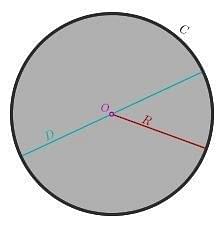
Circle
Radius
The radius of a circle is the distance between the center and a point on the edge. The letter 'r' or 'R' is used to represent it. The formula for the area and circumference of a circle, which we shall learn later, includes radius.
Diameter
The diameter of a circle is a line that runs through the center and has its endpoints on the circle. The letter 'd' or 'D' is used to represent it.
Diameter formula: The diameter formula of a circle is twice its radius. Diameter = 2 × Radius
d = 2r or D = 2R
Circumference
The length of the circle's boundary equals its circumference. This signifies that a circle's perimeter equals its circumference. The circumference of the circle will be equal to the length of the rope that perfectly wraps around its perimeter. The diagram below can assist you in visualizing the situation. The circumference can be calculated using the formula below:
Circumference of a Circle-: 2πR
where 'r' is the circle's radius and π is a mathematical constant whose value is around 3.14 or 22/7. The area of a circle can be calculated using its circumference.
The video below explains this:
Radius Formula Detailed Video Explanation:
Area of Circle formula
[Click Here for Sample Questions]
The diameter and circumference of a circle can be used to compute the area of a circle in intermediate steps. We can calculate the radius of a circle by multiplying the diameter and circumference. However, these formulae are the quickest way to calculate the area of a circle. If a circle has a radius of r, its area is πr² or πd²/4 in square units, where π = 22/7 or 3.14 and d is the diameter.
Area of a circle, A = πr² square units
The value of π = 22/7 or 3.14
r = radius
Read More:
Derivation of the Area of a Circle
- Area of a circle using rectangle
- Area of a circle using triangle
Determining the Area of a Circle using Rectangle
- The circle must be divided in 12 parts which should be equally divided.
- Among the 12 parts take a single sector and cut it into two parts making the total into 13 parts.
- They arrange the 13 sectors in a rectangular shape.
- All the parts of the circle provide the circumference of the circle and the length of a rectangle is provided by πr and the breadth is given by r.
- The area of the rectangle is equal to the area of the circle.
- Hence A = πr*r or A = πr²
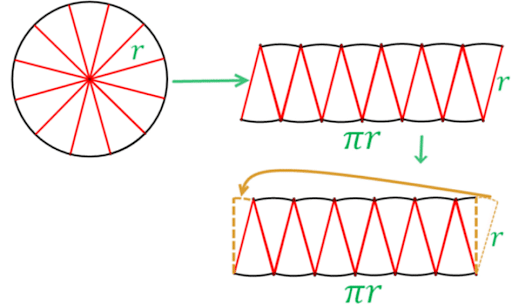
Determining the Area of a Circle using Rectangle
Determining the Area of a Circle using Triangle
- Fill the circle with r radius having concentric circles
- After dividing the circle along the given lines and spreading it, a triangle will be obtained
- The triangle’s base will be equal to the circle circumference and its height and radius of the circle will be equal
- Hence the area of the triangle (A) and the area of the circle will be equal.
- A = ½ * base * height
- A = ½ * (2πr) * r
- A = πr²

Determining the Area of a Circle using Triangle
Points To Remember
- P = 2πr gives the circumference (P) of a circle, or the perimeter of a circle region, with radius r.
- Area = π × r², where 'r' is the radius.
- Area = (π/4) × d², where 'd' is the diameter.
- Area = C²/4π, where 'C' is the circumference.
Also Read:
Sample Questions
Ques. The radius of a circular region is 7 m. Find its perimeter and area. (Use π = 22/7) (2 marks)
Ans. Here r = 7 m. Then,
Perimeter = 2πr = 2 × 22/7 × 7 m = 44 m;
Area = πr² = 22/7 × 72 m² = 154 m².
Ques. The perimeter of a circular plate is 132 cm. Find its area. (Use π = 22/7) (3 marks)
Ans. Let the radius of the plate be r. Then,
Perimeter = 2πr
? 132 cm = 2 × 22/7 × r
? 132 cm = 44/7 × r
? 44/7 × r = 132 cm
? r = 132 × 7/44
? r = 924/44
? r = 21 cm.
Therefore, area of the plate = πr2 = 22/7 × 212 cm2
= 227 × 441 cm²
= 97027 cm²
= 1386 cm²
Ques. If the length of the radius of a circle is 4 units. Calculate its area. (3 marks)
Ans. Radius(r) = 4 units(given)
Using the formula for the circle's area,
Area of a Circle = πr²
Put the values,
A = π4²
A =π × 16
A = 16π ≈ 50.27
Ques. The length of the largest chord of a circle is 12 units. Find the area of the circle. (2 marks)
Ans. Diameter(d) = 12 units(given)
Using the formula for the circle's area,
Area of a Circle = (π/4)×d²
Put the values,
A = (π/4) × 12²
A = (π/4) × 144
A = 36π ≈ 113.1
Ques. Find the area of a circle whose radius is 15 mm. (3 marks)
Ans. A = πr² square units
By substitution,
A = 3.14 x 15²
= (3.14 x 15 x 15) mm²
= 706.5 mm²
So, the area of the circle is 706.5 mm²
Ques. Calculate the area of the circle whose radius is 28cm. (2 marks)
Ans. A = πr² square units
= (3.14 x 282) cm²
= (3.14 x 28 x 28) cm²
= 2461.76 cm²
Ques. The area of a circle is 254.34 square yards. What is the radius of the circle? (3 marks)
Ans. A = πr² square units
254.34 = 3.14 x r²
Divide both sides by 3.14.
r² = 254.34/3.14 = 81
Find the square root of both sides.
√r² = √81
r = -9, 9
Since the radius cannot have a negative value, we take positive 9 as the correct answer.
So, the radius of the circle is 9 yards.
Ques. The lawn sprinkler sprays water 10 feet in every direction as it rotates. What is the area of the sprinkled lawn? (2 marks)
Ans. Here, the radius is 10 feet.
A = πr² square units
= 3.14 x 10²
= (3.14 x 10 x 10) sq. ft
= 314 sq. ft
Therefore, the area of the sprinkled lawn is 314 sq. ft.
Ques. Find the area of a circle with a diameter of 6 inches. (2 marks)
Ans. A = πd²/4 square units
= 3.14 x 62/4 Sq. inches.
= (3.14 x 6 x 6)/4 Sq. inches
= 28.26 sq. inches
So, the area of the circle with a diameter of 6 inches is 28.26 square inches.
Ques. Calculate the area of the circle whose diameter is 50 cm. (2 marks)
Ans. Given the diameter,
A = πd²/4 square units
= 3.14 x 50²/4
= (3.14 x 50 x 50)/4
=1962.5 cm².
Ques. Calculate the area of a dinner plate, which has a diameter of 10 cm. (1 marks)
Ans. A = πd²/4 square units
= 3.14 x 10²/4
= (3.14 x 10 x 10)/4
= 78.5 cm²



Comments