



Content Curator
Bacillus is a Gram-positive rod-shaped aerobic or anaerobic bacterium. It can be found in soil and water. Bacillus has been used to refer to all bacteria that are cylindrical or rod like. Bacillus can be reduced to oval endospores and can stay dormant in this condition for years. Bacillus is a bacterial genus that includes both nonparasitic (free-living) and parasitic (harmful) species. Endospores are heat, chemical, and sunlight resistant, and they are extensively spread in nature, mostly in soil, where they invade dust particles.
Also, Read: Gram-positive and Gram-negative Bacteria
| Table of Content |
Key Terms: Bacillus, bacteria, classification, cells, Diseases, gram-positive, prokaryote, endospores, DNA, peptidoglycan
Bacillus Bacteria Classification
[Click Here for Sample Questions]
Domain: Bacteria
The prokaryotes that people come into contact with on a daily basis are classified as domain Bacteria. Their cell walls include peptidoglycan. Amino acids and sugars combine to form peptidoglycan. It is also responsible for forming the cell wall. Prokaryotes are mostly single-celled organisms. There are no membrane-bound nuclei, mitochondria, or chloroplasts in them.

Bacteria
Kingdom: Eubacteria
Eubacteria are single-celled bacteria. Due to their prokaryotic nature, they lack a nucleus and contain DNA in a circular chromosome. It is possible for eubacteria to be either gram-negative or gram-positive.
Phylum: Firmicutes
Firmicutes have a low DNA content and are gram-positive.
Class: Bacilli
Bacilli are a taxonomic class of bacteria classified into two orders, Bacillales and Lactobacillales. The name of this class alludes to the organisms' morphological form. It is also a term used to describe the shape of rod-shaped bacteria.
Order: Bacillales
Endospores can be formed by the members.
Family: Bacillaceae
Bacillaceae are Gram-positive, heterotrophic, rod-shaped bacteria capable of producing endospores. Members of the Bacillacae family are all aerobic, meaning they utilise oxygen for cellular respiration.
Genus: Bacillus
They contain peritrichous flagella, which enable the bacteria to move. Bacillus species may be found in soil, water, and grow on plants.
Species: Bacillus cereus
Bacillus cereus differs from its counterparts in several ways. There are distinct phenotypic and pathogenic differences between Bacillus anthracis and Bacillus thuringiensis.
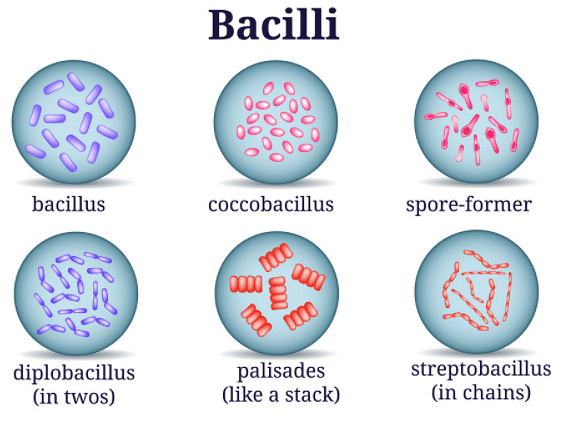
Bacillus Bacteria Classification Based on Cell Shape
[Click Here for Sample Questions]
Bacillus
A single-detached cell in the shape of a rod.
Example:
- Bacillus cereus
- Salmonella enterica
Diplobacilli
After cell division, two rods are joined and found in pairs in these bacteria.
Example:
- Moraxella Bovis
- Klebsiella rhinoscleromatis
Streptobacilli
Bacilli are grouped in a single chain in them due to single-plane cell division.
Example:
- Streptobacillus moniliformis
- Streptobacillus felis
Coccobacilli
In comparison to other bacteria, they have an oval form and are short.
Examples:
- Chlamydia trachomatis
- Haemophilus influenzae
- Gardnerella vaginalis
Palisades
After cell division, these bacteria bend and arrange themselves in a palisade.
Example:
- Corynebacterium diphtheriae
Bacillus Bacteria: Importance and Uses
[Click Here for Sample Questions]
- Bacillus spp. are found in a variety of habitats, including soil, and are resistant to a variety of stresses. Because of their capacity to live in harsh environments such as high pH (B. alcalophilus), high temperature (B. thermophilus), and high salt concentrations, Bacillus bacteria are found all over the world.
- It is generally considered safe to use Bacillus species and their products in the environment. These bacteria are recommended for commercialization due to their ability to emit a variety of bioactive chemicals.
- They maintain their vitality while being simple to store. Commercial Bacillus-based products are made and supplied all over the world.
- Bacillus coagulans may also make very acidic meals that taste awful.
- Bacillus thuringiensis, one of the Bacillus bacterium species, has the capacity to create toxins that may kill insects, making them natural pesticides.
- Antimicrobial substances in the bacteria B. siamensis can prevent plant diseases.
- Few Bacillus species are natively capable of DNA absorption via transformation.
Bacillus Bacteria: Disease
[Click Here for Sample Questions]
Bacillus bacteria can cause a variety of diseases, including
- Bacillus subtilis infections, including endocarditis, pneumonia, and septicemia. This is more common in patients with immunological disorders.
- The bacterium Bacillus anthracis causes infections of the skin, lungs, and intestines that are deadly to humans.
- Bacillus cereus can cause food poisoning when it causes food rotting.
Things to Remember
[Click Here for Sample Questions]
- One of the largest species of Bacillus is B megaterium, which is approx 1.5 μm (micrometres; 1 μm = 10−6 m) across 4 μm long. Bacilli typically live in groups.
- In 1877, Ferdinand Cohn published a detailed description of two separate types of hat bacillus. One is that it might be destroyed if exposed to heat, while the other exhibits heat resistance.
- Gram-positive Bacilli include Actinomyces, Clostridium, Bacillus, and gram-negative bacteria such as Escherichia coli, Klebsiella pneumoniae, Salmonella, Streptobacillus, and others.
- They are capable of serving at extreme temperatures, such as 4200 degrees Celsius.
- In nature, they are generally parasitic and free-living.
- These Bacteria are among the most common on the planet.
Sample Questions
Ques. Where are the species of Bacillus Bacteria used? (3 Marks)
Ans. Many Bacillus species are capable of producing huge amounts of enzymes, which are used in a range of industries. Alpha-amylase, for example, is employed in the hydrolysis of starch, and protease subtilisin is utilised in detergents.
Bacillus species can manufacture and generate surfactants and mycosubtilin, two lipopeptides. Bacillus species have also been discovered in marine sponges. Antibacterial peptides can be produced by Bacillus subtilis (strains WS1A and YBS29) discovered in marine sponges. These Bacillus subtilis strains can develop disease resistance in Labeo rohita.
Ques. What are the most important species of Bacillus to be noted? (3 Marks)
Ans. Among the Bacillus species worth mentioning are:
Bacillus anthracis is the bacteria that causes anthrax.
Bacillus subtilis is known for being a model bacteria. In the realm of genetic engineering, it is often used. Food poisoning is caused by the bacterium Bacillus cereus. Bacillus thuringiensis is a bacterium that helps to manage pests. It secretes a toxin that is toxic to several moths and butterflies.
Ques. Is Bacillus Coagulans a good bacteria? (3 Marks)
Ans. Bacillus coagulans is a helpful bacterium, or probiotic. It produces lactic acid, however, it is not the same as Lactobacillus, a different type of probiotic.
- coagulans can generate spores during their reproductive life cycle. In contrast to Lactobacillus and other probiotics, this is not the case. This property allows B. coagulans to go dormant in adverse conditions when other probiotics would be killed.
As a result, this bacterium strain is incredibly resilient. It has the ability to resist difficult stomach conditions such as high acidity. This might explain why B. coagulans is particularly effective in the treatment of gastrointestinal issues and other disorders.
Ques. Do bacteria grow in refrigerators? (4 Marks)
Ans. Pathogenic bacteria that cause foodborne disease and spoilage bacteria that cause foods to deteriorate and generate unpleasant odours, tastes, and textures are two different types of bacteria.
In the "Danger Zone," which is defined as the temperature range between 40 and 140 degrees Fahrenheit, pathogenic bacteria can swiftly multiply. The presence of a pathogen cannot be identified since it has no effect on the meal's flavour, smell, or appearance.
In chilly conditions, such as the refrigerator, spoilage bacteria can grow. They eventually cause bad odours and flavours to emerge in food.
Ques. Where do Bacillus Bacteria live and can they live in an extreme environment? (3 Marks)
Ans. The vast majority of these bacteria are found in the environment, in soil, air, dust, and waste. These organisms are common in cleanroom microflora and frequently dominate interior air in occupied buildings. They can also be found in large numbers in dust and on surfaces.
Bacillus is an example of a microbe that can withstand a wide pH range and high temperatures. The astounding variety of microbial life in hostile environments became apparent when metagenomic methods and 16S DNA sequencing were found.
Ques. Bacillus subtilis are
a)Hay
b)Nitrifying
c)Amonifying (2 Marks)
Ans. The correct option is A)
Hay bacillus is another name for Bacillus subtilis. They are bacteria that are gram-positive. They can be found in hay or in the top layer of soil. As a result, they're known as hay bacteria. Ruminants and humans both have them in their GI tracts. They're what's known as obligate aerobes.
As a result, the right response is 'Hay bacteria.'
Ques. Where is Bacillus bacteria found? (2 Marks)
Ans. The great majority of these bacteria are environmental organisms that may be found in soil, air, dust, and garbage. These organisms are ubiquitous components of the microflora in cleanrooms and often dominate indoor air in occupied buildings. They are also numerous in dust and on surfaces.
Ques. Write a short note on E. coli. (3 Marks)
Ans. Many common bacterial illnesses, such as cholecystitis, bacteremia, cholangitis, urinary tract infection (UTI), traveller's diarrhoea, and other clinical diseases such as newborn meningitis and pneumonia, are caused by Escherichia coli.
Theodor Escherich, who isolated the genus' original species, is the name of the genus Escherichia. Gram-negative bacilli occur singly or in pairs as Escherichia organisms.
Ques. Name the enzyme produced by the Streptococcus bacterium. Explain its importance in medical sciences. [All India 2011] (2 Marks)
Ans. Streptokinase is an enzyme generated by the Streptococcus bacteria. It is genetically engineered and employed as a clot-buster to remove clots from the blood arteries of individuals who have experienced a myocardial infarction.
Ques. Mention the importance of lactic acid bacteria to humans other than setting milk into curd. [Delhi 2012] (3 Marks)
Ans. (i)The Lactic Acid Bacteria (LAB) produce an acid known as lactic acid, which is an important industrial product. As well as beverages and meat products, it is used in confectionery, dairy products, etc.
(ii) It also checks for disease-causing microbes in the stomach.
Also read:



Comments