



Content Writer-SME
Budding is an important concept in biology that defines a form of asexual reproduction. In this type, a new individual develops via bud formation in parent organism. In some of the species, buds may be produced from any region of the body, while in many cases, bud formation is restricted to some specialised areas only. In this article, we will look into the fact that how budding forms a characteristic of a few unicellular organisms and metazoan animals.
| Table of Content |
Definition of Budding
A type of asexual reproduction in which a new organism develops as a small growth from the parent is called budding. This small growth separates from the parent organism after some time and is then called a bud. Unicellular (single-celled) organisms such as yeast and hydra reproduces through the process of budding.
- In plants like roses, the bud formation occurs along the stem of parent organism.
- The process of budding is also observed in animals such as jelly fish, sea anemones, corals, etc.
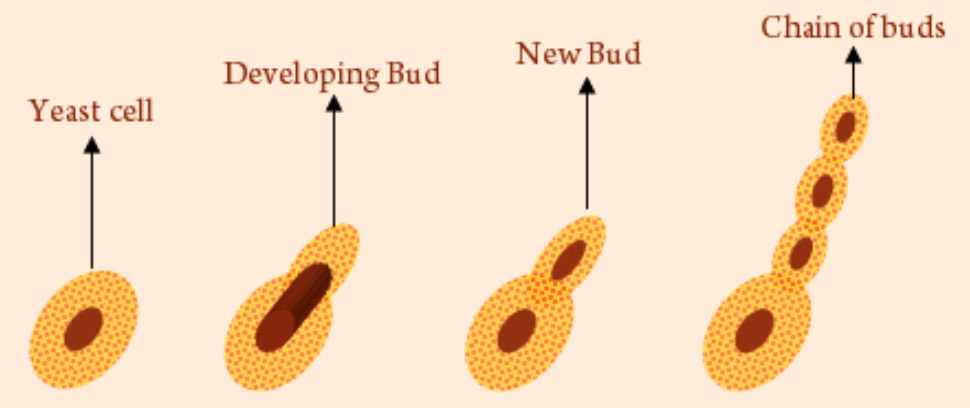
Budding Diagram
Types of Budding
The process of budding occurs in both plants and animals. Based on the location of bud formation in parent organism, it is categorized into five types: Exogenous, endogenous, lateral, basal, and apical budding.
Exogenous Budding
Exogenous budding is mainly seen in yeast and some bacteria. This type of budding occurs on the outer surface of the parent plant or animal. Once a bud has formed on the surface it begins to swell and after some time separates from the parent organism. In this way, by the formation of a bud, a complete organism is formed.
Endogenous Budding
Protozoa and other unicellular organisms reproduce through the process of endogenous budding. In this type, a bud or small growth is formed within the parent organism. The bud develops internally and over time it becomes free and develops into a new unicellular organism.
Lateral Budding
Lateral budding is one of the important types of budding that occurs in freshwater organisms such as hydra. In this type, a small outgrowth develops along the side of parent organism.
Basal Budding
When the formation of bud occurs in bottom region or base of the parent organism, it is called basal budding. In this type of budding, the small outgrowth called bud grows in vertically upward direction and then detaches itself from the parent. Basal budding is exclusively observed in plants such as ferns.
Apical Budding
In mostly corals, apical budding is seen where bud formation takes place at the tip or apex of parent organism. At the maturity, the bud is separated from the parent organism and further develops into a new and complete organism.
Budding in Yeast
Yeasts are eukaryotic, single-celled, and non-green organisms belonging to the fungi kingdom. These microorganisms are typically larger than the bacteria and have a diameter of 3-4 um. Cells of yeast reproduce asexually by the process of budding. Budding usually happens during an abundant supply of nutrition.
- During this process, a small bud or an outgrowth arises from the parent body.
- The nucleus of the parent yeast gets bifurcated into two parts and one of the nuclei shifts into the bud, which then grows into a new cell.
Budding in Hydra
Hydra is a cnidarian and small (half-centimeter long) organism found in freshwater bodies. The structure consists of a tubular body, containing the head, distal, and foot.
- By repeated mitotic division, a small bud generates from its parent body and receives its nutrition from it.
- The growth of the offspring begins by developing smaller tentacles and mouth.
- Finally, the newly produced organism gets separated and becomes an independent organism.



Comments