



Content Curator
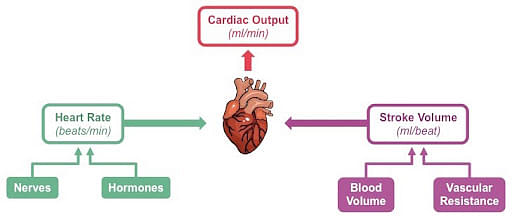
Cardiac Output refers to the volume of blood being pumped by the right and left ventricle of the heart per unit time. It consists of two important components: Heart Rate and Stroke Volume. Cardiac Output can be calculated by multiplying the heart rate with the stroke volume. The cardiac output of a healthy person is 5 litres of blood per minute.
| Table of Content |
Key Takeaways: Cardiac Output, Heart, Heart Rate, blood, oxygen
What is Cardiac Output?
[Click Here for Sample Questions]
Cardiac Output or the Heart Output is a term used in heart physiology that refers to the volume of blood being pumped by the right and left ventricle of the heart per unit time. Cardiac Output is controlled by the amount of oxygen required by the tissues in the body. When the oxygen demand increases, the blood flow through the tissues increases, resulting in an increase in the blood flow to the heart and hence, an increase in the cardiac output. Cardiac Output is an excellent indicator of how efficiently the heart can meet the body’s demand for the maintenance of adequate tissue perfusion.
Cardiac Output consists of two important components:
- Heart Rate: Heart Rate is known as the speed of heartbeat. It is calculated by the number of beats of the heart per minute. The heart rate varies according to different activities performed by us. For example, the heart rate is higher when we exercise as compared to when we are resting. Tachycardia and Bradycardia refer to high heart rate (100 bpm at rest) and low heart rate (60 bpm at rest) respectively.
- Stroke Volume: Stroke Volume is a term used in cardiovascular physiology that refers to the volume of blood pumped from the left ventricle per beat. The stroke volume for a healthy human being is 70ml.
Read More:
Factors determining Cardiac Output
[Click Here for Sample Questions]
The different factors that affect the cardiac output of the human heart are as follows:
- Venous Return: Venous Return refers to the amount of blood entering the heart through the vein. It becomes equal to cardiac output after a certain time interval.
- Force of Contraction: The stroke volume and cardiac output increase with an increase in the force of contraction.
- Heart Rate: Cardiac Output increases with an increase in the heart rate.
- Afterload: The ventricles experience resistance while circulating blood around the body. An increase in afterload leads to a decrease in the stroke volume, resulting in a decrease in the cardiac volume.
Read More:
Cardiac Output Formula
[Click Here for Sample Questions]
The cardiac output of a heart can be calculated by the multiplication of heart rate and stroke volume.
CO = HR x SV
Cardiac Output is affected by the factors that affect the heart rate and stroke volume. These factors are:
- Heart Rate (HR):
- Autonomic Innervation
- Hormones
- Fitness levels
- Age
- Stroke Volume (SV):
- Heart size
- Fitness level
- Contractility
- Gender
- Duration of contraction
- Preload
- Afterload
Read More:
Cardiac Output Measurement
[Click Here for Sample Questions]
Some of the methods that are used to measure cardiac output are as follows:
- Doppler Ultrasound: As the name suggests, the Doppler Ultrasound method uses the principles of ultrasound and the doppler effect to calculate the cardiac output. The velocity of blood through the heart causes a Doppler shift in the frequency of the returning ultrasound wavelength, which is then used to calculate the flow velocity, volume, and cardiac output.
- Echocardiography: Echocardiography also used the doppler effect and ultrasound to calculate the cardiac output.
- Transcutaneous: This method is used to measure cardiac output through the process of transcutaneous.
- Transoesophageal: This method is used to measure cardiac output through the process of transoesophageal.
Read More:
Cardiac Index
[Click Here for Sample Questions]
Cardiac Index is a dynamic of blood flood that relates the cardiac output with the body surface area. It is obtained by dividing the cardiac output by the body surface area.
Cardiac Index = Cardiac Output / Body Surface Area
The unit of measurement of the Cardiac Index is litre per minute square metre. The normal cardiac index range at rest is 2.6-4.2 L/min/m^2. It is used to determine how effectively the heart is functioning as a pump as it correlates the volume of blood pumped by the heart with the body surface area.
Read More:
Points to Remember
[Click Here for Sample Questions]
Following are some important points:
- Cardiac Output refers to the volume of blood being pumped by the right and left ventricle of the heart per unit time.
- Cardiac Output is an excellent indicator of how efficiently the heart can meet the body’s demand for the maintenance of adequate tissue perfusion.
- Cardiac Output can be measured using the formula: CO = HR x SV
- The methods used to calculate Cardiac Output are: Doppler Ultrasound, Echocardiography, Transcutaneous, and Transoesophageal.
- Cardiac Output is a dynamic of blood flood that relates the cardiac output with the body surface area. It is obtained by dividing the cardiac output by the body surface area.
Sample Questions
Ques: What is Cardiac Output? (3 Marks)
Ans: Cardiac Output or the Heart Output is a term used in heart physiology that refers to the volume of blood being pumped by the right and left ventricle of the heart per unit time. Cardiac Output is controlled by the amount of oxygen required by the tissues in the body. When the oxygen demand increases, the blood flow through the tissues increases, resulting in an increase in the blood flow to the heart and hence, an increase in the cardiac output. The cardiac output of a heart can be calculated by the multiplication of heart rate and stroke volume.
CO = HR x SV
Ques: What are two important components of cardiac output? (4 Marks)
Ans: The two important components of cardiac output are:
- Heart Rate: Heart Rate is known as the speed of heartbeat. It is calculated by the number of beats of the heart per minute. The heart rate varies according to different activities performed by us. For example, the heart rate is higher when we exercise as compared to when we are resting. Tachycardia and Bradycardia refer to high heart rate (100 bpm at rest) and low heart rate (60 bpm at rest) respectively.
- Stroke Volume: Stroke Volume is a term used in cardiovascular physiology that refers to the volume of blood pumped from the left ventricle per beat. The stroke volume for a healthy human being is 70ml.
Ques: What are the factors affecting cardiac output? (4 Marks)
Ans: The different factors that affect the cardiac output of the human heart are as follows:
- Venous Return: Venous Return refers to the amount of blood entering the heart through the vein. It becomes equal to cardiac output after a certain time interval.
- Force of Contraction: The stroke volume and cardiac output increase with an increase in the force of contraction.
- Heart Rate: Cardiac Output increases with an increase in the heart rate.
- Afterload: The ventricles experience resistance while circulating blood around the body. An increase in afterload leads to a decrease in the stroke volume, resulting in a decrease in the cardiac volume.
Ques: How is the cardiac output of a heart measured? (2 Marks)
Ans: The cardiac output of a heart can be measured using the following methods:
- Doppler Ultrasound
- Echocardiography
- Transcutaneous
- Transoesophageal
Ques: Describe the Doppler Ultrasound method of calculating cardiac output. (2 Marks)
Ans: The Doppler Ultrasound method uses the principles of ultrasound and the doppler effect to calculate the cardiac output. The velocity of blood through the heart causes a Doppler shift in the frequency of the returning ultrasound wavelength, which is then used to calculate the flow velocity, volume, and cardiac output.
Ques: What are the factors affecting heart rate and stroke volume? (2 Marks)
Ans: The factors affecting heart rate and stroke volume are as follows:
- Heart Rate:
- Autonomic Innervation
- Hormones
- Fitness levels
- Age
- Stroke Volume:
- Heart size
- Fitness level
- Contractility
- Gender
- Duration of contraction
- Preload
- Afterload
Ques: What is the Cardiac Index? (3 Marks)
Ans: Cardiac Index is a dynamic of blood flood that relates the cardiac output with the body surface area. It is obtained by dividing the cardiac output by the body surface area.
Cardiac Index = Cardiac Output / Body Surface Area
The unit of measurement of the Cardiac Index is litre per minute square metre. The normal cardiac index range at rest is 2.6-4.2 L/min/m^2.
Also Read:



Comments