



Content Writer
In general terms, a circle is a round, plane figure having a centre from which it is drawn. In mathematics, a circle is considered to be a two-dimensional figure in which all the points on its circumference are equidistant from a common point in the centre. This common point in the centre is called the centre of the circle or origin of the circle. The properties and formulas related to the circle are widely used in real-life applications.
| Table of Content |
Key Takeaways: Circle, Tangent, Chord, Tangent Circles, Concentric Circles, Congruent Circles, Segments of the Circle, Arc
Parts of the Circle
[Click Here for Sample Questions]
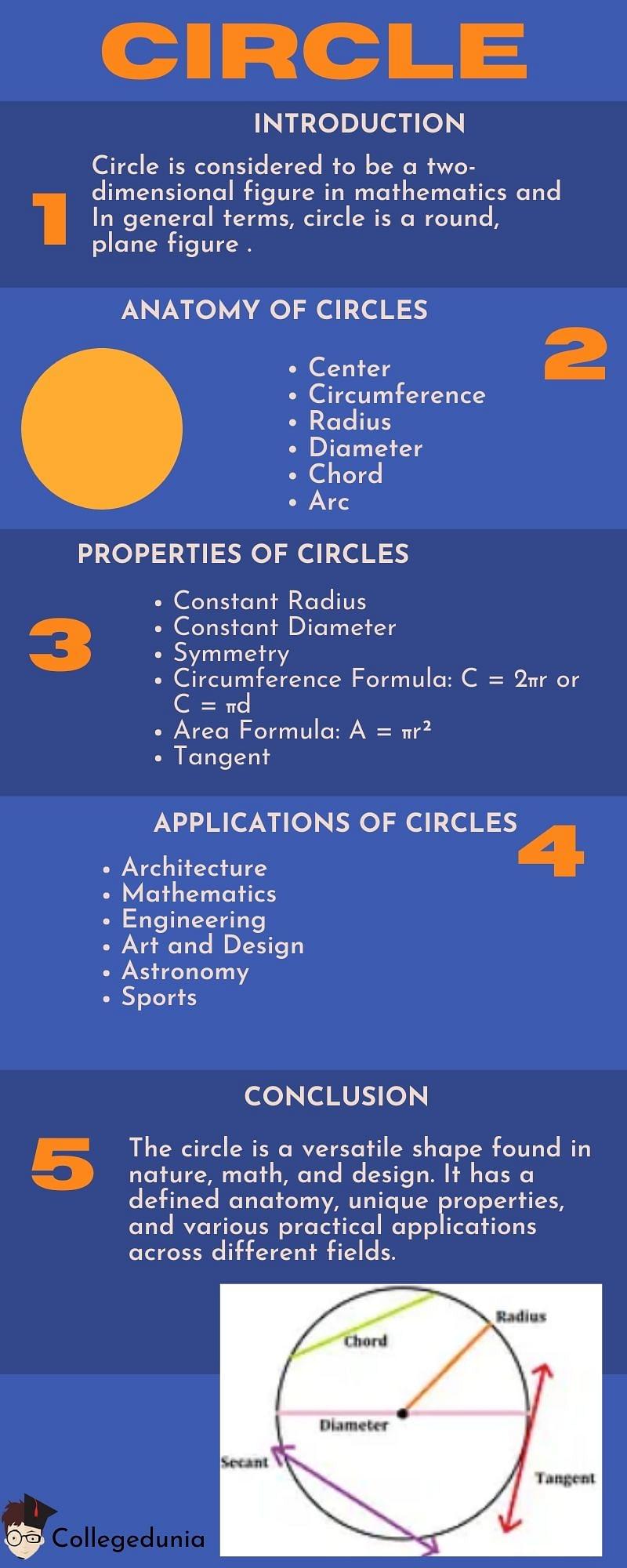
A circle can be divided into different parts each having their own importance and use. The different parts of the circle are as follows:
- Radius - The distance between the centre of the circle and any point on its circumference is called radius. A circle is always measured in terms of its radius. It is denoted by ‘r’.
- Diameter - A straight line touching two points on the circumference and passes through the centre is called diameter of the circle. It is denoted by d. It is double the length of the radius.
- Circumference - The length of the boundary of the circle is called its circumference. It is the perimeter of the circle.
- Tangent - A tangent is a line segment present outside the circle that touches the circle at a common point.
- Chord - A line segment drawn inside the circle that touches any two points on the boundary of the circle is called a chord. In a circle, diameter is the longest chord. A chord divides a circle into two parts.
- Arc - A segment of the circumference of a circle is called an arc of the circle. The smaller segment represents the minor arc and the larger segment is called the major arc.
- Segment - The two regions formed by the chord in a circle are called segments of the circle. The smaller region is called the minor segment and the larger one is called the major segment.
- Sector - The area enclosed by two radii in a circle is called sector of the circle. The smaller area is called the minor sector and the larger area is the major sector.

Parts of a Circle
The video below explains this:
Radius Formula Detailed Video Explanation:
Also Read: Trigonometry Values
Types of Circle
[Click Here for Sample Questions]
Depending upon the way in which two or more circles are related, there are three types of circles:
- Tangent Circles - When two or more circles intersect at a common point, they are called tangent circles. They do not have a common centre but they do have a common point at which they all intersect.
- Concentric Circles - When two or more circles share a common centre, they are called concentric circles. These circles have the same centre but different radii.
- Congruent Circles - Congruent circles are the circles that have the same radii but their centres are different.
Circle
Also Read:
Formulas Related to Circle
[Click Here for Sample Questions]
The main formulas related to the circle are as follows:
- Area of the circle = \(\pi\)r2
- Diameter of the circle = 2r
- Circumference of the circle = 2\(\pi\)r
- Arc Length = \(\theta\)r
- Area of a sector of a circle = \(\theta\)r2 / 2
- Length of the chord = 2 r sin\(\theta\)/2
- Area of segment = r2 (\(\theta\) - sin\(\theta\)) / 2
Read Also: Important Questions on Circle
Theorems Related to Circle
[Click Here for Sample Questions]
There are many theorems related to the circle. Some of them are given below:
Theorem 1: A perpendicular from the centre of the circle to the chord bisects the chord.

Given: AB is a chord. OM \(\bot\) AB
Prove: AM = BM
Proof: In \(\bigtriangleup\)AOM and \(\bigtriangleup\)BOM
AO = OB (radius)
OM = OM (common)
∠AMO = ∠BMO = 90°
So, \(\bigtriangleup\)AOM \(\cong\) \(\bigtriangleup\)BOM (by RHS rule)
∴ AM = BM (BY CPCT)
Hence proved
Theorem 2: The equal chords of a circle subtend equal angles at the centres.

Given: AB = CD
Prove: ∠AOB = ∠COD
Proof: In \(\bigtriangleup\)AOB and \(\bigtriangleup\)COD
AO = OD (radius)
AB = CD (given)
OB = OC (radius)
∴ \(\bigtriangleup\)AOB \(\cong\) \(\bigtriangleup\)DOC (by SSS rule)
So, ∠AOB = ∠DOC (by CPCT)
Hence proved
Theorem 3: Angles subtended by a chord at different points on the same side of the circumference are the same in measure.

Prove: ∠APB = ∠AQB
Proof: According to a theorem, the angle subtended by an arc at the centre is double the angle subtended by any point on the remaining part of the circle.
So, ∠AOB = 2 ∠APB …… (i)
∠AOB = 2 ∠AQB …… (ii)
From eq. i and ii
2 ∠APB = 2 ∠AQB
∠APB = ∠AQB
Hence proved
Theorem 4: The lengths of tangents drawn from an external point to a circle are equal.

Prove: PA = PB
Construction: Join OA, OB and OP.
Proof: ∠OAP = ∠OBP = 90° (tangent at any point of a circle is perpendicular to the radius through the point of contact)
Now, in right triangles \(\bigtriangleup\)OAP and \(\bigtriangleup\)OBP
OA = OB (radius)
OP = OP (common)
∴, \(\bigtriangleup\)OAP \(\cong\) \(\bigtriangleup\)OBP (by RHS rule)
Hence, PA = PB (by CPCT)
Theorem 5: In a cyclic quadrilateral, the sum of either pair of opposite angles is supplementary.

Given: ABCD is a cyclic quadrilateral.
Prove: ∠BAD + ∠BCD = 180°
∠ABC + ∠ADC = 180°
Proof: AB is the chord of the circle
∠5=∠8 …(i) (Angles in the same segment are equal)
BC is the chord of the circle
∠1=∠6 ….(ii) (Angles in the same segment are equal)
CD is the chord of the circle
∠2=∠4 ...(iii) (Angles in the same segment are equal)
AD is the chord of the circle
∠7=∠3 ….(iv) (Angles in the same segment are equal)
By angle sum property of a quadrilateral
∠A+∠B+∠C+∠D = 360°
∠1+∠2+∠3+∠4+∠7+∠8+∠5+∠6 = 360°
(∠1+∠2+∠7+∠8)+(∠3+∠4+∠5+∠6) = 360°
(∠1+∠2+∠7+∠8)+(∠7+∠2+∠8+∠1) = 360°
From equation (i), (ii), (iii) and (iv)
2(∠1+∠2+∠7+∠8) = 360°
(∠1+∠2+∠7+∠8) = 180°
∠BAD+∠BCD = 180°
Similarly, ∠ABC+∠ADC = 180°
Hence proved.
Also Read: Difference between mean median and mode
Things to Remember
- A circle is a two-dimensional figure whose all the points on the circumference are at equal distance from the centre.
- Two or more circles intersecting at a common point are called tangent circles.
- If two or more circles share a common centre then they are called concentric circles.
- If a perpendicular is drawn from the centre of the circle on the chord, then it divides the chord into equal parts.
- The area of the circle is given by \(\pi\)r2.
- The line segment drawn inside the circle that touches any two points on the boundary of the circle is called chord.
Sample Questions
Ques. In the given figure, O is the centre of the circle. PQ is a chord of the circle and R is any point on the circle. If ∠PRQ = l and ∠OPQ = m, then find l + m. (3 marks)

Ans. ∠POQ = 2∠PRQ
∠POQ = 2l
In \(\bigtriangleup\)PQO, OP = OQ = r
∠OQP = ∠OPQ = m
Also, ∠OPQ + ∠OQP + ∠POQ = 180°
m + m + 2l = 180°
2 (l + m) = 180°
l + m = 90°
Ques. In the given figure, ABCD is a cyclic quadrilateral such that ∠ADB= 40° and ∠DCA = 70°, then find the measure of ∠DAB. (2 marks)

Ans. ∠BCA = ∠ADB = 40° (angles in same segment of a circle are equal)
Now, ∠BCD = 70° + 40° = 110°
∠DAB + ∠BCD = 180°
∠DAB + 110° = 180°
∠DAB = 180° - 110°
∠DAB = 70°
Ques. Two circles of radii 5 cm and 3 cm intersect at two points and the distance between their centres is 4 cm. Find the length of the common chord. (5 marks)

Ans. OP = 5 cm
OS = 4 cm
PS = 3 cm
And, PQ = 2PR
Let RS = x.
In \(\bigtriangleup\)POR, OP2 = OR2 + PR2
52 = (4 - x)2 + PR2
25 = 16 + x2 - 8x + PR2
PR2 = 9 - x2 + 8x ……….(i)
In \(\bigtriangleup\)PRS, PS2 = PR2 + RS2
32 = PR2 + x2
PR2 = 9 - x2 ………….(ii)
By equating equation (i) and (ii),
9 - x2 + 8x = 9 - x2
8x = 0
x = 0
Now, put the value of x in equation (i)
PR2 = 9 - 0
PR = 3 cm
∴ length of the chord (PQ) = 2PR
So, PQ = 2 × 3 = 6 cm
Ques. A circular park of radius 20m is situated in a colony. Three boys Ankur, Syed and David are sitting at equal distance on its boundary each having a toy telephone in his hands to talk to each other. Find the length of the string of each phone. (5 marks)

Ans. Let the positions of Ankur, Syed and David be A,B and C respectively. They are sitting at equal distances, so they form an equilateral triangle.
Draw AD \(\bot\) BC. So, AD is the median of \(\bigtriangleup\)ABC and it passes through the centre O.
Also, O is the centroid of \(\bigtriangleup\)ABC. OA is the radius.
OA = 2/3 AD
Let the side of the triangle be a metres, then BD = a/2 m
Using pythagoras theorem in \(\bigtriangleup\)ABD,
AB2 = BD2 + AD2
AD2 = AB2 - BD2
AD2 = a2 - (a/2)2
AD2 = 3a2/4
AD = √3a / 2
OA = 2/3 AD
20m = 2/3 × √3a/2
a = 20√3 m
Hence, the length of the string is 20√3 m.
Ques. The radius of a circle is 8 cm and the length of one of its chords is 12 cm. Find the distance of the chord from the centre. (4 marks)

Ans. Radius of circle (OA) = 8 cm (Given)
Chord (AB) = 12cm (Given)
Draw a perpendicular OC on AB.
We know, perpendicular from centre to chord bisects the chord
So, AC = BC = 12/2 = 6 cm
In right ΔOCA:
Using Pythagoras theorem,
OA2 = AC2 + OC2
64 = 36 + OC2
OC2 = 64 – 36 = 28
or OC = √28 = 5.291 (approx.)
The distance of the chord from the centre is 5.291 cm.
Ques. In figure, O is the centre of the circle. If ∠APB = 50°, find ∠AOB and ∠OAB. (3 marks)

Ans. ∠APB = 50° (Given)
By degree measure theorem: ∠AOB = 2∠APB
∠AOB = 2 × 50° = 100°
Again, OA = OB (Radius of circle)
Then ∠OAB = ∠OBA (Angles opposite to equal sides)
Let ∠OAB = m
In ΔOAB,
By angle sum property: ∠OAB+∠OBA+∠AOB=180°
=> m + m + 100° = 180°
=>2m = 180° – 100° = 80°
=>m = 80°/2 = 40°
∠OAB = ∠OBA = 40°
Ques. If O is the centre of the circle, find the value of x in the following figure. (2 marks)

Ans. ∠AOC = 135° (Given)
From figure, ∠AOC + ∠BOC = 180° (Linear pair of angles)
135° +∠BOC = 180°
or ∠BOC = 180°−135°
or ∠BOC = 45°
Again, by degree measure theorem
∠BOC = 2∠CPB
45° = 2x
x = 45°/2
Ques. If a line intersects two concentric circles (circles with the same centre) with centre O at A, B, C and D, prove that AB = CD (2 marks)

Ans. First, draw a line segment from O to AD such that OM ⊥ AD.
So, now OM is bisecting AD since OM ⊥ AD.
Therefore, AM = MD — (i)
Also, since OM ⊥ BC, OM bisects BC.
Therefore, BM = MC — (ii)
From equation (i) and equation (ii),
AM-BM = MD-MC
∴ AB = CD
Also Read:



Comments