



Education Journalist | Study Abroad Lead
Circumcenter of a triangle is defined as the place where three perpendicular bisectors from its sides intersect each other or meet. The point of concurrency of a triangle is the other name for the circumcenter of a triangle. The circumcenter is the point of origin of a circumcircle, i.e. a circle encircled by a triangle. In order to construct the circumcenter of any triangle, the perpendicular bisectors of any two sides of a triangle are drawn. Regular polygons, triangles, rectangles, and right-kites are the only ones that can have the circumcenter.
| Table of Content |
Key Terms: Circumcenter, Triangle, Circumcircle, Polygons, Rectangle. Kites, Perpendicular Bisector, Cyclic Polygons, Acute Triangle, Obtuse Triangle
Definition of Circumcenter
[Click Here for Sample Questions]
The circumcenter is the centre point of the circumcircle drawn around a polygon. The circumcircle of a polygon is the circle that passes through all of its vertices and the centre of that circle is called the circumcenter. Cyclic polygons are all polygons that have circumcircles. A circumcircle is not necessary to be present for all polygons. The circumcircle and consequently the circumcenter can only be found in regular polygons, triangles, rectangles, and right-kites.
Circumcenter of A Triangle
[Click Here for Sample Questions]
The intersection of the perpendicular bisectors (i.e., the lines that are at right angles to the midpoint of each side) of all sides of a triangle yields the circumcenter of the triangle. This indicates that the triangle's perpendicular bisectors are concurrent (i.e. meeting at one point). Since all triangles are cyclic and can circumscribe a circle, they all have a circumcenter. Perpendicular bisectors of any two sides of a triangle are drawn to create the circumcenter of any triangle. The circumcenter of an acute triangle is located within the form, but the circumcenter of an obtuse triangle is located outside the triangle.
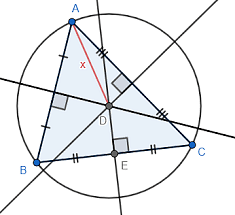
Circumcenter of Triangle
Read More: Centroid of a Triangle: Properties, Formula, Derivation, Theorem
Properties of Circumcenter of Triangle
[Click Here for Sample Questions]
The following are the properties of the circumcenter of the triangle.
Let us consider a triangle ABC whose circumcenter is denoted by O as shown in the figure.
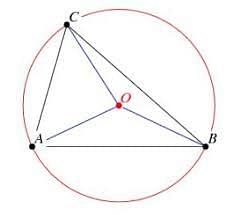
- Property 1: All the vertices of a triangle are at an equal distance from the circumcenter i.e AO = BO = CO.
- Property 2: The triangles that are formed by joining the circumcenter O to the vertices are isosceles triangles.
- Property 3: For a triangle whose ∠A is acute or when O and A are on the same side of BC, ∠BOC = 2 ∠A
- Property 4: For a triangle whose ∠A is obtuse or when O and A are on the different sides of BC, ∠BOC = 2(180° - ∠A).
- Property 5: The circumcenter of an acute angle triangle is located within the triangle.
- Property 6: In an obtuse angle triangle, the circumcenter lies outside the triangle.
- Property 7: The hypotenuse of a right-angled triangle is where the circumcenter is placed.
- Property 8: In an equilateral triangle, all four points, circumcenter, incenter, orthocenter, and centroid, are congruent. If the vertices of the triangle are linked, the circumcenter splits the equilateral triangle into three equal triangles.
Read More: Area of Equilateral Triangle, Perimeter & Altitude Formulas
How to Locate Circumcenter of A Triangle?
[Click Here for Sample Questions]
The circumcenter of every triangle may be obtained by drawing the perpendicular bisector of any of its two sides.
The procedures for determining the circumcenter of a triangle are outlined below.
- Step 1: Make a perpendicular bisector between any two triangle sides.
- Step 2: Extend the perpendicular bisectors until they meet at the intersection.
- Step 3: Make the intersection point O, which will be the circumcenter of the triangle.
The precision of the circumcenter's position will be improved by finding the third perpendicular bisector.
How To Construct A Circumcircle of a Triangle?
[Click Here for Sample Questions]
In order to construct the circumcenter of a triangle, a geometric tool called the compass is used. The steps to construct a circumcenter of a triangle are as follows:
- Step 1: Construct the perpendicular bisectors of at least two sides of the given triangle to get the circumcenter.
- Step 2: Stretch the compass point to any one of the vertices of the provided triangle from the circumcenter O.
- Step 3: Draw a circumcircle with the compass.
Read More: Properties of Triangle
Formulas To Locate The Circumcenter Of Triangle
[Click Here for Sample Questions]
Several formulae may be used to find or calculate the circumcenter of triangles. The numerous techniques for locating the circumcenter, as well as the processes, are listed below.
Method 1: Using the Midpoint Formula
- Step1: Using the mid-point theorem, find the coordinates of the midpoint (of sides AB, BC, and AC).
\(M(x, y)=\left(\frac{x_{1}+x_{2}}{2}, \frac{y_{1}+y_{2}}{2}\right)\) - Step2: Determine the incline of each side.
- Step3: Using the midpoint coordinates and the slope of the perpendicular line. write the line equation of the perpendicular bisector line.
\(\left(y-y_{1}\right)=\left(-\frac{1}{m}\right)\left(x-x_{1}\right)\) - Step4: Find the equations for the other lines in the same way.
- Step5: Solve these two perpendicular bisector equations to locate the intersection point.
The circumcenter of the provided triangle will be the obtained intersection point.
Method 2: Using the Distance Formula
The circumcenter is equidistant to all three vertices of a triangle, as we know from the property of the circumcenter.
Let the circumcenter of ABC be O (x, y). We obtain AO = BO = CO = Circumradius because the distances to O from the vertices are all equal.
Assume d1 is the distance between the circumcenter O (x, y) and the vertex A (x1, y1)
Using distance formula,
d = √(x−x1)2+(y−y1)2
Now, d1= √(x−x1)2+(y−y1)2
d2 = √(x−x2)2+(y−y2)2
d3 = √(x−x3)2+(y−y3)2
As we know d1 = d2 and d2 = d3
We'll receive two linear equations as a result of this:
Equation:1
(x−x1)2+(y−y1)2 = (x−x2)2+(y−y2)2
Equation:2
(x−x2)2+(y−y2)2 = (x−x3)2+(y−y3)2
The circumcenter O (x, y) coordinates can be found by solving these two linear equations using a substitution or elimination approach.
Method 3: Using the Circumcenter Formula
Using the circumcenter of a triangle formula, we can rapidly get the circumcenter:
\(\mathrm{O}(x, y)=\left(\frac{x_{1} \sin 2 A+x_{2} \sin 2 B+x_{3} \sin 2 C}{\sin 2 A+\sin 2 B+\sin 2 C}, \frac{y_{1} \sin 2 A+y_{2} \sin 2 B+y_{3} \sin 2 C}{\sin 2 A+\sin 2 B+\sin 2 C}\right)\)
Where ∠A, ∠B, and ∠C are respective angles of ΔABC.
Read More: Altitude and Median of Triangle
Method 4: Using Extended Sin Law
Using extended sin law,
\(\frac{a}{\sin A}=\frac{b}{\sin B}=\frac{c}{\sin C} = 2R\)
Given that a, b, and c are the lengths of the triangle's respective sides, and R is the circumcircle's radius.
We can calculate the radius of the circumcircle by using the extended version of the sin law, and we can discover the precise position of the circumcenter by utilising the distance formula.
Read More: Triangle Theorems
Things to Remember
- The place where three perpendicular bisectors from the sides of a triangle overlap or meet is called the circumcenter of a triangle.
- Cyclic polygons are all polygons that have circumcircles.
- The circumcenter of a triangle is equidistant from all three vertices.
- The circumcenter is the centre of the triangle's circumcircle.
- The perpendicular bisectors of a triangle's sides may or may not pass through the triangle's vertices.
- The circumcenter of an acute triangle is located within the form, but the circumcenter of an obtuse triangle is located outside the triangle.
- The circumcentre of a triangle can be located using various formulas such as Distance Formula, Midpoint Formula, Extended Sin Law and Circumcenter Formula.
Sample Questions
Ques. Find the circumcenter of the triangle formed by (−2,3), (2,−1) and (4,0). (3 Marks)
Ans. A = (-2,3), B = (2,-1), C = (4,0)
S(x,y) circumcenter
SA2=SB2
⇒(x+2)2+(y−3)2=(x−2)2+(y+1)2
⇒x2+4+4x+y2+9−6y=x2+4−4x+y2+1+2y
⇒8x−8y+8=0
⇒x−y+1=0 ........ (1)
SB2=SC2
(x−2)2+(y+1)2=(x−4)2+(y−0)2
4x+2y−11=0 ...... (2)
Circumcentre (\(\frac{3}{2}\), \(\frac{5}{2}\))
Ques. Using the circumcenter formula, find the circumcenter of \(\triangle\)ABC whose vertices A (0, 2), B (0, 0) and C (2, 0) and respective measures of angles A, B and C are 450, 900 and 450. (5 Marks)
Ans. If A (x1, y1), B (x2, y2), and C (x3, y3) are the \(\triangle\)ABC's vertices and A, B, C are their respective angles, then,
Circumcenter =
\(\mathrm{O}(x, y)=\left(\frac{x_{1} \sin 2 A+x_{2} \sin 2 B+x_{3} \sin 2 C}{\sin 2 A+\sin 2 B+\sin 2 C}, \frac{y_{1} \sin 2 A+y_{2} \sin 2 B+y_{3} \sin 2 C}{\sin 2 A+\sin 2 B+\sin 2 C}\right)\)
In the preceding formula, substitute the relevant coordinates of vertices and angle measurements of the ABC. We obtain the following
\(\mathrm{O}(x, y)=\left(\frac{0 \sin 2(45)+0 \sin 2(90)+2 \sin 2 (45)}{\sin 2 (45)+\sin 2 (90)+\sin 2 (45)}, \frac{2 \sin 2 (45)+0 \sin 2 (90)+0 \sin 2 (45)}{\sin 2 (45)+\sin 2 (90)+\sin 2 (45)}\right)\)
\(\mathrm{O}(x, y)=\left(\frac{2 (\sin 90)}{\sin (90)+\sin (180)+\sin (90)}, \frac{2 (\sin 90)}{\sin (90)+\sin (180)+\sin (90)}\right)\)
sin 45° = \(\frac{1}{\sqrt{2}}\), sin 90° = 1, sin180° = 0
⇒ O (x, y) = \(\left( \frac{2}{1+0+1}, \frac{2}{1+0+1} \right)\)
⇒ O (x, y) = \(\left( \frac{2}{2}, \frac{2}{2} \right)\)
⇒ O (x, y) = (1, 1)
Ques. Richard has a triangular piece of cardboard with a 19-inch side and a 30° angle on the other side. He wants to know how big the cylindrical box's base is so he can put this card entirely within. (3 Marks)
Ans. Using Extended sin law,
\(\frac{a}{\sin A}=\frac{b}{\sin B}=\frac{c}{\sin C} = 2R\)
\(\frac{19}{\sin 30}= 2R\)
R = 19 inches
Now, the area of the circumcircle = πr2 = π × 192
Therefore, Area = 1133.54 in2.
Ques. Determine the radius of the circle of an equilateral triangle whose sides are √3 inches each. (5 Marks)
Ans. Because it's an equilateral triangle, the circumcenter O will be bisected by AD (perpendicular bisector). Using circumcenter facts, we can see that if the vertices are linked, the equilateral triangle will be divided into three equal triangles.
i.e.
area of \(\triangle\)AOC = area of \(\triangle\)AOB = area of \(\triangle\)BOC
Therefore, area of \(\triangle\)ABC = 3 × area of \(\triangle\)BOC
Using the formula for the area of an equilateral triangle
= \(\frac{\sqrt{3}}{4}\) × a2
Also, the area of the triangle
= \(\frac{1}{2}\) × base × height
On substituting we get,
\(\frac{\sqrt{3}}{4}\) × a2 = 3 × \(\frac{1}{2}\) × a × OD
OD = \(\frac{1}{2\sqrt{3}}\) × a
Now for \(\triangle\)ABC
Again using the formula for the area of \(\triangle\) ABC = \(\frac{1}{2}\) × base × height
\(\frac{1}{2}\) × a × (R+OD)= \(\frac{\sqrt{3}}{4}\) × a2
\(\frac{1}{2}\)a × (R + \(\frac{a}{2\sqrt{3}}\)) = \(\frac{\sqrt{3}}{4}\) × a2
R = \(\frac{a}{\sqrt{3}}\)
Substituting,
a = √3
R = 1 inch.
Ques. Find the circumcenter of \(\triangle\)ABC with vertices A = (1, 4), B = (-2, 3), C = (5, 2). (3 Marks)
Ans. Since the distances to the circumcenter O from the vertices are all equal.
So, AO = BO = CO.
From the first equality, we have AO2 = BO2
(x - 1)2 + (y - 4)2 = (x + 2)2 + (y - 3)2
⇒-2x + 1 – 8y + 16 = 4x + 4 – 6y + 9
⇒ 3x + y = 2 ........(1)
Similarly, from the second equality, we have BO2 = CO2
⇒ (x + 2)2 + (y - 3)2 = (x - 5)2 + (y - 2)2
⇒ 4x + 4 – 6y + 9 = -10x + 25 – 4y + 4
⇒ 7x – y = 8 ........(2)
Solving equations (1) and (2)
Adding (1) + (2) gives:
x = 1 which in turn gives y = −1
Therefore, the circumcenter of triangle ABC is calculated as O = (1, -1).
Ques. If O is the circumcenter of the triangle \(\triangle\)AOC and ∠BOC is 40° then what is the value of ∠BAC? (3 Marks)
Ans. Given,
O circumcenter of the triangle, \(\triangle\)AOC and ∠BOC are 40°.
In the case when O is the circumcenter of the \(\triangle\)ABC, then the angle made at the circumcenter by joining any two vertices of the triangle is twice the angle at the third vertex of the triangle i.e the angle made at the circumference at the circle.
O is the circumcenter of \(\triangle\)ABC and ∠BOC = 40°
∠BAC = \(\frac{1}{2}\) × BOC
∠BAC = \(\frac{1}{2}\) × 40°
∠BAC = 20°
Therefore the value of ∠BAC is 20°
Ques. The three sides of a triangle are 40cm, 58cm and 42cm. Calculate the distance between the orthocentre and the circumcenter of a triangle. (3 Marks)
Ans. Given
The three sides of the triangle are given as 40cm, 58cm and 42cm
We can observe that
582 = 422+ 402
Therefore the triangle must be a right angle triangle
In a right-angled triangle, the orthocenter lies at the vertex at which the right angle is formed.
Hence B is the orthocentre and O is the circumcenter as per the diagram.
BO = Circumradius= 58/2 = 29cm
Related Links:



Comments