



Content Curator
Coconut Water is the clear liquid present inside green coconuts. It is also known as coconut juice and has a sweet taste. Coconut water is considered to be a rich source of nutrients. It is nothing but the liquid endosperm that forms in plants during the process of fertilization. In earlier development stages of coconut, it serves to nourish the growing embryo.
| Table of Content |
Keyterms: Coconut water, Coconut, Fertilization, Endosperm, Embryo, Plant, Double fertilization, Zygote, Gametophyte, Nuclei
How is Coconut Water formed?
Coconut Water is formed as a result of Double Fertilization in plants. In the process of double fertilization, two male gametes are released into the female gametophyte. Out of two, one male gamete (n) fuses with the egg cell (n), resulting in the formation of a diploid zygote (2n). The other male gamete (n) fuses with the two haploid polar nuclei and results in the formation of a triploid endosperm (3n). Because it involves the fusion of 3 haploid nuclei, it is also called Triple Fusion.
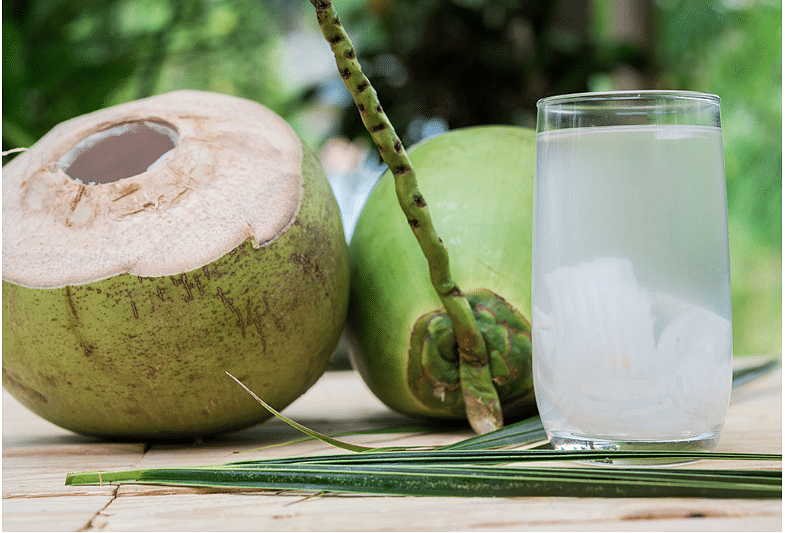
Coconut Water
Triple Fusion leads to the formation of the Primary Endosperm Nucleus (PEN). This primary endosperm nucleus undergoes free-nuclear division i.e. Karyokinesis which is not followed by cytokinesis. This leads to the formation of the liquid endosperm.
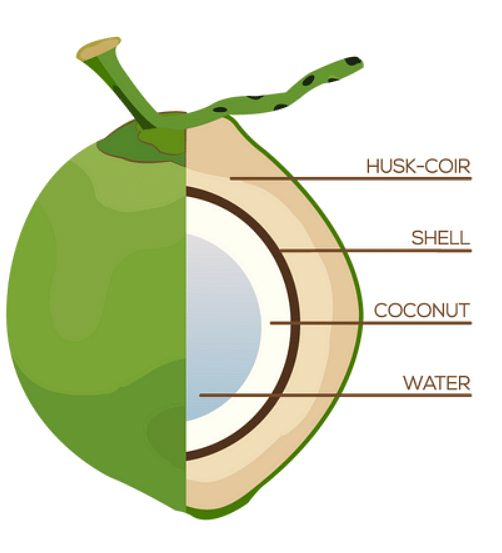
Coconut parts
In Coconut, coconut water is the liquid endosperm formed as a result of triple fusion and free-nuclear division in the plant. This is highly rich in nutrients. Endosperm also nourishes the growing embryo in the plant. As the plant grows, cell wall formation takes place on the periphery forming the white flesh known as Coconut Meat. Some of the liquid endosperms still remain in the centre.
The coconut water is extracted from the young, green coconuts at a tender age when cell wall formation is not prominent.

Double-fertilization
Also read:
| Fertilization in Plants | Pollen Grains |
| Sexual Reproduction in Flowering Plants | Reproduction in Plants |
Coconut Water Vs Coconut Milk
Coconut water should not be confused with coconut milk. These are two different beverages. While coconut water is the liquid endosperm found in green coconuts, coconut milk, on the other hand, is made from the white flesh of a mature, brown coconut. This white flesh is the Coconut Meat which is grated and mixed with hot water to form Coconut Milk.

Coconut water and Coconut milk
Here’s a comparison between coconut water and coconut milk:
| Coconut Water | Coconut Milk |
|---|---|
| It contains 95% water. | It contains 50% water. |
| It has low calories. | It has high calories. |
| It does not contain fat. | It contains a high amount of fat. |
| It is a naturally-occurring substance in young coconuts. | It is a processed by-product of mature coconuts. |
Also Read: Biogeochemical Cycles
Nutritional Value of Coconut Water
Coconut water contains 95% water and is highly rich in essential nutrients. It contains carbohydrates and electrolytes in an easily digestible state. Low fat and calories make it a healthy drink.
Following are some important nutrients present in coconut -
Potassium
Drinking a cup of coconut water is the same as eating a banana. Coconut water is a rich source of potassium which is necessary to maintain fluid and electrolyte balance in the body. A high amount of potassium also helps in balancing sodium levels in the body eventually helping in lowering blood pressure.
Calcium and Magnesium
Compared to other sports drinks or juices, coconut water contains more calcium and magnesium. Both calcium and magnesium play a vital role in muscle contraction. Calcium is essential for strong bones and magnesium is used in some major biological processes in the body. Coconut water contains both these ions making it a natural substitute for other commercial drinks.
Also Read: Heterotrophic Nutrition
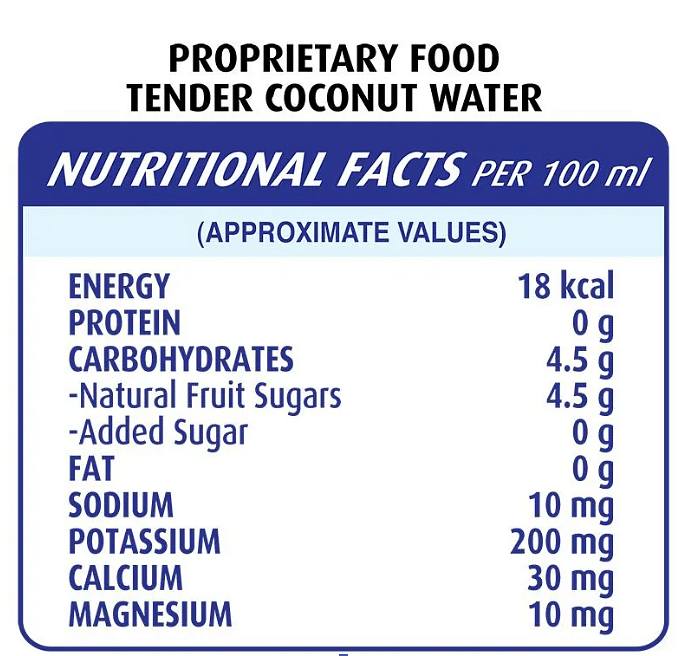
Nutritional Value of Coconut water
Antioxidants
Coconut water also contains antioxidants. Antioxidants prevent cells in the body from free radicals and lower the risk of heart diseases, cancer etc.
Amino Acids
Proteins are our body’s building blocks and these are made up of amino acids. Coconut water is a good source of several amino acids, especially arginine. Arginine is believed to help the body respond to stress and also keeps the heart-healthy.
Also read:
Health Benefits of Coconut Water
Coconut water, due to its high nutritional value, is considered to be a very healthy drink. This can be a good substitute for other sports drinks and juices which contain high amounts of calories.
Here are some major health benefits of coconut water-
-
Reduce the risk of Heart Diseases
Due to its antioxidant properties, coconut water reduces the effects of free radicals in the body. Also, having no cholesterol makes it a healthy drink for people with heart-related diseases.
-
Helps in lowering Blood Pressure
Coconut water is rich in potassium which balances out the number of sodium ions in the body and eventually keeps blood pressure normal.
Also read: Food Chain
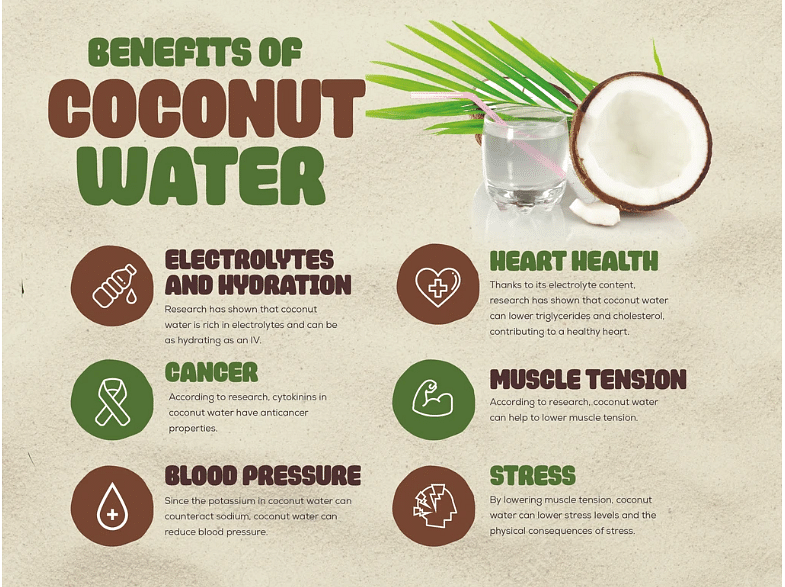
Benefits of Coconut water
-
Help prevent Kidney Stones
Studies show that consuming coconut water filters out excessive ions from the body through urine. It increases the removal of ions like potassium, chloride and citrate in the urine, preventing the risk of kidney stones.
-
Helps in keeping Body Hydrated
Due to the presence of electrolytes like potassium and magnesium, it can be used to rehydrate the body after exercise. Also, it can be used to recover lost electrolytes in the body after illness.
-
Healthy Skin
Due to its antimicrobial properties, coconut water also helps in preventing skin diseases like acne.
Things to Remember
- Coconut water is formed as a result of double-fertilization in plants.
- Coconut water is the liquid endosperm formed due to free-nuclear division in the primary endosperm nucleus.
- Coconut water is not the same as coconut milk.
- Coconut water is rich in electrolytes and contains low fat and calories.
- Due to its antimicrobial and antioxidant properties, coconut water reduces the risk of several heart diseases and skin problems.
Also read:
Sample Questions
Ques. Which process results in the formation of coconut water? (2 marks)
Ans. Coconut water is formed by the process of double-fertilization in plants. It is the liquid endosperm which results due to free-nuclear division of the primary endosperm nucleus. The PEN undergoes Karyokinesis which is not followed by cytokinesis. This leads to the formation of liquid triploid endosperm which nourishes the growing embryo in the plants.
As plants grow and mature, cell formation takes place and the liquid endosperm turns into a white flesh called Coconut Meat. However, a little amount of liquid endosperm still remains in the cavity of the mature fruit.
Ques. What is Double-fertilization? (2 marks)
Ans. Double-fertilization is the process in which two male gametes are released into the female gametophyte. Out of the two gametes, one male gametes fuses with an egg cell resulting in the formation of a diploid zygote. The other male gamete fuses with the two haploid polar nuclei resulting in a triploid Primary Endosperm Nucleus (PEN).
The PEN undergoes free-nuclear divisions but cell wall formation does not take place. This results in a highly nutritious liquid endosperm. The endosperm continues to nourish the growing embryo in the plant. As the plant matures, cell wall formation begins that turns liquid endosperm into white flesh.
Ques. What are different types of endosperm development? (3 marks)
Ans. There are mainly three types of endosperm development, found in angiosperms-
- Nuclear type - In this type, the nuclear division is not followed by cell wall formation. The nuclei are not bounded by cell-wall and remain free in the cytoplasm of the embryo sac. Cytokinesis may or may not take place depending upon the plant and in some it is even incomplete like coconut.
- Cellular type - In this type of development, each nuclear division is accompanied by cell-wall formation. There are no free nuclei in the cytoplasm.
- Helobial type - In this type, the first nuclear division is followed by cytokinesis but subsequent nuclei remain free and do not undergo cell-wall formation.
Also read: Reverse Osmosis
Ques. How is pollination different from fertilization? (2 marks)
Ans. Pollination is the process of transfer of pollen grains from anther to stigma of a plant. After depositing on the stigma, the pollen grains form a tube through the style through which male gametes enter into female gametophyte. It is a physical process.
Whereas, Fertilization is the term used to describe the process of fusion of male and female gametes resulting in the formation of a diploid zygote. The zygote then develops into an embryo. It is a biological process.
Ques. What are the different modes of asexual reproduction in plants? (5 marks)
Ans. In asexual reproduction, plants give rise to individuals which are genetically identical to their parent but do not involve fusion of male and female gametes. There are different ways of asexual reproduction seen in plants. Broadly, asexual reproduction in plants takes place in two ways:
- Natural Methods
- Artificial Methods
Natural Methods - In this, plants reproduce through self-propagation. This may take place in below mentioned ways:
- Budding - In this type, a new individual develops from a bud. A bud is generally an outgrowth on a plant formed due to cell division at a particular site.
- Fragmentation - In this, each part or fragment of the plant develops into a whole new individual.
- Vegetative Propagation - In this, new plants arise from vegetative parts like root, stem and leaves of a plant. This can occur naturally as well as can be artificially induced.
- Spore Formation - In this, plants produce asexual reproductive structures called spores which germinate and give rise to new individuals under favourable conditions.
Artificial Methods - Asexual reproduction in plants can be induced artificially in following ways:
- Grafting - In this method, parts of two different plants are cut and joined together. This is then grown under favorable conditions to form a new plant.
- Layering - This is a method in which the stem grows roots while being attached to the parent plant and then detaches from it when fully grown.
- Micropropagation - This is a technique used to grow a large number of plants at the same time under laboratory conditions. This is done by cutting a part of a plant called an explant (like shoot tip, root tip etc.) and growing it in laboratory conditions to produce a mature, fully grown plant.
Also read: Energy Flow
Ques. What are pre-fertilization events in plants? (2 marks)
Ans. During sexual reproduction, the processes which occurs before fertilization takes place are termed as pre-fertilization events. These are-
- Gametogenesis - It is the process of formation of gametes from male and female gametocytes. It takes place either by meiosis or mitosis. Haploid cells produce gametes through mitosis, whereas diploid cells undergo meiosis to produce gametes.
- Gamete Transfer - The process by which male and female gametes come together for the purpose of fertilization is called gamete transfer. In some cases, male gamete is motile and approaches towards female gamete for fertilization while in some both are motile. In plants, pollen grains are transferred from anther to stigma by pollination.
Ques. What are two types of pollination? (2 marks)
Ans. The two types of pollination observed in plants are-
- Self-Pollination - It is the process of transfer of pollen grains from anther to stigma of the same flower or different flower of the same plant. It can cause inbreeding depression and also decreases genetic diversity.
- Cross-Pollination - It is the process of transfer of pollen grains from anther to stigma of a different flower. It is carried out by pollinating agents like wind, insects etc. It increases genetic diversity.
Ques. What are the types and advantages of self-pollination? (3 marks)
Ans. There are two types of self-pollination:
- Autogamy - In autogamy, pollen is transferred from anther to stigma of the same flower.
- Geitonogamy - In geitonogamy, pollen is transferred from anther to the stigma of another flower of the same plant.
The advantages of self-pollination are given below:
- Since it occurs within the same flower or plant, it does not require pollinating agents.
- It prevents wastage of pollen grains as found in cross-pollination.
- It helps to maintain the genetic traits of a species and allow lesser genetic variations.
- It produces pure lines rather than giving hybrid varieties.
Ques. How would you test the presence of starch in leaves? (2 marks)
Ans. The presence of starch in leaves can be tested by the Iodine test. When we remove chlorophyll from the leaf by boiling it in alcohol and then putting 2 drops of iodine solution, its colour change to blue indicates the presence of starch.
Ques. With a neat, labelled diagram, describe the parts of a typical angiosperm ovule. (3 marks)
Ans: 
A typical angiosperm ovule
A typical angiosperm ovule is a small structure that is formed in the ovary. Ovule first develops as a projection on the placenta and is composed of multilayered cellular tissue called the nucellus. The hypodermal cell of the die nucellus enlarges and is transformed into a megaspore mother cell. This cell undergoes meiosis to produce four haploid cells only one of which develops & forms an embryo sac (female gametophyte). An ovule may be surrounded by one or two protective layers called integuments, leaving a small opening at one end termed as micropyle which acts as a passage for the entry of the pollen tube into the ovule. Thus, a typical ovule consists of a fully developed embryo sac with the nucellus and integuments.



Comments