



Education Journalist | Study Abroad Lead
We notice creatures all around us because they reproduce, which is self-evident. It's unlikely that we would have recognized the existence of a single, non-reproducing member of a species. The enormous number of organisms belonging to a single species is what draws our attention towards them. Now, how can we tell if two different organisms are members of the same species? We usually say this because they resemble each other. Hence, we can say that reproducing organisms produce new individuals that are in some way similar to themselves just like- Flowers.
| Table of Content |
Read More: Class 12 Reproduction
Sexual reproduction in flowering plants
[Click Here for Sample Questions]
Flowering plants, often known as angiosperms, reproduce in a sexual manner. Plant reproduction is primarily centered on the flower, which contains both male and female gametes. Although some components of flowers are sterile, but they all help in the reproduction process.
Angiosperms' reproductive organs are found in the flower. Sepals, petals, stamens, and pistils are the different sections of a flower. The germ cells are contained in the stamens and pistil, which are the reproductive portions of a flower. The flower can be unisexual (papaya, watermelon) if only the stamens or pistil are present, or bisexual (Hibiscus, mustard) if both stamens and pistil are present.
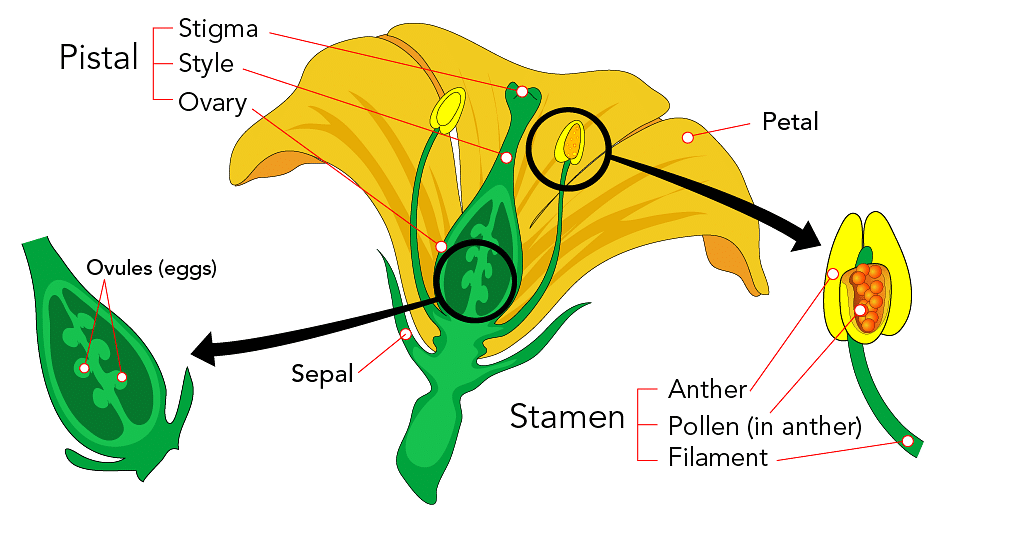
- The male reproductive portion of the flower, the stamen, generates yellowish pollen grains. You've probably seen the yellowish powder that sticks to our hands when we touch a flower's stamen.
- The female reproductive portion of a flower is the pistil, which is found in the center. The ovary, which is bloated at the bottom, the style, which is elongated in the middle, and the stigma, which is sticky at the end, are the three parts.
- Ovules are found in the ovary, and each ovule contains an egg cell.
- The female gamete in the ovule combines with the male germ-cell formed by a pollen grain.
- The zygote, which is capable of developing into a new plant, is formed through the fusion of germ cells or fertilization.
- As a result, pollen must be moved from the stamen to the stigma.
Read More: Difference Between Cross Pollination and Self Pollination
Reproductive Structure of a Flower
[Click Here for Sample Questions]
-
Androecium
It is the third whorl of a flower's male reproductive portion, which consists of stamens. Each stamen is made up of two parts:
- Anther
- Filament.
The filament supports the tip of the anther. Pollen is created here, by meiosis and finally vanishes.
- Anther: An anther is a four-lobed sac-like structure that produces pollen.
- Filaments: Filaments are thread-like structures that are attached to the anther and help to keep it in place.
Microsporangia is the transverse part of an anther that creates a pollen sac. Pollen grains are contained in the pollen sac.

-
Gynoecium
It is the flower's final whorl and the female reproductive organ. It is made up of pistil and is located in the center of the thalamus. The style, ovary, and the stigma make up the pistil. Internally, the ovary creates ovules. Ovules form megaspores, which grow into female gametophytes, through the process of meiosis. Egg cells are formed as a result.
Gynoecium can be:
- Monocarpellary: It consists of a single pistil. For eg., peas & beans.
- Multicarpellary: There are many pistils in this gynoecium.
- Syncarpous: It's the combined pistil gynoecium. Tomatoes and cucumbers are examples.
- Apocarpous: It's a gynoecium that has a free pistil. Lotus Vinca, for example.
Pistil:- Each pistil has three parts:
- Ovary: The ovary is a storage chamber for ovules (eggs) awaiting fertilization.
- Stigma: It's linked to the carpel's top, where pollen from other flowers lands.
- Style: The ovary and the stigma are connected by a tubular structure. It is in charge of transporting pollen from the stigma to the ovary as well as keeping the stigma in place.
Pollination
[Click Here for Sample Questions]
Pollination is an ecological activity that all flowering plants engage in. The developed pollen grains are transmitted from the anther to the stigma in this process, which allows flowering plants to reproduce sexually.
Pollination can be divided into two categories:
- Self-Pollination: The pollen grains from the anther are deposited on the stigma of the same flower, or another flower on the same plant, in this procedure.

- Cross-Pollination: When pollen grains from one flower's anther are transported to the stigma of another flower of the same species, this is known as pollen transfer.

Process of Self-Pollination
Self-pollination happens when pollen is transferred from one flower to another within the same flower. Cross-Pollination, on the other hand, occurs when pollen is transferred from one flower to another.
- Pollen is transferred from one flower to another by forces like wind, water, and animals.
- The pollen must reach the female germ cells in the ovary after landing on an appropriate stigma.
- A tube grows out of the pollen particle and passes through the style to the ovary to do this.
- The zygote splits multiple times after fertilization to produce an embryo within the ovule.
- The ovule develops a thick covering and transforms into a seed over time.
- The ovary develops quickly and ripens into a fruit.
- The petals, sepals, stamens, style, and stigma may shrink and fall off meanwhile.
- The seed contains the embryo, which develops into a seedling under the appropriate conditions. It's known as germination.
Read Also:
Fertilization
[Click Here for Sample Questions]
- Pollen is delivered to the ovary by the pollen tube after pollination.
- One of the male gametes unites with the ovule, or female gamete, after reaching the ovary (fertilization), and the other combines with the polar nuclei.
- When a gamete combines with eggs, it produces a zygote, which grows into an embryo over time.
- The endosperm nucleus is formed when the second gamete combines with the polar nuclei.
- The embryo receives nutrients from it.
- Ovules become seeds after fertilization, while the ovary develops into the fruit.

Previous Year’s Questions
Ques.1: What is pollination? How does it occur in plants? How does pollination lead to fertilization? Explain. (All India 2013, 5 Marks)
Answer: Pollination is the process in which pollen grains are transferred from anthers (male sexual parts) of a flower to the stigma part of the pistil (female sexual part). Pollination is done by insects, birds, wind and water.
There are two types of pollination-
- Self pollination- When the pollen grains from the anther of a flower are transferred to the stigma of the same flower or another flower on the same plant, it is called self pollination.
- Cross pollination- When the pollen grains from the anther of a flower on one plant are transferred to the stigma of a flower on another similar plant, it is called cross pollination.
Fertilization- When a pollen grain falls on the stigma of the carpel, it grows a pollen tube downwards through the style towards the female gamete in the ovary. A male gamete moves down the tube. When the pollen tube enters the ovule, its tip bursts open and male gamete comes out of the pollen tube and combines with the nucleus of the female gamete and forms zygote. This process is known as fertilization.
Ques.2: Draw a longitudinal section of a flower and label the following parts:
(i) Part that produces pollen grain.
(ii)Part that transfers male gametes to the female gametes.
(iii) Part that is sticky to trap the pollen grain.
(iv) Part that develops into a fruit. (All India 2010, 5 Marks)
Answer:

Ques.3: Name the parts A, B and C shown in the following diagram and state one function of each. (All India 2016, 3 Marks)

Answer:
A = Anther- Anther produces pollen grains which are the male gametes.
B = Style- Style provides the path through which the pollen tube grows and reaches the ovary.
C = Ovary- Ovary contains ovules and each ovule has an egg cell/female gamete. It develops into fruit after fertilization.
Ques.4: (a) List two reasons for the appearance of variations among the progeny formed by sexual reproduction.
(b)

(i) Name the part marked ‘A’ in the diagram.
(ii) How does ‘A’ reach part ‘B’
(iii) State the importance of part ‘C’.
(iv) What happens to the part marked ‘D’ after fertilization is over? (Delhi 2016, 3 Marks)
Answer:
(a) The appearance of variations among the progeny formed by sexual reproduction is due to the following reasons:
(i) Sexual reproduction takes place by the combination of two germ cells produced by two different individuals. Fusion of the male and female gametes.
(ii) Each time zygote is formed by the new combination of variants.
(b) (i) A = Pollen grains
(ii) Pollen grains, i.e., ‘A’ reach part ‘B’, i.e., stigma of the carpel by the process of pollination.
Pollination is carried out by insects (like bees, butterflies, etc.), birds, wind, water, etc.
(iii) ‘C’ = Pollen tube
Pollen tube grows downward through the style towards the female gamete in the ovary. Pollen tube helps the male gamete reach the egg or ovule (female gamete).
(iv) ‘D’ = Fertilised egg or Zygote
The fertilized egg (or zygote) divides several times to form an embryo within the ovule.
Ques.5: (a) Write the names of those parts of a flower which serve the same function as the following do in the animals: (All India 2014, 3 Marks)
(i) testis (ii) sperm (iii) ovary (iv) egg
(b) State the function of flowers in the flowering plants.
Answer:
(a) (i) testis – anther
(ii) sperms – pollen grains
(iii) ovary – ovary
(iv) egg – egg or ovum
(b) The function of flowers in flowering plants is to assist in the sexual reproduction process. The flowers make male and female gametes and to ensure that fertilisation will take place to make new seeds for the reproduction in plants.
Ques.6: Define the terms unisexual and bisexual giving one example of each. (All India 2007, 3 Marks)
Answer: Unisexual Plant- The plant whose flowers contain either stamens or carpels but not both are called unisexual plants. Example: Papaya, Watermelon.
Bisexual Plants- The plant whose flowers contain both stamens and carpels are called bisexual plants. Example: Hibiscus, Mustard.
Ques.7: Differentiate between ‘self-pollination’ and ‘cross-pollination’. Describe double fertilisation in plants. (All India 2007, 3 Marks)
Answer:

Fertilisation in Plants:
- One of the male gametes fuses with the female gamete present in the embryo sac.
- The other male gamete fuses with the two polar nuclei in the embryo sac.
- The first fusion product gives rise to the zygote while the second one forms the endosperm.
- The process of two fusions occurring in the embryo sac is called double fertilisation.
Ques.8: (a) Draw a diagram showing germination of pollen on the stigma of a flower.
(b) Label pollen grain, male germ- cells, pollen tube and female germ-cell in the above diagram.
(c) How is zygote formed? (All India 2008, 5 Marks)
Answer: (a) and (b)

(c) Zygote is formed when male gamete i.e. sperm fuses with female gamete, i.e. ovum.
Ques.9: List any three differences between pollination and fertilisation. (All India 2010, 3 Marks)
Answer:
| Pollination | Fertilization |
|---|---|
| Pollination is an external process. | Fertilization can be Both Internal and External |
| Pollination occurs before the Fertilization. | Fertilization occurs after the Pollination |
| Pollination starts from the anthers of stamens to the stigma of the ovary. | In Fertilization, the fusion of Female and Male gametes takes place. |
Sample Questions Based on Sexual Reproduction in Flowering of Plants
Ques: Do all flowering plants reproduce sexually? (1 mark)
Ans. Only angiosperms reproduce sexually. Gymnosperms, or non-flowering plants, lack reproductive organs and hence are unable to reproduce sexually.
Ques: What are the stages of the life cycle of a plant? (1 mark)
Ans. The following are the stages of the plant life cycle:
- Seed
- Germination
- Growth
- Reproduction
- Pollinating
- Spreading of seeds
Ques: Which parts of the pistil produce fruits and seeds? (1 mark)
Ans. The fruit grows from the ovary. The ovule matures into a seed.
Ques: What is the process of reproduction in flowers? (1 mark)
Ans. Pollination is the process through which flowers reproduce. Pollen grains are transmitted from the male flower's anther to the female flower's stigma, allowing fertilization and the formation of seeds.
Read Also:



Comments