



Content Curator
A bomb calorimeter is a calorimeter that is used to precisely quantify the energy change during a reaction. Berthelot's initial calorimeter was developed into the present Bomb calorimeter.
| Table of Content |
Read Also: Thermodynamics
Definition of Bomb Calorimeter
Calorimetry is a scientific discipline concerned with determining a body's condition in terms of thermal characteristics.A bomb calorimeter is a calorimeter precisely quantifies the energy change during a reaction. The contemporary bomb calorimeter is composed of corrosion-resistant steel, with the Bomb Calorimeter pair.
The bomb calorimeter is a device that measures the heat of reaction at a constant volume. The heat that is measured is referred to as the change of internal energy (E). The heat changes of a reaction can be monitored in chemistry at a fixed pressure or volume.. Bomb calorimeters must resist the high pressure within the calorimeter while measuring the response. The fuel is ignited using electrical energy; when the fuel burns, it heats up the surrounding air, which expands and exits through a tube leading out of the calorimeter. When air escapes through the copper tube, it heats the water outside the tube as well. The calorie content of the fuel may be calculated using the temperature change in the water.
Working of Bomb Calorimeter
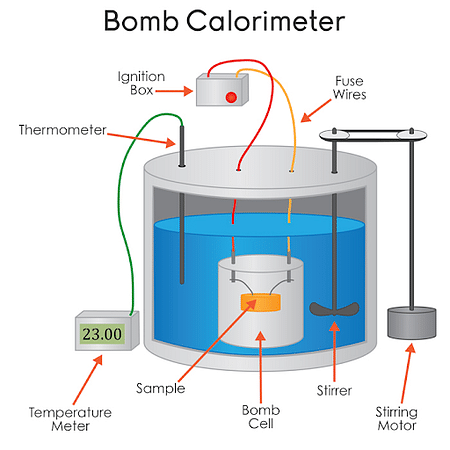
The calorimeter is composed of steel, which has excellent corrosion resistance and can sustain high pressures. In the calorimeter, a powerful cylindrical bomb is used to cause combustion. Just at the apex of the bomb, there are two values. One provides oxygen to a bomb, while the other emits exhaust fumes. As illustrated in fig. 1, a crucible in which a measured quantity of fuel sample is burned is placed between the two electrodes. The bomb is surrounded by a water jacket just on a calorimeter.
The calorimeter is also equipped with a water and air jacket to decrease light losses. Through the lid of the calorimeter, a stirrer keeps the temperature of the water consistent, and a thermometer with a temp precision of 0.001 degree C is installed. The environment is different and the calorimeter absorbs the heat generated by the fuel during burning. The specific heat of the fuel may be calculated using the information provided above.
Read Also: Vapour Pressure
Construction of Bomb Calorimeter
The sample, oxygen, the stainless steel bomb, and water make up the bomb calorimeter's main components.
The dewar stops heat from escaping from the calorimeter into the rest of the cosmos, i.e.
qcalorimeter = 0
The combustion process happens at a fixed volume and there is no work because the bomb is constructed of stainless steel.
wcalorimeter = - p dV = 0
Thus, the change in internal energy, DU, for the calorimeter is zero
DUcalorimeter = qcalorimeter + wcalorimeter = 0
The thermodynamic interpretation of this equation is that the calorimeter is isolated from the rest of the universe.
Uses of Bomb Calorimeter
Bomb Calorimeter in Thermodynamic studies
At its most basic level, bomb calorimetry is the scientific study of thermodynamic processes. The heat of combustion generated in a chemical process, as well as reaction enthalpy, heats engaged in creation, heats involved in a chemical reaction, and change in enthalpy all through the process, are all measured using a bomb calorimeter. Scientific and theoretical thermodynamic investigations require bomb calorimeters.
Bomb Calorimeter in Educational training
Education training is another typical application for bomb calorimeters. Calorimetry is covered in certain high school science programmes as well as university scientific programs. Individuals interested in pursuing jobs that require use of a bomb calorimeter should first gain a thorough understanding of the procedures involved.
Bomb Calorimeter in Fuel testing
These are used to determine the calorific value of solid and liquid fuels, and these values are being used to trade them. Coal and oil, for example, must comply with rules governing total calorie content, purity, and cleanliness. Liquid fuels like gasoline and kerosene may also be tested using bomb calorimetry.
Bomb Calorimeter in Waste disposal
These are used to determine the calorific value of solid and liquid fuels, and these values are being used to trade them. Coal and oil, for example, must comply with rules governing total calorie content, purity, and cleanliness. Liquid fuels like gasoline and kerosene may also be tested using bomb calorimetry.
Read Also: Cyclic Process
Things to Remember
- A bomb calorimeter consists of small sample cup, oxygen, a stainless steel bomb, water, a stirrer, a thermometer, a dewar or an insulating bottle and an ignition circuit
- The reaction takes place only in water when we talk about bomb calorimeter
- It can measure heat flow of the reaction, which may be equal to magnitude of enthalpy change
- When measuring heat prospective or the fundamental heat of a substance, many students utilise calorimeters. A calorimeter is used to calculate the total of heat energy and subsequently to measure the exact heat of a substance or other heat related information.
Also Read:
Sample Questions
Ques. In a bomb calorimeter, a 0.88 gummy bear is burnt. The temperature rose to 21.5 °C before settling at 24.2 °C. The heat capacity of the bomb calorimeter was calculated to be 11.4 kJ/°C by the manufacturer. Calculate the amount of heat released during burning per gramme of gummy bear.
Ans. ΔE = CvΔT = (11.4 kJ/°C)(24.2-21.5 °C) = (11.4 kJ/°C)(2.7 °C) = 30.78 kJ
(30.78 kJ)/(0.88 g) = 34.98 kJ/g
Ques. When a 100 g sample of methane, CH4, is burned in a bomb calorimeter the temperature changes from 21 °C to 31 °C and 2200 J of heat is given off. What is the specific heat of methane?
Ans. ΔE = CvΔT ⇒ Cv = ΔE/ΔT = (2200 J)/(10 °C) = 220 J/°C
Specific heat = Cv/g = (220 J/°C)/(100 g) = 2.20 J/g-°C
Ques. A vigorous reaction occurs when a 0.258 g piece of potassium solid is put in water inside a coffee cup calorimeter. Assume the final solution has a total volume of 100 mL. The temperature of the solution rises from 22 to 25.1 degrees Celsius as a result of the reaction. For this process, how much heat is created per gramme of potassium? Assume that the density of the solution after the reaction is water, and that the heat capacity of the solution and reaction vessel is solely attributable to the water, which has a specific heat of 4.184 J/g-°C.
Ans. ΔH = CpΔT = (100 g)(4.184 J/g-°C)(3.1 °C) = 1297 J
(1297 J)/(0.258 g) = 5027 J/g.
Ques. When a 45 g silver spoon (specific heat 0.24 J/g °C) at 25oC is placed in a cup of 95 °C coffee (180 g) and the two are allowed to attain the same temperature, how much will the temperature of the coffee be reduced? Assume that the density and specific heat of the coffee are the same as that of water.
Ans. Let final temperature of coffee be T
Heat lost by coffee is equal to the heat gained by the spoon.
Heat gained by spoon = mspoonCPspoonΔTSpoon
=45x0.24x(T-25)
Heat lost by coffee = mcoffeeCpcoffeenΔTcoffee
= 180x4.184x(95-T)
Notice that in the first case we did final temperature - initial temperature and in the second case we did initial temperature - final temperature. This is because in one case heat is lost and in the other case heat is gained.
Equating these two equations,
45x0.24x(T-25) = 180x4.184x(95-T)
T-25 = 69.7(95-T)
T = 94 oC
Hence, the temperature of the coffee will drop 1 degree.
Ques. How much heat is needed to change 100 g of water from ice at -12 °C to gas at 120 °C?
Ans. H2O(s, -12°) → H2O(s, 0°)
ΔH1 = CpiceΔT = (100 g)(2.092 kJ/g-°C)(12°) = 2510 J
H2O(s, 0°) → H2O(l, 0°)
ΔH2 = ΔHfus = (100 g)(1 mole/18 g)(6008 J/mole) = 75100 J
H2O(l, 0°) → H2O(l, 100°)
ΔH3 = Cp,liqΔT = (100 g)(4.184 kJ/g-°C)(100°) = 41840 J
H2O(l, 100°) → H2O(g, 100°)
ΔH4 = ΔHvap = (100 g)(1 mole/18 g)(40.67 J/mole) = 226 J
H2O(g, 100°) → H2O(g, 120°)
ΔH5 = Cp,gasΔT = (100 g)(1.841 kJ/g-°C)(20°) = 3682 J
ΔH = 2510 J + 75100 J + 41840 J + 226 J + 3682 J = 123358 J = 123 kJ
Ques. The heat of combustion of a certain chemical, compound A, is 3038.0 kJ/mol at constant volume. The temperature of the calorimeter (including its contents) rose by 4.313 C when 1.155 g of compound A (molar mass = 112.55 g/mol) was burnt in it. a) What is the calorimeter's heat capacity (calorimeter constant) based on this information? b) Assume a 3.517 g sample of chemical B was combusted in the same calorimeter, with the temperature rising from 25.75 C to 29.00 C. What is the heat of combustion of compound B per gramme?
Ans. (a)The heat absorbed by the calorimeter can be calculated from the heat of combustion and the moles of the compound.
qcal=ΔHc×molesqcal=3038.0kJ/mol×1.155g112.55g/mol=31.176kJqcal=ΔHc×molesqcal=3038.0kJ/mol×1.155g112.55g/mol=31.176kJ
Calculating the heat capacity (calorimeter constant) of the calorimeter:
Ccal=qcalΔTCcal=31.176kJ4.313K=7.228kJ/K
(b) Using the calculated heat capacity of the calorimeter, we can determine the heat of combustion per gram of compound B.
ΔHc=CcalΔTmassBΔHc=(7.228kJ/K)(29.00°C−25.75°C)3.517g=6.679kJ/g
Ques. At 19.5 degrees Celsius, a chemical student dissolves 4.51 grammes of sodium hydroxide in 100.0 mL of water (in a calorimeter cup). The temperature of the surrounding water rises to 31.7°C as the sodium hydroxide dissolves. Determine the heat of solution of the sodium hydroxide in J/g.
Ans. The answer to this problem is once again based on the fact that the amount of energy produced when sodium hydroxide dissolves equals the amount of energy absorbed by the water in the calorimeter. This may be expressed as an equation:
QNaOH dissolving = -Qcalorimeter
Qcalorimeter = m•C•ΔT
Qcalorimeter = (100.0 g)•(4.18 J/g/°C)•(31.7°C - 19.5°C)
Qcalorimeter = 5099.6 J
The assumption is that the amount of energy obtained by water equals the amount of energy released by sodium hydroxide as it dissolves. As a result, QNaOH-dissolving equals -5099.6 J. (A negative sign denotes a loss of energy.) This is the amount of heat generated when 4.51 grammes of sodium hydroxide are dissolved. While we calculate the ΔHsolution/g, this 5099.6 J of energy must be divided by the mass of NaOH.
ΔHsolution = QNaOH-dissolving / mNaOH
ΔHsolution = (-5099.6 J) / (4.51 g)
ΔHsolution = -1130.7 J/g
ΔHsolution = -1.13x10³ J/g
Ques. A cashew nut weighing 2.15 grammes is consumed. A 100.0-gram sample of water is heated from 18.2°C to 31.5°C by the heat emitted. After the experiment, the nut weighs 1.78 grammes. Calculate the nut's calorie value in Calories/gram. Assume that only 25% of the heat produced by the burning nut is absorbed by the water. 1.00 calorie equals 4.18 kJ.
Ans. Qwater = mwater•Cwater•ΔTwater
Qwater = (100.0 g)•(4.18J/g/°C)•(31.5°C - 18.2°C) = 5559.4 J = 5.5594 kJ
Qwater = 5.5594 kJ•(1.00 Calorie/4.18 kJ) = 1.3560 Calorie
Since it is given that energy absorbed by water is 1/4 (25%) of the energy released by the nut,
Qnut = -1.3560 Calorie/0.25 = -5.4238 Calorie
This 5.4238 Cal energy has been released while burning 0.37 grams of the Cashew. To find out the Calorie content on the basis of per gram, it needs to be divided by the quantity, i.e. 0.37 g.
Hence, the final Calorie Content = 5.4248 Cal/0.37 g = 14.6589 Cal/g = 15 Cal/g
For Latest Updates on Upcoming Board Exams, Click Here: https://t.me/class_10_12_board_updates
Check-Out:



Comments