



Education Content Expert
Composite Numbers are those numbers that have more than two factors. Composite numbers are different from prime numbers as prime numbers have only two factors, i.e. 1 and the number itself. These numbers are thus the opposite of prime numbers. All the natural numbers that are not prime numbers are classified as composite numbers as they are divisible by more than two numbers. For instance, 12 is a composite number as it is divisible by 1, 2, 3, 4, and 12 itself.
Numbers are categorized as prime numbers or composite numbers on the basis of the number of factors that they have. A number that has just two factors- 1 and the number itself, is a prime number. For example, 3 is a prime number with only two factors 1 and 3. Numbers with more than two factors are called composite numbers. For example, 15 is a composite number with four factors 1, 3, 5, and 15.
| Table of Content |
Key Terms: Composite Numbers, Prime Numbers, Natural Numbers, Factors, Integers, Even Numbers, Composites, Odd Numbers
What are Composite Numbers?
[Click Here for Sample Questions]
A composite number is defined as a natural number that is divisible by more than two numbers. It means if a number is divisible by a number other than 1 and the number itself, it is called a composite number. Composite numbers are commonly known as composites. All those natural numbers apart from prime numbers are composite numbers. These numbers are also defined as integers that can be generated by multiplying the two smallest positive integers.
Fact: Every even number greater than 2 is a composite number.
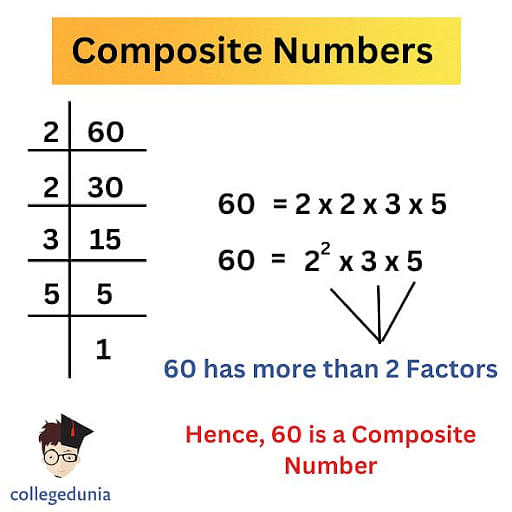
Composite Numbers
Read More:
| Chapter-Related Topics | ||
|---|---|---|
| Types of Numbers | Real Numbers | Digits |
| Number System | Rational Numbers | Decimals |
Examples of Composite Numbers
[Click Here for Sample Questions]
In order to understand what composite numbers are, we can take a few examples:
- 20 is a natural number that is divisible by 1, 2, 5, 10, and 20 itself. Thus, 20 has 5 factors which are more than 2 factors. Thus, we can say that 20 is a composite number.
- 10 is another natural number that is divisible by 1, 2, 5, and 10 itself. Thus, 10 is also a composite number as it has more than 2 factors.
- 16 is divisible by 1, 2, 4, and 16 itself, thus, it is also a composite number as it has more than 2 factors.
A few more examples of composite numbers are tabulated below:
| Composite Numbers | Factors |
|---|---|
| 6 | 1, 2, 3, 6 |
| 18 | 1, 2, 3, 6, 18 |
| 28 | 1, 2, 4, 7, 14, 28 |
| 30 | 1, 2, 3, 5, 6, 10, 15, 30 |
| 50 | 1, 2, 5, 10, 25, 50 |
Properties of Composite Numbers
[Click Here for Sample Questions]
Here are the properties of composite numbers:
- A composite number has more than 2 factors always.
- They are completely divisible by their factors.
- Every composite number is a factor of itself. For instance, 6 is a factor of 6 itself giving out the quotient as 1.
- The smallest composite number is 4 which has 3 factors 1, 2 and 4 itself.
- Each composite number is made up of two or more prime numbers as its factors. For instance, 10 = 2 x 5, where 2 and 5 are prime numbers.
- Composite numbers are also divisible by other composite numbers.
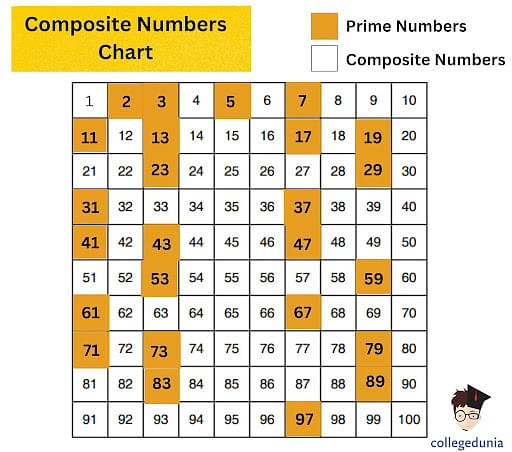
Composite Numbers Chart (1-100)
How to Find Composite Numbers?
[Click Here for Sample Questions]
In order to find out a composite number, we have to first find the factors of the given number. A number having more than 2 factors would be a composite number. Here is a step-by-step procedure to check whether a number is composite or not:
- Step 1: Find out all the factors of the given number.
- Step 2: If the number has only two factors, i.e, 1 and the number itself, then, it would be a prime number.
- Step 3: If the number has more than two factors, then the number is classified as a composite number.
Solved ExampleExample: Check whether 12 is a composite number or not. Solution: First we will find out the factors of 12.
The factors of 12 are 1, 2, 3 and 4, which is more than 2. Thus, 12 is a composite number. |
Types of Composite Numbers
[Click Here for Sample Questions]
Composite numbers can be classified into two main types in Maths:
- Odd Composite Numbers / Composite Odd Numbers
- Even Composite Numbers / Composite Even Numbers
Odd Composite Numbers
- All those odd numbers that are not prime numbers are odd composite numbers.
- For instance, 9, 15, 21, and 27 are odd composite numbers.
- Consider 9 and 15. They are odd composite numbers because these two odd numbers have more than 2 factors.
Even Composite Numbers
- All those even numbers that are not prime are even composite numbers.
- For instance, 4, 6, 8, 10, and 12 are even composite numbers.
- Consider 4 and 12. They are even composite numbers because these even numbers have more than 2 factors.
Smallest Composite Number
[Click Here for Sample Questions]
The smallest composite number is 4.
- The reason for the same is that 1 is not a composite number as its only divisor is 1.
- 2 is not a composite number as it has only two factors, i.e., 1 and the number 2 itself.
- 3 is not a composite number as it has only two factors, i.e., 1 and the number 3 itself.
- Coming to 4, it has 3 factors, i.e., 1, 2, and 4. Thus, it is the smallest composite number.
Prime Factorization of Composite Numbers
[Click Here for Sample Questions]
Composite Numbers from 1 to 50 with their prime factorization is given in the table below. We can see that the composite numbers are factorized in prime numbers.
| Composite Numbers | Prime Factorization |
|---|---|
| 4 | 2 x 2 |
| 6 | 2 x 3 |
| 8 | 2 x 2 x 2 |
| 9 | 3 x 3 |
| 10 | 2 x 5 |
| 12 | 2 x 2 x 3 |
| 14 | 2 x 7 |
| 15 | 3 x 5 |
| 16 | 2 x 2 x 2 x 2 |
| 18 | 2 x 3 x 3 |
| 20 | 2 x 2 x 5 |
| 21 | 3 x 7 |
| 22 | 2 x 11 |
| 24 | 2 x 2 x 2 x 3 |
| 25 | 5 x 5 |
| 26 | 2 x 13 |
| 27 | 3 x 3 x 3 |
| 28 | 2 x 2 x 7 |
| 30 | 2 x 3 x 5 |
| 32 | 2 x 2 x 2 x 2 x 2 |
| 33 | 3 x 11 |
| 34 | 2 x 17 |
| 35 | 5 x 7 |
| 36 | 2 x 2 x 3 x 3 |
| 38 | 2 x 19 |
| 39 | 3 x 13 |
| 40 | 2 x 2 x 2 x 5 |
| 42 | 2 x 3 x 7 |
| 44 | 4 x 11 |
| 45 | 3 x 3 x 5 |
| 46 | 2 x 23 |
| 48 | 2 x 2 x 2 x 2 x 3 |
| 49 | 7 x 7 |
| 50 | 2 x 5 x 5 |
Difference Between Prime Numbers and Composite Numbers
[Click Here for Sample Questions]
Prime numbers and composite numbers are the two types of numbers in Mathematics. The major difference between them is as tabulated below:
| Prime Numbers | Composite Numbers |
|---|---|
| Prime Numbers can only be divided by 1 and themselves which means that they have only two factors. | Composite Numbers have more than 2 factors which mean other factors than 1 and the number itself. |
| Prime Numbers can only be written as a product of two numbers. | Composite Numbers can be written as the product of two or more numbers. |
| Example: 2, as it has only two factors 1 and 5. | Example: 4, as it has more than two factors are 1, 2, and 4. |
Things to Remember
- Composite numbers are those natural numbers that have more than 2 factors.
- They are opposite to prime numbers that have exactly 2 factors only.
- Two types of composite numbers in Maths are Odd Composite Numbers and Even Composite Numbers.
- 4 is the smallest composite number.
- Composite numbers are generated by multiplying the two smallest positive integers.
- Examples of composite numbers include 4, 6, 9, 10, 12, 15, 20, 18, etc.
Read More:
Sample Questions
Ques. List the composite numbers from 1 to 100. (3 Marks)
Ans. The composite numbers from 1 to 100 are:
4, 6, 8, 9, 10, 12, 14, 15, 16, 18, 20, 21, 22, 24, 25, 26, 27, 28, 30, 32, 33, 34, 35, 36, 38, 39, 40, 42, 44, 45, 46, 48, 49, 50, 51, 52, 54, 55, 56, 57, 58, 60, 62, 63, 64, 65, 66, 68, 69, 70, 72, 74, 75, 76, 77, 78, 80, 81,82, 84, 85, 86, 87, 88, 90, 91, 92, 93, 94, 95, 96, 98, 99, 100
Ques. Name the following:
(a) Smallest Composite Number
(b) Smallest Prime Number
(c) Smallest Odd Composite Number
(d) Two-digit Smallest Composite Number (3 Marks)
Ans. (a) Smallest Composite Number = 4
(b) Smallest Prime Number = 2
(c) Smallest Odd Composite Number = 9
(d) Two-digit Smallest Composite Number = 10
Ques. What will be the product of the first 5 composite numbers? (3 Marks)
Ans. The first five composite numbers are 4, 6, 8, 9, and 10.
So, the product of the first 5 composite numbers will be
4 × 6 × 8 × 9 × 10 = 17280
Hence, the product of the first five composite numbers is 17280.
Ques. How are Prime Numbers Different From Composite Numbers? (3 Marks)
Ans. The main difference between a prime number and a composite number is that a prime number is only divisible by 1 and the number itself, which means that prime numbers have only two factors whereas composite numbers are divisible by more than two factors, that is, they are divisible by numbers other than 1 and itself also. Prime numbers can only be written in the form of a product of two numbers whereas composite numbers can be written in the form of the product of more than two numbers.
Ques. What are the two types of compost numbers? (3 Marks)
Ans. The two types of composite numbers are:
- Odd Composite Numbers: The odd numbers having more than 2 factors such as 21, 25, etc.
- Even Composite Numbers: The even numbers having more than 2 factors such as 10, 20, 34, etc.
Ques. Find out whether 486 is a composite number or not. (3 Marks)
Ans. First, we will find the factors of 486.
The factors of 486 are:
1, 2, 3, 6, 9, 18, 27, 54, 81, 162, 243, and 486.
It means that the number 486 has more than 2 factors other than 1 and itself. Thus, 486 is a composite number.
Ques. State true or false for the given statements about composite numbers: (2 Marks)
(a) Every even number is a composite number.
(b) 1 is classified as a composite number.
Ans. (a) False. 2, which is an even number is a prime number, thus, we can not say that all even numbers are not composite numbers.
(b) False. 1 is neither a prime number nor a composite number as it is divisible by itself only.
Ques. How many composite numbers are there between 1 to 10? (1 Mark)
Ans. There are only four composite numbers between 1 to 10 which are 4,6,8 and 9.
Ques. Is 1 a composite number? (1 Mark)
Ans. No, 1 is neither a composite number nor a prime number. It is because 1 does not have more than two factors as it has only 1 factor that is itself.
Ques. Pick out the composite numbers from the given set of numbers. (3 Marks)
2, 4, 9, 11, 21, 31, 44, 53, 67, 88, 101.
Ans. The composite numbers from the given set of numbers are
- 4: Factors are 1, 2, and 4.
- 9: Factors are 1, 3, and 9.
- 21: Factors are 1, 3, 7, 14, and 21.
- 44: Factors are 1, 2, 4, 11, and 44.
- 88: Factors are 1, 2, 4, 8, 11, and 88.
Ques. Mention the composite numbers between 20 and 30. (1 Mark)
Ans. The composite numbers between 20 and 30 are 21, 22, 24, 25, 26, 27, and 28. All of the mentioned numbers have more than 2 factors.
Ques. Is 49 a composite number or a prime number? (1 Mark)
Ans. 49 is a composite number as it has more than 2 factors which are 1, 7, and 49.
For Latest Updates on Upcoming Board Exams, Click Here:https://t.me/class_10_12_board_updates
Read More:



Comments