



Content Curator
Conduction of nerve impulse is caused with the presence of active and electronic potentials along the conductors. Nervous system is an important system in our human body that controls and coordinates the entire human function. The nervous system controls our body by generation and conduction of nerve impulses inside our brain. This system receives information about the surroundings via sense organs and creates a nerve impulse to make our human body respond to the environment. The element used to generate and conduct an impulse is known as a neuron, a single unit of the nervous system.
| Table of Content |
Read also: Nerve Impulse
What is Nervous System?
The nervous system is one of the very important systems in the human body which controls and coordinates the entire body function. It is made up of a complex network of nerves inside a human body that passes the messages from the brain and spinal cord to entire body parts and vice versa. There are two types of the nervous system: the central nervous system and peripheral nervous system.

Nervous System
What is Neuron?
A neuron is a single unit of the nervous system which acts as an information messenger to our human body. It transmits the information from the brain to other body parts or inside other parts of the brain by using some electrical and chemical signals. The electrical signals used by a neuron is known as nerve impulse.

What is Nerve Impulse?
It is a kind of coded signal that travels along the nerve membrane to stimulus cells-like muscle cells, hormone cells, gland cells etc. Using this nerve impulse the Nerve cells Communicate with other cells to perform a particular task and this coded signal relays on the Axon of the neuron.
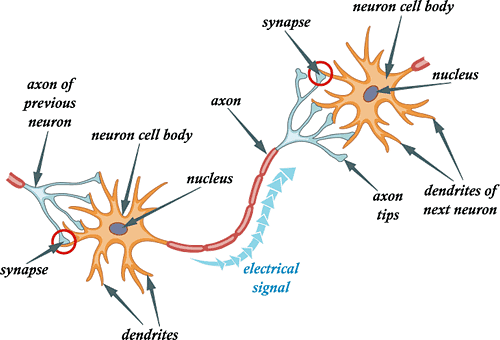
Parts of Neuron
The neurons are the single unit of the nervous system and there are millions of neurons in a human brain. Usually, the neuron has three parts, they are listed below:
- Cell body
- Axon
- Dendrites
Out of these three parts, the nerve impulse or relayed on Axon and the Axon is classified based on the presence of myelin sheath, They are myelinated nerve fibres and non-myelinated nerve fibres.
Process of Conduction of Nerve Impulse
There are three steps in the process of conduction of nerve impulse: polarization, depolarization and repolarization.
Polarization
This stage is also known as resting potential that means nerve fibres are not conducting any type of nerve impulse and this is known as the polarized state of nerves.
In this stage, the axoplasm contains negatively charged proteins and a low concentration of sodium ions with a high concentration of potassium ions. outside the axoplasm, there is a high concentration of sodium ion and a low concentration of potassium ions and this forms a concentration difference between inside and outside the membrane.
A sodium Potassium pump is present along the membrane of the Axon that allows the transportation of Ions across the membrane. Whenever 3 sodium ions are transported outside then potassium ions are transported inside the membrane and this creates a charge difference between membranes that result in the production of positive charges outside the membrane and production of negative charges with negatively charged protein inside the membrane.

Depolarization
This stage begins when the nerve fibres begin to conduct a nerve impulse. During this stage, a stimulus from a cell arrives if the strength of this stimulus is about the fixed threshold level of a polarized membrane.
Then the Sodium Ion or rapidly Transporter inside the Axon membrane and this results in the reversibility of polarised state. This causes the generation of positive charges inside the membrane and negative charges outside the membrane. This kind of potential difference across the membrane is known as action potential for nerve impulse but it is a temporary signal because the depolarized state of a nerve is very short.
Repolarization
After the depolarization state, the generation of negative charges inside the axon membrane and generation of positive charges outside the Axon membrane begins within a fraction of a second which results in the Restoration of the polarized state.
Then the nerve cell for fibre is prepared again to receive another stimulus and conduct the next nerve impulse. The time taken by the nerve fibre to come back to the polarised state is known as the refractory period and this period is very short.
Things to Remember
- The nervous system is like a control system of an organism especially the human body and it controls the entire body functions with the help of electrical and chemical signals.
- A neuron is a single unit of a nervous system that has three parts namely the cell body, axon, detritus and this acts as a messenger to transport information across the enter human body from the brain and the spinal cord.
- Whenever the stimulus from a cell reaches the neuron, conduction of nerve impulse takes place which is a signal to perform a specific task.
- The nerve impulse is conducted as a result of depolarization of the Axon membrane inside the neuron which is a temporary action that occurred within milliseconds.
Read also: Control and Coordination
Sample Questions
Ques. Explain the types of Axon. (2 Marks)
Ans. Based on the presence of myelin sheath, the Axon is classified into two types, they are myelinated nerve fibres and non-myelinated nerve fibres.
Myelinated nerve fibres: In some neurons, the Axon are myelinated i.e. it is covered by myelin sheath at some intervals. Then these gaps between this Axon are known as nodes of Ranvier and these types of nerve fibres are commonly found in the spinal nerve, cranial nerves and white matter of the brain.
Non-myelinated nerve fibres: In these nerve fibres, the myelin sheath is not present and these types of nerve fibres are commonly found in somatic and autonomic neural systems of organisms.
Ques. Mention the factors affecting the conduction of nerve impulses. (2 Marks)
Ans. There are three main factors that affect the conduction of nerve impulses, they are:
- Myelinated nerve fibres
- Axon Diameter
- Temperature
Ques. What is Myelin Sheath? (2 Marks)
Ans. Myelin is an insulating layer or covering layer that forms around nerves, especially axons and the fibres with myelin sheath are known as myelinated nerve fibres. This myelin sheath helps the electrical impulses (neural impulses) to transmit quickly along with the nerve cells. If myelin is damaged, these impulses slow down and this leads to diseases like multiple sclerosis.
Ques. How resting potential is transformed into an action potential. (2 Marks)
Ans. When a stimulus arrives at nerve cells it causes a change of ions across the neuron membrane when it is above the threshold level of the neuron membrane. As a result of ions transmission, the potential difference is generated across the membrane that is known as action potential.
Ques. What is the refractory period? (2 Marks)
Ans. The time taken by the nerve fibre to return from the depolarized State to polarized state again is known as the refractory period and this period is very short which is less than milliseconds.
This period of time is referred to as the refractory period, which is 250ms in duration and helps to protect the heart. Refractory periods are caused by the inactivation gate of the Na+ channel. Once inactivated, the Na+ channel cannot respond to another stimulus until the gates are reset.

Ques. What is the difference between resting potential and action potential? (3 Marks)
Ans.
| Resting Potential | Action Potential |
|---|---|
| It is the voltage difference along the neuron membrane when there is no signal transmitting | It is the voltage difference along the neuron when there is signal transmission |
| Resting Potential = -70mV | Action Potential = +40mV |
| More sodium ions and fewer potassium ions outside the membrane | More Potassium ions and fewer sodium ions outside the membrane |
Read also: Neuroscience
Ques. Explain the stage of conduction of nerve impulses. (4 Marks)
Ans. The nerve impulse is generated and conducted by three stages:
- Polarization: The transmission of a nerve impulse along a neuron from one end to the other occurs as a result of electrical changes across the membrane of the neuron. The membrane of an unstimulated neuron is polarized—that is, there is a difference in electrical charge between the outside and inside of the membrane.
- Depolarization: Depolarization is the process by which the neuron's membrane potential increases positively. Since the neuron normally sits at a potential of -70 mV, increasing the potential towards 0 mV decreases the total polarity of the cell. At the peak of depolarization, the neuron reaches a membrane potential of +30 mV.
- Repolarization: Repolarization is the process by which the neuron regains its negative resting membrane potential. The membrane potential will drop past the resting potential before potassium channels begin to close. This occurs around -80 mV and makes up the beginning of hyperpolarization.



Comments