



Education Journalist | Study Abroad Lead
Neuron is a specialized cell that transmits information through electrical as well as chemical signals. Found in the brain, peripheral nerves, and the spinal cord, neurons are also called nerve cells.
- They are referred to as messengers that pass information from different brain parts to the rest of the nervous system.
- Neurons come in a variety of shapes and sizes, all of which aid in the transmission of information.
- The function and location of neurons determine their shape and size.
- The diagram of Neuron is frequently asked and has a high weightage in both Class 11 and 12 board exams.
Key Terms: Neuron Diagram, Network of Neuron, nerve cell diagram, types of neurons, motor neuron, sensory neurons
Definition of Neuron
[Click Here for Sample Questions]
“Neurons are the basic building blocks of the nervous system, capable of transmitting information to various parts of the body.”
A group of neurons combine together to form a nerve. Neurons are the structural and functional units of our nervous system. Humans have two types of neurons –
- Sensory Neurons – These neurons transmit information from sensory receptor cells present all over the body to the brain.
- Motor Neurons – These neurons send information from the brain to the body muscles.
Interneurons are little nerve cells that are responsible for carrying information between different neurons in the body.
Read More:
Diagram of Neuron
[Click Here for Previous Year Questions]
A neuron is a type of cell that is largely responsible for conveying information via electrical and chemical impulses. The Neuron diagram is useful for both Class 11 and 12 board exams. A well labelled diagram of neurons along with a brief explanation of its parts is given below –
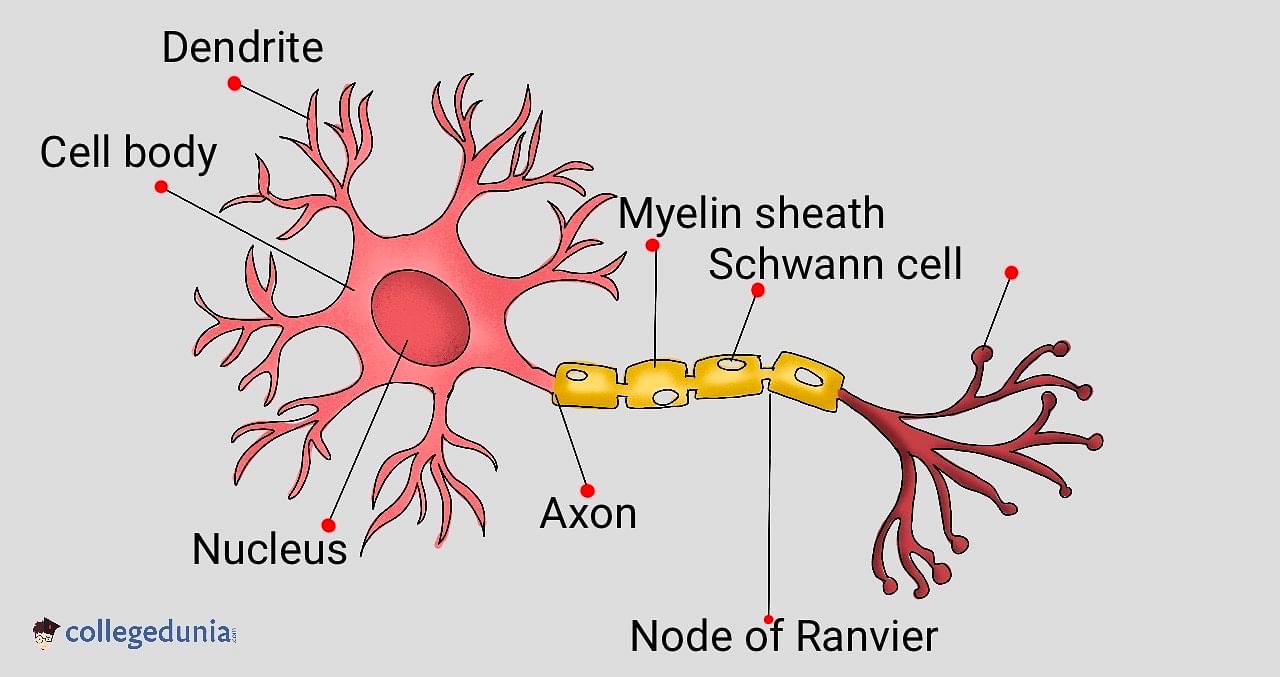
Neuron Diagram
The parts of neurons include –
-
Dendrites
These are tree-like extensions at the beginning of the neuron that help to expand the cell body's surface area.
- As seen in the neuron diagram, in most neurons – the dendrites extend outwards from the cell body.
- They receive signals from neighbouring neurons and send electrical stimulation to the neuron's soma or cell body.
- If the electrical signals transferred inward towards the soma are large enough, an action potential is generated, and the signal is conveyed along the axon.
-
Cell Body
The nucleus of the neuron is the cell body, also known as soma. The cell body is in charge of carrying genetic information, maintaining the neuron's shape, and supplying energy to drive activity.
- The soma of a neuron, like that of other cell bodies, contains a nucleus and specialized organelles.
- It is surrounded by a membrane that protects it while also allowing it to interact with its surroundings.
- The cell body of a neuron contains the nucleus, endoplasmic reticulum, Golgi apparatus, mitochondria and other components.
-
Axon Hillock
Axon Hillock, as seen in the diagram of neuron, is positioned at the end of the soma and regulates neuron firing. When the cumulative strength of a brain signal surpasses the axon hillock’s threshold limit, the structure fires an action potential down the axon.
- The total excitatory and inhibitory signals are regulated and kept track of by the axon hillock.
- An action potential is triggered when the cumulative quantity of these signals surpasses a particular threshold, and an electrical signal is delivered down the axon away from the soma.
- A neuron has an intrinsic polarization of roughly -70mV in its resting state.
- When a cell receives a signal, sodium ions enter the cell, causing the polarity to decrease.
An action potential transmits the electrical signal down the axon to the synapses when the axon hillock is depolarized to a particular threshold. It's worth noting that the action potential is an all-or-nothing procedure, meaning that the signals aren't sent in stages.
-
Axon
Axon is the neuron's elongated fibre that transports the neural signal from the soma to the terminal endings. The axon's diameter determines how quickly it can transfer information.
- Myelin, a fatty material that acts as an insulator, is found on some axons.
- These can range in length from 0.1 mm to 3 feet.
- The myelin sheath, which covers the myelin, is split up at locations known as Ranvier nodes.
- Electrical impulses in the brain can jump from one node to the next, which helps to increase the signal's transmission speed.
-
Synapses and Terminal Buttons
The major function of terminal buttons, which may be found at the end of each neuron as seen in the neuron diagram, is to deliver a neurological signal to other neurons. They're also in charge of reabsorbing excess neurotransmitters.
- A synapse is a gap at the terminal button's end.
- The neurological or electrical signal is carried across the synapse to neighbouring neurons via neurotransmitters.
- Neurotransmitters are released into the synaptic gap when an electrical signal reaches the terminal buttons.
- Those electrical impulses are converted into chemical messages by the terminal buttons.
- The neurotransmitters then pass across the synapse and are picked up by other neurons.
Also Read:
Functions of Neuron
[Click Here for Sample Questions]
The following are some of the most important functions of a neuron:
-
Chemical Synapse
The action potential in chemical synapses influences other neurons via the synapse, a space between two neurons. The action potential travels through the axon to a postsynaptic terminal, where it causes neurotransmitters, or chemical messengers, to be released. These neurotransmitters stimulate the postsynaptic neurons, which then generate their action potential.
-
Electrical Synapse
A gap junction connects two neurons to form an electrical synapse. Ion channels, which aid in the direct transmission of a positive electrical signal, are among the gaps. Chemical synapses are much slower than this.
Types of Neuron
[Click Here for Previous Year Questions]
Neurons can be classified into three types:
-
Sensory Neurons
Sensory neurons are responsible for converting inputs from the outside world into inside stimuli. Sensory inputs activate sensory neurons, which then transmit sensory data to the brain and spinal cord. Their structure is pseudounipolar.
-
Motor Neurons
These are multipolar neurons that originate in the central nervous system and extend their axons outside of it. This is the most prevalent type of neuron, and it is responsible for transmitting information from the brain to the body's muscles.
-
Interneurons
They have a multipolar structure. Their axons only connect to sensory and motor neurons in the immediate vicinity. They aid in the transmission of messages between two neurons.

Things to Remember
- Neuron Diagram is an important part of the CBSE class 11 Biology Chapter 21, Neural Control and Coordination.
- Neurons are the ones responsible for the transmission of messages throughout the body.
- They coordinate all functions through electrical and chemical signals.
- Sensory neurons help in the transmission of information from outer glands into the CNS and motor neurons pass information from CNS to outer parts of the body.
- Interneurons help in connecting sensory and motor neurons to ensure a smooth flow of information.
- The large diameter myelinated neurons transmit messages at a speed of 70-120 m/s (meter per second) or 156-270 mph (miles per hour).
- Small diameter unmyelinated fibres travel at a speed of 0.5-2 m/s or 1.1 - 4.4 mph.
Previous Year Questions
- Receptor sites for neurotransmitters are present on… [NEET 2017]
- Myelin sheath is produced by… [NEET 2017]
- Bowman's glands are located in the… [NEET 2007]
- Identify the parts of the sagittal section of human brain… [NEET 2013]
- A gymnast is able to balance his body upside down even in the total darkness because of… [NEET 2015]
- Difference between rod cells and cone cells of our retina is… [NEET 2008]
- Injury to vagus nerve in human is not likely to affect… [NEET 2004]
- Destruction of the anterior horn cells of the spinal cord would result in loss of… [NEET 2015]
- Afferent nerve fibre carries impulses from… [NEET 1992]
- Alzheimer disease in humans is associated with the deficiency of… [NEET 2009]
Sample Questions
Ques 1. Give a polarity-based classification of neurons. (5 mark)
Ans. Neurons can be classified as follows based on their polarity and the number of axons and dendrites:
Unipolar: Only one structure extends from the cell body, or soma, of these neurons.
Bipolar: One axon and one dendrite extend from the soma of these neurons.
Multipolar Neurons: These neurons have a single axon and many dendrites. Purkinje cells, Anterior horn cells, and other cells are examples.
Anaxonic: The axon and dendrites cannot be distinguished in these neurons.
Pseudo Unipolar: It has a single structure that extends from the soma and then splits into two separate components.
Ques 2. What are Interneurons, and How Do They Work? (2 mark)
Ans. Interneurons, also known as neural intermediaries, are neurons that are located in the brain and spinal cord. Sensory signals are passed from sensory neurons and other interneurons to motor neurons and other interneurons through them. They also frequently build complicated circuits that aid in your response to external stimuli.
Sensory neurons in your fingertips, for example, transmit a neurological signal to interneurons in your spinal cord when you touch something really cold. This signal is sent by certain interneurons to the motor neurons in the hand, causing humans to move their hands away.
Ques 3. Neurons can be found all over the body. (1 mark)
Ans. The bulk of neurons in vertebrates are found in the central nervous system. Some of them, however, are found in peripheral ganglia, and many sensory neurons are found in sensory organs like the retina and cochlea.
Ques 4. What are the functions of a neuron? (3 mark)
Ans. The following are some of the most important functions of a neuron:
- Chemical Synapse:
The action potential in chemical synapses influences other neurons via the synapse, which is a space between two neurons. The action potential travels through the axon to a postsynaptic terminal, where it causes neurotransmitters, or chemical messengers, to be released. These neurotransmitters stimulate the postsynaptic neurons, which then generate their action potential.
- Electrical Synapse:
A gap junction connects two neurons to form an electrical synapse. Ion channels, which aid in the direct transmission of a positive electrical signal, are among the gaps. Chemical synapses are much slower than this.
Ques 5. What is the function of the terminal buttons? (1 mark)
Ans. The major function of terminal buttons, which may be found at the end of each neuron, is to deliver a neurological signal to other neurons. They're also in charge of reabsorbing excess neurotransmitters.
Ques 6. How does information travel within the body? (3 marks)
Ans. Neurons help in the transmission of messages to and fro from the brain to the different parts of the body. Here are the steps:
- Informations are sent in the form of action potential which are packets of messages.
- The action potential moves through a single neuron cell in the form of an electrochemical cascade which allows a net inward motion of positively charged ions inside the axon.
- The ends of the axon contain vesicles packed with neurotransmitters, ready to be freed.
- Synapse is the gap between the end of an axon of a cell and the dendrites of another.
Ques 7. What is a synapse? (2 marks)
Ans. A synapse is a gap at the terminal button's end. The neurological or electrical signal is carried across the synapse to neighboring neurons via neurotransmitters. Neurotransmitters are released into the synaptic gap when an electrical signal reaches the terminal buttons. Those electrical impulses are converted into chemical messages by the terminal buttons. The neurotransmitters then pass across the synapse and are picked up by other neurons.
Ques 8. Give the names of the neurotransmitters. (3 marks)
Ans. The different types of neurotransmitters are:
- Acetylcholine neurotransmitters
- Inhibitory neurotransmitter
- Endorphin
- GABA
- Dopamine
- Serotonin
- Excitatory neurotransmitter
- Norepinephrine
- Epinephrine
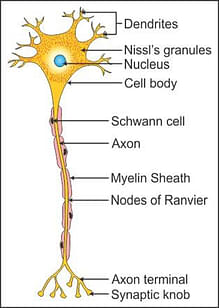
Ques 9. Draw a labelled diagram of a neuron. (5 marks)
Ans. A labelled diagram of a neuron:
Ques 10. The human nervous system is capable of a wide range of functions. What is the basic unit of the nervous system? (1 mark)
(A) Glial cell
(B) Meninges
(C) Neuron
(D) Cerebrospinal fluid
Ans. C, neuron.
Ques 11. The neuron cell is made up of which of the following parts? (1 mark)
(A) Axon
(B) Dendrite
(C) Nucleus
(D) All of the Above
Ans. D, all of the above.
Ques 12. Neurons come in which different types? (1 mark)
(A) Sensory
(B) Motor
(C) Skeletal
(D) A and B
Ans. D) A and B.
Also Read:



Comments