



Content Curator
The major difference between Mirror and Lens is that Mirrors reflect the light whereas the Lens Refract the light. Mirrors are objects that reflect the light falling on them and help us to see our image on them. Lenses are the ones that manipulate the light and form the image by refraction.
| Table of Content 1.Mirror 3.Lens |
Mirror
A mirror is a piece of glass that reflects the light falling on it, resulting in the formation of a clear image of the objects that are placed in front of it. Mirrors are polished from one side so that they can reflect more light and form a clear image.

Mirrors can be both plane and curved. They are essential to us in our daily lives. Some of the uses of Mirrors are-
- Looking glass
- Solar cooker
- Dressing table
- Mirror tiles
- Telescope
- Projectors
- Home decors
Types of Mirror based on the principle of Reflection
- Plane Surface Mirror- When parallel beams of light fall on a plane surface mirror, the reflected rays formed will be parallel.
- Concave Mirror- When light falls on a concave surface mirror, the reflected beams will be convergent.
- Convex Mirror- When light falls on a convex surface mirror, the reflected beams will move in a divergent direction.

Lens
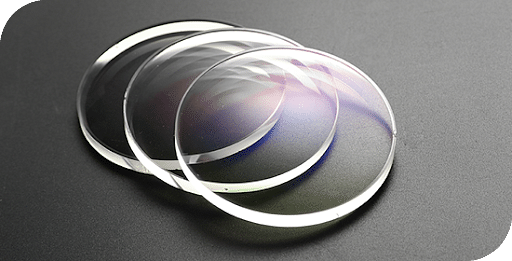
A lens is a piece of glass or any transparent material with curved sides to concentrate and disperse light. The curves of the lens are almost always spherical. The lens forms images in front of it. Some of the uses of Lens are-
- Telescope
- Microscope
- Flashlight
- Contact lens/Spectacle glass
Difference between Lens and Mirror
| Mirror | Lens |
| Mirror is a glossy object which reflects light and forms images of the person or object in front of it. | Lens is a transparent object made of glass or plastic bound by curved surface either on one or both sides and it refracts light resulting in the formation of images. |
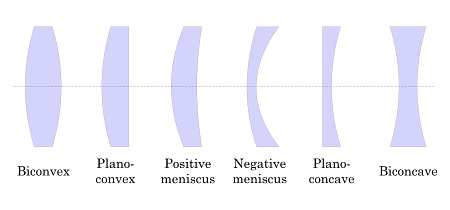
| There are three kinds of mirrors- Plane surface mirror, Convex mirror and Concave mirror | There are six kinds of lens- Biconvex, Plano-convex, Concave-convex, Biconcave, Plano-concave, Convexo-concave |
| Plane mirrors do not have a focal point | Lens have 2 focal points namely, F and 2F |
| Mirrors follow the laws of reflection | Lens follow the laws of refraction |
| Ideal Mirrors reflect 100% light. | Ideal Lenses refract 100% light |
| Mirrors are made of glass and metal | Lens are made of glass and plastic |
| A concave mirror is a converging mirror whereas a convex mirror is a diverging mirror. | A convex lens is a converging lens whereas a concave lens is a converging lens. |
| The formula for image formation of the lens is- 1v- 1u= 1f | The formula for image formation of the mirror is- 1v+ 1u= 1f |
| Mirrors are used in houses, social appliances and in automobiles | Lenses are required in scientific industries, medical and research purposes. |
Things to Remember Based on Difference Between Mirror and Lens
- A mirror is a piece of glass that reflects the light falling on it.
- Mirrors form a clear image of the objects that are placed in front of it.
- A lens is a transparent object made of glass or plastic bound by a curved surface either on one or both sides.
- Lenses refract the light resulting in the formation of images.
- Plane mirrors do not have a focal point whereas lenses have two focal points i.e. F and 2F.
- Mirrors work on the principle of reflection whereas the lenses work on the principle of refraction.
- Ideal Mirrors reflect 100% light and Ideal Lenses refract 100% light.
- The formula for image formation of the lens is- 1v- 1u= 1f
- The formula for image formation of the mirror is- 1v+ 1u= 1f
Important Questions Based on Difference Between Mirror and Lens
Ques: A highly polished furniture acts like a (1 Mark)
(a) pinhole camera
(b) mirror
(c) lens
(d) transparent object
Ans: (b) mirror
The polished surface is smooth and reflects light easily.
Ques: What are mirrors? Give three important examples. (2 Marks)
Ans: The smooth, polished and glossy surface that can reflect light in the same medium is called a mirror. Examples of mirrors are- Looking glass, a rearview mirror of vehicles, a barber's mirror, etc.
Ques: In a completely dark room, if you hold up a mirror in front of you, will you see a reflection of yourself in the mirror? (2 Marks)
Ans: Image is formed when the light is reflected from a mirror. In a completely dark room, there is no light to get reflected. Therefore, no reflection will take place on the mirror.
Ques: Three mirrors, one plane, one concave and one convex are lying on the table. How can a person identify them without touching them or using any other apparatus or device? (2 Marks)
Ans: Plane mirror produces an image of the same size. The concave mirror produces the magnified image while the convex mirror will produce a diminished image.
Ques: Write two uses of a concave mirror.(2 Marks)
Ans: Two uses of a concave mirror are-
(1) As reflectors for automobile headlights.
(2) As a shaving mirror.
Ques: A concave lens has a focal length of 20 cm. At what distance from the lens can a 5 cm tall object be placed so that it forms an image at 15 cm from the lens? Also, calculate the size of the image formed. (Delhi 2007, 3 Marks)
Ans:

Ques: The image of a candle flame placed at a distance of 45 cm from a spherical lens is formed on a screen placed at a distance of 90 cm from the lens.
Identify the type of lens and calculate its focal length. If the height of the flame is 2 cm, find the height of its image. (Delhi 2012, 3 Marks)
Ans:

So, the height of the image is 4 cm and the negative sign indicates that the image is formed below the principal axis.
Ques: An object is placed at a distance of 10 cm from a convex mirror of focal length 15 cm. Find the position and nature of the image. (3 Marks)
Ans. Given that:
f = +15 cm, u = -10 cm.
By using the mirror formula:
1/f = 1/v +1/u
1/v = 1/15 +1/10
1/v = 5/30
v = + 30 cm.
The image is formed 6 cm behind the mirror and is virtual and erect.
Ques: A concave lens has a focal length of 20 cm. At what distance from the lens a 5 cm tall object be placed so that it forms an image at 15 cm from the lens? Also, calculate the size of the image formed? (3 Marks)
Ans: Given that:
f = 20cm
h = 5 cm
V = -15 cm
We have to find
h’ = ?
U =?
1/u = 1/v +1/f
1/u = -1/15 +1/20
1/u = -1/60
u = -60 cm
h’/h = v/u
h’/5 = -15/-60
h’= (15 x 5)/60
h’ = 5/4 = 1.25cm



Comments