



Exams Prep Master
We know that matter is of two types is Solid, Liquid, and gas. But, further, the matters are classified into two fields is Substances and mixtures. The substances that cannot get separated into the other forms of matter are known as pure substances whereas the combination of two or more substances is known as the mixture. Further, the mixtures are classified into two categories that are – Homogenous mixtures and Heterogeneous Mixtures. A mixture can also be considered as a solution which is the combination of the solvent and solute. A solvent is a substance in which the solute has to be mixed whereas the solute is something that has to be mixed in the solvent to form a solution. Let’s discuss the major differences between pure substances and mixture.
| Table of Content |
Key takeaways: pure substances, mixtures, homogeneous and heterogeneous mixtures, elements, compounds.
What are Mixtures?
[Click Here for Sample Questions]
The mixtures are the combination of two or more substances that are separated either by the Chemical properties or the Physical Properties. Above all, the components of the mixtures are not completely or chemically combined but may have the physical or temporary force of attractions that is the reason that the components get dispersed or shattered from the methods like distillations, filtration, and so on. Moreover, in a mixture, the properties of all the components that are added are available even after the combination and hence, we can conclude this with an example of the Sugar solution in which we can taste sugar even after getting dissolved. The mixtures are further divided into two types – Homogenous mixtures and Heterogeneous Mixtures.

Homogenous Mixtures
In, the Homogenous Mixture, the composition of the mixture is the same and the arrangement of the particles is in an orderly way. Most importantly, there is not included any layer separation in the homogenous mixtures and the homogenous mixtures are one-phase mixtures. Subsequently, the components in the Homogenous mixtures are the atomic level or the molecular level in the mixture.
Heterogeneous Mixtures
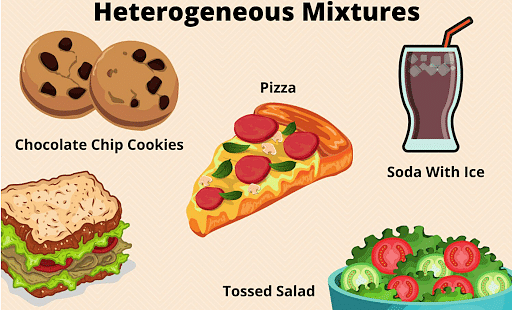
The components that are mixed in the heterogeneous mixture can be distinguished with the naked eye because the components that are added in the heterogeneous mixtures are of different properties or can be said unlike. In, the Heterogenous Mixture, the composition of the mixture is not the same, which means there exists no uniformity in the heterogeneous mixture.

The perfect illustration for the heterogeneous mixture is when we add water and sand together and dissolve. We can easily distinguish the sand and water in the solution.
Also read: Difference between mixture and solution
What are Pure Substances?
[Click Here for Sample Questions]
The substance which doesn’t contain any of the mixtures with any component or in other words the substance in the original form is known as the pure substance. Based on the chemical position, the pure substances are divided into two categories that are – elements and compounds. Examples of pure substances are – Gold, silver, Iron, Aluminum, and so on.

Elements
The element is the pure form of the substance which consists of one type of atom and hence, the elements cannot be broken into two types or more types of compounds because of having one kind of atom. An illustration for the demonstration of the elements consisting of a single kind of an atom is that when we broke gold by chemical or physical means, the extracted material is only gold and nothing else.
Compounds
The compounds are also the pure form of substances in which there are one or more identical components are held together with strong chemical bonds. Hence, the elements of the compound of any type that compose the properties cannot be considered as the compound.
Also read: Collision Theory of Chemical Reaction
Difference Between Pure Substances and Mixtures
[Click Here for Sample Questions]
The difference between the Pure substances and the mixtures based on the properties and other categories is mentioned in the table below –
| Pure Substances | Mixtures |
|---|---|
| Substances that are made up of single components are known as pure substances. | More than one Element can together in a combined way generated a mixture. |
| Pure substances are categorized in - Solid, Liquid, and Gas. | The mixtures are categorized into – Heterogeneous mixtures and Homogenous Mixtures. |
| The separation of the elements of the pure substance by the physical process is not possible. | The separation of the elements of the pure substance by the physical process is possible by evaporation, magnetic separation, and other methods. |
| The chemical properties of the Pure Substances are Constant. | The chemical properties of the mixtures vary. |
| Examples – Gold, water, silver, and so on. | Examples – a mixture of sand and water. |
Things To Remember
- Mass [solution] = Mass [solute] + Mass [ Solvent]
- Mass[solute] = Mass [Solution] - Mass[solvent]
- Mass [solvent] = Mass [solution] + Mass [Solute]
- Mass of percentage = (the Mass of solute/ the Mass of Solution) *100
- Substances that are made up of single components are known as pure substances.
- The separation of the elements of the pure substance by the physical process is possible by evaporation, magnetic separation, and other methods.
- The components that are mixed in the heterogeneous mixture can be distinguished with the naked eye because the components that are added in the heterogeneous mixtures are of different properties or can be said unlike.
- The composition of the mixture in the Homogenous Mixtures is the same and the arrangement of the particles is in an orderly way.
- The compounds are also the pure form of substances in which there are one or more identical components are held together with strong chemical bonds.
Read More: Number of Moles Formula
Sample Questions
Ques: Given a solution containing 40 grams of common salt dissolved in 320 grams of water. Find the concentration in terms of mass percentage of the solution. (3 marks)
Ans: We have given the mass of salt = 40 grams, Mass of solvent = 320 grams. We know the formula, for calculating the mass of solution which is: Mass of Solute + Mass of Solvent.
Mass of solution = Mass of solute + Mass of Solvent
Mass of solution = 40 grams + 320 grams
Mass of solution = 360 grams
Mass of percentage = (Mass of solute/ Mass of Solution) *100
Mass of percentage of solution = 40/360 * 100 = 11.1%
Ques: What is Compounds with respect to the Pure substances? (2 marks)
Ans: The substances that refer to the matters consisting of two or more different substances that are joined chemically. Examples of pure substances are – Gold, Iron, Silver, and so on.
Ques: Mention a difference between that mixture and Pure Substances concerning the separation of elements? (2 marks)
Ans: The separation of the elements of the pure substance by the physical process is not possible whereas the separation of the elements of the pure substance by the physical process is possible by evaporation, magnetic separation, and other methods.
Ques: Which of the following are under the category of the mixture – Lemonade, Milk, Water, Dilute acid, vinegar, filtered water? (1 mark)
Ans: The substances from the given list that falls under the category of the mixture are – Lemonade, Dilute Acid.
Ques: Mention a difference between Homogenous and Heterogenous Mixtures? (2 marks)
Ans: Homogenous Mixtures are the mixtures that have a uniform composition and we cannot see the solute in homogenous solution whereas the heterogenous mixtures have the ununiform composition and the solute can be seen in the heterogeneous solution.
Ques: In a given solution, the mass of the solution is 500 grams and the mixture of solute is 250 grams. Find the mass of solvent. (3 marks)
Ans: We know the formula to calculate the mass of solution –
Mass [solution] = Mass [solute] + Mass [ Solvent]
We have to find the mass of solvent, hence the formula for that is –
Mass of Solvent = Mass of a solution - Mass of solute
Mass of solvent = 500 grams – 250 grams
Mass of Solvent = 250 grams
Ques: Give some examples of Homogenous mixtures and Heterogenous mixtures. (2 marks)
Ans: The examples for both the solutions are mentioned below –
Homogenous Mixtures – air, alloys, bitumen, and many more.
Heterogeneous Mixtures – Oil and water, kerosene and water, and many more.
Ques: Calculate the mass percentage of solution where the mass of the solution is 120 grams and the mass of solute 60 grams. (2 marks)
Ans: We know the formula of calculating the solution mass percentage is –
Mass of percentage = (the Mass of solute/ the Mass of Solution) *100
Mass of percentage of solution = (60/120) *100
Mass of percentage of solution = 50%
Chemistry Also Read:



Comments