



Content Curator
Aluminium bromide is a chemical solution that has a light yellow colour. The IUPAC name of aluminium bromide is Tribromoalumane or aluminium tribromide. It is toxic to humans due to its ability to cause severe burns to the skin and eyes. The molecular formula for aluminium bromide is AlBr3. The chemical formula is composed of chemical symbols of the atoms which are found in a specific compound. In this case, the chemical symbol of aluminium is Al and bromine is Br. The molecular formula shows that the compound is made up of one atom of aluminium and three atoms of bromine.
Also Read: Purpose of Sorting materials
| Table of Content |
Keyterms: Aluminium, Tribromoalumane, Aluminium tribromide, Atoms, Skin, Eyes, Bromine, Electron, Electronegativity, Ion
Formation of Aluminium Bromide
[Click Here for Sample Questions]
Aluminium bromide is formed via a redox reaction, in which the oxidation states for the atoms involved in the reaction change. So, one species is reduced while the other is oxidised. Reduction of a species occurs when an atom gains an electron, thus reducing the oxidation number. Oxidation represents the loss of an electron by an atom. In this reaction, aluminium is reduced while bromine is oxidised. The ionic bonds occur when there are differences in the electronegativity between two atoms or an electrostatic attraction occurs between positively charged ions.
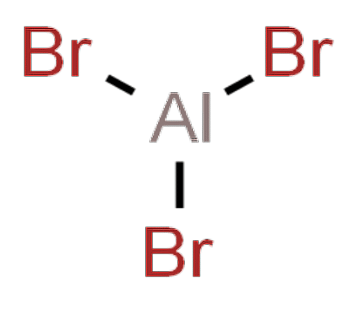
Aluminium Bromide compound
The aluminium ion Al3+ has more protons than electrons and the bromine ion Br1- will have more electrons than protons. This would result in an electrostatic attraction between aluminium and bromine ions. So, the aluminium ion will be able to make bonds ionically to three bromine atoms as it needs three electrons to create stable electron configuration. Therefore, the balanced chemical equation will be:
2Al(s) + 3Br2(l) → 2AlBr3(s)
Also Read:
Derivation of Aluminium Bromide Formula
[Click Here for Sample Questions]
The formula of aluminium bromide is AlBr3. It will have the characteristics of ionic compounds. Ionic compounds are those where there is a bonding of charged ions. The metal atom is a positively charged ion as it gives electrons. In the case of aluminium bromide, all aluminium atoms give three electrons while the bromine atom will take one electron.
Al+3 + 3Br-1 → AlBr3
Therefore, the representation of aluminium ion is Al+3 and bromide ion is Br-1. Ionic compounds are electrically neutral. So, there are ion charges that will cancel each other. Therefore, one requires multiple ions of each so as to make the compound neutral. So, for this case one requires one aluminium ion and three ions of bromine,
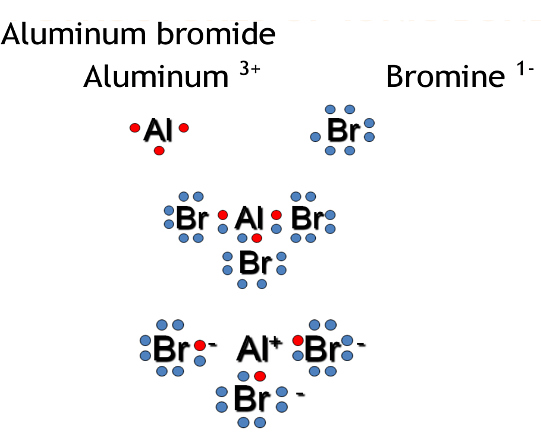
Aluminium Bromide lewis structure
Read More:
Properties of Aluminium Bromide
[Click Here for Sample Questions]
Properties of aluminium bromide are further classified into Physical and Chemical Properties.
Physical Properties
- It is anhydrous in nature.
- It has a really strong odour.
- This compound is corrosive to skin and eyes and it appears as white to yellowish-red lumpy solid.
- The boiling point of this compound is 255°C and melting point is 97.5°C.
- Due to its nature, this compound is soluble in many organic solvents.
Also Read: Three States of Matter
Chemical Properties
- The most common aluminium bromide is Al2Br6. Al2Br6 can be separated to give strong lewis acid AlBr3.
- In accordance with the characteristics of lewis acid, water hydrolyzes Al2Br6. This hydrolysis of water takes place with HBr evolution and formation of Al-OH-Br species.
- Aluminium Bromide compound reacts with alcohols and carboxylic acids easily.

Corrosive Nature of Aluminium Bromide
Read More:
Things to Remember
[Click Here for Sample Questions]
- Aluminium bromide is white crystalline compound that melts into a colourless liquid. It is a hygroscopic compound. This compound is used as a catalyst for the Friedel-Crafts Alkylation reaction.
- It belongs to the class of inorganic compounds which are called post-transition metal bromides. The largest halogen atom in this case is bromine.
- Aluminium bromide compound is anhydrous in nature. Also, this compound appears as white to yellowish-red lumpy solid. This compound has a very strong odour.
- The most common form of aluminium bromide is aluminium tribromide. It is a highly water-soluble crystalline. Aluminium sources whose uses are suitable with bromides and lower pH.
- It has an empirical formula AlBrx, and it is colourless, sublimable hygroscopic solid, hence old samples are to be hydrated mostly as aluminium tribromide hexahydrate.
Also Read:
Sample Questions
Ques. Discuss the preparation of Aluminium bromide. (2 Marks)
Ans. Aluminium bromide is prepared from the reaction of aluminium oxide or metallic aluminium with hydrobromic acid or by the reaction of metallic aluminium with bromine gas at high temperature.
2Al + 6HBr → Al2Br6 + 3H2
Al2O3 + 6HBr → Al2Br6 + 3H2O
2Al + 3Br2 → Al2Br6
Ques. What are the uses and safety hazards for Aluminium bromide? (2 Marks)
Ans. Uses: It will be used in organic synthesis for catalysing reactions of alkylation and isomerization. It is used as a reactant in bromination reactions.
Safety hazards: It is highly reactive in nature as it is a lewis acid. Also, it is extremely harmful for health. It may be flammable in nature.
Ques. Comment on the solubility of aluminium bromide. (2 Marks)
Ans. Aluminium bromide is slightly soluble in methanol, diethyl ether and acetone. It is highly soluble in water, partially hydrolysis indicated by a fuming solution and an optional appearance of white precipitate.
Ques. Is aluminium bromide ionic or covalent compound? (2 Marks)
Ans. It is an ionic compound, one where charged ions stick together due to electrostatic attraction which is formed from the reaction of aluminium with liquid bromine. Aluminium atoms give three electrons which results in Al3+ and bromine atoms gain one electron which results in Br-1.
Ques. What are the different types of reactions? (5 Marks)
Ans. Different types of reactions are:
- Decomposition reaction: In this, molecules or compounds break down into two or more than two simpler chemically new substances.
- Combination reaction: In this, two or more molecules combine together chemically to form a new substance.
- Combustion reaction: It is an exothermic reaction that releases energy, normally in the form of heat.
- Neutralisation reaction: In this reaction, acid and base react with each other and form salt and water.
- Precipitation reaction: In this reaction, two soluble salts in aqueous solution are combined and form an insoluble precipitate.
- Redox reaction: In this reaction, oxidation and reduction of chemical compounds takes place simultaneously.
Ques. Write some characteristics of a chemical reaction. (3 Marks)
Ans. Some characteristics of a chemical reaction are:
- Change in colour
- Change in temperature
- Change in energy
- Change in state
- Formation of precipitate
- Evolution of gas
Ques. Define molar mass and molecular mass. (3 Marks)
Ans. Molar mass is a property which is defined as the mass of substance divided by its amount of substance in moles. In other words, it is the mass of one mole of a particular substance. In SI, units for molar mass is kg/mol.
Molecular mass is the mass of a molecule calculated as the sum of the mass of each atom in the molecule multiplied by the number of atoms of that element in the molecule. Molecular mass is a dimensionless quantity.
Ques. Molten Aluminium bromide is a poor conductor of electricity. Explain. (3 Marks)
Ans. Aluminium bromide is a covalent compound which ionises to a very small extent in the molten state, so it is a poor conductor of electricity. Ionic compounds are known to conduct electricity when they are dissolved in water as free ions or electrons are present which help in the conduction. Therefore, covalent compounds neither conduct in the solid state nor in the liquid state.
Ques. How can the equation for this reaction be written: Aluminium bromide and chlorine gas react to form aluminium chloride and bromine gas? (5 Marks)
Ans. The chemical equation will be written as:
AlBr3 + Cl2 -> AlCl3 + Br2 which is an unbalanced equation.
On balancing,
2AlBr3 + 3Cl2 -> 2AlCl3 + 3Br2
In aluminium bromide, aluminium has an oxidation number of +3 and bromine has an oxidation number of -1. In order to sum it to zero, you should have three bromines with an overall charge of -3 and one aluminium, with a charge of +3, so -3 + 3 = 0. Therefore, AlBr3 is generated. The other reactant Cl2 will need two chlorines, as it is one of the elements that requires two of itself to have an oxidation charge of zero. This is a single displacement reaction, in which the free elements in reactants become the part of compound in products, which replaces one of the original elements in compound, and makes the replaced element become the free element in the products.
Ques. Write a short note on Aluminium chloride and Aluminium iodide. (5 Marks)
Ans. Aluminium chloride is used for making pure aluminium metals. This compound can be put through a chemical reaction in which one of the products is pure aluminium. It has many industrial applications. It is used in making many petrochemicals, paint and synthetic rubber. It forms a gel that temporarily plugs up sweat glands and closes pores. This plugging of sweat glands prevents sweating.
Aluminium iodide is a compound which is composed of only aluminium and iodine. It is an ionic compound which is used as a catalyst in certain organic reactions. It is a hexahydrate which we obtain from the reaction between metallic aluminium or aluminium hydroxide with hydrogen iodine or hydroiodic acid. It is a strong lewis acid and absorbs water from the atmosphere. It also acts as a reagent for the scission of certain kinds of C-O and N-O bonds. Aluminium iodide belongs to the halogen family and it is a highly reactive non metal.
Also Read:



Comments