



Content Writer-SME
Mixture and solution are the basic concepts of chemistry class 9 that must not be confused by the students. A mixture in simple words is a combination of usually two or more substances. The substances here, are not chemically combined and their properties remain the same. Since, it is combined physically, the identities of individual substances are retained.
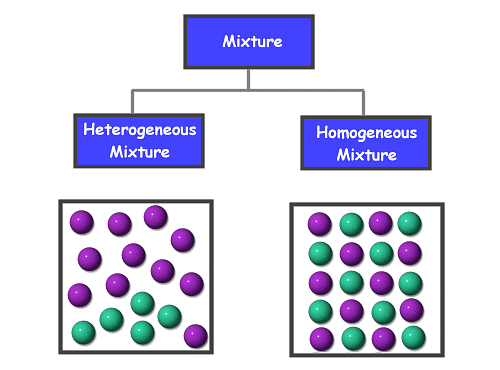
- Mixtures can be either heterogeneous or homogeneous, depending upon the uniformity of components.
- The solution, on the other hand, is completely different from a mixture.
- The solution is a type of mixture, wherein the substances are dissolved.
- Solution is a homogeneous mixture containing one or more solutes in a solvent.
- An example of a solution can be sugar syrup.
- Thus, a solution is a type of mixture, but a mixture may or may not be a solution.
Read further to understand better the difference between the two.
What is Mixture?
[Click Here for Sample Questions]
The combination of two or more substances, without bringing in any chemical change is known as a mixture in chemistry. When the substances in a mixture combine together, they do neither lose their individual properties nor change their chemical bondings. They usually result in a product of a chemical combining of substances.
Some of the examples of mixtures include; a mixture of water and salt, like seawater, a mixture of gases like oxygen, carbon dioxide, nitrogen, carbon monoxide, etc forming air, a mixture of different types of colored dyes forming ink.
Properties of Mixture
The original properties of a mixture do not change. Depending on the components and how they are mixed, mixtures can have different compositions and characteristics. The main properties of mixtures are given below:
- The proportion of ratio of the constituents can vary.
- The melting and boiling points of mixtures are not very high.
- Depending on their composition, they either melt or boil at a variety of temperatures.
- There is little or no change in energy due to the formation of a mixture.
- In every state of matter, such as liquid, gas, or solid, two or more components can form a mixture.
- A mixture's constituents can exist in any ratio. For instance, the concentration of salt in saltwater might vary.
- They can be physically separated using techniques like distillation, evaporation, or filtration.
Types of Mixture
When two or more compounds are physically combined but not chemically linked, they are called a mixture. Their structure and characteristics allow them to be classified into two types:
-
Homogeneous Mixture
In a homogenous mixture, the various components are difficult to identify by visual inspection and the composition remains constant. It is the one wherein two compounds have similar characteristics are mixed with each other, such that they are uniform throughout. The example of homogenous mixture includes salt and water.
-
Heterogeneous Mixture
A mixture is said to be heterogeneous if its constituent parts are not uniformly dispersed and do not retain their unique properties. It is the one wherein two different types of compounds with different properties are mixed with one another. The mixture of salt and sand are considered as heterogenous mixture.
Read also: States of Matter
What is Solution?
[Click Here for Sample Questions]
The solution is a homogeneous mixture, wherein the size of particles is not more than 1nm. It consists of two substances, namely, solute and solvent. The solution can exist in both liquid gaseous forms.
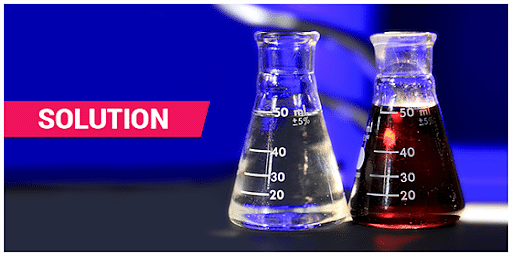
The solute is a substance that is dissolved in a solvent and is much less in quantity than a solvent. A solvent, on the other hand, is an aqueous component in which a solute is dissolved. It's quantity is more than the solute. Some of the common examples of solutions include; air, sugar syrup, etc.
Characteristics of Solution
A homogeneous mixture of two or more compounds is called a solution, and it usually consists of a solvent (the material that dissolves) and a solute (the substance that dissolves). The salient features are as follows:
- The solute is dispersed equally throughout the solvent, and the composition of the solution is constant.
- The solute particles in a solution are usually smaller than one nanometer and are at the molecular or ionic level.
- Under normal circumstances, solutions are stable and the solute does not separate slowly from the solvent or freeze.
- The process of filtration fails to separate solute particles in solution due to their microscopic particle size.
Types of Solution
Solutions have been divided into nine main categories:
- Solid-solid
- Solid-liquid
- Solid-gas
- Liquid-liquid
- Liquid-solid
- Liquid-gas
- Gas-liquid
- Gas-solid
- Gas-gas
Read more:
Difference between Mixture and Solution
[Click Here for Sample Questions]
The difference between solution and mixture is mentioned in the table below.
| Basis of Comparison | Mixture | Solution |
|---|---|---|
| Definition | In a mixture, substances are just mixed and are not completely dissolved. | In a solution, substances are dissolved completely and cannot be filtered out. |
| Mixing | Substances are combined physically in a mixture. | The solutes get dissolved in the solvent and can be separated using mechanical methods. |
| Tyndall Effect | In mixtures, tyndall effect is prevalently seen. | No, the solutions do not show tyndall effect. |
| Chemical Properties | The chemical properties of each substance are retained. | Chemical properties change. |
| Ratio of Substances | The number of substances in a mixture can vary as they do not have a fixed ratio. | A solution usually has a fixed ratio of the number of substances. |
| Nature | The mixture can be either heterogeneous or homogeneous. | A solution is a homogeneous mixture. |
| Examples | Air, alcohol in water, Mixture of sand in water are all examples of mixture. | Sugar in water and salt in water are the examples of solution. |
Things to Remember
- Mixture is the combination of two or more substances, without bringing in any chemical change.
- A mixture can be heterogeneous or homogeneous.
- Solution is a type of homogeneous mixture, wherein the substances are dissolved chemically.
- In a mixture, the chemical properties of a substance are retained, while, they change in a solution.
Read more: High-Density Polyethylene structure
Sample Questions
Ques. What is a mixture? Give two examples. (2 marks)
Ans: Mixture is the combination of two or more substances, that are formed without bringing in any chemical change. The substances here, are not chemically combined and their properties remain the same. A mixture of water and salt, like seawater, or a mixture of gases in the air are examples of a mixture.
Ques. What is a solution? Give two characteristics of the same. (2 marks)
Ans: Solution is a type of homogeneous mixture, wherein the substances are dissolved using chemical methods. In a solution, substances are dissolved completely and cannot be filtered out. A solution is a homogeneous mixture. The particles of a solution are less than 1nm in size.
Ques. What is the major difference between a mixture and a solution? (2 marks)
Ans: • Substances in a mixture are combined physically, while those in a solution are dissolved using mechanical methods.
- The chemical properties of substances in a mixture are retained, while those of a solution do change.
- The amount of substances in a mixture is not in a fixed ratio, while in a solution, the substances are in a fixed ratio.
Ques. Is sugar syrup a mixture or a solution? (2 marks)
Ans: Sugar syrup is a type of solution. It is a liquid-solid mixture, wherein the sugar is diluted in water. Here, sugar acts as a solute, whereas water acts as a solvent.
Ques. What is a heterogeneous mixture? (2 marks)
Ans: A heterogeneous mixture is a mixture having non-uniform composition. Here, two different types of compounds with different properties are mixed with each other. The composition of mixtures of sodium chloride and iron fillings, oil, and water are some of the examples of a heterogeneous mixture.
Ques. Which of the following substances fall in the category of mixtures. (2 marks)
(a) Sodium
(b) Soil
(c) Sugar solution
(d) Silver
(e) Calcium carbonate
(f) Tin
(g) Silicon
(h) Coal
Ans: The following substances can be classified as mixtures:
Soil
Sugar solution
Coal
Ques. Classify each of the following as heterogeneous or homogeneous mixture. Soda water, wood, air, soil, vinegar, filtered tea (2 marks)
Ans: Homogeneous mixtures: Soda water, air, vinegar
Heterogeneous mixtures: Wood, soil, filtered tea
Ques. Identify which of the following mixtures are solutions: (2 marks)
(a) Soil
(b) Sea water
(c) Air
(d) Coal
(e) Soda water
Ans: The following mixtures are solutions:
Sea water
Soda water
Air
Chemistry Related Links:



Comments