



Education Journalist | Study Abroad Lead
Radicle and plumule are major parts of a seed embryo. Radicle is the embryonic root of the plant that rises first from the seed germination process. Plumule is that part that grows into the shoot during seed germination. Radicle and plumule, both can be found in the cotyledons of the seed embryo.
Key Terms: Seed, Plumule, Radicle, Pollen Tube, Embryo, Germination, Plant, Cotyledons, Seed Embryo
What is Seed?
[Click Here for Sample Questions]
After transfer of pollen grains to the ovary via pollen tube in the pistil of a flowering plant, the pollen grain fuse with female eggs present in the ovary, which is termed as fertilization. Fertilization leads to the transformation of the ovule into a seed and the newly formed seed contains an embryo. The embryo is the future plant.
Germination in Seed
- Seed is thus an embryonic plant and an essential reproductive unit.
- The seeds are mainly a mode of propagation for angiosperms and gymnosperms.
- The structure of a typical seed consists of a radical, embryonic axis and one or two cotyledons.
- In angiosperms, based on the number of cotyledons(one or two) a seed is further divided into monocotyledon and dicotyledon.
- Seeds containing the embryo germinate under suitable conditions which include temperature, moisture, etc.
Radicle Definition
[Click Here for Sample Questions]
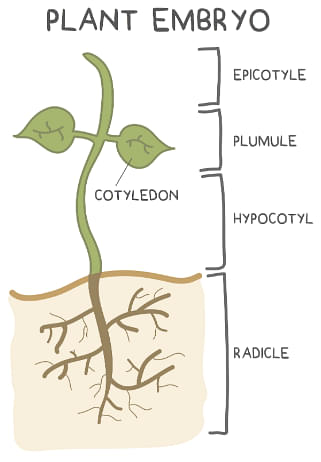
Radicle is the embryonic root of a plant and later develops into roots of the plant. It is interesting to note that the radicle is also the first part of a seed that comes out during seed germination. Radicles generate from the micropyle of the seed. Micropyle occurs in both seed and ovule. It is a narrow pore due to the growth of the pollen tube in the ovule, during fertilization. And further, radicles grow downward into the soil, to absorb water and minerals for the development of the embryo.
Radicle
Based on the direction of growth with respect to the hilum, radicles are categorised into two groups. If the radicle grows away from the hilum, then it is termed as ‘antitropous’. And if it develops towards hilum, it is termed as ‘syntropous’.
Plumule Definition
[Click Here for Sample Questions]
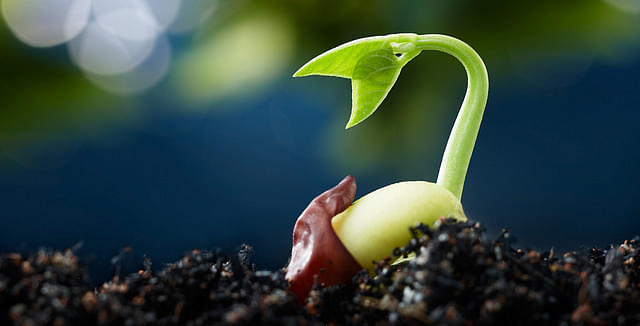
Plumule emerges later from the seed after the radicle. It is the embryonic shoot of a plant. Plumule develops into the first true leaves but it is just the growing tip of epicotyl. Epicotyl is what grows into the future stems, leaves and flowers of a plant. The initial growth of plumule happens as per the requirements of the embryo of the plant.
Plumule
If sufficient food is stored in the cotyledons then the growth of plumule is small. Whereas if food is insufficient then the plumule develops into well-formed leaves to capture sunlight and prepare food for the embryo, by the process of photosynthesis. In anyways, it supports the endosperm or cotyledons for food availability.
The germination of seeds can be of two types: epigeal and hypogeal germination. In epigeal germination, the cotyledons grow above the soil and are followed by the plumule. On the other hand in hypogeal germination, the cotyledons stay below the surface.
Difference between Radicle and Plumule
[Click Here for Sample Questions]
The major differences between radicle and plumule are:
| Parameter | Radicle | Plumule |
|---|---|---|
| Definition | Radicle is the embryonic root of a plant | Plumule is the embryonic shoot of a plant |
| Function | Radicle absorbs water and nutrients from the soil for the development of the embryo | Plumule supports the cotyledons in terms of food availability. It synthesises food for the embryo through photosynthesis |
| Time of occurrence | Radicle is first to come out of a seedling from the micropyle of a seed | Plumule is second to come out from a seed |
| Direction of growth | Downwards into the soil | Upwards away from the soil |
| Future development | Radicale is a rudimentary root it develops into roots of the future plant | Plumule is the rudimentary shoot, it develops into the first true leaves of a plant |
| Colour | Radicle is white in colour | Plumule is less white than radicle |
| Phototropic: growth in response to light stimuli | No, it is not phototropic. As a radicle does not grow towards sunlight so it is negative | Yes, it is phototropic. As plumule grows toward sunlight so it is positive |
| Hydrotropic: growth in response to potential water gradient in soil | Yes, the radicle is hydrotropic. As it grows towards a higher water gradient | No, plumule is negatively hydrotropic |
| Geotropic: growth in response to gravity | Positive as it grows down into the soil | Negative as it grows away from the soil |
Things to Remember
- Radicle is the embryonic root while Plumule is the embryonic shoot.
- Radicle develops into the future root of the plant whereas the plumule develops into the shoot.
- Radicle absorbs water and minerals from the soil. Whereas plumule captures sunlight to synthesis food by photosynthesis
- Radicle is positively hydrotropic, geotropic and negatively phototropic
- Plumule is negatively hydrotropic, geotropic and positively phototropic
- Germination of seeds can be of two types: epigeal germination and hypogeal germination. Epigeal germination, the cotyledons grow above the soil and are followed by the plumule. Hypogeal germination, the cotyledons stay below the surface of the soil.
- Radicles are of two types: antitropous and syntropous
Sample Questions
Ques. Differentiate between plumule and radicle on the basis of their function. (2 Marks)
Ans. The difference between plumule and radicle on the basis of their function is as follows:
| Plumule | Radicle |
|---|---|
| Plumule is the embryonic shoot of a plant. It supports the cotyledons in food availability. It synthesises food for the embryo through photosynthesis | Whereas radicle is the embryonic root of a plant, it absorbs water and nutrients from the soil for the development of the embryo |
Ques. Differentiate between epigeal germination and hypogeal germination. (2 Marks)
Ans. Epigeal germination, the cotyledons grow above the soil and are followed by the plumule. Whereas, in hypogeal germination, the cotyledons stay below the surface of the soil.
Ques. What are the types of radicle and define them? (2 Marks)
Ans. Radicles are of two types, based on the direction of growth with respect to the hilum: antitropous and syntropous. The radicle growing away from the hilum then is termed antitropous. When a radicle grows towards the hilum it is called syntropous.
Ques. Differentiate between plumule and radicle on the basis of their tropic movements. (3 Marks)
Ans. The difference is as follows:
| Tropic Movements | Plumule | Radicle |
|---|---|---|
| Phototropic: growth in response to light stimuli | Positively phototropic. As plumule grows toward sunlight | Negatively phototropic. As a radicle does not grow towards sunlight |
| Hydrotropic: growth in response to potential water gradient in soil | No, plumule is negatively hydrotropic | Yes, the radicle is hydrotropic. As it grows towards a higher water gradient |
| Geotropic: growth in response to gravity | Negative as it grows away from the soil | Positive as it grows down into the soil |
Check-Out:



Comments