



Content Writer
In physics, torque is the rotational equivalent of linear force. This means that when an object rotates, a force is applied. That rotating force is called torque.
- It is a perpendicular distance from the point of rotation to the force’s line of action.
- The moment is a force that causes the body to rotate about a specific axis.
- The main difference between torque and moment is torque is a dynamic force, and moment is a static force.
- Torque is utilized where rotation is present, whereas moment is used where there is no rotation.
- Opening of a door by its hinge is a common example of torque.
- On the other hand, unscrewing a nut with a spanner is a real life example of a moment.
Key Terms: Difference between Torque and Moment, Torque, Moment, Force, Dynamic Force, Static Force, Axis of Rotation, Motion, Moment of force, Measurement of Torque and Moment
What is Torque?
[Click Here for Sample Questions]
[Click Here for Sample Questions]
Torque is defined as the amount of force required to spin an object around an axis. In simpler terms, when an object moves around a fixed axis, a force is produced which allows it to turn. That turning force is called torque.
- The point around which the object is rotating is called the axis of rotation.
- Newton metre (N-m) is the SI unit of torque.
- It helps an object acquire angular acceleration.
- Torque is a vector quantity, which means it depends upon the direction of the force on the axis.
- Its dimensions include [M0 L2T−2].
Types of Torque
There are two types of torque, which are as follows:
- Static Torque: Static torque refers to the process of applying force on an object that is in a state of rest or equilibrium. Pushing a closed door is an example of static torque.
- Dynamic Torque: Dynamic Torque refers to the process of applying force on an object which is in a state of motion. Starting the engine of a car, which results in the spinning of the crankshaft, is an example of dynamic torque.
Real life Applications of TorqueExample 1: If we switch on the fan, we have observed that it starts rotating with its center at rest. Since the center of the fan stays at rest, it means the vector sum of all the external forces acting on the fan has to be zero. Meaning, one can generate angular acceleration in an object even when an external force is zero. Example 2: A similar concept of torque was used in old tanks where the force of falling water rotates the water wheel. The water wheels were connected to the dynamo thus generating electricity by the principle of conversion of kinetic energy into potential energy. Example 3: People in rural areas still apply the concept of the moment to churn milk by applying torque to the handle using a rope. The rope is tied to a wooden stick which rotates about its axis and in turn, turns the milk. |
Read More:
| Read More topics in System of Particles and Rotational Motion Chapter | ||
|---|---|---|
| Difference between torque and moment | Angular Velocity Formula | Tangential velocity formula |
| Charging by Induction | Rotational inertia formula | Moment formula |
| Torque Formula | Rolling motion | Radius of Gyration |
What is Moment?
[Click Here for Sample Questions]
The moment is the measurement of the perpendicular distance from the point of rotation to the force’s line of action. In other words, a moment in physics is an expression that involves the product of a distance and physical quantity.
- In this way, it accounts for the way in which the physical quantity is located or arranged.
- It deals with physical quantities that are placed at a certain distance from that centre.
- The components of the moment of force include the applied force and the distance from the fixed axis.
- It is calculated for both balanced and unbalanced types of forces.
- The SI unit of the moment is Newton metre (N-m).
- The right-hand grip rule is used to determine the orientation of the moment of force.
Real Life Application of MomentExample: Let us understand it with a simple example. Everyone has played a sea-saw or at least is familiar with its mechanics. What if I tell you that you can keep the sea-saw balanced by having 120 Kg person on one side and 50 Kg person on the other side.
|
Measurement of Torque and Moment
[Click Here for Sample Questions]
The measurement of torque and moment are as follows:
Measurement of Torque
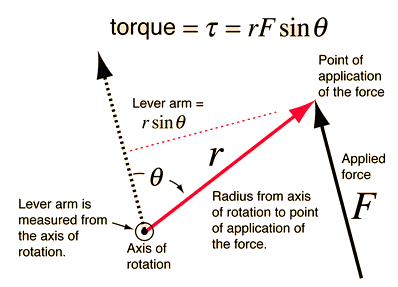
The formula of torque,
T = rF sinθ
Where, T = torque
r = radius
F = force
θ = angle between F and the lever arm
Measurement of Moment
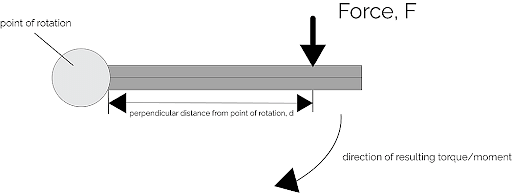
The formula of the moment,
μn = rn Q
Where, μn = moment
rn = distance to some point
Q = physical quantity such as a force applied at a point/a point mass/a point charge, so on.
Difference between Torque and Moment
[Click Here for Sample Questions]
The difference between torque and moment are as follows:
| Point of Difference | Torque | Moment |
|---|---|---|
| Definition | Torque is the twisting and turning effect of the body. | The movement or bending of an object under the influence of any form of external force is called moment. |
| Type of Force | It is a dynamic force | It is a static force. |
| Used for | This is used where there is rotation | The moment is used in case of no rotation. |
| Used in | Torque is used in objects having fixed or pivot points and the axis of rotation | It is used in an object which has a nonrotating or bending tendency and is generated under the influence of applied force. |
Read More:
| Read More topics in System of Particles and Rotational Motion Chapter | ||
|---|---|---|
| Linear Accelerator | Moment of inertia | Angular Momentum Formula |
| Relation between torque and moment of inertia | Rigid Bodies | Angular Acceleration Formula |
Things to Remember
- The term "moment" relates to the tendency of a force to move an item, whereas torque refers to the tendency of a force to spin an object in a pivot.
- SI unit of torque and moment is Nm (Newton Meter).
- Formulae of torque are "T= r x F . "where T stands for Torque, F is force, and r is force's perpendicular distance.
- The formula of the moment is "M= d x F", where M stands for Moment, F is force, and d is the perpendicular distance from the line of action.
- Torque is a moving force, whereas a moment is a static force.
- Moment is employed when there is no rotation, but torque is used when there is rotation and a pivot.
Sample Questions
Ques: What's the connection between torque and moment of inertia? (2 marks)
Ans: Torque is the change in the angular momentum. It can be defined as the rate of change of angular momentum which is the same as the cross product of the linear force and the distance from the axis.
Ques: Find out the torque on the door if a force of 10N is applied on the door 0.5m from the hinge? (2 marks)
Ans: Torque is given by,
T = F x R
Where, R denotes the force's perpendicular distance from the rotating axis.
Given, R = 0.5m and F= 10N
Putting the values in the equation
T= 10 x 0.5 Nm
T= 5 Nm
Ques: A thin wheel can stay upright on its rim for a considerable time when rolled with a considerable velocity, while it falls from its upright position with the slightest disturbance, when stationary. Explain? (3 marks)
Ans: The equilibrium is unstable when the wheel is motionless and standing erect on the rim. However, when the wheel is rolling, it has angular momentum in the horizontal direction, which is a motion conserved quantity. Unless the angular velocity is slowed by friction, the angular momentum remains unchanged.
- When the velocity is higher, the angular momentum is higher, hence more internal torque is required to shift the angular momentum.
- When the angular velocity approaches zero, the angular momentum approaches zero as well, hence the angular momentum may be adjusted even with little disturbances.
Ques: A child is sitting at one end of a trolley which is moving uniformly with speed V on a horizontal surface. What is the speed of the CM of the (trolley + child) system if the child gets up and goes around on the trolley in any way? (3 marks)
Ans: No. The child is running about aimlessly on a v-shaped trolley. It will not influence the trolley's center of mass velocity. This is because the force generated by the boy's motion is entirely internal. Internal forces do not influence the motion of the objects they interact with. Because there is no external force in the boy-trolley system, the boy's motion does not affect the trolley's center of mass velocity.
Ques: In a tornado, the speed of the inner layers of the whirlwind is extremely high. Give a reason? (2 marks)
Ans: In a tornado, the inner layers of the whirlwind are close to the axis of rotation. It indicates that the M.I. of the air molecules in the inner layers is low. As a result, the core of the inner layers of the whirlwind in a tornado is extremely high. It follows the rule of conservation of angular momentum.
Ques: Why cannot a single force balance the torque? (3 marks)
Ans: The impact of torque is to induce rotational acceleration, which is somewhat different from the effect of a force that produces linear acceleration. As a result, a single force is unable to balance the torque. It is really hard to pinpoint the difference between torque and moment as they both have little to no difference in application. However, I hope by going through this article you have grasped the basic idea regarding their differences.
Ques: The width of a door is 40 cm. If it is released by exerting a force of 4 N at its edge (away from the hinges). Calculate the torque produced which causes the door to open? (3 marks)
Ans: Given
- Applied force, F = 4 N
- Length of the lever arm, r = 40 cm = 0.4 m
In this case, the direction of the applied force is perpendicular to the lever arm, hence, θ = 90 degree
The torque produced which causes the door to open is given by
τ = rF sinθ
⇒ τ = 0.4 x 4 = 1.6 N-m
Ques: What torque results from a 500 N force 30° from perpendicular on a wrench 0.50 meters away from the bolt? (3 marks)
Ans: Given
- Applied force, F = 500 N
- Length of the lever arm, r = 0.50 m
- Angel between force and lever arm, θ = 30°
Torque is given by the formula
τ = rF sinθ
⇒ τ = 0.50 x 500 = 250 N-m
Ques: If a 20N force acts at a perpendicular distance of 0.40m from the turning point, calculate what will be the moment of the force? (2 marks)
Ans: As we know that,
Moment = Fd
= 20 x 0.40
= 8.0 Nm
Ques: If the moment of force of 30 N about a point is given as 5 Nm, what will be the distance of the point of application of the force from the point? (2 marks)
Ans. We know that
Moment of force = force × distance
5 Nm = 30 N×r
r = 0.6 m
Ques: What torque results from a 1600 N force 30° from perpendicular on a wrench 0.80 meters away from the bolt? (3 marks)
Ans: Given
- Applied force, F = 1600 N
- Length of the lever arm, r = 0.80 m
- Angel between force and lever arm, θ = 30°
Torque is given by the formula
τ = rF sinθ
⇒ τ = 0.80 x 1600 = 1280 N-m
For Latest Updates on Upcoming Board Exams, Click Here: https://t.me/class_10_12_board_updates
Do Check Out:
| Class 11 Physics Study Guides | ||
|---|---|---|
| NCERT Class 11 Physics Book | Topics for Comparison in Physics | Formulas in Physics |



Comments