



Content Curator
Electron spin is a type of angular momentum as well as a quantum feature of electrons. In addition, the magnitude of this angular momentum is unchanging. Also, just like charge and rest mass, electron spin is a fundamental feature.
In addition to its theoretical implications, spin has practical applications as well. Some direct applications of spin include:
- Electron spin resonance (ESR or EPR) spectroscopy in chemistry and physics.
- Giant magnetoresistive (GMR) drive-head technology in modern hard disks.
- Electron spin resonance (ESR or EPR) spectroscopy in chemistry and physics.
- Magnetic resonance imaging (MRI) in medicine, is a type of applied NMR, which relies on proton spin density.
Key Terms: Spin, Angular momentum, intrinsic properties, electrons, atom, Quantum number, Hydrogen spectrum, Magnetic field, Spin quantum number
What is Electron Spin?
[Click Here for Sample Questions]
Otto Stern and Walter Gerlach devised an experiment in 1920 that unintentionally led to the discovery that electrons have their own individual, continuous spin as they move along their atom's orbital.
Today, the fourth quantum number, also known as the Electron Spin Quantum Number(ms), represents the electron spin.
- In 1925, Samuel Goudsmit and George Uhlenbeck proposed that previously unexplored aspects of the hydrogen spectrum may be explained by assuming electrons act as if they have a spin.
- Otto Stern and Walter Gerlach conducted the experiment indicated above with silver that was vaporized in an oven. As a result, silver atoms generated a beam that split in half when it travelled through a magnetic field.
- The spin of an electron creates a magnetic field, which explains this.
- Because the positive and negative spins cancel each other out, there is no net magnetic field when electrons with opposing spins are combined.
- The silver atom in the experiment has 47 electrons in total, 23 of one spin type and 24 of the other. Because electrons with the same spin cancel each other out, the atom's spin is determined by the single unpaired electron.
- Because there is a significant probability of either spin due to the vast number of electrons, it split into two beams when it passed through the magnetic field.
- The periodic table's location for each element reveals significant details about the element's structure, characteristics, and behavior in chemical reactions.
- Hence, the periodic table aids in determining the electron configuration of a nucleus, allowing you to comprehend how electrons are grouped around the nucleus.
- Because atoms employ their electrons to participate in chemical processes, understanding an element's electron configuration can help you forecast how it will react and interact with atoms of other elements.
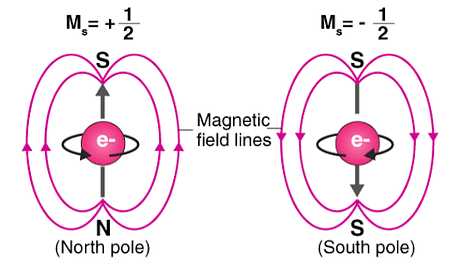
The spin of the electron is shown in the figure below. An arrow pointing up, which is +1/2, or an arrow pointing down, which is -1/2, can be used to represent this spin.

Electron Spin Theory
[Click Here for Sample Questions]
The electron spin theory, in contrast to the classical theory, which shows the electron as a simple sphere, depicts it as a quantum particle. In addition, the theory provides information on the direction of electron spin. It also explains its impact on certain features, such as the magnetic properties of the atom.
Types of Electron Spin Direction
[Click Here for Sample Questions]
The two basic electron spin directions are:
- Spin Up (+z direction)
- Spin Down (–z-direction)
Furthermore, these spins (spin up and spin down) relate to particles with a spin of 1/2, such as electrons.
- An electron can be compared to a tiny magnetic bar in quantum theory.
- Furthermore, the spin points of an electron can be compared to the north pole of a minute bar.
- The production of a magnetic field by two adjacent electrons with comparable spin directions enhances each other.
- As a result, the formation of a strong magnetic field occurs. If the spin directions of the proximate electrons are opposite, the magnetic field produced by them cancels out. As a result, there would be no magnetic field.

How to Identify Electron Spin?
[Click Here for Sample Questions]
The following three steps can be used to determine an electron spin:
- Calculating the number of electrons in an atom.
- Drawing the electron arrangement of an atom. For this aim, one can look at the electronic configurations for further information.
- Use up and down arrows to represent the direction of the electron spin while distributing the electrons.
Electron Spin Formula
[Click Here for Sample Questions]
The electron spin is one of the three fundamental characteristics of electrons. The mass and charge of an electron are also important features. Furthermore, an electron's spin can be simply described as the spinning of an electron around its axis

.The spin quantum number or electron spin is associated with the spin angular momentum. The spin angular momentum is given by the equation
\(S=\hbar\sqrt{s(s+1)}={h\over 2\pi}\sqrt{s(s+1)}\)
Where
- ħ = h/2π is the reduced Planck Constant
- h = Planck Constant
- s = spin quantum number or simply electron spin
- S = spin angular momentum
The spin quantum number can be expressed as s = n/2,
\(S={h\over 2\pi}\sqrt{{n\over2}({n\over2}+1)}={h\over 4\pi}\sqrt{n(n+2)}\)
where n can be any non-negative integer.
The permissible values for the electron spin value are 0, 1/2, 1, 3/2, 2, and so on.
Spin Quantum number s = 1/2 or n =1, can be used to describe the inherent angular momentum of an electron. The total angular momentum S is given by:
\(S={h\over 4\pi}\sqrt{1(1+2)}={\sqrt{3}h\over 4\pi}={\sqrt{3}\over 2}\hbar\)
Electron Spin and Electron Spin Quantum Number: Same or Different?
[Click Here for Sample Questions]
Electron Spin Quantum Number and Electron Spin are frequently confused to be the same thing. In fact, both are quantum numbers.
- They are two distinct but closely connected notions. The electron spin quantum number is denoted by the sign ms, and electron spin is denoted by the symbol s.
- There is only one possible value for the electron spin i.e. 1/2.
- Spin is the same as the electron's rest mass and charge.
- Unlike the mass and charge of an electron, spin has an orientation.
- The spin quantum number(ms) represents the spin's orientation.
- ms can have a positive or negative connotation.
Things to Remember based on Electron Spin
- Spin up and spin down are the two basic electron spin directions.
- The spin quantum number(ms) represents the spin's orientation. 'ms' can have a positive or negative connotation.
- The electron spin is one of the three fundamental characteristics of electrons. The mass and charge of an electron are also important features. Furthermore, an electron's spin can be simply described as the spinning of an electron around its axis.
- By drawing the electron arrangement of an atom, electron spin can be identified.
- The electron spin theory shows the electron as a simple sphere and depicts it as a quantum particle. The theory provides information on the direction of electron spin.
Sample Questions
Ques. On what factors does the electron spin cause? (2 marks)
Ans. Electron spins are caused by a variety of factors.
Because electrons with the same spin cancel each other out, the atom's spin is determined by the single unpaired electron. Because there is a significant probability of either spin due to the vast number of electrons, it split into two beams when it passed through the magnetic field.
Ques. Is it true that nuclei spin? (2 marks)
Ans. Yes, an atom's nucleus rotates. Because the nucleus is made up of neutrons and protons, we can argue that if the neutrons and protons rotate, the whole nucleus rotates like a rigid body.
Ques. What factors determine whether an electron spin is positive or negative? (3 marks)
Ans: The orientation of the two electrons in one orbital is always the opposite of each other, as we can see. One electron will be spinning up, while the other will be spinning down. ms = +½, if the last electron to enter, is spinning up. The ms = -½ if the last electron that enters is spin down.
Ques. Give a brief description of what is Electron Spin (3 marks)
Ans. Electron spin is a type of angular momentum as well as a quantum feature of electrons. In addition, the magnitude of this angular momentum is unchanging. In addition, just like charge and rest mass, electron spin is a fundamental feature.
Ques. Mention the different types of Electron Spin Directions (3 marks)
Ans. Spin up and spin down are the two basic electron spin directions. Furthermore, spinning in the +z or –z direction corresponds to the spin up and spin down directions.
Ques. Is Electron Spin and Electron Spin Quantum Numbers the same or different? (2 marks)
Ans. Electron Spin Quantum Number and Electron Spin are frequently confused to be the same thing. In fact, both are quantum numbers. They are two distinct but closely connected notions. The electron spin quantum number is denoted by the sign ms, and electron spin is denoted by the symbol s.
Ques. Write the steps to identify electron spin. (2 marks)
Ans. There are certain steps used to identify an electron spin. Calculating the number of electrons in an atom, Drawing the electron arrangement of an atom. For this aim, one can look at the electronic configurations for further information and use up and down arrows to represent the direction of the electron spin while distributing the electrons.
Also Read:



Comments